Table of Contents
- Across the Middle Sea: Hadrian Turns His Gaze to Africa
- Africa Proconsularis Before Hadrian: Grain, Gods, and Garrison Towns
- Numidia at the Empire’s Edge: Cavalry, Tribes, and Thin Roman Lines
- The Journey of 128: When the Emperor’s Footsteps Crossed the Sand
- Entering Carthage: Rituals, Processions, and the Theater of Power
- Hadrian Among Governors and Legates: Private Councils Behind Public Splendor
- Inspections on the Ground: Forts, Roads, and the Pulse of the African Frontier
- Into Numidia: The Emperor Rides with the Cavalry
- Desert Winds and Border Wars: Negotiating with Tribal Leaders
- The Human Face of Empire: Soldiers, Settlers, and the People Hadrian Met
- Bread for Rome: Grain, Estates, and the Economics of Imperial Attention
- Religion in the African Sun: Temples, Cults, and Hadrian’s Piety
- Monuments that Remember: Inscriptions and Stones After the Imperial Visit
- Shifting Frontiers: What Changed in Africa and Numidia After 128
- Memory, Myth, and Scholarship: How We Reconstruct Hadrian’s African Tour
- Echoes in the Sand: The Long Shadow of Hadrian’s African Journey
- Conclusion
- FAQs
- External Resource
- Internal Link
Article Summary: In 128 CE, Emperor Hadrian crossed the Mediterranean to set his own eyes on Rome’s African provinces, and especially on the windswept landscapes of Numidia. This article follows the hadrian africa numidia inspection as both a physical journey and a political drama, tracing the emperor’s progress from the harbors of Carthage to the frontier forts that clung to the edge of the desert. We explore how his presence reshaped administration, fortified borders, and reimagined the relationship between Rome and its African subjects. Along the way, we encounter the soldiers who guarded the frontiers, the magnates who owned the great grain estates, and the indigenous communities whose lives were recast in stone and law. The narrative moves between intimate scenes—private councils, roadside encounters, tense negotiations—and sweeping analysis of imperial strategy. Drawing on inscriptions, archaeology, and later historians, it reconstructs the stakes and significance of the hadrian africa numidia inspection for both center and periphery. Above all, it asks what it meant when the most powerful man in the empire chose to stand, in person, under the African sun.
Across the Middle Sea: Hadrian Turns His Gaze to Africa
The year was 128 CE, and the sea lay between emperor and province like a sheet of hammered bronze. Somewhere off the coast of Sicily, a Roman fleet cut through the waters of the central Mediterranean, its prows pointed toward the African shore. On one of those ships, surrounded yet curiously alone, stood Publius Aelius Hadrianus—Hadrian, emperor of Rome, architect of walls and cities, lover of travel, and restless inspector of his own world. It is in this moment, more than in any decree drafted in marble-clad halls, that the hadrian africa numidia inspection truly began.
Hadrian’s reign had already been marked by motion. Unlike his adoptive father Trajan, the conqueror of Dacia and the dreamer of eastern conquests, Hadrian had closed the fist of the empire into a more compact, defensible shape. He relinquished territories in Mesopotamia, strengthened borders from Britain to the Danube, and insisted that the empire’s strength lay not in endless expansion but in ordered stability. Yet stability, in his mind, was not an abstraction managed by remote control: it was a reality to be seen, tested, and touched. So he traveled—more than any emperor before him—across provinces, ports, and frontiers.
Africa was no ordinary province. Africa Proconsularis, with its heart at Carthage, fed Rome with the grain that kept the urban masses from hunger and revolt. Beyond Africa lay Numidia, a more rugged land of plateaus, scrublands, and steppe, where Roman towns intermingled with the tent camps of indigenous tribes and the outposts of auxiliary cavalry. To leave the comfort of Italy for this region was not merely to honor a formality of imperial visitation; it was to step into the machinery that kept the empire’s capital alive.
As the waves broke against the hull, Hadrian’s advisors could trace the logic of this voyage on wax tablets and scrolls. Reports had reached Rome of tensions on the fringes of Numidia, of raids and counter-raids, of disputes over tax burdens and land ownership. There were questions about the reliability of certain auxiliary units and murmurs of friction between local elites and Roman officials. The emperor’s solution was characteristic: he would go there himself. The hadrian africa numidia inspection was, in essence, an imperial audit—but one conducted with the full theatricality of Roman power.
Still, this was more than a performance. Hadrian prided himself on meticulous attention to detail. He was known to personally examine soldiers’ equipment, to quiz officers about discipline, to interrogate local magistrates on finances and public works. He read inscriptions, compared accounts, and sketched buildings. For an emperor whose portrait busts often depict a calm, introspective gaze, his mind was relentlessly active, always measuring the gap between the ideal of empire and its lived reality. The African journey would be no exception.
When the coastline finally appeared—a smudge of gold on the blue horizon—the emperor was not simply approaching another province. Africa and Numidia would test the guiding principles of his reign: consolidation instead of conquest, reform instead of spectacle, presence instead of distance. The sea voyage was only the prelude. The real story would unfold on dusty roads, in echoing forums, and in shadowed military headquarters, where decisions made in the emperor’s presence would ripple out for decades to come.
Africa Proconsularis Before Hadrian: Grain, Gods, and Garrison Towns
To understand why Hadrian’s steps on African soil mattered, one must first see Africa Proconsularis as it stood on the eve of his arrival. This was a province layered with histories. Long before the eagle standards of Rome were planted along its roads, Carthage had ruled these coasts and hinterlands as the heart of a Punic empire. The memory of the Punic Wars, of Hannibal and Scipio, still floated through Roman imaginations like smoke over a battlefield, even though Carthage itself had been refounded as a Roman colony and transformed into a booming metropolis.
By the second century CE, Carthage rivaled many Italian cities in wealth and splendor. Its harbors were crowded with merchant ships; its streets, lined with colonnades and bustling with traders, artisans, and slaves. The countryside around it—lush where the soil was rich, carefully terraced where less generous—was a patchwork of estates. Some belonged to Roman senators who rarely set foot on them, others to local elites who had long ago woven themselves into the fabric of Roman citizenship. These estates produced olives, wine, and above all, grain. The African grain fleets that sailed annually for Rome were the lifeline of the capital.
Yet the prosperity of Africa Proconsularis was not merely an economic fact; it was a political reality. A province that fed the metropolis wielded a certain leverage. Its proconsul, chosen from among Rome’s highest-ranking senators, commanded both respect and scrutiny. Any hint of mismanagement, corruption, or unrest here could quickly become an imperial headache. Hadrian, whose approach to governance combined skepticism toward senatorial grandstanding with a genuine desire for administrative efficiency, had reasons to see for himself how this critical artery of empire was functioning.
Religion in Africa had also taken on a distinct, hybrid character. Roman deities stood side by side with local gods and long-respected Punic cults. Temples to Saturn and Juno Caelestis rose on hilltops, while shrines to Baal Hammon and Tanit persisted in more subtle forms in the countryside. This religious pluralism was tolerated, even harnessed, by Rome. Festivals, dedications, and priesthoods became channels through which local elites expressed loyalty to the empire, sponsoring grand processions and lavish sacrifices that honored both Rome and their own communities.
Across the province stood garrison towns and legionary bases. Though Africa Proconsularis was relatively peaceful compared to the storm-tossed Danube or the restless eastern marches, its soldiers were not mere ceremonial ornaments. They guarded roads, patrolled rural areas prone to banditry, and served as a deterrent to unrest. Auxiliaries recruited from local populations and neighboring regions added a further layer of complexity: their loyalty was to Rome, but their roots were in Africa’s villages and tribes. This integration of local manpower into the imperial military fabric was both a strength and a potential fault line.
As Hadrian’s ships approached the coast in 128, Africa Proconsularis stood at a sort of high noon of Romanization. Latin inscriptions proliferated; Roman law framed daily transactions; amphitheaters and baths proclaimed the presence of a shared imperial culture. But look closely, and one would still see the older currents flowing beneath the surface—Punic phrases whispered in households, indigenous customs marking births and burials, tribal ties influencing local politics. Any meaningful hadrian africa numidia inspection would need to see, and not merely gloss over, these layers.
Thus the stage was set: a wealthy, essential province whose prosperity could not be taken for granted, where Rome’s institutions had sunk deep roots but had not yet entirely displaced older loyalties. Into this landscape, an emperor was about to step, not just as a distant sovereign, but as an on-the-ground assessor of the empire’s great African experiment.
Numidia at the Empire’s Edge: Cavalry, Tribes, and Thin Roman Lines
Beyond the more thoroughly integrated lands of Africa Proconsularis stretched Numidia, a region that had always embodied the ambiguities of Roman control. Once the domain of kings like Massinissa and Jugurtha, whose political maneuvers had drawn Rome into North African power struggles, Numidia had gradually been carved into administrative units, some annexed fully into provincial structures, others treated as client territories and frontier zones. By Hadrian’s time, parts of Numidia were incorporated under Roman governance, yet large swaths still pulsed with semi-autonomous tribal life.
Geographically, Numidia was a land of contrast. To the north, closer to the Mediterranean, there were uplands and fertile valleys capable of supporting agriculture and towns. Further south, the landscape shifted toward steppe and desert, where rainfall was uncertain and survival depended on mobility and resilience. Here lived semi-nomadic groups—often labeled collectively as “Mauri” or other ethnonyms in Roman sources—whose political structures were looser, whose loyalties were layered, and whose relations with Rome oscillated between alliance, dependence, and outright hostility.
For Rome, Numidia represented both potential and risk. Its upland zones could be turned into productive agricultural land, dotted with veteran colonies and municipia that extended Roman legal and social models. Its people provided some of the finest light cavalry in the empire—horsemen famed since the days of Hannibal for their speed, maneuverability, and deadly javelins. Numidian and Moorish cavalry units were by now a familiar sight far from their homelands, serving on frontiers from Britain to Syria. Yet the same equestrian skills that made them valuable auxiliaries also made their kin formidable raiders when relations soured.
Roman control here was expressed less through massive fortifications than through a network of roads, forts, and watchtowers—a flexible frontier line rather than a single solid wall. Patrol routes traced arcs across the rough terrain, linking small garrisons that had to rely on local intelligence and rapid response. Commanders walked a delicate line: too harsh an approach could ignite resistance, but too lax a hand opened the door to increased raiding and instability. It is this delicate balance that Hadrian wished to examine in person during his hadrian africa numidia inspection.
In some towns, stone inscriptions proclaimed the pride of local elites who had taken up Roman names and offices. They dedicated arches to emperors, funded bathhouses, and boasted of their service in the Roman army. In the countryside, however, tribal identities still shaped daily life. Kinship groups, chieftains, and customary law held sway. The Roman state might be acknowledged, but it was one authority among several, and not always the most immediate or intimate.
By 128, there were signs that this frontier arrangement needed fine-tuning. Patterns of raiding suggested that certain routes were insufficiently protected. Some auxiliary units were reputed to be under-strength, their nominal numbers on parchment masking the reality of desertion, sickness, or lax recruitment. There were also reports—never entirely clear—of tensions between settled populations and mobile groups over access to pasture, water, and trade revenues. In such a context, an imperial visit was not ceremonial—it was a test.
Numidia, then, was both margin and mirror. In its shifting alliances, semi-integrated communities, and militarized landscape, it reflected the broader challenges of ruling an empire that stretched across countless cultures and environments. Hadrian’s decision to ride these roads and visit these forts would reveal much about how he understood the nature of Roman power—not only in Africa, but everywhere the empire met the untamed edges of the known world.
The Journey of 128: When the Emperor’s Footsteps Crossed the Sand
The itinerary of Hadrian’s African journey can only be partially reconstructed from the scattered evidence—inscriptions commemorating his presence, later writers like Cassius Dio alluding to his travels, and the practical logic of Roman geography. Yet even in fragments, the path of the hadrian africa numidia inspection emerges with a vividness that invites us to walk it in imagination.
After leaving Italy and touching at Sicily, Hadrian’s fleet likely made for the prominent harbors of Africa Proconsularis, above all Carthage. From there, his circuit seems to have included major urban centers and strategic nodes: cities whose loyalty and prosperity were vital, road junctions that controlled movement inland and along the coast, and military posts that anchored the frontier. The emperor did not move alone. His retinue included members of the imperial household, secretaries, military aides-de-camp, bodyguards from the Praetorian Guard, and specialists—architects, engineers, surveyors—whose presence reveals how Hadrian intended not only to see but to change.
Imagine the spectacle of an imperial arrival along an African road. Dust rises in a low yellow cloud as the column comes into view: cavalry scouts in front, standard-bearers holding aloft the vexilla that proclaim the emperor’s presence, wagon trains loaded with supplies and baggage, officials mounted on sturdy horses, and finally, at the heart of it all, the emperor and his closest companions. Local inhabitants—farmers, traders, women with children in their arms—gather at the roadside, drawn by curiosity, obligation, or genuine reverence. For many of them, this would be the only time in their lives that they would see the ruler whose image was stamped on their coins.
But this was only the beginning. The journey was not a single triumphant march; it was a series of arrivals and departures, each one layered with protocol. At city gates, magistrates in their formal attire came forward to greet the emperor. They presented the keys of the city, offered garlands, and delivered speeches extolling his virtues and those of his predecessors. Priests led sacrifices to Jupiter and the imperial household, smoke from burnt offerings curling into the hot sky. Children recited phrases drilled into them for days. Inside, streets were cleaned and decorated; the best houses were prepared to accommodate members of the imperial entourage.
Behind the public face of celebration lay the grinding logistical effort of sustaining the journey. Local communities were required to provide food, fodder, and lodging under the system of hospitalitas and requisition that accompanied imperial travel. For some, this was a financial strain that had to be absorbed or passed down as higher rents and taxes. For others—wealthier landowners and merchants—it was an opportunity: to curry favor with imperial officials, to secure advantageous decisions in disputes, to petition for privileges such as tax remissions or the elevation of a town’s legal status.
Hadrian, for his part, did not see these travels as empty rituals. He insisted on being briefed about each community he visited—its population, main economic activities, history of loyalty or trouble, needs and complaints. In the evenings, while the desert winds cooled the air, he might sit in a governor’s residence or in a military camp’s headquarters, poring over documents by lamplight. The hadrian africa numidia inspection was not confined to what was visible in the day’s processions; it continued in those more intimate, laborious hours when decisions were weighed and written orders drafted.
As the emperor’s circuit led him gradually from the richer, more thoroughly Romanized coastal and near-coastal regions toward the harsher interior of Numidia, the atmosphere changed. Urban pageantry gave way to sparser gatherings. The roads became rougher, the distances between settlements greater. Patrols rode a little further ahead, scanning the horizon. It is here, in this transition zone between cultivated Africa and contested Numidia, that the stakes of the journey came into sharpest focus.
Entering Carthage: Rituals, Processions, and the Theater of Power
No city in Roman Africa could rival Carthage in symbolic weight. To enter it as emperor was to reenact, in peaceful form, the culmination of earlier generations’ wars. Hadrian’s approach to Carthage would have been choreographed down to the smallest detail—the imperial cult priests, the civic council, the youth corps training for public life, all mobilized to stage the city’s loyalty. Yet behind the celebrations, there was also a quieter calculation: how to impress upon the emperor that Carthage deserved his favor and future investment.
The day of arrival began with sounds—the blare of trumpets from the walls, the rhythmic chant of processional hymns, the low murmur of thousands of spectators. At the main gate or harbor, a temporary arch, hastily built and garlanded, might frame the emperor’s entrance. Statues of Hadrian, hastily polished or newly erected, stood at key junctions, their stone faces reflecting the ideal of an emperor who had finally come in person.
Hadrian dismounted—or stepped from his chariot, depending on the exact staging—and walked before the assembled magistrates. The proconsul of Africa bowed, perhaps kissed the imperial hand, and recited a speech of welcome that spoke of Rome’s protection and Carthage’s gratitude. Offerings were made: bulls led to sacrifice, baskets of grain symbolizing the province’s bounty, golden crowns representing honor and submission.
From the gate, the procession moved inward. Citizens and foreigners alike crowded balconies and rooftops, craning for a glimpse. Inscriptions from Carthage and other African cities, while often formulaic, hint at the emotions that might have coursed through the crowd: pride in being part of the Roman world, hope that imperial attention would translate into concrete benefits, awe at the physical proximity of near-absolute power. For the emperor, the walk through the city was both an inspection and a theater tour. He saw the state of the streets, the condition of public buildings, the level of civic organization.
At the forum, the heart of Carthage’s political life, further ceremonies unfolded. The emperor paid his respects at key temples, perhaps offering sacrifices to Jupiter and to Saturn, whose cult enjoyed particular prominence in Africa. The blending of Roman and local religious practices—Latin prayers intoned in spaces that once echoed with Punic invocations—was on full display. Hadrian, known for his personal engagement with cults and mysteries across the empire, would have observed this with keen interest. It was, in many ways, a barometer of how deeply Roman culture had penetrated provincial society.
Yet it was in the closed chambers behind the forum’s colonnades that the most consequential aspects of his visit unfolded. There, away from the crowds, he met with the proconsul and leading members of the Carthaginian elite. They briefed him on legal disputes involving great estates, on the status of public works—harbor maintenance, aqueduct repairs, new building projects—and on the delicate balance of relations with neighboring Numidian communities. Petitions were read aloud, some granted, others deferred or quietly dismissed. A city seeking imperial favor could ask for many things: funds to complete an amphitheater, confirmatory grants of land, elevation to a higher civic status that would enhance its prestige.
The Carthaginian visit also served a symbolic purpose in the broader hadrian africa numidia inspection. By starting—or at least concentrating much of his attention—here, Hadrian sent a double message. To Africa’s Romanized elites, he signaled that their city and province mattered, that their loyalty was seen and valued. To the more restive regions beyond, he demonstrated that the emperor’s authority was anchored in powerful, prosperous centers that could project influence outward. Carthage was both stage and command post for what would follow deeper inland.
Hadrian Among Governors and Legates: Private Councils Behind Public Splendor
If the public ceremonies of the African tour were the visible crest of the wave, the private councils between Hadrian and his senior officials were the deeper current that moved policy. Governors, legates, financial procurators, and senior officers in the African and Numidian commands had much to gain—or lose—from the hadrian africa numidia inspection. Their reports, long sent in writing to Rome, now had to withstand direct questioning by a ruler known for his probing intellect and impatience with incompetence.
Picture one such council held in the spacious, yet suddenly tense, official residence of the provincial governor. Maps are spread on a table: waxed tablets marked with roads and rivers, tiny wooden or bronze markers representing forts and garrisons. The governor and his aides stand or sit facing the emperor, who listens as they outline the situation along the frontier, the fiscal health of the province, and the conduct of subordinate officials. Hadrian’s questions cut into their narrative. Why, exactly, has there been an uptick in complaints from this district? How many men are actually present and fit for duty in that auxiliary cohort, as opposed to the ideal number on paper?
Roman sources occasionally hint at Hadrian’s severity. The Historia Augusta, a late and at times unreliable collection, nonetheless captures something essential when it portrays him as an emperor willing to dismiss or discipline officials on the spot if he judged them unworthy. Modern historians, such as Anthony Birley, have noted that his travels frequently coincided with administrative reforms and adjustments. Even if the precise details of each African meeting are lost, this pattern suggests that the hadrian africa numidia inspection would have had real consequences for those seated in these rooms.
It’s astonishing, isn’t it, to imagine careers being made or broken over the course of a few intense days of imperial scrutiny. A capable officer who had struggled to get recognition from distant superiors might finally present his case directly, pointing to a well-organized fort, a loyal unit, or a successfully pacified district. A corrupt procurator, who had grown rich by squeezing local communities beyond what the law permitted, might find his clever accounting unraveling under the emperor’s questions. Hadrian’s presence functioned as both judgment and opportunity.
These councils were not solely punitive in nature. Hadrian was also a planner, eager to shape the provinces to his vision of a rational, well-ordered empire. Discussions would have turned to infrastructure—where roads needed repair or extension, which bridges were at risk, whether additional milestones and posting stations should be established. The emperor might order the redirection of funds, the deployment of army engineers, or the granting of imperial patronage to key building projects that could serve both military and civilian needs.
In the context of Numidia, another set of questions arose: should the frontier line be reconsidered? Were some forts too isolated, others poorly positioned for rapid response? Did local commanders have enough auxiliary cavalry to patrol the wide expanses they were responsible for? The hadrian africa numidia inspection, in these rooms thick with the rustle of parchment and the flicker of oil lamps, became a strategic review as much as a bureaucratic audit.
Behind every dry discussion of taxes, troop numbers, and legal jurisdictions lay human realities—villages straining under levy demands, soldiers stationed far from home, merchants negotiating customs duties on their caravans. Hadrian’s challenge was to translate the mass of data and testimonies into a coherent, just, and sustainable set of policies. Whether he always succeeded is another question, but his willingness to confront these complexities in person set him apart from many of his predecessors and successors.
Inspections on the Ground: Forts, Roads, and the Pulse of the African Frontier
Hadrian’s passion for architecture and engineering is well documented. The man who would leave his mark on Athens’ skyline and commission the monumental Pantheon in Rome was not content to let roads crumble or forts decay unnoticed. Along the African and Numidian routes, the imperial party made a point of visiting key infrastructural sites. Here, the hadrian africa numidia inspection took on a distinctly practical flavor.
Arriving at a frontier fort—perhaps one perched on a low ridge overlooking a valley of scrub and thorn—Hadrian did not merely ride by. He dismounted, entered through the gate flanked by towers, and walked the perimeter. He saw the thickness of the walls, the condition of the ditch, the state of the barracks. He examined storage facilities: granaries where the grain supply bore directly on a garrison’s capacity to endure a siege or a drought. In some accounts from other provinces, he is said to have examined even the quality of the soldiers’ boots and equipment; it is reasonable to imagine similar attentiveness in Africa.
Roads, too, came under his gaze. Roman Africa, laced with carefully engineered highways, depended on them for both commerce and control. Milestones bearing the names of emperors had long lined these routes, and Hadrian’s name would join them, chiseled into stone after repairs or extensions were ordered. In places where erosion threatened a bridge, or where shifting tribal patterns rendered an existing route vulnerable, the emperor could order new alignments—decisions that would redirect the flow of trade and the lives of countless travelers.
Alongside the forts and roads were smaller, more improvisational posts—waystations where couriers could change horses, fortified farmsteads that doubled as observation points, clusters of watchtowers watching over passes. The emperor’s presence in such humble places carried its own symbolism. To the soldiers stationed there, often far from the relative comforts of larger bases, it was an affirmation that their hardships were not entirely invisible. To local populations, seeing the ruler examine these rough installations underlined the message that Rome took its frontiers seriously.
It was during these ground-level inspections that Hadrian could best judge the morale of his troops and the reality of frontier life. Official reports might present units as fully staffed and well-supplied; a quick glance at weary faces, patched tunics, or outdated equipment could tell another story. He could ask direct questions: When was the last pay distributed? How often had the unit been engaged in punitive expeditions or escort duty? Were relations with nearby communities peaceful, tense, or openly hostile?
The hadrian africa numidia inspection thus unfolded not only in grand councils, but in the dust of parade grounds where troops were drawn up for review, in the cramped courtyards of frontier forts where centurions tried to hide their anxieties, and on the crest of ridges where the emperor paused to look out over landscapes of scrub and stone. It was here, between the stones and the sand, that imperial policy met the practicalities of geography and human endurance.
Into Numidia: The Emperor Rides with the Cavalry
At some point in the African tour, the itinerary carried Hadrian decisively into Numidian territory. The air grew drier, the vegetation sparser, and the settlements more scattered. Yet here, among the rolling uplands and semi-arid plains, were stationed some of Rome’s most prized auxiliary units: the Numidian and Moorish cavalry whose reputation was stitched into the very fabric of Roman military memory.
Hadrian, himself a keen hunter and no stranger to riding, took a particular interest in such troops. An emperor who valued mobile defense and flexible frontier management needed cavalry who could patrol wide expanses, pursue raiders, and serve as the empire’s quick reaction force. The hadrian africa numidia inspection was therefore as much about testing horses and riders as about inspecting walls and ditches.
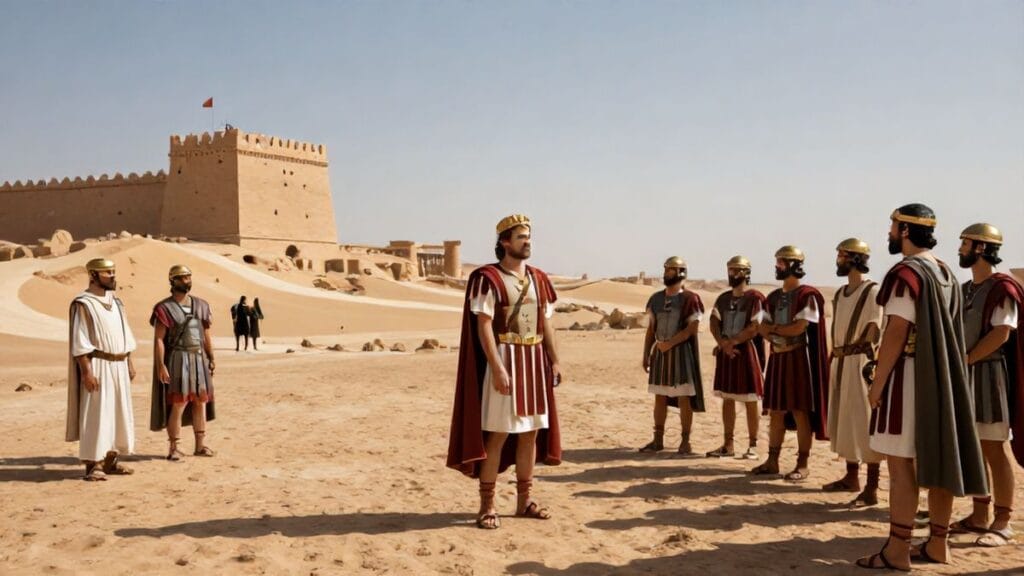
Envision a day when the imperial party arrived at a cavalry base, perhaps little more than an open field with some stables and low barracks nearby. After the initial formalities, the emperor requested a demonstration. Trumpets sounded; troopers in light armor—some wearing locally styled cloaks, others more conventionally equipped—mounted their small but tough horses. They rode in loose formations, wheeling with remarkable agility, hurling javelins at targets before turning and vanishing in simulated retreats. Dust clouds rose as hooves hammered the ground.
Hadrian watched, assessing not only their martial display but the discipline beneath the showmanship. Did the officers maintain order? Were commands relayed quickly? Did the men handle their mounts with confidence? In some surviving accounts from other provinces, he is said to have personally praised units that impressed him and to have criticized those that fell short. It is not difficult to imagine similar scenes unfolding under the African sun, the emperor’s words translated into the lingua franca these men understood—sometimes Latin, sometimes a mix of Punic, Berber tongues, and gestures.
Beyond the parade ground, Hadrian might have ridden out with a small escort to see how such units patrolled the surrounding territory. Riding alongside seasoned officers, he would ask about routes, watering points, and patterns of movement among local tribes. Which groups were friendly, which merely tolerant, which simmering with resentment? Were current patrol practices effective in deterring raids, or did they simply respond to incursions after the fact?
These rides blurred the line between inspection and reconnaissance. They allowed the emperor to feel, quite literally, the scale of the land Rome claimed to control and the limits of that control. In the wide-open spaces of Numidia, fortified walls meant little without the ability to move swiftly and decisively. The hadrian africa numidia inspection, in this sense, reinforced a broader truth of Roman rule: that legions alone could not hold an empire; it required the partnership, and often the mastery, of local forms of mobility and warfare.
Yet there was another layer to these encounters. Many of the cavalrymen Hadrian addressed had relatives across the frontier—kin who might one day ride as raiders rather than auxiliaries. Their loyalty was built on pay, prestige, shared victories, and a sense that service in the Roman army offered a path to status and security. The emperor’s personal attention, his willingness to praise or promote, strengthened that bond. Conversely, any sign of neglect or contempt could erode it. In the dust of those Numidian fields, the future of Rome’s relationship with its border peoples was, to a small but real extent, being negotiated with each review and each exchanged word.
Desert Winds and Border Wars: Negotiating with Tribal Leaders
The frontier in Numidia was not a simple line; it was a zone of negotiation. Between the formal Roman provinces and the deeper desert lived tribal confederations whose autonomy varied and whose allegiance could not be taken for granted. The hadrian africa numidia inspection was therefore also a diplomatic journey. Roman records, sparse as they are, hint that emperors and their representatives often met with local chieftains to confirm treaties, adjust obligations, or respond to disputes.
Imagine a gathering at a neutral site—a hilltop or a spring, perhaps marked by an older sacred stone. On one side, the emperor and his retinue under the shade of hastily erected awnings; on the other, tribal leaders in distinctive dress, accompanied by their mounted retainers. Between them, interpreters who labored to turn Latin pronouncements into idioms that resonated with tribal conceptual worlds, and vice versa.
The issues on the table were as vital as they were perennial: access to pastureland along the margins of the cultivated zone; rights to water in drought-prone areas; compensation for raids, real or alleged; the status of hostages or guarantors given in earlier agreements. Roman governors often relied on a mix of intimidation, incentive, and flexibility. Hadrian, now present in person, could recalibrate that mix. He might confirm certain tribal leaders as official “friends and allies of the Roman people,” granting them titles, gifts, and trading privileges in return for commitments to keep the peace and prevent their followers from crossing into Roman territory with hostile intent.
Such meetings were fraught with unspoken tensions. Tribal leaders knew that refusal to cooperate could invite devastating punitive expeditions. Romans knew that overreach—demanding too much, too quickly—could spark a coalition of resistance that would be costly to suppress. The emperor’s presence lent gravitas to the proceedings, but it also raised the stakes. Promises made in his hearing carried more weight; any perceived slight or betrayal afterward would be remembered in Rome’s records.
In these encounters, cultural misunderstandings abounded. What Romans thought of as fixed, written treaties, carefully inscribed on bronze tablets, might be seen by tribal groups as more flexible, situation-dependent arrangements. A bad harvest, a new chieftain, or a feud with a neighboring tribe could alter their willingness or ability to honor commitments. Similarly, Roman concepts of land ownership clashed with more fluid patterns of usage and seasonal migration. Hadrian’s ability to listen, to interpret through his advisors, and to adjust expectations would have been crucial.
Nevertheless, imperial power had its own inexorable logic. If diplomacy faltered, Rome could and did resort to force. The hadrian africa numidia inspection likely included assessments of where future campaigns might be needed, where fixed defenses should be reinforced, and where a more mobile, punitive posture would suffice. But whenever possible, Hadrian preferred ordered arrangements over open-ended warfare. His broader imperial policy, seen from Britain to the East, favored stabilized frontiers and predictable relations with neighbors.
Border negotiations in Numidia thus encapsulated the empire’s constant balancing act: to impose a Roman order while recognizing that its frontiers were porous, and that beyond those frontiers lived people whose lives and aspirations did not fit neatly into lines inked on Roman maps. The desert winds that brushed the imperial awnings during these councils carried with them the reminder that Rome’s reach, though vast, had limits—limits Hadrian was wise enough to sense, even as he tried to push them outward.
The Human Face of Empire: Soldiers, Settlers, and the People Hadrian Met
Grand strategies and frontier logistics can easily overshadow the individuals whose lives were touched, directly or indirectly, by Hadrian’s African journey. Yet the hadrian africa numidia inspection was, at every step, a human encounter. For many in Africa and Numidia, the emperor appeared not as a distant figure on coins and in imperial decrees, but as a physical presence passing along their roads, speaking in their forums, eating in their houses—if only for a fleeting moment.
Consider a veteran settled on a modest plot of land near a Roman colony in Africa Proconsularis. He had served decades in a legion along the Rhine, survived winters in damp forts, marched long miles in the service of emperors he never saw. Now, retired and granted land in Africa, he worked the soil with calloused hands. News spreads that the emperor is coming through a nearby town. For this man, the journey to see Hadrian is as much pilgrimage as curiosity. He stands along the road, sees the imperial party pass, and recognizes in the disciplined formation and gleaming armor echoes of his own past. The sight affirms that his sacrifices were part of something enduring.
Or take a local African merchant who has built a modest fortune trading olive oil and grain. Roman rule has opened markets, imposed standard weights and measures, and offered, at least in theory, the protection of Roman law. Yet taxes bite, and corrupt officials can make or break a business. The arrival of the emperor presents a narrow window of hope. Through a patron or relative in the city council, he manages to attach his petition to those that will be presented. Perhaps he beseeches Hadrian for a reduction in a burdensome toll, or for the settlement of a dispute with a neighboring landowner. Whether his plea is granted or lost in the shuffle, the attempt itself reflects how imperial presence activated local aspirations.
Women, whose names are less often preserved in inscriptions, were nonetheless woven into this tapestry of encounters. Elite women in Carthage and other cities might host members of the imperial entourage, donate to public feasts held in the emperor’s honor, or dedicate altars thanking the gods for his safe arrival. In rural communities and among tribal groups, women watched from doorways or the fringes of crowds as the imperial column went by, perhaps curious, perhaps wary. In the wake of the journey, changes in taxation, land usage, or security would filter into their daily routines, altering how they raised children, managed households, and moved through their worlds.
Then there were the slaves—unfree laborers in house, field, and workshop, whose hands built the roads and structures Hadrian inspected. For them, imperial travel was another burden: extra work to prepare accommodations, clean streets, harvest early, or supply provisions. Some might hope that the emperor’s famed concern for justice could reach them indirectly, for instance if he condemned particularly cruel masters or abusive officials. But for most, the imperial visit likely passed overhead like the flight of an eagle: impressive, remote, and scarcely altering the conditions of their confinement.
Amid all these lives, soldiers formed a distinct, ever-present human stratum in the hadrian africa numidia inspection. Recruited from diverse regions, many had never seen Africa before their posting. The emperor’s arrival in their camp was a moment of pride and anxiety. They stood in ranks, armor polished, hoping that no fault in their drill or appearance would draw imperial ire. A kind word from Hadrian, a bonus of pay, or even a simple acknowledgement could linger in memory long after he moved on. For others, a reprimand or the demotion of an unpopular officer might bring a sense of rough justice.
In all these ways, Hadrian’s African journey was not an abstract administrative act. It was a sequence of human meetings, some brief and wordless, others extended and consequential. The traces of those encounters are thin in our sources—an inscription praising imperial clemency here, a later historian’s anecdote there. Yet if we look closely at the surviving stones and texts, we can glimpse the web of emotions—hope, fear, calculation, pride—that the emperor’s presence sparked in the people of Africa and Numidia.
Bread for Rome: Grain, Estates, and the Economics of Imperial Attention
At the core of Roman Africa’s importance, and thus of the hadrian africa numidia inspection, was a simple, sobering fact: Rome could starve. The capital’s population, often estimated at one million or more, depended heavily on imported grain. African shipments were not the only source—Egypt and other regions contributed—but they were central. Any disruption in African production, storage, or transport could send ripples of scarcity and unrest across the Mediterranean.
Hadrian’s advisors would have arrived in Africa armed with data: harvest reports, shipment records, tax yields, and price trends. On the ground, the emperor could compare these figures with what he saw on the great estates that carpeted the province. Some were owned by absentee senatorial landlords, others by local magnates who had risen to wealth by astutely leveraging Roman markets and laws. These estates were complex machines—employing overseers, tenant farmers, hired labor, and slaves—dedicated to extracting as much value as possible from the land.
During his tour, Hadrian likely visited at least a few prominent estates, either in person or through detailed reports delivered by their owners. He would inquire about irrigation works, storage capacity, and the impact of recent weather patterns. Droughts in North Africa were nothing new; the question was how resilient the agricultural system had become under Roman administration. Had investments in wells, cisterns, and canals kept pace with expanding cultivation? Were roads and harbors sufficient to move harvests quickly before spoilage set in?
Grain supply was not just an economic matter; it was political. The annona—the grain dole in Rome—was both welfare system and pressure valve. Emperors who appeared to neglect it risked popular discontent and elite criticism. Thus, part of the logic of the hadrian africa numidia inspection lay in assuring himself that Africa’s role in this system remained solid. If he detected vulnerabilities, he could order remedial measures: improving port facilities, incentivizing certain forms of cultivation, or adjusting the fiscal framework to encourage more stable production.
Yet the very success of African agriculture had its darker side. Expanding estates often pushed smallholders off their lands or absorbed them as dependent tenants, eroding the autonomy of rural communities. Over time, this concentration of land in fewer hands could produce social tensions that manifested in banditry or localized unrest—issues that, in turn, concerned imperial security. Hadrian’s policies in other provinces suggest that he was not blind to such dynamics; he occasionally intervened to protect smaller landowners or limit abuses of power by local elites.
Numidia’s role in this agrarian story was more modest but growing. As Roman settlement penetrated deeper into its uplands, new tracts were brought under the plow. Veterans received land grants there, and new town foundations or upgrades created nodes of Roman-style urban life. The hadrian africa numidia inspection would have given the emperor a clearer sense of how far this agricultural frontier had progressed and what obstacles it faced—be they environmental, logistical, or political.
In a way, the voyage that had brought Hadrian across the sea to Africa mirrored the annual journeys of grain ships sailing in the opposite direction. His presence in the province was an acknowledgment that the empire’s political center of gravity was inseparable from its economic and ecological dependencies. To stand in an African granary, surrounded by the pungent smell of stored wheat, was to feel the invisible tether that bound Rome’s urban throngs to these distant fields and the people who worked them.
Religion in the African Sun: Temples, Cults, and Hadrian’s Piety
Religion in Roman Africa formed a mosaic of beliefs, and Hadrian’s journey provided a rare moment when this mosaic was rearranged in the light of imperial presence. The hadrian africa numidia inspection did not concern troop dispositions and taxes alone; it also touched on the sacred landscape, where temples, shrines, and cults articulated the relationship between humans, gods, and empire.
Hadrian himself had a reputation for religious curiosity. During his travels across the empire, he participated in mysteries in Eleusis, consulted oracles, and supported diverse cults. In Africa, his piety took on both personal and political meanings. At Carthage and in other major cities, he would have visited prominent temples—those dedicated to Jupiter, Juno, and Minerva, as well as to Saturn, whose cult in Africa carried deep local resonance. Sacrifices offered in his presence reaffirmed the bond between the imperial house and the gods that allegedly watched over Rome’s fate.
Yet African religion was not merely a copy of Roman orthodoxy. Local deities continued to command devotion. Juno Caelestis, often associated with Tanit, loomed large at sites like Dougga, where later inscriptions and temple remains testify to a powerful, hybrid religious life. Hadrian’s priests and advisors, versed in managing provincial cults, likely paid close attention to how these syncretic deities were framed. Were they being presented in ways that harmonized with Roman values, or did they harbor potential for alternative, less controllable loyalties?
Imperial cult, the veneration of the emperor and his household as semi-divine, also wove through the religious fabric of Africa and Numidia. Altars and temples dedicated to the numen of the emperor stood in city forums. During the hadrian africa numidia inspection, ceremonies at these sites took on heightened significance. Processions bearing the emperor’s image converged not merely on a statue, but on the living man himself. This convergence allowed local elites to dramatize their loyalty and, in return, to be seen as pillars of imperial order.
Numidia’s religious landscape added further layers. Indigenous sanctuaries, sometimes set on isolated hilltops or near springs, persisted alongside more Romanized urban cults. Hadrian may not have visited many of these more remote sites personally, but his governors reported on them, and he certainly encountered their adherents in towns and garrisons. Allowing such practices to continue, within limits, was part of Rome’s strategy of cultural accommodation. At the same time, the empire preferred that visible, monumental religion—temples in city centers, statues on public squares—speak the language of Rome.
Our knowledge of Hadrian’s precise religious acts in Africa is patchy, but inscriptions citing his generosity toward temples and priesthoods hint at his involvement. An inscription might record that, in the year of his visit, funds were granted to repair a sanctuary or to sponsor a new festival. These acts had meaning beyond their pious veneer. They strengthened bonds between the emperor and local clergy, ensured that religious celebrations reinforced imperial ideology, and integrated local holy places into a network of sites that all, in their way, acknowledged Rome’s supremacy.
Religion, in short, was both mirror and instrument of power. As the African sun beat down on temple courtyards and sacrifice altars, the hadrian africa numidia inspection engaged with a world where divine favor and imperial order were thought to intertwine. The emperor moved through this world not as a distant deity, but as a human ruler navigating the complex interplay between local devotion and universal authority.
Monuments that Remember: Inscriptions and Stones After the Imperial Visit
The most tangible traces of Hadrian’s African journey are not the transient shouts of crowds or the dust of his horse’s hooves, but the stones that remain. Inscriptions raised in cities and towns across Africa and Numidia serve as our primary witnesses to the hadrian africa numidia inspection. They are terse, formulaic, and yet, when read attentively, extraordinarily revealing.
In a city’s forum, on a temple wall, or beside a triumphal arch, a block of limestone or marble might proclaim that “the Emperor Caesar Traianus Hadrianus Augustus” visited this place in a certain year, accepted the city’s honors, and perhaps granted a specific favor. Such texts often list the local magistrates in office at the time, anchoring imperial presence to the life cycles of municipal governance. For the inhabitants, these inscriptions were a way of fixing the fleeting moment of the emperor’s visit into enduring stone, to be read by future generations as proof that their community had once stood in the spotlight of imperial attention.
Other inscriptions, less immediately grand, recorded practical outcomes: the repair of a road “by order of the emperor,” the construction of a new fortification, the dedication of an aqueduct or bath complex that received imperial funding or endorsement. In some cases, building projects may have been in progress before Hadrian’s arrival, but the emperor’s willingness to associate himself with them through patronage or formal approval turned local ambitions into imperial achievements.
Archaeological remains supplement these texts. Forts along the African and Numidian frontier sometimes show evidence of renovation or reorganization in the early second century, consistent with a period of renewed attention to frontier defense. Road networks bear the marks of Hadrianic repairs. In Carthage and other major centers, architectural styles and building programs reflect the broader Hadrianic aesthetic: harmonious, classically inspired, yet practical.
Historians, working like detectives, stitch these fragments together. As Fergus Millar once observed when writing about imperial presence in the provinces, the emperor’s travels “left tracks no less real than those of the armies” he commanded. The hadrian africa numidia inspection can thus be partially reconstructed from a scattering of inscribed moments, each one a snapshot of encounter between emperor, local society, and physical space.
These stones also reveal how local communities wanted to remember the visit. The language is often effusive: Hadrian is “best and greatest,” “savior,” “benefactor.” Such praise was, to be sure, formulaic, but its repetition across disparate communities underscores how deeply imperial ideology had penetrated provincial civic culture. To be favored by the emperor was to gain symbolic capital that could be deployed in local rivalries—with neighboring towns, with competing elites, or with provincial authorities.
In Numidia, where Romanization was less complete, inscriptions bearing Hadrian’s name could function as fragile footholds of Roman memory in a landscape where oral traditions and tribal histories predominated. Even if the emperor’s visit faded from local storytelling, the stones remained, ready to be deciphered centuries later by archaeologists and epigraphists. It is through them that we, standing at an even greater distance from Hadrian’s time, can trace the arc of a journey that would otherwise be invisible.
Shifting Frontiers: What Changed in Africa and Numidia After 128
The immediate spectacle of the hadrian africa numidia inspection ended when the imperial fleet lifted anchor and turned back toward Italy or onward to other provinces. Yet the journey’s true significance lies in what followed. In the years after 128, Africa and Numidia experienced a series of adjustments—some subtle, others more pronounced—that bore the imprint, directly or indirectly, of Hadrian’s visit.
On the military front, there is evidence that frontier arrangements were refined. Some forts were strengthened, others relocated to more defensible or strategically advantageous positions. Patrol patterns along the edges of Roman-controlled territory in Numidia were likely recalibrated, with greater emphasis on mobility and rapid response. Auxiliary units may have seen changes in their deployment or composition, as the emperor acted on his impressions regarding their effectiveness and loyalty.
Administratively, Hadrian’s penchant for rationalization likely led to adjustments in provincial boundaries and jurisdictions. The process by which Numidia would eventually emerge as a more clearly defined province in its own right was gradual, but Hadrian’s attention to the region’s unique challenges helped set that evolution in motion. His policies elsewhere—such as standardizing legal procedures and clarifying the roles of local councils versus imperial officials—found echoes in Africa, where they contributed to a more predictable, if sometimes rigid, governance structure.
Economically, investments in infrastructure ordered or endorsed during the inspection bore fruit over time. Improved roads facilitated both military movements and commerce; enhanced port facilities supported the continued expansion of grain exports. In some areas, new or repaired aqueducts allowed for the growth of towns whose water supplies had previously been precarious. These practical changes reinforced Africa’s role as a stable provider within the imperial system of supply.
Socially and culturally, the visit strengthened ties between African elites and the imperial center. Families who could boast of hosting the emperor, receiving his letters, or winning his favor gained added luster in local politics. Their loyalty to Rome, now marked by personal as well as institutional bonds, further solidified the Roman character of coastal and near-coastal Africa. In Numidia, progress was slower, but the incremental spread of Roman law, urban institutions, and Latin inscriptions indicates that, over time, imperial influence thickened.
Of course, not all consequences were intended or purely positive. Greater integration into the imperial system brought heavier fiscal demands and deeper entanglement in imperial conflicts. In later decades and centuries, Africa would witness uprisings, religious controversies, and economic shifts that owed as much to the burdens of empire as to its benefits. Yet even these later tensions unfolded within frameworks that Hadrian’s policies had helped consolidate: clear frontiers, structured provincial administrations, and dense networks of roads and forts.
In another sense, the hadrian africa numidia inspection contributed to the making of Hadrian’s own image. His biographers and subsequent historians would portray him as the traveling emperor, the restless guardian of Rome’s provinces. Africa and Numidia formed one chapter in this broader narrative of imperial presence, both reflecting and reinforcing the idea that a good emperor was not merely a ruler from afar, but a superintendent who walked, quite literally, the boundaries of his domain.
Memory, Myth, and Scholarship: How We Reconstruct Hadrian’s African Tour
When we speak of the hadrian africa numidia inspection today, we are not recounting a neat story preserved in a single ancient text. Instead, we are assembling a mosaic from scattered pieces: a line in Cassius Dio here, an inscription from Carthage there, archaeological reports from Numidian forts, and the broader context of Hadrian’s known policies and travels. The resulting picture is necessarily partial, but it is also carefully argued, the product of generations of modern scholarship.
Ancient literary sources provide only faint outlines. Cassius Dio, writing in the early third century, notes Hadrian’s extensive travels, including visits to provinces in the West and East, but he does not dwell in detail on Africa. The Historia Augusta, composed later and often blending fact with fiction, offers anecdotes about Hadrian’s character and habits that, while sometimes dubious in specifics, help flesh out how contemporaries and near-contemporaries imagined his behavior on tour—his penchant for surprise inspections, stern judgments, and acts of clemency.
Modern historians, like Anthony Birley in his biography Hadrian: The Restless Emperor, draw on these literary hints while giving pride of place to epigraphic and archaeological evidence. Inscriptions dated to 128 and nearby years, mentioning Hadrian’s presence in African cities or recording building works “under Hadrian,” form the backbone of reconstructions of his route. Archaeological layers showing Hadrianic construction techniques or stylistic features add further support. As one scholar observed in a journal article on imperial itineraries, “the emperor’s path is written less in ink than in stone.”
There is also an element of educated inference. Knowing that Hadrian valued direct inspection, that he visited Africa Proconsularis between documented stays in other regions, and that Africa’s strategic and economic importance was high, historians reason that he would not have confined himself to a single port of call. The pattern of imperial travel—mixing major urban centers, military sites, and places of particular symbolic value—seen in other provinces is applied to Africa and Numidia, yielding plausible, if not provable, itineraries.
Myths, too, have attached themselves to Hadrian’s African journey. Later local traditions sometimes claimed specific structures or sites as having been personally ordered or visited by the emperor, even when hard evidence is lacking. While such stories cannot be taken at face value as historical fact, they reveal how communities sought to anchor themselves in the orbit of imperial memory. To say “Hadrian was here” was to assert a place in a wider narrative of Roman greatness, even centuries after his reign.
For the modern reader, aware of these gaps and reconstructions, the hadrian africa numidia inspection becomes a story told in layers of probability rather than certainties. We know that he went; we can identify many places he almost certainly saw; we can trace the broad outlines of what he likely did, based on patterns observed elsewhere. Within that framework, imagination—disciplined by evidence and context—allows us to bring the journey to life without pretending to possess a detailed travel diary that never existed.
In this sense, writing about Hadrian in Africa is as much about how we know history as about the history itself. It invites us to respect the limits of the record while still daring to reconstruct the lived experiences behind inscriptions and ruins. The desert has swallowed many of the words that once described these events, but enough remain for us to hear, faintly, the echoes of an emperor’s footsteps on North African soil.
Echoes in the Sand: The Long Shadow of Hadrian’s African Journey
Standing today amid the ruins of Roman Africa—beneath the archways of Carthage, in the theaters of El Djem, on the windswept remains of frontier forts—it is easy to forget that these stones once formed the backdrop to living, urgent politics. Yet the hadrian africa numidia inspection invites us to see these sites not as static relics, but as nodes in a dynamic system that an emperor traveled great distances to understand and maintain.
Hadrian would die a decade later, in 138, worn down by illness and the weight of rule. In the intervening years, he continued to shape the empire’s frontiers, its cities, and its administration. Africa and Numidia, briefly illuminated by his presence, receded again into the broader fabric of provincial life. But the adjustments and investments triggered by his visit helped ensure that, for much of the remaining second century, Roman Africa remained relatively stable and prosperous—a bulwark of grain and cavalry at the southwestern corner of the Mediterranean world.
Centuries later, as the empire fractured and new powers rose in North Africa, the memory of emperors like Hadrian blurred. Vandals, Byzantines, and Arab conquerors would each, in turn, reinterpret or repurpose the Roman legacy they found there. Some Roman roads remained in use; some towns continued, transformed; some temples became churches or were quarried for new buildings. The direct line from Hadrian’s 128 journey to these later transformations is tenuous, but the structures and administrative patterns he helped reinforce formed part of the substrate on which later histories were built.
For us, in the present, the story of Hadrian in Africa and Numidia resonates in several ways. It reminds us that even immense imperial systems depend on the health of their peripheries, on the consent—or at least acquiescence—of diverse populations, and on the robustness of infrastructures that can appear mundane until they fail. It also underlines the importance of leadership that is willing to look beyond the palace walls, to confront realities on the ground, however imperfectly.
At the same time, the hadrian africa numidia inspection highlights the limits of even the most energetic imperial engagement. Hadrian could tour, inspect, and reform; he could not fully bridge the cultural divides between urban Carthage and the semi-nomadic communities of Numidia, nor could he erase the inequities built into the structures of Roman rule. The empire’s very successes in Africa—its efficient extraction of grain, its recruitment of hardy cavalry, its enticement of local elites into the imperial system—were accompanied by displacements, dependencies, and silences that would only become more pronounced over time.
And yet, when we stand on the remains of a Roman road in modern Tunisia or Algeria and look out toward the hazy line of hills that once marked the frontier, it is possible, if one listens carefully, to hear the distant echo of that imperial column passing by. The emperor’s standard, flickering in the harsh light; the murmur of local spectators; the measured steps of an inspection that sought to hold together a world stretched across continents. The sand has shifted, the stones have weathered, but the questions Hadrian asked—about security, justice, prosperity, and belonging—remain our questions, too.
Conclusion
Emperor Hadrian’s inspection of Africa and Numidia in 128 was more than a ceremonial tour; it was an embodied act of governance in a world held together by sea lanes, stone roads, and fragile loyalties. Crossing the Mediterranean, he stepped into a province whose grain sustained Rome’s hungry crowds and into frontier zones where cavalry patrols and tribal negotiations defined the edge of imperial reach. The hadrian africa numidia inspection wove together grand public rituals in Carthage, meticulous reviews of forts and roads, candid councils with governors and officers, and tense encounters with tribal leaders whose allegiance was never guaranteed.
Through this journey, Hadrian sought to align the reality of Africa and Numidia with his vision of a consolidated, well-ordered empire. He inspected the physical infrastructure that underpinned military strength and economic stability, reaffirmed the bonds between Roman power and local elites, and recalibrated frontier policies to meet the challenges of a complex human landscape. The consequences, though not always visible in dramatic events, unfolded over decades in the form of more stable borders, fertile estates tied ever more closely to Rome’s fate, and a denser weave of Roman institutions across North Africa.
At the same time, the limitations of imperial oversight remained clear. No journey, however thorough, could fully resolve the tensions between center and periphery, conqueror and conquered, settled farmer and wandering herdsman. The very structures reinforced by Hadrian’s presence—tax regimes, land concentrations, military demands—contained seeds of future strain. Yet his insistence on seeing things for himself, on testing reports against firsthand observation, set a standard for what Roman rule at its most conscientious could be.
Today, our knowledge of the journey rests on inscriptions, ruins, and cautious historical reconstruction. From these fragments we piece together a narrative in which a single year’s travel becomes a lens on an entire system of power. Hadrian’s African journey reminds us that empires are not abstractions; they are lived in roads and fields, temples and forts, hopes and fears. Along the dusty routes of Africa and the stark frontiers of Numidia, an emperor once walked that truth, leaving behind echoes we can still trace in stone.
FAQs
- Did Emperor Hadrian definitely visit both Africa and Numidia in 128 CE?
Yes. While ancient literary sources are brief, inscriptions from cities in Africa Proconsularis and along the Numidian frontier confirm Hadrian’s presence in the region around 128 CE. Modern historians connect these epigraphic traces with his broader pattern of provincial travel to identify this period as the time of his inspection of Africa and Numidia. - What was the main purpose of Hadrian’s inspection tour in Africa and Numidia?
The primary purposes were strategic and administrative. Hadrian wanted to assess the security of the Numidian frontier, the reliability of local auxiliary forces (especially cavalry), and the health of the agricultural and fiscal systems that supplied grain to Rome. The hadrian africa numidia inspection also allowed him to evaluate governors and other officials, reward loyal communities, and authorize key infrastructure projects. - How did Hadrian’s visit affect the grain supply to Rome?
Indirectly, it reinforced and improved it. By examining estates, ports, roads, and storage facilities, Hadrian could identify weaknesses in the African grain system and order repairs or reforms. Investments in roads and harbor infrastructure, along with closer oversight of provincial administration, helped keep the flow of grain stable in the following decades, supporting Rome’s vast urban population. - Did Hadrian fight any major battles in Africa or Numidia during this journey?
No major campaigns are recorded for his African tour. Hadrian’s approach favored stabilization and negotiation over large-scale warfare. While small-scale skirmishes or punitive expeditions along the Numidian frontier may have occurred, the inspection itself focused on reviews, diplomacy with tribal leaders, and strategic adjustments rather than on full-scale battles. - How do we know what Hadrian did during his African inspection if sources are limited?
We rely on a combination of inscriptions, archaeological evidence, and patterns from his better-documented travels elsewhere. Stones recording his presence, building projects dated to his reign, and the known importance of Africa and Numidia in imperial strategy allow historians to reconstruct his likely activities. Works by scholars such as Anthony Birley and Fergus Millar discuss these methods and argue for a cautious but convincing reconstruction of the journey. - Did Hadrian’s visit change the status of Numidia as a province?
Not immediately, but it contributed to a longer process. At the time of his visit, Numidia was partially integrated into provincial structures and partially organized as a frontier zone. Hadrian’s attention to its specific military and administrative challenges helped set the stage for its clearer provincial organization under later emperors, embedding it more firmly within the imperial system. - What impact did the inspection have on local African and Numidian elites?
For African city elites, the visit was an opportunity to demonstrate loyalty, petition for favors, and secure imperial backing for civic projects. Successful interactions with Hadrian could elevate a family’s prestige for generations. In Numidia, chieftains and local notables negotiated treaties, privileges, and responsibilities in face-to-face meetings, deepening their entanglement with Roman power while trying to preserve their own authority. - Are there visible remains today that can be linked to Hadrian’s African tour?
Yes, though they are indirect. Inscriptions mentioning his visit survive in several North African sites, and some roads, forts, and public buildings show Hadrianic phases of construction or repair. While we cannot always say a specific stone was seen by Hadrian, the pattern of second-century development in Carthage, frontier forts, and road networks aligns closely with the period of his inspection.
External Resource
Internal Link
Other Resources
- Encyclopaedia Britannica – general search for the exact subject
- Google Scholar – academic search for the exact subject
- Internet Archive – digital library search for the exact subject