Table of Contents
- Storm on the Steppe: A World on the Eve of Kublai’s Rise
- Heir of the Horse‑Lords: Kublai’s Youth and Formation
- Empire Without a Center: Aftermath of Möngke’s Death
- The Road to Shangdu: Maneuvering for the Great Khanate
- Shangdu in Spring: The Setting of a Fateful Election
- Kublai Khan Elected Great Khan: The Ceremony of 5 May 1260
- The Shadow Khan: Ariq Böke and the Rival Court at Karakorum
- Civil War of the Steppe: Brothers at War for the Soul of the Empire
- From Nomad Tent to Imperial Palace: Kublai’s Vision of Rule
- Mandates and Mandalas: China Confronts a Mongol Emperor
- Ordinary Lives in an Extraordinary Empire
- Networks of Trade, Faith, and Knowledge Under Kublai’s Rule
- The Weight of Victory: Costs of Civil War and Imperial Overreach
- Memory and Myth: How Later Ages Remembered Kublai’s Election
- Conclusion
- FAQs
- External Resource
- Internal Link
Article Summary: On 5 May 1260, in the grasslands around Shangdu, kublai khan elected great khan of the Mongol Empire became more than a dynastic formality; it marked a turning point in Eurasian history. This article traces the tumultuous context leading to that decision, from the death of the Great Khan Möngke to the deep rivalry between Kublai and his brother Ariq Böke. Moving chronologically, it explores how the event split the Mongol realm, ignited a brutal civil war, and pushed Kublai to fuse steppe traditions with Chinese imperial ideals. The narrative peers inside camps, courts, and markets to show how soldiers, envoys, peasants, and merchants experienced the changing order. It also follows the long consequences of seeing kublai khan elected great khan: the birth of the Yuan dynasty, the reshaping of Silk Road trade, and the complex layering of cultures that followed. Along the way, it considers how contemporaries described the election and how later historians reimagined it. By the end, the article argues that when kublai khan elected great khan at Shangdu, the Mongol Empire quietly shifted from a conquering confederation of horse‑lords into an experiment in world‑spanning imperial governance. That single spring day, both celebrated and contested, became the hinge between nomadic past and global early modernity.
Storm on the Steppe: A World on the Eve of Kublai’s Rise
In the middle of the thirteenth century, the winds over the Eurasian steppe carried the smell of smoke from a hundred conquered cities. From the plains of Hungary to the shores of the Yellow Sea, envoys invoked a single, chilling phrase: “Submit or be destroyed.” This was the age of the Mongols, and the world they were tearing apart – and rebuilding – formed the stage on which a single decision in 1260 would unfold: the moment when Kublai Khan was elected Great Khan at Shangdu.
The Mongol Empire had grown with terrifying speed. Under Genghis Khan and his successors, its armies had depopulated whole regions, toppled dynasties, and turned caravan tracks into thriving arteries of war and commerce. Yet this unprecedented expansion masked a vulnerability. At the empire’s heart, a question gnawed at every ruler and commander: who had the right, and the strength, to call himself Great Khan, supreme over all other princes of the Borjigin clan?
By the 1250s, the empire was roughly divided into vast uluses, or domains, ruled by different branches of Genghis Khan’s descendants. Batu and his heirs dominated the western steppes of the Golden Horde; Hülegü carved out a dominion in Persia that would become the Ilkhanate; while in the East, the main line of Ögedei and then Tolui held Mongolia and the conquered Chinese territories. Over this complex arrangement presided a single Great Khan, theoretically acknowledged by all. That unity was already strained by distance, ambition, and differing visions of rule.
As news and rumors flowed along the trade routes, monarchs and merchants alike tried to gauge the intentions of the Mongols. In Baghdad, the Abbasid caliph nervously courted Hülegü, not realizing that his city would soon fall. In Europe, Louis IX of France sent embassies to the Mongol courts, torn between seeking alliance or fearing invasion. In the Song dynasty strongholds south of the Yangtze, ministers debated how long their shrinking world could resist this nomadic storm. Unseen by these watchers, a tall, broad‑shouldered prince named Kublai was emerging as a figure who stood slightly apart from traditional Mongol leaders – restless, curious, drawn to administration as much as conquest.
It is within this tense and fractured global landscape that the phrase kublai khan elected great khan would, in time, gain such resonance. That future was not yet visible in the early 1250s. All eyes remained on Möngke Khan, Genghis’s grandson, whose reign seemed to promise renewed unity. Yet the seeds of future conflict were already sown in the personalities of his brothers and in the subtle transformations of Mongol rule across Asia.
Heir of the Horse‑Lords: Kublai’s Youth and Formation
Kublai was born in 1215, the year Mongol horsemen hammered on the gates of Chinese cities. His earliest memories would have been of tents, herds, harsh winters, and the constant movement of a nomadic court. Yet even as a child, his world was not purely that of the open steppe. Stories from later sources describe a boy who listened carefully to Chinese advisers and Buddhist monks, who took pleasure in hunting but also in learning, who sat by campfires as elders recited the deeds of Genghis, and wondered what it meant to inherit such a legacy.
His grandfather, Genghis Khan, died when Kublai was still very young. But the name “Genghis” was everywhere – chiseled into memory through ritual, song, and law. Kublai’s father, Tolui, was known both as a fierce general and as a stabilizing presence within the imperial family. From Tolui, Kublai inherited not only powerful lineage but also the burden of competing brothers: Möngke, Hulägü, Ariq Böke, each with his own circle of allies and his own idea of what the empire should become.
As a young man, Kublai was entrusted with territories in north China. There, away from the sacred pastures of Mongolia, he encountered irrigated fields, tax registers, and a dense web of local officials who had survived dynastic catastrophes by serving whichever conqueror claimed their province. Kublai began to recruit Chinese administrators, Confucian scholars, and Buddhist advisors. They taught him the rituals of Chinese statecraft, the moral vocabulary of the “Mandate of Heaven,” and the techniques of census, land measurement, and granary management. Some Mongol nobles muttered that he was becoming too close to the sedentary world, too fond of palaces and paperwork.
Yet Kublai remained a Mongol prince in his bones. He hunted vigorously, adhering to traditional seasonal bans on killing animals during breeding times; he maintained large herds and rewarded warriors with grazing lands. In the field, he could still ride all day and sleep in the saddle. The tension between these two sides – the nomad and the incipient emperor – would define his future rule. When later chroniclers wrote that kublai khan elected great khan at Shangdu “carried two worlds within him,” they gestured at this dual formation: forged under the open sky, yet increasingly drawn toward walled cities and written laws.
By the late 1240s and early 1250s, Kublai had gained a reputation as a capable governor and generous patron. He showed a willingness to reduce tax burdens on devastated Chinese regions, ordering relief shipments of grain and remitting arrears that lesser officials had used to enrich themselves. This won him support among local populations and administrators, but also provoked suspicion at the main court in Karakorum, where some advisers feared his growing independent power. The stage was quietly setting itself for a struggle that would reach its climax when kublai khan elected great khan in 1260 – a moment that would not only crown his ambitions but also test whether his experiments in governance could survive the brutal logic of Mongol politics.
Empire Without a Center: Aftermath of Möngke’s Death
Möngke Khan ascended the throne in 1251 amid a purge of rival lineages and a renewed commitment to expansion. His reign saw large‑scale campaigns in both the Middle East and China. He dispatched his brother Hülegü westward to punish the Ismaili fortresses and the Abbasid caliphate; he himself turned his gaze to the stubborn Southern Song dynasty, entrusting Kublai with much of the eastern theatre. For several years, it seemed that the empire, though enormous, was being driven by a single will.
But unity depended on one thing: Möngke’s survival. In 1259, while besieging the Song fortress of Diaoyu in Sichuan, Möngke fell ill – perhaps of dysentery, perhaps of wounds, perhaps of the accumulated strain of campaigning. Within weeks, he was dead. The news spread like a shock wave. Far to the west, Hülegü abruptly halted his advance after taking Baghdad, unsure how his actions would be judged by the next Great Khan. In the east, Kublai faced the same question, but with more immediate urgency: how to secure his position before others claimed the throne.
The Mongol tradition demanded that a new Great Khan be elected by a kurultai – a grand assembly of princes and nobles, ideally held on the ancestral pastures of Mongolia. Yet the realities of empire meant that many key figures were now thousands of kilometers from Karakorum. Should they abandon vital campaigns to race back for a great council? Who would control the armies, the supply lines, the conquered territories while they were gone? In the gaps between custom and practicality, ambition pushed forward.
Ariq Böke, the youngest of Tolui’s sons, remained in the Mongolian heartland when Möngke died. Respected for his adherence to nomadic tradition and backed by powerful conservative nobles, he was in a prime position to act swiftly. Kublai, in contrast, was deep in the complexities of Chinese war and administration, surrounded by steppe warriors, Chinese officials, and assorted foreign advisers. Each brother heard the same news; each saw a competing future. The question was no longer whether the Great Khanate would continue – but who would shape it, and in whose image.
As letters and messengers shuttled across the empire, the fragile political architecture Möngke had built began to wobble. Governors wondered which brother to obey. Generals considered where their loyalties lay. Merchants worried which seal would guarantee safe passage: that of a khan in Mongolia, or that of the powerful prince in China. Historians such as the Persian chronicler Rashid al-Din later emphasized the pivotal nature of this moment, noting that “from the death of Möngke, discord spread like fire in dry grass.” The notion of kublai khan elected great khan at Shangdu was still unformed, but the path toward that decision had begun to narrow for everyone involved.
The Road to Shangdu: Maneuvering for the Great Khanate
In the months after Möngke’s death, Kublai acted with calculated urgency. He understood that to claim leadership of a realm forged by conquest, he could not appear hesitant. Yet he also knew that a crude grab for power would alienate the princes and generals whose support he needed. His council in north China became a war room of maps, messengers, and hurried consultations held in felt tents pitched beside unfinished palaces.
Chinese advisers urged Kublai to seek legitimacy not only as a Mongol prince but also as a ruler who could claim the Chinese “Mandate of Heaven.” That required stability, justice, and an air of inevitability. Mongol generals, meanwhile, reminded him that without the cavalry of the steppe, seals and edicts meant little. Kublai’s response was to move on both fronts. He reassured Chinese elites by promising reduced tax burdens and the continuation of familiar institutions. At the same time, he sent gifts and urgent letters to key Mongol nobles, arguing that his experience and resources made him the best guardian of Genghis Khan’s empire.
The choice of Shangdu as the site of his election was itself symbolic. Located in what is now Inner Mongolia, Shangdu – known in Chinese as Kaiping – sat at the intersection of steppe and agricultural zones. It was a compromise landscape: close enough to the ancestral grasslands to honor tradition, yet near enough to China to signal Kublai’s broader ambitions. When he ordered leading figures to assemble there, he was already shaping the narrative: this was not an illicit usurpation but a duly convened kurultai, one that simply happened to be held where his influence was strongest.
As spring of 1260 approached, carts creaked along newly thawed tracks, carrying noble families, tents, herds, and ceremonial equipment toward Shangdu. Falconers led trained birds hooded and calm, to be flown during the breaks between council sessions. Priests of different faiths – Buddhist lamas, Nestorian Christian clerics, Islamic imams, and traditional shamans – all moved toward the same point, preparing blessings for whichever candidate emerged supreme. To observers, it might have seemed as if the entire eastern half of the Mongol political world was converging on one patch of grass.
In private, Kublai rehearsed his arguments and weighed his alliances. Some relatives were openly skeptical; others signaled conditional support. He knew that Ariq Böke, in the far north, was unlikely to remain passive. But if he could be first to secure a broad, if incomplete, consensus, he might force doubters to accept the new reality. It was a gamble, one that risked splitting the empire in two. Yet in a sense, the split already existed: between those who thought the Mongol Empire must remain anchored in nomadic tradition, and those who believed it must evolve into something more like the settled empires it now ruled.
When later storytellers recounted the tale of kublai khan elected great khan, they often dramatized these days as a chess match played on the scale of continents. The pieces were armies and provinces; the stakes were not only a throne but the future character of Eurasian politics. Kublai stepped onto the field in the knowledge that once events were set in motion at Shangdu, there would be no easy retreat.
Shangdu in Spring: The Setting of a Fateful Election
The morning air over Shangdu in early May 1260 carried a fragile sense of renewal. Grass pushed up through thawing soil, horses grazed restlessly, and the sky vaulted in a clean blue arc over the gathering encampment. Yet beneath this pastoral calm lay tension coiled as tightly as a bowstring. Here, between the low hills and watercourses, was where Kublai had chosen to test whether his vision of Mongol rule could triumph over his brother’s claim.
Shangdu was not yet the legendary summer capital it would later become, set to inspire the poet Samuel Taylor Coleridge centuries afterward. Still, its layout already hinted at the hybrid identity Kublai favored. To one side rose the outlines of stone and brick constructions, designed under Chinese influence, promising halls and gardens modeled on imperial residences further south. To the other sprawled ranks of felt gers – round tents of the nomads – arrayed like a sea of small white clouds grounded on the earth. The smell of horse sweat mingled with incense and cooking mutton.
Delegations arrived with ceremony. Each noble family erected its own tents, placed at a carefully observed distance from the central encampment reserved for Kublai’s headquarters. The arrangement itself spoke volumes: those whose tents edged closest were signaling allegiance or at least pragmatic proximity. Those who kept further away hinted at reservations, or at their own potential leadership. Armed retinues sharpened weapons but kept them sheathed, waiting for the signal that would decide whether this gathering ended in acclamation or bloodshed.
Over the course of several days, Kublai received visitors. Some came openly, pledging their support. Others spoke in oblique phrases about “maintaining unity” and “the will of Eternal Heaven,” carefully testing his reactions. Envoys from distant domains carried coded messages from princes who could not attend: Batu’s successors in the west, Hülegü in the newly conquered lands of Persia. Their cautious words suggested that while they might accept Kublai as Great Khan, their recognition would hinge on his strength – and on whether he could outmaneuver Ariq Böke.
Religious figures found their own places in this mosaic. Tibetan Buddhist lamas, whom Kublai increasingly favored, performed rituals to propitiate deities for wisdom and longevity. Muslim judges and scholars, drawn by the empire’s growing trade and cosmopolitanism, watched attentively, knowing that the election would shape policies affecting caravans and communities across Asia. Traditional shamans, draped in furs and iron ornaments, beat drums and invoked the sky god Tengri, seeking signs in the flicker of flames and the flight of birds.
All of this built toward a single day, 5 May 1260, when kublai khan elected great khan would move from intention to reality. The grassy field chosen for the formal assembly lay just beyond the tent city. Postholes marked where ceremonial standards would be planted. A raised platform had been prepared – nothing as monumental as a stone throne, but a symbolic height from which the new ruler would be seen above his peers. Even before the first chants began, Shangdu had become a theatre of destiny.
Kublai Khan Elected Great Khan: The Ceremony of 5 May 1260
The day dawned clear. According to later accounts, a cool wind swept across the plain as the sun rose, a sign considered auspicious by the Mongols. Nobles and commanders arrayed themselves according to rank, forming concentric arcs facing the central platform. Banners bearing the tamgha – the clan mark of the Borjigins – stirred above them. The murmurs of thousands fell slowly to silence.
Kublai emerged from his main tent armored but unhelmeted, a deliberate blend of warrior and statesman. He walked, rather than rode, toward the platform, a gesture that allowed his followers to see his face clearly. The chronicler Rashid al-Din would later write that “his countenance was broad and calm, as if he bore the weight of the four quarters of the world.” Ascending the platform, Kublai turned to face the assembly and the vast, unbounded horizon beyond them.
The formalities began. Representatives of major lineages stepped forward to declare the purpose of the gathering: to choose a Great Khan in the wake of Möngke’s death, to preserve the unity of the empire, to ensure that Genghis Khan’s yasa – his law – continued to frame their world. Some speeches were undoubtedly carefully prepared, others more impromptu, shaped by the emotions of the moment. Kublai’s supporters emphasized his experience ruling Chinese territories, his generosity, and his ability to supply armies with grain and silver. More conservative voices might have raised concerns – but here, surrounded by Kublai’s forces and allies, outright dissent was perilous.
The key ritual act was acclamation. Mongol election was less a secret ballot than a public, performative endorsement. When the moment came, heralds cried out Kublai’s name and asked whether the assembly accepted him as Great Khan. A roar of approval rose: shouted words, raised fists, weapons brandished in salute. Whether all hearts were in this acclaim matters less than the fact that it created a visible, audible reality: kublai khan elected great khan, before Eternal Heaven and the gathered elite.
Next came the symbols of authority. The white standard, associated with Genghis himself, was brought forward and placed near Kublai’s platform. Seals of state, banners, and perhaps even ritual cups of fermented mare’s milk passed through his hands. Blessings were spoken by religious figures from multiple traditions, each in their own language and rites, as if acknowledging that this steppe confederation now ruled over many faiths. Kublai likely swore to govern according to the yasa, to protect his people, to continue the momentum of conquest – or at least, to safeguard the gains already made.
For a moment, unity seemed within reach. Observers would have seen a single man now placed above the fractious assembly, endorsed by an impressive coalition. Yet behind this spectacle lurked the absent presence of Ariq Böke, whose own kurultai in Karakorum would soon declare him Great Khan as well. The very fact that kublai khan elected great khan in Shangdu – rather than on the ancestral pastures of the Onon and Kherlen rivers – gave Ariq and his supporters rhetorical ammunition. According to one tradition, a skeptical noble muttered, “Two eagles cannot share one sky.”
Still, for those present that day, the election had the force of reality. Feasts followed, with roasted meat piled on large platters, songs recounting the line of Genghis, and toasts made to Kublai’s health and to the empire’s glory. Horses were raced; wrestlers grappled in the dust; falcons were slipped from their perches to chase game birds. It was celebration and consolidation at once, joy edged with the knowledge that somewhere beyond the horizon, another court was forming, another Great Khan being proclaimed.
In the narrative arc of history, 5 May 1260 stands as the day when kublai khan elected great khan openly committed the Mongol Empire to a forked path. The ceremony did not resolve the question of legitimate succession; it transformed that question into a looming civil war.
The Shadow Khan: Ariq Böke and the Rival Court at Karakorum
While Shangdu echoed with songs in Kublai’s honor, another center of power pulsed in the north. In Karakorum, the traditional capital of the Mongol Empire, Ariq Böke convened his own kurultai. Here, in the heartland most closely associated with Genghis’s memory, he could claim a strong ritual advantage. To his supporters, Kublai’s election appeared not as legitimate innovation but as dangerous deviation.
Ariq Böke’s base of support came largely from conservative elements of the Mongol elite: nobles and commanders who feared that the empire under Kublai would drift away from its nomadic foundations. They watched with unease as Kublai engaged Chinese administrators, constructed cities, and spent more time in settled lands than on the open steppe. To them, a Great Khan should sleep under felt, not behind walls; eat meat from freshly slaughtered herds, not be served elaborate banquets on lacquered plates.
In Karakorum’s own assembly, Ariq Böke was acclaimed Great Khan. His followers denounced Kublai’s election as irregular, arguing that only a kurultai held in the ancestral lands, with proper representation from all major lineages, could produce a rightful ruler. This was not merely a legalistic dispute. It embodied a clash of cultures within the Mongol world: steppe traditionalism versus an emerging imperial cosmopolitanism. The notion that kublai khan elected great khan at Shangdu could claim ultimate authority seemed to them an affront.
With two Great Khans now proclaimed, the empire stood on a knife‑edge. Both brothers sent letters to distant rulers and governors, each insisting on his legitimacy and condemning the other as a usurper. Some, like Hülegü in Persia, tried to hedge their bets, delaying public commitment. Others, nearer to the centers of power, were forced into immediate choices, which would shape their fates for decades to come.
The rivalry quickly hardened into preparations for war. Ariq Böke controlled the core Mongol homelands and their herds, as well as the administrative center at Karakorum. Kublai, in contrast, commanded the richer, agrarian regions of north China, with their granaries, tax base, and growing bureaucratic apparatus. It was a stark contrast: one brother rooted in the portable wealth of livestock and tradition; the other anchored in the immovable wealth of fields, cities, and captured treasuries.
In such conditions, the phrase kublai khan elected great khan became not only a political statement but a battle cry. For Ariq Böke’s partisans, its very utterance was an act of rebellion; for Kublai’s followers, repeating it affirmed that their path aligned with the future, not the past. The Mongol Empire, once so terrifyingly unified in conquest, had become a house with two masters.
Civil War of the Steppe: Brothers at War for the Soul of the Empire
The conflict that followed was not a brief skirmish but a prolonged, grinding civil war that stretched from 1260 to 1264. It left battlefields and broken alliances scattered across the steppe and northern China. Armies that had once ridden side by side to crush foreign enemies now turned their bows and lances on one another. The war between Kublai and Ariq Böke would decide more than a throne; it would determine whether the Mongol Empire would remain a mobile confederation or reconfigure itself into regionally distinct states.
Initial engagements went in Ariq Böke’s favor. Drawing on the traditional muster of steppe warriors, he launched attacks to disrupt Kublai’s supply lines and threaten his positions in the north. Yet Kublai had advantages of his own. His control over agricultural zones allowed him to field larger, more systematically supplied armies. Chinese engineers and siege experts under his command brought new tactics to the battlefield, while his treasury enabled him to hire additional forces and secure the loyalty of wavering nobles.
The fighting took many forms. On open plains, swirling cavalry battles resembled the classic Mongol style: feigned retreats, rapid flanking maneuvers, clouds of arrows darkening the sky. In more settled regions, fortified towns became targets, testing Ariq Böke’s ability to adapt to siege warfare. As years passed, the strain began to tell. Droughts and overgrazing struck the steppe; caravans avoided contested routes; famine loomed in some areas. The war, meant to preserve the empire’s unity under a single ruler, was quietly eroding the material foundations that had made Mongol expansion possible.
Ordinary people bore the costs. A herdsman in central Mongolia might wake to find his animals requisitioned by one faction’s troops one month, only to have the other side’s forces sweep through the next. Chinese farmers, already grappling with the disruptions of conquest, now found themselves taxed, conscripted, or pillaged as Kublai and Ariq Böke’s agents competed for resources. Merchants, once protected under imperial decrees that guaranteed safe passage, now faced new tolls, confiscations, or outright attacks as commanders grew desperate to feed and pay their men.
Kublai leveraged his growing administrative machinery to outlast his brother. He convened Chinese scholars and Central Asian financiers, worked to regularize taxation, and used the proceeds to stabilize his war effort. He also cultivated propaganda, portraying himself as the protector of order and prosperity, while hinting that Ariq Böke’s stubbornness threatened to plunge the known world into chaos. The repetition of kublai khan elected great khan in his proclamations was deliberate, an incantation of legitimacy.
By 1264, Ariq Böke’s position had weakened severely. Famine gnawed at his territories; key supporters defected under pressure or for reward. Recognizing the unsustainability of continued resistance, he surrendered to Kublai. The meeting between the brothers, long enemies in arms, must have been heavy with unspoken memories of shared childhood and lost unity. The outcome, however, was clear: Kublai emerged as the uncontested Great Khan.
Ariq Böke would die under what many sources describe as suspicious circumstances a few years later, perhaps poisoned, perhaps worn down by captivity and political sidelining. With his fall, the civil war ended – but its consequences had only just begun. The bonds linking the empire’s distant domains to a single center had been irreparably frayed. Kublai had won the struggle for the title, but the Mongol world he now presided over was less cohesive than the one he had inherited.
From Nomad Tent to Imperial Palace: Kublai’s Vision of Rule
With Ariq Böke defeated, Kublai could finally act on the vision that had been implicit since the day kublai khan elected great khan at Shangdu. He would be more than a warlord primus inter pares among nomads; he would be an emperor in the grand tradition of China and the broader Asian world. In 1271, he proclaimed the founding of the Yuan dynasty, asserting that he, a grandson of Genghis, held the Mandate of Heaven to rule all of China.
This move did not mean abandoning his steppe identity. Kublai continued to maintain large encampments and to spend summers in Shangdu, hunting and holding court in the open air. But he increasingly divided his life between two centers: the mobile, felt‑tented court of the nomads and the walled, ritual‑laden palaces of his Chinese capitals, first at Dadu (modern Beijing) and elsewhere. The dual nature of his rule became a kind of living metaphor for the fusion he sought: nomadic flexibility married to bureaucratic stability.
Administratively, Kublai undertook major reforms. He ordered comprehensive censuses to determine the empire’s population and resources, dividing subjects into categories – Mongols, Central Asians and other “colored‑eye” peoples, northern Chinese, and southern Chinese – each with different rights and burdens. While such stratification cemented Mongol privilege, it also reflected an attempt to manage diversity within a coherent framework. He standardized currency, promoted paper money, and tried to regulate its value through state control of precious metals and crucial industries.
Kublai also recognized the importance of infrastructure. He expanded the Grand Canal system and improved postal relay stations, ensuring that messengers, officials, and military units could move efficiently across vast distances. These projects provided employment but also demanded heavy taxation and labor corvées from Chinese peasants already exhausted by decades of warfare. The benefits and costs of Kublai’s vision were unevenly distributed, and the murmurs of discontent never fully disappeared.
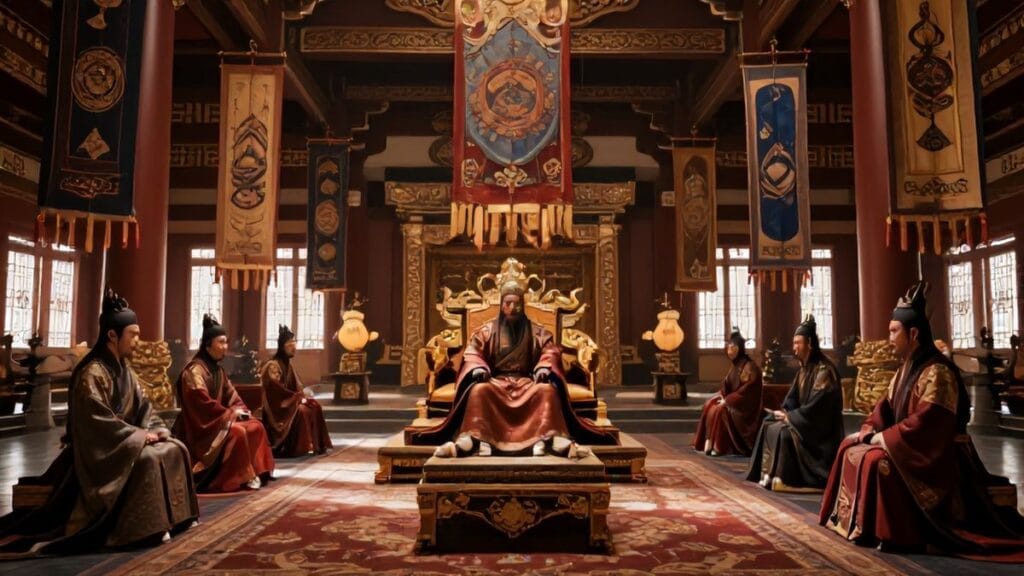
At court, Kublai surrounded himself with a kaleidoscope of advisers: Confucian scholars who drafted edicts in elegant Chinese, Tibetan Buddhist lamas who offered spiritual counsel and ritual power, Central Asian and Persian administrators adept at finance and trade, and Mongol nobles who expected rewards for their loyalty. This pluralistic milieu impressed foreign visitors like Marco Polo, who later wrote (as translated and compiled by rustic European authors) of Kublai’s splendor and wise governance. Yet some Chinese literati regarded the court with a mix of admiration and resentment, seeing in it both a revival of imperial order and an alien occupation.
The figure who had once stood on a wooden platform in Shangdu as kublai khan elected great khan now presided over complex ceremonies where dragons and steppe banners intertwined. His edicts bore both the authority of Eternal Heaven and the moral rhetoric of Confucian kingship. This hybrid legitimacy was powerful – but fragile. It depended on constant negotiation, on Kublai’s personal capacity to balance competing interests and expectations. The question that hovered in the background was whether the structures he built could outlast him.
Mandates and Mandalas: China Confronts a Mongol Emperor
To rule China as a foreign conqueror was to walk on thin ice over a deep lake of memory. Chinese political culture was steeped in millennia of dynasties rising and falling under the Mandate of Heaven, a concept that tied legitimacy to moral conduct, effective governance, and the well‑being of the population. Kublai’s reign, shaped from the moment kublai khan elected great khan, had to engage with that intellectual and spiritual heritage, even as it disrupted existing hierarchies.
Confucian scholars were among the first to test and be tested by the new order. Some refused to serve what they considered barbarian overlords, retreating into private teaching or poetic lamentation. Others, more pragmatic, accepted posts in the Yuan administration, arguing that good governance transcended ethnic origin and that their duty was to alleviate suffering where they could. Kublai courted these men with titles, stipends, and gestures of respect for classical texts. He sponsored the compilation of massive works of geography, history, and administrative law, seeking to demonstrate that his dynasty was not a transient occupation but a legitimate continuation of the Chinese imperial tradition.
At the same time, Kublai relied heavily on Buddhist networks, particularly Tibetan forms of Vajrayana Buddhism that emphasized ritual potency and protection. The Sakya lama Phagpa became a key adviser, granted authority over Buddhist affairs across the empire. Under Kublai’s patronage, stupas and monasteries rose, paintings and sculptures flourished, and a distinctive blend of Mongol, Tibetan, and Chinese religious art emerged. This Buddhist alliance helped solidify his personal aura of sanctity but aroused suspicion among some Confucians, who feared the erosion of moralistic governance in favor of esoteric rites.
Daoists and Muslims also navigated this changing landscape. Daoist institutions, which had enjoyed favor under previous regimes, saw their influence challenged by Buddhism. In one famous dispute, Kublai convened debates between Buddhist and Daoist representatives; when the Buddhists prevailed, he ordered the destruction of certain Daoist texts he deemed plagiarized. Muslim communities, particularly those of Central Asian origin, found new opportunities in trade and administration but sometimes clashed with local populations wary of foreign officials and unfamiliar customs.
Meanwhile, resistance to Mongol rule smoldered, especially in regions still loyal to the Southern Song. Though Kublai ultimately completed the conquest of the south in 1279, after protracted campaigns, memories of destruction and humiliation lingered. Secret societies, bandit groups, and disgruntled gentry all contributed to a low but persistent background of instability. Each drought, flood, or tax increase risked being interpreted as a sign that Heaven had withdrawn its mandate from the Yuan.
Yet it is striking how many aspects of Chinese life persisted beneath and within Mongol rule. Local markets functioned; family rituals continued; scholars sat for examinations (though in truncated form and not always in their preferred classical style). The empire that had once been known chiefly for its horse‑archers now became, under Kublai, a key node in a broader East Asian cultural sphere. The decision at Shangdu in 1260 had folded the steppe into the long story of Chinese statehood, even as it left sharp edges where cultures met and sometimes clashed.
Ordinary Lives in an Extraordinary Empire
The chronicles and official histories focus on khans, generals, and ministers, but the impact of kublai khan elected great khan also reverberated through the daily routines of people who never saw a kurultai or palace. To understand the human consequences of that decision, it helps to imagine a few lives caught in the vast machinery of the empire.
Consider a Mongol herdsman on the Orkhon steppe. Before the civil war, his chief concern was the health of his animals, the timing of migrations, and occasional levies for distant campaigns. The struggle between Kublai and Ariq Böke brought war to his doorstep. One year, recruiters from Ariq’s faction took his best horses; the next, Kublai’s tax agents demanded animals in lieu of grain. When the war ended in Kublai’s favor, he found himself increasingly summoned not for far‑flung raids into unknown lands but for patrols along caravan routes and service in garrisons that protected settled populations. His world narrowed even as the empire’s institutions expanded.
In northern China, a peasant woman whose village had fallen under Mongol control decades earlier faced different realities. Under Kublai’s administration, she might see new officials arrive, some speaking her language haltingly, others more fluent. Tax registers were updated, sometimes with promises that excessive corvée labor would be curbed. Roads and canals were repaired, making it easier to bring goods to market. Yet she also bore the burden of supplying garrisons, feeding passing armies, and adjusting to periodic policy shifts as court debates filtered down into local edicts.
Farther west, in a thriving Silk Road town like Samarkand or Kashgar, a Muslim merchant recalculated his risks. The early Mongol conquests had brought devastation, but by Kublai’s reign the empire functioned as a vast, if imperfect, free‑trade zone. With relative security on major routes and a single overarching authority – nominally the Great Khan, in practice a patchwork of khans and governors – he could transport textiles, spices, and metals from one end of Eurasia to the other. The knowledge that kublai khan elected great khan in the East mattered to him mainly insofar as it meant that the seals stamped on his travel permits would be recognized across multiple jurisdictions.
Religious minorities navigated opportunities and dangers. Nestorian Christian communities, many of them of Turkic or Persian background, enjoyed moments of favor at the cosmopolitan court, where their clerics competed with Buddhist and Muslim leaders for influence. Jewish traders found niches in finance and commerce. For them, the Mongol practice of broad religious tolerance – grounded less in modern ideals than in pragmatic desire to harness all available forms of spiritual and administrative capital – offered space, albeit under a regime that could turn harsh when it perceived disloyalty.
For all these people, the high politics of the kurultai at Shangdu might have seemed distant. Yet the structures and policies born from that day shaped the rhythms of their existence: the languages of official documents, the terms of taxation, the dangers on the roads, the availability of credit and protection. History’s grand hinge moments are rarely felt as such by those living through them. They experience instead the incremental shifts that, over years, make their world easier or harder to navigate.
Networks of Trade, Faith, and Knowledge Under Kublai’s Rule
One of the most enduring legacies of Kublai’s victory was the deepening of trans‑Eurasian connections. The Mongol Empire had already created, in historian David Morgan’s words, “a kind of Pax Mongolica” in the mid‑thirteenth century. Under Kublai, that peace was uneven and sometimes violently interrupted, yet it still provided an unprecedented framework for long‑distance exchange. The fact that kublai khan elected great khan and later founded the Yuan dynasty meant that the eastern terminus of those routes was governed by a ruler committed to both military security and commercial expansion.
Caravans moved with relative assurance between the domains of the Golden Horde, the Ilkhanate, the Chagatai Khanate, and Kublai’s Yuan. Though these successor states grew increasingly autonomous, they shared enough legal norms, diplomatic rituals, and practical interests to cooperate more than they fought – at least for several decades. Mongol relay stations protected envoys and merchants, who carried not only goods but ideas: medical knowledge from the Islamic world, astronomical techniques from China, artistic motifs that blended Persian, Central Asian, and East Asian traditions.
Religious communities rode these same routes. Buddhist monks traveled between Tibet, China, and the Mongol heartland, spreading texts and ritual practices. Sufis and other Muslim mystics journeyed eastward, sometimes winning converts among Turkic and Mongol populations. Christian missionaries, including Franciscans sent by the papacy, reached Kublai’s court and reported back to Europe with a mixture of awe and misunderstanding. One Franciscan account marveled at the Khan’s openness to learning, describing how he listened as carefully to their sermons as to Buddhist discourses, even if he did not convert.
Intellectual and technological transfers accelerated. Chinese innovations in printing, gunpowder, and navigation circulated more widely, while Kublai’s interest in astronomy and calendrics led him to sponsor Muslim and Chinese experts in shared observatories. In one notable example, the Muslim astronomer Jamal al-Din worked alongside Chinese counterparts to refine astronomical tables for the Yuan state, demonstrating how empire could foster scientific collaboration across cultural boundaries.
Yet the same networks that enriched many also exposed vulnerabilities. Epidemics moved along trade routes; local economies could be disrupted by shifts in imperial policy or warfare between khanates. The integrative power set in motion when kublai khan elected great khan had a double edge: it could create prosperity and cultural efflorescence, but it could also spread crises rapidly. Two generations later, the Black Death would traverse these arteries, carrying catastrophe across continents.
Still, for a time, the Mongol‑Yuan order under Kublai represented one of the most interconnected eras the Old World had ever seen. The echoes of 1260 reached into markets, monasteries, and workshops far beyond Shangdu, as people adapted to a world in which a Mongol emperor in China might influence the fate of a merchant in Tabriz or a craftsman in Kiev.
The Weight of Victory: Costs of Civil War and Imperial Overreach
Every triumph in history carries hidden costs, and Kublai’s ascent was no exception. Although he emerged from the civil war as the recognized Great Khan and later emperor of the Yuan, the very struggle that secured his position had weakened the fabric of the empire. The act by which kublai khan elected great khan at Shangdu once seemed to promise renewed unity; instead, it hastened the centrifugal forces that would fracture the Mongol world.
In the west, Batu’s successors in the Golden Horde increasingly treated the Great Khan as a distant relative rather than an immediate overlord. The Ilkhans in Persia pursued their own policies, sometimes at odds with Yuan interests. The Chagatai realm in Central Asia oscillated between cooperation and hostility. Kublai could still claim ceremonial primacy, and envoys continued to travel between courts bearing gifts and lavish compliments. But the reality was a family of increasingly separate states, bound by shared heritage more than by effective central control.
Within China, the strains of empire also began to show. Military campaigns to conquer the Southern Song required massive expenditures of men and material. Even after victory, integrating the lush but war‑torn southern provinces posed a formidable challenge. Taxation became heavier in some areas, sparking local revolts. Natural disasters were interpreted by many Chinese as signs that Heaven questioned Mongol rule. While Kublai took steps to provide relief and maintain order, the sheer scale of his realm made it difficult to prevent abuses by local officials or commanders.
Court politics grew more fraught as Kublai aged. Factional struggles erupted among his sons and grandsons, echoing the very succession disputes that had once pitted him against Ariq Böke. Trusted advisers died or retired; new favorites emerged, sometimes resented by long‑serving elites. The delicate balances Kublai had constructed between Mongols and non‑Mongols, between different religious groups, and between military and civilian authorities required constant adjustment. No system, however ingeniously designed, could fully insulate politics from human ambition and fear.
Economically, Kublai’s grand projects and military campaigns strained state finances. The extensive use of paper money, while innovative, proved vulnerable to inflation when not adequately backed by silver or other assets. Attempts to stabilize the currency through strict regulations sometimes clashed with the flexibility needed for long‑distance trade. Peasants and urban artisans felt the pressure most acutely, experiencing in their own lives the abstract tug‑of‑war between imperial ambition and economic reality.
Legacy, then, became a contested terrain even before Kublai’s death in 1294. Was he the wise, far‑seeing ruler celebrated by admirers like Marco Polo and certain Buddhist chroniclers? Or was he, as some Confucian writers later suggested, the powerful but ultimately flawed foreign emperor whose reign sowed the seeds of Yuan decline? The answer depends, in part, on where one stands in the empire’s social hierarchy and which facet of his rule one chooses to emphasize.
What is clear is that the moment kublai khan elected great khan in May 1260 set in motion forces that neither he nor his contemporaries could fully control. His victory solved one crisis – the immediate succession – but opened a series of new ones: how to govern permanent cities with a nomad aristocracy, how to balance universal claims with regional realities, how to keep an empire stitched together across deserts, mountains, and seas.
Memory and Myth: How Later Ages Remembered Kublai’s Election
Centuries after Kublai’s death, the specific details of the Shangdu kurultai blurred in popular memory, but its symbolic weight endured. In Chinese historiography, compiled under later dynasties, Kublai appears as the founding emperor of the Yuan, evaluated according to criteria applied to native rulers: his success in unifying the realm, his patronage of culture, his management of floods and famines. The fact that kublai khan elected great khan in a Mongol assembly is acknowledged, but often overshadowed by his assumption of the imperial title Shizu and his role in the dynastic sequence.
Mongol oral traditions, by contrast, tended to emphasize the earlier, more archetypal figure of Genghis, whose charisma and conquests formed the core of national myth. Kublai appears as a powerful but somewhat ambivalent figure – the grandson who turned the energies of the steppe toward walled cities and bureaucratic apparatus. In some stories, his Chinese orientation is portrayed as wisdom; in others, as a step away from the pure, free life of the ancestors.
Persian and Arabic chroniclers, such as Rashid al-Din and al-Nasawi, placed Kublai within the broader tapestry of Mongol khans who had transformed the Islamic world. They noted his distant authority over western domains, his role in shaping the overall destiny of the Mongol realms, and the eventual divergence between eastern and western khanates. Their works, written for courts that had themselves emerged from the shattering impact of Mongol invasions, balanced fear, admiration, and a keen awareness of how much the old world had changed.
In Europe, Kublai’s image was mediated through travel accounts and later literary works. Marco Polo’s tales, filtered through editorial hands, painted him as a nearly superhuman sovereign: just, generous, militarily brilliant, and surrounded by marvels. The factual accuracy of Polo’s descriptions remains debated among historians, but their influence on Western imagination is undeniable. By the time Coleridge composed “Kubla Khan” in the early nineteenth century – famously inspired by an opium dream after reading about Xanadu, or Shangdu – the historical Kublai had become an almost mythical figure, presiding over an exotic, semi‑fantastical realm.
Modern scholarship has tried to disentangle these layers of myth and memory. Drawing on Chinese, Persian, Mongol, and European sources, historians reconstruct the politics of the Shangdu election and the contours of Kublai’s rule with increasing nuance. Some emphasize his role in fostering Eurasian connections; others highlight the violence and coercion that underpinned his power. The debate over his legacy reflects broader questions about empire, globalization, and cultural encounter.
Yet even in the most critical accounts, there remains a recognition that the event when kublai khan elected great khan in 1260 represents a watershed. It stands as a moment when one man’s ascent encapsulated a complex convergence: nomadic tradition meeting sedentary civilization, localized powers being drawn into a vast imperial web, and the old rhythms of regional politics yielding, however briefly, to a continental scale of governance.
Conclusion
The election of Kublai Khan as Great Khan at Shangdu on 5 May 1260 was at once a ceremony, a gamble, and a turning point in world history. In the instant when kublai khan elected great khan, the Mongol Empire crossed an invisible threshold: from a primarily nomadic war machine into an experiment in ruling cities, fields, and diverse peoples through a hybrid of steppe and sedentary institutions. The subsequent civil war with Ariq Böke and the fragmentation of the wider Mongol world revealed just how high the stakes of that gamble had been.
Under Kublai, the Yuan dynasty drew China into a new imperial configuration, while also anchoring the eastern terminus of a pan‑Eurasian network of trade and cultural exchange. His reign brought both opportunity and suffering, innovation and exploitation, grandeur and decay. For herdsmen on the steppe, peasants by the canal, merchants on the caravan trail, and monks in their monasteries, the ripples of Shangdu reached into the most ordinary aspects of life, shaping taxes, security, patronage, and belief.
Looking back, it is tempting to see inevitability in the arc from Genghis’s conquests to Kublai’s empire and its eventual fragmentation. But the election at Shangdu reminds us that history often hinges on contested decisions made under pressure, in specific landscapes, by individuals whose visions both reflect and reshape their worlds. Kublai’s choice to claim the Great Khanate, and the coalition that raised him on that platform, produced an outcome neither purely Mongol nor purely Chinese, but something new, unstable, and globally consequential.
Today, when we speak of the Mongol Empire’s legacy – of connected continents, mixed cultures, and shifting sovereignties – we are in part tracing the afterlife of that spring day in 1260. The story of kublai khan elected great khan is thus not just a tale of dynastic succession; it is a chapter in the ongoing human struggle to organize power across difference, to reconcile mobility with rootedness, and to imagine political order on a world‑spanning scale.
FAQs
- Why was Kublai Khan’s election in 1260 so controversial?
The controversy stemmed from both procedure and principle. Traditionalists argued that only a kurultai held in the ancestral Mongol heartland, with all major lineages represented, could legitimately choose a Great Khan. Kublai’s supporters convened in Shangdu, closer to his Chinese power base, and declared him Great Khan before a rival kurultai in Karakorum elected his brother Ariq Böke. The result was a contested succession that ignited a civil war and accelerated the political fragmentation of the Mongol Empire. - How did Kublai’s rule change the Mongol Empire?
Kublai shifted the empire’s center of gravity toward China, adopting the title of Yuan emperor and building a bureaucratic state that combined Mongol military elites with Chinese and Central Asian administrators. He emphasized infrastructure, taxation, and urban governance more than continual expansion, integrating the empire into existing East Asian political and cultural traditions. This transformation helped create a more stable regime in China but loosened the Great Khan’s direct control over western Mongol domains. - What happened to Ariq Böke after the civil war?
After several years of fighting, Ariq Böke’s position deteriorated due to famine, defections, and Kublai’s superior resources. In 1264 he surrendered to Kublai, was brought to his brother’s court, and was treated outwardly with formal respect but kept under close watch. He died a few years later, under circumstances that some sources imply may have involved poisoning or harsh confinement, symbolizing the ruthless logic of succession politics in the Mongol elite. - Did Kublai Khan rule over all of the Mongol Empire?
Formally, as Great Khan, Kublai claimed sovereignty over all Mongol domains from Eastern Europe to the Pacific. In practice, his effective power was strongest in China, Mongolia, and adjacent regions. The Golden Horde, Ilkhanate, and Chagatai Khanate acknowledged his primacy in ceremonial terms for a time but increasingly operated as semi‑independent states, pursuing their own military and diplomatic agendas. - How reliable are our sources on Kublai’s election and reign?
Our knowledge comes from a mosaic of sources: Chinese dynastic histories, Persian chronicles like Rashid al-Din’s “Jami‘ al-Tawarikh,” Mongol legal and narrative texts, and Western travel accounts such as that attributed to Marco Polo. Each source reflects its own biases, audience, and political context. By comparing and cross‑checking them, modern historians can reconstruct events like the Shangdu election with reasonable confidence, though some details – especially about internal court debates – remain uncertain. - What long‑term impact did Kublai’s election have on Eurasian history?
Kublai’s victory entrenched the separation of the Mongol world into distinct khanates and anchored a Mongol‑ruled dynasty in China for nearly a century. His reign intensified trans‑Eurasian trade and cultural exchange, fostering what some scholars call a “Mongol world system.” At the same time, the administrative and social patterns established under the Yuan influenced later Chinese dynasties, while the empire‑wide connections built in his era shaped the spread of technologies, religions, and, eventually, pandemics across the Old World.
External Resource
Internal Link
Other Resources
- Encyclopaedia Britannica – general search for the exact subject
- Google Scholar – academic search for the exact subject
- Internet Archive – digital library search for the exact subject