Table of Contents
- The Shadow of the Pyrenees: Setting the Stage for War
- A Fragmented Peninsula: Christian Kingdoms and Taifas
- Ramiro I of Aragon: A King Between Faith and Steel
- Sancho Ramírez and Alfonso VI: Princes on the Edge of Legend
- Zaragoza and the Ambitions of Ahmad al-Muqtadir
- The Road to Graus: Raids, Ransoms, and Uneasy Pacts
- Calling the Mercenary Knight: Rodrigo Díaz Before El Cid
- Spring 1063: Mustering Banners in Aragon and Zaragoza
- The Siege Tightens: Life and Fear Inside the Walls of Graus
- The Eve of Battle: Camps of Torchlight and Whispered Prayers
- The Battle of Graus Unleashed: Clash by the River Cinca
- The Death of Ramiro I: Arrow, Ambush, or Betrayal?
- Aftermath on the Field: The Silence of the Fallen
- Ripples Through the Kingdom of Aragon
- From Graus to Legend: El Cid’s Controversial Reputation
- Faith, Frontier, and Everyday Lives After 1063
- Memory, Chronicle, and Debate: How Historians Read Graus
- Conclusion
- FAQs
- External Resource
- Internal Link
Article Summary: On a May morning in 1063, at the small frontier town of Graus in the Kingdom of Aragon, a battle took place whose echoes would rumble across centuries. The battle of graus was more than a clash between a Christian king and a Muslim taifa; it was a knot of ambitions, shifting alliances, and emerging legends. In this article we follow Ramiro I of Aragon in his final campaign, trace the political web that drew in Zaragoza and Castile, and meet a young Rodrigo Díaz, the future El Cid, fighting not against Muslims, but alongside them. We explore the social and religious tensions that made this borderland both a war zone and a place of exchange. We look at how the battle’s outcome reshaped the kingdom of Aragon, influencing dynastic succession and frontier policy. Along the way, we examine how medieval chroniclers and modern historians have argued over details—from who truly commanded the troops to how Ramiro I died on the field. The narrative situates the battle of graus within the broader story of the Iberian Reconquista, showing how messy and fluid that struggle really was. Ultimately, this account reveals how one relatively small engagement became a turning point in the making of Aragonese power and the myth of El Cid.
The Shadow of the Pyrenees: Setting the Stage for War
The wind that sweeps the foothills of the Pyrenees in early May carries a chill even when the wheat fields are turning green. In 1063, that wind bent the banners of Aragonese knights as they rode toward the valley of the Cinca, toward a modest but stubborn fortress-town called Graus. The hills echoed with the creak of leather, the jangle of mail, the curses of muleteers hauling siege engines. To those who marched under King Ramiro I, this was one more step in the long, grinding war along the frontier—a war that did not yet have a single name, but which later centuries would fold into the sweeping saga of the Reconquista. The battle of graus would mark the end of one man’s story and the opening paragraph of another’s.
From a distance, Graus did not look like a place where the destiny of kings could break. It clung to a rise above the confluence of the Ésera and Cinca rivers, guarded by stout walls of stone and mortar, its houses clustered close as if for warmth against the mountain winds. To the north, the high ranges of the Pyrenees formed a jagged horizon; to the south stretched a patchwork of cultivated fields and scrub, a landscape that could feed an army in good years and starve it in bad. Yet this nondescript town lay on a fault line—political, cultural, and spiritual. It was a forward bastion for the Muslim taifa of Zaragoza, a thorn in the side of Aragon’s ambitions, and a gate to the fertile lowlands beyond.
In the decades before the battle, the frontier between Christian and Muslim polities in northeastern Iberia had not been a single, fixed line but a shifting band of contested castles and tributary agreements. Raids crossed it in both directions; merchants and peasants slipped through in quieter times; and occasionally, knights changed sides when coin or patronage beckoned. The story of the battle of graus sits at the intersection of all these movements. It was shaped by personal feuds and dynastic strategies as much as by the language of crusade that later generations would retroactively impose on these years.
As twilight settled on the eve of the campaign, campfires dotted the Aragonese encampment like a second, low-lying constellation. Ramiro I, grey-bearded and battle-hardened, walked among his men, exchanging a word here, a blessing there. He had fought his way from count to king, carving out a realm from the old Carolingian borderlands and the ruins of earlier Muslim strongholds. Graus was not his first siege, nor his first gamble. But somewhere beyond that dark rise, in the defensive lines of Zaragoza, a different sort of force was gathering—one that included not only Andalusi warriors, but also Christian knights in foreign service. Among them, if the later tales are to be believed, rode a young Castilian named Rodrigo Díaz, who would one day be called El Cid.
A Fragmented Peninsula: Christian Kingdoms and Taifas
To understand why Graus came under siege, one must step back and look at the Iberian Peninsula of the mid-eleventh century as a mosaic of power rather than a two-tone map of Christians and Muslims. The collapse of the Umayyad Caliphate of Córdoba in the early 1000s had shattered centralized rule in al-Andalus. In its place arose a constellation of taifa kingdoms—independent principalities, often centered on major cities such as Zaragoza, Toledo, Seville, and Badajoz. Each rivaled the others in culture, architecture, and courtly splendor, but they were plagued by internal coups and external threats. Their rulers bought peace with gold when they could, with blood when they must.
On the Christian side of the frontier, the situation was no less fractured. In the north, the Kingdom of León vied with its offshoot, the County (soon Kingdom) of Castile, for regional primacy. To the far northeast lay the County of Barcelona and other Catalan counties, tied by custom and marriage to the wider world of Occitania and the Frankish realms. Nestled in the Pyrenean valleys, the Kingdom of Navarre and the fledgling Kingdom of Aragon were carving out their identities. The idea that these polities formed a united Christian front against Islam is, as many historians now emphasize, largely a construction of later centuries.
Instead, alliances sprawled across confessional lines. A Christian king might accept parias—tribute payments—from a Muslim taifa in order to fund wars against a Christian rival. A Muslim amir might hire Christian mercenaries or seek the arbitration of a bishop. The battle of graus emerges as a perfect illustration of this world of opportunistic politics. It was, ostensibly, a Christian assault on a Muslim-held town. Yet Zaragoza, the target, was at that very moment paying tribute to Christian rulers, and its defense may have been bolstered by Christian knights from Castile. The battlefield was less a stage for a simple clash of faiths and more a crossroads where the ambitions of many rulers collided.
By 1063, tension had been mounting along the upper Ebro and the foothills of the Pyrenees. The taifa of Zaragoza, ruled by the Banu Hud dynasty, sought to keep its borders secure against the aggressive push of Aragon and, to a lesser extent, Navarre. Aragon, small but ferocious, saw the lands around Graus as part of its natural sphere of expansion—fertile territories that could feed its people, strengthen its tax base, and secure vital routes through the mountains. Both sides were conscious of the shifting balance of power further west, where León and Castile were contesting supremacy and occasionally intervening in eastern affairs. It is against this backdrop that the battle of graus took shape, not as an isolated eruption of violence, but as a chapter in a larger, continent-spanning story of medieval state-building.
Ramiro I of Aragon: A King Between Faith and Steel
Ramiro I had not been born to wear a crown. The illegitimate son of Sancho III of Navarre, he acquired lands and titles along the southern slopes of the Pyrenees as part of the great partition of his father’s domains. What began as a collection of counties and marches, however, was forged under his rule into the Kingdom of Aragon. It was a hard-won transformation. Ramiro’s Aragon lay in a narrow strip of rugged terrain, hemmed in by Navarre to the west, the Pyrenees to the north, and Muslim territories to the south and east. To survive, he had to be ruthless, pragmatic, and unrelenting in his campaigns.
Over the course of his reign, Ramiro captured fortresses, negotiated marriages, and struck deals with both Christian and Muslim neighbors. His court was a lean one: fewer sumptuous banquets than in León or Zaragoza, more councils held in drafty halls where local lords pledged men and horses in exchange for land and privilege. Yet, as the decades passed, Aragon grew. Castles that had once flown the banners of Muslim governors were refortified under Christian command; mountain passes that had seen only pack animals now bore the hoof-marks of armored cavalry.
Ramiro I’s piety, at least as the later chroniclers portray it, was intense and straightforward. He endowed monasteries, such as San Juan de la Peña, and sought the counsel of abbots and bishops. Faith and steel went hand in hand; the conquest of new lands was portrayed as both a political goal and a religious duty. But Ramiro, like other rulers of his time, could also be flexible. He extracted tribute from Muslim neighbors and, when necessary, respected existing Muslim communities under his rule, seeing them as a source of labor and revenue. The frontier was harsh, but it was also permeable.
By the early 1060s, Ramiro was entering the later years of his life, but he remained every inch a war-king. His eldest son, Sancho Ramírez, was already an experienced commander, yet Ramiro did not withdraw from the field. Graus represented both a challenge and an opportunity. Its capture would extend Aragonese control down the Cinca valley, weaken Zaragoza’s hold on the region, and perhaps open the door to further advances. For a king whose prestige had been built on steady expansion, the chance to add one more hard-won stone to his realm was irresistible. The decision to besiege Graus—in hindsight, the decision that would end his life—was an extension of the same relentless logic that had framed his entire career.
Sancho Ramírez and Alfonso VI: Princes on the Edge of Legend
While Ramiro I marched toward his fate, younger men in neighboring realms were stepping into roles that would shape Iberian history. In Aragon, his son Sancho Ramírez was already emerging as a key figure at court. Born into a rough, martial environment, Sancho had been prepared from childhood to lead war-bands, command sieges, and manage restive nobles. He had watched his father turn a fragmented territory into a recognized kingdom, learning both the art of war and the techniques of diplomacy.
Across the mountains and plains, in the lands of León and Castile, another prince was coming of age: Alfonso, the future Alfonso VI. At the time of the battle of graus, Alfonso was still a young man, shaped by his father Ferdinand I’s efforts to expand Christian influence and by the intricate politics of a divided inheritance. Alfonso’s later career—as the king who would capture Toledo in 1085 and stand at the center of one of the most dramatic phases of the Reconquista—is well documented. But in 1063, he was still maneuvering for position, occasionally seeking allies even among Muslim rulers, just as they courted him in turn.
According to some later traditions, the young Alfonso was sent into exile at the court of Zaragoza for a period during the turmoil following his father’s death. These accounts, though debated, hint at how close the ties between Christian and Muslim elites could be. If Alfonso truly spent time in Zaragoza, he may well have shared halls and banquets with the same Hudid rulers who were preparing to defend Graus against his distant Aragonese cousins. The Iberian frontiers were full of such unexpected proximities: royal hostages, exiled princes, and mercenary captains crossing boundaries that modern readers might assume to be rigid.
The careers of Sancho Ramírez and Alfonso VI would eventually intersect with the legacy of the battle of graus. For Sancho, his father’s death in 1063 meant a hurried transition from prince to king, from subordinate commander to supreme authority in a time of mourning and danger. For Alfonso, events in Aragon and Zaragoza were part of a shifting constellation of forces that he would have to reckon with as he sought to consolidate power in León-Castile. Although neither young man commanded directly at Graus—at least not in a clearly documented way—the battle rippled unavoidably into their lives, shaping the political landscape on which their own wars would later be fought.
Zaragoza and the Ambitions of Ahmad al-Muqtadir
Facing Ramiro I across the frontier was the taifa of Zaragoza, ruled in 1063 by Ahmad al-Muqtadir, a member of the Banu Hud dynasty. Zaragoza, perched on the Ebro River, was more than just a political capital; it was a center of learning, poetry, and architectural innovation. The court of al-Muqtadir patronized scholars and poets, sponsored the embellishment of mosques and palaces, and engaged in the same delicate balancing act as other taifa rulers: paying tribute when necessary, warring when possible, and always playing rivals against each other.
Yet beneath the sheen of courtly refinement lay a persistent anxiety. The Hudid rulers had seized Zaragoza from their rivals in the chaotic years following the fall of the caliphate, and they knew that power won by the sword could be lost the same way. To the west loomed the taifa of Toledo; to the south, other Muslim polities jostled for territory. To the north and east, the Christians of Aragon, Navarre, and the Catalan counties pressed inexorably closer. Al-Muqtadir could not afford to lose Graus, a key outpost that guarded one of the approaches to his realm.
For Zaragoza, the battle of graus was a defensive war but also a test of prestige. If a relatively small Christian kingdom like Aragon could tear away one of its fortified towns, other foes might be emboldened. The Hudid ruler’s response, therefore, was characteristically vigorous. He gathered Andalusi troops from his own domains and summoned allies and mercenaries alike. Among those who answered, if the chronicles are to be believed, were Christian knights from Castile, led by or at least including the young Rodrigo Díaz. This image—Zaragoza’s Muslim emir relying on the swords of Christian knights to preserve his frontier—captures in a single stroke the tangled reality of eleventh-century Iberia.
Al-Muqtadir’s ambitions were not confined to mere survival. He sought to expand his influence westward and to maintain a recognized authority among neighboring taifas, sometimes adopting titles that evoked the older caliphal grandeur. Victories on the battlefield reinforced such claims; defeats eroded them quickly. Thus, when Ramiro I laid siege to Graus, the stakes were uncomfortably high. Losing the town might not have toppled al-Muqtadir immediately, but it would have signaled weakness to his rivals and to the Christian rulers who watched the frontier like hawks, weighing when and where to strike next.
The Road to Graus: Raids, Ransoms, and Uneasy Pacts
The battle of graus did not burst from a clear blue sky; it grew from a long season of skirmishes, tribute demands, and broken agreements. Along the Cinca and Ésera valleys, small-scale warfare was almost routine. A detachment of Aragonese knights might raid a Muslim-held village, seizing livestock and captives; a few months later, a Hudid war-band would ride north to burn fields and test the resolve of a border garrison. Peasants on both sides of the line paid the price: their homesteads turned to ash, their sons pressed into service, their daughters traded as slaves or ransomed back to their families.
These frontiers were also zones of negotiation. Captured nobles and wealthy townspeople were rarely killed outright; they were ransomed, often through intermediaries who knew both Arabic and Romance languages. Stories circulate in later sources of Christian and Muslim commanders who exchanged gifts, shared intelligence, and occasionally met in person to arrange swaps of prisoners. A chronicler might denounce such familiarity, but on the ground it was sheer pragmatism. The people who lived nearest the line understood that today’s enemy could be tomorrow’s ally or, at the very least, tomorrow’s trading partner.
Somewhere within this cycle, Graus changed from being a persistent irritant to a strategic priority for Ramiro I. Perhaps repeated Hudid raids from the town had stung too deeply. Perhaps he judged that Zaragoza, engaged in conflicts elsewhere, was temporarily weak and unable to send serious aid. Perhaps internal politics in Aragon—pressure from nobles eager for land, or the desire to cement his legacy before old age overtook him—pushed Ramiro toward a bold stroke. The surviving sources are frustratingly silent on his precise motives, but his actions speak clearly enough: he mobilized a significant force and moved on Graus in earnest.
For al-Muqtadir, the siege was a challenge that could not be ignored. The Hudid ruler, like his Christian counterparts, had a complex web of pacts to manage. He may have been paying tribute to León-Castile; he might have had truces with Navarre or Barcelona. To defend Graus, he had to rearrange this diplomatic puzzle, ensuring that he would not expose his flanks to other enemies while he focused on Aragon. Out of this calculation came one of the most controversial elements of the battle: the recruitment of Christian warriors from Castile, very likely operating as mercenaries or allies of convenience rather than as representatives of a unified Christian cause.
Calling the Mercenary Knight: Rodrigo Díaz Before El Cid
Long before he became the hero of epic song, Rodrigo Díaz de Vivar was simply a young knight seeking his fortune in a violent world. Born in the frontier town of Vivar, near Burgos, he had risen in the service of Sancho II of Castile. The later “Cantar de mio Cid” would depict him as the very model of a Christian champion, but history, as so often, is more entangled than legend allows. Several medieval chronicles, such as the Historia Roderici, hint that Rodrigo fought in the service of Muslim rulers during his early career, and modern historians have long debated whether he was present at the battle of graus.
One line in the twelfth-century chronicle of the monk of Silos, for example, suggests that Castilian forces aided Zaragoza against Ramiro I around this time, and later tradition expands this into the claim that Rodrigo himself commanded them. The evidence is not ironclad. As scholar Richard Fletcher once cautioned, “certainty is a luxury seldom afforded to students of the eleventh century.” Yet the possibility is compelling, and many accounts—including those used in classrooms and popular histories—now cautiously accept that Rodrigo may indeed have fought at Graus, side by side with Andalusi comrades, opposing a Christian king who was not his own.
If so, the image is a striking one: a band of Castilian horsemen, mail glinting, banners fluttering, riding under the pay or patronage of Ahmad al-Muqtadir. Among them, a tall, lean figure with a hard-set jaw and the reflexes of a born warrior—Rodrigo Díaz, still years away from exile, from the great campaigns around Valencia, from the grave on which pilgrims would one day lay offerings. At Graus, he was not a symbol but a soldier, his loyalties shaped more by personal bonds and opportunities than by a straightforward division of “Christian” and “Muslim.”
The presence of such mercenary or allied Christian troops on the Zaragoza side helps explain why the battle of graus defies later nationalist narratives. It was not a clean story of one faith versus another. Rather, it was a raw contest for local dominance in which men like Rodrigo, skilled in arms and mobility, could sell their talents to whichever lord offered them a path to wealth and honor. That many later Spaniards would still celebrate him as a Christian icon, despite his service to Muslim patrons, speaks volumes about the power of legend to smooth over the inconvenient edges of reality.
Spring 1063: Mustering Banners in Aragon and Zaragoza
As winter receded from the Pyrenees in 1063, word would have spread through stone keeps and village squares: the king was calling his men. In Aragon, local lords—tenentes, castellans, and rural magnates—gathered their retainers. Peasants were ordered to provide provisions, carts, and draft animals. Armorers hammered out last-minute repairs; fletchers bound feather to arrow shaft. The royal summons was no abstract matter. For many free men, answering it was a duty enshrined in custom; for others, it was the price of land tenure or royal favor. The host that Ramiro I brought to Graus was not enormous by later medieval standards, perhaps numbering in the low thousands, but it was likely one of the largest he had ever assembled.
On the other side of the frontier, the mobilization was just as intense. In Zaragoza, al-Muqtadir’s agents rode out to collect levies from rural districts and to summon professional warriors from the city’s garrison. Messengers streaked westward into Castile, carrying promises of gold and plunder. In response, Christian knights eager for action and reward began the long ride east, their routes threaded through mountain passes and river valleys, their presence sometimes tolerated and sometimes resented by the local populations they passed.
Logistics, always the invisible spine of war, shaped the coming clash. The approach to Graus from the north and northwest meant traversing difficult terrain: narrow valleys, steep ridges, and river crossings that could become choke points. Ramiro’s forces had to maintain supply lines back to safer areas, where grain and livestock could be requisitioned. Zaragoza’s troops, by contrast, moved along better-developed routes down the Ebro and up the Cinca, but they too had to coordinate widely dispersed contingents. A misstep in timing or provisioning could turn a campaign into a disaster without a single sword being drawn.
By late April or early May, the pieces were in motion. The Aragonese army drew its cordon around Graus, planting banners on nearby heights and beginning the slow work of siegecraft. Inside the town, the Hudid garrison and local defenders steeled themselves, repairing walls, stockpiling missiles, and organizing watch rotations. Farther off, Zaragoza’s field army advanced, likely hugging the river valleys, scouts fanning out to gauge the size and positioning of the besiegers. Both sides knew that a decisive encounter was looming, and once again the battle of graus began to gather momentum as a convergence of wills and fears.
The Siege Tightens: Life and Fear Inside the Walls of Graus
Imagine standing on the walls of Graus in those days before the battle, looking out over a plain now scarred with enemy encampments. Smoke from Aragonese cookfires curled into the sky. Wooden mantlets and siege engines were being hauled into position. From time to time, a test arrow arced lazily toward the town, thudding against stone or embedding itself in the packed earth of the streets. The defenders, Muslim and perhaps some local Christians living under Hudid rule, knew that sieges could last weeks, even months. Their fates depended on deep wells, full granaries, and the grim patience to outlast hunger and fear.
Inside the walls, daily life bent under the pressure of war but did not entirely break. Bakers still kneaded dough; mothers still hushed crying children; traders, if any markets continued, did so under watchful eyes. Yet everything was colored by anxiety. Families counted sacks of grain, wondering how long they would last. Men of fighting age reported for duty shifts on the ramparts. Religious leaders—imams in the mosques, perhaps Christian priests in small churches, or Jewish rabbis in their quarters—led prayers for deliverance. The frontier, after all, was a place of religious pluralism as well as of violence.
From the Aragonese lines, the town might have looked deceptively calm. But this was the calm of coiled defiance. Ramiro’s men began probing the defenses, launching small assaults to test the response, showering the parapets with arrows and stones. Siege towers or ladders may have been readied, though the sources are vague. If the town could be starved into submission, that was often preferable to a direct storm, which chewed up attackers at a horrifying rate. Yet time, for the besiegers, was also dangerous. The longer they sat before Graus, the more likely it became that Zaragoza’s field army would arrive to challenge them.
Rumors seeped through the besieging camp: scouts reported movements to the south; distant dust plumes on the horizon suggested marching columns. Some said that al-Muqtadir himself was coming. Others whispered of foreign knights in the service of Zaragoza, hard riders from Castile whose courage was as sharp as their lances. For the ordinary soldier on rammed-earth parapets or in makeshift tents, such stories were as unsettling as they were thrilling. They knew that when the relief force finally came, they might be caught between garrison and field army, squeezed in a lethal vice against the walls of Graus.
The Eve of Battle: Camps of Torchlight and Whispered Prayers
The night before a medieval battle is one of tension that transcends centuries. At Graus, under a moon perhaps veiled by thin cloud, the Aragonese camp shimmered with torchlight. Men checked the straps of their helmets and the condition of their spears. Horses were brushed down, their tack inspected for wear that might spell disaster in the chaos of combat. Priests passed among the ranks, granting blessings and hearing hurried confessions. For many, the boundary between fear of death and hope of salvation was dangerously thin.
Across the fields, beyond the line of siegeworks, another camp pulsed with light and movement. Zaragoza’s army had arrived. The arrival itself must have carried a roar of noise and emotion—a surge of shouted orders, neighing horses, the clatter of gear. If Rodrigo Díaz and his Castilians were indeed present, their camp might have been just a little removed from the main Andalusi host, bound by contract but marked by language and custom. Yet as the night deepened, common anxieties would have blurred these boundaries: all awaited dawn, all knew that their survival depended on leadership, discipline, and no small measure of luck.
Commanders held councils beneath tent awnings or in hastily cleared spaces. Ramiro I, perhaps seated on a traveling chair or simple stool, listened to his captains propose formations. Should they break off the siege and turn fully to face Zaragoza’s army in the open field? Should they maintain pressure on the town, hoping to prevent a sally while fending off the relief force from prepared positions? On the other side, al-Muqtadir and his commanders weighed whether to attempt a direct assault on the Aragonese encampment, to coordinate a sortie with the garrison, or to maneuver for better ground.
The sources do not preserve the precise words spoken in those councils, but the decisions taken there shaped the slaughter to come. Men tried to sleep, but many lay awake, listening to the murmur of voices, the occasional bray of a donkey, the drone of distant chants. Some carved small crosses or Qur’anic inscriptions into the wood of their shields. Some wrote hasty wills or messages, hoping that, should they fall, a friend or comrade would carry word back to their families. It’s astonishing, isn’t it, how little separates us from them in such moments? The centuries vanish, leaving only the universal knot in the stomach as the world narrows to the valley, the rivers, and the looming battle at dawn.
The Battle of Graus Unleashed: Clash by the River Cinca
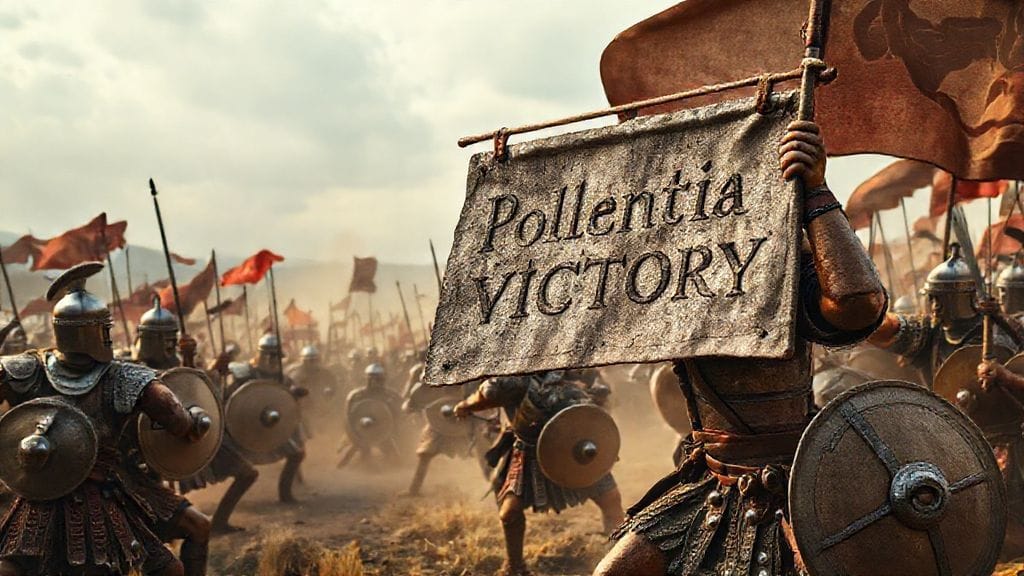
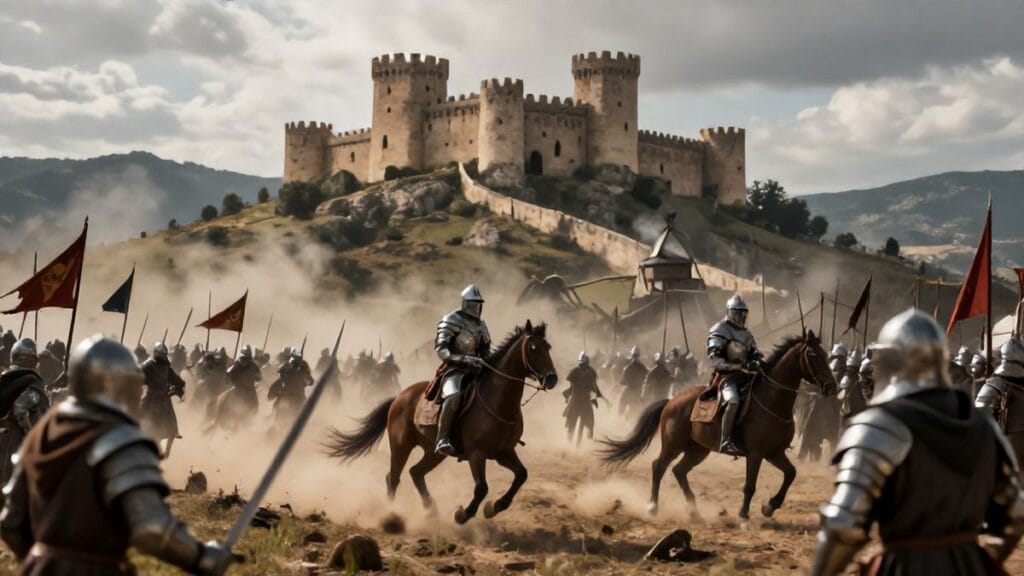
With the first pale light of May 8, 1063, banners lifted in the valley around Graus. Trumpets or horns sounded in both camps. The Aragonese, called to arms, formed up in units that reflected their feudal structure: contingents under local lords, each clustering around its standard. At the core were the mounted knights, the military elite of Ramiro’s realm, clad in mail hauberks, conical helmets with nasal guards, and armed with lances, swords, and shields painted with simple, bold devices. Around them stood infantry—less well armored, but still crucial for holding lines and supporting the cavalry.
Zaragoza’s forces advanced in turn, likely deploying in a mix of light and heavy cavalry, infantry archers, and spear-armed footsoldiers. Andalusi warfare in this period often emphasized speed and maneuver: swift cavalry used to harry and encircle, archers to weaken the enemy before a decisive charge. The presence of Castilian knights, if confirmed, added a heavier punching force—warriors trained in the shock tactics of the northern kingdoms. From the walls of Graus, the garrison watched, hopeful and tense, ready to sally if the moment came.
The exact sequence of the battle of graus is obscured by time and contradictory accounts, but certain patterns emerge from the chronicles. Early in the fighting, there would have been an exchange of missile fire: arrows falling in dark, deadly arcs, stones hurling from slings. Then came the cavalry clashes—groups of riders surging forward, shouting war cries in Romance and Arabic, the impact of horse and lance reverberating through human bone. Dust rose, turning the air into a choking fog. Men lost sight of their standards and clung to the shouts of their officers.
At some point, the Aragonese lines began to buckle. Whether this was due to superior Zaragoza tactics, an ill-chosen position near the rivers, or a flanking maneuver led by mercenary knights remains debated. One plausible reconstruction suggests that Zaragoza’s cavalry managed to swing around one of Ramiro’s wings, driving it back toward the siegeworks and creating a pocket of confusion. Seeing an opening, the garrison of Graus may have launched a sortie, slamming into the rear or flank of the besiegers and turning a hard fight into a rout.
The chronicles agree on one core fact: the day ended in defeat for Aragon. The battle of graus cost Ramiro I his life, and with him many noble companions. Some were cut down in the melee, others drowned in the rivers, pushed off the banks in the press of retreat. The field, alive that morning with the colors of two great hosts, was by afternoon a landscape of ruin: broken spears, abandoned shields, the dead and dying scattered among the trampled grass.
The Death of Ramiro I: Arrow, Ambush, or Betrayal?
The death of a king on the battlefield is always fertile ground for legend, and Ramiro I’s end at Graus is no exception. Later sources, seeking drama or moral lessons, embroidered the bare fact of his fall with vivid details. One tradition claims that Ramiro was struck by an arrow while rallying his men, the missile piercing armor and flesh in what his supporters might have seen as a martyr’s death. Another suggests that he was ambushed in the confusion of retreat, cut down by pursuing cavalry as his guard disintegrated.
More intriguingly, some late and highly colored accounts hint at darker possibilities—whispers of betrayal among his own followers or a fatal miscalculation rooted in overconfidence. In a world where noble factions were often at odds, the notion that a king might be abandoned at a crucial moment, intentionally or otherwise, is not implausible. Yet hard evidence remains elusive. As historian Bernard Reilly noted in a different context, “medieval chroniclers wrote to edify as much as to inform,” and the battle of graus is no exception: the line between description and moralizing is blurred.
What is clear is that Ramiro’s death reverberated instantly through the Aragonese host. The fall of the royal banner, the news that the king himself lay dead or dying, would have shattered morale. Some units would have broken and fled outright, others fought on stubbornly, desperate to carve a path to safety. The young Sancho Ramírez, if present at the battle, may have had to fight his way out with a small band, already carrying on his shoulders the weight of a kingdom suddenly bereft of its founding king.
In Zaragoza, the news of Ramiro’s death was a triumph. For al-Muqtadir, it was vindication of his decision to defend Graus vigorously and perhaps to hire Christian allies. For those who fought on his side—Andalusi warriors and Castilian knights alike—it was a badge of honor: they had slain a king. In later Aragonese memory, however, Ramiro’s fall at the battle of graus took on a more tragic valence. He became the old lion cut down in the last hunt, a symbol of both martial courage and the dangers of unceasing expansion.
Aftermath on the Field: The Silence of the Fallen
When the clamor of battle finally died down, a heavy silence fell over Graus and its surrounding fields. The victors moved cautiously through the wreckage, wary of stray arrows or desperate last strikes from the wounded. The cries of the injured mingled with the soft rush of the nearby rivers. Above them, the walls of the town were crowded with faces—families searching for loved ones, soldiers pointing out where the fighting had been thickest.
The immediate tasks after such a battle were brutal and practical. The dead had to be buried or burned before disease took hold. In a conflict that straddled religious lines, burial customs complicated matters. Christian dead, whether Aragonese or Castilian, ideally required consecrated ground; Muslim dead, swift interment according to Islamic law. Yet on a chaotic battlefield, compromises and improvisations were inevitable. Some noble corpses might be carefully removed, wrapped, and sent home under guard. Others—peasants, lesser soldiers—were interred in mass graves, their names already slipping from record.
Looting also followed swiftly. Victorious troops stripped the fallen of weapons, armor, and anything of value. Prisoners were gathered—those Aragonese who had surrendered or been knocked senseless rather than killed outright. Their fates varied widely. High-ranking captives were worth ransoms that could enrich a commander’s purse or fund future campaigns. Common soldiers might be sold into slavery, forced into labor, or eventually released as part of prisoner exchanges. For the citizenry of Graus, the lifting of the siege meant relief from the specter of starvation and assault, but it also likely meant an influx of wounded and displaced people, burdening their already strained resources.
Somewhere among the corpses lay the body of Ramiro I. If recovered by his men, it would have been treated with solemnity, prepared for transport back to his chosen resting place—traditionally associated with monasteries such as San Juan de la Peña, where kings of Aragon sought eternal association with holy intercessors. The journey of a dead king across the mountains, escorted by tired, mourning warriors, must have been an eerie counterpoint to the proud processions of earlier campaigns. The battle of graus, in this sense, did not end at the town’s edge; it continued in the slow, dolorous trek of news and bodies back to Aragon’s heartlands.
Ripples Through the Kingdom of Aragon
The news of Ramiro’s death hit Aragon like a thunderclap. In a small, still-consolidating kingdom, the sudden loss of its founding monarch could have triggered fragmentation or even collapse. That it did not is a testament to the structures Ramiro had built and to the readiness of his successor, Sancho Ramírez. Yet the transition was anything but smooth. The young king had to move quickly to secure the loyalty of key nobles, reassure the church, and present a credible posture to external rivals suddenly alert to potential weakness.
Graus remained under Zaragoza’s control. The military setback forced Aragon to recalibrate its ambitions, at least temporarily. Sancho Ramírez, inheriting not only a crown but also a war in progress, had to choose between pressing immediate retaliation and shoring up internal stability. The balance he struck would shape the kingdom’s trajectory. Over the following years, Sancho focused on strengthening royal authority, cultivating ties with the papacy, and carefully choosing targets for expansion—sometimes toward the south, sometimes eastward toward the lands of Barbastro and beyond.
Politically, the battle of graus also affected Aragon’s relationships with neighboring Christian powers. A defeated realm often had to appease stronger neighbors through marriages, tribute, or alliances. Sancho’s Aragon eventually wove itself into the broader Christian coalition that, in later decades, pushed deeper into Muslim-held territories. But the memory of 1063 lingered as a cautionary tale: even a determined and experienced king could fall when confronting a well-defended frontier backed by flexible alliances.
Within Aragonese society, the loss of so many fighting men created gaps in the noble hierarchy and disruptions in local leadership. Estates fell to widows, minors, or distant kin, prompting legal disputes and negotiations that occupied royal courts and monastic scribes. The economic cost was substantial: lands left temporarily underworked, villages that had contributed heavily to the war effort struggling to recover. Yet the frontier resilience of Aragon’s people—accustomed to hardship, to rebuilding after raids and floods—should not be underestimated. Within a generation, the kingdom would resume its push southward, transformed but not broken by the defeat at Graus.
From Graus to Legend: El Cid’s Controversial Reputation
As the decades turned to centuries, the battle of graus slipped from immediate memory into the realm of chronicles and, eventually, legend. One of the most enduring threads binding it to wider European consciousness was its association with Rodrigo Díaz, El Cid. For medieval poets and later nationalists, the idea that Spain’s quintessential Christian hero had once fought for a Muslim lord at Graus posed an awkward problem. Some traditions simply ignored it; others sought to explain it away as loyal service to his rightful overlord, who had in turn allied with Zaragoza.
The historical Rodrigo was far less tidy than his legendary counterpart. He served different masters at different times, including both Christian kings and Muslim emirs. His campaigns around Valencia in the late eleventh century involved complex manipulations of its Muslim population, alternating between protection and oppression. The battle of graus, if indeed he fought there, fits perfectly into this pattern of pragmatic, shifting loyalty. It also challenges the simplistic dichotomy of a Reconquista framed as eternal and unwavering antagonism.
Modern historians have seized on this complexity. Rather than seeing El Cid as either pure hero or pure mercenary, many now view him as emblematic of a frontier aristocracy that was simultaneously deeply Christian in belief and remarkably flexible in alliances. Academic debates about his presence at Graus often turn on detailed readings of sparse texts, the dating of charters, and the evaluation of chronicle biases. One scholar might emphasize the plausibility of his service to al-Muqtadir; another might caution against building too much on late or tendentious sources.
For the broader public, however, the image of El Cid at Graus adds a layer of fascination. Here is the young knight, unencumbered by later myth, earning his reputation in the dust and blood of a frontier battle. His participation—whether as commander or merely as one among many—reminds us that the battle of graus was a crucible not only for kingdoms but also for individual destinies. In that sense, it stands as one of the earliest stages on which the future champion of Valencia may have tested his mettle, learning the brutal lessons that would define his controversial career.
Faith, Frontier, and Everyday Lives After 1063
The shockwaves of Graus were felt not only in royal courts and noble halls, but also in the daily rhythms of frontier communities. For peasants in the valleys of the Cinca and Ésera, the end of the siege and Aragonese defeat meant a reprieve from immediate devastation—but not an end to insecurity. The battle might delay Aragonese expansion for a time, but the frontier remained volatile. Villages reinforced their palisades, families dug hiding places for valuables, and local shrines became focal points for prayers for protection.
Religious identities in this region were profound but interwoven. Muslim villagers under Hudid rule attended mosques, Christian minorities their churches; Jewish communities, though smaller, maintained synagogues and commercial networks. The battle of graus reinforced for some the sense that divine favor could shift dramatically. Preachers on both sides might have interpreted the outcome as a sign: for Muslims, a proof that God still defended them against encroaching infidels; for Christians, a chastisement for sins or insufficient zeal. Yet even as sermons framed events in cosmic terms, ordinary people continued to trade, to intermarry across linguistic lines, and to share irrigation systems and grazing lands.
In the decades after 1063, patterns of coexistence and conflict along this frontier evolved but did not disappear. Aragon, once recovered, resumed its push into the Ebro basin, capturing towns and incorporating Muslim populations as mudejares—non-Christian communities under Christian rule. Zaragoza, for its part, navigated the increasingly dangerous waters of Iberian politics, fending off threats from both Christian kingdoms and rival taifas until, in the early twelfth century, it too would fall to an Aragonese king, Alfonso I “the Battler.” Seen from that vantage point, the battle of graus appears as an episode in a longer story of gradual Christian advance, but it is important not to flatten its immediate human textures into a simple historical stepping stone.
For the people who tended vines, flocks, and grain-fields near Graus, 1063 was a year of fear, loss, and rebuilding. Some families never saw their men return from Ramiro’s host. Others welcomed back husbands and sons who bore scars, both visible and invisible. The battlefield, once cleared, remained haunted ground. Travelers passing near the rivers might cross themselves or recite prayers, remembering tales of the king who fell there and of the fierce struggle that once shook these quiet hills.
Memory, Chronicle, and Debate: How Historians Read Graus
The battle of graus, though modest in scale compared with titanic clashes like Las Navas de Tolosa or the siege of Toledo, has occupied a disproportionate space in historical debate. This is in part because it sits at a crucial crossroads: the early formation of the Kingdom of Aragon, the blossoming of the taifa of Zaragoza, and the shadowy early career of El Cid. The medieval chronicles that mention Graus—Latin, Arabic, and later Romance—each approach it with their own agendas. Monastic writers in Christian realms emphasized Ramiro’s courage and martyr-like death; Andalusi authors highlighted the defensive valor of Zaragoza and the humiliation of an aggressive Christian king.
Modern historians, combing through these sources, must weigh them against each other with care. When a twelfth-century chronicler claims that Rodrigo Díaz commanded at Graus, is he preserving a genuine memory or retrojecting the later fame of El Cid back into earlier decades? When an Arabic source praises al-Muqtadir’s victory, is it inflating numbers or simplifying a more complex set of maneuvers? Critical methodology—examining manuscript traditions, cross-referencing charters, assessing internal consistency—becomes essential. As one modern scholar observed, “the battle of Graus seems always to hover between fact and literary construction.”
The debates are not merely academic hair-splitting. They touch on larger questions about how we understand the so-called Reconquista. Was it a centuries-long religious crusade, steady and unidirectional, or a more tangled process of state formation, alliance, and occasional holy war? The battle of graus, with its Christian king attacking a Muslim town defended in part by Christian knights, is a powerful case study in the latter view. It forces us to confront the multiplicity of motives—economic, dynastic, personal—that animated medieval warfare in Iberia.
In the last few decades, archaeological work in the region, while not as spectacular as on some grander battlefields, has begun to add material texture to the written record: patterns of fortification, traces of settlement continuity or rupture, and the distribution of artifacts. Combined with a careful reading of texts, these findings help ground the story of Graus in the physical landscape. The hills, rivers, and ruined walls become more than backdrops; they are active participants in the narrative, shaping tactics and memories alike.
Ultimately, the battle of graus endures in historiography not only because of what happened on that May day in 1063, but because of what later generations chose to see in it: the fall of a founding king, the possible first major engagement of a legendary knight, and a snapshot of a frontier world where the lines between friend and foe were as winding as the rivers of the Pyrenees foothills.
Conclusion
Looked at from the vantage point of nearly a millennium, the battle fought outside the walls of Graus on May 8, 1063 might appear small. No empires fell that day; no continent-shaking treaties followed in its wake. Yet for the people of Aragon and Zaragoza, and for the generations who would look back on their struggles, it was a turning point. The battle of graus brought down Ramiro I, the rugged founder of the Aragonese monarchy, and in doing so forced his kingdom to mature faster than it might have otherwise. It showcased the resilience and tactical skill of the taifa of Zaragoza under Ahmad al-Muqtadir and highlighted the ways in which Christian and Muslim powers intertwined their fates through war and alliance.
The clash also marks an early, shadowed moment in the story of Rodrigo Díaz, the future El Cid, whose legend would come to dominate medieval Spanish literature. If he fought at Graus, as many scholars now cautiously accept, he did so as a Christian knight in Muslim employ, complicating any simple narrative of religiously polarized warfare. That complexity is perhaps the battle’s most enduring lesson. It reminds us that the Iberian frontier in the eleventh century was not a straightforward line between two civilizations, but a dense web of loyalties, rivalries, and shared practices.
Through the lens of Graus, we see how royal ambition, local survival, and personal glory collided in the landscapes of the Pyrenees. We glimpse the fear inside besieged walls, the grim resolve of marching armies, the shifting calculus of diplomacy in courts that spoke different languages but understood power in similar terms. In the end, Aragon recovered from defeat and went on to become a major Mediterranean power; Zaragoza enjoyed its victory for a time, only to fall decades later. Yet the memory of 1063 lingered in chronicles and songs, in the stones of forts, and in the quiet of monastic scriptoria.
History often moves through such moments: battles that are neither the largest nor the most celebrated, but which crystallize wider forces at work. The battle of graus was one such moment. It stands as a window into a frontier society where courage and cruelty, faith and pragmatism, coexistence and conquest were woven together as tightly as the mail shirts of the warriors who met by the waters of the Cinca that spring morning. To study it is to be reminded that the past was never simple—and that our own narratives about it must strive to be as rich and complicated as the lives of those who lived and died there.
FAQs
- Where and when did the Battle of Graus take place?
The Battle of Graus was fought on May 8, 1063, near the town of Graus in the foothills of the Pyrenees, within the territory of the medieval Kingdom of Aragon. The fighting centered around the defenses of Graus itself, positioned near the rivers Ésera and Cinca. - Who were the main leaders involved in the Battle of Graus?
On the attacking side stood Ramiro I, king of Aragon, leading a mixed force of Aragonese nobles and their followers. Defending Graus was the taifa of Zaragoza under its Hudid ruler Ahmad al-Muqtadir, whose field army included Andalusi troops and, quite possibly, Christian knights from Castile. - Did El Cid really fight at the Battle of Graus?
Many medieval and modern accounts suggest that Rodrigo Díaz de Vivar, later known as El Cid, fought for Zaragoza at Graus as a young Castilian knight. While the evidence is not absolutely conclusive, a combination of chronicle references and contextual probability has led numerous historians to consider his presence likely, though the exact role he played remains uncertain. - Why was the Battle of Graus important for the Kingdom of Aragon?
The battle was crucial because it ended with a decisive defeat for Aragon and the death of its founding king, Ramiro I. This forced a rapid succession, bringing Sancho Ramírez to the throne and compelling the kingdom to pause and reorganize its expansionist ambitions. Despite the setback, Aragon eventually recovered and continued to grow, but Graus marked a sharp and painful turning point. - How does the Battle of Graus challenge simple views of the Reconquista?
The battle complicates straightforward narratives of Christian–Muslim conflict because a Christian king (Ramiro I) attacked a Muslim-held town (Graus) that was defended in part by Christian knights serving a Muslim ruler (Ahmad al-Muqtadir of Zaragoza). This web of alliances shows that political and personal interests often cut across religious lines, making the frontier far more fluid than later, more ideological accounts suggest. - What were the long-term consequences of the Battle of Graus?
In the short term, the battle secured Graus for Zaragoza and halted Aragonese advances in that sector. In the longer run, it set the stage for the reign of Sancho Ramírez, who strengthened Aragon internally and pursued a more calculated program of expansion. Graus also entered the historical and literary record as an early episode in the life of El Cid and as a vivid example of the complex politics of the eleventh-century Iberian frontier.
External Resource
Internal Link
Other Resources
- Encyclopaedia Britannica – general search for the exact subject
- Google Scholar – academic search for the exact subject
- Internet Archive – digital library search for the exact subject