Table of Contents
- A Waterway Awakens: Setting the Stage for 5 June 1975
- From Dream to Artery: The 19th-Century Birth of the Suez Canal
- Empire, Nationalism, and the Road to the Suez Crisis
- War on the Banks: The 1967 Six-Day War and the Sudden Closure
- The Canal Turned Battlefield: The War of Attrition and Global Shockwaves
- Sunken Steel and Silent Waters: The Ghost Years of the Blocked Canal
- Diplomacy in the Shadow of War: From 1973 to the Hope of Reopening
- Operation Nile Clear: Minesweepers, Divers, and the Great Cleanup
- 5 June 1975: The Day the Suez Canal Reopened to the World
- Ships, Flags, and Cameras: Inside the First Convoy Through the Reborn Canal
- Egypt’s Gamble and Glory: Sadat’s Vision for a New Era
- Port Cities Reborn: Ismailia, Suez, and Port Said After the Silence
- Oil, Trade, and the Cold War: Global Consequences of the Reopening
- Lives on the Waterway: Sailors, Pilots, and Families Remember 1975
- Memory, Monuments, and Myths: How History Remembers the Reopening
- From 1975 to the Present: Upgrades, Crises, and the Canal’s Living Legacy
- Conclusion
- FAQs
- External Resource
- Internal Link
Article Summary: On 5 June 1975, after eight long years of war, mines, and political deadlock, the phrase “suez canal reopens 1975” captured a moment when geography and history suddenly shifted together. This article traces the canal’s journey from a 19th-century imperial construction site to a 20th-century battleground and, finally, to a reopened lifeline of global trade. It explores how the Six-Day War and the War of Attrition turned the waterway into a graveyard of ships, and how painstaking international efforts cleared it for navigation once more. Readers will follow Egyptian President Anwar Sadat’s calculated decision to reopen the canal as a symbol of sovereignty and reconciliation, even while the Arab–Israeli conflict remained unresolved. The narrative also examines how oil flows, shipping costs, and Cold War strategy were transformed when suez canal reopens 1975 became a headline rather than a distant hope. Through eyewitness memories, statistics, and political analysis, it shows how the reopening reshaped port cities along the canal and redefined Egypt’s place in the world. In the end, the article reflects on how this event still echoes through contemporary crises in the region, demonstrating that when suez canal reopens 1975 is not just a date but a turning point in the story of globalization. Finally, it invites readers to see the canal not only as a route on a map, but as a living corridor of human effort, sacrifice, and ambition.
A Waterway Awakens: Setting the Stage for 5 June 1975
By dawn on 5 June 1975, the desert air along the Suez Canal carried a strange quiet, a silence that felt less like calm and more like the held breath of an entire nation. Egyptian soldiers in pressed uniforms, dockworkers with calloused hands, and foreign journalists clutching notebooks all turned their eyes toward a narrow ribbon of water that had been both prize and prison. The phrase on everyone’s lips—though not yet in the headlines—might as well have been “suez canal reopens 1975,” a simple statement that concealed the weight of nearly a decade of blockade, war, and painstaking reconstruction.
For eight years the canal had been sealed, its surface broken only by winds, drifting sand, and the rusting hulls of ships trapped in what came to be known as the “Yellow Fleet.” A channel that once carried a substantial portion of the world’s trade had been transformed into a front line and then into a silent scar running through Egypt. When the first convoy prepared to move southward from Port Said that June morning, it was doing more than reestablishing a route; it was threading together pieces of a fractured international order.
The suez canal reopens 1975 moment was born of layers: 19th-century dreams of empire, mid-20th-century decolonization, Arab nationalism, Cold War calculations, and the intense human desire to turn battlefields back into workplaces and homes. Onshore, families who had fled artillery fire years before were slowly trickling back, staring uneasily at cities half-ruined and half-rebuilt. Offshore, captains and pilots prepared their charts as if handling fragile manuscripts, knowing that any misstep in the newly cleared channel might be disastrous.
Egyptian President Anwar Sadat understood the symbolism better than most. For him, reopening the canal was both a diplomatic message and an economic necessity, a statement that Egypt could no longer afford to have its central artery cut. In Cairo, state radio prepared triumphant broadcasts; in London, Athens, and Tokyo, shipping companies recalculated routes and margins. The day when the suez canal reopens 1975 would become official did not arrive suddenly; it had been prepared by years of negotiation and danger, of divers descending into murky water thick with explosives and memories.
Yet this was only the beginning of the story. To understand why the reopening mattered so deeply—to a farmer in the Nile Delta, a shipowner in Rotterdam, or a Soviet planner in Moscow—we have to move backward in time, to the origins of the canal itself, and to the moments when it became not merely a passageway, but a symbol powerful enough to ignite wars and redraw maps.
From Dream to Artery: The 19th-Century Birth of the Suez Canal
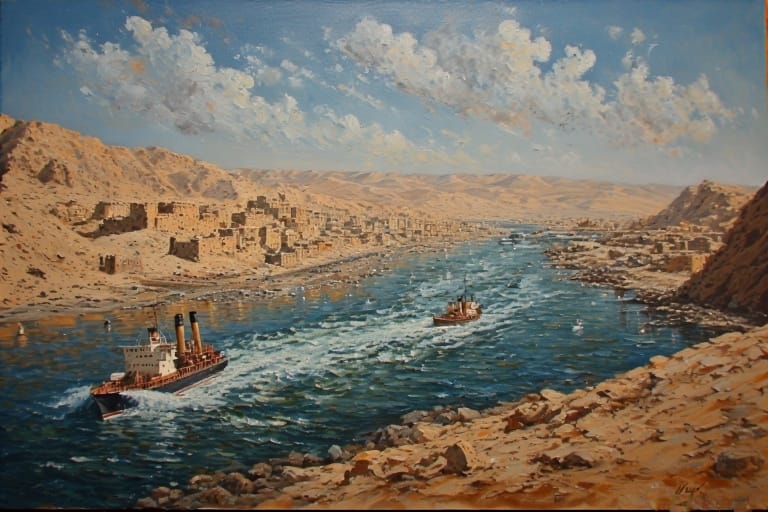
The Suez Canal began as an audacious dream scratched across maps by French engineers and imperial strategists. In the mid-19th century, when the Ottoman Empire still nominally held sway over Egypt, the idea of cutting a waterway between the Mediterranean and the Red Sea was not new; pharaohs had once contemplated—and partially built—canals linking the Nile to the Red Sea. But the modern canal, championed above all by the French diplomat Ferdinand de Lesseps, promised something grander: a shortcut between Europe and Asia that could save ships some 7,000 kilometers by avoiding the long detour around the Cape of Good Hope.
In 1859, construction began under the banner of the Suez Canal Company, with labor supplied largely by Egyptian peasants subjected to corvée, a system of forced labor that sent thousands to the sands. They dug and dredged under the burning sun, often with little more than shovels and baskets. Cholera, exhaustion, and accidents took a heavy toll, but the project moved forward at a pace that astonished even its backers. When the canal finally opened in 1869, fireworks lit the desert sky, and the Empress Eugénie of France sailed in splendor along its waters. What had been a ribbon of sand became a new axis of world trade.
The strategic consequences were immediate. Britain, whose steamships bound for India and beyond now had a vastly shorter route, quickly grasped the canal’s importance. In 1875, when the financially strapped Khedive Ismail of Egypt sold his shares in the Suez Canal Company, it was the British government that stepped in to buy them. Within a few years, British influence had hardened into direct control. The canal was no longer merely a commercial venture; it had become, in the words of one British statesman, “the jugular vein of the Empire.”
Traffic numbers tell part of the story. By the early 20th century, thousands of ships each year were passing through Suez, carrying everything from Indian cotton and Australian wool to Asian spices and Persian Gulf oil. Each vessel that cut through the canal knotted Egypt more tightly into global networks—and tied Egyptian sovereignty to foreign interests. The waterway’s slender outline on maps concealed the weight of the politics aboard the ships that sailed it.
For many Egyptians, the canal was both a source of pride and a wound. It demonstrated the country’s centrality to global trade while highlighting its subordination to foreign powers. Port towns along the route—Port Said in the north, Ismailia in the middle, Suez in the south—became cosmopolitan enclaves, filled with European managers, Levantine merchants, and Egyptian laborers whose lives intersected in the markets and along the docks. Yet decisions about tariffs, security, and investment were made in London and Paris, not Cairo.
It is astonishing, isn’t it, how a simple trench of water could become the fulcrum on which empires turned? That tension between geography and power between local land and global ambition would shape everything that followed, including the chain of events that one day made the phrase “suez canal reopens 1975” meaningful at all. The 19th-century canal was an engineering marvel; the 20th-century canal would become a political powder keg.
Empire, Nationalism, and the Road to the Suez Crisis
By the first half of the 20th century, the canal’s importance deepened as oil began to supplant coal. Tankers carrying Middle Eastern crude used Suez as a vital corridor to European refineries. With every loaded ship that passed, British and French dependence on the canal grew, even as their imperial grip on the region began to loosen. In Egypt, nationalist movements gained strength, railing against foreign control and the visible symbol of it: the Suez Canal Zone, where British troops were stationed as if on their own land.
After World War II, as decolonization swept across Asia and Africa, the canal began to look increasingly anachronistic as a foreign-run strip of territory. In 1952, a group of young Egyptian military officers, including Gamal Abdel Nasser, overthrew King Farouk and eventually proclaimed a republic. Nasser, a fierce advocate of pan-Arabism and independence from Western domination, saw the canal not only as a source of revenue but as a matter of national dignity.
The confrontation was inevitable. In July 1956, after the United States and Britain withdrew funding for his ambitious Aswan High Dam project, Nasser announced the nationalization of the Suez Canal Company. He delivered his speech in Alexandria, and when he reached the coded reference to the company—using the name of its founder “de Lesseps”—crowds roared in understanding. The canal would now be under Egyptian control, its revenues redirected to Egypt’s own development.
Britain and France, fearing the loss of their influence and financial stakes, conspired with Israel to retake the canal by force. The result was the Suez Crisis of 1956. Israeli forces invaded Sinai, and British and French troops followed under the pretext of separating the combatants and securing the canal. Militarily, they performed well; diplomatically, they suffered a humiliating defeat. The United States and the Soviet Union, rivals in all else, both pressured the European powers to withdraw. Under intense international scrutiny, the British and French pulled back, and Egypt emerged with control of the canal intact.
The Suez Crisis left deep marks. It signaled the end of Britain and France as unquestioned global powers and elevated Nasser as a hero in the Arab world. It also introduced a new era in which the canal’s fate would be closely tied to the Arab–Israeli conflict and the Cold War. Although traffic resumed and the canal remained open in the following decade, the balance around it had shifted. It was no longer a colonial artery to be guarded from Cairo; it was a nationalist symbol to be defended at any cost. That mindset would have drastic consequences in 1967, when war returned to the Sinai and the canal’s waters turned from trade route to front line.
War on the Banks: The 1967 Six-Day War and the Sudden Closure
In June 1967, tension along Israel’s borders with Egypt, Jordan, and Syria escalated into open conflict. The Six-Day War was brief but transformative. Israeli forces, launching preemptive strikes, swiftly destroyed much of the Egyptian Air Force on the ground and advanced across the Sinai Peninsula. In less than a week, Israel seized Gaza, Sinai, the West Bank, East Jerusalem, and the Golan Heights. For Egypt, the defeat was shattering; for the Suez Canal, it was catastrophic.
As Israeli forces reached the eastern bank of the canal, the waterway instantly became a front line. Egyptian authorities reacted in the only way they believed they could: they closed the canal to navigation. To prevent its use by an enemy or as a vulnerability, they scuttled ships, laid mines, and allowed wreckage to accumulate. Vessels that happened to be in the canal at the moment of closure found themselves stranded. Fourteen foreign ships—German, British, Polish, Swedish, Czechoslovak, American, Bulgarian, and others—became hostages of geography, trapped in the Great Bitter Lake.
The closure was more than a temporary disruption. The canal, which had carried roughly two-thirds of Europe’s oil imports from the Middle East, now lay silent. Ships were forced to sail around the Cape of Good Hope, adding weeks to journeys and multiplying costs. Insurance premiums soared; freight rates followed. According to some contemporary estimates, shipping costs on certain routes increased by more than 30 percent, reshaping global trade patterns almost overnight.
On the canal’s western bank, Egyptian soldiers dug trenches and fortified positions. On the eastern bank, Israeli troops did the same. The water between them, once reflecting only the wake of ships and the glint of sun on steel, now mirrored barbed wire and artillery batteries. The suez canal reopens 1975 might someday be a headline, but in 1967 it was inconceivable. The canal was too valuable a military boundary—too saturated with symbolic meaning—to be anything other than a line of confrontation.
Civilians paid the price. Towns like Suez and Ismailia, which had thrived on the movement of ships and workers, fell within artillery range and were progressively evacuated or damaged. Households that had lived for generations within sight of the canal found themselves scattered across Egypt, refugees within their own country. The canal zone, once noisy with commerce, began its long slide into a haunted quiet, broken only by the sharp thunder of guns.
The Canal Turned Battlefield: The War of Attrition and Global Shockwaves
After the guns of June 1967 fell silent, neither Egypt nor Israel accepted the new status quo. President Nasser refused to concede the loss of Sinai; Israeli leaders, though victorious, were wary of holding territory under constant threat. In this uneasy limbo, the Suez Canal became the stage for a new kind of conflict: the War of Attrition, fought from 1968 to 1970.
Artillery duels, commando raids, and air strikes became routine along the canal. Egyptian forces, aided by Soviet advisers and anti-aircraft systems, sought to bleed Israel’s hold on the eastern bank by constant pressure. Israel replied with devastating air raids deep into Egyptian territory, including near Cairo. The canal zone turned into one of the most militarized strips of water in the world. Each exchange destroyed more infrastructure, killed more civilians, and made the prospect that suez canal reopens 1975 could ever occur seem more like fantasy than future.
Yet behind the shelling, international anxiety grew. The canal’s closure was already reshaping global logistics. Oil tankers, increasingly built to supertanker dimensions that the original canal could barely accommodate, rerouted around Africa. Some shipping companies adapted, others faltered. The closure contributed to volatility in oil markets, even before the 1973 oil crisis, by tightening supply lines and encouraging producers to rethink destinations.
Diplomatic efforts faltered amid the gunfire. United Nations ceasefire proposals came and went. Civilians remained in exile from the canal cities, watching newsreels that showed their streets as rubble-strewn ruins. According to one estimate cited by contemporary observers, more than a million Egyptians were displaced from the canal region during these years, their lives suspended while the world’s most strategic waterway lay effectively dead.
In 1970, exhausted and under pressure, both sides accepted a ceasefire brokered by the United States and other international actors. Nasser died shortly thereafter, and Anwar Sadat rose to the presidency. The guns grew quieter, but they did not vanish, and the canal remained closed, heavily mined and lined with fortifications. It was, in a sense, a hostage to its own importance: too valuable to abandon, too dangerous to reopen.
Sunken Steel and Silent Waters: The Ghost Years of the Blocked Canal
Between 1967 and 1975, the Suez Canal existed in a peculiar limbo. It was neither alive nor dead, neither fully battlefield nor merely waterway. Those who visited it during the early 1970s described an eerie landscape: rusted wrecks protruding from the surface, sand drifting across abandoned roads, and the hulks of the trapped “Yellow Fleet” ships moored in the Great Bitter Lake, slowly coating themselves in the region’s famous dust.
The fourteen stranded ships formed an accidental community. Their crews, initially expecting a short delay, soon realized they were in for a long wait. They organized their own postal system, the “Great Bitter Lake Association,” issued makeshift stamps, and shared supplies. Sailors from different nations celebrated holidays together, repaired each other’s vessels, and watched the world change from a sliver of contested water in Egypt. Their story has been recounted in memoirs and articles, a strange, almost surreal human subplot to the larger geopolitical standoff.
Onshore, the canal cities languished. Factories idled, shops closed, and whole neighborhoods stood empty. In Suez, bombardment had left large swaths of the town in ruins. Families displaced from the canal zone often lived in temporary housing or crowded apartments in Cairo and other cities, waiting for word that it was safe to return. For them, the phrase “when the canal reopens” was less about global trade and more about the chance to go home.
Environmentally, the canal suffered as well. Sunken ships leaked oil and fuel. Unexploded ordnance, mines, and debris littered the banks and the channel. Military engineers on both sides had dug trenches, built bunkers, and left behind a deadly legacy of munitions that would complicate any future attempts at reopening. Each passing year made the task more daunting, and yet also more urgent, because the longer the canal stayed closed, the more the world adjusted to life without it.
By the early 1970s, some shipping lines had fully recalibrated their routes, building larger tankers specifically for longer voyages around Africa. In a sense, the world was hedging its bets: if the suez canal reopens 1975 or at any time, the shortcut would be welcome, but it could no longer be taken for granted. For Egypt, this was an intolerable situation. The canal was not simply a potential revenue stream; it was a symbol of national standing and a geographic advantage that could not be left dormant.
Still, war had one more act to play out along the canal before the waterway could return to life. The October 1973 conflict, known in Israel as the Yom Kippur War and in the Arab world as the October War, would fundamentally reshape the strategic landscape and set the stage for the bold decision that suez canal reopens 1975 would encapsulate.
Diplomacy in the Shadow of War: From 1973 to the Hope of Reopening
On 6 October 1973, as many Israelis observed Yom Kippur, Egyptian and Syrian forces launched a coordinated surprise attack on Israeli positions in Sinai and the Golan Heights. Along the Suez Canal, Egyptian troops crossed the water under cover of massive artillery barrages, breaching the Bar Lev Line of Israeli fortifications. In the early days of the war, Egypt’s success electrified the Arab world and restored a sense of pride badly damaged in 1967.
Israel, stunned at first, mobilized and pushed back. After intense battles, Israeli forces crossed the canal in the opposite direction, establishing a bridgehead on its western bank and threatening Cairo. Superpower involvement deepened as the United States airlifted supplies to Israel and the Soviet Union supported its Arab allies. The threat of broader war loomed. A United Nations–brokered ceasefire eventually halted the fighting, but not before the conflict sparked the 1973 oil embargo by Arab members of OPEC, triggering an energy crisis in the West.
For the Suez Canal, the war was both a curse and a catalyst. Fighting further damaged the canal zone and its infrastructure. Yet the conflict also forced all parties to confront the unsustainable nature of the stalemate. Sadat, who had launched the war partly to break the diplomatic deadlock, now positioned himself as a partner in peace negotiations. Through the mediation of U.S. Secretary of State Henry Kissinger and others, a series of disengagement agreements were reached between Egypt and Israel in 1974 and 1975, pulling forces back from the canal’s immediate vicinity.
One central question soon emerged: could the canal be reopened as part of the new arrangements? For Egypt, reopening offered clear benefits: toll revenues, economic revival of the canal cities, and a powerful signal that sovereignty and normalcy were returning. For Israel, the canal’s reopening would not automatically confer advantage, but the broader diplomatic package—security guarantees, phased withdrawals, and a reorientation of Egypt’s alliances—was more compelling.
Internationally, there was eager support. Western nations, stung by the oil embargo and the shock of the energy crisis, had every interest in stabilizing Middle Eastern trade routes. The Soviet Union, too, saw potential advantages in a reopened canal that could facilitate its naval presence and trade. UN agencies and naval experts began to draft plans for what would become an unprecedented clearance operation: the removal of mines, wrecks, and hidden dangers from a 190-kilometer-long war-scarred channel.
When Sadat declared in 1974 that he intended soon to reopen the canal, many were skeptical. The physical obstacles alone were daunting, and the political risks high. But the determination in Cairo was real. The suez canal reopens 1975 was not merely a slogan for press conferences; it was a target date that focused the efforts of engineers, soldiers, and diplomats from multiple countries. The canal, once a symbol of colonial subjugation and war, was about to test whether it could also be an instrument of cautious peace.
Operation Nile Clear: Minesweepers, Divers, and the Great Cleanup
The operation to prepare the Suez Canal for reopening was as much an act of reconstruction as any postwar rebuilding of a city. Though less visible to the world’s cameras, it demanded a similar blend of courage, expertise, and international cooperation. The channel was littered with sunken vessels, unexploded ordnance, mines, and the skeletal remains of bridges and fortifications. Clearing it required not just machines, but human beings willing to descend into murky, dangerous water.
Egypt called upon both its own forces and foreign partners. The United States, the Soviet Union, the United Kingdom, France, and others contributed equipment, minesweepers, and technical advice. It was an unusual convergence: Cold War rivals cooperating—albeit cautiously—on the same project. According to one U.S. Navy account, American minesweepers and explosive ordnance disposal teams worked alongside Egyptian personnel to detect and neutralize mines laid over the course of several conflicts. Soviet advisers, who had played a major role in Egypt’s military during the War of Attrition, also provided vital assistance.
Divers faced near-zero visibility and shifting silt. Every object they touched could be harmless debris—or a live explosive. Many of them were young men who had grown up hearing about the canal as a site of national humiliation and resistance; now they risked their lives to make it a site of commerce again. They worked long hours, often with minimal recognition, aware that a single mistake could cost not only their lives but potentially the safety of future convoys.
Above the surface, salvage teams used cranes, barges, and tugboats to raise the carcasses of sunken ships and military hardware. Some wrecks were too damaged to repair; they were cut into sections and removed piece by piece. Others were refloated and towed away, silent reminders of battles fought years earlier. Satellite imagery and aerial reconnaissance aided planning, but the final judgment always came down to those on the water and under it.
By early 1975, the channel was declared navigable. Test runs, hydrographic surveys, and trial passages confirmed that large ships could once again pass safely. Each successful trial was a small rehearsal for the moment when the world would watch, when suez canal reopens 1975 would cease to be a working phrase among engineers and become a headline for the global public. The final decision now rested in the hands of Egypt’s leadership, whose eyes were fixed on a symbolic anniversary.
5 June 1975: The Day the Suez Canal Reopened to the World
The date was not chosen at random. On 5 June 1967, the Six-Day War had begun, leading to the closure of the canal and a profound Egyptian defeat. By reopening the canal exactly eight years later, on 5 June 1975, President Sadat intended to overwrite the memory of loss with one of renewal. History, he believed, could be answered with history.
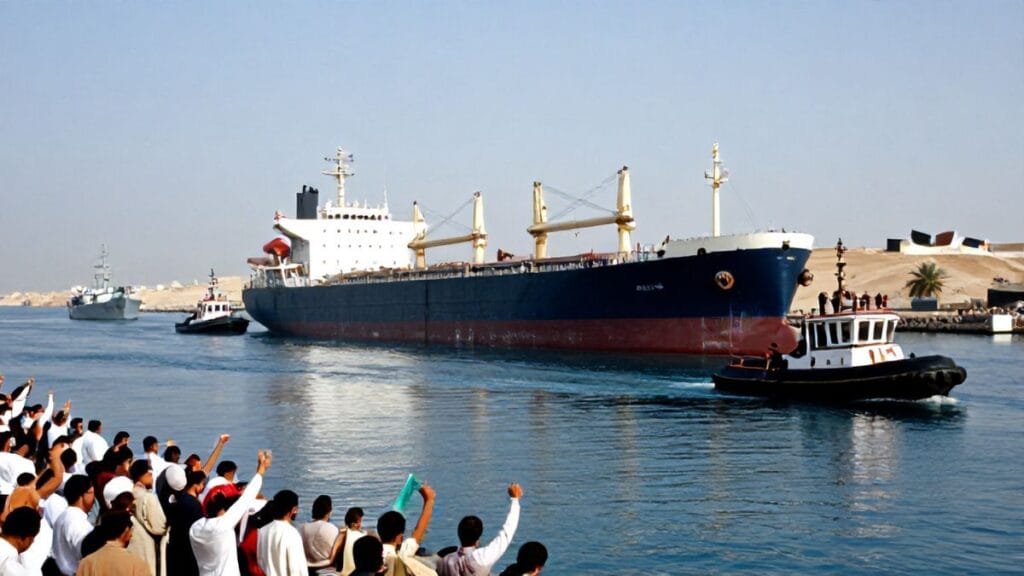
That morning, under a bright Egyptian sun, ceremonies unfolded along the canal. Flags snapped in the breeze; military bands played; delegations from around the world gathered. Television cameras framed the scene for audiences on multiple continents. Sadat, dressed in a civilian suit that underlined his role as statesman rather than general, stood as the central figure. When he signaled the official reopening, cheers rose from the gathered crowds, mingling with the horns of ships preparing to move.
The first convoy, a carefully selected group of vessels representing different nations, began its journey. As they glided into the canal’s northern entrance at Port Said and proceeded southward, sailors lined the rails, waving at people onshore. Some Egyptians watched with tears in their eyes. For those who had lived through bombardments, displacement, and years of uncertainty, the sight of ships moving peacefully through the canal was almost surreal.
International observers were quick to emphasize the broader significance. One American journalist wrote that “for the first time in nearly a decade, the shortest sea route between Europe and Asia is open, and the world’s arteries of commerce feel the pulse quicken.” An Egyptian commentator, quoted in the local press, declared that “today we have turned a page in blood and written in water and trade.” The suez canal reopens 1975 became a phrase appearing in newspapers from Cairo to New York, shorthand for a rare good-news story in a region too often associated with conflict.
But behind the celebrations lay caution. The canal was open, but the Arab–Israeli conflict was far from resolved. Peace negotiations were ongoing, and the political future uncertain. Sadat himself understood that the reopening was a step in a longer journey, not a final destination. Nonetheless, he seized the day as an opportunity to pivot Egypt away from permanent war footing and toward a vision of economic development and international engagement.
Ships, Flags, and Cameras: Inside the First Convoy Through the Reborn Canal
For the sailors aboard the first convoy, the reopening was a mixture of ceremony and routine. They had cargoes to deliver, timetables to meet, and navigation to manage—yet they were also participants in history, framed by television cameras and diplomatic rhetoric. On the bridge of one European cargo vessel, the captain reportedly kept two logs that day: an official one for the ship and an informal one noting every detail of the passage, from the weather to the exact moment the Egyptian flag saluted his vessel from the shore.
The convoy moved slowly, escorted by tugs and monitored by pilots who had spent months studying the newly surveyed channel. Every bend, every narrowing, was approached with care. Though the mines had been cleared and wrecks removed, caution remained the watchword. Along the banks, Egyptian soldiers stood at ease rather than with weapons raised, a subtle but powerful reversal of the previous decade’s imagery.
Crew members described a mixture of solemnity and relief. Some had sailed the canal before its closure, in the 1950s or early 1960s, and remembered bustling ports and crowded anchorages. Comparing those memories with the 1975 landscape—still bearing scars of war, with many buildings damaged or half-rebuilt—was jarring. Yet the very presence of the convoy signaled that the long ghost years were ending.
News agencies captured iconic images: the lead ship cutting through calm water with Egyptian flags flying, Sadat saluting from the deck of a yacht, workers waving from repaired quays. These images fed into a global narrative that, for a brief moment, allowed optimism to overshadow cynicism. In boardrooms and ministries thousands of kilometers away, planners adjusted their calculations. The suez canal reopens 1975 was no longer a forecast but a reality, and schedules, cost models, and even ship designs would have to adapt.
One shipping executive later recalled, in an interview cited by historians, that “the reopening changed everything overnight—routes, insurance, fuel consumption, even the way we thought about the size of ships. Suez coming back was like opening a door we’d started to think might stay closed forever.” For Egypt’s canal pilots, the day was also deeply personal: it meant the return of their profession, their daily dance with currents, wind, and steel giants in narrow waters.
Egypt’s Gamble and Glory: Sadat’s Vision for a New Era
Reopening the canal was not simply a technical achievement; it was a political gamble by Anwar Sadat. In choosing to clear and reopen the waterway, he signaled a willingness to move beyond the posture of permanent confrontation that had defined much of Nasser’s era. He also took a calculated risk that economic strength and international partnerships could serve Egypt’s interests more effectively than a state of frozen war.
Sadat’s broader strategy, often summarized as the “Open Door Policy” (Infitah), aimed to attract foreign investment and liberalize parts of Egypt’s economy. The canal, in this vision, was a central asset. Its toll revenues could support national development; its operation could anchor Egypt within global trade networks; its very existence, humming with daily traffic, would demonstrate that Egypt was a reliable partner rather than an unpredictable battlefield.
At the same time, Sadat had to manage domestic expectations and regional perceptions. Many Egyptians still saw Israel as an occupying power in Arab lands. To reopen the canal while Israeli forces were still present in parts of Sinai required careful diplomacy. The disengagement agreements, verified by UN observers, created a buffer that made the reopening politically palatable, but not without controversy. Some critics argued that Sadat was moving too quickly toward accommodation; others feared that without reopening the canal, Egypt’s economy would continue to suffocate.
Sadat’s later decision in 1977 to visit Jerusalem and address the Israeli Knesset would overshadow, in popular memory, the reopening of the canal two years earlier. Yet the canal’s reopening laid crucial groundwork. It signaled to the world—and to Sadat’s own people—that Egypt could take bold, unilateral steps to reshape its destiny. When historians cite turning points in modern Middle Eastern diplomacy, they often mention Sadat’s Jerusalem visit and the Camp David Accords. But as one scholar noted, “the path to Camp David ran along the banks of a reopening Suez.”
Port Cities Reborn: Ismailia, Suez, and Port Said After the Silence
While diplomats and shipping magnates assessed the reopening in terms of treaties and tonnage, ordinary Egyptians along the canal experienced it as the return of life to their streets. In Port Said, Ismailia, and Suez, the years of closure had left deep wounds: bombed-out buildings, broken infrastructure, and the intangible damage of years lived in fear and exile. The reopening did not magically erase these scars, but it created the conditions for return.
Families who had fled artillery shelling began to come back, sometimes finding their homes destroyed or occupied, sometimes discovering them miraculously intact but cloaked in dust and silence. Schools reopened, markets slowly revived, and new construction projects sprang up. The state invested in rebuilding and expanding port facilities, eager to handle the renewed flow of ships. Jobs returned for dockworkers, pilots’ assistants, mechanics, and countless others whose livelihoods depended on the canal.
The social fabric, however, was not easily re-woven. Years of displacement had reshaped communities. Some who had found work or relative stability in Cairo or Alexandria hesitated to uproot their families again. Others returned with a sense of mission, determined to restore their cities’ former vibrancy. Stories circulated of neighbors helping each other clear rubble, repaint façades, and reopen shuttered shops. The sense that “the canal is back” offered an emotional anchor, a reason to believe that the sacrifices of the past years had not been entirely in vain.
For children born during the years of closure, the sight of ships passing daily was something new and hypnotic. They grew up with the reopened canal as a backdrop, its steady traffic a reminder that their hometowns, once emptied and bombarded, were again connected to the wider world. Some of those children would later become canal workers themselves, inheriting a relationship with the waterway that was part profession, part identity.
The reopening also brought a more complex cultural change. With foreign ships and crews once again docking in Egyptian ports, local communities encountered new languages, goods, and customs. Cafés that had been half-empty now filled with the hum of multiple tongues. For some, this cosmopolitan revival recalled the pre-1956 era; for others, it represented a new and more balanced form of connection, occurring under Egyptian sovereignty rather than colonial oversight.
Oil, Trade, and the Cold War: Global Consequences of the Reopening
On the global stage, the reopening of the Suez Canal in 1975 recalibrated more than just shipping charts. It altered the arithmetic of world trade at a moment when energy politics were already in flux. The 1973–1974 oil crisis had demonstrated the vulnerability of industrial economies to disruptions in Middle Eastern supply. By restoring the shortest route between producers in the Gulf and consumers in Europe, the canal reduced shipping times and costs, easing some pressures on energy markets.
Quantitatively, the change was stark. For a tanker traveling from the Persian Gulf to Western Europe, the Suez route could shave off around 4,300 to 5,000 nautical miles compared to rounding the Cape of Good Hope—often a difference of 10 to 15 days, depending on speed and conditions. Fuel consumption fell accordingly, and fleets could be deployed more efficiently. Container shipping, which was rapidly expanding during the 1970s, benefited as well; the canal offered a key link in emerging Asia–Europe supply chains.
Cold War strategists also took note. For the Soviet Union, which maintained a naval presence in the Indian Ocean and Mediterranean, a reopened canal offered both opportunities and challenges. The U.S. Navy likewise evaluated how the canal’s availability would affect its ability to shift fleets between theaters. While military transit through the canal remained subject to Egyptian control and political constraints, its mere existence as an option changed the calculus in crisis planning.
Insurance companies and shipping consortia revised their models, adjusting premiums for routes that now passed once more through Suez. Ports like Rotterdam, Piraeus, and Marseille recalibrated schedules and capacities to handle altered traffic patterns. The suez canal reopens 1975 thus became embedded in spreadsheets and strategic memos as much as in speeches and headlines. The canal’s daily throughput of millions of tons of cargo was both symbol and substance: a measurable index of how a narrow geographic corridor could influence the flow of global capitalism.
At the same time, the reopening did not eliminate all vulnerabilities. The canal remained chokepoint, susceptible to political upheaval, conflict, or even accidents. In that sense, 1975 did not resolve the tension between dependence and risk; it simply restored an old pattern under new conditions. The world, grateful for the shortcut, once again accepted the gamble that came with it.
Lives on the Waterway: Sailors, Pilots, and Families Remember 1975
History often records events like the reopening of the Suez Canal in the language of leaders and statistics, but its truest texture lies in the memories of those who lived it. Egyptian canal pilots who returned to work in 1975 remember a mix of pride and apprehension. One pilot later recalled in an oral history project that “the first time I took a big tanker through after the reopening, my hands were steady on the controls, but my heart was racing. We knew every meter of that water, but it felt like a different canal after the war.”
Dockworkers talked about the first time they saw port cranes moving again after years of rust. Some described the reopening in almost spiritual terms, as if a beloved relative had awoken from a long coma. Families who had lost members in the wars of 1967, 1969–1970, and 1973 felt the day with bittersweet intensity. The canal that reopened was, for them, also a vast grave, its banks echoing with the absent voices of sons, brothers, and fathers.
Foreign sailors, too, carried vivid impressions. Crewmembers who had been part of the “Yellow Fleet” sometimes returned in later years, docking once more at ports they had known only as distant shores during their enforced anchorage in the Great Bitter Lake. Their stories of building makeshift clubs, staging sailing regattas with lifeboats, and celebrating multinational Christmases during the closure stand in poignant contrast to the efficient transits of the reopened era.
Local shopkeepers remembered the awkward first months, when returning residents and new arrivals mingled under half-rebuilt shopfronts. Some businesses took the canal’s reopening as a cue to modernize, importing new goods and adopting new practices. Others clung to older ways, selling the same staples that had sustained canal workers since the early 20th century: strong tea, simple meals, spare parts, and stories.
These personal recollections, preserved in interviews, memoirs, and local histories, remind us that suez canal reopens 1975 was not only an economic or diplomatic marker. It was an inflection point in thousands of individual lives, a moment when people had to adapt again—to movement after stasis, to normalcy after emergency, to hope after long years of hardened expectations.
Memory, Monuments, and Myths: How History Remembers the Reopening
With time, the 1975 reopening of the Suez Canal has taken on a layered place in Egyptian and international memory. In Egyptian schoolbooks, it is often presented as one in a series of national achievements under Sadat, alongside the partial military success of October 1973 and the later peace treaty with Israel. Photographs of the first convoy and Sadat’s speeches appear in commemorative volumes, reinforcing the narrative of recovery and forward movement.
Monuments along the canal, including memorials to fallen soldiers and plaques marking key events, weave the reopening into a broader story of sacrifice and redemption. Local museums in canal cities display artifacts from both the construction of the canal in the 19th century and its wars and closure in the 20th. Visitors can see rusted shell casings, faded uniforms, and sometimes fragments of the ships that once lay sunken in the channel.
Internationally, the reopening has often been overshadowed by more dramatic episodes: the 1956 Suez Crisis, the 1967 war, the 1973 conflict, and the Camp David accords. Yet among maritime historians and economists, 1975 stands as a watershed. As one maritime historian wrote, “the reopening of the Suez Canal in 1975 was the quiet hinge on which a new phase of globalization turned.” Her observation captures the paradox: an event both highly publicized at the time and somewhat underappreciated in long-term public consciousness.
Myths and simplifications have inevitably crept in. Some popular accounts condense the closure years into a blur, ignoring the complex lives of those in the canal zone or the Yellow Fleet. Others portray the reopening as an almost inevitable step once the wars subsided, downplaying the technical difficulty and political courage it required. A more nuanced understanding, supported by archival research and eyewitness testimony, restores contingency to the narrative: things could have gone differently; the canal might have remained closed much longer, or reopened under more fragile conditions.
In this sense, recalling that suez canal reopens 1975 is not just a date but a contested memory helps us see how history is constantly curated and reinterpreted. Each anniversary, each new diplomatic crisis, casts the reopening in a slightly different light—sometimes as a model of pragmatic compromise, sometimes as a reminder of unresolved tensions that still roil the region.
From 1975 to the Present: Upgrades, Crises, and the Canal’s Living Legacy
From the vantage point of the 21st century, the 1975 reopening stands at the midpoint of the Suez Canal’s evolving story, not its end. In the decades that followed, Egypt undertook significant expansions and upgrades, deepening and widening the channel to accommodate larger ships and greater traffic. The canal became a pillar of the national economy: toll revenues contributed billions of dollars, funding infrastructure, social programs, and, at times, military spending.
In 2015, another major expansion—sometimes referred to as the “New Suez Canal”—was inaugurated, adding a parallel waterway along part of the route to allow for two-way traffic in key sections. Once again, ceremonies and speeches portrayed the canal as the lifeline of Egypt’s future, echoing the rhetoric of 1975. The continuity is striking: both projects, forty years apart, were attempts to harness geography for modern economic imperatives, framed in the language of national pride.
The canal has also faced new kinds of crises. Piracy in the Gulf of Aden and off the Somali coast in the late 2000s and early 2010s raised security concerns. Regional instability, from the Iranian–Iraqi tensions to unrest in the Sinai, periodically heightened fears about the canal’s safety. Most dramatically for global audiences, the temporary blockage of the canal in March 2021 by the container ship Ever Given reminded the world once more of the vulnerability of this narrow thoroughfare. For six days, as the massive vessel lay wedged across the waterway, news outlets revisited the canal’s history, and some commentators drew direct lines back to 1975 and earlier closures.
These episodes underline a recurring truth: when suez canal reopens 1975 entered the historical record, it did not solve the fundamental tension between dependence on a chokepoint and the risks inherent in that dependence. Instead, it reactivated the canal as a central element in a world economy whose speed and interconnection have only increased since the 1970s. Today, roughly 10–12 percent of global trade is estimated to pass through Suez, including a significant share of the world’s container traffic and energy shipments.
For Egyptians living along the canal, the waterway remains both backdrop and protagonist in their daily lives. Children still stand on shores, counting stacked containers as ships move slowly by. Workers rotate through shifts on dredgers and patrol boats. Pilots climb rope ladders thrown over the sides of towering vessels to guide them through narrow bends. The canal is no longer the haunted, silent frontier it was before 1975; it is instead a living, humming corridor whose past tragedies and triumphs still whisper beneath the sound of diesel engines and the slap of wakes against concrete banks.
Conclusion
When the Suez Canal reopened on 5 June 1975, the world briefly paused to watch a stretch of water that had been the stage for empires, wars, and dreams. The event condensed a century of history—colonial construction, nationalist revolt, Cold War confrontation, and local resilience—into a single, symbolic gesture: ships moving again where guns had once roared. To say “suez canal reopens 1975” is to invoke not just a logistical adjustment in shipping routes, but a turning point in how Egypt and the wider world chose to move from confrontation toward cautious interdependence.
The reopening was made possible by the labor of thousands: divers neutralizing unseen mines, engineers raising twisted steel from the depths, displaced families rebuilding homes on scarred streets, and diplomats bridging divides that had seemed unbridgeable. It unfolded against a backdrop of unresolved conflict and fragile peace, which means that its success was never guaranteed. That it held, that the canal has remained open through subsequent crises, is a testament to both hard-headed calculation and a shared recognition of mutual dependence.
Looking back from today’s vantage point of dense global trade and instant communication, the 1975 reopening appears as an early chapter in the story of modern globalization. It reconnected oceans and markets at a moment when the world was still reeling from oil shocks and ideological rivalries. At the same time, it reinforced an enduring lesson: that the infrastructures binding the world together—canals, cables, pipelines—are as vulnerable as the politics and people that surround them.
If there is a final image that captures the significance of that June day, it is perhaps not the official ceremony but the quiet sight of water parting before the bow of the first ship, ripples carrying outward toward shores lined with people who had waited years to see such a simple movement again. In that moment, history did not end; it flowed. And along the banks of Suez, a line long associated with division once more became a channel of connection.
FAQs
- Why was the Suez Canal closed before it reopened in 1975?
The canal was closed after the June 1967 Six-Day War, when Israeli forces reached its eastern bank and it became a front line between Egypt and Israel. For security reasons, Egypt blocked the waterway, scuttling ships and laying mines. Subsequent fighting during the War of Attrition (1968–1970) and the October 1973 war further damaged the canal, making it unsafe for navigation until a major clearance and reconstruction effort was completed. - What is meant by the phrase “suez canal reopens 1975”?
It refers to the official reopening of the Suez Canal to international shipping on 5 June 1975, after being closed for eight years due to Arab–Israeli wars. The date marked the restoration of a critical trade route between Europe and Asia and symbolized a broader shift in Egyptian policy from continuous confrontation to cautious engagement and economic recovery. - How long was the Suez Canal closed before 1975?
The canal was closed from June 1967 until June 1975, a period of roughly eight years. During this time, a group of ships known as the “Yellow Fleet” remained trapped in the Great Bitter Lake, while the canal zone became heavily militarized and suffered significant damage from artillery duels and air strikes. - Who played key roles in reopening the Suez Canal?
Egyptian President Anwar Sadat was the central political figure behind the decision to reopen the canal, linking it to broader peace and economic reforms. On the technical side, Egyptian engineers, soldiers, and divers worked alongside foreign experts and navies from countries such as the United States, the Soviet Union, the United Kingdom, and France to clear mines, remove wrecks, and make the canal safe for navigation. - What impact did the reopening have on global trade?
The reopening significantly reduced travel times and costs for ships moving between Europe and Asia, especially oil tankers and container vessels. It restored the shortest sea route between the Persian Gulf and European ports, easing pressure on energy markets and reshaping shipping patterns that had been forced to reroute around the Cape of Good Hope for eight years. The canal’s return to operation became a cornerstone of the expanding global trade system of the late 20th century. - How did the reopening affect people living in the canal cities?
For residents of Port Said, Ismailia, and Suez, the reopening allowed many displaced families to return home, rebuild damaged neighborhoods, and regain employment linked to port and canal operations. It brought back economic activity, revived local markets, and restored a sense of connection to the outside world. However, the process of social and physical reconstruction took years, as communities struggled to overcome the traumas and losses of war and displacement. - Is the Suez Canal still important today?
Yes. Today the Suez Canal carries an estimated 10–12 percent of global trade, including a major share of the world’s container traffic and energy shipments. Its importance was highlighted again during the 2021 Ever Given incident, when a single grounded ship temporarily blocked the canal and disrupted supply chains worldwide, echoing earlier reminders of how critical—and vulnerable—this narrow corridor remains.
External Resource
Internal Link
Other Resources
- Encyclopaedia Britannica – general search for the exact subject
- Google Scholar – academic search for the exact subject
- Internet Archive – digital library search for the exact subject