Table of Contents
- Storm over Flanders: Setting the Stage for a Summer of War
- After the Golden Spurs: A Kingdom Humiliated
- Flanders in Revolt: Weavers, Merchants, and Militia
- Kings and Counts: Philip IV, Robert of Béthune, and Their World
- Toward Mons-en-Pévèle: The Road to the 1304 Campaign
- Armies on the Move: Who Fought at Mons-en-Pévèle?
- The Landscape of Battle: Why Mons-en-Pévèle Mattered
- The Morning of 18 August 1304: Tension before the Storm
- Clash of Lines: The First Assaults on the Flemish Infantry
- Crisis in the French Camp: The King Almost Taken
- Twilight Counterstroke: From Flemish Advance to Sudden Rout
- Counting the Dead: Casualties, Captives, and Survivors
- From Battlefield to Treaty Table: Paving the Way to Athis-sur-Orge
- Winners, Losers, and Something in Between: Who Really Prevailed?
- The Long Shadow over Flanders: Cities, Trade, and Power after 1304
- Memory and Myth: How Chroniclers Told the Story
- The Battle of Mons-en-Pévèle in the Larger Arc of Medieval Warfare
- Echoes across Centuries: Nationalism, Identity, and Commemoration
- Conclusion
- FAQs
- External Resource
- Internal Link
Article Summary: On a hot August day in 1304, near the modest rise of Mons-en-Pévèle, the fate of Flanders and the prestige of the French crown collided in a violent and chaotic struggle. This article traces the deep roots of the conflict, from the social tensions in Flemish cities to the humiliating French defeat at Courtrai, leading inexorably to the battle of mons-en-pévèle. Through a cinematic reconstruction of the march, the camp, and the clash of arms, we follow the ordinary weavers and hardened knights who turned the fields of Pévèle into a charnel house. We explore how the battle wavered between Flemish triumph and French disaster before turning, suddenly and brutally, in favor of King Philip IV. Yet behind the battlefield tactics lay questions of taxation, trade, and urban autonomy that would shape northern Europe for generations. The article examines how chroniclers, later historians, and nationalist movements recast the battle of mons-en-pévèle into legend. It also situates the engagement within the shifting realities of medieval warfare, where infantry and militia could now, at times, stand against royal cavalry. In the end, the battle of mons-en-pévèle emerges not as a simple French victory or Flemish defeat, but as a bitter, ambiguous turning point in the long, fraught relationship between crown and cities.
Storm over Flanders: Setting the Stage for a Summer of War
In the first years of the fourteenth century, the skies over northern France and Flanders seemed permanently overcast with the smoke of burned villages and the dust of marching armies. The region, a mosaic of fertile fields and industrious cities, lay at the crossroads of Europe. Wool from England, cloth from Ghent and Bruges, spices from the Mediterranean, silver from Germany—all of it passed through the markets and harbors of the County of Flanders. Yet beneath the prosperity, resentment simmered. It was here, amid warehouses and windmills, that the battle of mons-en-pévèle would one day erupt and leave an indelible scar on medieval memory.
The tensions pitted a powerful, centralizing monarchy—France under King Philip IV “the Fair”—against a turbulent, semi-autonomous principality ruled by the counts of Flanders but increasingly dominated by its cities. French kings had long considered Flanders both a fief and a treasure chest, a place to extract wealth, prestige, and military support. Flemish counts, meanwhile, struggled to balance their obligations to the crown with the demands of their subjects: guildsmen who had fought for and won a measure of civic independence and were loathe to see it eroded by distant rulers.
By 1304, these overlapping loyalties and grievances had boiled into war. The French monarchy was determined to erase a previous humiliation at the hands of Flemish infantry. The men of Flanders, fresh from an astonishing victory at the Battle of the Golden Spurs in 1302, were equally determined not to surrender their hard-won dignity and freedoms. Both sides marched toward Mons-en-Pévèle with the weight of past defeats and future hopes resting on their shoulders. What unfolded there was more than a clash of arms; it was a struggle over who would control the political and economic heart of northwestern Europe.
After the Golden Spurs: A Kingdom Humiliated
To understand why the battle of mons-en-pévèle was fought with such ferocity, one must first return to the bruising memory of Courtrai, 1302. On fields not far from the Lys, the flower of French chivalry had charged headlong into a nightmare. Expecting the usual triumph over disorganized foot soldiers, French knights found themselves ensnared in marshy ground, hemmed in by ditches, and beaten down by compact Flemish infantry formations armed with pikes, goedendags, and fierce determination. Over a thousand knights perished, and the battlefield was said to be littered with the golden spurs of the fallen French nobility.
In a world where the mounted knight embodied military superiority, the defeat at Courtrai was more than a military setback; it was a shock to the psychic order of Christendom. Chroniclers, often themselves close to noble patrons, wrote in pained tones of the disaster. The chronicle of Guillaume de Nangis, for example, lamented that “many of the greatest men of France were struck down by rustic hands.” The insult was clear: how could common townsmen humiliate a king’s knights?
Philip IV could not let this stand. His authority was already strained by conflicts with the papacy and the need to extract ever-greater revenues from his subjects. The memory of the Golden Spurs hung around his neck like a millstone. The French aristocracy, too, burned for revenge. Families who had lost fathers, brothers, and sons at Courtrai demanded satisfaction. Many saw in the future battle of mons-en-pévèle the chance to wash away the shame in Flemish blood.
Yet two years passed with no decisive showdown. Skirmishes, raids, sieges—yes. But the kingdom needed a reckoning on the scale of Courtrai, a chance for the royal army to reassert its dominance over the famed Flemish militias. That reckoning would come in 1304, when Philip IV assembled one of the largest armies of his reign and marched north, determined to bring Flanders to heel once and for all.
Flanders in Revolt: Weavers, Merchants, and Militia
On the other side of the frontier, the County of Flanders was anything but united. Its power lay above all in its cities—Bruges, Ghent, Ypres, Lille—hives of commercial activity where guild militias could be raised in alarming numbers. The men who fought at Mons-en-Pévèle were not professional soldiers in the strict sense. They were weavers and fullers, coopers and brewers, porters and small merchants. Yet they had a tradition of collective organization and a sense of civic pride that rivaled any baronial lineage.
The Flemish uprising that culminated in battles like Courtrai and later in the battle of mons-en-pévèle had deep roots. The population resented French interference in their affairs and the fiscal burdens imposed by both the French crown and their own count when he aligned with Paris. While the high nobility sometimes wavered between loyalty to king and county, the urban middle classes saw the struggle in starker terms: their privileges, their guild charters, their access to trade and justice were at stake.
In 1302, the killings of French partisans in Bruges—the notorious “Bruges Matins,” when locals allegedly tested suspects by asking them to pronounce difficult Flemish words—had signaled a point of no return. The subsequent victory at Courtrai gave the townsmen a ghostly confidence; they had brought down a chivalric army once, so why not again? Yet, by 1304, the mood was more complicated. War was expensive. Trade routes had been disrupted. Wheat prices had climbed. Wives and mothers, eyeing the makeshift spears and helmets of their menfolk, wondered if the next campaign would end as gloriously as the last.
Still, when the call went out to muster against a new French invasion, the cities responded. Contingents assembled, banners unfurled, and the ragged but formidable Flemish infantry once more tramped toward the horizon. They did not fight for an abstract idea of “Flanders” alone. They fought for Bruges and Ghent; for their guild halls; for the right to govern their own streets; and, not least, for revenge against a monarch whose officers had long treated them like rebellious servants rather than autonomous citizens.
Kings and Counts: Philip IV, Robert of Béthune, and Their World
The drama that led to Mons-en-Pévèle was not only a clash of social forces; it was also an intensely personal duel between rulers. On the one side stood Philip IV of France, tall, reserved, and unbending, a king whose sobriquet “the Fair” referred to his looks but whose political style was anything but gentle. He was a master of legalistic maneuver, using jurists as much as knights to expand royal power. On the other side, representing the rebellious Flemish forces in 1304, was Robert of Béthune, the eldest son of Guy of Dampierre, count of Flanders.
Robert, sometimes known as the “Lion of Flanders” in later romanticized retellings, had spent time as a prisoner of the French. His father’s earlier attempts to ally with England and to escape French overlordship had ended badly, with the count imprisoned and his territories partly occupied. For Robert and his followers, the war of the early fourteenth century was thus as much a fight to redeem family honor as to secure civic liberties.
The relationship between the two rulers’ houses had once been more cooperative. Flanders, in theory, was a vassal of the French crown, bound by feudal ties of homage. The count owed the king military assistance and counsel; the king, in turn, was meant to respect the internal autonomy of the county. By the late thirteenth century, however, the expansionist ambitions of the Capetian monarchy and the volatile politics of Anglo-Flemish trade had rendered such balance nearly impossible.
In the years leading to the battle of mons-en-pévèle, Philip IV tightened his grip. Royal officials intervened in Flemish justice, garrisoned castles, and meddled in urban affairs. Robert of Béthune emerged as a focal point of resistance, rallying not only the traditional knightly elite of Flanders but also, crucially, the urban militias. The uneasy alliance between nobles and burghers would shape the composition and tactics of the army that took the field in August 1304.
Toward Mons-en-Pévèle: The Road to the 1304 Campaign
The campaign that would climax in the battle of mons-en-pévèle did not begin with a theatrical declaration of war but unfolded as the grim continuation of a conflict already in progress. After Courtrai, skirmishes, sieges, and punitive expeditions dotted the map. French forces recaptured some positions, while Flemish raiding parties struck deep into enemy territory. Yet neither side achieved the decisive breakthrough needed to impose a lasting settlement.
By 1304, Philip IV had decided that enough was enough. He organized a grand offensive, drawing in not only French troops but also allied contingents, particularly from royal domains and regions dependent on the crown. The campaign was coordinated with a naval push against Flemish interests, notably the battle of Zierikzee, where the French and their allies clashed with a combined Flemish and Zeeland fleet. In early August 1304, the French gained the upper hand at sea, weakening Flemish control of crucial maritime routes.
On land, the royal army moved methodically into the Pévèle region, just south of Lille. This rolling landscape of fields and gentle hills, crisscrossed by roads linking key towns, offered both tactical and symbolic advantages. Whoever controlled it held a gateway between France and the Flemish heartland. Meanwhile, Robert of Béthune and his commanders gathered their forces—city militias, rural levies, and a smaller corps of noble cavalry—determined to check the French advance before it penetrated deeper into the county.
News traveled fast along the network of merchants and messengers. By mid-August, rumors of a pending showdown near Mons-en-Pévèle were circulating in Bruges and Paris alike. Chroniclers, sensing that a second great clash might be at hand, sharpened their quills. The stage was set for a battle that would be compared, in its own time, to Courtrai and would later be measured against the epochal fights of the Hundred Years’ War to come.
Armies on the Move: Who Fought at Mons-en-Pévèle?
Understanding the battle of mons-en-pévèle requires a close look at the men who marched there. On the French side stood a classic royal host: heavy cavalry at its core, surrounded by infantry, archers, and crossbowmen. Royal household knights, bannerets from the great territories of the crown, and contingents from loyal or dependent lords answered Philip IV’s summons. Their armor gleamed—hauberks of mail, reinforcing plates, helmets crested with heraldic devices. Many rode warhorses bred and trained for shock combat, animals as costly as small estates.
The French infantry, though sometimes overshadowed in chronicles by the nobility, formed an essential supporting force. They included crossbowmen attached to urban centers under French influence and levies from towns and rural districts owing service to the king. If Courtrai had taught anything, it was that reckless cavalry charges alone could be ruinous. Whether this lesson would truly be learned at Mons-en-Pévèle remained to be seen.
Facing them were the Flemish forces, again dominated by infantry. City militias formed the backbone of the army: organized by guild, each with its banner, its captains, and its traditions. These men carried long pikes, polearms, and the infamous goedendag—a hybrid between club and spear designed to knock riders from their saddles or crush them in the mud. Their armor was more modest: padded gambesons, occasional coats of mail scavenged or purchased, sturdy leather, wooden pavises. Yet they had one critical advantage: cohesion born of living and fighting together in their own streets.
Robert of Béthune could also count on a smaller but not insignificant contingent of knights and mounted sergeants. These men, often drawn from the lower and middle strata of the nobility, had their own grievances against French interference. However, the tactical doctrine of the Flemish side continued to rest primarily on the defensive strength of closely packed infantry formations, a lesson reinforced by the triumph at Courtrai. Between these two armies—royal cavalry and militias of cities—stood a modest hill and a patchwork of fields that would soon echo with the roar of combat.
The Landscape of Battle: Why Mons-en-Pévèle Mattered
Mons-en-Pévèle itself was no great fortress or glittering city. It was, rather, a modest eminence—a hill rising from the northern plain, flanked by fields, hedges, and small villages. And yet, in the tactical geography of the campaign, it was crucial. Whoever held the hill could observe enemy movements, protect the approach to Lille and surrounding towns, and anchor a defensive line. In an era when line of sight and the control of roads mattered as much as castle walls, such a position could make the difference between victory and defeat.
Contemporary sources offer varying details about the exact disposition of forces, but most agree that the Flemish chose or accepted a position near the rise, forming up in dense blocks. The French, arriving in strength, pitched their camp nearby, within striking distance but not immediately pressing the attack. This uneasy proximity created a charged atmosphere. Soldiers could see each other’s banners in the distance, hear the muffled clamor of the opposing camp at night, and wonder who would still be standing after the inevitable clash.
The ground itself was a silent participant in the battle of mons-en-pévèle. Fields that had fed generations would be trampled and soaked in blood. Slight undulations could hinder or facilitate a cavalry charge. Ditches, hedgerows, and village enclosures could offer cover to infantry or funnel attackers into killing zones. Historians such as David Nicholas and Henri Pirenne later emphasized how much the success or failure of medieval armies often rested on their ability to exploit or misread such terrain.
Locals, no doubt, watched anxiously as the two hosts took position around their modest hill. For them, Mons-en-Pévèle was not a symbol but a livelihood: land to till, paths to travel, churches to attend. They understood all too well that when kings and counts chose their fields of glory, it was usually peasants who paid the long-term price.
The Morning of 18 August 1304: Tension before the Storm
On the morning of 18 August 1304, the air around Mons-en-Pévèle would have carried a mix of summer warmth and the metallic tang of anticipation. The two armies, already camped within lethal reach of each other, woke to the sound of trumpets, clanging armor, and shouted orders. Fires smoldered low; some men swallowed a last mouthful of coarse bread or a gulp of wine, their stomachs knotted not only with hunger but with fear.
For the Flemish militiamen, many of whom had marched from their cities under the banners of their guilds, this morning was both familiar and strange. They had done this before—two years prior at Courtrai—and walked away as victors. Yet they also knew that this time the odds might not be as kind. Stories had circulated of the size of the French host, its renewed discipline, and the personal presence of the king. Still, to turn back now would be unthinkable. They formed their ranks, pikes bristling, shields overlapping, banners of Bruges, Ghent, and other cities lifting in the light breeze.
In the French camp, armored knights checked cinches and tested lances. Some joked loudly, their bravado a thin shell over private dread. Others knelt in prayer, pressing lips to relics or muttering Latin phrases they half remembered from chapel. Philip IV, according to later chroniclers, moved among his men, a distant figure of authority rather than an intimately inspiring commander. Yet his very presence spoke volumes: the king had come to erase the shame of Courtrai. The royal oriflamme, the sacred war banner of Saint Denis, may have fluttered over the host, adding a spiritual weight to what was already a politically charged encounter.
Between the lines, scouts and heralds rode back and forth, measuring distances, testing enemy reactions, carrying messages. A few arrows may have arced lazily across the no-man’s-land, harassing rather than truly injuring. But everyone knew that this uneasy testing would give way quickly to something far more final. Around Mons-en-Pévèle, the morning bell of a village church likely rang, its sound lost amid the growing tumult of two armies about to collide.
Clash of Lines: The First Assaults on the Flemish Infantry
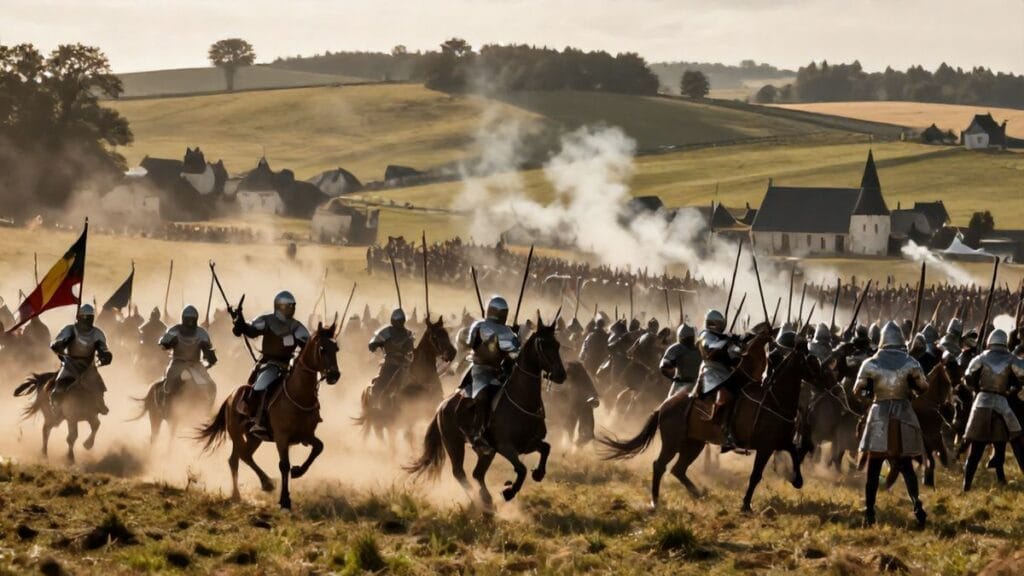
When the first French assaults rolled forward, the battle of mons-en-pévèle began not with a single, dramatic charge but through phases of mounting intensity. Chroniclers differ in their exact sequencing, but many agree that the French initially sought to destabilize the Flemish infantry formations before committing to all-out cavalry attacks. Missile troops—archers and crossbowmen—were pushed forward to pepper the enemy lines, hoping to provoke a disorderly advance.
The Flemish, however, were no longer untested levies. Their commanders had learned from the disciplined defensive tactics that had worked at Courtrai. They planted their pavises, braced their pikes, and endured the missile fire with grim resolve. Casualties mounted in the front ranks, but the blocks held. From behind shields and spearheads, they watched as the first waves of French horsemen gathered for the charge.
The subsequent impact was ferocious. Armor crashed against spear points, horses screamed, and men vanished under a writhing heap of steel and flesh. In some sectors, the Flemish line bent under the shock but did not break. Knights who had charged with confidence found themselves bogged down in close quarters, their long lances now a hindrance, their heavy armor turning each step into a desperate labor as infantry swarmed around them with hooks, axes, and spikes.
Nevertheless, the French army had depth. As one attack faltered, others followed. The king’s commanders tried to probe for weaknesses, directing new charges at segments of the Flemish force that seemed exhausted or isolated. Battle standards leaned this way and that, marking the ebb and flow of advantage. Through it all, the hill of Mons-en-Pévèle loomed, witness to the brutal testing of two very different military systems: chivalric cavalry against civic infantry militias hardened by previous victory and fresh outrage.
Crisis in the French Camp: The King Almost Taken
In the chaos of medieval combat, moments of near-catastrophe often hid within the fog of war, only later crystallizing into legend. At Mons-en-Pévèle, one such moment came when a portion of the Flemish forces, perhaps sensing a wavering in the French ranks or seeking to exploit local success, pushed forward with unexpected aggression. What began as a controlled defensive battle threatened, if only briefly, to flip into a rout of the royal host.
Some sources, such as the chronicle attributed to Geoffroi of Paris, suggest that Flemish infantry and supporting troops managed to break through to the vicinity of the French camp itself. There, among supply wagons, tents, and hastily assembled guards, panic briefly took hold. If true, this would mean that the very heart of the royal army—its logistical base and, more importantly, its command structure—was at risk.
In the confusion, King Philip IV himself was reportedly in grave danger. Accounts vary: some place him fighting doggedly to defend the camp, others suggest he was caught in the tide of fleeing men before rallying them. One later narrative describes him losing his horse and barely escaping capture. While the precise details are contested, the consensus is that for a terrifying interval, the possibility of the king’s capture or death was all too real. Had the Flemish succeeded in seizing Philip, the political consequences would have been explosive, perhaps rivaling the earlier French humiliation at Courtrai.
But this was only the beginning of the turning point. The very crisis seemed to jolt the French leadership into desperate coherence. Officers rallied scattered troops, royal guards formed a protective cordon, and reinforcements were rushed to plug the gaps. What might have become a cascading collapse instead became, in retrospect, the last Flemish high tide before the flood receded.
Twilight Counterstroke: From Flemish Advance to Sudden Rout
As the afternoon wore on, heat and exhaustion weighed heavily on both sides. The Flemish infantry, having pushed far toward the French camp, found themselves increasingly stretched. The discipline that had held firm in tight defensive formation was harder to maintain during an offensive surge. Gaps opened in their ranks; coordination between different urban contingents frayed. Men who had marched and fought since dawn felt their arms grow heavy, their breath ragged.
It was in this fraught moment that the French mounted a decisive counterstroke. Fresh reserves—knights who had not yet fully engaged or had withdrawn to reorder their lines—saw their opportunity. Under the gathering shadows of late afternoon or early evening, they charged against over-extended Flemish units now far from the secure cohesion of their original positions.
The effect was brutal. Without the solidity of a dense pike wall, individual Flemish groups were far more vulnerable to cavalry. French horsemen crashed into flanks and rears, cutting down those who tried to form up and running down those who broke. What had moments earlier seemed like a daring Flemish advance now became a trap snapping shut. Panic spread from one militia company to another. Banners that had once rallied courage now marked concentrations of targets for French attacks.
Discipline collapsed in places. Some Flemings fought to the end, forming desperate last stands around their standards, buying time for comrades to retreat. Others fled toward any safe route they could find: back toward Mons-en-Pévèle, into nearby villages, or across open fields where French cavalry pursued them. The line between controlled withdrawal and disaster blurred, then vanished. By nightfall, the French held the field. The Flemish army, though not annihilated, had been driven from its positions, its losses severe, its morale shattered. The battle of mons-en-pévèle, which had for a time threatened to become another Courtrai, ended instead as a hard-fought but undeniable French victory.
Counting the Dead: Casualties, Captives, and Survivors
In the aftermath of battle, numbers become a language of grief and triumph. Chroniclers, eager to impress upon readers the scale of the clash, often exaggerated or selectively emphasized casualties. Exact figures for the battle of mons-en-pévèle are elusive, but the consensus among historians is clear: the human cost was terrible.
Flemish losses were heavy, particularly among the urban militias. Many of the same towns that had sent proud contingents to Courtrai now received back carts of corpses or the grim silence of missing men. Estimates vary, but several thousand Flemish fighters may have fallen or been captured. For communities already strained by years of conflict and economic disruption, this represented a grievous blow. Guilds lost experienced leaders; families lost breadwinners; city councils faced new waves of widows and orphans needing support.
The French, too, paid for their victory in blood. Knights and men-at-arms had died in the first brutal collisions with the Flemish pike formations. Infantrymen, who often bear the brunt of such fights, left their bones on the fields around Mons-en-Pévèle. However, unlike at Courtrai, it was the Flemish side that ultimately suffered the greater proportional losses. The psychological impact of defeat magnified the toll of physical casualties.
Captivity added another layer to the human drama. Those taken prisoner—especially wealthier townsmen or nobles—faced the prospect of ransoms, negotiations, and prolonged absence from their homes. For some, captivity could become a strange, liminal existence, neither alive nor present in their communities. For others, it ended in death from disease, neglect, or harsh treatment. Medieval warfare, as the events of 18 August 1304 remind us, was not only about banners and strategies but about ordinary bodies broken and lives redirected or extinguished by the throw of fate.
From Battlefield to Treaty Table: Paving the Way to Athis-sur-Orge
Military victory rarely translates immediately into political settlement, and the battle of mons-en-pévèle was no exception. Although Philip IV emerged as the tactical victor, Flanders was not instantly subdued. Resistance continued in pockets; the political landscape within the county remained complicated, with tensions between the count, the nobility, and the cities. Yet the psychological scales had tipped. The aura of invincibility that had surrounded Flemish infantry after Courtrai was cracked, and the French monarchy had regained a crucial measure of prestige.
In the months and years that followed, negotiations unfolded between the two sides, shaped as much by economic realities as by the memory of battlefield bloodshed. Trade, especially in wool and cloth, could not simply be abandoned. Merchants on both sides of the frontier pressed for some resolution that would allow them to resume profitable business. The French crown, meanwhile, desired not the complete ruin of Flanders—whose wealth was valuable to Paris—but its disciplined integration into the sphere of royal influence.
This long diplomatic dance culminated in the Treaty of Athis-sur-Orge in 1305. Under its terms, Flanders was forced to make significant concessions. The county recognized the suzerainty of the French crown anew, paid a heavy indemnity, and ceded important territories, including some strategically and economically valuable towns. Yet the treaty also acknowledged, implicitly, the stubborn resilience of Flemish autonomy: the county remained formally distinct, and its urban communities retained enough strength to continue shaping their own destinies.
Thus, Mons-en-Pévèle fed directly into a negotiated reordering of power. The battle had not erased Flanders as a political entity, but it had weakened its bargaining position. At the same time, it reinforced the lesson—felt across northern Europe—that the politics of kings and cities were now inextricably intertwined. No settlement could ignore the demands of merchants and guilds for long without inviting renewed unrest.
Winners, Losers, and Something in Between: Who Really Prevailed?
On the surface, the answer seems clear: France won, Flanders lost. The French army held the field at Mons-en-Pévèle, drove the enemy to retreat, and proceeded to secure a favorable treaty. Yet, as historians have often noted, medieval warfare rarely offers such neat verdicts. When we probe deeper, the battle of mons-en-pévèle appears less as a straightforward triumph than as a costly, ambiguous inflection point.
For Philip IV, the victory undoubtedly brought relief. He had avenged Courtrai, preserved his personal honor, and reasserted royal authority. But the cost of the long Flemish conflict—in money, men, and political capital—was enormous. The king’s insatiable need for revenue to sustain such wars contributed to his controversial policies toward the Church, the Jews, and, not least, the Knights Templar. The monarchy emerged stronger in relation to Flanders, yet more entangled in financial and institutional strains that would echo into the next generations.
For Flanders, defeat at Mons-en-Pévèle did not mean total subjugation. The county retained its distinct identity; its cities continued to thrive as economic powerhouses in the long term. The memory of resistance, of urban militias defying a king, remained a potent symbol. However, the immediate price was harsh: territorial losses, financial penalties, and periodic royal interventions. The mythic glow that had surrounded the Flemish infantry after Courtrai now shared space with a darker recollection of failure and suffering.
In a broader sense, perhaps neither side “won” in the way they had imagined. Mons-en-Pévèle marked the consolidation of a pattern: monarchies would continue to test and sometimes crush urban autonomy, yet would also depend on cities for money and manpower. The tension between centralization and local liberties, between royal ambition and urban pride, did not end in 1304. It simply took on new forms, from later Flemish uprisings to the turbulent city politics of the Hundred Years’ War.
The Long Shadow over Flanders: Cities, Trade, and Power after 1304
In the wake of the battle of mons-en-pévèle and the Treaty of Athis-sur-Orge, the fabric of Flemish society had to be rewoven. Cities that had thrown themselves into open rebellion now had to find ways to coexist, however uneasily, with a more assertive French monarchy and a count who oscillated between partnership and dependence on Paris. The cost of indemnities and war damage weighed heavily. Yet the underlying economic dynamism of Flanders—its skilled craftsmen, its well-situated ports, its enterprising merchants—could not be easily extinguished.
Over the following decades, Flemish cities slowly recovered their vigor. Cloth production resumed; foreign merchants returned. But the political calculus had changed. Urban elites, sobered by the memory of defeat, sometimes opted for more cautious strategies, bargaining within the framework of royal suzerainty rather than outright defiance. At other times, they proved willing to take up arms again when they felt their fundamental interests threatened. The see-saw of concession and revolt, of repression and compromise, continued.
On the French side, control over Flanders remained a priority, but not an obsession to the same fevered degree once immediate vengeance had been secured. Other challenges demanded attention: tensions with England, disputes with the papacy, internal fiscal reforms. Flanders became one piece among many on the chessboard of Capetian strategy. Yet its cities still mattered disproportionately, for they were among the few in Europe capable of generating the kind of wealth that could sustain royal ambitions elsewhere.
Socially, the scars of Mons-en-Pévèle lingered in subtler ways. Families that had lost fathers and sons had to adapt: widows taking on new roles, apprentices stepping into master positions sooner than expected, guilds reshuffling their leadership. The memory of 1304 circulated in guild halls and taverns, carried in anecdotes of bravery and cowardice, of noble betrayal or heroic stand. It’s astonishing, isn’t it, how a few hours of terror on one August day could ripple through generations of quiet, daily life.
Memory and Myth: How Chroniclers Told the Story
As with most medieval battles, the story of Mons-en-Pévèle did not end on the field; it continued in the pages of chronicles and the tales told by survivors. French and Flemish writers approached the events with different agendas and emotional investments. For French chroniclers close to the court, the battle of mons-en-pévèle offered material for a narrative of royal vindication. They emphasized the courage of Philip IV, the near-disaster in the camp, and the miraculous recovery that led to ultimate victory. The king, they implied, had been tested by fire and found worthy.
Flemish accounts, where they survive, often display a more complex tone. Some, writing in the generation after the battle, cast a nostalgic glow over the earlier triumph at Courtrai and treated Mons-en-Pévèle as a tragic reversal of fortune. Others highlighted internal divisions and tactical errors, hinting that disunity or overconfidence played as great a role in defeat as French strength. Over time, storytellers embellished certain episodes: the near capture of the king, the desperate Flemish push into the French camp, the heroism of particular guild companies or noble leaders.
Modern historians have approached these sources with caution. The nineteenth-century Belgian historian Henri Pirenne, for instance, was deeply interested in the role of cities and bourgeoisie in medieval politics. In studying Flanders, he used battles like Courtrai and Mons-en-Pévèle to illustrate how urban militias could shape the destinies of kingdoms, even if they did not always emerge victorious. Other scholars, such as David Nicholas, have stressed the interplay between local and royal power, reading the battle as part of a “long negotiation” between town and crown rather than as a single decisive break.
Yet behind the scholarly debates, one can still glimpse the raw immediacy with which contemporaries felt the blow of 1304. To them, this was not an abstract case study in the rise of the state or the evolution of infantry tactics. It was the day when their kin died, their banners fell, and the sky over Mons-en-Pévèle darkened with the smoke of burning hopes.
The Battle of Mons-en-Pévèle in the Larger Arc of Medieval Warfare
Placed within the broader history of medieval warfare, the battle of mons-en-pévèle occupies a fascinating, transitional space. It came after the shock of Courtrai but before the great set-piece battles of the Hundred Years’ War, such as Crécy and Poitiers, where infantry and missile troops would again prove devastatingly effective against mounted nobility. Mons-en-Pévèle demonstrated both the potential and the limitations of urban militias when set against a disciplined royal host determined to learn from past mistakes.
On the Flemish side, the reliance on dense infantry formations was consistent with the new confidence of townsmen who had discovered their collective military power. Their equipment and organization reflected a shift away from purely feudal levies toward more civic-based armies. Yet the events of 1304 also underscored a vulnerability: such militias, while formidable in static defense, could become dangerously exposed when drawn into over-extended offensive maneuvers, especially late in the day and on unfamiliar ground.
On the French side, Mons-en-Pévèle signaled an adaptation, however partial, to the realities revealed by Courtrai. The use of infantry and missile troops in supporting roles, the willingness to fight through multiple phases rather than relying on a single overwhelming charge, and the capacity to rally after near-disaster all point to a maturing of royal military practice. It would be an overstatement to call the battle a revolution in tactics, but it was certainly part of an evolutionary path toward more complex, combined-arms warfare.
In this sense, Mons-en-Pévèle can be seen as a precursor to later conflicts where kings would increasingly field armies composed of varied social elements: not only noble cavalry, but hired crossbowmen, urban militias, mercenary companies, and, eventually, professional standing troops. The hill of Mons-en-Pévèle thus belongs to a chain of battlefields on which the medieval world experimented—often in blood—with ways of organizing violence on a mass scale.
Echoes across Centuries: Nationalism, Identity, and Commemoration
Centuries after the last blood dried at Mons-en-Pévèle, the battle returned to life in the imaginations of later generations. In the nineteenth century, as modern nationalism took root across Europe, medieval conflicts were eagerly enlisted into new narratives of identity. The County of Flanders, long absorbed into larger political units, became a touchstone for discussions about regional autonomy, language, and culture in what would become Belgium and parts of northern France.
Romantic writers and painters sought heroic scenes in the past: the sturdy Flemish militiaman defying the proud French knight, the banner of a city fluttering above a sea of helmets, the embattled king fighting for his throne. While the Battle of the Golden Spurs remained the more celebrated symbol of Flemish resistance, the battle of mons-en-pévèle also found a place in this pantheon—often as the tragic sequel, the moment when bold defiance crashed against the unyielding wall of royal power.
Local commemorations around Mons-en-Pévèle, though more modest, kept the memory alive. Plaques, memorial crosses, or occasional reenactments linked contemporary villagers to the long-ago struggle that had ravaged their fields. In some cases, historians and amateur scholars published small monographs or articles in regional journals, arguing for the battle’s importance and urging recognition of its role in the formation of local identity.
Yet behind these modern uses of medieval history lies an enduring truth: people have always turned to the past to make sense of the present. Whether they saw in 1304 a parable of urban liberty and royal oppression, or a tale of just monarchy restoring order, or a sobering warning about the costs of war, later generations remade Mons-en-Pévèle in their own image. That, perhaps, is the final irony: a battle fought to settle immediate political disputes became, in memory, an open text upon which each era wrote its own anxieties and aspirations.
Conclusion
On 18 August 1304, on a modest rise in the County of Flanders, thousands of men met in a storm of steel whose echoes have never entirely faded. The battle of mons-en-pévèle was, in one sense, a straightforward contest between a wounded monarchy and a rebellious principality, ending in a clear if costly royal victory. Yet to reduce it to that alone is to miss its deeper resonances. It was also a collision between two ways of wielding power: the centralized authority of a king, claiming to speak for a realm, and the decentralized, often unruly vitality of cities determined to defend their autonomy.
The battle grew from the tangled roots of prior events—the humiliation of Courtrai, the social tensions in Flemish towns, the ambitions and anxieties of Philip IV and Robert of Béthune. It unfolded through phases of brutal contests between cavalry and infantry, moments of near-disaster in the French camp, and a sudden reversal that turned Flemish hope into flight. Its immediate consequence was to reshape the political relationship between France and Flanders, paving the way for the Treaty of Athis-sur-Orge and altering the balance of power in the region.
But its longer-term significance lies just as much in what it revealed about medieval society on the cusp of change. Urban militias could no longer be dismissed as rabble; they were strategic actors, capable of both stunning victory and costly defeat. Kings could not simply command; they had to bargain, tax, negotiate, and sometimes bleed for their claims. The line between “noble” and “common” in warfare was becoming blurred, not only on the battlefield but in the halls where treaties were sealed.
Today, when we look back on Mons-en-Pévèle, we see more than knights and pikemen on a hazy August day. We see the outlines of modern dilemmas taking shape: the relationship between central authority and local liberty, the power of organized citizens to challenge entrenched elites, and the enduring temptation to seek in war a decisive solution to complex political problems. The men who fought and died there could not know that historians, centuries later, would puzzle over their choices and their fates. Yet in telling their story, we honor the reality that history is made not only by kings and counts, but by weavers and shopkeepers, archers and foot soldiers—by all those whose footsteps once shook the fields of Mons-en-Pévèle.
FAQs
- What was the Battle of Mons-en-Pévèle?
The Battle of Mons-en-Pévèle was a major medieval engagement fought on 18 August 1304 between the forces of King Philip IV of France and a largely urban-based army from the County of Flanders. It took place near the hill of Mons-en-Pévèle in what is now northern France and ended in a hard-fought French victory that helped restore royal prestige after the earlier disaster at the Battle of the Golden Spurs. - Why did the battle take place?
The battle was part of a broader conflict over control of Flanders, a wealthy and strategically important county whose cities sought to maintain autonomy against growing French royal interference. After Flemish militias humiliated French chivalry at Courtrai in 1302, Philip IV was determined to reassert his authority. The 1304 campaign and the clash at Mons-en-Pévèle were the culmination of this effort. - Who commanded the armies at Mons-en-Pévèle?
The French army was led personally by King Philip IV “the Fair,” supported by high-ranking nobles and royal officers. The Flemish forces were under the leadership of Robert of Béthune, son of the imprisoned count of Flanders, Guy of Dampierre. Robert served as the key military figure rallying both Flemish nobles and the powerful urban militias. - What role did Flemish city militias play in the battle?
Flemish city militias formed the core of the army opposing Philip IV. Organized by guilds and urban communities, these infantry units were armed with pikes, polearms, and the distinctive goedendag. They fought in dense formations and initially resisted French attacks effectively, drawing on tactics that had worked at Courtrai. However, during a late offensive push toward the French camp, their formations became over-extended, leaving them vulnerable to the decisive French cavalry counterattack. - How close did the French come to losing?
According to several chroniclers, the French came dangerously close to disaster when Flemish troops penetrated the area around the royal camp. In the confusion, King Philip IV himself was reportedly in serious danger of capture or death. Only a determined rally by royal guards and reserves prevented a complete collapse, illustrating just how precarious the French position was at one point in the battle. - What were the immediate consequences of the French victory?
The French victory at Mons-en-Pévèle broke the momentum of the Flemish revolt and undermined the near-mythic reputation of their militias. It strengthened Philip IV’s political hand and cleared the path for diplomatic negotiations that resulted in the Treaty of Athis-sur-Orge in 1305. Under this treaty, Flanders accepted renewed French suzerainty, paid a large indemnity, and ceded territory, though it remained a distinct political entity. - How did the battle affect the cities of Flanders?
Flemish cities suffered heavy human losses, particularly among their guild militias, and had to contribute to the financial burdens imposed by the peace settlement. Yet their economic vitality allowed them to recover over time. The battle did, however, temper some of their earlier boldness; urban elites often adopted more cautious strategies in dealing with the French crown, even as they continued to defend key freedoms and privileges. - Was the Battle of Mons-en-Pévèle a turning point in medieval warfare?
While not as famous as battles like Crécy or Poitiers, Mons-en-Pévèle was part of a broader shift in medieval warfare that highlighted the growing importance of infantry and urban militias. It demonstrated both the strengths and weaknesses of civic-based armies facing a royal host and showed that chivalric forces, when better coordinated and supported by infantry and missile troops, could recover from earlier humiliations. - How reliable are the sources about the battle?
The main accounts come from contemporary or near-contemporary chronicles, many of which were written with clear political or regional biases. French chroniclers tended to emphasize royal heroism and divine favor, while Flemish-leaning sources highlighted urban courage and the suffering of their side. Modern historians cross-examine these narratives, compare them with diplomatic documents and economic records, and use critical methods to reconstruct the most plausible sequence of events. - Why does the Battle of Mons-en-Pévèle still matter today?
The battle matters not only as a key episode in Franco-Flemish relations but also as a window into the evolving relationship between monarchies and cities in medieval Europe. It raises enduring questions about resistance and authority, the power of organized citizens, and the ways in which societies remember and repurpose their past. For regions once part of the County of Flanders, it also remains a symbol—sometimes heroic, sometimes tragic—of a long history of negotiating autonomy under larger powers.
External Resource
Internal Link
Other Resources
- Encyclopaedia Britannica – general search for the exact subject
- Google Scholar – academic search for the exact subject
- Internet Archive – digital library search for the exact subject

