Table of Contents
- A Europe in Ruins: The Long Shadow Before 1815
- From Revolution to Empire: The Road to the Congress
- Metternich’s Vision and the Birth of a Conservative Dream
- Paris, September 1815: The Holy Alliance Is Conceived
- When the Holy Alliance Formed: The Signing, the Men, the Moment
- An Oath Dressed as a Prayer: The Religious Language of Politics
- The Tsar, the Emperor, and the King: Personalities Behind the Pact
- Metternich’s Calculations: The Unofficial Architect
- From Paris to the Provinces: How Europe Reacted
- Swords Sheathed, Pens Drawn: The Holy Alliance in Action
- Silencing the Echoes of 1789: Repression and Control
- Cracks in the Edifice: Liberal Movements and National Awakenings
- Revolt, Intervention, and Fear: The Alliance in the 1820s
- The Human Cost: Exiles, Censors, and the Lost Generation of Reformers
- A Promise of Peace, A Seed of Future Wars
- The Slow Unraveling of the Holy Alliance
- How Historians Remember the Day the Holy Alliance Formed
- Echoes in Modern Politics: Sovereignty, Unity, and Fear of Change
- Conclusion
- FAQs
- External Resource
- Internal Link
Article Summary: On September 26, 1815, in the uneasy calm that followed Napoleon’s defeat, the holy alliance formed among the monarchs of Russia, Austria, and Prussia, promising to bind European politics to Christian morality and dynastic solidarity. This article follows the dramatic arc from the devastation of the Napoleonic Wars to the hushed rooms of Paris where the pact was drafted and signed. It explores how, when the holy alliance formed, rulers sought not merely peace but protection against revolution, liberalism, and nationalism. Yet behind the language of brotherhood and faith lay fear, calculation, and a determination to lock the social order into place. We trace the political maneuvers of figures like Tsar Alexander I and Metternich, the repression that followed, and the rising tide of revolt that slowly undermined the pact. As the holy alliance formed, it promised stability but planted seeds of future conflict and frustration. In examining its legacy, we see how a conservative dream of harmony turned into a rigid system that could not contain Europe’s demands for freedom and self-determination.
A Europe in Ruins: The Long Shadow Before 1815
Before the ink dried on the document by which the holy alliance formed, Europe had already lived a generation in fire. For more than two decades, the continent had been ravaged by war: first the shock of the French Revolution, then the campaigns of Napoleon that turned battlefields from Portugal to Russia into graveyards. The date 1815, which would later be remembered for peace treaties and solemn oaths, sat on the smoking ruins of a civilization that had flirted with both liberation and annihilation.
Villages counted their missing; churches buried their sons in mass graves; cities like Vienna, Berlin, Madrid, and Paris carried invisible scars. Millions had marched, hundreds of thousands had died, and nearly every throne in Europe had trembled, if not toppled. A peasant in the Tyrol, a merchant in Hamburg, a weaver in Lyon—each of them felt that the old order had fractured and might never be fully restored. And yet the monarchs intended to restore it, almost at any cost.
The fear was not only of armies. It was of ideas. The French Revolution had done more than execute a king and defy Europe’s monarchs; it had taught the masses the language of rights, citizenship, and sovereignty. Newspapers, pamphlets, and tavern conversations carried phrases like “the nation,” “the people,” and “liberty” into places where, only a generation earlier, few had spoken of anything beyond the parish and the dynasty. That memory terrified kings at least as much as the memory of cannon fire.
By the time Napoleon was finally defeated at Waterloo in June 1815, many Europeans felt oddly suspended between two worlds. The ancien régime of absolute monarchies could not simply pretend that 1789 had never happened; but the revolutionary era itself had proven terrifying, bloody, and unstable. What future could be built on this wreckage? In that vacuum of certainty, the holy alliance formed as a promise—or a threat—of a new kind of stability.
Armies were demobilizing, men were limping home, and great caravans of diplomats and courtiers were shuttling between Vienna, Paris, and other capitals. Taverns in Brussels still told stories of Waterloo as if it had happened yesterday. In Poland, the dream of nationhood flickered yet again after having been partitioned out of existence. In Italy and Germany, students whispered of unity, even as princes returned to their palaces. The landscape was not only physical; it was psychological, and the trauma of the Napoleonic era created a desperate hunger for order. When, in this context, the holy alliance formed, it appeared to some as a providential shield against further catastrophe. To others, it looked like a velvet glove withdrawn from an iron fist.
From Revolution to Empire: The Road to the Congress
The story of the holy alliance formed in 1815 cannot be understood without stepping back to 1789. The French Revolution had erupted as a domestic crisis of debt and injustice but quickly became a European crisis of legitimacy. When Louis XVI’s head fell beneath the guillotine in 1793, it sent a shudder through every royal court. If the French could execute a king, what protected any other crowned head?
Coalitions of monarchies formed then too—not alliances of spiritual brotherhood, but coalitions of raw military necessity. Austria, Prussia, Britain, Russia: they joined arms, broke apart, rejoined, all in the name of containing or overthrowing revolutionary France. Yet time and again, they underestimated the energy unleashed by the revolution’s promises and the genius—and relentless ambition—of Napoleon Bonaparte.
From the early 1800s onward, Napoleon reorganized Europe by force. Crowns were knocked off and rebalanced; duchies disappeared; the Holy Roman Empire, a medieval relic, was quietly euthanized. As his French Empire expanded, he placed his brothers and marshals on thrones, reshaping the political map like a general rearranging pieces on a war table. Some peoples, like many in the German states or Italy, experienced this as both oppression and opportunity: oppression because of French domination and conscription, opportunity because Napoleonic reforms brought law codes, reduced feudal privileges, and, in places, a sense that old shackles were weakening.
But war has its limits. The invasion of Russia in 1812 shattered Napoleon’s aura of invincibility. Frozen roads, scorched earth, and the desolate retreat from Moscow drained the blood of the Grande Armée. From that catastrophe, a new coalition emerged, a coalition that gradually learned to cooperate more deeply than before. The 1813–1814 campaigns, culminating in Napoleon’s first abdication, led directly to the Congress of Vienna, where the victors sought to refashion the continent.
At Vienna, from late 1814 into 1815, diplomats danced and negotiated in almost equal measure. As the Austrian statesman Klemens von Metternich later suggested, it was a moment when “the map of Europe was spread out like a patient on the surgeon’s table.” Borders were redrawn, old houses restored, and compromises sealed in candle-lit chambers while orchestras played in the next room. Yet Napoleon’s escape from Elba and his final bid for power—the Hundred Days, ending with Waterloo—reminded everyone just how fragile these arrangements could be. Even as the Congress drew to a close, a sense of unfinished business haunted the corridors.
It was from this world—a continent exhausted, anxious, yet still on the edge of uncertainty—that the holy alliance formed. The peace of Vienna needed a guardian. The monarchs needed a moral language that went beyond treaties and troop deployments. They needed, they believed, a sacred cement to hold together the new order.
Metternich’s Vision and the Birth of a Conservative Dream
Few figures embodied the post-Napoleonic desire for stability more than Klemens von Metternich, the Austrian foreign minister. Elegant, shrewd, and deeply conservative, Metternich had watched the revolutionary era with horror and calculated precision. He saw in the French Revolution not a glorious birth of liberty but an outbreak of social disease that had to be contained lest it infect all of Europe.
Metternich believed in hierarchy—between classes, between nations, between rulers and ruled. He believed in diplomacy conducted by a small circle of informed, aristocratic statesmen, not by parliaments or public opinion. To him, the masses were not a political subject but a force to be managed. When the holy alliance formed, Metternich was not its formal author, but he was its great interpreter, the man who would wield its vague language as a tool of concrete policy.
In the months after Waterloo, Metternich’s goal was clear: freeze Europe in a stable equilibrium. The great powers—Austria, Russia, Prussia, Britain (and to a lesser extent, restored Bourbon France)—were to form a balance that would prevent any one state from dominating as France had done under Napoleon. At the same time, they were to cooperate to prevent the return of revolution in any guise. Where Tsar Alexander I saw mystical brotherhood, Metternich saw a useful cover for a system of concerted reaction.
His dream was of a “Concert of Europe”: a system by which the main powers would regularly consult, intervene, and adjust to maintain peace and order. It was conservative but not, in his mind, mindlessly so. He accepted certain changes as permanent—the disappearance of the Holy Roman Empire, for instance—but insisted that political change must emerge from above, in slow, controlled reforms, if at all. Popular sovereignty, he thought, meant chaos. For that reason, any alliance that cloaked monarchic solidarity in sacred terms was a gift. Metternich would later say that the holy alliance formed a “noise” that he could shape into melody.
It is astonishing, isn’t it, that a single man’s vision could influence the fate of millions? Yet Metternich alone did not author the alliance’s emotional tone. That came from another source: the mind and conscience of the Russian emperor.
Paris, September 1815: The Holy Alliance Is Conceived
In the late summer of 1815, Paris was a city under watchful eyes. The restored Bourbon monarchy, protected by allied troops, ruled uneasily over a populace that had grown accustomed to imperial glory and the rhetoric of popular sovereignty. Russian, Prussian, Austrian, and British soldiers lined the boulevards; foreign officers filled salons and cafés. The scent of gunpowder had faded, but the echo of recent battles still lingered in conversations and glances.
Here, amidst occupation and restoration, the holy alliance formed in embryo. Tsar Alexander I of Russia, triumphant yet reflective, stayed in Paris with his entourage. He was a man notoriously difficult to pin down: alternately ruthless and compassionate, mystical and pragmatic. Over the previous years, he had become increasingly inclined toward religious introspection. Influenced by spiritual advisers, he began to speak of his role as a monarch in biblical terms, as a shepherd accountable not only to history but to God.
During discussions with his foreign minister and advisors, Alexander floated an idea: an alliance between Christian monarchs that would go beyond ordinary treaties. It would affirm that kings ruled not simply by historical accident or dynastic rights but by divine appointment, and that they owed to one another a bond of brotherly affection. War, in this vision, was to be renounced as a tool between Christian nations, except in defense. Internal revolutions, by contrast, were implicitly treated as a rebellion not only against the throne but against a divinely ordained order.
Paris, the symbolic capital of revolution and empire, became the improbable cradle of this conservative spiritual pact. As discussions unfolded in the palaces and residences commandeered by the victorious powers, drafts took shape. The document would be short, almost disarmingly so. It would mention Christ, the Gospel, and the fraternity of the three sovereigns. When the holy alliance formed on paper, it did so as a kind of political prayer, though one carefully worded to retain maximum interpretive flexibility.
Outside those chambers, the ordinary people of Paris heard only rumors: that the monarchs were planning some grand union, that Russia sought to dominate Europe, that Austria wanted to smother any embers of change. For most, the details were invisible, but the atmosphere was clear: the age of public festivals of “the people” seemed to be yielding to an age of sacralized monarchic congresses.
When the Holy Alliance Formed: The Signing, the Men, the Moment
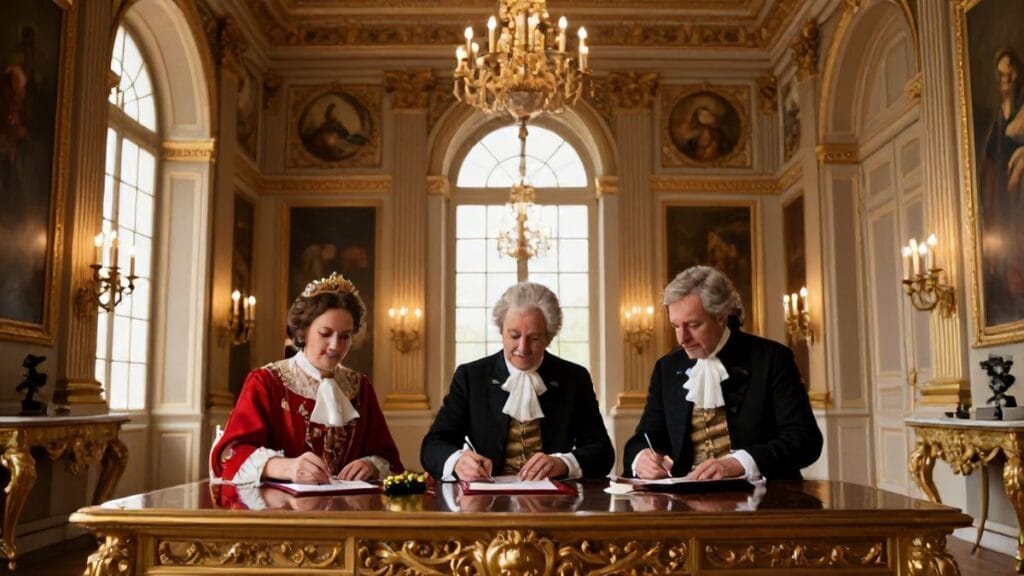
On September 26, 1815, the idea became reality. In an act that for contemporaries was momentous yet oddly understated, the holy alliance formed through the signatures of three men: Tsar Alexander I of Russia, Emperor Francis I of Austria, and King Frederick William III of Prussia. They were not merely individuals; they were embodiments of empires, dynasties, and traditions stretching back centuries.
The signing itself was not a public spectacle. There were no cheering crowds, no grand outdoor ceremonies. Instead, it took place within the intimate, closed world of royal and diplomatic protocol. Yet participants later recalled a feeling of solemnity, as if a sacrament were being performed. The language of the document enhanced that sense. It opened by invoking the “Most Holy and Indivisible Trinity,” declaring that the three monarchs, “in consequence of the great events” which had “afflicted Europe,” felt drawn to “manifest to the world their unshakable determination to adopt no other rule of conduct… but the precepts of that holy religion.”
Thus the holy alliance formed around a text that deliberately blurred the line between politics and piety. The three rulers promised to act toward one another as “members of one and the same Christian nation.” They pledged to support justice, charity, and peace, and to regard their subjects as children of one father, God. To a modern reader, the language may sound naïve or hypocritical; to many contemporaries, it sounded either inspiring or alarmingly vague.
The vagueness was no accident. The alliance did not specify mechanisms of enforcement or concrete obligations, beyond a general commitment to mutual support and Christian principles. This allowed each monarch and his ministers to interpret the pact in ways that served their own interests. As a historian later noted in a famous study of the period, the holy alliance formed a “moral screen” behind which power politics would continue much as before, only more closely coordinated.
In the room at that signing, one can imagine the competing inner monologues. Alexander, perhaps, saw himself as a kind of Christian emperor, almost a figure out of early Byzantine history, binding rulers together under a higher law. Francis of Austria, cautious and conservative, undoubtedly viewed the alliance as one more layer of protection for his fragile, polyglot empire. Frederick William III, whose Prussia had suffered humiliation and rebirth during the Napoleonic era, may have seized on the alliance as confirmation that his kingdom now stood among the arbiters of Europe’s fate.
Whatever their private motives, the result was the same: the holy alliance formed that day as a symbolic and ideological pillar of the new European order. Soon, other monarchs would be invited to adhere. Some would do so quickly; others, like Britain’s Prince Regent, would hesitate, troubled by the alliance’s overt religious tone. But the center of gravity was clear. The three eastern monarchies had proclaimed a sacred partnership over the continent’s future.
An Oath Dressed as a Prayer: The Religious Language of Politics
Perhaps the most striking feature of the document by which the holy alliance formed is its language. In a century that would see the further rise of secular ideologies, here was a foundational text of European diplomacy framed as a Christian confession. Its drafters chose not the lean, technical prose of traditional treaties but the expansive, devotional vocabulary of sermons and catechisms.
They spoke of the Gospel, of the Holy Trinity, of “brotherly affection” and “immutable principles.” They pledged to govern their peoples in the spirit of “religion, justice, and peace.” The effect was deliberate: to cast monarchy not simply as a political institution but as a sacred trust. The alliance was thus not only about borders and armies but about souls and duties before God.
Yet behind the reverence lay ambiguity. Which version of Christianity was meant? Catholic? Orthodox? Protestant? The three signatories represented three different confessions. The document carefully avoided doctrinal specifics, elevating instead a generalized “Christian” ethic that could be claimed by all. In doing so, it wrapped diverse and sometimes conflicting traditions in a single cloak of holy unity.
Critics, then and later, noted the irony. An alliance proclaiming the supremacy of Christian love and peace would, in practice, justify interventions to crush uprisings, stifle constitutions, and preserve systems of inequality. The historian A.J.P. Taylor once wryly remarked that the holy alliance formed “more in the name of order than of the Sermon on the Mount,” capturing this tension between rhetoric and reality. But the religious language was not merely cynical; many of its authors sincerely believed that godliness and order were inseparable.
For Tsar Alexander, this was particularly true. He believed that if sovereigns truly internalized Christian ethics, war could be tamed and politics ennobled. For Metternich, who privately scoffed at the more mystical aspects, the language was a useful instrument: it clothed his system of conservative realpolitik in garments that appealed to kings, priests, and a large portion of the devout population.
It’s astonishing, isn’t it, how words can both reveal and conceal? The moment the holy alliance formed, its quasi-religious phrasing made it extraordinarily adaptable. Any action taken in the name of “order” or against “revolutionary excess” could be framed as defending Christian civilization. Thus an oath dressed as a prayer became, in effect, a flexible charter for intervention.
The Tsar, the Emperor, and the King: Personalities Behind the Pact
The alliance was, at its core, a pact between three men, each carrying his own burdens and dreams into the agreement. To understand why the holy alliance formed and how it functioned, one must step into their lives.
Alexander I of Russia had ascended the throne in 1801 after the assassination of his father, Paul I—a crime in which he was, at minimum, passively complicit. That trauma haunted him. Throughout his reign, he oscillated between reformist impulses and authoritarian reflexes, between Enlightenment ideals and mystical piety. By 1815, the horrors of war and the weight of victory had driven him further into religious contemplation. He felt himself chosen—by history, by God—to restore moral order to Europe. When the holy alliance formed, he saw it as an expression of his spiritual mission.
Francis I of Austria, by contrast, represented continuity and caution. Ruler of a sprawling, multi-ethnic empire held together by bureaucracy and tradition, Francis had little taste for innovation. He distrusted liberalism, nationalism, and anything that might stir his restless populations in Italy, Hungary, Bohemia, and beyond. For him, the alliance was a bulwark, another fence against the encroachments of modernity.
Frederick William III of Prussia occupied an intermediate position. His kingdom had suffered crushing defeat at Napoleon’s hands in 1806 and then, through reform and resilience, emerged as a renewed military power. The king, personally conservative and devout, had promised his subjects a constitution during the struggle against France but balked at fulfilling that pledge once victory was secure. The holy alliance formed, in his mind, as both consolation and justification: a sign that true legitimacy flowed from above, from God and dynastic rights, not from negotiated charters.
These men were not marionettes of abstract forces; they were complex, sometimes tormented rulers. Alexander’s spiritual restlessness would later lead him to withdraw emotionally from the alliance he had championed. Francis’ rigidity would amplify Metternich’s influence, making the Austrian foreign minister almost a co-ruler in foreign policy. Frederick William’s hesitancy and indecision would shape Prussia’s uneven path between reform and repression.
Their personalities mattered in ways both subtle and profound. When the holy alliance formed, it gained much of its initial energy from Alexander’s fervor. As that fervor cooled in later years, the alliance’s religious tone became more formulaic. Yet the structure it created—a habit of consultation, a presumption of joint action against revolution—endured well beyond any single man’s lifetime.
Metternich’s Calculations: The Unofficial Architect
Although he did not sign as a monarch, Klemens von Metternich hovered over the holy alliance like a shadowy architect. Publicly, he offered polite support; privately, he sometimes ridiculed its mystical language. In his view, Europe needed not sermons but systems. But he understood the power of symbols, and he recognized that when the holy alliance formed, it could serve as a useful façade for the more practical “Concert of Europe” he was constructing.
Metternich’s calculations were meticulous. Austria’s position was precarious. It lacked the vast population of Russia, the growing industrial might of Britain, or the rising dynamism of Prussia. Its strength lay in its central location, diplomatic skill, and a subtle web of alliances. To preserve the Habsburg Monarchy, Metternich needed to prevent both French resurgence and Russian domination. He also needed to suppress nationalist and liberal movements that could fragment the empire from within.
The alliance, with its invocation of Christian brotherhood, allowed him to reframe counter-revolutionary intervention as a moral obligation. When he later persuaded Russia and Prussia to support Austrian interventions against uprisings—whether in Italy, Germany, or elsewhere—he could invoke not just mutual interest but shared principle. The holy alliance formed a vocabulary that turned his tactical maneuvers into acts of supposed virtue.
He also deftly played on Alexander’s conscience. Whenever the Tsar hesitated about harsh measures, Metternich would remind him of their duty to protect Europe from the return of Jacobin terror, chaos, and atheism. In private letters, he argued that true freedom lay not in unbridled popular sovereignty but in a stable, ordered society guided by wise elites. The alliance’s rhetoric of Christian love was, in his hands, reconceptualized as an argument for paternalistic control.
In this sense, the holy alliance formed the emotional and spiritual front of a larger conservative strategy. Behind it stood other, more explicitly political arrangements, such as the Quadruple Alliance (including Britain) that guaranteed the Vienna settlement and coordinated diplomacy. Metternich bridged these two worlds—the world of intimate royal promises and the world of cold strategic calculation. His legacy would be debated for generations: was he a visionary of peace or a jailer of progress? Perhaps he was both.
From Paris to the Provinces: How Europe Reacted
News of the alliance did not sweep the continent overnight; communication in 1815 moved with the speed of horses and sailing ships, not radio or telegraph. Still, within weeks and months, word spread through diplomatic channels, newspapers, pamphlets, and rumor that a “Holy Alliance” of monarchs had been formed. Reactions varied sharply by region and social class.
Among royal courts and conservative elites, the response was often positive, even enthusiastic. Many saw the alliance as the long-awaited antidote to the horrors of the previous decades. If, as they believed, the erosion of religious authority and respect for monarchy had opened the door to revolution, then a loudly Christian, loudly monarchic pact seemed a fitting remedy. Bishops and priests in some countries preached sermons praising the rulers’ embrace of Christian principles.
But among liberals, intellectuals, and those who had tasted even limited political freedoms during the Napoleonic era, the alliance aroused suspicion and dread. In universities in Germany and Italy, students debated its implications late into the night. Was this a new “league of kings” against the peoples? Did the language of Christian love mask a deeper commitment to censorship and repression? Pamphleteers in Britain and France, somewhat freer to criticize, often mocked the alliance’s pious pose.
Britain itself stood somewhat apart. The Prince Regent (later George IV) and his government declined to sign the alliance, uncomfortable with its explicit religious framing and its potential entanglements. British policy would often intersect with the aims of the holy alliance—especially in resisting French expansion—but it would do so through more traditional, secular treaties. The British press sometimes derided the alliance as a “mystic crusade” of autocrats, hinting at the divergence between island and continent.
For ordinary peasants and townspeople in Central and Eastern Europe, the alliance was more sensed than understood. They saw returning monarchs, foreign garrisons, and the gradual tightening of censorship. They heard less talk of “the nation” and more of obedience and order from pulpits and official proclamations. For many, the alliance was simply part of the great, distant machinery that determined whether there was war or peace, famine or plenty. It was real in their lives not as parchment in Paris but as an atmosphere: the feeling that the window briefly opened by revolution had been pushed shut again.
Swords Sheathed, Pens Drawn: The Holy Alliance in Action
Once the holy alliance formed, it did not remain a mere declaration. Over the next decade and a half, it shaped a new style of European politics. Instead of sudden shifts, solo campaigns, and shifting coalitions, the major monarchies increasingly acted in concert, consulting and planning through periodic congresses—at Aix-la-Chapelle (1818), Troppau (1820), Laibach (1821), and Verona (1822).
At these meetings, foreign ministers and monarchs gathered to assess threats to the Vienna settlement. A vocabulary emerged in which “revolution,” “radicalism,” and “disorder” were treated as diseases to be contained. The holy alliance’s moral terms—Christian duty, brotherhood, peace—floated in the background of debates that were, in substance, about how far to go in suppressing uprisings and constitutional movements.
One of the alliance’s early symbolic acts was the evacuation of allied troops from France in 1818. At Aix-la-Chapelle, the powers agreed that France, now ruled by the restored Bourbons, could be treated as a full partner rather than a defeated pariah. It joined the Concert of Europe, demonstrating that the post-war system was not merely punitive but, in some cases, rehabilitative. Yet this magnanimity toward France contrasted sharply with the alliance’s stance toward revolutionary movements elsewhere.
After the holy alliance formed, a pattern became clear: whenever a revolution or revolt threatened a monarchy—especially on the European continent—the alliance’s mechanisms clicked into place. Proposals for intervention would be discussed; envoys would be sent; if necessary, armies would cross borders under the banner not only of mutual defense but of restoring legitimate order. The sword was sheathed in peacetime but always within reach, and it was the pen—the instruments of diplomatic agreement—that enabled it to be drawn in a coordinated way.
In this system, smaller states found their room for maneuver restricted. Constitutional experiments, demands for press freedom, or calls for national unification could suddenly be declared matters not merely of domestic policy but of “European concern.” The alliance, founded in the name of peace, gradually evolved into a transnational committee of conservative oversight.
Silencing the Echoes of 1789: Repression and Control
Behind the ornate phrases about Christian compassion, the holy alliance formed the moral scaffolding for a vast project of repression. Metternich and his counterparts feared not just open revolutions but the very circulation of ideas that might lead to them. And so they turned their attention to universities, newspapers, secret societies, and any other channels through which new political visions might spread.
One of the most famous responses to this fear came in 1819, after a liberal student in Germany assassinated the conservative writer August von Kotzebue, whom he regarded as a traitor to the German nation. Shocked, the German princes convened at Metternich’s urging and adopted the Carlsbad Decrees. These measures imposed strict censorship on the press, surveillance of universities, and the dissolution of nationalist student associations. Though technically a German affair, their spirit echoed the ethos of the holy alliance: better to suffocate dangerous thoughts early than face a future uprising.
Similar patterns unfolded elsewhere. In Austria and its Italian possessions, censors scrutinized every pamphlet, book, and play. In Russia, censorship remained severe, with the alliance’s rhetoric reinforcing the notion that free expression could be a pathway to treason. The Catholic Church in many regions, aligning itself with monarchic power, preached obedience as a religious duty. The state and the altar, both invoked in the alliance, worked hand in glove.
Yet this repression was not uniform or all-powerful. Ideas are notoriously hard to imprison. Smuggled pamphlets, clandestine meetings, and coded language in literature kept the spirit of dissent alive. A poem could suggest what a political manifesto could not say outright. A university lecture on history could, under the surface, question the inevitability of dynastic rule. The more the alliance tried to silence echoes of 1789, the more it sometimes turned them into whispers that carried farther in the dark.
Cracks in the Edifice: Liberal Movements and National Awakenings
Despite the vigilance of kings and ministers, the early nineteenth century was an age of awakening. The same decades during which the holy alliance formed and acted also saw the rise of movements that spoke new languages—of nations rather than dynasties, of citizens rather than subjects. The alliance could slow these movements; it could sometimes seemingly crush them. But it could not erase the historical forces that had been set in motion.
In the German lands, a sense of cultural and linguistic community deepened. Writers like Johann Gottlieb Fichte and others had, during the Napoleonic Wars, begun to speak of the “German nation” as something more than a collection of princely possessions. After 1815, this consciousness persisted. Students gathered at festivals such as the Wartburgfest of 1817, waving black-red-gold flags and demanding national unity and liberal constitutions—much to Metternich’s alarm.
In Italy, the peninsula remained fragmented into kingdoms, duchies, and territories under foreign influence. Yet secret societies like the Carbonari spread among officers, professionals, and students. They dreamed of a free, united Italy, rid of Austrian dominance and homegrown absolutism alike. Their rituals were clandestine, their numbers limited, but their resolve was fierce.
In Spain and Portugal, struggles over constitutions and royal authority flared repeatedly. The example of Spanish resistance to Napoleon, which had mobilized a broad spectrum of society in defense of “the nation” and its traditions, fed into later liberal movements demanding charters and assemblies. The waves of unrest that would later sweep Latin America, leading to independence movements there, also intersected with the broader crisis of the old imperial order.
The holy alliance formed precisely to contain these energies. Yet each new generation of students, intellectuals, and urban professionals found ways of reconnecting with the revolutionary vocabulary of rights and representation. It was as if Europe lived a double life: by day, at the level of official diplomacy, it belonged to kings speaking of Christian brotherhood; by night, in apartments and taverns, it belonged to conspirators and dreamers whispering of nations and freedoms yet to come.
Revolt, Intervention, and Fear: The Alliance in the 1820s
The 1820s put the alliance to the test. Across Europe, revolutions broke out like brush fires ignited by long-smoldering embers. In 1820, army officers in Spain forced King Ferdinand VII to restore the liberal constitution of 1812. In Naples and Piedmont, Carbonari conspiracies succeeded, at least temporarily, in compelling their rulers to grant constitutions. In Portugal, similar upheavals unfolded. The question for the alliance was simple and stark: would it tolerate these experiments in constitutionalism?
The answer soon became clear. At the Congress of Troppau in 1820 and the Congress of Laibach in 1821, Austria, Russia, and Prussia reaffirmed what came to be known as the “Troppau Protocol”: that states where a revolution had overthrown legitimate monarchical authority ceased to be members of the European alliance community and could be subject to intervention. The holy alliance formed a moral canopy over this doctrine; under it, Austrian troops marched into Naples and later into Piedmont to restore absolutist rule.
Spain posed a more complex challenge, partly because British interests were deeply involved. At the Congress of Verona in 1822, debates raged. Ultimately, France—under the Bourbon monarchy, ironically enough—intervened in 1823 to restore Ferdinand VII’s absolute authority, with the tacit blessing of the alliance powers (though Britain remained aloof). Each of these interventions broadcast a clear message: constitutions granted under revolutionary pressure would not be tolerated.
Beyond Western Europe, the alliance also took a dim view of nationalist uprisings within empires. When Greeks began their war of independence against the Ottoman Empire in 1821, the reaction in European capitals was conflicted. On the one hand, philhellenism—romantic admiration for ancient Greece—ran strong in public opinion, especially in Britain and France. On the other hand, the uprising looked suspiciously like another revolutionary contagion. Here, the alliance’s unity began to fray, as Russia’s own interests in the Balkans and Orthodox solidarity complicated its stance.
Fear was the common thread: fear that the fires of the 1790s would reignite, that thrones would topple again, that social hierarchies would be upended. The holy alliance formed as a promise that the great powers would face such crises together. The 1820s showed how far they were willing to go to keep that promise—and how the very act of repression created martyrs and memories that would fuel future struggles.
The Human Cost: Exiles, Censors, and the Lost Generation of Reformers
All the high diplomacy and royal correspondence can make the history of the holy alliance seem like a chess game played by kings and ministers. But underneath the polished tables and sealed envelopes were human lives: writers silenced, activists imprisoned, families torn apart by exile. The holy alliance formed a climate of fear that shaped an entire generation of would-be reformers.
In Italy, after Austrian troops crushed the constitutional movements, many Carbonari and liberals fled or were arrested. Some found refuge in France, Britain, or Switzerland, joining an émigré world of exiled patriots whose only weapons were the pen and the spoken word. They met in cafés, wrote manifestos, and plotted future uprisings that would, in many cases, come to fruition only decades later.
In the German states, professors who espoused nationalist or liberal ideas were dismissed; students were watched, sometimes jailed. A poet might discover that a single line deemed seditious could cost him his livelihood. Journals that criticized the order sanctified when the holy alliance formed were shut down. The public sphere narrowed, pushing dissenting voices either into carefully coded language or outright clandestinity.
In Eastern Europe, especially in Polish territories divided between Russia, Prussia, and Austria, the sense of suffocation was acute. Poles dreamed of restoring their state, wiped from the map in the late eighteenth century. But any move that smacked of national agitation could be interpreted as revolutionary and thus as a threat to the sacred agreement between the great powers. Young Poles joined secret circles, read banned literature, and waited for an opportunity that would eventually come in the form of uprisings later in the century.
The psychological toll was heavy. People learned to censor themselves, to speak in half-truths, to live double lives: outwardly loyal subjects, inwardly skeptical or rebellious. Talented individuals who might have contributed to gradual, peaceful reform found themselves instead in prisons, in exile, or in the bitter margins of political life. The alliance’s promise to treat subjects as “children of one father” rang painfully hollow to many who felt treated instead as perpetual minors, incapable of political maturity.
Yet the repressive climate also forged strong bonds among those who resisted it. Shared risk created solidarities across borders: an Italian exile might share more with a German or Polish liberal than with many of his own countrymen. Ideas of constitutionalism, national self-determination, and civil liberties circulated in these circles, refined by adversity. Thus, beneath the surface calm the alliance tried to maintain, a different Europe was slowly being imagined into existence.
A Promise of Peace, A Seed of Future Wars
Measured by one standard, the alliance system that emerged after the holy alliance formed was surprisingly successful. Europe did not plunge into another continent-wide war for almost a century. From 1815 to 1914, conflicts certainly occurred—Crimea, the wars of Italian and German unification, the Franco-Prussian War—but nothing comparable to the Thirty Years’ War or the Napoleonic conflagrations engulfed the entire continent. The Congress system and the habit of great-power consultation helped defuse crises and regulate rivalries.
But this peace came at a price, and it was not evenly distributed. Many of the deeper tensions—between rulers and ruled, between empires and subject nations, between the promise of equality and the reality of hierarchy—were not resolved, merely postponed. The holy alliance formed a kind of lid, pressing down on a boiling pot. As long as the heat below remained moderate, the lid held. When the heat increased, cracks appeared.
Nationalist frustrations, especially in multi-ethnic empires like Austria, accumulated over decades. Demands for representation and rights in Prussia and other German states were repeatedly deferred. The Italian dream of unity clashed with Austrian strategic interests. In Eastern Europe and the Balkans, the decline of the Ottoman Empire raised urgent questions about who would control liberated territories. Each time diplomacy and limited war rearranged these problems, but few were definitively solved.
Moreover, the habit of secretive diplomacy among a small circle of great powers, reinforced when the holy alliance formed, fostered a political culture that often excluded broader participation. Ordinary citizens, and even many elites outside government circles, found themselves suddenly confronted with faits accomplis—new borders, new rulers, new obligations—decided in distant conference rooms. This fed resentment and suspicion, which demagogues in later generations would exploit.
Historians have long debated whether the conservative system of 1815 made the later explosions of 1848 and, still later, 1914 more likely. One influential school argues that by blocking moderate liberal reforms and national accommodations, the alliance helped radicalize opposition, making future conflicts more destructive. Another stresses that the long peace allowed economic growth and political maturation that eventually made constitutional reforms possible. Both views contain a grain of truth. The holy alliance formed part of a complex legacy: it preserved some lives by preventing war but arguably condemned others to live in political suffocation or to die later in more traumatic upheavals.
The Slow Unraveling of the Holy Alliance
No alliance is eternal, and the holy alliance formed in Paris in 1815 was no exception. Its unraveling was slow, uneven, and at times almost imperceptible; but by the mid-nineteenth century, its spirit had faded, even if some of its practices lingered on.
The first blow was generational. The original trio of monarchs and their key advisers aged, died, or lost influence. Tsar Alexander I, once the alliance’s most fervent advocate, became increasingly disillusioned and withdrawn in the 1820s before his death in 1825. His successor, Nicholas I, was also conservative and repressive but more bluntly autocratic and less inclined to Alexander’s mystical, supra-national vision. The alliance’s Christian-romantic aura dimmed, replaced by a grimmer, more nationalistic calculation.
Then came 1830, a year of revolutions. In France, the July Revolution overthrew the Bourbon King Charles X and replaced him with the “Citizen King” Louis-Philippe, who ruled under a more liberal constitutional monarchy. In Belgium, a successful revolt led to independence from the Netherlands. In Poland, an uprising sought to overturn Russian domination. The alliance powers responded unevenly: Russia brutally crushed the Polish revolt, while the Belgian independence was eventually accepted. The holy alliance’s supposed united front showed visible fractures, with Britain and France pursuing their own interests.
The decisive rupture, however, arrived in 1848, when revolutions erupted across much of Europe. From Paris to Vienna, Berlin to Milan, crowds took to the streets demanding constitutions, national unity, and social reforms. For a moment, it seemed that the entire post-1815 order might collapse. Metternich himself was driven into exile, fleeing Vienna in disguise. Although many of the 1848 revolutions were eventually repressed, the ideological landscape changed permanently.
After 1848, even conservative rulers recognized that some concessions would have to be made. Constitutions, parliaments with limited powers, and partial civil rights became more common. National unification movements in Italy and Germany advanced through a mixture of war, diplomacy, and popular mobilization, eventually producing two powerful nation-states that were very different from the multi-dynastic arrangement the alliance had sought to preserve.
By the time of the Crimean War (1853–1856), the alliance’s spirit had effectively evaporated. Russia found itself opposed by former partners Britain and France, while Austria’s equivocal stance alienated Moscow. The idea that the great Christian monarchs would act as brothers under a higher moral law seemed almost quaint in the face of these hard geopolitical rivalries. The holy alliance formed an important chapter in Europe’s conservative reaction, but history, inexorably, had moved on.
How Historians Remember the Day the Holy Alliance Formed
Modern historians have offered varied interpretations of that September day in 1815 when the holy alliance formed. Some view it as a curious, almost theatrical gesture—an expression of Tsar Alexander’s temporary religious enthusiasm more than a decisive turning point. Others see it as a crucial ideological cornerstone of the conservative order that dominated Europe for a generation.
In the mid-twentieth century, diplomatic historian Paul W. Schroeder argued that the post-1815 system, including the alliance, represented a major shift from old-style balance-of-power politics toward a more cooperative security arrangement. In his view, despite its flaws, it created a more stable and peaceful Europe. By contrast, more critical scholars, often writing from liberal or leftist perspectives, emphasized the alliance’s role in propping up oppressive regimes and delaying necessary reforms, thereby contributing to the violent upheavals that followed.
There is agreement, however, that the alliance’s religious language reflected a transitional moment in European political culture. It was one of the last times when rulers could plausibly ground an international order so explicitly in a shared Christian framework. As secular ideologies—liberalism, nationalism, socialism—grew in influence, appeals to divine right and sacred monarchy gradually lost their persuasive power.
The holy alliance formed, too, at a moment when memory of the French Revolution’s extremes was still raw. For contemporaries, it was less a bizarre relic of pre-modern thinking than a rational, if controversial, response to a perceived existential threat. If one believes that unchecked popular sovereignty leads inevitably to terror, then a sacred league of monarchs can appear as a guardian of civilization rather than an enemy of progress.
In classrooms and books today, the alliance often serves as a lens for discussing broader questions: How should societies balance order and freedom? When, if ever, is external intervention in another state’s affairs justified to prevent instability or revolution? Can shared values—religious or otherwise—truly bind states together, or do interests always prevail? The story of how the holy alliance formed, flourished, and faded becomes, in this light, not just a narrow diplomatic episode but a case study in the perennial tension between stability and change.
Echoes in Modern Politics: Sovereignty, Unity, and Fear of Change
Though the holy alliance formed in a very different world, its echoes can be heard in modern debates. Today’s international organizations—from the United Nations to regional blocs—also claim to uphold peace and shared values. They, too, walk a tightrope between respecting national sovereignty and intervening when internal events are thought to threaten broader stability.
Like the alliance, modern institutions often couch their actions in moral language: defending human rights, democracy, or regional security. Yet critics frequently suspect that behind these ideals lie more traditional concerns—strategic advantage, resource control, ideological preference. The gap between rhetoric and reality, so evident when the holy alliance formed, remains a persistent feature of international life.
There is also a recurring anxiety about revolution and rapid change. In the early nineteenth century, it was liberal and national revolutions that terrified monarchs. In more recent times, different waves of change—from decolonization to the Arab Spring—have provoked similar dilemmas. Should outsiders support demands for freedom, even at the risk of instability? Or should they prioritize order, even if it means backing authoritarian regimes? These questions, though framed in new vocabularies, carry the same basic tension that haunted Metternich and Alexander.
Finally, the alliance’s attempt to ground politics in a shared spiritual or civilizational identity finds parallels in contemporary discussions of “Western values,” “the Islamic world,” or other broad cultural blocs. Attempts to forge unity on such bases can inspire solidarity, but they can also exclude and stigmatize those deemed outside the imagined community. The holy alliance formed a club of Christian monarchs; today’s clubs are different, but the politics of inclusion and exclusion remain.
Studying that moment in Paris in 1815 is thus not an exercise in antiquarian curiosity. It offers a mirror—distorted by time, but recognizable—reflecting enduring human struggles over how to build a stable, just, and meaningful international order in a world of competing interests and ideals.
Conclusion
On a September day in 1815, as the smoke of the Napoleonic Wars slowly drifted away, the holy alliance formed with a flourish of pen strokes in Paris. It promised to sanctify politics with Christian virtue, to fuse the destinies of monarchs into a fraternal bond stronger than mere expediency. For a time, it seemed to work. Europe entered a long, if imperfect, peace. Revolutions were stifled, borders held, and the Vienna settlement endured far longer than many contemporary observers would have guessed.
Yet behind the language of brotherhood lay fear: fear of revolution, fear of social upheaval, fear of the still half-understood forces of nationalism and liberalism. The alliance’s sacral aura justified repression, censorship, and interventions that crushed fragile experiments in self-government. It preserved order but often at the expense of legitimacy, driving opposition underground and sharpening the resolve of those who dreamed of a different Europe.
In the end, history outpaced the hopes of its architects. New generations arose that no longer accepted divine right as self-evident, that spoke fluently the languages of rights and national identity. The holy alliance formed a significant chapter in the story of how Europe tried to heal from the trauma of revolution and war by clinging to old certainties. But no alliance, however holy, can stop time. The tensions it sought to suppress resurfaced in 1830, 1848, and beyond, reshaping the continent in ways the signatories could scarcely have imagined.
To look back on that moment is to confront the perennial dilemma of politics: how to balance the yearning for stability with the equally human hunger for freedom and justice. The Holy Alliance’s answer was to sacralize the old order. Its failure and partial successes remind us that any order, sacred or secular, that silences too many voices will eventually face a reckoning.
FAQs
- What was the Holy Alliance?
The Holy Alliance was a pact signed on September 26, 1815, primarily by Russia, Austria, and Prussia. It committed their monarchs to govern according to Christian principles and to support each other in preserving the existing dynastic and social order in Europe after the defeat of Napoleon. - Where and when was the Holy Alliance formed?
The holy alliance formed in Paris, France, on September 26, 1815, in the aftermath of the Congress of Vienna and Napoleon’s final defeat at Waterloo. It emerged as part of the broader effort to stabilize Europe and prevent a return of revolutionary upheavals. - Who were the main rulers behind the Holy Alliance?
The principal signatories were Tsar Alexander I of Russia, Emperor Francis I of Austria, and King Frederick William III of Prussia. Although Britain and other states did not fully join in the same way, many European monarchs later expressed formal adherence to the alliance. - What were the main goals of the Holy Alliance?
The alliance aimed to preserve peace and the existing monarchical order by binding rulers together under a declared commitment to Christian morality, mutual assistance, and opposition to revolution. In practice, it became a framework for coordinated conservative intervention against liberal and nationalist movements. - How did the Holy Alliance affect ordinary people?
For many ordinary Europeans, the Holy Alliance’s impact was felt through increased censorship, police surveillance, and restrictions on political activity. Constitutional experiments and demands for civil liberties often faced repression justified in the alliance’s language of defending order and Christian civilization. - Did the Holy Alliance succeed in maintaining peace?
In one sense, yes: Europe avoided a large-scale, continent-wide war for nearly a century after 1815, and the post-Napoleonic settlement proved durable. However, the alliance also suppressed reform and nationalism, contributing to periodic revolutions and long-term tensions that later erupted in conflict. - Why did the Holy Alliance eventually decline?
The alliance declined due to leadership changes, growing national rivalries, and the rise of liberal and nationalist movements. Events like the revolutions of 1830 and 1848, along with the Crimean War, exposed deep divisions among the great powers and made the earlier ideal of a united Christian monarchic front obsolete. - How is the Holy Alliance viewed by historians today?
Historians are divided. Some see it as a stabilizing force that prevented further catastrophic wars after Napoleon, while others criticize it as a reactionary tool that delayed necessary reforms and suppressed legitimate popular aspirations. Most agree that it was central to the conservative political culture of early nineteenth-century Europe. - Is there anything similar to the Holy Alliance in modern times?
While no modern alliance is explicitly grounded in a shared religion among monarchs, certain international organizations and blocs echo its attempt to combine common values with security cooperation. Debates over intervention, sovereignty, and the defense of a particular “civilization” or value system show thematic parallels with the era when the holy alliance formed. - Why does the Holy Alliance still matter today?
The Holy Alliance matters because it highlights enduring questions about how states justify their power, how they respond to internal uprisings elsewhere, and how they balance ideals with interests. Its story offers insights into the risks of trying to freeze a social and political order at a moment when deeper historical forces are pushing relentlessly toward change.
External Resource
Internal Link
Other Resources
- Encyclopaedia Britannica – general search for the exact subject
- Google Scholar – academic search for the exact subject
- Internet Archive – digital library search for the exact subject