Table of Contents
- The Shores of a New World: Florida, 1539
- From Extremadura to Empire: The Making of Hernando de Soto
- Dreams of Peru in the North: Why the Expedition Was Launched
- Assembling the Armada: Soldiers, Slaves, Priests, and Opportunists
- Sailing into Uncertainty: The Atlantic Crossing and Approach to Florida
- First Footsteps on Florida’s Sand: The Landing at Tampa Bay
- Encounter and Captivity: Native Guides and the Struggle for Control
- Marching Inland: Through Swamps, Timucua Towns, and Fields of Maize
- Chains and Crosses: Violence, Conversion, and Resistance
- Into the Heart of the Southeast: Georgia, the Carolinas, and Beyond
- Winter in the Chiefdoms: Coosa, Cofitachequi, and the Fragile Balance of Power
- Across the Great River: The Mississippi and De Soto’s Final Gamble
- Death on the Riverbank: The End of Hernando de Soto
- Survivors and Silence: The Broken Return to Mexico
- Epidemics and Empty Villages: Long-Term Consequences for Native America
- Myths, Maps, and Misunderstandings: How the Expedition Redefined a Continent
- Spanish Dreams, Imperial Limits: What the Crown Learned—and Ignored
- Echoes in the American South: Memory, Archaeology, and Modern Debate
- Conclusion
- FAQs
- External Resource
- Internal Link
Article Summary: In the summer of 1539, the hernando de soto expedition came ashore on the Gulf Coast of Florida, carrying on board not only soldiers and horses, but also a set of imperial dreams that would collide with the complex societies of the American Southeast. This article traces the journey from De Soto’s formative years in Spain to the moment his boots first touched Florida sand, and follows his army through swamps, forests, and powerful native chiefdoms stretching from Florida to the Mississippi River. It explores how violence, religion, and greed intertwined as the expedition demanded food, labor, and allegiance from indigenous communities who had their own histories, rivalries, and strategies of resistance. Along the way, the narrative reveals how the hernando de soto expedition helped spread deadly diseases, shifted political balances, and left scars that lasted for centuries. Yet behind the clanking armor and grand proclamations, we also meet the enslaved Africans, native allies, and reluctant soldiers whose lives were consumed by this quest for northern “Peru.” By weaving together eyewitness accounts, later chronicles, and modern archaeological findings, the article shows how a single march through the Southeast reshaped European understandings of North America. Ultimately, the story of the hernando de soto expedition is less about a heroic conquest and more about a tragic collision of worlds. And as we follow the expedition to its bitter end on the banks of the Mississippi, we confront enduring questions about power, memory, and the human cost of empire.
The Shores of a New World: Florida, 1539
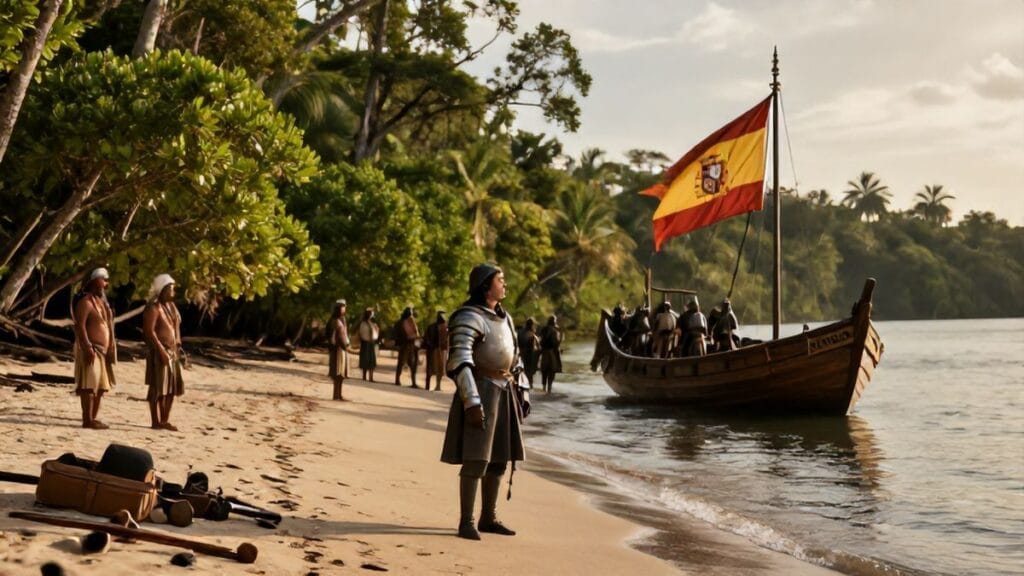
The early summer air along the Gulf Coast in 1539 was heavy and wet, the kind of humidity that clung to skin and armor alike. Mangroves and palmettos rustled in the onshore breeze, while flocks of wading birds wheeled above the shallows. For the people who already called this place home—the Timucua and other indigenous communities spread across the Florida peninsula—these shores were familiar, a living border between land and sea, season and season. For the hundreds of men aboard the Spanish ships slowly edging toward land, they were the threshold of a mystery.
As the vessels anchored off the west coast of Florida, likely near present-day Tampa Bay, metallic creaks and shouted orders cut through the rhythmic slap of waves against hulls. Casks of water thudded onto the decks, horses snorted nervously below, and in the dim holds, chained captives—enslaved Africans and Native Americans taken in earlier raids—were jostled as sailors prepared the landing. At the center of it all stood a man who believed this coast could make him a legend. His name was Hernando de Soto, veteran of brutal wars in Central and South America, newly appointed adelantado of Florida, and the driving force behind what would become one of the most consequential expeditions in North American history.
The hernando de soto expedition did not arrive as a mere scouting party. It came ashore as a moving city of conquest: hundreds of soldiers in gleaming breastplates and battered helmets, dozens of cavalry horses, war dogs, priests with their crucifixes and chalices, craftsmen, porters, and enslaved guides pressed into service. Banners bearing the royal arms of Spain snapped in the coastal wind. Muskets were primed; crossbows were strung. At least on paper, this armada was the spearhead of a new empire, a northern echo of what had been done in Mexico with Cortés and in Peru with Pizarro.
But this was only the beginning. As the first landing boats slid toward the shore and armor-clad men stumbled into the warm surf, the distance between fantasy and reality would grow with every step. What unfolded after those initial landings in 1539 was not a swift and glorious conquest, but a grinding, years-long march through dense forests, river valleys, and bustling native chiefdoms, leaving a trail of burned villages, shattered alliances, and unmarked graves. To understand how these first moments on the Florida coast became a prelude to devastation, we must turn back, across the Atlantic and into the life of the man whose ambition set all this in motion.
From Extremadura to Empire: The Making of Hernando de Soto
Long before the hernando de soto expedition splashed into Florida’s shallows, the boy who would lead it was born far from the sea, in the rugged, hardscrabble landscapes of Extremadura in western Spain. Extremadura was a frontier region, its hills and plains shaped by centuries of war against Muslim kingdoms and by the harsh inequalities of a rural, honor-obsessed society. Wealth here was scarce, nobility fiercely guarded, and younger sons like De Soto often grew up with little inheritance but a fierce drive to escape poverty.
Estimates place Hernando de Soto’s birth around 1500, in either Jerez de los Caballeros or a nearby town. He was not destitute, but neither was he secure. In the Spain of Ferdinand and Isabella, and later Charles V, opportunities for social mobility increasingly lay abroad, in the growing imperial frontiers of the Americas. Tales of gold, glory, and land filtered back from the Caribbean and the newly conquered territories on the mainland. For ambitious young men from Extremadura—Cortés, Pizarro, and De Soto among them—the New World became a stage where daring could rewrite destiny.
De Soto left Spain as a teenager, sailing first to the Caribbean and then to Panama. In Central America he gained a reputation for ruthless efficiency, serving under Pedrarias Dávila and participating in violent campaigns against indigenous populations in Nicaragua. He learned to command men, to use terror as a tool, and to read the political fractures within native societies. More than anything, he learned that astonishing wealth could be wrung from distant lands—if one was willing to take the risk and spill the blood.
His turning point came in Peru. Joining Francisco Pizarro’s expedition, De Soto rode into the Andean highlands as one of the chief cavalry captains in the campaign against the Inca Empire. He was present at Cajamarca in 1532, when the Spanish ambushed and captured the Inca emperor Atahualpa in a brutal display of force and duplicity. Within hours, thousands of Inca nobles and soldiers lay dead or dying, while the emperor sat a prisoner, offering up a roomful of gold and silver in a desperate bid for his life. The treasure that followed—tons of precious metal melted down and divided among the conquerors—transformed De Soto’s fortunes. He emerged rich, decorated, and hungry for a conquest of his own.
Yet behind the celebrations and the mounted parades in newly subjugated Peru, De Soto chafed under Pizarro’s authority and the increasingly bitter disputes among the conquerors. He wanted not merely a share of someone else’s glory, but a realm over which he alone would rule. By the mid-1530s, he had returned to Spain, appearing at the royal court in Valladolid as a man who could boast of both his wealth and his experience in toppling empires. There, he set his sights on Florida—an ill-defined region in the Spanish imagination, potentially vast, rumored to hold both riches and souls ripe for Christianization.
In a court crowded with petitioners begging for rights to colonize far-flung lands, De Soto was persuasive. He framed himself as the ideal adelantado for a new northern venture, promising both material wealth and the expansion of Christendom. To a crown burdened by wars in Europe and eager to secure its North American claims against potential French encroachment, the offer sounded tempting. In 1537, Charles V granted De Soto the title of governor of Cuba and adelantado of Florida, giving him the legal authority to conquer, govern, and reap the fruits of a territory barely known outside sailors’ logs and scattered reports.
From that royal grant, the idea of the hernando de soto expedition took shape: an armed, colonizing march into the heart of an unknown continent, modeled less on cautious exploration and more on the spectacular, violent successes of Mexico and Peru. That model, as events would show, was disastrously ill-suited to the realities of North America.
Dreams of Peru in the North: Why the Expedition Was Launched
To understand why hundreds of men willingly followed De Soto toward Florida, one must grasp the powerful illusions that haunted the European imagination in the 1530s. Mexico and Peru had set a precedent that seemed almost miraculous: a handful of Spaniards, leveraging superior steel, horses, and opportunistic alliances, had toppled massive indigenous empires and seized unimaginable wealth. The stories that circulated around Seville and Madrid were filled with golden idols, rivers of silver, and cities more dazzling than anything in Europe.
Florida, first sighted by Juan Ponce de León in 1513 and sporadically visited by later voyages, had not yet yielded such wonders. Earlier attempts at colonization had failed, thwarted by hostile environments, determined native resistance, and poor planning. Yet rumors persisted of powerful chiefdoms in the interior, of pearls and gold traded along distant riverways, and of fertile lands that could support Spanish settlements. The interior of the continent remained a blank space on European maps—an emptiness that Spaniards eagerly filled with echoes of the Aztec and Inca.
De Soto and his backers convinced themselves that north of the Caribbean, somewhere amid the forests and rolling hills, there must be another wealthy kingdom waiting to be seized—another “Peru.” Official documents cloaked the venture in the language of Christian duty and royal authority, but private letters and contracts made the core motive plain: profit. Soldiers and hidalgos invested their savings or borrowed heavily, wagering that the expedition would return with enough plunder to set them up for life. Merchants in Seville and Cádiz outfitted ships to carry the men, horses, and supplies, agreeing to share in future spoils.
The Spanish Crown’s motives were broader than gold alone. King Charles V faced rivals in Europe and worried about France’s increasing interest in North America. Claiming and settling Florida would help secure the sea-lanes of the Gulf of Mexico, protect the treasure fleets returning from New Spain, and extend Spain’s religious and political influence farther north. Officially, De Soto was to “pacify and populate” Florida, to establish towns, distribute encomiendas, and bring the local people into the orbit of the Catholic faith.
Yet even in the carefully worded royal documents, there was a telling ambiguity. Florida was little more than a name for a vast, uncertain region. Its borders were undefined; its peoples believed to be scattered and backward compared to the monumental civilizations farther south. The crown granted De Soto authority not only over the peninsula but over lands inland, wherever he might choose to march. In reality, he had been handed a license to roam and conquer as he saw fit, so long as he declared his actions in the service of God and king.
Thus the hernando de soto expedition emerged from a potent mix of imperial anxiety, religious zeal, and personal ambition. It was less a planned colonization effort than a roving enterprise of conquest-by-opportunity, driven by an expectation that somewhere in the interior, a great concentration of wealth would justify every hardship. When De Soto began to recruit men in Spain and later in Cuba, he sold them not the harsh realities of long marches and uncertain supplies, but the dream of discovering the next great empire—one that would bear his name.
Assembling the Armada: Soldiers, Slaves, Priests, and Opportunists
By 1538, ports in Andalusia were buzzing with activity connected to the hernando de soto expedition. In Seville, Jerez, and Sanlúcar de Barrameda, notaries recorded contracts as would-be conquistadors pledged their service in exchange for a share of whatever might be taken. De Soto and his agents combed the taverns, parade grounds, and markets for suitable recruits—veterans of earlier campaigns, young nobles with more pride than money, peasants fleeing debts, and craftsmen who could forge tools, shoe horses, or mend weapons on the march.
Contemporary accounts suggest that roughly 600 to 700 European men ultimately embarked for Florida, though exact numbers vary. They came from Spain, Portugal, and possibly other parts of Europe. Among them were armored cavalrymen with plumed helmets and fine horses, and infantry soldiers armed with swords, lances, crossbows, and a growing number of arquebuses—rudimentary firearms that belched smoke and flame, terrifying to people who had never seen such weapons.
But the expedition’s human composition extended beyond these European volunteers. De Soto purchased or requisitioned enslaved Africans to serve as porters, laborers, and sometimes as combatants. These men and women, torn from their homes and sold in Caribbean markets, were forced into a campaign whose objectives had nothing to do with their own survival or aspirations. As the writer-historian Charles Hudson later summarized, the expedition moved through the Southeast as “a mobile slave-taking machine,” capturing additional native people along its path to replenish its ranks of coerced labor.
Priests, too, played a role, although their numbers were small relative to the soldiers. They carried portable altars, missals, and vestments, ready to say Mass in makeshift chapels or under the open sky. Their presence offered a veneer of sacred purpose to what was fundamentally an armed invasion. In their sermons, they could frame submission to Spanish rule as submission to the true faith, and in their letters, they would later describe the native peoples in terms that mixed ethnographic curiosity with the rhetoric of salvation and sin.
Alongside these groups came interpreters, some of them Native Americans who had been captured on earlier expeditions around the Gulf Coast, others from regions farther south who knew some Spanish and a scattering of indigenous languages. One of the most important, later known to the Spaniards as Juan Ortiz, had his own harrowing story of shipwreck and captivity in Florida long before De Soto arrived. Such figures were essential—and deeply vulnerable—as Hispanic and indigenous worlds collided.
By early 1539, De Soto’s armada was ready to depart from Cuba, where he had paused to assert his authority as governor and secure additional supplies. The fleet, described variously as nine ships, or even more when counting smaller vessels, carried not only men and weapons but also perhaps several hundred pigs, destined to serve as a walking larder. Horses, tightly packed and often seasick, shifted and stamped in their cramped quarters. Every plank and nail, every barrel of wine, olive oil, and hardtack, every rosary and chain of iron had been brought together to push a singular vision into the unknown continent.
Yet even as trumpets sounded and sails billowed, there were hints of unease. Some veterans of earlier Florida ventures doubted that De Soto’s hopes for a northern Peru were realistic. Others worried about the logistical nightmare of moving so many people and animals through uncharted lands. But the contracts were signed, the debts incurred, and the ships already rolling on the Atlantic swells. Whether inspired by faith, fear, or greed, those who boarded had committed themselves to a journey that would be far more grueling than they imagined.
Sailing into Uncertainty: The Atlantic Crossing and Approach to Florida
The crossing from Cuba to Florida, though shorter than the transatlantic voyage from Spain, felt no less momentous to those aboard. Tropical storms could still lash the seas into chaos, and navigation in the Gulf of Mexico remained imprecise. The pilots plotted their course with astrolabes and dead reckoning, guided in part by the experiences of earlier explorers whose charts were often little more than sketches, coastlines scratched onto parchment and memory.
For many of the men, this was not their first time heading toward the edge of the known world. Yet the uncertainty of Florida bore a different weight than the better-mapped routes to Mexico or the Caribbean islands. On deck, soldiers leaned against rails and peered westward, trading rumors: of fierce warriors who could shoot arrows through armor, of swamps infested with alligators, of cities hidden beyond dark forests. In the creaking hold beneath them, the horses shifted with each swell, an unsettling clatter of hooves and chains echoing through the wooden hull.
De Soto moved among his officers, reviewing plans and reconfirming each man’s responsibilities. Scouts would have to secure the landing zone; interpreters would need to make first contact with local communities; priests would be ready to bless the venture as feet first touched land. The adelantado’s demeanor, as later chroniclers described it, was firm and confident, but he was not blind to the risks. He had seen how quickly fortunes could reverse in the Americas, how an ambush or a misjudged alliance could turn victory into catastrophe.
The hernando de soto expedition approached the Florida coast in late May 1539, its ships cautiously probing along the shoreline until a suitable harbor was found. Contemporary sources point to the bay the Spaniards called Espíritu Santo, widely believed to correspond to modern Tampa Bay or an adjacent stretch of coast. Low, forested land came into view, broken by inlets and marshes. Smoke curled upward in the distance, signaling the presence of human communities.
As anchors dropped and sails were furled, the mood on board shifted from anticipation to taut readiness. Boats were lowered over the sides, supplies and arms carefully loaded to avoid capsizing in the choppy surf. Officers checked armor straps, tightened sword belts, and counted off their men. Some soldiers, unused to the idea of fighting in dense woods rather than open plains, eyed the dark tree line with unease. The monks murmured prayers; a few men crossed themselves repeatedly, invoking protection against both visible and invisible threats.
The first landing parties stepped into the small boats and pushed off, oars biting into the water. The ships receded behind them as the shore grew larger and more detailed. Sandbars, mangroves, and tall grasses appeared one by one, then the faint outlines of distant dwellings or mounds. Florida, after decades of rumor and fragmentary contact, was about to become a very real and dangerous place in the imperial imagination.
First Footsteps on Florida’s Sand: The Landing at Tampa Bay
When the keels of the landing boats grated against the shallows and the first armored men swung down into the surf, a new chapter in the history of North America began to unfold. The hernando de soto expedition, with its soldiers, animals, and enslaved laborers, now had soil under its feet—a firm but precarious foothold on a coast that would soon witness both pageantry and violence.
The landing was not a silent affair. Boots splashed in the shallows, horses were coaxed or half-dragged ashore, snorting and flailing as they adjusted from ship’s planking to shifting sand. Men shouted orders in Spanish and Portuguese; the clank of metal and the crack of shifting crates punctuated the humid air. Standard-bearers planted royal banners in the damp earth, and priests quickly prepared a makeshift altar. In a ritual repeated countless times across the Americas, De Soto and his officers knelt to kiss a cross and hear Mass, symbolically claiming the land for God and king.
Yet this land was not empty. Indigenous scouts had almost certainly watched the ships’ approach from a distance, relaying word back to their communities. The Timucua and other peoples of the region were no strangers to Europeans. They remembered earlier expeditions—Narváez’s disastrous venture in 1528, Pánfilo de Narváez’s men stumbling through Florida’s coastlines, leaving behind disease, death, and tales of cruelty. Survivors’ stories likely traveled from village to village, embedding the Spaniards in native political calculations long before De Soto’s arrival.
Initial contacts were tense and wary. Some native groups approached the shore cautiously, bearing tokens of peace or curiosity, while others kept their distance. Interpreters tried to bridge the gulf between languages and worldviews, but they themselves often came from different regions and linguistic families, making misunderstandings almost inevitable. De Soto, accustomed to asserting dominance through display and force, soon demanded food, porters, and information about powerful rulers in the interior. Local leaders faced a grim choice: comply with this armed, unpredictable presence or resist and risk destruction.
The adelantado moved quickly to secure a base camp near the bay, ordering the construction of temporary shelters and storage areas. From this precarious beachhead, the expedition would reorganize itself into a marching column. Horses were sorted into companies, weapons distributed, and the chain of command reemphasized. De Soto’s plan, conceived in the royal courts of Spain and refined in Cuba, was to strike inland in search of richer lands and more centralized power—places where, he believed, loot and leverage might be concentrated in the hands of a few rulers, as in Mexico and Peru.
But Florida’s political landscape was very different. Instead of a single empire, De Soto faced a mosaic of chiefdoms, each with its own leaders, rivalries, and historical memories. His arrival near Tampa Bay did not confront a unified front; it sent shockwaves through a networked world of alliances and enmities stretching into the interior. And as the Spaniards began to prepare for their march, the first signs appeared that this expedition would leave more devastation than treasure in its wake.
Encounter and Captivity: Native Guides and the Struggle for Control
Early in the Florida campaign, the hernando de soto expedition seized upon a tactic that had been used by conquerors elsewhere in the Americas: the capture and coercion of local guides and interpreters. Native knowledge of pathways, river crossings, and political centers could mean the difference between starvation and survival, between stumbling blindly and striking swiftly at the heart of a chiefdom. To De Soto, forcibly acquiring such knowledge was a logical step; to the indigenous communities, it was a profound violation of social bonds.
One of the most striking stories of this period involved Juan Ortiz, a Spaniard who had been shipwrecked in Florida years earlier and survived as a captive and then as a kind of intermediary within native society. When De Soto’s men learned of a “Christian” living among the locals, they organized a daring search, eventually recovering him from a village where he had learned the Timucua language and adapted, at least partially, to life among his captors. Ortiz’s presence gave the expedition a fragile bridge into certain communities, but it also highlighted the volatility of cross-cultural encounters: a man presumed dead now returned, carrying memories of both Spanish cruelty and native hospitality.
In other cases, De Soto simply seized local leaders or their relatives, forcing them to serve as guides or hostages. Chiefs who initially welcomed the Spaniards with corn, fish, and ritual greetings soon found themselves bound, interrogated, or marched along the column to guarantee their people’s compliance. Such tactics, while effective in the short term, sowed deep resentment. Every abduction, every killing of a resisting warrior, rippled outward through kin networks and alliances, turning curiosity into fear and often into determined hostility.
Indigenous strategies of encounter were not passive. Some communities attempted to manipulate Spanish expectations, sending them in directions that would steer the invaders away from their closest allies or sacred sites. Others dangled tales of distant wealthy cities, knowing that greed might pull the strangers ever farther from the coast and deeper into unfamiliar territory. Still others chose armed resistance from the start, harassing the column with hit-and-run attacks, burning fields ahead of its advance, or using intricate knowledge of the terrain to ambush small Spanish detachments.
Within the expedition itself, captivity and coercion were grimly familiar, for even the Spaniards were bound in webs of obligation and fear. Many common soldiers owed debts they could not easily repay; some had effectively mortgaged their future for a chance at spoils. Enslaved Africans and indigenous captives bore the brunt of the physical labor, carrying loads, building camps, and sometimes standing in the front lines of battle as expendable shields. The entire enterprise moved forward on the backs of people who had little say in where they went or whether they would live to see home again.
It’s astonishing, isn’t it, how the fate of thousands could pivot on a single decision to seize a guide or kill a resisting leader? In letters and later chronicles, the justifications were often couched in the language of necessity and royal mandate. Yet behind those words lay a brutal reality: the hernando de soto expedition advanced by systematically undermining the social and political fabric of every community it touched.
Marching Inland: Through Swamps, Timucua Towns, and Fields of Maize
Leaving the relative security of the coastal camp, De Soto organized his men into a marching column that quickly became a familiar, if terrifying, sight to the peoples of the interior. At its front rode armored cavalrymen, their horses’ hooves thudding against packed earth or sucking into swampy ground. Behind them came blocks of infantry, pikes and crossbows at the ready, flanked by small contingents of arquebusiers whose gunfire would signal the beginning of many battles. Interspersed among the armed men were porters, priests, blacksmiths, carpenters, and the long, miserable train of enslaved laborers.
The Florida interior presented a challenging environment. Miles of wetlands and cypress swamps forced the expedition to slog through waist-deep water, their armor rusting and their supplies repeatedly soaked. Mosquitoes swarmed at dusk and dawn; diseases, though poorly understood, took their toll on man and beast alike. Horses broke legs or died from exhaustion and infection; pigs, more resilient, foraged and bred, ensuring a continuing food supply but also trampling fields and spreading chaos in native villages.
Yet the land also revealed its richness. The expedition passed through maize fields and well-organized towns, some with earthen mounds and wooden structures that testified to centuries of agricultural and political development. They encountered the Timucua, Apalachee, and other groups who had constructed complex societies with trade networks that reached far beyond the peninsula. Storehouses of corn, beans, and squash supported large populations, while skilled hunters and fishers exploited the region’s abundant wildlife.
De Soto’s men, trained by their experiences in Mesoamerica and the Andes to look for hierarchy, quickly began to identify powerful chiefs—caciques—who wielded significant authority in their regions. However, the political patterns of the Southeast, built around decentralized chiefdoms rather than unitary empires, baffled Spanish expectations. A chief might command several towns and thousands of people, yet still exist within a web of reciprocal alliances and rivalries that extended across rivers and ridges. To the Spaniards, who sought a single “king” to conquer, this mosaic of power centers felt frustrating and, at times, invisible.
As the column moved, it demanded food and labor from each community it encountered. Some chiefdoms responded with tribute and attempted hospitality, hoping to appease or redirect the invaders. Others, recognizing that Spanish demands quickly became insatiable, chose resistance, leading to skirmishes and punitive raids. Towns were burned, granaries emptied, and sacred objects looted or desecrated. The march inland thus became a pattern of extraction and flight: extraction by the Spaniards, and flight by indigenous families who retreated into forests and swamps ahead of the foreign storm.
From the perspective of De Soto’s chroniclers, these months were filled with tests of endurance and moments of spectacular violence. From the perspective of the people whose homes lay in the expedition’s path, they were a catastrophe in slow motion, a relentless intrusion that uprooted daily life and set in motion changes that would be felt for generations.
Chains and Crosses: Violence, Conversion, and Resistance
In the chronicles of the hernando de soto expedition, religion and violence were often intertwined. Priests spoke of bringing the true faith to “heathen” peoples, while soldiers enforced obedience through whips, blades, and fire. At each major village or town, De Soto insisted on formal acts of submission, demanding that local leaders accept Spanish authority ostensibly granted by the distant Pope and king. This ritual, known in earlier conquests as the reading of the Requerimiento, set out in Latin or Spanish a legal fiction: that indigenous resistance justified enslavement and war.
Of course, few if any of the listeners understood the words. What they heard, instead, were the actions that followed. Houses burned as warnings. Dissenters were hanged or cut down. Women and children were taken as captives. Men were pressed into service as carriers or forced laborers, tied together with ropes and driven ahead of the column. The sight of chained lines of indigenous porters becoming part of the moving Spanish camp burned itself into the memories of survivors and set a grim precedent for future encounters between Europeans and the peoples of the Southeast.
Conversions to Christianity, when they occurred, were often hurried and superficial. A chief might accept baptism as a political gesture, a means of staving off immediate violence or gaining favor with this dangerous new power. Priests recorded such events with triumph, describing the “saving of souls,” yet the surrounding context makes clear that fear, not conviction, usually drove them. When the expedition moved on, those baptized were rarely left with sustained instruction or protection; the sacraments had been tools of negotiation, not genuine dialogue.
Native resistance took many forms. At times it was direct and bloody: warriors massed to attack Spanish detachments, showering them with arrows and attempting to exploit the vulnerabilities of cavalry in forests or swamps. At other times, it was subtle and slow-burning. Villages deliberately underreported their stores of food, hid their young men, or sent the expedition misleading information about distant “rich lands” in hopes of diverting it elsewhere. Women, who bore the brunt of both physical violence and the disruption of families, used the spaces available to them to hide children, maintain secret practices, or pass on stories of what they had seen.
European observers, steeped in the justifications of empire, often described such resistance as treachery or stubbornness. Modern historians, by contrast, tend to see it as rational survival strategy. As one scholar has observed, indigenous communities encountered “not just a column of soldiers, but the advance edge of a whole new ecological and political order.” Faced with such a threat, no single response was sufficient; instead, a patchwork of resistance, accommodation, and strategic distance emerged, reflecting the diversity of cultures and situations across the Southeast.
In the short term, Spanish steel and horses usually carried the day in open confrontations. In the longer term, however, it was not armor but pathogens that would have the most devastating impact. Even as De Soto and his men moved northward, they likely carried with them diseases such as smallpox, measles, and influenza, to which indigenous populations had no prior exposure. The resulting epidemics—often striking after the expedition had moved on—would hollow out towns, kill leaders, and unravel the social fabric in ways no conquistador could fully control or even comprehend.
Into the Heart of the Southeast: Georgia, the Carolinas, and Beyond
By late 1539 and into 1540, the hernando de soto expedition had begun to push beyond the borders of what we now call Florida, moving into the territories of present-day Georgia and the Carolinas. The landscape changed as they advanced: coastal wetlands gave way to rolling hills, pine forests, and broad river valleys. The climate, while still humid and punishing in summer, offered cooler winters, and the evidence of complex, agrarian societies became ever more apparent.
The Spaniards encountered a succession of chiefdoms, each with its own internal hierarchy, ceremonial centers, and agricultural surplus. At Cofitachequi, in what is now likely South Carolina, they entered a political center that impressed even hardened veterans of Mexico and Peru. The town boasted large mounds, wooden structures, and storehouses. Here, the expedition met a female ruler—often referred to in chronicles as a “lady of Cofitachequi”—whose grace and political acumen challenged Spanish assumptions about gender and authority in indigenous societies.
Yet even in these moments of apparent diplomacy, the pattern of exploitation continued. De Soto sought gold and pearls, precious metals and portable wealth that he could send back to Spain as proof of his success. When the quantities he found did not match his overheated expectations, he responded with greater pressure, taking hostages and stripping temples and graves of their valuables. The relationship between guest and host, already strained by the sheer size of the Spanish party and its appetites, frequently snapped under such strain.
The expedition’s movements were not linear; they often looped and detoured based on rumors and fragmentary intelligence. Scouts reported distant cities and rich lands to the west, prompting De Soto to alter his course repeatedly in search of a definitive prize. This wandering quality has made it difficult for modern historians and archaeologists to reconstruct the exact route, but consensus suggests that the expedition passed through significant portions of Georgia, South Carolina, North Carolina, Tennessee, and Alabama.
Each new region brought fresh encounters and fresh dangers. The Spaniards had to cross wide rivers without the benefit of bridges, sometimes building crude rafts or commandeering native canoes. They ascended and descended steep hills, their heavy armor and weaponry turning every slope into a test of endurance. Supplies fluctuated; in times of scarcity, tensions within the expedition sharpened, and De Soto’s authority was tested by murmurs of discontent among men who had expected quick riches, not endless marching.
Still, the adelantado refused to turn back. Pride, ambition, and the sunk costs of the venture pushed him onward. Having promised the Crown and his investors a new Peru, he could not easily admit that the Southeast, for all its vibrant societies, did not fit the script he had borrowed from earlier conquests. The result was a grim determination to press farther into the unknown, no matter how many lives it cost.
Winter in the Chiefdoms: Coosa, Cofitachequi, and the Fragile Balance of Power
Wintering in the American Southeast was perhaps the greatest trial of the hernando de soto expedition. Cold rains soaked thin clothing and seeped into every joint of worn armor. Nights grew longer; supplies of fresh food dwindled, and the countryside, already pressured by repeated Spanish demands, could not easily sustain such a large external population. In this context, the expedition’s interactions with major chiefdoms like Coosa became crucial.
Coosa, located in what is now likely northern Georgia or Alabama, sat at the center of an extensive network of allied towns and subordinate communities. Its leaders commanded not only military forces but also ritual authority. Spanish chroniclers described large public spaces, mounds, and a well-fed populace—signs of an organized and prosperous society. To De Soto, Coosa represented both a potential prize and a potential threat.
Relations there and in other winter encampments followed a familiar arc. Initial hospitality, often formal and ceremonial, was followed by escalating Spanish demands for food, clothing, and workers. Local leaders, fearing the consequences of outright refusal, tried to balance the needs of their own people with the dangerous caprices of their visitors. In some cases, they used the Spaniards as temporary allies against rival chiefdoms, redirecting the expedition’s destructive potential outward. In others, they quietly prepared for resistance, counting the foreigners’ weaknesses as carefully as the foreigners counted their horses and swords.
Inside the Spanish camp, winter intensified existing hierarchies and tensions. Officers clung to their privileges; common soldiers grumbled about broken promises. Enslaved porters and native captives, more vulnerable to hunger and exposure, sickened and died in greater numbers. Priests struggled to interpret the hardships: were they divine tests, punishments for sin, or simply the cost of carrying the faith into new lands? To many in the ranks, such questions seemed distant; survival, not theology, consumed their days.
The fragile balance of power between De Soto and the chiefdoms that hosted or endured his presence could tip with startling speed. A single insult, a misunderstood gesture, or a perceived act of treachery could trigger deadly reprisals. In some winters, entire towns were abandoned ahead of the Spanish advance, leaving behind cold, empty houses and hastily hidden stores of grain. In others, carefully negotiated truces allowed both sides a tense coexistence until the spring thawed not only the ground but also the expedition’s restless urge to move on.
Among modern scholars, these winter encampments are often cited as key turning points, moments when De Soto might have chosen to consolidate, negotiate permanent settlements, or even withdraw. Instead, he treated them as pauses in a larger, forward-driving narrative. Winter was not a conclusion but an interlude—a time to regain strength before pushing toward the next rumored center of wealth, the next “Cibola” or “Peru” that danced just beyond the horizon of Spanish knowledge.
Across the Great River: The Mississippi and De Soto’s Final Gamble
In the spring of 1541, the hernando de soto expedition confronted a barrier unlike any it had yet faced: a river so broad and powerful that it seemed, to some eyes, more like an inland sea. This was the Mississippi, though the Spaniards knew it by other names given by the local peoples and their interpreters. Its muddy waters ran strong, its far bank barely visible in places through the morning mists. Logjams and drifting debris hinted at the river’s force even when its surface seemed deceptively calm.
To stand on that eastern bank, armor glinting under a hazy sun, was to feel the scale of the continent pressing in. The great river marked not just a physical frontier but an emotional one. Crossing it meant venturing into lands that no European had yet described in writing, beyond even the hazy rumors that had guided the expedition up to this point. For some of De Soto’s men, already exhausted and disillusioned, the Mississippi represented the edge of sanity. To go farther felt like tempting not only misfortune but divine wrath.
Yet De Soto saw the river as another challenge to be mastered. Drawing on the skills of his carpenters and the coerced labor of hundreds of native porters, he ordered the construction of boats—floating platforms sturdy enough to ferry men, horses, and equipment to the western shore. Over several days, trees were felled, planks shaped, and crude caulking applied. The work was slow and dangerous, conducted under the watchful eyes of local warriors who shadowed the Spanish camp from a distance, testing the newcomers’ resolve with occasional volleys of arrows.
When the crossing finally began, it was a spectacle of determination and precariousness. Horses balked at the strange movement of the rafts beneath their hooves; waves slapped against the sides; men clutched at rigging and shields, praying that the overloaded vessels would not capsize midstream. On the far bank, armed groups waited, uncertain whether to challenge the invaders directly or retreat and preserve their strength for a later confrontation.
Despite losses and close calls, the expedition reached the western side, establishing a presence in what is now the Arkansas–Mississippi region. From there, it continued its wandering—pushing into territories dominated by powerful Mississippian chiefdoms that had flourished for centuries along the river’s vast basin. But the Mississippi crossing had taken a toll. Supplies were running ever thinner, men were dying of wounds and disease, and the hope of discovering a single, wealthy empire was fading into the grim realization that the Southeast and beyond were home instead to numerous, dispersed centers of power.
For De Soto personally, the Mississippi was both the high-water mark of his ambition and the threshold of his decline. He had reached a point of geographic significance that later European empires would claim and contest for centuries, but he had failed to find the concentrated riches he sought. His health began to falter, a subtle erosion that mirrored the fraying of his grand design.
Death on the Riverbank: The End of Hernando de Soto
By 1542, the relentless strain of years on campaign had caught up with Hernando de Soto. The man who had strode through the plazas of Cajamarca and the mounds of Coosa now found himself increasingly confined to his tent, ravaged by fever and exhaustion. The exact nature of his illness remains uncertain—historians speculate on diseases ranging from malaria to typhus—but its effects were undeniable. The adelantado of Florida, conqueror of Peru’s battlefields, was dying in a foreign land far from the glory he had sought.
The expedition’s morale, already low, sank further as news of De Soto’s condition spread. For all the resentment and fear he inspired, he was the glue that held together this precarious coalition of officers, soldiers, and coerced laborers. Without him, who would command the necessary obedience to keep the expedition from collapsing into mutiny or chaotic retreat? Officers whispered among themselves, some positioning for succession, others quietly contemplating desertion or surrender to local powers.
When De Soto finally died, likely near the Mississippi River in present-day Louisiana or Arkansas, his followers faced a practical and symbolic crisis: what to do with the body of the man who had proclaimed himself a near-mythic figure to both Spaniards and natives. He had allowed local people to believe, or at least not denied, that he was more than mortal—an envoy of a supreme power, perhaps even a semi-divine being. If they saw him dead, the Spaniards feared, any remaining aura of invincibility would evaporate.
The solution was as grim as it was revealing. According to the chronicler Rodrigo Ranjel and later accounts preserved by the Inca Garcilaso de la Vega, De Soto’s body was wrapped in cloths and ballast, then secretly lowered into the dark waters of the Mississippi under the cover of night. There, in the muddy current he had struggled so hard to cross and claim, the adelantado vanished from sight. A man who had dreamed of monuments and titles was consigned instead to an unmarked, shifting grave, his resting place known only to the river and its witnesses.
The death of Hernando de Soto marked the end of the expedition’s central myth—but not the end of its movement. Leadership passed, after some contention, to men like Luis de Moscoso Alvarado, who now faced a stark choice: attempt to continue the quest in the faint hope of eventual triumph, or seek a way out of the continent that had swallowed their fortunes and their general. The decision, when it came, would shift the expedition’s narrative from conquest to survival.
Survivors and Silence: The Broken Return to Mexico
Without De Soto’s unbending will driving them forward, the surviving members of the expedition began to reevaluate their prospects. The hernando de soto expedition, once conceived as a spearhead of new conquests, had devolved into a depleted, traumatized band of men far from any friendly port. Their numbers had shrunk dramatically from the initial six or seven hundred Europeans; hundreds more indigenous captives and allies had died or dispersed. Horses, the symbol of Spanish military might, had perished in swamps, in battle, or under the weight of too many forced marches.
Luis de Moscoso and the other leaders debated whether to push westward toward the rumored Spanish outposts in New Spain or to strike south in hopes of reaching the Gulf coast and building ships. Both options were fraught with peril. To the west lay more unknown territory and potentially hostile peoples; to the south, long stretches of difficult terrain and the logistical nightmare of creating seaworthy vessels in the wilderness.
In the end, they attempted both, zigzagging through regions of present-day Texas and back toward the Mississippi, never quite finding a straightforward path to safety. Starvation stalked them; they were forced to eat their remaining pigs, then their war dogs, and eventually leather and whatever else could sustain life. Skirmishes with native groups continued, fueled now less by the allure of plunder than by the desperate need for food and canoes.
Finally, at the Mississippi’s edge once more, the survivors resolved to build boats that could carry them downriver to the Gulf of Mexico. Using salvaged iron from breastplates and weapons, they forged nails and tools. Trees were felled and shaped into planks and ribs. For weeks, the sounds of hammering and sawing mingled with the constant fear of attack. When the makeshift boats were finally launched, they were as much coffins as vessels of salvation, overloaded and fragile.
The journey downstream was harrowing. Sandbars, snags, and sudden storms threatened to overturn the craft at every bend. Yet somehow, by a mixture of skill, luck, and the grim determination of men who had no other choice, a core group of survivors emerged into the Gulf and followed the coast westward, eventually reaching Spanish settlements in Mexico in 1543. Of the hundreds who had embarked from Cuba and Florida years earlier, barely over half of the European contingent survived, and countless indigenous captives had lost their lives in the process.
When these survivors told their stories in Mexico City and later in Spain, their accounts were tinged with both wonder and disillusion. They spoke of vast rivers, populous chiefdoms, and fertile lands—evidence that North America was not the empty wilderness some Europeans imagined. But they also described grinding poverty among the peoples they met, a lack of the concentrated gold and silver that had made Mexico and Peru so profitable. For many colonial officials and investors, the lesson was clear: Florida and the Southeast were not worth another grand, Peru-like expedition.
And so, in the years immediately following, a kind of official silence settled over De Soto’s venture. The hernando de soto expedition had failed to deliver the spectacular triumph that would justify lavish celebration. Its surviving chronicles circulated among scholars and administrators, but the enterprise itself stood as a cautionary tale, a reminder that not every frontier could be remade in the image of earlier conquests.
Epidemics and Empty Villages: Long-Term Consequences for Native America
While European investors turned their attention elsewhere, the consequences of the expedition continued to unfold across the American Southeast, especially among indigenous communities that had borne the brunt of Spanish demands. Diseases carried by the expedition—smallpox, measles, influenza, and perhaps others—spread along trade routes and kinship networks, often arriving in towns that had never seen a European face. The deadly microbes traveled faster than any armored column, touching off epidemics that devastated populations and leadership structures.
Archaeologists and ethnohistorians have pieced together a haunting picture. Sites that show evidence of dense occupation and complex political life in the early 1500s appear to thin out or become abandoned in the decades after contact. Oral traditions among various Southeastern nations preserve memories of a time when “strange sicknesses” swept through, leaving whole families and lineages shattered. Fields lay fallow as survivors struggled to bury the dead and maintain even a minimal level of subsistence.
These demographic shocks had profound political implications. Chiefdoms like Coosa, Cofitachequi, and others that had impressed De Soto with their organization found it increasingly difficult to sustain the large labor forces needed to build and maintain mounds, storehouses, and ceremonial centers. Succession crises multiplied as entire elite families sometimes perished within a few years. In this shattered environment, the centralized Mississippian political systems that had dominated the Southeast for centuries began to fragment, giving way to smaller, more fluid communities that would later be encountered by English, French, and Spanish colonizers in the 1600s and 1700s.
Later European arrivals regularly described coming upon “empty villages” or “deserted fields,” interpreting them variously as signs of savagery, laziness, or divine providence. Rarely did they recognize that these landscapes bore the scars of earlier waves of disease and violence triggered by ventures like the hernando de soto expedition. The apparent emptiness was not primordial; it was created—an artifact of contact and catastrophe.
In some cases, the memory of De Soto’s march endured as a kind of distant warning. As historian Patricia Galloway and others have noted, tribes encountered by the French and English in later centuries often had stories of pale invaders who had come long before, demanding food and submission and leaving ruin in their wake. These tales, though sometimes compressed or transformed by oral tradition, served to shape indigenous strategies in dealing with later colonial powers. The first encounter with Europeans in the Southeast, then, was not a blank slate when the English founded Jamestown or the French settled along the Mississippi; it was layered over an older, bloodier history.
Thus, the legacy of the hernando de soto expedition was not merely the mapping of rivers or the naming of provinces. It lay in the invisible but enduring wounds it helped inflict on the peoples of the Southeast—wounds that changed the trajectory of entire nations long before most Europeans knew they existed.
Myths, Maps, and Misunderstandings: How the Expedition Redefined a Continent
Despite its material failures, the expedition significantly reshaped European mental maps of North America. The accounts brought back by survivors provided some of the earliest detailed descriptions of the interior of what is now the United States, from Florida’s wetlands to the Mississippi River and beyond. Chroniclers such as the Gentleman of Elvas and Rodrigo Ranjel recorded lists of towns, rivers, and peoples, however distorted by their own cultural filters and the exigencies of memory.
Cartographers in Spain and elsewhere drew on these texts to update maps, sketching in rivers like the Mississippi long before its full course was understood. Chiefdom names—Coosa, Apalachee, Cofitachequi, and others—appeared on charts and in administrative documents, often misplaced or misunderstood but nonetheless signaling that the interior was populated and politically complex. In this way, the hernando de soto expedition helped dislodge older European fantasies of a largely empty or uniformly “primitive” North American interior.
At the same time, the narratives also seeded powerful myths and misunderstandings. Early readers, conditioned by the spectacular wealth of Mexico and Peru, struggled to reconcile the presence of populous towns with the relative scarcity of precious metals. Some wrote off the Southeast as a land of “poor Indians,” suitable for missions and forts but not for grand plundering enterprises. Others, noting the fertility of the soil and the abundance of game, saw potential for agricultural colonies that would exploit the land rather than mines.
Within Spain’s imperial bureaucracy, De Soto’s reports contributed to a recalibration of priorities. The Crown and its advisers increasingly focused on stabilizing and exploiting already-conquered regions in Mexico, the Caribbean, and the Andes, while treating Florida and the northern Gulf region as strategic borderlands rather than primary theaters of imperial expansion. This shift opened space, centuries later, for other European powers to stake their own claims along the Atlantic seaboard and up the Mississippi basin.
As the centuries passed, the expedition’s story itself became a contested terrain. Spanish writers of the late sixteenth century, like the Inca Garcilaso de la Vega in his La Florida del Inca (1605), blended eyewitness testimony with literary embellishment, turning De Soto’s march into both a cautionary tale and a romantic saga. Garcilaso, writing as a mestizo intellectual in Spain, used the narrative to explore themes of cultural encounter and imperial excess, at times criticizing the cruelty of the conquest while still operating within its ideological framework.
Modern historians and archaeologists, sifting through sites, artifacts, and documentary fragments, have sought to peel back these layers of myth. Excavations at likely expedition camps—where European artifacts such as glass beads, iron tools, and Spanish ceramics appear in indigenous contexts—offer a silent but eloquent counterpoint to the chronicles. As one scholar has noted, “the ground remembers what the victors tried to forget.” These material traces anchor the story of De Soto’s march in physical reality, even as interpretations of its meaning continue to evolve.
Spanish Dreams, Imperial Limits: What the Crown Learned—and Ignored
The hernando de soto expedition taught the Spanish Crown and colonial administrators harsh lessons about the limits of imperial projection. The sheer scale and cost of the venture, measured against its tangible returns, made it a poor model for future undertakings in similar regions. Raising hundreds of armored men, transporting them across oceans, and sustaining them in hostile and little-known interiors required a level of investment and risk that, in the absence of easily extractable bullion, proved unsustainable.
In the decades after De Soto, Spain shifted its strategy in the northern Gulf and Atlantic regions. Rather than launching new, large-scale conquests into the interior, it focused on establishing fortified coastal outposts and missions, most notably in St. Augustine (founded 1565) and later along the Atlantic coast of Georgia and the Carolinas. These smaller, more permanent settlements aimed to secure sea-lanes, monitor rival European activity, and exert influence over nearby indigenous communities without committing to another multi-year march into the unknown.
Yet if the Crown learned to be more cautious in some respects, it ignored—or chose not to fully confront—other lessons. The brutal treatment of indigenous peoples by De Soto’s men, though criticized in some clerical and intellectual circles, did not fundamentally alter the underlying assumptions of Spanish colonial policy. Forced labor systems, coerced conversions, and the use of military force to suppress resistance remained core tools of empire. The tragedies of the Southeast became one more entry in a growing ledger of conquest, folded into broader debates about the “just war” doctrine and the rights of native peoples.
Within the Spanish world, voices like that of Bartolomé de Las Casas, who famously condemned the abuses of conquest in his Brief Account of the Destruction of the Indies, used cases like Florida to highlight the moral costs of imperial expansion. Although De Soto’s expedition is not the central focus of Las Casas’s work, it fits squarely within the pattern he described: ventures justified in the name of Christianization that instead brought widespread suffering and often failed to achieve their stated spiritual goals.
For future European powers watching from afar, the mixed results of the expedition suggested that North America might not be easily transformed into another Mexico or Peru. French and English colonizers, when they eventually embarked on their own ventures in the Southeast and along the Atlantic seaboard, adopted different models—emphasizing trade, smaller settlements, and alliances over large-scale inland conquest (at least initially). In this sense, De Soto’s failure helped shape not only Spain’s path but also the broader trajectory of European colonization in North America.
Echoes in the American South: Memory, Archaeology, and Modern Debate
Today, the routes once trudged by the hernando de soto expedition cut through modern states, highways, and suburbs. Markers and monuments dot the landscape—plaques near rivers, statues in city squares, reconstructed forts and interpretive centers—each offering its own version of what De Soto’s journey meant. In some places, he is remembered as an intrepid explorer, the first European to “discover” the Mississippi. In others, especially within Native American communities, he is recalled as the harbinger of disease, slavery, and cultural rupture.
Archaeologists have played a central role in grounding these memories in material evidence. At sites like the presumed winter camp at Anhaica near Tallahassee, and other locations scattered across the Southeast, they have unearthed European artifacts in unmistakably sixteenth-century indigenous contexts: iron nails, chainmail fragments, Spanish-style ceramics, glass beads, and copper-alloy items. These finds, carefully dated and analyzed, help refine our understanding of where the expedition actually traveled, providing a check against the sometimes contradictory written sources.
At the same time, indigenous nations whose ancestors encountered De Soto have asserted their own narratives. For the Muscogee (Creek), Choctaw, Chickasaw, and others, the expedition forms part of a longer history of resilience and adaptation in the face of European intrusion. In tribal museums, cultural preservation programs, and educational materials, the focus often lies less on De Soto himself and more on the societies he failed to fully comprehend—peoples who had long histories before 1539 and continued to endure long after 1543.
Public history debates frequently center on how to present figures like De Soto to broad audiences. Should monuments erected in earlier eras, which sometimes celebrate him uncritically as a heroic pathfinder, be recontextualized or removed? How should textbooks balance the drama of the expedition’s narrative with the sobering recognition of its destructive consequences? These questions reflect broader struggles over memory in the United States and beyond: who gets to define the past, and which perspectives are prioritized.
In recent decades, scholarship has moved decisively away from triumphalist conquest narratives. Works like Charles Hudson’s Knights of Spain, Warriors of the Sun (a landmark study of the expedition and its context) emphasize the sophistication of Mississippian cultures and the agency of indigenous actors. This shift aligns with a broader trend in global history that seeks to decenter imperial viewpoints and foreground the experiences of those who resisted, negotiated, and survived empire’s incursions.
Yet the story of De Soto’s march retains a powerful, if unsettling, fascination. It offers a stark, almost cinematic tableau: armored men hacking through swamps; native warriors watching from the tree line; tense councils between chiefs and conquistadors; the slow, invisible spread of pathogens; and finally, a dying general sunk into a mighty river under cover of darkness. To engage with this story today is to confront both the allure of adventure tales and the ethical imperative to see beyond them—to recognize the lives disrupted and the worlds forever changed by that landing on a Florida shore in 1539.
Conclusion
Seen in full, the hernando de soto expedition stands as one of the most revealing episodes of early colonial North American history. It began with high imperial hopes—a veteran conquistador, wealthy from Peru, entrusted with the task of transforming a vaguely imagined “Florida” into a new jewel of the Spanish Crown. It unfolded as a grueling odyssey through the complex societies of the Southeast, where chiefdoms with deep histories and sophisticated politics confronted a mobile force of armored strangers demanding food, labor, and submission. And it ended not with triumphant cities founded or great treasure fleets dispatched, but with a quiet burial in the Mississippi and a battered remnant of survivors drifting toward Mexico in makeshift boats.
The expedition’s legacies are manifold. It accelerated the spread of devastating diseases, contributed to the unraveling of Mississippian political systems, and left scars in oral traditions and archaeological strata alike. It also filled in European maps, reshaped imperial priorities, and helped convince both Spain and its rivals that North America would require different colonial strategies from those used in Mexico and Peru. Above all, it exposed the limits of a conquest model based on the expectation that all lands could be made to yield another Aztec or Inca empire to a handful of determined invaders.
For indigenous peoples of the Southeast, De Soto’s march was a catastrophe but not an ending. Despite demographic collapse and political upheaval, they rebuilt, reconfigured, and carried forward cultural traditions that endure to this day. Their resilience stands as a counterpoint to the narrative of Spanish failure, reminding us that history is not only written in the chronicles of conquistadors, but also in the lived continuities of those who survived them.
Remembering the hernando de soto expedition, then, is not an exercise in romanticizing exploration. It is an opportunity to reckon with the human cost of imperial ambition, to listen for voices long drowned out by the clang of armor and the thunder of hooves. On that Florida shore in 1539, two worlds met under unequal terms. The reverberations of that encounter still echo in the landscapes, communities, and historical debates of the modern American South.
FAQs
- Who was Hernando de Soto?
Hernando de Soto was a Spanish conquistador from Extremadura who gained wealth and fame in the conquest of the Inca Empire in Peru before leading a major expedition into Florida and the broader American Southeast between 1539 and 1543. - What was the main goal of the hernando de soto expedition?
The primary goal was to find a wealthy, centralized indigenous kingdom—another “Peru” or “Mexico”—that could be conquered for gold, silver, and prestige, while also claiming and “pacifying” Florida for the Spanish Crown. - Where did the expedition land in North America?
The expedition landed on the west coast of the Florida peninsula, most likely in or near present-day Tampa Bay, at a harbor the Spaniards called Espíritu Santo. - How many people took part in the expedition, and how many survived?
Roughly 600–700 European men, along with enslaved Africans and indigenous captives, began the journey. By the time the remnants reached Spanish territory in Mexico in 1543, only a bit more than half of the original European contingent were still alive, and countless indigenous captives had died. - Did Hernando de Soto really discover the Mississippi River?
De Soto and his men were the first Europeans known to cross and describe the Mississippi River in detail, but indigenous peoples had lived along and navigated the river for centuries. “Discovery” in this context refers only to European awareness. - How did the expedition affect Native American societies?
The expedition brought intense violence, forced labor, and the spread of Old World diseases, which contributed to population decline, political fragmentation, and long-term disruption of Mississippian chiefdoms throughout the Southeast. - Why is the expedition often considered a failure?
It is considered a failure because it did not find the vast stores of precious metals the Spaniards sought, did not establish lasting colonies, and ended with De Soto’s death and a desperate retreat, despite enormous human and financial costs. - What sources do historians use to study the expedition?
Historians rely on several primary chronicles written by participants or their near contemporaries, such as the Gentleman of Elvas, Rodrigo Ranjel, and the Inca Garcilaso de la Vega, combined with archaeological evidence from sites along the expedition’s probable route. - How long did the hernando de soto expedition last?
The expedition lasted about four years, from its landing in Florida in 1539 to the survivors’ arrival in Spanish Mexico in 1543. - Did the Spanish try another expedition like De Soto’s in the Southeast?
No large-scale expedition on the scale of De Soto’s was launched again into the interior Southeast. Later Spanish efforts focused on smaller coastal outposts and missions rather than sweeping inland conquests. - How is the expedition viewed today?
Today, it is viewed as a pivotal but tragic chapter in early American history—important for what it reveals about indigenous societies and colonial ambitions, but also emblematic of the violence and disruption that accompanied European expansion.
External Resource
Internal Link
Other Resources
- Encyclopaedia Britannica – general search for the exact subject
- Google Scholar – academic search for the exact subject
- Internet Archive – digital library search for the exact subject

