Table of Contents
- On the Eve of Devastation: Ganzak before the Flames
- Empires at War: Byzantium, Persia, and the Long Road to 624
- Heraclius’ Gamble: A Byzantine Emperor Turns Invader
- March into Atropatene: The Approach to Ganzak
- The City and the Fire-Temple: Heart of Atropatene
- The Day the Sky Darkened: The Sack of Ganzak Unfolds
- At the Temple of Ādur Gushnasp: Sacred Flames Extinguished
- Blood, Ash, and Echoes: Human Stories from a Broken City
- Heraclius’ Message to Chosroes: Vengeance in Smoke
- Persia Reacts: Fury, Grief, and the Waning of Sasanian Power
- Faith Tested: Zoroastrianism after the Fall of Ganzak
- Byzantine Triumph or Moral Burden? The Empire after 624
- Chroniclers and Silences: How the Sack Was Remembered
- Archaeology in the Ashes: Traces of a Lost City
- From Imperial War to Civilizational Turning Point
- Long Shadows: The Sack of Ganzak and the Coming of Islam
- Memory, Myth, and Modern Identity in Atropatene’s Landscape
- Conclusion
- FAQs
- External Resource
- Internal Link
Article Summary: In the winter of 624, amid one of late antiquity’s most brutal wars, the sack of Ganzak in Atropatene marked a violent turning point between the Byzantine and Sasanian empires. This article follows the road that led Emperor Heraclius into the Persian heartlands and into the sacred city that housed the revered Zoroastrian fire-temple of Ādur Gushnasp. Through narrative reconstruction, it explores how the sack of Ganzak unfolded, how soldiers and civilians experienced it, and why this single act sent political and religious shockwaves across the Near East. We examine the desperation of Byzantium, the hubris and vulnerability of the Sasanian state, and the symbolic power of extinguishing a holy flame that had burned for kings. By weaving eyewitness-style vignettes with careful historical analysis, the article shows how the sack of Ganzak was both a calculated military strike and an assault on meaning itself. It also follows the aftermath: Persian outrage, spiritual disorientation, and the slow crumbling of an imperial order. Finally, we trace how this episode has been remembered, misremembered, and partly buried, even as its consequences helped shape the world that Islam would soon inherit.
On the Eve of Devastation: Ganzak before the Flames
Before the clash of steel and the smell of smoke, Ganzak was, first and foremost, a living city. Nestled in the highlands of Atropatene, in what is now northwestern Iran, it had seen centuries of rulers pass—Achaemenids, Seleucids, Atropatenian kings, Arsacids, and finally the mighty Sasanian shahs. To a traveler approaching from the west on a cold morning in 624, Ganzak would not have looked like a place fated for destruction. Fields ringed the settlement, irrigated by canals that wound like silver threads through the landscape. The low winter sun picked out the outlines of houses, workshops, and storehouses, and above them all, on its rise, the sacred complex where the eternal fire of Ādur Gushnasp burned for rulers and warriors.
In the streets, Armenian merchants haggled with local farmers over bales of wool and amphorae of wine. Sogdian traders, with their far-reaching commercial networks that touched lands as distant as China and the Black Sea, might be passing through, red-faced from the cold, cloaks wrapped tightly about them. Women carried bread from communal ovens; children darted between stalls; priests in white linen robes navigated the lanes with the calm gravity of those who believed the world’s order depended on their rituals. The city’s sounds were ordinary: a smith’s hammer, the call of a vendor, the lowing of cattle. No one knew—no one could know—that within months, this world would be scorched, its sacred heart torn out in an episode later remembered simply as the sack of Ganzak.
Yet tension hung in the air like frost. Rumors preceded the reality. Pilgrims from the west came with alarming tales: that the Romans—or rather, as they were now called, the Byzantines—had not only survived years of Persian invasions but were fighting back with a fury that seemed almost reckless. They said an emperor named Heraclius had taken up the sword, that he rode at the head of his armies into lands no Roman army had dared enter since the days of Trajan. They spoke of battles in Armenia and raids deep into Persian-controlled territories. To some in Ganzak, these stories were distant thunder. To others—especially the priests and local officials who understood the geography of power—they were omens.
At night, the wind swept down from the mountains, rattling shutters. In the fire-temple precinct, however, there was warmth and light. The sacred fire—tended carefully by Zoroastrian priests who traced their authority back through generations—did not flicker with uncertainty. It was the visible sign of the divine order, of the covenant between the king of kings and the god Ahura Mazda. So long as it burned, there was a sense that even in times of war, the cosmos itself remained aligned. The city’s identity was wrapped around that flame. Agricultural surplus, caravan trade, administrative functions—all converged on Ganzak because of the temple’s prestige. People here did not think of their home only as a provincial town; they thought of it as a hinge of the sacred.
And that is precisely why, when the fires of war finally did reach Atropatene, they would burn so fiercely. The sack of Ganzak would not be a random atrocity committed by soldiers out of control. It would be, as we shall see, a deliberate blow aimed at the spiritual and political foundations of the Sasanian Empire, carried out by a cornered emperor who wagered everything on terror, spectacle, and psychological warfare. On the eve of its destruction, however, Ganzak still breathed in rhythms set by the harvest, the festivals of the Zoroastrian calendar, and the slow movements of caravans—not by the violent calculations of distant courts.
Empires at War: Byzantium, Persia, and the Long Road to 624
To understand why Ganzak became a target in 624, one must step back into the stormy decades that made such an act imaginable. The early seventh century was a time when the Byzantine Empire, ruling from Constantinople, and the Sasanian Empire, ruling from Ctesiphon on the Tigris, were locked in conflict of almost apocalyptic proportions. The war that led to the sack of Ganzak began in 602 and would last, with only brief interruptions, until 628. It is sometimes called the last great war of antiquity, and it deserves that title.
The conflict’s origins lay in a coup and a friendship. In 590, the Sasanian prince Khusrau II, known to Greek sources as Chosroes, was driven from his throne by a usurper. Fleeing east, he found an unlikely ally: the Byzantine emperor Maurice. Maurice supported Khusrau’s bid to reclaim power, sending troops and resources. Their gamble succeeded. Khusrau returned to Ctesiphon as king, indebted to his Christian neighbor. For a time, relations between the two empires improved. The frontier stabilized. Peace seemed possible.
Then everything collapsed. In 602, soldiers of the Byzantine army mutinied. They elevated a low-ranking officer, Phocas, to the throne. Maurice and his sons were captured and brutally executed—thrown, according to some accounts, into the sea. Khusrau seized upon this regicide as a casus belli, claiming he would avenge his benefactor and restore Maurice’s line—or at least pretend to. Under that banner, Sasanian armies surged into Byzantine territories. They captured fortress after fortress, city after city. By the 610s, they controlled much of Syria and Mesopotamia. In 614, they took Jerusalem itself, seizing the True Cross and sending shockwaves through the Christian world.
Heraclius, who became emperor in 610 after overthrowing Phocas, inherited a realm on the edge of collapse. Persian forces advanced into Anatolia; their presence could be felt dangerously close to Constantinople. The empire’s revenues shrank; its armies were exhausted. Egyptians, Syrians, and Armenians saw Persian banners flying over their cities. Some local elites, disillusioned with the distant government in Constantinople, even cooperated with the invaders. For Khusrau, this was a moment of triumph. He could present himself as the rightful avenger and as the shāhānshāh—the king of kings—favored by the gods.
But the war dragged on, grinding down both sides. What began as a punitive campaign mutated into a total struggle for supremacy. The devastation was immense. Towns in eastern Anatolia and northern Mesopotamia changed hands multiple times. Armies lived off the land, requisitioning grain, cattle, and people. Into this vortex stepped Heraclius with a radical idea: instead of remaining on the defensive, he would strike deep into Persian territory. He would turn the war around not by recapturing lost provinces one by one, but by threatening the very core of the Sasanian system.
When Heraclius finally launched his counteroffensive in the early 620s, the war entered a new and more brutal phase. No longer was it simply about borders. It was about sacred spaces, imperial legitimacy, and the psychological foundations of rule. This is the larger, darkening horizon against which the sack of Ganzak must be set. The city, with its holy fire and its position in Atropatene, lay within a region that had been relatively shielded from the earlier phases of the conflict. By 624, however, nowhere in the Sasanian realm was truly safe.
Heraclius’ Gamble: A Byzantine Emperor Turns Invader
Heraclius’ decision to invade Persian territory was not an act of imperial swagger; it was an act of desperation sharpened into genius. By the late 610s, he had debated abandoning Constantinople altogether, fleeing to Carthage in North Africa and ruling a shrunken state from there. Patriarch Sergius and other church leaders urged him to stay, to trust that God had not abandoned the Christian empire. That appeal to faith intertwined with cold strategic calculation. If Heraclius remained on the defensive, the slow suffocation of his empire seemed inevitable. Only a daring stroke could alter the dynamic.
Beginning in 622, Heraclius reorganized his armies, raising new forces from Anatolia and the Balkans. He also restructured the financial system, drawing heavily on church wealth. Icons and vessels were melted down; gold and silver were turned into pay for soldiers and supplies for campaign. In an echo of later crusading rhetoric, Byzantine chroniclers describe Heraclius casting his campaign as a holy war, a struggle to reclaim the True Cross and humiliate the Zoroastrian “fire-worshipers” who had defiled Christian lands. It is hard to disentangle genuine piety from political necessity here, but there is no reason to doubt that the emperor believed he fought under divine favor.
In 622, Heraclius left Constantinople at the head of an army, an emperor once again becoming a field commander. Over the next years, he fought and maneuvered in Armenia and northern Mesopotamia, scoring significant victories that surprised the Persians. He forged alliances with the Turkic Khazars in the Caucasus, widening the war. By 624, he was ready to push further, across the Araxes River and down into Atropatene—the land that would bring him to the gates of Ganzak.
This was a bold move. To march into Atropatene was to penetrate deep into a region the Persians considered part of their core sphere, a shoulder of the Iranian plateau that had long served as a corridor for armies and caravans heading toward Media and beyond. Sasanian rulers counted on the loyalty of local nobility here, on the prestige of major fire-temples like Ādur Gushnasp, and on the protection of rugged terrain. Heraclius knew that if he could operate successfully in these mountains, burning and plundering as he went, he would send a message that no part of Khusrau’s empire was beyond Roman reach.
Sources differ on some details. The Armenian historian Sebeos, writing a generation later, portrays Heraclius as a cunning strategist who moved with speed and surprise, striking where he was least expected. Greek chroniclers, such as Theophanes the Confessor (who would write in the early ninth century), emphasize the emperor’s piety and the miracles that, in their view, accompanied him. Persian sources tend to be silent or terse on these humiliations. Yet one point of convergence emerges: wherever Heraclius’ army went in 624, destruction followed. Settlements were looted, garrisons broken, storehouses emptied. It was warfare stripped down to its harsh essentials.
By the time Heraclius turned his gaze toward Ganzak, the logic of the campaign had crystallized. He would not win by merely defeating Persian armies in the field; he would win by unmaking the mental map that assured Khusrau of his invulnerability. The sack of Ganzak, as later remembered, was a calculated piece in that strategy. Destroying a holy place tied to Sasanian kingship would be, from Heraclius’ perspective, a victory not only in the material but in the symbolic realm. The emperor’s gamble was that such shocks would push the Persians toward crisis and, eventually, negotiation. It is astonishing, isn’t it, how often in history devastation is justified as a path to peace?
March into Atropatene: The Approach to Ganzak
The route into Atropatene was no easy march. In 624, Heraclius led his forces across rugged country, where winter could be as deadly as any enemy. The army moved through a patchwork of valleys and passes, encountering fortified positions and villages whose names have since vanished from most records. Each advance was a test of logistics. Pack animals strained under loads of grain and weaponry; scouts ranged ahead, sounding out Persian positions. Behind Heraclius, the long shadow of previous campaigns loomed. Roman armies had once ventured east with dreams of annexation; now, he ventured east with dreams of survival.
Armenian and local Christian guides proved crucial. These were men familiar with the trails that cut across the mountains, the river fords that could be used even in winter’s low waters, the hidden paths that allowed relatively large forces to appear where they were not expected. Heraclius’ alliance-building bore fruit here. He did not rely solely on his Byzantine core: contingents from allied peoples moved with him, giving his force a composite character. The war was drawing in more and more actors, many of them motivated by local grievances against Sasanian rule.
For ordinary soldiers, the march must have felt like an endless succession of cold mornings, hurried meals, and sudden alarms. Yet there were also moments of grim satisfaction when Sasanian outposts were overwhelmed or when word arrived that another Persian detachment had retreated rather than risk engagement. The psychological tide was turning. Where once Byzantines had feared the seemingly unstoppable advance of Khusrau’s generals, now it was Persians who felt a new unease. Reports flowed back to Ctesiphon: Heraclius had crossed this river; Heraclius had burned that depot; Heraclius was heading into Atropatene. Each message chipped away at the illusion of secure frontiers.
Ganzak’s elites would have heard of these movements. Messengers from local nobility or imperial officials, perhaps breathless from hard riding, would have delivered updates to the city’s magistrates and priests. The question on everyone’s lips: would the Roman army really come this far? Some argued that it was impossible. Others, more cautious, might already have begun moving family members or valuables to safer locations. The fire-temple’s custodians likely intensified their rituals, seeking divine favor against an approaching storm. In their worldview, the empire’s fortunes were inseparable from cosmic order, and cosmic order manifested itself in the well-tended sacred flame. To imagine that flame extinguished was, in a very real sense, to imagine the world thrown into chaos.
Heraclius, too, understood the power of symbols. Marching into Atropatene, he would have been briefed by advisers and local informants about the significance of Ganzak and its temple. Here was a place visited by kings, a place of pilgrimage for the Sasanian aristocracy, a spiritual anchor. Roman generals had assaulted cities and shrines before—Jerusalem’s own sufferings under earlier emperors were not forgotten—but in the religiously charged atmosphere of the seventh century, the political calculus was different. To destroy a temple was to declare war on the god who dwelt there and on the king who claimed to protect it. Heraclius, cast by his own propagandists as a champion of Christ, was about to turn that theological conflict into burning reality.
The City and the Fire-Temple: Heart of Atropatene
To grasp the enormity of what the sack of Ganzak meant, one must pause and dwell on the city’s special status. Ganzak was more than a provincial administrative hub; it was a linchpin of Sasanian religious geography. Within or near the city stood the fire-temple of Ādur Gushnasp, one of the three great fires of Zoroastrian tradition, associated especially with warriors and kings. It drew nobility from across the Iranian world who came seeking blessing before campaigns, coronations, or major undertakings.
Ancient descriptions of the temple are sparse but evocative. Later Islamic geographers, relying on fading local memories, speak of a grand complex with richly decorated halls, treasuries filled with offerings, and precincts where priests performed rituals with a precision inherited from centuries past. The fire itself burned in a sanctuary that only the purest specialists could enter. Fed with carefully chosen fuel, protected from pollution, it symbolized not merely physical warmth but the presence of asha—cosmic truth and order—in a world threatened by druj, the Lie. Kingship, in Zoroastrian ideology, was legitimate only insofar as it aligned with asha. That is why rulers such as Khusrau II took their relationship to the temple so seriously.
In the city streets, this high theology translated into concrete rhythms. Festivals tied to fire worship and seasonal cycles punctuated the year. On important days, processions might wind through the streets, carrying offerings up to the temple. Artisans produced objects destined for the sanctuary—finely worked metal stands, textiles embroidered with royal motifs, vessels for sacred liquids. Wealth flowed into Ganzak not simply because it sat on trade routes, but because it was a magnet for pious generosity and royal attention. Even those who did not care much for theology understood that the temple sustained jobs, prestige, and patronage networks.
The Sasanian kings, heirs to a long line of Iranian monarchs, used such shrines as stages upon which to enact their power. An inscription or later literary tradition might recount how a king made a lavish donation after a victory, or how he fulfilled a vow by refurbishing the temple’s roof or adding new ornaments. In this interplay of religious and royal authority, Ganzak held a place of honor. Its destruction at Byzantine hands was therefore a direct challenge to the ideological scaffolding of Sasanian rule. To put it bluntly: if the Romans could burn Ādur Gushnasp, what else in Khusrau’s realm was truly sacred or safe?
On the eve of the attack, then, we must imagine the temple complex as both active and vulnerable. Priests chanting sacred verses, lay visitors making offerings, guards posted at outer gates, local townsfolk moving in and out of the precinct on errands. Some might have heard distant rumors of a Roman advance; a few might have glimpsed distant smoke from villages already raided. But the scale of the coming assault—the complete, deliberate sack of Ganzak and the desecration of its holiest site—was beyond most people’s darkest nightmares.
The Day the Sky Darkened: The Sack of Ganzak Unfolds
The sources do not offer a minute-by-minute account of the sack of Ganzak, but by piecing together chronicles and patterns of late antique warfare, we can reconstruct the arc of that terrible day. Dawn probably broke cold and gray. Heraclius’ army, having approached under cover of terrain and weather, formed up on the heights or plains overlooking the city. Trumpets sounded; officers barked orders; cavalry units checked their tack. Below them lay their target—walls, gates, crowded houses, the temple’s rising forms. The emperor’s objective was not occupation or negotiated surrender. It was shock.
Whether the city’s defenders had time to organize a coherent resistance is uncertain. Sasanian military forces were stretched thin by this point in the war. Garrisons had been pulled from secondary locations to reinforce more threatened frontiers. Ganzak, though important, was not a traditional fortress. Its walls—if substantial—were not designed to withstand a concentrated imperial siege. Heraclius, a veteran of campaigns in Armenia, likely used a combination of surprise assault and intimidation. If emissaries were sent to demand surrender, their terms would have been harsh. More likely, the Romans struck quickly, using ladders, rams, and missile fire to break through or force gates.
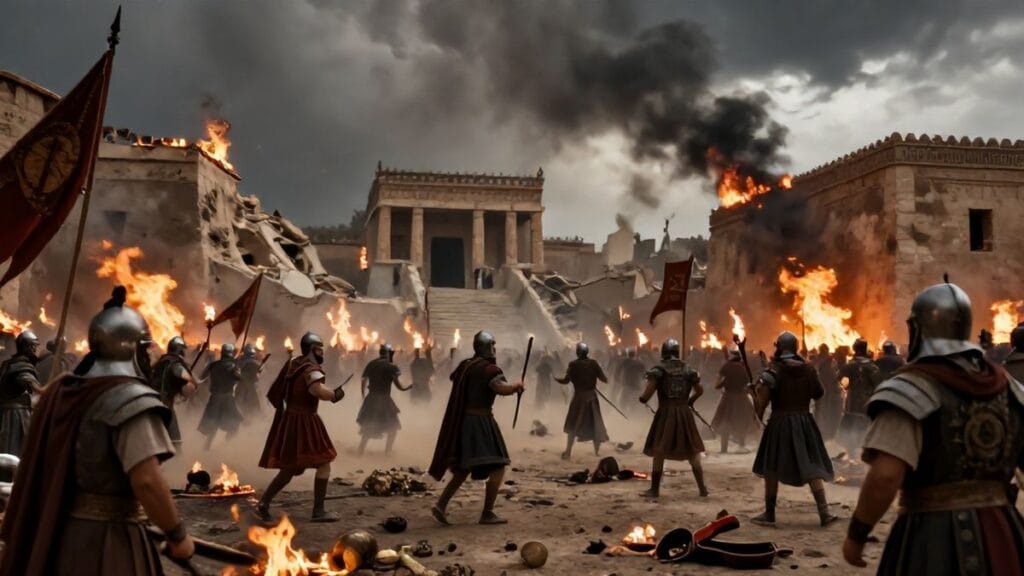
Once the attackers breached the outer defenses, the city became a battlefield. Streets turned into killing grounds, doorways into last-ditch redoubts. Soldiers poured in, their armor glinting, their shouts mingling with the screams of inhabitants. Fires began in one quarter, then another—sometimes set deliberately to flush out defenders, sometimes accidental as houses went up in flames after being looted. Smoke began to coil into the sky, blotting out the sun and turning daytime into an eerie half-darkness. This, quite literally, was the sky darkening over Ganzak.
Contemporary or near-contemporary Christian sources speak of Heraclius’ campaigns in 624 as acts of righteous vengeance, but behind their triumphant tones lies the reality of urban sack: the looting of homes, the seizing of valuables, the killing of armed men and, often, unarmed civilians caught in the chaos. Byzantines had no monopoly on such behavior; Persian armies had done much the same in cities like Jerusalem and Alexandria. Late antique warfare was brutal and intimate. When a city fell without favorable terms, the attackers expected their share of plunder and captives. Ganzak was no exception.
The moment the city’s outer resistance crumbled, the path to the temple opened. Heraclius knew why he had come. The sack of Ganzak was not complete, in his eyes, until the fire-temple of Ādur Gushnasp was broken. Soldiers pushed toward the sacred precinct, cutting down any who stood in their way. Priests and temple guards, shocked from the serenity of ritual into the terror of battle, may have tried to barricade doors, to hide sacred objects, to shield the flame. Theodorus Lector, an earlier chronicler, once wrote that “war does not spare even what is holy when kings so command”—a judgment that fits this moment well, even if he did not have Ganzak in mind.
By midday, the city was in Roman hands. Bodies lay in streets; smoke and dust made eyes sting and lungs burn. The sack of Ganzak, long feared by some and unimaginable to others, had become a fact. Now the focus shifted to the temple, where the final, symbolic act of destruction was about to unfold.
At the Temple of Ādur Gushnasp: Sacred Flames Extinguished
Imagine the scene as Byzantine soldiers forced their way into the precinct of Ādur Gushnasp. The outer courtyards, once filled with pilgrims and supplicants, echoed with hurried footsteps and shouted commands. Ornate doors were flung open, mosaics and carvings splintered under boots and blows. The temple treasury, stocked with decades of royal and noble gifts—plate, jewelry, ritual instruments—became an irresistible target. Men who had marched hungry and cold through mountains now seized armfuls of glittering metal, silks, and coins. But for Heraclius and his closest circle, this was about more than material wealth.
The inner sanctuary housed the holy fire. In Zoroastrian tradition, such a fire was not simply lit once and allowed to burn; it was carefully nurtured, ritually fed, its continuity connecting past, present, and future. To approach it required strict purification. Foreign boots crossing that threshold under orders of destruction marked a rupture in the moral cosmos as the temple community understood it. Priests, if any survived to witness this, must have felt they were watching the end of the world as they knew it.
Byzantine chroniclers are less specific about the mechanics of the desecration, but they agree on the outcome: the temple was destroyed, the fire extinguished, and the complex plundered. Some accounts add lurid details, describing how Heraclius ordered the sacred flame doused with blood or filth, or how he mocked the Zoroastrian god by erecting crosses amidst the ruins. These embellishments reflect the polemical spirit of the age, in which humiliating the rival’s religion was part and parcel of celebrating victory. Whether or not such specific gestures occurred, the core fact remains: the sack of Ganzak culminated in the ritual center of Atropatene being physically and symbolically annihilated.
For Heraclius, this act had multiple layers of meaning. Militarily, it deprived Khusrau of a key prestige site and perhaps of stores and funds kept there. Psychologically, it demonstrated to the Persian court and nobility that Rome could strike at pillars of their identity. Religiously, it allowed Heraclius and his supporters to frame the campaign as a triumph of Christianity over “fire worship,” a phrase commonly used in Byzantine texts to reduce Zoroastrian practice to a kind of idolatry. In one later report, the emperor is said to have declared that as Persians had profaned Christian churches, so he had redeemed the insult by overthrowing their temple of fire—a symmetry that must have appealed to an audience exhausted by years of war.
For the people of Ganzak and for the broader Zoroastrian community, the shock was profound. The breaking of the temple was not just a local disaster; it reverberated across the Sasanian world through networks of priests and pilgrims. It told them that the king of kings had failed in his duty to protect the most sacred sites. In a polity where spiritual legitimacy and temporal power were intertwined, that failure had dire implications. The sack of Ganzak, and especially the extinguishing of Ādur Gushnasp’s flame, became a symptom of something gone terribly wrong in the relationship between heaven and empire.
Blood, Ash, and Echoes: Human Stories from a Broken City
Behind the abstractions of “sack” and “campaign” lie countless human experiences, most of them unrecorded. To approach them, we must move cautiously, using analogy and fragmentary testimony from other late antique sieges. Consider, for instance, an imagined figure: a middle-aged artisan named Vahram, whose family had lived in Ganzak for generations. He woke that morning to alarms and the smell of smoke. As word spread that foreign soldiers had breached the walls, he did what thousands have done in such moments: he tried to decide whether to flee or to hide.
Perhaps he sent his wife and children toward the countryside with a few bundles while he stayed to guard the house, believing that if he did not, looters would take everything. Perhaps he joined neighbors in a desperate defense of a barricaded street, armed with little more than tools and kitchen knives. In many cities under sack, those who stayed behind did so out of a mixture of duty, fear, and disbelief. It was hard to accept that the everyday world could vanish so quickly.
By midday, Vahram’s street might already have been overrun. A soldier smashed his door; others rifled through storage jars and chests. They took what could be carried and, angered by the smallness of the haul, beat him or worse. Another family, hiding in a cellar, listened as the boots overhead came and went, praying they would not be discovered. In other houses, fires set in the course of looting spread uncontrollably, turning homes into furnaces. The city’s layout—narrow alleys, closely built structures—became a trap. Those who tried to run often found their paths cut off by collapsing roofs or by enemy patrols.
Not all Romans in Ganzak were indifferent to suffering. History offers rare but telling glimpses of soldiers moved by pity, helping children or sparing the elderly. Yet such individual acts could not erase the structural cruelty of sack as a military institution. Commanders allowed, even encouraged, a certain degree of plunder as the soldiers’ reward and as a way to break the enemy’s will to resist. Captives were part of that plunder. Men, women, and children were seized, bound, and marched away—destined for sale in markets far from Atropatene. Our hypothetical Vahram might have found himself shackled in a column of prisoners, glancing back one last time at a skyline now made jagged by smoke and flame.
Those who escaped into the countryside faced a different ordeal: displacement, hunger, and the slow realization that there was no home to return to. Fields had been trampled; stores looted; the city’s economic networks disrupted. Refugees would cluster in villages or with kin elsewhere, telling and retelling the story of how Ganzak fell. Oral accounts would vary—some blaming Roman cruelty, others Sasanian failure, others fate itself. Each retelling sharpened certain details: the sight of the temple’s dome collapsing, the screams from the market quarter, the moment the sacred fire went out. Over time, these stories became the raw material of communal memory.
The sack of Ganzak, then, was not solely an episode in high diplomacy or military strategy. It was a trauma woven into the lives of thousands. Its echoes lasted far longer than the smoke that hung over the city that day, shaping how communities in Atropatene and beyond understood the fragility of order and the capriciousness of imperial power.
Heraclius’ Message to Chosroes: Vengeance in Smoke
If the people of Ganzak experienced the sack as catastrophe, Heraclius experienced it as communication. Every burned building, every looted treasury, every extinguished flame spoke across mountains and deserts to a single listener: Khusrau II. The Byzantine emperor knew that news of Ganzak’s fall would reach the Persian court swiftly, carried by panicked messengers and survivors whose testimony would be colored by grief and rage. In that sense, the sack was an open letter written in blood and ash.
We do not possess a verbatim exchange between the two rulers about this episode, but later sources preserve hints of their rhetorical duel. Sebeos, in his Armenian history, presents Khusrau as enraged and shaken by Heraclius’ invasions into his realm, and the Armenian historian suggests that the shah considered any negotiation beneath him until repeated shocks forced his hand. Byzantine writers depict Heraclius as sending defiant messages boasting of his exploits, including the destruction of Persian temples, as proof that God favored him.
The symbolic logic was clear. By burning Ādur Gushnasp, Heraclius turned the Sasanian practice of religious politics against itself. For decades, Khusrau had basked in the glow of an empire that seemed blessed by its gods. His armies had taken holy Christian cities; his governors had ruled over Christian populations; his court had welcomed Christian and Jewish allies willing to cooperate against Constantinople. Now the Christian emperor had flipped the script: he had gone on the offensive, desecrating a key Zoroastrian shrine and presenting that act as just retribution.
In the theatre of imperial rivalry, such gestures mattered. Allies and subjects watched closely. Armenian nobles, long courted by both sides, would have seen in the sack of Ganzak proof that the Romans were no longer on the back foot. Arab tribes, Georgian princes, and steppe khans all assessed the shifting balance of power. The smoke rising from Ganzak was therefore also a signal fire to the watchful political world. Heraclius hoped it would attract support and demoralize his enemies.
This does not mean that every aspect of the sack was scripted. War has its own messy logic. Yet in the end, the event was integrated into Byzantine narratives of triumph. Chroniclers cast Heraclius as a new Constantine or a new David, humbling a haughty pagan adversary. Their enthusiasm sometimes glossed over the ambiguities of the emperor’s actions, but one line from Theophanes stands out: he calls Heraclius “the one who broke the arrogance of the Persians and laid low their proud shrines.” Through that phrase, the sack of Ganzak merges into a broader moral arc: a story not just of cities falling, but of pride punished.
Persia Reacts: Fury, Grief, and the Waning of Sasanian Power
For Khusrau II and his court, the news from Atropatene must have landed like a thunderclap. This was not the loss of a remote outpost; it was the desecration of a core sacred site. The shah, who had once seemed invincible, now faced the uncomfortable reality that his enemies could roam inside his heartlands. Rage was a predictable response, but anger alone could not reverse the damage. The Sasanian administration had to decide: where to send armies, how to punish collaborators, how to reassure a shaken public.
The war, by 624, was already straining Persia’s resources. Years of campaigning in the Levant, Egypt, and Anatolia had drained treasuries and manpower. There were multiple fronts to manage, from the Caucasus to the fringes of Arabia. Rebellion smoldered in some regions; aristocratic factions at court maneuvered for influence. The blow at Ganzak intensified these pressures. To protect every temple and city at once was impossible. To avenge each outrage demanded troops that Khusrau increasingly did not have.
Nonetheless, Sasanian generals moved to counter Heraclius’ incursions. Later in the war, they would confront him in major battles, notably at Nineveh in 627, where the Byzantine emperor would win a decisive victory. But something intangible had shifted in 624. The aura of inevitability that had surrounded Persian expansion earlier in the century began to crack. Subjects asked themselves why the king of kings had failed to shield the sacred fires. Priests confronted a theological shock: had Ahura Mazda withdrawn his favor, or were they misreading the divine will?
In political terms, the sack of Ganzak contributed to a creeping delegitimization of Khusrau’s regime. After 627, when defeats piled up and Heraclius approached Ctesiphon itself, the shah’s enemies within the elite seized the opportunity. In 628, Khusrau was overthrown and executed in a palace coup. His successors, fragile and short-lived, could not restore stability. The Sasanian Empire entered a rapid downward spiral, with civil wars, child rulers, and regional usurpers tearing it apart. By the time Arab-Muslim armies began their own conquests in the 630s, they encountered a polity exhausted and fractured.
We must be cautious, of course, not to treat the sack of Ganzak as the single cause of Sasanian collapse. Empires crumble under the weight of many factors: economic strain, succession crises, external aggression, and sheer bad luck. Yet it is equally wrong to strip the event of causal weight. It was part of a chain of humiliations and shocks that eroded faith—in both the political and the literal religious sense—in Sasanian structures. As historian James Howard-Johnston has argued in another context, symbolic defeats can have disproportionate effects when they expose deeper fragilities. The blackened ruins of Ādur Gushnasp did exactly that.
Faith Tested: Zoroastrianism after the Fall of Ganzak
When a holy place burns, what happens to the faith rooted in it? Zoroastrianism in the early seventh century was not a brittle religion dependent on one shrine, yet the loss of Ādur Gushnasp struck at nerves that ran throughout its body. Fire-temples across Iran shared a theology that linked ritual purity, sacred flames, and the health of the cosmos. Their priests knew of one another; doctrines and ceremonies had been standardized over generations of Sasanian patronage. The news from Ganzak thus posed a problem that could not be easily localized.
One likely response was liturgical and doctrinal adaptation. Priests could interpret the destruction as a test, a temporary triumph of druj that would ultimately be overturned. Just as earlier Zoroastrian texts had made sense of foreign invasions and internal strife, so too could new narratives incorporate the sack of Ganzak as part of a cyclical struggle between truth and falsehood. In this way, the faith could absorb trauma without surrendering its core claims. There may even have been efforts to reestablish a successor temple or to ritually transfer the sanctity of the extinguished fire to another flame.
At the same time, ordinary believers had to navigate cognitive dissonance. They had been told that sacred fires, with royal protection, formed bulwarks against chaos. When one of the greatest of these was stamped out by a Christian emperor, some must have wondered why. Was it because they, or their rulers, had sinned? Was it a sign of the approaching end times, themes of which existed in Zoroastrian eschatology as much as in Christian apocalyptic thought? Such questions did not automatically lead to conversion, but they did reframe how people saw the relationship between divine will and historical events.
Ironically, the years after the sack of Ganzak would see Zoroastrianism subjected to even greater pressures, not from Byzantium but from the rising power of Islam. The Muslim conquests that began a decade after the Byzantine–Sasanian war’s end would topple the Sasanian state and, over time, gradually displace Zoroastrian religion from its central place in Iranian public life. When later Zoroastrian communities looked back on their history, the reign of Khusrau II and the wars with Rome often appeared as a prelude to catastrophe, a last blaze of imperial glory followed by defeat.
In that retrospective narrative, the burning of Ādur Gushnasp in Ganzak could be cast as an ominous sign—a warning that the old order was no longer secure. Whether or not medieval Zoroastrian texts mention this specific temple by name, the pattern is clear: shrines can be rebuilt, but the psychological certainty that they will endure forever is harder to restore. The sack of Ganzak thus occupies an ambiguous place in the story of Zoroastrianism: not its end, but a crack in the façade of invulnerability that had long surrounded it.
Byzantine Triumph or Moral Burden? The Empire after 624
In Constantinople and other Byzantine centers, news of Heraclius’ victories in Persia, including episodes like the sack of Ganzak, was greeted with relief and jubilation. Here was tangible proof that the empire had not been abandoned by God, that the humiliations of earlier decades could be avenged. Sermons, processions, and official celebrations framed Heraclius as a divinely guided ruler. The eventual recovery of the True Cross, after the peace of 628, would only deepen this narrative of redemption.
Yet triumph came at a high price. The years of offensive warfare in the east, though strategically successful, placed enormous burdens on Byzantine society. Taxation remained heavy; frontier regions suffered from the movement of armies and the destruction of infrastructure. Moreover, the moral ambiguities of Heraclius’ methods—his use of scorched earth, his assaults on civilian centers, his targeting of religious sites like Ganzak—could not be entirely cloaked in pious rhetoric. Within the Christian tradition itself, there were long-standing tensions between the ideal of loving enemies and the reality of justifying holy war.
Some theologians of the period tried to resolve this by arguing that God used emperors as instruments of justice, even if their tools were violent. Others focused more on the miraculous aspects of Heraclius’ campaigns, emphasizing divine interventions that supposedly minimized suffering or protected the innocent—claims that sit uneasily alongside the realities of urban sack. Over time, the more disturbing details of the war receded from liturgical memory, while the symbolic achievements—Heraclius’ pilgrimage to Jerusalem, the restoration of the Cross—took center stage.
On another level, the empire’s triumph over Persia proved fleeting. Within a generation of the war’s end, Byzantine territories in Syria, Palestine, and Egypt would fall to Arab-Muslim forces. The very regions whose recovery had seemed part of God’s favor slipped away, despite the earlier sacrifices and brutalities committed in their name. In retrospect, the great victories of Heraclius, including the intimidation of Persia through acts like the sack of Ganzak, appeared as a last bright flare before a profound transformation of the Near Eastern order.
For Byzantines who lived through these reversals, the meaning of the earlier campaigns must have grown more ambiguous. Had the suffering endured and inflicted really secured the empire’s future, or had it only exhausted both great powers, paving the way for a new force? In that light, Heraclius’ torching of Ganzak and its temple reads less like a final Christian triumph over paganism and more like one episode in a long, tragic unwinding of the late antique world.
Chroniclers and Silences: How the Sack Was Remembered
The sack of Ganzak is a vivid episode, yet it emerges in our records as through a fog. Different traditions mention it briefly, highlight different aspects, or pass it over in silence. These variations tell us as much about the chroniclers and their agendas as they do about the event itself.
Christian sources, particularly Byzantine and some Armenian writers, tend to foreground Heraclius’ eastern campaigns and to present the destruction of Persian temples as righteous retribution. They celebrate the emperor’s courage and piety, sometimes attributing miraculous assistance to his efforts. The specific identification of Ganzak and Ādur Gushnasp may be obscured by their lack of familiarity with Persian religious geography, yet the gist is clear: a major fire-temple in Atropatene was sacked and burned. In their narratives, this functions as a high point in a morality tale of good triumphing over evil.
Persian and later Iranian sources are more hesitant. Many Sasanian-era texts were lost in the turmoil of conquest and regime change. What survives often comes from later compilations under Islamic rule, where Zoroastrian traditions were preserved in new contexts. Some of these works recall the existence of great fires and the patronage of kings, but the harsh details of their downfall at Roman hands receive less emphasis. There is a natural tendency in communal memory to highlight times of glory rather than moments of humiliation. The silence around Ganzak in some Persian narratives thus reflects not ignorance but a choice about what to remember.
Modern historians, working with fragmentary evidence, have debated the exact chronology and localization of Heraclius’ attacks on fire-temples. Nevertheless, a broad consensus accepts that in 624 he struck at a major shrine in Atropatene, most plausibly the temple of Ādur Gushnasp near or within Ganzak. The convergence of geographical indications, the timing of the campaign, and our understanding of Sasanian sacred topography make this interpretation persuasive. As one contemporary scholar has written, “the sack of Ganzak stands as one of the clearest cases of strategic religious violence in the long Byzantine–Persian conflict” (a paraphrased synthesis of views found in modern historiography).
Yet even with this consensus, gaps remain. We do not know the names of the priests who died or fled, the specific damage tallied, or the precise reactions in adjacent towns. Those silences are part of the story. They remind us that history is constructed out of what survives—and that acts of destruction, like the burning of archives and the killing of scribes, shape our ability to see the past. The sack of Ganzak thus stands partly in shadow, its contours clear but its inner textures dimmed, a testament to both the event itself and the long erasures that followed.
Archaeology in the Ashes: Traces of a Lost City
In the modern era, archaeologists have attempted to recover the physical traces of ancient Ganzak and its temple. The exact location of the city has been debated, with several candidate sites in northwestern Iran—near modern Takab and elsewhere—proposed based on textual clues and surface remains. Excavations in the region have uncovered remnants of Sasanian-period settlements, fortifications, and religious structures, but tying any one of them definitively to Ādur Gushnasp remains challenging.
Part of the difficulty lies in the nature of destruction and reuse. A city sacked in the seventh century did not necessarily remain a ruin forever. Survivors or new populations might rebuild on the same spot, scavenging stone, brick, and even foundation lines from older buildings. Later polities, from early Islamic dynasties to medieval principalities, left their own layers of construction atop the old. Over centuries, the material signature of the sack—the ash layer, the collapsed walls, the burned timbers—became mixed into a complex archaeological palimpsest.
Nonetheless, certain patterns offer tantalizing hints. At some sites thought to be associated with Ganzak, excavators have found evidence of intensive burning in late Sasanian layers, followed by signs of reorganization or partial abandonment. Artifacts—coins, ceramics, inscriptions—point to a flourishing settlement in the sixth and early seventh centuries, disrupted around the time of the Byzantine–Sasanian war. While we cannot simply label every burn layer “the sack of Ganzak,” the convergence of data reinforces the textual narrative: something catastrophic did happen in this region around 624.
Archaeology also helps us visualize urban life more concretely. Foundations of houses, workshops, and public buildings reveal the density and layout of the city. Water systems and storage facilities testify to planning and investment. Even small finds—spindle whorls, gaming pieces, jewelry—hint at ordinary activities and pleasures. To stand at such a site today, looking out over eroded mounds and scattered stones, is to feel the dissonance between the quiet of the present and the violence of the past. One can imagine the roar of Heraclius’ army echoing off hills that are now grazed by sheep.
In this way, the earth itself becomes a witness, mute but eloquent. Even if we never pin down every building Heraclius’ men burned or every street where fighting raged, the combination of archaeological and textual evidence allows us to anchor the sack of Ganzak in a real, tangible landscape. The event was not a legend floating in mythic time; it was a historical shock wave that passed through bricks, bones, and soil—traces of which we can still, dimly, detect.
From Imperial War to Civilizational Turning Point
The sack of Ganzak occurred in the midst of a war that, at first, looked like one more round in a centuries-old rivalry. Byzantium and Persia had fought before and would, it seemed, fight again after any truce. Yet with hindsight, the conflict of 602–628 and its peak moments—including Heraclius’ raid into Atropatene—appear as something more: the final convulsion of the classical Near Eastern imperial system.
Both empires entered the war with deep reserves of legitimacy and institutional strength. Byzantium could draw on Roman law, Christian theology, and the formidable defenses of Constantinople. The Sasanian Empire could draw on an Iranian aristocratic tradition, Zoroastrian religious authority, and centuries of administrative practice. The campaigns that culminated in the sack of Ganzak stressed these systems to breaking point. By mobilizing resources on an unprecedented scale, moving armies across greater distances, and targeting not just borderlands but core religious and urban centers, the two states pushed each other into a spiral of escalation.
When peace finally came in 628–629, it was less a stable settlement than a mutual exhaustion. Territories shifted back more or less to their pre-war lines. The True Cross was returned to Jerusalem; some cities resumed paying taxes to their old masters. But beneath this apparent restoration, the foundations had cracked. Economic devastation, demographic losses, and political delegitimization left both Byzantium and Persia vulnerable. The sack of Ganzak thus forms part of a broader picture: an era in which imperial leaders were willing to sacrifice sacred and civilian spaces alike in pursuit of victory—and in doing so, undermined the worlds they sought to preserve.
It is in this sense that we can speak of the sack of Ganzak as a civilizational turning point. Not because it single-handedly caused the subsequent transformations, but because it exemplifies and accelerates trends that made those transformations possible. The choice to burn Ādur Gushnasp reflected a new ruthlessness in interstate conflict, one that eroded the taboos and shared assumptions that had long regulated power struggles. Once such lines were crossed, it became easier—psychologically, politically—to contemplate even more radical changes in the structure of the region.
Long Shadows: The Sack of Ganzak and the Coming of Islam
Within a decade of Heraclius’ campaigns, Arab-Muslim armies began to move north and east out of Arabia. In the 630s and 640s, they would defeat both Byzantine and Sasanian forces in a series of battles—Yarmouk, Qadisiyyah, Nihawand—that reshaped the map of the Near East. The old imperial duopoly crumbled. New religious and political frameworks emerged. In that story, the sack of Ganzak is an early tremor before the earthquake.
By 636, when the Sasanian army suffered heavy defeat at Qadisiyyah, the empire was already weakened by the internal turmoil that followed Khusrau II’s overthrow. The loss of key revenues, the disaffection of elites, and the lingering psychological shock of earlier devastations—all diminished the state’s capacity to respond effectively. The memory of episodes like the sack of Ganzak surely circulated among aristocrats and priests, shaping their assessment of the king of kings’ ability to protect them. Some may have calculated that new overlords could not be worse than the chaos into which the empire had descended.
For communities in regions like Atropatene, the arrival of Muslim rule would bring fresh challenges, but also new forms of accommodation. Zoroastrian temples, already vulnerable, now existed under a regime that offered them a degree of tolerance but no longer treated them as centers of public authority. Christian communities, memory of Roman and Persian depredations still vivid, navigated their place within an Islamic polity that, at least initially, taxed but did not forcibly convert them. In such a context, the brutalities of the earlier Byzantine–Sasanian war—including the sack of Ganzak—may have seemed both distant and formative: reminders of what imperial rivalry could do and yardsticks by which to measure the new dispensation.
Islamic historians writing in later centuries looked back on the pre-Islamic era with a mix of fascination and disapproval. They often portrayed the wars between “the Romans and the Persians” as paradigms of futile conflict, exhausting both sides and preparing the ground for God’s new revelation. From this vantage point, the sack of Ganzak could be seen as emblematic—an episode in which rulers destroyed each other’s sacred spaces, only to lose their own primacy soon thereafter. Although Muslim chroniclers did not always dwell on this particular city, the pattern into which it fit was central to their vision of history: God humbles the proud, sometimes using their own violence as an instrument.
Thus the event casts a long shadow, reaching into narratives that frame the rise of Islam not as an isolated miracle, but as a response to deeper structural and moral crises within the late antique world. The smoke over Ganzak, in this reading, was one of many signals that an era was ending.
Memory, Myth, and Modern Identity in Atropatene’s Landscape
Today, the name Ganzak is unfamiliar to most outside specialist circles. The landscapes of Atropatene have been folded into modern nation-states; new cities and new shrines draw the eye. Yet traces of the event linger, sometimes explicitly in scholarly debate, sometimes implicitly in local folklore and regional identity.
In Iranian historiography, the Sasanian period has often been presented as a golden age of pre-Islamic statecraft and culture. Kings like Khusrau I and II figure prominently as symbols of Iranian greatness. The disasters of the early seventh century—Heraclius’ raids, the sack of cities like Ganzak, the final collapse under Arab pressure—are acknowledged but frequently overshadowed by the grandeur of earlier centuries. For some currents of modern nationalism, emphasizing glory over defeat serves an understandable function: it provides a positive heritage on which to build.
Meanwhile, local memories in northwestern Iran sometimes preserve echoes of ancient holy sites in stories about ruins, “fire temples,” or pre-Islamic sanctuaries. A traveler in the nineteenth or early twentieth century might hear villagers speak of an old mound or stone foundation as the remains of a place where fire once burned for kings. Whether or not such identifications are archaeologically accurate, they show how deeply the concept of sacred fire-temples has embedded itself in regional imagination. The sack of Ganzak, though rarely named, haunts any story about lost flames in this landscape.
Academic historians and archaeologists, working with new tools—from satellite imagery to refined ceramic typologies—continue to refine the map of Sasanian Atropatene. Their findings feed back, slowly, into broader public understandings of regional history. Popular histories and documentaries occasionally mention Heraclius’ daring campaigns and the destruction of Persian temples, introducing wider audiences to the notion that northwestern Iran once hosted one of Zoroastrianism’s great fires. In that sense, the memory of the sack of Ganzak is being reconstructed, layered onto older narratives of the area’s past.
At the same time, global discussions about cultural heritage and wartime destruction give the story renewed relevance. When contemporary conflicts see temples, churches, or mosques destroyed—whether in the Balkans, the Middle East, or elsewhere—commentators sometimes reach back into the deep past for parallels. The sack of Ganzak fits uncomfortably well within that lineage. It reminds us that attacking sacred sites as a form of psychological warfare is not a modern invention, but an old and recurring temptation in human affairs.
For those living today on or near the lands where Ganzak once stood, the story can thus be read in multiple keys: as a chapter in Iranian history, as a cautionary tale about religiously charged violence, and as an invitation to think about how landscapes remember even when names fade.
Conclusion
The sack of Ganzak in 624 was at once a local catastrophe and a world-historical moment. On one level, it was the story of a single city: its homes plundered, its inhabitants killed or scattered, its proudest monument—the temple of Ādur Gushnasp—reduced to rubble. On another level, it was a chapter in the final, furious struggle between Byzantium and the Sasanian Empire, a struggle that pushed both states to extremes they had rarely reached before. Heraclius’ decision to penetrate into Atropatene and strike at a sacred fire was not an aberration but the logical culmination of a war that had already seen holy places fall on both sides.
By extinguishing the flame at Ganzak, Heraclius aimed not only at Persian arms and coffers, but at the very idea of Sasanian invincibility. The message to Khusrau II and his subjects was brutal and clear: no shrine was beyond Roman reach, no symbol of royal legitimacy unassailable. That message, written in the language of fire and blood, contributed to a mounting crisis of confidence within the Sasanian world. Combined with military defeats and internal revolts, it helped propel the empire into the downward spiral from which it would never emerge.
Yet the story does not end with imperial politics. The sack of Ganzak also challenged religious communities to rethink the relationship between sacred spaces and divine favor. For Zoroastrians, it raised hard questions about how to interpret the fall of a great fire-temple. For Christians, it posed the moral dilemma of celebrating victories won through the destruction of others’ holy places. In both traditions, later memories smoothed over some of these rough edges, but they never entirely erased them.
In the centuries that followed, new empires and faiths would rise over the ruins of the old. The arrival of Islam transformed the political and religious map of the Near East, relegating the Byzantine–Sasanian conflict, and episodes like the sack of Ganzak, to the prelude of a different story. Yet if we look closely, we can still discern how that earlier war hollowed out the ground upon which the new order was built. The smoke that darkened Ganzak’s sky in 624 was one plume among many, but together they signaled the end of an age.
To remember Ganzak today is to confront the enduring entanglement of power, faith, and violence. It invites us to ask how rulers justify attacks on sacred spaces, how communities cope with the loss of their holiest places, and how the scars of such events shape the trajectories of civilizations. The sack of Ganzak may lie more than thirteen centuries behind us, but its lessons about hubris, desperation, and the fragile bonds that tie sacredness to stone remain unsettlingly current.
FAQs
- What was Ganzak, and where was it located?
Ganzak was an important city in the Sasanian Empire, situated in the region of Atropatene in what is now northwestern Iran. It served as an administrative and economic center and was closely associated with the famous Zoroastrian fire-temple of Ādur Gushnasp, a key shrine for Sasanian kings and warriors. - What is meant by the “sack of Ganzak”?
The sack of Ganzak refers to the capture and violent plundering of the city by the Byzantine emperor Heraclius and his forces in 624. During this assault, the city was looted, many inhabitants were killed or enslaved, and the nearby or associated temple of Ādur Gushnasp was destroyed, with its sacred fire extinguished. - Why did Heraclius target Ganzak and its fire-temple?
Heraclius targeted Ganzak as part of a bold strategy to undermine the Sasanian Empire by striking deep into its heartlands. Destroying the prestigious fire-temple of Ādur Gushnasp was a calculated move designed to attack not only Persian military capacity but also the religious and ideological foundations of Sasanian kingship, sending a powerful psychological message to Khusrau II and his subjects. - How do we know about the sack of Ganzak?
Our knowledge comes from a combination of Byzantine, Armenian, and later Persian and Islamic sources, as well as archaeological evidence from northwestern Iran. Chroniclers like Sebeos and Theophanes describe Heraclius’ campaigns and note the destruction of Persian temples, while modern historians correlate these accounts with what is known of Sasanian sacred geography and archaeological burn layers in likely candidate sites. - What impact did the sack of Ganzak have on the Sasanian Empire?
The sack of Ganzak dealt a serious symbolic and psychological blow to the Sasanian state by exposing its inability to protect a major holy site. While not the sole cause of the empire’s eventual collapse, it contributed to a growing crisis of legitimacy and confidence in Khusrau II’s rule, coming amid mounting military setbacks and internal dissent that culminated in his overthrow and the rapid disintegration of Sasanian power. - Did the temple of Ādur Gushnasp ever recover from the attack?
There is no clear evidence that the temple of Ādur Gushnasp at Ganzak was fully restored to its former prominence after the sack. The continued turmoil of the late Sasanian period, followed by the Arab-Muslim conquests, altered the religious and political landscape. While some form of local religious activity may have persisted, the temple never regained its status as a premier state-sponsored shrine. - How did the sack of Ganzak affect Zoroastrianism?
The destruction of such an important fire-temple challenged assumptions about divine protection and imperial patronage within Zoroastrianism. It forced priests and believers to reinterpret the meaning of sacred loss, likely integrating the event into broader narratives of cosmic struggle between truth and falsehood. Over the longer term, as Islamic rule spread, Zoroastrianism lost its central public role, and episodes like the sack of Ganzak became part of a larger story of displacement and adaptation. - Is the site of ancient Ganzak known today?
The precise location of Ganzak is still debated, though many scholars associate it with sites near modern Takab in northwestern Iran. Archaeological work has uncovered Sasanian-layer settlements and evidence of significant burning, but conclusive identification of one specific site as Ganzak and its temple complex remains an ongoing research question. - How did the sack of Ganzak relate to the rise of Islam?
The sack of Ganzak was one episode in the long Byzantine–Sasanian war that exhausted both empires. The resulting political, economic, and moral fatigue weakened their ability to resist new challengers. When Arab-Muslim armies began their conquests in the 630s, they encountered states already destabilized by decades of conflict and shocks like Ganzak’s destruction, which helped make rapid Islamic expansion possible. - Why is the sack of Ganzak significant for historians today?
For historians, the sack of Ganzak is important because it illuminates the intersection of war, religion, and imperial ideology in late antiquity. It shows how sacred sites could become strategic targets, how symbolic violence could shape political outcomes, and how the final conflict between Byzantium and Persia paved the way for a new Islamic order. Studying it deepens our understanding of how civilizations transition and how religious and political trauma are intertwined.
External Resource
Internal Link
Other Resources
- Encyclopaedia Britannica – general search for the exact subject
- Google Scholar – academic search for the exact subject
- Internet Archive – digital library search for the exact subject

