Table of Contents
- Rome in Crisis: The World Before the Decree of 1059
- The Long Shadow of Simony and Chaos in Papal Elections
- From Bruno of Toul to Nicholas II: A Reforming Pope Takes the Stage
- The Road to the Lateran: Gathering the Reformers in Rome
- Inside the Synod: Voices, Fears, and Hopes on the Eve of Change
- The Papal Election Decree 1059: Text, Structure, and Revolutionary Ideas
- Cardinals Chosen as “First Electors”: A New Spiritual Aristocracy
- Emperors, Princes, and People: Redefining Power in the Decree
- Ceremony at the Lateran: The Day the Decree Was Proclaimed
- Resistance and Rebellion: Antipopes, Nobles, and Imperial Anger
- The Human Faces of Reform: Hildebrand, Peter Damian, and Their Circle
- Reverberations Across Christendom: Bishops, Monks, and the Common Faithful
- From 1059 to the Investiture Controversy: A Decree Sparks a Firestorm
- Shaping the College of Cardinals: From Ad Hoc Council to Permanent Electorate
- Ritual, Symbol, and Space: Why the Lateran Mattered
- Legal Memory: How Canonists Preserved and Interpreted the Decree
- Echoes in Modern Conclave Rules: The Long Afterlife of 1059
- Seeing 1059 Through Human Eyes: Anxiety, Faith, and Ambition
- Conclusion
- FAQs
- External Resource
- Internal Link
Article Summary: On 13 April 1059, within the stone walls of the Lateran in Rome, a group of anxious churchmen approved a text that would permanently reshape the election of popes: the papal election decree 1059. This article follows the world that made such a decree necessary—an age of bribed bishops, violent Roman nobles, and emperors who treated the papacy as a prize of imperial politics. It then walks, in narrative fashion, into the Lateran Synod itself, tracing the personalities, arguments, and spiritual fears that produced this watershed legislation. The papal election decree 1059 re-centered the choice of the pope in the hands of the cardinals, redefining the role of emperor and people and sowing the seeds of later conflicts such as the Investiture Controversy. Yet behind the legal language were human stories: reforming monks haunted by corruption, laypeople craving stability, and rulers alarmed at losing influence. Over the centuries, canon lawyers, theologians, and later popes interpreted and reinterpreted the papal election decree 1059, weaving it into the growing legal fabric of the Church. Today, modern papal conclaves still echo the logic born in that spring synod, where fear of chaos and hope for holiness met in a single, carefully crafted decree.
Rome in Crisis: The World Before the Decree of 1059
In the middle of the eleventh century, Rome did not look like the serene spiritual capital that later paintings would imagine. The city was a fractured mosaic of fortified towers, feuding clans, and crumbling ancient ruins pressed into service as strongholds. The Tiber ran sluggish and brown beneath half-ruined bridges; pilgrims picked their way past armed retainers and makeshift barricades. Over it all, the dome and towers of the Lateran and St. Peter’s loomed, symbols of an authority that felt strangely fragile. The papacy—meant to embody unity and holiness—had, in living memory, been bought, sold, and seized at sword-point.
For generations, the great Roman aristocratic families—names like Tusculani and Crescentii—had treated the papal throne as the apex of local power. They were not alone. East of the Alps, emperors of the so‑called Holy Roman Empire viewed Rome and its bishop as a keystone in their vision of Christian rulership. A pope obedient to the imperial will could be a powerful ally, crowning emperors and lending divine legitimacy to political designs. A pope chosen by rival factions, however, could be a threat or an insolent critic. This volatile mixture of noble and imperial influence meant that the election of a pope was rarely a peaceful spiritual discernment. It was a contested event, sometimes a military campaign.
In earlier centuries, the process of choosing a pope had been less strictly defined. Clergy and people of Rome gathered, influence radiated from noble palaces and imperial courts, and some kind of consent emerged, however messy. But by the early 1000s, the blend of custom, power, and bribery had become poisonous. Stories circulated of men ascending the papal throne by handing purses of gold to greedy nobles, or by promising favors to German princes. The term that reformers whispered with disgust was simony—the buying and selling of spiritual offices, named after Simon Magus in the Acts of the Apostles. Simony made ordination and election feel less like sacraments and more like contracts.
Ordinary believers felt the weight of this corruption. When a bishop’s office could be purchased, how could anyone trust the moral authority of the man who presided at the altar? When the pope himself might be installed by a factional coup, how could Christians believe that the Holy Spirit truly guided the Church? In the countryside, peasants listened to wandering preachers decry “the harlotry of the Church,” a phrase that shocked but resonated. In monasteries, especially in reform‑minded houses like Cluny in Burgundy, monks prayed and wrote letters begging for purification of the clergy and renewal of the Church’s heart.
Amid this turmoil, one problem loomed large: the papal election mechanism itself was broken. Left uncontrolled, it allowed the most powerful lay lords—whether Roman or German—to capture the spiritual center of Western Christendom. Fixing that mechanism would mean challenging embedded interests and habits going back generations. It would require not just a new rule, but a new vision of how God’s choice should be recognized in human politics. The papal election decree 1059 would become that rule and that symbol, but before it was ink on parchment, it was an aspiration struggling to be born in a city in crisis.
The Long Shadow of Simony and Chaos in Papal Elections
To grasp why a sweeping decree became thinkable in 1059, it is necessary to look at the long shadow cast by previous papal elections. The eleventh century did not invent corruption, but it inherited the consequences of a gradual erosion of norms. Chroniclers, writing in Latin that occasionally burned with indignation, recorded episodes that later reformers would hold up as cautionary tales. A notorious benchmark was Benedict IX, who became pope as a young man from the powerful Tusculan family and whose tenure was marked by scandal, violence, and alleged crimes that horrified even hardened Romans.
Benedict IX’s papacy, beginning in 1032, exposed everything that was broken. Supported by his aristocratic kin, he treated the papal office less as a spiritual burden than as a possession. His enemies claimed he indulged in debauchery and neglected reform; his allies saw in him a guarantor of Tusculan advantage. Rome fractured around him. In an extraordinary sequence of events, Benedict was driven from office, replaced, returned, and at one point reportedly sold the papacy to his godfather, the reform‑minded John Gratian, who became Gregory VI. Even if some details are colored by polemic, the outline is clear: the papacy became a bargaining chip.
This grotesque spectacle drew in the German emperor Henry III, who descended into Italy in 1046 to restore order. He convened a synod at Sutri and, encountering multiple competing claimants to the papal throne, deposed them. In their place, Henry chose Clement II, a German bishop he trusted. It was an act of imperial surgery: decisive, effective, and deeply revealing. The emperor did not hesitate to remove and install popes, as if they were high officials in a royal court. Clement II crowned Henry emperor in Rome, and many reformers breathed a sigh of relief. But under that sigh lay a dangerous precedent: were popes now effectively imperial appointees?
Over the next few years, Henry III continued to nominate German bishops as popes—Damasus II, Leo IX, Victor II. These men were often allies of the emerging reform movement, committed to fighting simony and clerical marriage. Yet their very appointment by a secular ruler troubled those who dreamed of a Church free from lay domination. If the cure for Roman aristocratic control was imperial oversight, what then if emperors grew hostile to reform? The papacy would be perpetually vulnerable, balanced on the favor of distant sovereigns and the swords of their armies.
Within this context, the papal election decree 1059 would later be remembered as a corrective, a way of closing the door to both noble chaos and imperial manipulation. But in the early 1050s, that door was still wide open. Every papal vacancy was an anxious moment. Messengers hurried north across the Alps to consult emperors; Roman factions sharpened knives and prepared bribes. The very uncertainty of the process made violence more likely. Whoever controlled the first days after a pope’s death could shape the outcome.
One can imagine the psychological climate among the clergy who loved the Church yet watched its highest office tossed between competing powers. Young monks copying manuscripts in scriptoria must have shaken their heads over reports reaching them from Rome. Bishops in distant dioceses, trying to root out simony locally, feared that any progress could be undercut if a corrupt or pliable pope took office. A system that allowed the selling or seizing of the papal throne threatened to drag the entire ecclesiastical hierarchy into disrepute.
Reformers began to dream of a different order: an election guided more clearly by the clergy who knew the candidate’s life, insulated—at least officially—from the direct intervention of nobles and emperors. The idea was radical for its time, not because it invented clerical participation in papal elections, but because it aimed to enshrine and limit it legally, reducing the room for arbitrary external pressures. The long shadow of simony and disorder made that radical path seem, step by step, less unthinkable and more necessary.
From Bruno of Toul to Nicholas II: A Reforming Pope Takes the Stage
Into this troubled landscape stepped Bruno of Toul, the man who would, after a journey to Rome and an act of deliberate humility, become Pope Leo IX. His rise helps explain why the papal election decree 1059 was not a sudden improvisation but the fruit of a decade of reformist rule. Bruno was a German bishop, chosen by Emperor Henry III to be pope after the deposition of the scandal‑ridden claimants in 1048. But when he reached Rome, Bruno made a theatrical and revealing choice: he did not at once assume the papal tiara.
Instead, he entered the city barefoot, dressed as a pilgrim, and presented himself to the clergy and people of Rome, asking to be elected by them as well. The gesture, later celebrated in reform narratives, signaled a dual loyalty—respect for imperial nomination, but also acknowledgment of Roman ecclesiastical and popular consent. With this act, Bruno—now Leo IX—embodied a transitional model. He accepted that emperors had a role, but he also wanted the papacy to be more than an imperial gift. His papacy, filled with synods, journeys, and condemnations of simony, became a turning point.
Leo IX’s pontificate (1049–1054) launched the so‑called “Gregorian Reform” era, although Gregory VII would come later as its most dramatic figure. Leo traveled widely, holding councils in Germany, France, and Italy, denouncing corrupt practices and insisting that bishops must be chosen for their spiritual merit, not their wealth. His circle included figures who would become architects of later change: Humbert of Silva Candida, a sharp‑tongued cardinal and polemicist; Peter Damian, the ascetic hermit bishop; and a relatively obscure archdeacon named Hildebrand, who would one day be Pope Gregory VII.
These men formed the intellectual and moral backbone of a movement that feared one thing above all: that the Church’s soul might be lost if it remained captive to secular powers. For them, the way bishops and popes were chosen lay at the core of the problem. If unworthy men could buy or extort their way into office, how could the sacraments—mediated through those offices—retain their purity? One chronicler capturing the reformers’ spirit wrote that the Church was like a bride “torn between adulterous lovers,” a daring metaphor that cast secular lords as corrupting intruders upon a body meant for Christ alone.
When Leo IX died in 1054, the fragile balance between imperial appointment and Roman election was again tested. His successor, Victor II, was likewise nominated by Henry III, reinforcing the imperial pattern even as reformist ideals deepened. Henry’s sudden death in 1056, leaving a child, Henry IV, as heir under a regency, transformed the political chessboard. The Empire’s hand in Italian affairs weakened, and reform leaders in Rome saw an opening. Without a strong adult emperor to dominate papal elections, could they redesign the system?
After Victor II came Stephen IX (also known as Frederick of Lorraine), a reform‑minded pope close to Hildebrand and Peter Damian. But his death in 1058 triggered a crisis that fully exposed the vulnerability of the papal throne. Roman nobles, impatient to revive their traditional influence, rushed to elect their own candidate, Benedict X, in a process marred—according to reform sources—by violence and bribery. Hildebrand and his allies refused to accept Benedict’s election, denouncing it as simoniacal and illegitimate.
Fleeing Rome, the reform party gathered allies in Tuscany and Lombardy. In December 1058, they elected a rival pope, Gerard of Burgundy, bishop of Florence, who took the name Nicholas II. His election, held away from the pressure cooker of Rome and backed by reform‑sympathetic magnates like Duke Godfrey of Lorraine and his formidable wife Beatrice, was both a gamble and a statement. Here was a pope whose legitimacy they claimed did not rest on the favor of Roman barons or the absent emperor, but on a coalition of reformist clergy and lay rulers. To secure Nicholas II’s position, something more than military victory would be needed. They would have to rewrite the rules.
The Road to the Lateran: Gathering the Reformers in Rome
Nicholas II’s first challenge was straightforward yet perilous: he had to take Rome. Benedict X and his supporters held the city, relying on entrenched noble networks. Over months of negotiation, skirmishing, and pressure, Nicholas—backed by Duke Godfrey’s forces—gradually tightened his grip. Benedict was eventually forced to flee and, under pressure, abdicated. Yet Nicholas knew that mere triumph in a power struggle would not do. If his own election’s legitimacy was to stand the test of time, it had to be framed not as a victory of one faction over another, but as the inauguration of a new order grounded in law.
Thus the idea of a great synod in Rome took shape. The Lateran Palace, long the residence of popes and the seat of important councils, was the obvious stage. Summons went out across Italy and beyond. Bishops, abbots, and representatives of distant churches were called to gather. Reformers understood the power of such assemblies: they were moments when local struggles could be reinterpreted as universal decisions, when the raw practice of power could be wrapped in the vestments of canon law and spiritual necessity.
In the early spring of 1059, pilgrims, prelates, and envoys converged on Rome. The city itself, with its mix of decaying imperial grandeur and Christian sanctuaries, must have seemed alive with rumors. Merchants in the markets discussed which lord favored which pope; monks in guesthouses whispered of letters from Cluny or Lorraine. Armed retainers of dukes and bishops, camped outside the walls, reminded everyone that whatever decisions were made within the synod hall, the shadow of the sword still loomed over them.
The journey to Rome mattered spiritually for those attending. Many, coming from dioceses scarred by simoniacal appointments, hoped not just for new rules but for a cleansing of the Church’s atmosphere. Others, loyal to the old ways where emperors and great men chose bishops and popes, approached with suspicion. Would this synod strip princes of their rightful role? Would it place too much power in the hands of a small clerical elite centered in Rome?
Nicholas II and his closest advisors—Hildebrand prominent among them—worked behind the scenes. Drafts of a proposed decree on papal elections circulated among trusted canonists. They did not start from nothing: older traditions and scattered precedents existed, but they were inconsistent and lacked firm legal articulation. What the reformers sought was a clear, reasoned, and enforceable set of norms. The papal election decree 1059 would, they hoped, institutionalize what Leo IX and others had embodied symbolically: that the Church herself, through her senior clergy, should choose her shepherd, with only a carefully defined space left for lay rulers and local consent.
As the date for the Lateran council drew near, tension sharpened. Nicholas II’s fragile authority, the prestige of the reform movement, and the future of imperial influence over the papacy all seemed to hang in the balance. The road to the Lateran was not merely a physical journey for the bishops and abbots trudging dusty highways; it was a passage into a new vision of how divine authority might be recognized amid human politics.
Inside the Synod: Voices, Fears, and Hopes on the Eve of Change
When the Lateran Synod opened in April 1059, the vast hall in the patriarchal palace filled with a sea of woolen and silk‑trimmed vestments, the soft murmur of Latin prayers, and the faint clink of episcopal rings against carved wooden benches. Beneath frescoes of saints and apostles, bishops took their places in order of precedence. The pope’s throne, raised on a dais, anchored the room’s attention. Yet it was not Nicholas II’s person alone that mattered; it was the text soon to be read in his name.
Contemporary sources give only glimpses of the debates, but we can imagine the atmosphere. The air would have been thick with incense, the light filtered through small windows, the occasional creaking of timbers punctuating speeches. Cardinals, still not yet the fully formed college they would become, sat close to the pope, while envoys from powerful rulers, including the Norman princes of southern Italy, observed keenly. The imperial presence was less direct; with the young Henry IV under regency, Rome had a breathing space, but imperial interests hovered invisibly over every discussion.
As drafts of the decree were recited, line by line, churchmen weighed their implications. Some welcomed the central role proposed for the cardinal‑bishops of the Roman Church, seeing in it a safeguard against both local Roman noble factions and the whims of distant emperors. Others worried that such concentration of power might cut ordinary clergy and laity out of a process long understood, at least in theory, as including the acclamation of the Christian people. Was the Church exchanging one form of oligarchy—noble families—for another—cardinal elites?
At stake were not just constitutional niceties, but deep theological anxieties. If the Church is the body of Christ, as Paul had intoned centuries before, how could its head on earth be chosen without risking sin? Every bishop in the room knew stories of corrupt elections, of candidates who paid for votes or invited soldiers into sanctuaries. The papal election decree 1059 aimed to erect spiritual and legal barriers against such abuses, but no human law could banish sin entirely. Behind every practical clause loomed the question: could they trust that the Holy Spirit would still guide this more structured, clerically centered process?
Factional undercurrents almost certainly rippled through the hall. Supporters of Roman nobles who had backed Benedict X might quietly lobby against provisions that reduced lay influence. Reform zealots pressed for language that unequivocally condemned simony and its fruits. Some may have proposed more radical restrictions on lay interference than the final text would contain; others, more cautious, urged compromise to avoid provoking open imperial hostility.
Yet through the arguments, a shared sense of urgency held the assembly together. The memory of recent chaos was too fresh, the shame of papal scandals too raw. If they left the Lateran without a clear resolution, the next papal vacancy might return Rome to bloody contention. With each speech, each amendment considered and accepted or rejected, the decree took shape as a fragile but determined attempt to harness law in the service of holiness.
It is astonishing, isn’t it, to imagine how these men, wrapped in medieval garb and steeped in eleventh‑century assumptions, grappled with questions that still ignite debate: how to balance tradition and reform, hierarchy and participation, spiritual ideals and political realities. On the eve of the final promulgation, they could not know that the text they fashioned would echo through nearly a millennium of papal history. They only knew that they were tired of seeing the Bride of Christ bartered and bruised.
The Papal Election Decree 1059: Text, Structure, and Revolutionary Ideas
When at last the decree was ready to be proclaimed, it existed as a carefully crafted Latin text—solemn, concise, and packed with implications. The papal election decree 1059, sometimes called In nomine Domini after its opening words (“In the name of the Lord”), began by affirming the spiritual dignity of the papal office and condemning the scandals that had recently marred it. From there, it turned to the core question: who, precisely, would henceforth have the right and duty to elect the Bishop of Rome?
The answer was bold. The decree vested the primary responsibility for choosing a pope in the hands of the cardinal‑bishops of the Roman Church. These were the bishops of the suburban sees surrounding the city—Ostia, Porto, Sabina, and others—who formed a distinct group among the Roman clergy. According to the decree, they would be the first to deliberate and nominate a candidate. Once they had reached agreement, the rest of the cardinals (priests and deacons) and the Roman clergy would add their assent, followed by the broader consent of the people.
This ordering was revolutionary in two ways. First, it effectively carved out the cardinal‑bishops as the core electoral body, prefiguring the later, more formalized College of Cardinals. Second, it re‑imagined the traditional acclamation of the Roman clergy and people as an act that followed and confirmed a choice already made by a select clerical elite. The “people” were still mentioned, but their role was now one of receiving rather than initiating or co‑determining the decision.
The decree also addressed the role of secular rulers. Here the language was careful, even diplomatic. It acknowledged that in past times, the Roman Church had “honored” the German king and emperor by allowing his assent in papal elections, but it stopped short of granting him a legal right to choose. Going forward, the papal election decree 1059 suggested, imperial involvement would be conditioned on the pope’s discretion and good order, rather than on custom alone. In effect, it reframed imperial participation as a privilege, not an entitlement.
Another key provision dealt with location and security. Ideally, the election was to take place in Rome. But the decree anticipated emergencies—times of war, plague, or political danger—by allowing the cardinals to convene elsewhere if necessary. This clause was more than a practical footnote; it embodied the memory of Nicholas II’s own election outside Rome and sought to protect the process from being held hostage by local violence. If Roman streets ran with blood again, the Church, in theory, could still choose a pope in safety.
The decree condemned, once more, simony in the clearest possible terms. Anyone who sought to obtain the papacy by bribery or force was branded a usurper, and those who aided such attempts risked excommunication. The papal election decree 1059 thus linked its procedural reforms to the moral heart of the reform movement. It was not enough to change who voted; the spirit in which they voted must also be purified, at least in aspiration. Law and ethics, structure and sanctity, were woven together.
A historian like Walter Ullmann would later argue that this decree represented a turning point in medieval political thought, advancing the idea of the Church as a legal person capable of ordering its own internal life independently of secular powers. Another modern scholar, I. S. Robinson, has noted how the decree crystallized the emerging conviction that the spiritual office of the pope should be free from lay domination, even if political reality often lagged behind the legal ideal. In 1059, however, those present at the Lateran did not have the benefit of such analyses; they simply felt the arrival of a new kind of norm—a papal election law that aspired to bind future generations.
The text’s structure—solemn prologue, clear delineation of electoral roles, clauses on place and security, and condemnations of simony and violence—gave it both coherence and gravitas. The papal election decree 1059 did not solve every ambiguity, but it created a framework whose basic outlines remain recognizable in the conclave procedures of modern times.
Cardinals Chosen as “First Electors”: A New Spiritual Aristocracy
One of the most striking features of the papal election decree 1059 is the quiet elevation of the cardinals, especially the cardinal‑bishops, into a distinct and privileged body. Before this time, the title “cardinal” simply indicated certain prominent clergy attached to important churches in Rome and its environs. It had not yet hardened into the formal, geographically diverse college we know today. The decree began that process by singling out cardinal‑bishops as “first electors” of the pope.
This was a momentous innovation. It effectively created a spiritual aristocracy within the Church—those whose proximity to the Roman see and whose episcopal rank made them guardians of the papal succession. In an age when most Christians never traveled more than a few days from their birthplace, these men moved in a transregional world of synods, embassies, and theological disputes. Their networks and perspectives were broader than those of local parish clergy or even many distant bishops.
Yet their new status came with burdens. Under the decree, when a pope died, the cardinal‑bishops would be expected to gather swiftly, even amid uncertainty and fear, to discern a successor. Their failure to act, or their corruption, could plunge Christendom into a new schism. The papal election decree 1059 did not merely empower them; it bound them by law and conscience to rise above factions and think of the Church universal.
For other churchmen, the change could be unsettling. Ordinary Roman priests and deacons, who had once played a more direct role in acclamations, saw themselves shifted into a secondary place of consent. The laity, whose cries of “Saint Peter has chosen him!” had historically echoed through basilicas at papal consecrations, now entered the process only after the core decision was shaped. Some may have accepted this as a necessary refinement; others might have sensed a shrinking of their historic voice, even if they lacked the conceptual vocabulary to articulate it.
Nonetheless, the logic of the decree resonated with the reformers’ wider vision. If the Church was to become more coherent and independent of secular pressure, it needed a stable, legally defined inner core to safeguard its leadership choices. In practice, this meant trusting a small group of clerical elites—cardinals—to act as custodians of apostolic succession at its highest point. Over time, the College of Cardinals would broaden, including non‑Roman and non‑Italian members, but the seed planted in 1059 remained: the pope is chosen by a college, not a crowd.
The creation of this spiritual aristocracy did not abolish holiness as a criterion. On the contrary, reformers insisted that cardinals must embody the virtues they defended—chastity, freedom from greed, zeal for justice. Yet from the distance of centuries, one can see how the decree also opened new temptations. Power gravitates toward those who hold keys to succession. Later medieval history would record intrigues and factions within the College itself. Still, without the legal scaffolding erected by the papal election decree 1059, there would have been no enduring platform from which later refinements and corrections could be made.
Emperors, Princes, and People: Redefining Power in the Decree
If the decree elevated the cardinals, it also delicately reoriented the roles of emperors, princes, and the Christian people. For generations, German rulers had assumed a kind of guardianship over the papacy, rooted in the memory of Charlemagne and reinforced by the troubled synods of the mid‑eleventh century. When Henry III deposed rival popes at Sutri and installed his own candidate, he embodied this putative right. The papal election decree 1059 stopped short of an outright confrontation with that legacy, but it clearly sought to put limits on it.
In one of its most significant gestures, the decree recalled that the Roman Church had, “by way of honor,” allowed the German king to participate in papal elections. The phrase was like a subtle legal knife. If something is done as an honor, it is a courtesy, not an obligation. Honors can be withdrawn if circumstances change. While not openly revoking imperial involvement, the papal election decree 1059 reframed it as a matter of custom and papal goodwill, not a foundational legal right.
This repositioning had profound political consequences. It planted the idea that secular rulers, however mighty, were guests in the house of ecclesiastical decision‑making, not masters. That idea would later explode into open conflict in the Investiture Controversy under Gregory VII, but its legal prelude lay here, in the seemingly modest language of a synodal decree. When Henry IV later insisted on his right to “invest” bishops with ring and staff, Gregory could appeal to a developing tradition in which the Church claimed the internal ordering of its offices as its own domain.
Princes closer to Rome, such as the Norman lords of southern Italy, also felt the tremors. Nicholas II had concluded an alliance with Norman leaders like Robert Guiscard, recognizing their conquests in return for protection. The Normans’ presence in Rome during and after the Lateran Synod signaled that secular swords still mattered. But the decree made clear that protection was not the same as control. Papal gratitude for military support did not translate into the right to nominate or impose papal candidates.
For the Christian people—especially the citizens of Rome—the decree offered a mixed message. On the one hand, it promised an end to the brutal street battles and bought elections that had torn their city apart. On the other hand, it tamed their traditional shout of acclamation into a more formalized “consent” that followed a clerical decision. In theory, this shift protected them from manipulation by powerful barons; in practice, it meant that the voice of the marketplace and parish might count for less.
Yet there was also a spiritual democratization implicit in the reform movement’s rhetoric. By condemning simony and insisting on the moral purity of clergy, the papal election decree 1059 signaled that even the highest offices must answer, however indirectly, to the expectations of the faithful. A pope tainted by simoniacal election would not only be a political problem; he would be a wound in the conscience of every believer. Secular rulers, noble patrons, and Roman crowds all found their roles recalibrated—but none were entirely excluded from the story the Church told about its leadership. They remained on the stage, just farther from the center.
Ceremony at the Lateran: The Day the Decree Was Proclaimed
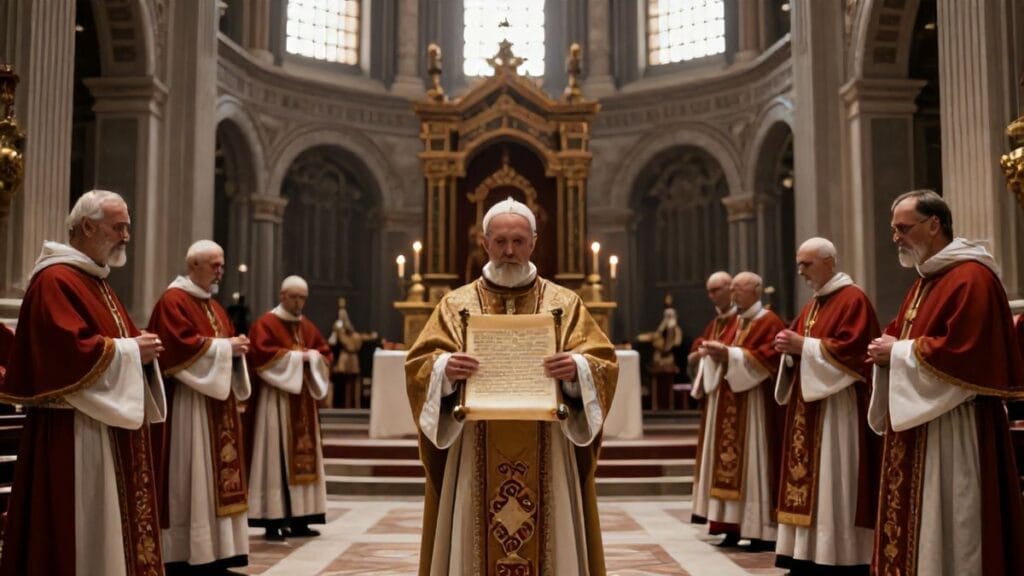
The promulgation itself likely took place amid solemn liturgy. Scribes, quills sharpened, stood ready to copy the text as it was finalized. Deacons held wax tablets or scrolls. Perhaps the Lateran basilica echoed with the chanting of the Gradual as clergy processed in, candles flickering, the scent of frankincense rising toward vaulted ceilings. Nicholas II, vested in white and gold, took his place before the altar, flanked by cardinal‑bishops and priests.
At a signal, a notary or cardinal began to read. In sonorous Latin, he declared the Church’s resolve to reform the way her highest shepherd was chosen, invoking the authority of Peter and Paul and the canons of earlier councils. As the key clauses of the papal election decree 1059 rang out—naming the cardinal‑bishops as primary electors, condemning simony and bribery, setting conditions for imperial involvement—listeners in the nave and choir must have felt a mixture of relief, pride, or unease, depending on their loyalties.
Those who had suffered under corrupt bishops might have silently thanked God for this new clarity. Those tied to noble or imperial patronage networks could have wondered what their patrons would think when they heard. Some envoys, dutifully attentive, mentally composed reports for their rulers back home, calculating how far this new law might be pushed or resisted. The walls of the Lateran, which had seen so many councils and crises, now absorbed words that would outlast the banners and armor of that day’s attendees.
After the reading, the assembly likely responded with a collective affirmation. Decrees of this kind were not purely papal fiats; they derived moral and practical strength from bishops’ and abbots’ explicit consent. Each signature on the parchment, each seal affixed, transformed Nicholas II’s will into a more universal commitment. When bishops returned to their dioceses, they carried copies of the text or at least its main points, ready to explain to their clergy how the head of the Church would henceforth be chosen.
Ritual reinforced law. Mass continued, and the Eucharist was celebrated beneath the same roof that had just heard the new electoral norms. In a symbolic sense, the decree passed through the fire of the altar: it was not merely a human contract but an offering of order to a God of order. As Nicholas II raised the consecrated host, some hearts must have whispered that, perhaps now, the man who performed this act in future generations would be less likely to have bought his way to the altar.
But this was only the beginning. Outside those walls, nobles nursed grudges, soldiers waited for orders, and imperial counselors sharpened their Latin to parse just how far this papal audacity extended. The parchment stored in the Lateran archives, though fragile, contained words that could destabilize old power balances. The decree’s life would unfold not only in chancery copies and canon law collections, but in the soil of politics and the storms of future confrontations.
Resistance and Rebellion: Antipopes, Nobles, and Imperial Anger
No law, however solemn, erases entrenched interests overnight. In the years following 1059, resistance to the new electoral norms surfaced in various forms—sometimes quiet evasion, sometimes open rebellion. The supporters of Benedict X, though formally defeated, did not immediately vanish. Some Roman families longed to restore the days when they could broker papal elections in smoky halls, trading promises of votes for lands or gold.
Beyond Rome, imperial circles watched with unease. The regency governing on behalf of the young Henry IV faced its own challenges and could not instantly confront Nicholas II. But as the boy grew into a king and later a self‑assertive emperor, the question of who controlled episcopal and papal appointments would move from background to center stage. The papal election decree 1059, by articulating a vision of clerical independence, provided a legal script for those who would later resist imperial nominations not only for the papacy but for bishoprics across the Empire.
Opposition sometimes coalesced around alternative candidates to the papal throne—antipopes. When Gregory VII later clashed with Henry IV, the emperor would sponsor men like Clement III as rival popes, claiming that Gregory’s own election, rooted in the very norms of 1059, was invalid or politically tainted. The irony is rich: a decree designed to stabilize the papal succession and prevent disputed elections became a weapon in the hands of those contesting reformist popes.
Roman nobility adapted as well. Some sought positions within the cardinalate, finding new ways to influence from inside what they could no longer openly control from outside. Others turned to secular or imperial patrons, offering local expertise and support in exchange for backing in any future Roman turmoil. The decree had shifted the battlefield, but it had not abolished conflict.
In Italy’s patchwork of principalities and communes, the Church’s new self‑assertion also complicated local rivalries. A city that sided with the papal reform cause might find itself at odds with an emperor who saw his rights curtailed; one that embraced imperial patronage risked papal censure. Thus the legal lines drawn in the papal election decree 1059 traced themselves across landscapes, fueling the emergence of factions later labeled “papalist” or “imperialist,” “Guelf” or “Ghibelline.” A technical reform of election procedure became spark and symbol in a larger reordering of medieval politics.
But resistance was not always dramatic. Some bishops simply ignored parts of the decree that inconvenienced them. Others interpreted its clauses narrowly, arguing that the unique rights granted to cardinal‑bishops in papal elections did not automatically apply to other ecclesiastical appointments. Each such interpretation was an attempt to limit the reach of the reforming spirit. In the push and pull between innovation and tradition, law and practice danced a slow, uneven waltz.
The Human Faces of Reform: Hildebrand, Peter Damian, and Their Circle
Behind the legal Latin of the papal election decree 1059 stood flesh‑and‑blood personalities whose convictions and wounds shaped its lines. Chief among them was Hildebrand, the Archdeacon of Rome. Born of humble origins, possibly in Tuscany, Hildebrand had risen through the ecclesiastical ranks by sheer ability, piety, and a burning zeal for reform. He had served Leo IX, journeyed to synods, negotiated with princes, and seen, up close, the humiliations endured by the papacy at the hands of both Roman nobles and emperors.
Hildebrand’s vision was stark. He believed that the Church must be free—libertas ecclesiae—if it was to fulfill its divine mandate. The buying of offices, the marriage of priests, and the domination of bishops by lay lords were, to him, not merely administrative flaws but spiritual diseases. He regarded the papal office as the fulcrum on which this freedom turned. Only a pope chosen without simony and without lay coercion could legitimately challenge kings and nobles to moral reform. It is almost certain that Hildebrand played a central role in drafting and championing the papal election decree 1059.
His ally and occasional critic, Peter Damian, brought a different temperament. A former hermit of Fonte Avellana, Peter was a man of fierce asceticism and emotional rhetoric. His letters and treatises lashed out at corrupt clergy and lax morals; he called the Church to a chastity of soul and body. To him, the papal election decree 1059 was one tool among many to purify the bride of Christ. Yet Peter sometimes feared that legal reforms could outpace spiritual conversion. Without hearts changed, could a new voting procedure really save the Church?
Other figures in Nicholas II’s circle contributed their insight. Humbert of Silva Candida, known for his role in the East‑West schism of 1054, possessed a sharp legal mind and a combative style. He understood the power of clear canons to shape behavior over time. Bishops from reforming dioceses north of the Alps, influenced by monastic networks like Cluny, lent support and legitimacy to the Roman initiatives. Their presence at the Lateran Synod signaled that 1059 was not merely a local Italian event but part of a trans‑European movement.
The humanity of these reformers is easy to forget amid dates and decrees. They suffered illness, felt fear, doubted their own adequacy. Hildebrand, later Gregory VII, would weep as exile and opposition battered his pontificate. Peter Damian, exhausted by his labors, begged at times to be allowed to return to the quiet of his hermitage. Yet they returned again and again to the fight for a holier Church. The papal election decree 1059 was, for them, a milestone, not an endpoint—a necessary bulwark against a tide of abuses they believed could drown souls.
In their letters, preserved across centuries, we hear a tone both stern and tender. They write of the Church as mother, as bride, as a wounded body. They invoke Scripture not as ornament but as living authority. For them, the drama of 1059 was part of a cosmic struggle between purity and corruption, obedience to God and enslavement to worldly power. The decree’s legal prose thus conceals a passionate spiritual drama—one in which real men, with all their flaws, strove to align institutional practice with transcendent ideals.
Reverberations Across Christendom: Bishops, Monks, and the Common Faithful
As news of the Lateran Synod and its famous decree spread across Western Christendom, reactions varied according to local histories and sensibilities. In some dioceses, bishops enthusiastically embraced the reforming wind. They had long battled simony and lay interference in their own sees; now they could point to Rome and say, “See, even the papal throne is to be safeguarded by law.” The papal election decree 1059 became a rallying point, a symbol that the highest office would no longer be above the standards demanded of all.
Monastic communities, especially those aligned with the Cluniac reform or similar movements, rejoiced. For decades they had criticized episcopal worldliness and sexual immorality among clergy. Many had flirted with semi‑separatist ideas, imagining monasteries as pure islands in a corrupt ecclesiastical sea. The new decree gave them reason to hope that the tide might begin to turn, that bishops and pope alike might move toward the blessèd rigor monastic writers praised.
Yet the reception was not uniformly positive. In some regions, local elites resented what they perceived as a centralizing Roman move. If the pope was now more securely in the hands of cardinals, often with ties to a particular reform party, would that not distance him from the everyday concerns of distant churches? Medieval communications were slow; a decision taken by a small circle in Rome might take months or years to be known at the edges of Christendom. Some felt that a process less open to lay voices risked alienating communities that had, until then, felt a certain symbolic participation in choosing their supreme pastor.
Among ordinary believers, the impact was subtler but no less real. News traveled in snippets: a sermon mentioning a “holy synod in Rome,” a passing reference in a bishop’s letter read aloud in a cathedral. What many grasped most clearly was the decree’s passionate condemnation of simony and violent usurpation. They knew, from bitter experience, what it meant when a local priest bought his post and recouped the cost by fleecing his parishioners. If such men could no longer hope to climb to the papal throne, if at least at the top there would be some safeguard, it might mean one less layer of cynicism between them and God.
But there were confusions too. Medieval minds were not naïve; they understood that law could be broken, that powerful men might twist rules to their advantage. Some likely asked: If a pope chosen under the new norms acts unjustly, what then? Does legality guarantee sanctity? The decree did not, and could not, answer such questions directly. It was a structural remedy for structural sins, not a replacement for personal conversion.
Still, the reverberations were unmistakable. Councils in various regions began to echo the decree’s language. Canonists copying collections of church law gave the papal election decree 1059 pride of place among recent norms. Over time, the notion that the Church’s highest leadership should be chosen by a defined clerical college, shielded from overt lay domination, took root as an assumption. To challenge it would require more than local custom; it would mean confronting a text now woven into the fabric of ecclesial memory.
From 1059 to the Investiture Controversy: A Decree Sparks a Firestorm
The decades after 1059 saw the gradual ignition of a conflict that would shake medieval Europe: the Investiture Controversy. At its heart lay a question closely related to those addressed in the papal election decree 1059: who has the right to appoint and invest bishops and popes? If the Church claimed the internal ordering of its own hierarchy as a spiritual prerogative, emperors and kings, long used to bestowing rings and staffs as symbols of episcopal office, faced a direct challenge to their authority.
When Hildebrand himself ascended the papal throne as Gregory VII in 1073, his papacy unfolded almost as a commentary on 1059. He pushed the logic of reform to its limits, insisting that the pope, as successor of Peter, held a moral authority above that of any secular ruler. Gregory’s famous Dictatus Papae, a list of papal prerogatives preserved in his register, asserted, among other claims, that the pope could depose emperors and that no synod could be called without his permission. These claims were not directly written into the papal election decree 1059, but the decree’s assertion of clerical control over papal succession provided the necessary foundation. A pope who owed little to secular nomination could speak more boldly to kings.
Henry IV, coming into his own as ruler of the German kingdom and empire, refused to accept the erosion of customary royal rights. To him, the appointment of bishops was an integral tool of governance. Bishops were not only spiritual leaders; they were imperial princes, holders of lands and offices, crucial to the administration of the realm. Relinquishing control over their investiture felt like political suicide. Thus, when Gregory VII condemned lay investiture and excommunicated bishops who received their office from Henry, the emperor retaliated by declaring Gregory deposed and supporting a rival pope.
The drama that followed—Henry IV’s excommunication, his barefoot penance at Canossa in the snows of 1077, the subsequent renewed conflict and civil war in Germany—has often been told. Less often noted is how deeply these events drew upon and tested the principles encoded in 1059. The core question—does the Church elect and appoint its own leaders, free from lay coercion?—had not changed. What had changed was the intensity with which both sides clung to their answers, armed now with more systematic legal reasoning.
In the end, compromises such as the Concordat of Worms in 1122 sought to balance spiritual and temporal claims: the Church would confer the spiritual office, while secular rulers retained a role in granting temporalities. But even those compromises bore the imprint of the papal election decree 1059. No one could seriously propose a return to a world where emperors simply nominated popes at will. The idea that the cardinals gathered, deliberated, and chose had entered the bloodstream of ecclesiastical culture.
Thus, what began as an attempt to clean up the chaos of papal elections in Rome contributed to a Europe‑wide redefinition of church–state relations. The firestorm of the Investiture Controversy illuminated, in searing flashes, just how radical the logic of 1059 really was. A decree crafted amid incense and Latin prose had helped to redraw the mental map of power.
Shaping the College of Cardinals: From Ad Hoc Council to Permanent Electorate
Over the century following 1059, the group singled out by the decree—the cardinals—evolved from a somewhat loose association of Roman clergy into a structured, prestigious college. Initially, cardinals were linked to specific churches and roles in and around Rome. But as the papacy’s horizon expanded, so too did the composition of its electors. Popes began to name cardinals from distant dioceses, bringing French, German, English, and Iberian churchmen into the circle.
The papal election decree 1059 had not explicitly prescribed such internationalization; it focused on the cardinal‑bishops of the suburbicarian sees. Yet by defining a privileged electoral core, it encouraged popes to think in terms of a stable body of close advisors whose membership they could shape. Later reforming popes used this tool to surround themselves with men loyal to their spiritual program. The College of Cardinals gradually became a microcosm of Christendom—a place where different regions, monastic orders, and schools of thought met and sometimes clashed.
With growing status came ceremonial elaboration. Cardinals adopted distinctive dress, symbolizing their special relationship to the papal see. They received hats and titles, were addressed with honorifics, and took part in ever more intricate liturgies. Yet the core of their importance remained what the decree had planted: when a pope died, they, and they alone, held the right to elect his successor. Over time, the initial emphasis on cardinal‑bishops lessened, and all cardinals—bishops, priests, and deacons—came to share the vote.
This evolution was not without controversy. Critics occasionally complained that the College was too easily swayed by family interests or by the pressures of the city where it met. Stories of locked conclaves, of deadlocked votes dragging on for months, of factions buying and selling influence, blemished its dignity. But precisely because the electoral mechanism was so clearly defined, scandals could be identified and reforms attempted. Later popes introduced measures to sequester cardinals during elections, to prevent outside interference, and to regulate the required majority—steps that can be seen as logical descendants of the precautions first articulated in the papal election decree 1059.
By the high Middle Ages, the papal election process was one of the most sophisticated institutional mechanisms in Europe, blending ritual, law, and politics. Its birth in 1059 at the Lateran was thus not a minor administrative tweak but the genesis of a living institution that would, centuries later, still shape world headlines whenever a pope died and red‑hatted men entered a locked chapel to vote.
Ritual, Symbol, and Space: Why the Lateran Mattered
It is no accident that the papal election decree 1059 emerged from a synod held at the Lateran. Long before St. Peter’s became the emblem of papal Rome, the Lateran Basilica of St. John—the “mother and head of all the churches of the city and of the world”—served as the pope’s cathedral and residence. Its halls had witnessed imperial audiences, ancient councils, and the daily rhythm of papal administration. To gather there was to step into a continuum of authority stretching back to Constantine and the earliest public manifestations of Christian power.
The Lateran’s physical space embodied the fusion of sacred and civic roles that defined the medieval papacy. Marble columns reused from pagan buildings lined its aisles; mosaics glinted above the apse; adjoining palaces housed not only chapels but also reception rooms and archives. When Nicholas II and the reformers convened their synod in 1059, they tapped into this layered symbolism. Any decision taken here would feel less like a novel experiment and more like a restoration of an ancient, rightful order—even if, in truth, they were charting new constitutional ground.
Ritual amplified this sense of continuity. The chanting of psalms, the kissing of altars, the procession of candles—these practices did not change just because a new electoral rule was being crafted. On the contrary, their familiar rhythms reassured participants that law was serving, not undermining, tradition. The papal election decree 1059 thus floated on a sea of ritual continuity, appearing less as a disruptive statute than as an organic extension of the Church’s liturgical life.
Space mattered in another way too: it signaled ownership. To meet in an imperial palace in Germany, as at Sutri, had implied imperial oversight of papal affairs. To meet in the Lateran was to say, subtly but powerfully, that the Church possessed a house of her own, a place from which to legislate for herself. The stones of the Lateran, weathered by centuries yet still standing, gave material form to the abstract idea of ecclesiastical autonomy. When future generations looked back on 1059, they would see not just a text but a place—a palace and basilica in Rome where the Church had found her voice.
Legal Memory: How Canonists Preserved and Interpreted the Decree
Law in the medieval Church lived not only in original parchments but in the minds and manuscripts of canon lawyers. After 1059, the papal election decree quickly entered the orbit of those who compiled collections of ecclesiastical legislation. Early private collections circulated among scholars and bishops; later, more systematic works, culminating in Gratian’s Decretum in the twelfth century, wove the decree into a rich tapestry of canons from councils and papal letters.
Canonists did more than copy; they commented, reconciled, and, when necessary, harmonized apparent contradictions. How did the rights described in the papal election decree 1059 fit with earlier customs of popular acclamation or imperial participation? What precedence did its norms hold compared to those of other regional synods? Through their glosses and marginal notes, these jurists effectively interpreted the decree for each new generation. One could say that the law of 1059 acquired its enduring shape less in the Lateran’s hall than in the scriptoria and schools where it was studied.
By situating the decree among other canons condemning simony and lay investiture, canonists helped ensure that it was read not as a narrow procedural rule but as part of a comprehensive reform vision. Later papal documents, such as those issued by Urban II or Paschal II, would cite or allude to its principles, especially in disputes with secular rulers. Over time, the idea that popes were chosen by cardinals became so embedded in canonical collections that it felt, to many, less like a recent ruling and more like an ancient pillar.
Citation was itself a form of power. When a bishop argued with a king over who could nominate a candidate to a vacated see, he might point to 1059 as evidence that the Church was moving toward greater internal freedom. When a secular prince complained that he had been excluded from papal elections, papal advisors could reply, with legal texts in hand, that such exclusion was envisaged by a synod whose authority had never been overturned. The papal election decree 1059 thus lived on as a reference point in countless local struggles, its Latin clauses echoing in courtrooms, councils, and letters.
By the high Middle Ages, canon law had become a sophisticated discipline taught in universities like Bologna. Students pored over compilations that treated the decree as a foundational text. Professors debated its interpretation in disputations, honing arguments that would filter into episcopal courts. In this way, a decision made by a relatively small group of bishops in 1059 was amplified by generations of legal minds into a cornerstone of ecclesiastical self‑understanding.
Echoes in Modern Conclave Rules: The Long Afterlife of 1059
If one watches a modern papal conclave—cardinals entering the Sistine Chapel, doors closing with the traditional cry “Extra omnes!,” ballots cast and burned—one sees the distant offspring of the papal election decree 1059 at work. The details have changed dramatically. Modern conclaves involve cardinals from every continent, complex rules about majorities, and elaborate security measures to prevent leaks. Yet the core principle—a defined college of clerical electors choosing the Bishop of Rome without formal participation from secular powers—remains the same.
Subsequent popes refined and codified the electoral process. In 1274, at the Second Council of Lyon, Gregory X introduced the practice of sequestering cardinals during papal elections, to prevent external pressure and speed up decisions. Later laws adjusted voting thresholds, age limits, and procedures for dealing with deadlocks. Through all these changes, however, the central idea that the cardinals alone elect the pope persisted, rooted in the precedent set in 1059.
Even the ritual locale—now St. Peter’s and the Sistine Chapel rather than the Lateran—does not obscure the lineage. When white smoke curls up from the chapel roof, signaling a successful election, it expresses in theatrical form a reality born of medieval legal imagination: that the Church, gathered in her cardinals, recognizes God’s choice without asking leave from emperor or king. No monarch stands poised in a nearby palace, ready to veto the result. No Roman noble rides at the head of armed men to install his favorite candidate by force.
Modern canon law, codified in 1917 and revised in 1983, still treats papal election as a matter governed by special norms, many of which echo the concerns of the eleventh‑century reformers. Simony in elections remains explicitly condemned and, in principle, renders acts void. Secular interference is anathematized. The very secrecy of the conclave—including oaths sworn by cardinals and staff—not only protects privacy but also symbolizes the Church’s determination to keep this most delicate discernment insulated from worldly coercion.
It is of course true that politics—ecclesiastical and to some extent secular—still swirl around modern papal elections. Human beings, with their ambitions and fears, have not changed. But the structural and legal environment in which those dynamics unfold is the heir of Nicholas II’s Lateran Synod. The papal election decree 1059, once read aloud in a half‑lit medieval hall, continues to whisper beneath the polished Latin and global media spectacle of contemporary papal succession.
Seeing 1059 Through Human Eyes: Anxiety, Faith, and Ambition
To reduce the papal election decree 1059 to a set of clauses is to miss much of its human drama. Imagine, instead, the faces of those who lived through it. A Roman artisan, whose children slept uneasily whenever rival armed bands roamed the streets, might have listened as rumors spread that the pope and his bishops were finally doing something to stop violent, bought elections. For him, the decree was hope that his city’s sacred center might be less often drenched in blood.
A minor noble, accustomed to bargaining his family’s influence during papal vacancies, felt something different—a shrinking of opportunity. The papal election decree 1059 closed doors that had once swung wide for those with money and men‑at‑arms. Ambition did not vanish; it adapted. Some sought entry into the clerical elite; others looked for new avenues of secular power, turning their energies away from papal intrigues toward regional lordships or imperial service.
For a conscientious bishop in a far‑off diocese, the decree was both comfort and burden. Comfort, because he could trust that, at least in theory, his ultimate ecclesiastical superior would not be a man bought by coin or cowed by princes. Burden, because the bar of holiness and integrity had been raised; the whole Church watched the pope’s election with new critical eyes. If reform began at the top, pressure would surely ripple downward.
Monks reading the text in their chapter houses saw in it an external confirmation of their internal ideals. In their cloisters, they had long prayed for a chaste clergy and a pure Church. The papal election decree 1059 did not fulfill these dreams overnight, but it translated them into institutional form. Law gave bones to visions; decrees sketched shapes for grace to inhabit.
Yet even the reformers harbored anxieties. What if, despite their best efforts, a corrupt or weak man still won the cardinals’ votes? What if secular rulers retaliated violently, plunging the Church into wars that would cost countless lives? Hildebrand and his companions knew they were playing a high‑stakes game. They gambled that God’s providence would work through, not against, the structures they were building.
To stand emotionally in 1059 is to feel a world in flux. Old hierarchies trembled; new concepts of authority glimmered on the horizon. The papal election decree 1059, with its blend of canonical precision and spiritual fervor, crystallized that tension. It was both an act of faith—that law, properly framed, could help channel divine will—and an act of audacity, pressing back against emperors and nobles in the name of a freedom still only dimly understood.
Conclusion
The promulgation of the papal election decree 1059 at the Lateran Synod in Rome marked a watershed in the history of the Church and of medieval Europe. Born from the chaos of simoniacal popes, rival claimants, and violent Roman factions, the decree sought to restore dignity and order to the office of the Bishop of Rome by redefining who chose him and how. By entrusting primary responsibility to the cardinal‑bishops, circumscribing imperial involvement, and condemning the buying and selling of spiritual power, it erected legal boundaries around a process that had too often fallen prey to naked force and gold.
Its effects radiated far beyond the walls of the Lateran. The papal election decree 1059 helped catalyze the broader Gregorian Reform, fed the ideological currents that would culminate in the Investiture Controversy, and laid the institutional foundations for the College of Cardinals and the modern conclave. At the same time, it reshaped the expectations of clergy and laity alike, suggesting that holiness and legality were not enemies but potential allies in the Church’s quest for integrity.
The decree did not eliminate corruption or conflict; history after 1059 remained marked by antipopes, disputed elections, and fierce struggles between popes and princes. Yet without this attempt to anchor papal succession in a more coherent and autonomous framework, later reforms and corrections would have had no stable base. The parchment crafted in that Roman spring became a reference point for canonists, a weapon for reformers, and a symbol of ecclesiastical self‑assertion.
Seen across nearly a millennium, the papal election decree 1059 stands as a testament to the medieval Church’s willingness to use law to seek holiness amid political storms. It reminds us that institutions, though fragile and flawed, can be instruments of moral vision, and that even in an age of swords and simony, men and women dared to imagine a purer way of choosing those who would shepherd souls.
FAQs
- What exactly was the papal election decree 1059?
The papal election decree 1059, often called In nomine Domini, was a law issued by Pope Nicholas II and the Lateran Synod in April 1059 that restructured how popes were chosen. It made the cardinal‑bishops the primary electors of the pope, reduced the direct role of emperors and lay nobles, condemned simony in papal elections, and allowed elections to be held outside Rome in emergencies. Its aim was to protect the papacy from corruption and secular domination. - Why was this decree considered revolutionary?
It was revolutionary because it shifted the decisive power over papal elections from emperors, Roman aristocrats, and popular acclamations to a defined clerical elite—the cardinal‑bishops and, gradually, the wider College of Cardinals. By framing imperial participation as a courtesy rather than a right, it challenged long‑standing assumptions about secular control of the papacy and asserted the Church’s capacity to govern its own leadership succession. - Did the decree immediately end corruption in papal elections?
No. While the decree sharply condemned simony and violence, and provided clearer rules, it could not instantly change human behavior or political realities. Disputed elections, antipopes, and secular interference continued to occur. However, the decree gave reformers a powerful legal tool to contest corrupt practices and gradually shaped expectations about how papal elections should be conducted. - How did the decree affect the role of the Holy Roman Emperor?
The decree acknowledged that the German king and emperor had been “honored” with participation in past elections but did not grant him a continuing legal right to choose popes. This subtle redefinition weakened imperial claims and contributed to later conflicts, especially the Investiture Controversy, in which popes like Gregory VII insisted that secular rulers had no authority to appoint or invest church officials. - What connection does the decree have to the modern papal conclave?
The modern conclave, in which cardinals alone elect the pope behind closed doors, is a direct institutional descendant of the principles articulated in 1059. While later regulations refined voting procedures, secrecy, and majorities, the basic idea that a defined body of cardinals chooses the pope independently of secular rulers stems from the papal election decree 1059. - Who were the main figures behind the decree?
Pope Nicholas II formally issued the decree, but key reformers such as Hildebrand (the future Gregory VII), Peter Damian, and Humbert of Silva Candida almost certainly played central roles in drafting and promoting it. They were part of a broader reform movement seeking to free the Church from simony and lay control and to restore moral integrity to the clergy. - Did the decree change the role of ordinary Christians in papal elections?
Yes, in practice it reduced the direct influence of the Roman populace in choosing the pope. While the decree still mentioned the consent of clergy and people, their role now followed the decisive choice made by the cardinal‑bishops and other cardinals. Popular acclamation shifted from being a key factor in selection to a more confirmatory and symbolic act.
External Resource
Internal Link
Other Resources
- Encyclopaedia Britannica – general search for the exact subject
- Google Scholar – academic search for the exact subject
- Internet Archive – digital library search for the exact subject