Table of Contents
- Storm Clouds Over Europe: The World Before Cadiz, 1587
- A Queen, A King, and a Broken Christendom
- From Devon Seafarer to Elizabeth’s “Dragon”
- Spain’s Floating Colossus: The Armada in the Making
- Planning the Blow: How Francis Drake Raids Cadiz Took Shape
- Setting Sail Into the Lion’s Den
- Nightfall at Cadiz: The English Fleet Slips Into the Harbor
- Fire and Thunder: The First Hours of the Attack
- “Singeing the King of Spain’s Beard”: Destruction in the Inner Harbor
- Merchants, Mariners, and Panic in the Streets
- Spoils, Seizures, and Intelligence: What Drake Took Away
- The Long Shadow: How the Raid Delayed the Armada
- Voices From Two Kingdoms: Triumph in London, Fury in Madrid
- Lives Upended: Ordinary People Caught in an Imperial Duel
- Sea Power Redefined: Tactics, Technology, and Naval Revolution
- Myths, Memory, and the Legend of Drake at Cadiz
- From Cadiz to the Armada: The Road to 1588
- Echoes Across Centuries: Why the Cadiz Raid Still Matters
- Conclusion
- FAQs
- External Resource
- Internal Link
Article Summary: In April 1587, as Europe braced for a climactic clash between Protestant England and Catholic Spain, Francis Drake sailed boldly into the enemy’s own harbor at Cadiz and set it ablaze. This article traces how political tension, religious rivalry, and imperial ambition converged in the audacious episode often summed up as “francis drake raids cadiz.” It follows Drake from his roots as a Devon mariner to his emergence as Elizabeth I’s favorite privateer, then plunges into the dramatic hours of the surprise attack itself. Along the way, it examines the human cost in Cadiz’s streets and docks, the shattering of Spanish preparations, and the intoxicating celebrations that erupted in London. It shows how the raid delayed the Spanish Armada, reshaped naval warfare, and fed powerful myths on both sides of the Channel. We also look closely at the ordinary sailors, merchants, and townspeople whose lives were overturned in a single night of fire. Finally, the article explores why the events of April 1587 still resonate today, as a lesson in pre-emptive war, propaganda, and the fragile balance of sea power.
Storm Clouds Over Europe: The World Before Cadiz, 1587
Europe in the late 1580s was a continent on edge, a mosaic of fragile alliances and simmering hatreds. The Protestant Reformation had torn Christendom apart a half-century earlier, and by 1587 the fracture lines were no longer simply theological. They were political, commercial, and deeply personal. If one were to stand on the windswept cliffs of southern England in the spring of that year, looking south across the churning Channel, it would have been possible—if not yet by sight, then certainly in imagination—to glimpse the shape of the looming Spanish Armada.
Spain loomed over the European scene like a giant. Under King Philip II, the Spanish monarchy commanded vast territories: the wealthy kingdoms of Castile and Aragon, Portugal and its overseas empire, the rich cities of Italy, and above all the treasure-laden Americas. Silver from Potosí and Zacatecas poured into Spanish coffers, underwriting armies in Flanders and fleets across the Atlantic. Yet this apparent strength concealed growing strains: spiraling debts, exhausted soldiers, and overstretched lines of supply. The empire was mighty, but it was also brittle.
Opposite Spain stood a smaller, more vulnerable kingdom: England under Queen Elizabeth I. By 1587, Elizabeth had reigned nearly three decades, guiding her realm through religious upheaval and economic insecurity. Officially Protestant, England was still home to many Catholics, and its status as a heretical kingdom in the eyes of Rome was sealed when Pope Pius V excommunicated Elizabeth in 1570. That papal bull did more than condemn a queen; it invited Catholic powers to see her removal as a godly duty. From that moment on, England’s security was inextricable from the hostility of Catholic Europe, and most of all from Spain.
Trade and religion twisted together into a knot of rivalry. English privateers and adventurers roamed the Atlantic, eyeing Spanish shipping with a mix of envy and hunger. The Caribbean became a contested space, with English raiders attacking Spanish treasure fleets and Caribbean ports. To Madrid, these men were pirates. To London, especially to courtiers close to the queen, they were sometimes useful tools—a way to hurt Spain without formal war. Among them, one name would soon tower over the rest: Francis Drake.
By the time francis drake raids cadiz in 1587, the atmosphere between the two kingdoms had long since curdled into open hostility, even if diplomats still exchanged letters. In the Netherlands, English “volunteers” aided the Dutch rebels against Spanish rule. In France, religious wars gave every prince and envoy a reason to plot. Across Europe, observers spoke fearfully of a coming “last great enterprise”: a massive armada being assembled by Philip II to crush Elizabeth’s regime, restore Catholicism, and break England’s rising maritime power.
It is against this backdrop of mounting dread, whispered prophecies, and feverish preparations that the audacity of the raid on Cadiz must be understood. The attack was not an isolated act of piracy. It was a calculated stroke in a wider contest for mastery of the seas, waged under the banner of faith but driven equally by gold, glory, and survival.
A Queen, A King, and a Broken Christendom
The duel at Cadiz began, in a sense, decades earlier, in the intertwined fates of two monarchs: Elizabeth Tudor of England and Philip Habsburg of Spain. Their relationship was a study in contradiction. Once, Philip had been Elizabeth’s brother-in-law, the Spanish husband of her Catholic half-sister, Mary I. For a brief period in the 1550s, he had even held the title of King of England. But after Mary’s death and Elizabeth’s accession, he became instead her most implacable foe.
Philip II was a man of habit, ritual, and deep piety, ruling from the austere corridors of the Escorial. He believed himself chosen by God to defend Catholicism, and he interpreted the religious tumult of his age through that uncompromising lens. To him, heresy was not merely an error but a contagion, one that threatened the soul of Europe. The spread of Protestantism in England was thus a scandal and a strategic menace: it opened the Channel to enemies and provided a base for aid to rebels in the Netherlands.
Elizabeth, by contrast, cultivated flexibility. She balanced factions at court, played Catholic and Protestant powers against one another, and spoke in carefully crafted ambiguities. Where Philip saw clarity and duty, she saw nuance and opportunity. Yet even her famed caution had limits. The execution of Mary, Queen of Scots, in February 1587—just two months before the raid on Cadiz—marked a point of no return. Mary had been a Catholic claimant to Elizabeth’s throne and a focus for countless plots. Her death infuriated Catholic Europe and especially Philip, who now carried a personal as well as a religious grievance.
The broken state of Christendom gave their rivalry its intensity. The Protestant Reformation had created two camps that saw themselves not merely as rivals but as embodiments of Truth and Error. The massacre of Huguenots in France, the burning of heretics in Spain, the execution of Catholic priests in England—all formed part of a grim tapestry of violence. When people spoke of the Spanish Armada as a “crusade,” they meant it. When English preachers warned of a Catholic invasion as a prelude to mass slaughter, they believed that, too.
In this charged climate, sea power took on a new meaning. Control of the oceans meant control of commerce, colonization, and communication. It meant access to the New World’s bullion and the ability to starve one’s enemies or keep one’s own allies supplied. The Channel, the Atlantic approaches, and the Mediterranean gateways like Cadiz and Lisbon became more than ports; they were symbols of dominion.
Thus when, in the spring of 1587, Elizabeth authorized a bold strike against Spanish preparations, it was not an act she could disavow as mere piracy. It was a decision that aligned her fate even more closely with that of the man she had once refused to marry. King and queen, former in-laws now turned adversaries, would test whose vision of Europe would prevail, and the first true measure of that test would be taken in the harbor of Cadiz.
From Devon Seafarer to Elizabeth’s “Dragon”
To understand why francis drake raids cadiz became possible, one must understand Francis Drake himself—his rise, his character, and the hard schooling of his early voyages. Born around 1540 in Tavistock, in the rugged county of Devon, Drake grew up in a world where the sea was both a path to fortune and a grave. His family, modest and devoutly Protestant, moved to Kent when he was young, but his vocation was already clear. He apprenticed with a shipmaster, learning the intricate crafts of navigation, seamanship, and command in the cramped, dangerous environment of an English coastal vessel.
The 1560s and 1570s were years of apprenticeship in a harsher sense. Drake sailed with his kinsman John Hawkins on voyages to West Africa and the Caribbean, voyages that were deeply entangled with the brutal slave trade. English ships captured or bought Africans and sought to sell them illicitly in Spanish colonies, in defiance of Spanish law. The Spanish colonial authorities retaliated when they could. In 1568, at San Juan de Ulúa, a Spanish fleet attacked Hawkins and Drake’s small squadron in harbor, killing many Englishmen and nearly capturing their leaders. Drake survived, but he did not forgive.
It was in the wake of that betrayal, as he saw it, that Drake hardened into the implacable foe of Spain who would one day sail into Cadiz. He embarked on a series of privateering raids against Spanish shipping in the Caribbean, striking at Nombre de Dios and along the American coasts. He combined audacity with a talent for intelligence-gathering, cultivating informants and learning the rhythms of Spanish trade. These years honed the qualities that would later define his attack on Cadiz: a willingness to take extraordinary risks, a flair for psychological warfare, and a conviction that Spain’s global empire was a fair target for English retribution.
Drake’s circumnavigation of the globe from 1577 to 1580 transformed him from a daring privateer into a national hero. Sponsored discreetly by Elizabeth and by powerful courtiers like Sir Christopher Hatton, the voyage yielded spectacular loot and even more spectacular prestige. Drake plundered Spanish settlements along the Pacific coast, seized the treasure-laden galleon Nuestra Señora de la Concepción—nicknamed the Cacafuego—and claimed distant shores in the queen’s name. When he returned, his ship, the Golden Hind, was heavy with gold, silver, and spices. Elizabeth went down to Deptford in person to knight him aboard his own deck, a public gesture that told the world she stood behind this “pirate” after all.
The Spanish saw Drake as a devil of the seas. English ballads and pamphlets celebrated him as God’s scourge against a tyrannical Catholic power. Somewhere between those extremes stood the man himself: capable of ruthlessness, no doubt, but also capable of camaraderie with his crew, demanding but often generous, a commander whose men were willing to follow him into extraordinary dangers. By 1587, when rumors swirled of the vast Armada being assembled in Iberian ports, there was no figure better suited—or more inclined—to strike at the very heart of Spanish preparations.
Spain’s Floating Colossus: The Armada in the Making
In the years leading up to 1587, Spain’s planners and shipwrights were engaged in the staggering task of assembling what they hoped would be an unstoppable force: the Armada. It was not yet the finished fleet that would sail in 1588, but in every major port along the Atlantic seaboard of Spain and Portugal, the work of preparation throbbed and echoed. Timber yards rang with the chop of axes and the clatter of mallets. Ropewalks stretched into the distance, twisting the fibers that would bind sails and anchor cables. Forges glowed as smiths hammered iron into nails, bolts, and cannon fittings.
Cadiz, perched on a narrow spit of land along Spain’s southern coast, was one of the crucial centers of this activity. It was a gateway to the Atlantic, a staging point for ships bound to and from the Americas, and now a key hub for vessels being mustered for the king’s “Great Enterprise” against England. Within its harbor rode armed galleons, supply ships, smaller escorts, and countless merchantmen pressed into royal service. Their holds bulged with timber, barrels of wine and oil, biscuit, salt meat, gunpowder, shot, and all the other necessities for a trans-Channel invasion force.
The logistics of such a fleet were immense. An armada of more than 100 ships required not only hulls and sails but also months of provisions for tens of thousands of sailors and soldiers. Grain had to be bought and baked into hardtack. Livestock had to be herded to coastal cities and slaughtered, its flesh salted and barreled. Casks had to be made, coopered tight enough to resist leaking on long voyages. Artillery pieces needed carriages; carriages needed wheels. Every link in this chain was vulnerable to disruption.
Philip II believed that God favored his enterprise, but he also understood the need for preparation. He relied on ministers and admirals—men like the Marquis of Santa Cruz, Álvaro de Bazán—to oversee the Armada’s formation. Santa Cruz, an experienced naval commander, pushed relentlessly to assemble a fleet of robust, heavily armed galleons. Yet even Philip’s authority could not conjure ships and supplies out of thin air. Spain’s finances were strained; creditors demanded repayments even as the crown requisitioned more and more resources.
It was into this complex, fragile system that the idea of a pre-emptive English strike fell like a spark. If an enemy could disrupt the gathering of ships, destroy supplies at their moorings, and sow fear among Spain’s coastal populations, the entire Armada might be delayed or weakened. The harbor of Cadiz, crowded with munitions and provisions, appeared a tantalizing target. An attack there would be not merely symbolic: it would tear at the roots of Spain’s invasion plans.
Planning the Blow: How Francis Drake Raids Cadiz Took Shape
In early 1587, as word of Spanish preparations reached London through spies, diplomats, and merchants, a question pressed upon Elizabeth’s council: should England wait passively for the storm to break, or strike first? The queen, instinctively cautious, disliked committing to open war. Yet she could not ignore intelligence hinting at a vast fleet mustering in Iberian ports. Her principal secretary, Sir Francis Walsingham, a man obsessed with security and espionage, favored a bold, disruptive stroke.
It was in this tense moment that francis drake raids cadiz was conceived. Drake himself, aware of Spanish preparations through his own network of informants and from the reports of returning seamen, argued for an expedition to “disturb, annoy, and destroy” the king of Spain’s naval stores. He framed it as a necessary defense—a way to blunt the edge of the coming blow and perhaps even deter it. His instincts as a privateer merged neatly with Walsingham’s hard-headed strategy.
Elizabeth’s final authorization was characteristic: she granted a commission, but with carefully hedged language. Drake was to “impede” Spanish preparations and, where possible, seize valuable prizes for the crown and his investors. The enterprise remained technically a private venture, backed by a consortium of courtiers and merchants eager for profit. Yet everyone involved understood that this was, in effect, an offensive operation by the English state.
Drake’s planning was meticulous and opportunistic. He gathered a fleet of around 25 to 30 ships—some royal, some private—armed and victualed for a long cruise. Among them were swift, maneuverable English galleons designed for gunnery duels and chasing down prey. The plan was not only to strike Cadiz but to patrol along the Iberian coast, intercepting supply ships and disrupting communications. Intelligence-gathering was as important as damage: Drake meant to learn as much as he could about the true scale and state of the Armada preparations.
Secrecy, as far as possible, was preserved. Officially, England and Spain were not yet in declared war, though blood had been spilled on both sides in the Netherlands and the New World. The fiction of peace allowed ambassadors to protest and pamphleteers to feign shock. But among sailors and soldiers, there was little illusion. Men signing on to Drake’s fleet knew they were heading into the lion’s den.
By April 1587, everything was ready. The English ships, their holds packed with provisions and their decks bristling with culverins and sakers, turned their prows toward the Spanish coast. What remained uncertain was not Drake’s determination but the response of the Spanish defenses at Cadiz. Would they be alert, their guns trained seaward? Or would the audacity of the move grant him a crucial element: surprise?
Setting Sail Into the Lion’s Den
The departure of Drake’s squadron had an air of both routine and destiny. English ports were no strangers to the comings and goings of fleets, but this expedition carried a peculiar, charged atmosphere. Rumors chased along the quays: talk of a great Armada assembling in Spain, of papal blessings and Spanish blessings upon its pennants, of the risk that England might soon face fire and sword upon its own shores. Against that ominous backdrop, the sight of English ships steering south had a different, defiant significance.
Drake’s own demeanor combined cheerfulness with iron focus. He was known for keeping a relatively loose discipline compared to some captains, dining with his officers and ensuring his crew were reasonably fed. Yet he expected obedience in battle and preparations, and his record of victories gave him authority. As the fleet cleared the English coast and caught the winds that would carry them down past the Bay of Biscay, Drake briefed his captains on his intent: to strike wherever Spanish weakness presented itself, but above all to reach Cadiz and burn the king’s stores.
The voyage south was itself a reminder of the precariousness of sea power. Storms could blow up unexpectedly; a snapped mast or shredded sail could delay the whole enterprise. Spanish patrols might be encountered, or neutral ships that could carry warning ahead. Drake countered these risks with speed and aggressive patrolling, sending out scouts and intercepting vessels along the way. When they captured neutral ships, he took great care in interrogating their masters, drawing out bits of news about the Spanish coast—a squadron seen here, a convoy expected there.
As the English fleet approached the Iberian coast, the air grew warmer and saltier. The whitewashed towns clung to the shoreline, and the scent of foreign lands reached the sailors’ nostrils. Many had never seen Spain, though they had heard songs and sermons about its grandeur and cruelty. To them, this was not merely an enemy country but the beating heart of the empire they had harried from afar. Now they would bring the fight directly to its doorstep.
Somewhere ahead lay Cadiz, its harbor nestled behind protective fortifications, its streets bustling with merchants and artisans, its docks crowded with ships laden with the materiel of war. Few in that city expected that, within days, English guns would be thundering in the roads, and that a night of terror and flames would etch itself into their collective memory.
Nightfall at Cadiz: The English Fleet Slips Into the Harbor
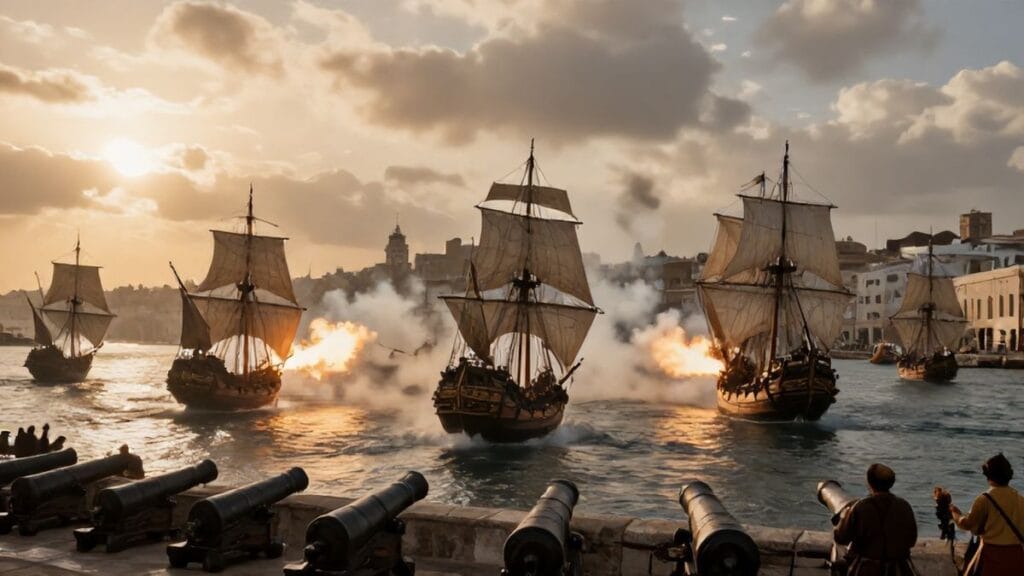
On 19 April 1587, as dusk gathered over the Andalusian coast, the English fleet approached Cadiz. The city’s outline grew distinct: the low houses, the church towers, the defensive works that guarded the entrance to the harbor. The waters around the port shimmered in the slanting light, dotted with the hulks and masts of a crowded anchorage. It was into this seemingly guarded space that Drake now intended to thrust.
What followed was an exercise in calculated boldness. Rather than lurk offshore or attempt a cautious reconnaissance, Drake steered directly toward the harbor entrance. He had studied the charts, questioned local pilots captured along the way, and weighed the risks. Surprise, he concluded, was worth almost any danger. Spanish lookouts may have sighted the approaching sails, but if so, their warnings did not translate into swift, coordinated defense.
As twilight deepened, the English vanguard slipped past the outer defenses. Behind them, more ships followed in line, their sails trimmed, their guns run out and ready. Drake’s flagship led the way, its crew hushed save for the quiet commands of officers and the creak of timbers. Lanterns were shaded; noise was kept to a minimum. It was a moment of razor-edged suspense. If the Spanish batteries opened fire at the right moment, if a chain or boom had been stretched across the channel, the English could find themselves trapped under heavy guns.
But fortune—or perhaps Spanish complacency—favored Drake. By the time the defenders fully grasped the scale of what was happening, English warships were already inside the roads, bearing down on the anchorage where dozens of ships lay at anchor. Many were ill-prepared for battle: merchantmen, supply ships, and partially fitted-out men-of-war, their decks cluttered with cargo and their crews incomplete.
For a brief instant, there was a surreal calm, as if the harbor held its breath. Then the English guns spoke.
Fire and Thunder: The First Hours of the Attack
The opening salvoes of the attack on Cadiz shattered the harbor’s tranquility. English broadsides roared in the night, their flashes illuminating the rigging and casting stark shadows on the water. Cannonballs tore into the hulls of anchored ships, splintering wood and sending showers of deadly fragments flying across crowded decks. Spanish sailors, jolted from routine tasks or from sleep, scrambled to cut anchor cables, man guns, or take to the boats.
Drake had chosen his entry point and his angle of attack with care. He steered his leading ships to bear down on the thickest clusters of vessels, focusing first on those that seemed heavily laden with stores. The goal of francis drake raids cadiz was not simply to sink warships but to annihilate supplies—timber, casks, provisions, munitions—anything that could feed the looming Armada. English gunners, trained in relatively rapid firing for their day, worked the cannon with grim efficiency.
Panic spread among the Spanish crews. Some captains ordered their men to slip cables and attempt to run their ships aground to save them from capture. Others tried desperately to bring their guns to bear on the attackers, but the chaos of the harbor and the suddenness of the assault left them at a disadvantage. English ships, built for maneuverability, used the wind and their superior gunnery to stay at standoff range, hammering away while keeping out of the worst of the defensive fire.
On shore, alarm bells clanged. Civilians poured into the streets, staring in disbelief at the spectacle in the bay: foreign ships inside their supposedly secure harbor, flames licking at masts and rigging, the night punctuated by the boom of artillery and the crack of musketry. Somewhere in the confusion, Spanish officers tried to impose order, shouting commands to batteries along the waterfront. Cannon on the walls belched smoke, but in the half-light and with friendly ships crowding the waters, their effect was limited.
For the English sailors, the scene was terrifying but also intoxicating. They saw their enemies’ ships disintegrating under their fire, heard the screams of men in Spanish and other tongues, smelled the acrid tang of gunpowder mingled with the sickly scent of burning pitch and tar. Yet they also knew that every moment spent in the harbor increased the risk of counterattack or entrapment. Drake, pacing his deck, had to balance aggression with prudence, pressing the attack hard enough to achieve maximum destruction before the tides—or Spanish reinforcements—turned against him.
“Singeing the King of Spain’s Beard”: Destruction in the Inner Harbor
As the night wore on, the attack shifted from shock assault to systematic devastation. The phrase that would echo through English chronicles—Drake’s boast that he had “singed the King of Spain’s beard”—captured both the audacity and the theatricality of the deed. In practical terms, francis drake raids cadiz meant reducing the material basis of Spain’s planned invasion to charred wreckage.
English boarding parties, their faces smeared with soot, rowed out in small boats to set captured or disabled ships ablaze. They carried torches, oil-soaked rags, and sometimes primitive incendiaries. Once aboard, they worked swiftly, piling combustibles in key locations—the waist of the ship, around masts and rigging, near stores of tar and rope—and then putting fire to them. The dry timbers and tarred ropes caught quickly; within minutes, flames would leap skyward.
At least thirty Spanish and allied ships were destroyed or captured in the course of the raid, many of them laden with precious stores for the Armada. Contemporary accounts, such as those later summarized by the English chronicler William Camden, emphasize the destruction of barrels, planks, and all manner of provisioning. One modern historian has noted that Drake’s blow was aimed “less at Spain’s teeth than at her stomach”—a vivid way of saying that he attacked the supply chain more than the warships themselves.
The harbor became a hellish panorama. Burning ships drifted, their mooring lines parted or cut, turning into giant floating torches that threatened any vessel they touched. The reflected flames danced on the water, making it difficult for rowers to judge distances or avoid wreckage. Explosions occasionally ripped apart hulls when fire reached powder magazines, sending timbers and bodies flying through the air. The roar of destruction mingled with shouted commands, prayers, curses, and the wails of the wounded.
Yet Drake kept a cold eye on the overall picture. He directed his captains to target those ships whose loss would most cripple the Armada effort: store-ships, victuallers, vessels carrying seasoned shipbuilding timber, and those that appeared to be fitted out for long-range deployment. He seized some of the best-laden prizes for England, arranging to send them home once it was safe. The rest he consigned without hesitation to fire and water.
By dawn, the cost to Spain was grimly clear. The harbor, once a forest of masts, was now a graveyard of smoldering wrecks and sunken hulls. Smoke hung over the city like a funeral veil. The damage to the Armada preparations would take months to reckon in full, but even the most optimistic defenders could see that they had been surprised, humiliated, and robbed of irreplaceable resources.
Merchants, Mariners, and Panic in the Streets
Behind the statistics of burned ships and delayed fleets lay the human dimension of the Cadiz raid. For the people of the city—the merchants whose cargoes fed Spain’s global trade, the artisans who worked the docks, the women and children who called the harbor-side streets home—the attack arrived as a nightmare without warning.
Imagine a wine merchant, his fortune tied up in casks stacked in a ship’s hold, waking to the sound of cannon and the glow of fire at sea. Rushing to the quayside, he would have seen not the orderly bustle of a working port, but chaos: boats overturning in the crush to reach endangered ships, sailors shouting conflicting orders, pieces of wreckage bobbing in the water. Somewhere out there, perhaps, was his own vessel, now lit by enemy flames. Whatever hopes he had for recouping his losses through insurance or royal compensation would contend with the grim reality that the Spanish crown itself was staggering under the cost of war.
For sailors caught aboard targeted ships, the choices were brutal. Some leapt into the water, hoping to swim to shore or to a nearby boat, only to be dragged down by heavy clothing or pulled under by panic-stricken comrades. Others stayed to fight the fires or to man a few guns in desperate defiance, even as the decks grew too hot to stand on. English boarding parties, driven by their own survival as much as by orders, rarely had time for mercy. Captives were taken when possible, both for ransom and for intelligence, but in the confusion many perished unseen.
The city’s authorities scrambled to respond. The governor’s messengers galloped through the streets summoning militiamen to the walls and to the batteries that overlooked the harbor. Priests hurried to churches, where terrified citizens gathered, kneeling in candlelit naves as the thunder of battle rolled above them. Some prayed for deliverance; others no doubt prayed for vengeance—against the heretic queen and her marauding sea captain who had brought this disaster upon them.
Women searched the faces of the returning survivors for signs of husbands, sons, brothers. Children cried at the strange, terrifying light flickering through their windows and at the rolling detonations that seemed to shake the very stones of their houses. For many, the memory of that night would never fade. Years later, elderly residents of Cadiz would still speak of the time when the English came, when the sea burned and the sky rained embers.
Spoils, Seizures, and Intelligence: What Drake Took Away
Raids like Cadiz were not purely acts of destruction. They were also, in classic privateering fashion, opportunities for enrichment. Drake and his backers expected profit as well as strategic gain, and in this they were not disappointed. Among the ships captured rather than burned were vessels richly laden with commodities: wine, oil, dried fruits, and in some cases more militarily sensitive cargoes like naval stores and munitions.
Drake carefully organized the handling of these prizes. Crews were assigned to sail the most valuable captures back to England once the immediate danger had passed. He knew that each ship dispatched home was a double blow to Spain: a loss to the enemy and a gain for England’s coffers. Yet he had to balance that calculation against the need to maintain a strong striking force along the coast for as long as conditions allowed.
Perhaps even more valuable than the cargoes was the intelligence gathered. From captured documents, interrogated prisoners, and direct observation, Drake built up a clearer picture of the Armada’s state. He learned the approximate numbers of ships being prepared, the nature of their provisioning, and the weaknesses in Spain’s coastal defenses. All of this would be conveyed, in due time, to Elizabeth and her council, feeding into their strategic assumptions and preparations for 1588.
Contemporary letters from Drake, later quoted by historians such as Garrett Mattingly, show a man keenly aware of the broader significance of his exploit. He boasted—accurately—that he had destroyed enough supplies to delay Spanish plans by many months. He also conveyed the sense that Spanish morale had been shaken, their aura of invincibility tarnished by the sight of enemy flags flying inside one of their key harbors.
Despite this, Drake was not blind to his own fleet’s limitations. He knew that lingering too long in hostile waters could invite disaster. Spanish reinforcements might converge; coastal defenses could be stiffened. After several days of destructive activity around Cadiz and in adjacent waters, he began to pull back, steering along the Iberian coast to harry additional targets but avoiding a protracted siege against increasingly prepared foes.
The Long Shadow: How the Raid Delayed the Armada
In the months and years that followed, the question of how much francis drake raids cadiz truly altered the course of history became a subject of debate among statesmen and, later, historians. What is clear is that the material damage was severe and that the psychological shock was profound. Spanish records attest to the loss of vital provisions, shipbuilding materials, and outfitted or partially outfitted vessels. Replacing them required money, labor, and time—resources already stretched thin.
Most modern scholars agree that the raid delayed the sailing of the Armada by several months, pushing what might have been a 1587 campaign into the fateful summer of 1588. This delay mattered. It gave England more time to strengthen its coastal defenses, mobilize its own navy, and refine its intelligence on Spanish intentions. It also forced Philip’s planners to adjust their timetables, compressing preparations and compelling them to make compromises in provisioning and manning their fleets.
The Marquis of Santa Cruz, the experienced admiral charged with leading the Armada, died in early 1588, leaving a leadership vacuum at a critical moment. While his death cannot be attributed directly to the Cadiz raid, the strain of trying to meet the king’s expectations in the aftermath of such a setback surely did not help. Philip eventually appointed the Duke of Medina Sidonia, a nobleman with little naval experience, to command the fleet—a choice that would later draw criticism.
The raid also forced Spain to divert attention to the security of its own coasts. Defensive works around key ports were reinforced; patrols were increased; resources that might have gone into offensive preparations were instead channeled into shoring up vulnerabilities exposed by Drake’s incursion. The Spanish state, already groaning under debts, had to stretch itself further still.
When the Armada finally sailed in 1588, it did so under a weight of logistical and organizational challenges, compounded by the lost stores and disrupted timetables of the previous year. One can never know with certainty how events might have unfolded had the Cadiz raid never taken place. Yet it is difficult to escape the conclusion that Drake’s firestorm in 1587 left the great fleet weaker and later than it might otherwise have been, with consequences engraved in the annals of European history.
Voices From Two Kingdoms: Triumph in London, Fury in Madrid
News of the Cadiz raid traveled by sail and rumor, spreading first along coastal communities and then into the royal courts. In Madrid, the initial reports were fragmentary, colored by shock and anger. As fuller accounts arrived, Philip II and his ministers absorbed the magnitude of what had occurred. One of the empire’s key ports had been violated, its harbor ravaged, its supplies destroyed by an enemy who had sailed away virtually unscathed.
The reaction in Spain blended fury with resolve. To Philip and his circle, the raid was proof—if more were needed—of England’s perfidy and aggression. It underscored the righteousness of a full-scale punitive expedition. Preachers in Spanish churches thundered against the heretic queen and her “corsair,” framing the disaster at Cadiz as a test sent by God, to be answered not with despair but with renewed zeal for the holy cause. Publicly, Spanish officials emphasized their determination to rebuild and to strike back. Privately, some must have worried about the empire’s vulnerabilities and the risks of overextension.
In London, the mood was jubilant. When word reached Elizabeth’s court that francis drake raids cadiz had succeeded beyond expectation, the queen and her councillors exhaled a collective sigh of relief and delight. Pamphlets and ballads soon began to circulate, praising Drake and mocking Spanish arrogance. The phrase about “singeing the King of Spain’s beard” took hold almost immediately, a witticism turned patriotic slogan. In an age when news was often slow and unreliable, such memorable language helped fix events in the popular imagination.
Elizabeth herself, ever conscious of image, made sure that Drake’s feat was acknowledged but not overstated in official rhetoric. She still had to navigate the treacherous waters of European diplomacy, and an open, unrestrained gloating could have further inflamed her enemies. Yet she could not wholly hide her satisfaction. Her decision to back Drake had been a gamble; Cadiz made it look inspired.
Among ordinary English people, the raid fed a heady sense of maritime destiny. Here was proof that their relatively small kingdom could strike at the heart of the mightiest Catholic power in Europe. Port towns buzzed with stories told by returning sailors—some accurate, some embellished—of fires in Cadiz harbor, of panicked Spaniards, of ships going up like kindling. In taverns and on wharves, men drank to Drake’s health and speculated about what Spain might do next.
That “next” was never in doubt for long. Both kingdoms understood that the Cadiz raid was not an end but a prelude. Spain redoubled its efforts to assemble the Armada; England, chastened by its own audacity, started to prepare more systematically for the invasion everyone now expected. The emotional aftershocks of Cadiz—rage in Madrid, exultation in London—fed directly into the atmosphere of impending cataclysm that surrounded 1588.
Lives Upended: Ordinary People Caught in an Imperial Duel
High politics and grand strategy often obscure the lives of those who lived and died beneath their shadow. The story of Cadiz is not only a tale of admirals and monarchs; it is also the story of sailors whose names never entered the chronicles, of dockworkers and artisans, of women whose livelihoods depended on husbands and sons who might never return from the sea.
On the English side, many of Drake’s crew were drawn from coastal communities that had long supplied mariners to privateering ventures. For these men, signing on for the Cadiz expedition was a chance at profit as well as peril. A successful raid could yield prize money enough to support a family for months, perhaps longer. But the risks were brutal. The sea could claim them long before any Spanish gun; disease and accident were constant companions on wooden ships. When they sailed south, their families watched the dwindling masts from the shore with a mixture of pride and dread.
In Spain, the raid’s effects rippled through a different social fabric. Shipowners and merchants in Cadiz and surrounding cities saw years of investment go up in smoke in a single night. Artisans who relied on shipbuilding and provisioning for their income suddenly faced uncertainty, their workshops idle as the city struggled to recover. Families who had sons working aboard the burned vessels endured agonizing waits for news that often never came. In an age without systematic casualty lists, silence could stretch into months of hope tinged with growing resignation.
There were also those caught between the two powers: foreign sailors, perhaps from Italian or Flemish ports, serving on Spanish or hired ships; local fishermen whose boats were commandeered in the emergency; laborers pressed into service to repair defenses and clear wreckage. Some might have harbored quiet resentment against the Spanish crown, others loyal devotion, but in that moment all found themselves living in the crossfire of empire.
The emotional landscape of the aftermath was complicated. In Cadiz, survivors struggled with trauma in a world that had little language for it. They would not have spoken of “post-traumatic stress,” but nightmares, sudden panics at loud noises, and aversion to the sea after witnessing such horror were surely common. English sailors, returning with tales of victory, also carried memories of burned men and shattered ships. For some, these were just the hard facts of war; for others, perhaps, they lingered as unsettling shadows beneath the bravado.
Sea Power Redefined: Tactics, Technology, and Naval Revolution
The raid on Cadiz did more than burn ships; it showcased a new way of thinking about naval warfare. In earlier centuries, sea battles had often resembled land battles afloat—great melee engagements where ships closed to grapple, and the outcome was decided by boarding actions. Cannon played a role, but not necessarily the decisive one. By the late sixteenth century, that model was beginning to shift, and English practice under commanders like Drake hastened the change.
At Cadiz, the English exploited the superior gunnery and maneuverability of their ships. Rather than attempting to swarm and board every Spanish vessel, they used their artillery to disable and overwhelm from a distance, choosing targets carefully and keeping their own losses low. This emphasis on “stand-off” firepower, combined with agile sailing tactics, foreshadowed a broader revolution in naval combat that would reach full expression in later centuries with the line-of-battle doctrine.
Technology underpinned these tactics. English ship design in the 1580s favored relatively lean, fast galleons with low superstructures and efficient sail plans, capable of tacking and wearing more responsively than many of their bulkier Spanish counterparts. Their guns, often mounted on lower decks closer to the waterline, could unleash effective broadsides. Spanish ships were not technologically backward, but their war-fighting doctrine still leaned more toward boarding actions and close combat, reflecting different priorities and traditions.
The idea of a pre-emptive naval strike against an enemy’s fleets and supplies at anchor was also significant. Instead of waiting to fight the Armada on the open sea near England’s shores, the Cadiz raid took the fight into Spain’s presumed sanctuary. This notion—that sea power could be projected at long range to strike logistical targets—would resonate through later centuries of naval strategy. One can draw a line, however cautiously, from Drake’s attack on Cadiz to much later doctrines of striking enemy fleets “in being” before they could fully mobilize.
Citation of this shift appears in numerous modern studies of sea power; as naval historian N.A.M. Rodger has observed, such operations revealed that “the effective enemy was not only the warship but the system that created and sustained it.” Cadiz was a practical demonstration of that insight: Drake attacked not just ships but the infrastructure and stores that turned hulls into functioning weapons.
Myths, Memory, and the Legend of Drake at Cadiz
From the moment news reached England, the story of Cadiz began to pass from event into legend. In printed pamphlets, sermons, and songs, Drake’s raid was cast as a near-miraculous triumph of Protestant courage over Catholic arrogance. He became “El Draque,” the dragon who defied the might of Spain, a figure whose exploits at sea stood as proof that God smiled upon Elizabeth’s England.
The phrase “singeing the King of Spain’s beard” was itself a piece of myth-making. It reduced a complex, violent operation—heavy with human suffering—into a witty, almost playful jab at a royal adversary. This kind of rhetorical flourish helped distance the public from the blood and fire of the actual battle, turning it instead into a domestic anecdote, something one could share with a chuckle in a London tavern. Such is often the fate of war in memory: the sharp edges are smoothed, the dead made abstract.
In Spain, the memory took a darker shape. Francis Drake became a byword for sacrilege and brutality, the embodiment of heretical aggression. Stories of Cadiz were told as cautionary tales of the need for vigilance and the treachery of England. Over time, the raid fed into a broader narrative of Spanish victimhood at the hands of Protestant enemies—a narrative later complicated by Spain’s own imperial actions but nonetheless potent in shaping collective memory.
Historians, writing centuries later, have had to disentangle these layers of myth from the archival record. Some early English chroniclers, such as Richard Hakluyt, presented Drake’s actions in a glowingly heroic light, emphasizing divine favor and playing down ambiguity. Modern scholars have taken a more nuanced view, acknowledging both the strategic brilliance of the raid and its moral murkiness. As one modern historian writing in the English Historical Review observed, the episode “stands at the intersection of piracy and policy, where the boundaries between national war and private plunder blur into a single smoke-filled horizon.”
Yet even the most rigorous analysis cannot fully strip the story of its legendary aura. There is something undeniably cinematic about the image: English ships slipping into an enemy harbor at dusk, the sudden eruption of fire and thunder, the king of Spain’s plans going up in smoke. That image has endured not because it is purely factual, but because it speaks to enduring themes—audacity, vulnerability, the drama of a small power striking at a great one—that resonate across generations.
From Cadiz to the Armada: The Road to 1588
The year that followed Cadiz unfolded with the inexorability of a classical tragedy. Spain struggled feverishly to repair the damage, replacing lost supplies, reconditioning ships, and pressing more men into service. England, sobered by its own daring, switched from offense to defense, bracing itself for the counterblow that everyone now assumed would come.
Philip II, far from being deterred by francis drake raids cadiz, regarded the raid as further justification for his grand enterprise. If England would not be chastened by diplomacy or the threat of force, then only a crushing military victory could restore order and faith. Orders flowed from the Escorial, pressing every region of his domains for contributions of ships, men, and supplies. The Armada, initially conceived as a formidable but manageable task, now loomed as an all-consuming project.
In England, the months after Cadiz saw frantic preparations. Coastal beacons were inspected and repaired; musters were taken of militia forces who would be called upon if Spanish troops landed. The royal navy, supplemented by private ships, underwent refitting and training. Drake himself, along with other seasoned commanders like Lord Howard of Effingham and John Hawkins, played key roles in readying the fleet that would eventually confront the Armada in the Channel.
Diplomatic maneuvering continued in the background. Elizabeth cautiously explored the possibility of negotiations, hoping perhaps to delay or dilute Philip’s plans. But trust between the two courts was shattered. Cadiz had dramatized the mutual hostility more plainly than any exchange of embassies could. The die, it seemed, was cast.
By the summer of 1588, the great confrontation was at hand. The Armada sailed from Lisbon, its sails whitening the horizon, crosses painted on its banners, priests aboard its decks blessing the mission. English watchers along the coast signaled its approach, and the beacons flamed to life. When the two fleets finally clashed in the Channel, off places like Plymouth, Portland, and Gravelines, the shadow of Cadiz hung over the contest. The English ships, with Drake among their leaders, had already demonstrated their capacity to strike boldly and to use gunnery and maneuver to their advantage. The Spanish, for all their courage and discipline, were burdened by logistical strains and by the delays and losses inflicted the previous year.
The Armada’s eventual failure would enter legend just as surely as Cadiz had, but it is important to see the continuity that connects them. The fires that burned in Cadiz harbor in 1587 were, in a sense, the first sparks of the greater conflagration that would engulf the Channel in 1588.
Echoes Across Centuries: Why the Cadiz Raid Still Matters
Looking back from the distance of more than four centuries, one might be tempted to see the Cadiz raid as a colorful episode in a larger story, a dramatic but ultimately secondary prelude to the better-known events of the Armada. Yet to do so is to underestimate its significance, both in its own time and as a window into enduring questions about power, pre-emption, and the human cost of war.
On a strategic level, the raid offers a case study in preventive action. Drake did not wait for the Spanish Armada to appear off English shores; he sought to weaken it before it sailed. This logic—strike before you are struck—has recurred throughout history, invoked by statesmen to justify everything from small commando raids to full-scale invasions. The Cadiz operation shows both the potential effectiveness and the inherent risks of such moves. It achieved much of what Drake intended, delaying and disrupting the Armada, but it also hardened Spanish resolve and helped close off avenues of negotiation.
On a technological and doctrinal level, Cadiz stands at a turning point in naval history. It demonstrated that fleets could be used not just to protect trade or escort armies, but to directly attack the enemy’s maritime infrastructure far from home. In an age when sea power is still a central element of global politics, that lesson retains its relevance. Modern naval strategists, studying concepts like “sea denial” and “power projection,” could find in Drake’s raid an early, vivid example of those principles at work.
On a human level, the raid reminds us that behind every bold stroke of policy lie individual lives irreversibly altered. The merchants of Cadiz, the sailors lost in its burning harbor, the English families waiting on distant shores—all experienced the raid not as an abstract move in a geopolitical game, but as a personal catastrophe or a precarious windfall. When we speak of francis drake raids cadiz today, we should hear, faintly but insistently, the voices of those who had no say in the making of the decisions that shaped their fates.
Finally, on a cultural level, the endurance of the Cadiz story speaks to our fascination with audacity. We are drawn to tales of the few striking at the many, of surprise and cunning compensating for numerical inferiority. Drake’s raid has inspired historians, novelists, dramatists, and filmmakers because it captures that archetype so cleanly. Yet, as with all such stories, the romance can too easily obscure the reality. To recover Cadiz in full is to see it in three dimensions: a feat of arms, a blow for a nervous kingdom, and a night of terror for a coastal city that awoke to find its world on fire.
Conclusion
On an April night in 1587, English masts rose against the dusk outside Cadiz, and within hours the harbor that had seemed a symbol of Spanish might became a scene of devastation. The raid that followed was an act of calculated audacity, born of fear and opportunity, and executed by a man whose life had been shaped by the clash with Spain. In francis drake raids cadiz we see a microcosm of the late sixteenth-century struggle: religious rivalry sharpened into war, emerging naval technologies and tactics tested in combat, and the fates of empires turning on decisions taken in the cramped cabins of wooden ships and the council chambers of wary monarchs.
The material results of the raid were clear enough: ships burned and sunk, stores destroyed, timetables disrupted. Its less tangible consequences were no less important: Spanish pride wounded, English confidence boosted, the road to the Armada reshaped. For the people of Cadiz and the sailors on both sides, the raid was a searing, immediate experience of loss and danger; for Elizabeth and Philip, it was another step along the inexorable path toward open, decisive conflict.
In the centuries since, the fires of Cadiz have cooled into memory, but their light still flickers in our understanding of sea power and strategy. The raid stands as an early, powerful example of pre-emptive naval warfare, of striking at an enemy’s capacity to wage war before their full strength can be brought to bear. It also stands as a cautionary episode, reminding us that such strikes, however clever or successful, rarely end conflicts on their own; more often, they deepen enmities and hasten larger confrontations.
To revisit Cadiz is to be reminded that history is built from moments when individuals and states gamble on bold moves in uncertain times. Sometimes the gamble pays off, as it did for Drake and Elizabeth, at least in the short term. But the flames that consume an enemy’s ships can just as easily fuel a greater fire to come. That tension—between audacity and escalation, between tactical brilliance and strategic risk—is what gives the story of Cadiz its enduring power, and why it still deserves our attention today.
FAQs
- What was the main objective of Francis Drake’s raid on Cadiz in 1587?
The primary objective was to disrupt and delay the preparations of the Spanish Armada by destroying ships, naval stores, and provisions gathered in the harbor of Cadiz and nearby ports. By striking at the logistical heart of Spain’s planned invasion, Drake hoped to weaken the eventual fleet that would sail against England. - How many ships were destroyed or captured during the Cadiz raid?
Contemporary and modern estimates vary, but most historians agree that Drake’s forces destroyed or captured at least 30 ships in and around Cadiz. Many of these were supply and store-ships laden with crucial materials for the Armada, making their loss particularly damaging to Spanish plans. - Did the Cadiz raid actually delay the Spanish Armada?
Yes. The destruction of ships and, above all, of stores and provisions forced Spain to rebuild and resupply, a process that took many months. Most scholars believe this contributed significantly to delaying the Armada from a possible 1587 sailing to the summer of 1588, giving England precious extra time to prepare. - Was the raid on Cadiz an act of piracy or formal warfare?
Legally and politically, it occupied a gray area. England and Spain were not formally at war, and Drake operated under a commission that blended privateering motives with state objectives. In Spanish eyes, it was piracy; in English eyes, it was a justified pre-emptive strike against an imminent threat, though it still carried the profit-seeking hallmarks of privateering. - How did the people of Cadiz experience the raid?
For the civilians of Cadiz, the raid was a sudden catastrophe. They endured a night of bombardment, fires, and panic as English warships attacked ships in the harbor. Merchants lost cargoes and vessels; sailors died or were captured; families searched desperately for missing relatives. The episode left a long-lasting scar on the city’s collective memory. - What did Francis Drake mean by “singeing the King of Spain’s beard”?
The phrase was Drake’s witty description of the Cadiz raid. By it he meant that he had inflicted a painful, humiliating but not yet fatal blow on Philip II’s preparations for war—like scorching a man’s beard without killing him. The image quickly caught on in England, becoming a popular way to describe the raid. - Did the Cadiz raid alone ensure the failure of the Spanish Armada?
No single factor explains the Armada’s failure. The Cadiz raid weakened and delayed the Spanish fleet, but weather, English tactics in the Channel, logistical problems, leadership issues, and the hazardous return voyage around Scotland and Ireland all played critical roles. Cadiz was an important contributing factor, not the sole cause. - How do modern historians view Francis Drake’s actions at Cadiz?
Modern historians generally see the raid as a strategically shrewd and innovative operation that successfully targeted Spain’s naval infrastructure. At the same time, they recognize its moral ambiguities, including the suffering of civilians and the blending of state war aims with private profit. Drake is neither purely villain nor purely hero in their accounts, but a complex figure of his turbulent age.
External Resource
Internal Link
Other Resources
- Encyclopaedia Britannica – general search for the exact subject
- Google Scholar – academic search for the exact subject
- Internet Archive – digital library search for the exact subject

