Table of Contents
- A March Morning in Rome: Setting the Stage for an Imperial Coronation
- From Franconian Duke to King: The Rise of Conrad II
- The Road to Rome: Diplomacy, Procession, and Peril
- The Theater of Power: Rome and Saint Peter’s in 1027
- Palm Sunday to Easter: The Liturgical Drama Before the Crown
- The Ceremony Unfolds: Ritual, Relics, and the conrad ii coronation
- Voices in the Basilica: Pope, Princes, and People
- Empress Gisela and the Gendered Politics of Empire
- A Crown for Christendom: Symbolism and Theology of the Imperial Title
- Allies, Rivals, and Spectators: Canossa, Normandy, and Beyond
- Oaths, Privileges, and Promises: The Political Deals Behind the Incense
- Echoes in the Streets: How Ordinary Romans Experienced the Day
- From Rome Back to the Rhine: Governing an Uneasy Empire
- Memory, Chronicle, and Legend: How the coronation Was Remembered
- The Birth of the Salian Empire: Long-Term Consequences of 26 March 1027
- Foreshadowing Conflict: Church, Empire, and the Coming Investiture Struggle
- Historians and the conrad ii coronation: Modern Debates and Interpretations
- Conclusion
- FAQs
- External Resource
- Internal Link
Article Summary: On 26 March 1027, within the shadowed nave of Old Saint Peter’s in Rome, Conrad II received the imperial crown and sealed his place in the long, uneasy history of the Holy Roman Empire. This article follows the conrad ii coronation from its political origins in the German lands to the incense-filled drama of the coronation mass itself. It explores why this moment mattered not only for kings and popes, but for merchants, soldiers, pilgrims, and ordinary Romans who thronged the city’s streets. Moving chronologically, it traces Conrad’s ascent from Franconian noble to emperor, setting his rise against the wider background of European rivalries and fragile alliances. Along the way, it examines the religious symbolism of the rite and the ways in which Conrad and Pope John XIX staged their power for a watching Christendom. The narrative also probes the marriage politics around Empress Gisela, the presence of foreign rulers in Rome, and the legal promises whispered behind the liturgical chants. By returning again and again to the conrad ii coronation as a focal point, the article shows how one day in 1027 helped shape the institutional identity of the medieval Empire. It concludes by considering how chroniclers, and later historians, transformed this coronation into a milestone in the story of medieval Europe.
A March Morning in Rome: Setting the Stage for an Imperial Coronation
Rome, 26 March 1027. The city woke beneath a pale spring light, its ruined forums and crowded alleys caught between antiquity and the living Middle Ages. Pilgrims shuffled along the Tiber’s banks, merchants argued in a half-dozen tongues near the bridges, and on the Vatican hill, Old Saint Peter’s basilica—already ancient, already patched and repaired a thousand times—stood ready to receive a king who would soon be called emperor. On this morning the fate of Conrad, a Franconian ruler from the German lands, was bound tightly to this landscape of columns, mosaics, and dusty relics. What happened that day—the conrad ii coronation—was not merely the crowning of a man. It was meant to be the baptism of an empire’s new age.
The air around the basilica carried scents that told their own story: wax from hastily molded tapers, sweat from the armored escorts of northern princes, incense from Roman churches already deep into Lent, and the sour tang of animals and people packed into too small a space. All of it blended into a heady perfume of devotion and power. High above, banners and fabrics hung from makeshift poles, transforming the approach to Saint Peter’s into a ceremonial corridor. It looked almost theatrical—because it was. Coronations in the eleventh century were acts as much of theater as of theology, and Rome, with its papal court and its crumbling imperial ruins, provided a stage no other city could match.
Yet behind the celebrations lay tension. Conrad’s armies had entered Italy with enough force to remind any would-be opponent that the king of the Germans did not come as a supplicant. At the same time, he could not simply impose his will. Even an emperor needed the pope’s blessing and the symbolic sanctity of Rome. Italian nobles calculated what Conrad’s elevation might mean for their own positions, while the Roman aristocracy—deeply entwined with the papal office—wondered how to profit from or restrain this new monarch. The city was noisy with rumor: that certain counts might revolt, that foreign princes in town for the occasion would use the gathering to plead feuds, that the pope’s own family, the Tusculani, would turn the ceremony into a spectacle of their dominance.
It is astonishing, isn’t it? A world in which the legitimacy of a vast “Roman” Empire depended on a few scripted gestures, a few words read aloud in Latin, and a crown placed carefully on one man’s head by another. Yet that is what this day in March was about: weaving the fragile threads of authority into something that looked unbreakable. To understand how the conrad ii coronation could matter so much, we must step back from this single morning in Rome and follow Conrad’s road to the imperial capital, a road paved with family struggles, dynastic extinction, and the shifting loyalties of kings and bishops.
From Franconian Duke to King: The Rise of Conrad II
Long before incense drifted under the vaults of Saint Peter’s, Conrad’s story began amid the patchwork principalities of the German kingdom. Born around 990, Conrad was a Salian noble from Franconia, a region that cut across the heart of what is now central Germany. He was not the heir of Charlemagne’s line, nor did he appear destined from birth for empire. Instead, he emerged from a network of counts and dukes who maneuvered among greater dynasties, seeking to marry into, serve, or supplant them.
By the time Conrad reached adulthood, the ruling Ottonian dynasty—the so‑called “Saxon” emperors—was weakening. The death of Henry II in 1024 without an heir created a dynastic vacuum. Henry, remembered for his piety and his administrative rigor, left a realm whose nobility was both empowered and anxious. Who would be king now? Which candidate could hold the kingdom’s diverse regions together: Saxony, Bavaria, Swabia, Franconia, Lorraine?
In that uncertainty lay Conrad’s opportunity. Supported by powerful bishops and some of the leading nobles, he put himself forward at the royal election held at Kamba (near the Rhine). There, in 1024, the gathered princes weighed their options. They could seek a foreigner, perhaps someone from the Capetian house in France, or raise one of the great German dukes, or gamble on this Franconian who promised continuity yet came from a fresh line. Conrad’s election as king of the Germans (often called king of the Romans in the sources) was not inevitable; it was the product of negotiation and calculation. His coronation as king at Mainz in September 1024 marked the first step toward Rome, but not yet the guarantee of an imperial future.
Conrad’s early reign was a test of his capacity to turn election into effective rule. He needed to secure his authority over the duchies, reconcile or cow rival claimants, and maintain the delicate alliance between monarchy and episcopate that had become a hallmark of German kingship. He also had to navigate a Europe shifting in subtle ways: the Capetian monarchy in France slowly consolidating, the kingdom of Burgundy weakened but strategically vital, the Italian principalities oscillating between independence and submission to northern kings, and the papacy itself entangled in Roman aristocratic clans.
Marriage bolstered Conrad’s claim. By wedding Gisela of Swabia, a woman with illustrious Carolingian and Ottonian blood, he wrapped himself symbolically in the legitimizing cloak of earlier dynasties. Their union, controversial at first due to questions of consanguinity, required papal approval, thus underscoring from an early point in Conrad’s career the importance of the Roman see for his ambitions. When Conrad imagined, or was encouraged to imagine, an imperial future, he knew it would run through Rome and through a pope willing to confirm his rule by placing on his head the imperial crown once worn by Charlemagne and Otto I.
But this was only the beginning. Being king in Germany meant holding the royal title by election and sacred anointing, but the emperor’s title, with its promise of universal Christian leadership, required a second, still more exalted ritual: the conrad ii coronation in Rome. To reach that moment, Conrad would have to cross the Alps, quell Italian unrest, appear as protector of the Church, and persuade or pressure Pope John XIX to complete the rite. The king of the Germans could rule north of the Alps; the emperor, ideally, ruled Christendom itself. It was this distinction that made the coming journey south so essential.
The Road to Rome: Diplomacy, Procession, and Peril
The journey to Rome in the early eleventh century was both a pilgrimage and a campaign. Conrad’s southward progress in 1026 and early 1027 unfolded like a slow-moving court on the move: knights, bishops, clerks, servants, mules loaded with liturgical vestments, archival chests, and personal baggage. Along the way, he had to manage alliances and display enough strength to discourage rebellion, yet not so much that he alienated the Italian elites whose cooperation he needed.
In northern Italy, the shadow of earlier emperors loomed large. Towns such as Pavia and Milan remembered Ottonian encampments and ceremonies. Some citizens saw the German king’s arrival as a chance to protect their communal privileges and trade routes; others feared the burden of hosting an itinerant court and its soldiers. Conrad made oaths, granted charters, and confirmed rights—each act a small brick in the edifice of his authority. In return, bishops and counts offered hospitality and, crucially, promises of support for his imperial agenda.
Crossing the Apennines, the procession became more fragmented and vulnerable. Banditry remained a real danger; rival nobles might use the moment to demonstrate independence or to press their claims. Chroniclers hint at skirmishes and tense negotiations, though the details have faded with time. What is clear is that Conrad arrived in Rome not as a lone supplicant but at the head of a formidable entourage comprising German, Burgundian, and Italian magnates. His approach transformed the city’s rhythms, as inns filled up, grain prices rose, and a small army of artisans rushed to prepare banners, seating, and temporary wooden structures for the great day.
Diplomatically, Conrad’s path to Rome had to pass through the papal court. Pope John XIX, a member of the powerful Tusculan family, was no neutral spiritual arbiter. His relatives controlled much of Rome’s political life; they were specialists in turning religious office into a source of secular power. For them, crowning an emperor meant both bestowing honor and securing payment—symbolic and material—for Rome. Negotiations likely touched on imperial protection for papal territories, confirmation of Roman privileges in the Empire, and the status of key bishoprics in Italy and beyond.
Conrad’s moves were watched not only by Italians and Romans but by foreign rulers whose envoys tracked every development. The dukes of Normandy, the kings of England, the princes of Kievan Rus, and the Muslim powers in Sicily and North Africa all had their own interests in the balance of power within Latin Christendom. News traveled slowly but steadily along trade routes and pilgrim paths, carried by monks, merchants, and envoys. Even before the conrad ii coronation took place, Europe was already reacting to the possibility of a new emperor.
The Theater of Power: Rome and Saint Peter’s in 1027
Rome itself was a city of layers. In 1027, anyone approaching from the north would first encounter the remnants of imperial grandeur: broken aqueducts, half-collapsed baths, and amphitheaters now used as quarries or fortifications. Interspersed among these ruins were churches, monasteries, and the fortified towers of noble families. The papal palace on the Lateran hill housed much of Rome’s bureaucracy, while the Vatican area, across the Tiber, revolved around Saint Peter’s basilica, built in the fourth century over the tomb of the apostle.
Old Saint Peter’s was more than a church; it was a monument of memory. Its wide nave, supported by rows of spolia columns taken centuries earlier from abandoned pagan buildings, led the eye toward a gleaming apse mosaic. Marble floors, worn by pilgrims’ feet, testified to the centuries of devotion. Within this space, emperors had prayed, and a few had been crowned. By 1027, however, the basilica also bore scars: repairs in timber, patched roofs, and irregular lighting that left corners in deep shadow. This mixture of awe and decay made it a fitting symbol of the empire Conrad sought to inherit—grand, fragile, revered, and contested.
Rome’s political mood in 1027 was shaped by its noble families. The Crescentii and Tusculani had long vied for dominance, often installing popes from their own ranks. John XIX, from Tusculan stock, had risen from lay status to the papacy with dizzying speed, a fact that scandalized some contemporaries but underscored the power of his clan. For the Tusculani, hosting an imperial coronation meant a chance to display their global reach: foreign princes would see that the gate to the imperial title ran through a papacy controlled, at least for the moment, by their house.
The city’s ordinary inhabitants approached the event differently. For them, the arrival of a German king and his retinue promised both hardship and spectacle. More mouths to feed, more soldiers to avoid in dark alleys—but also processions, music, and perhaps alms dispensed for the sake of the poor and of the donors’ souls. Rome was used to pilgrims. Yet the appearance of a potential emperor, especially one whose armies could impose or resist change, made everything feel more precarious. Rumors might claim that new taxes would follow, or that ancient privileges would be confirmed. Fear and hope walked together through the city’s twisting streets.
Within this complex urban landscape, Saint Peter’s became a carefully curated theater of power. Temporary seating and platforms had to be arranged for the pope, cardinals, bishops, and princes. Passageways were organized to control movement: one route for the emperor-elect and empress, another for the papal procession, yet others for foreign rulers invited to witness the event. Scribes and ceremonial experts consulted older ordines—liturgy books that described the proper forms of imperial coronation—to ensure that each step, each chant, each gesture fit within recognizable precedent even as it responded to present needs.
Palm Sunday to Easter: The Liturgical Drama Before the Crown
The conrad ii coronation did not stand alone as a single, isolated act. It was framed by the liturgical rhythm of the season. Conrad’s arrival in Rome coincided with Lent, and his coronation took place close to Easter, the highest feast of the Christian year. This timing was no accident. To be crowned emperor in the days when the Church remembered Christ’s Passion and Resurrection linked Conrad’s elevation to the central mysteries of the faith. In a sense, the king’s rise mirrored the movement from suffering to glory celebrated in the liturgy.
In the days before the coronation, Conrad and Gisela likely participated in processions and masses at major Roman churches. Palm Sunday, with its reenactment of Christ’s entry into Jerusalem, must have felt resonant to a ruler about to ride triumphantly to Saint Peter’s. The ritual of carrying blessed branches, of processing with chants through crowded streets, blurred the lines between biblical story and contemporary politics. Just as Christ had entered the holy city before his Passion, so did Conrad enter Rome, aware that adulation could quickly become hostility if fortune turned.
Each service before the coronation provided opportunities for display and negotiation. Conrad might appear in ceremonial dress, but not yet crowned as emperor, standing deferentially at certain moments before the altar while still projecting royal dignity. Bishops from his realms could take prominent roles in liturgies, reminding Roman observers that the German church hierarchy stood behind their king. Meanwhile, the pope and his clerics would emphasize Rome’s primacy in prayers and readings, subtly reminding everyone that the city’s bishop held the keys to universal authority—both spiritual and, in a symbolic sense, political.
The tension between humility and exaltation ran through these rituals. Medieval kingship, especially in its imperial form, claimed to imitate Christ, the king who suffered. Therefore Conrad had to appear pious, willing to kneel, to pray, to accept admonition. At the same time, he was about to be hailed as “Augustus,” heir to a line of emperors reaching back to the Romans. The liturgy helped manage this contradiction by placing the king within a sacred narrative: he was powerful only as long as he submitted to God’s will, mediated by the Church. “The king is in the Church, not above the Church,” as later reformers would insist; yet for now, king and pope still sought to choreograph a partnership.
The Ceremony Unfolds: Ritual, Relics, and the conrad ii coronation
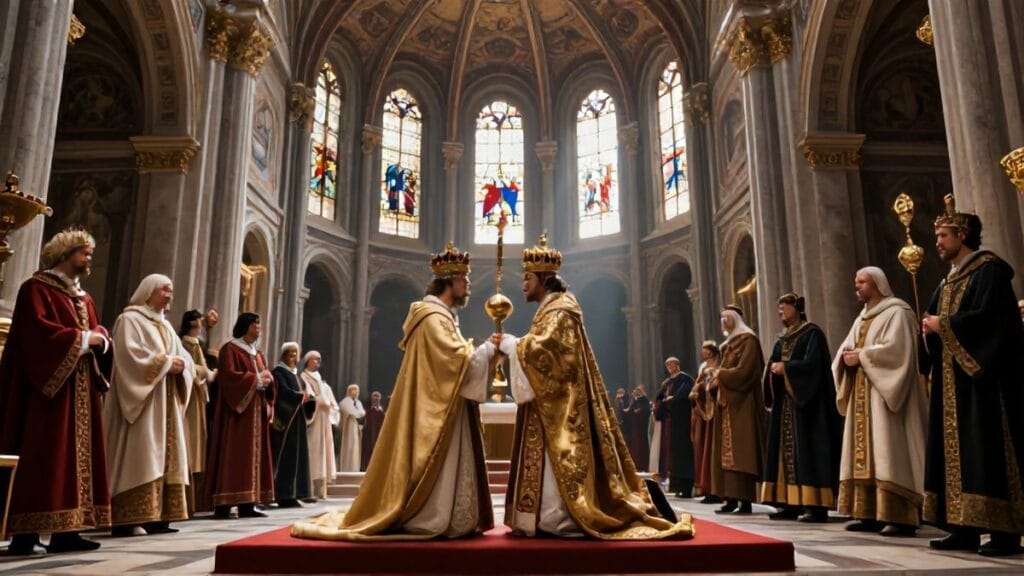
On the morning of 26 March 1027, the basilica of Saint Peter’s filled with a dense, expectant crowd. Torches and candles pushed back the dimness. The gulf between nave and sanctuary—between people and clergy—was marked by railings and steps, but sound flowed everywhere: Latin chants, murmured prayers in German and Italian, the clink of mail and weapons where guards stood uneasily near sacred space. At a predetermined moment, the processions began. The pope advanced from one entrance, flanked by cardinals and Roman clergy; Conrad and Gisela entered from another, followed by their own escort of bishops and nobles.
The conrad ii coronation ritual combined elements inherited from earlier Roman and Frankish traditions. Sources like the later “Roman-German Pontifical” preserve forms of this liturgy, though not necessarily verbatim for 1027. The king would first be questioned about his faith and his duties: to defend the Church, to uphold justice, to protect widows and orphans, to maintain peace. This interrogation transformed the coronation into a contract, at least symbolically, between ruler and the Christian community. Responding in the affirmative, Conrad publicly accepted the burdens of the office he sought.
Next came the anointing, arguably more important than the crowning itself in medieval eyes. Oil, blessed with elaborate prayers, was applied to Conrad’s head and perhaps chest, setting him apart as a ruler consecrated by God. The gesture drew from biblical precedents—Saul, David, Solomon—who had been anointed by prophets. It fused monarchy and priestly imagery, even as canon law maintained a clear boundary between clerical and lay functions. Standing before the altar, Conrad became rex et sacerdos in the imagination of some, a king-priest who governed earthly affairs while protecting the channels of grace.
Gisela too received a ritual of coronation and blessing, underscoring how medieval imperial power envisaged itself through a ruling couple. Her crown, less politically central yet still potent, signaled participation in the sacral aura surrounding the dynasty. The empress would be expected to patronize churches, monasteries, and charitable works, to intercede for the poor and for sinners, and to act as a kind of maternal figure for the realm. In visual representations, emperor and empress often appeared side by side beneath Christ’s outstretched arms, reflecting a shared though asymmetrical dignity.
Once anointed, Conrad advanced toward the altar, where the imperial crown awaited. According to later descriptions of similar ceremonies, the pope would take the crown and, after pronouncing formulaic words, place it upon the ruler’s head. In that instant, the king of the Germans became emperor of the Romans, at least in name. The congregation responded with an acclamation—voices rising in a multilingual “Vivat! Vivat imperator!” The choir broke into a solemn chant, perhaps the “Te Deum,” that hymn of thanksgiving so often associated with great public celebrations. The sound, echoing against stone and wood, fused piety and triumph.
Relics played their part too. Sometime during or around the rite, Conrad would have been led to venerate the tomb of Saint Peter, whose bones lay beneath the high altar. To touch, or even approach, that space was to place his reign under the apostle’s protection. It was also a reminder that no emperor, however mighty, could claim authority independent of the saints and the Church that kept their memory alive. The conrad ii coronation thus unfolded within a dense web of liturgical actions: readings, prayers, litanies, blessings of sword and scepter, distribution of communion. Each element communicated that this was not merely a political promotion but a transformation of Conrad’s very identity.
Voices in the Basilica: Pope, Princes, and People
Yet behind the carefully choreographed prayers, human voices and motives crackled. Pope John XIX, presiding at the ceremony, had his own reasons for cooperating with Conrad. Crowning him emperor allowed the papacy to assert the principle that imperial legitimacy flowed through Rome. It was the pope’s hands, not any bishop’s, that completed the elevation. For a papacy still enmeshed in local Roman power struggles, this assertion of universal authority was invaluable. At the same time, the pope counted on imperial protection against enemies closer to home.
German bishops near Conrad saw the coronation through another lens. To them, the ceremony confirmed a model of empire in which the king, allied with the episcopate, governed a Christian people in close cooperation with the Church. Some bishops held extensive lands and quasi-princely power in the German realm. Their support for Conrad had helped him become king; now, his new imperial status promised to reinforce the prestige of the church institutions they led. They listened to the liturgical formulas as both guardians of orthodoxy and stakeholders in the Empire’s political future.
Foreign magnates in attendance left their reactions in brief chronicle notes. The Anglo-Saxon Chronicle, for instance, records that King Cnut of England and Denmark was present in Rome around this time for Easter and almsgiving, though it does not dwell on his view of Conrad’s rise. Still, the fact that Cnut—himself a kind of northern emperor, ruling over a North Sea realm—came to Rome when Conrad sought his crown speaks volumes about how the city functioned as a hub of prestige. For such princes, witnessing the coronation was a means to measure the new emperor, to assess his demeanor, his alliances, his relative power.
At the margins of this elite audience stood the anonymous multitude: Roman laypeople, Italian pilgrims, servants in noble houses, minor clerks. Their perception of the conrad ii coronation was shaped less by the intricate theology of rulership than by the visible and audible signs of change. They saw new banners, heard foreign dialects, watched richly robed men and women pass in processions, and perhaps received coins or bread distributed by the emperor’s entourage. For them, the “meaning” of the coronation filtered down through rumor and story. Some would have boasted in later years, “I was there when the German king became emperor at Saint Peter’s.”
Chroniclers, writing for monastic or courtly audiences, tended to smooth over the diversity of reactions in the basilica. One contemporary, the chronicler Wipo—who served in Conrad’s court—presents the event in polished, approving tones, emphasizing its solemnity and providential character. Like many medieval writers, he saw imperial success as a sign of divine favor. His account, though partial, remains one of the most precious sources we have, offering detail and interpretation even as it advocates for Conrad’s legitimacy. Through Wipo’s words we glimpse not only the ceremony but also the ideological framework that made such events so central to medieval political imagination.
Empress Gisela and the Gendered Politics of Empire
While Conrad stood at the center of the ritual, Gisela’s role in 1027 should not be underestimated. As queen and now empress, she embodied continuity with past dynasties and helped soften the martial image of the Salian regime. Her lineage linked her to both the Carolingians and the last Ottonians, weaving Conrad into a web of remembered legitimacy. When she processed into Saint Peter’s, crowned or about to be crowned, she brought with her a cloud of associations: pious queens, founding abbesses, benefactresses of the poor.
Sources suggest that Gisela was active in politics, advising Conrad and interceding for subjects. Her coronation alongside him formalized this partnership. The liturgy for empresses typically invoked Old Testament heroines and holy women who had supported or guided rulers. By publicly acknowledging Gisela’s office, the conrad ii coronation reinforced a model of rulership that was familial as well as institutional. The empire was imagined as a kind of extended household, with emperor and empress at its head.
This had practical implications. Empresses often played crucial roles as regents when emperors traveled or during minorities. They also served as channels for supplicants, especially women and ecclesiastical institutions, who might find a more sympathetic ear at the empress’s court. Gisela’s presence in Rome signaled to Italian and Roman elites that Conrad’s rule came wrapped in a broader network of kin and patronage, anchored in a dynasty that planned to endure, not a solitary warrior-king passing through.
At the same time, Gisela’s position was constrained by the expectations placed upon royal women. She was to be obedient, chaste, generous, and pious. Any misstep—real or rumored—could be weaponized against both her and Conrad. The coronation amplified this scrutiny: the eyes of Christendom, or at least of its leading princes and prelates, rested on her comportment. Yet by all accounts she performed her role with dignity, strengthening rather than undermining Conrad’s image.
A Crown for Christendom: Symbolism and Theology of the Imperial Title
What, in concrete terms, did Conrad gain by being crowned emperor in Rome? Legally, the empire remained a patchwork of kingdoms—Germany, Italy, Burgundy—each with its own customs and elites. The title “emperor of the Romans” did not suddenly grant him direct control over all of Latin Christendom. Many rulers, including the Capetian kings in France and the kings of England, operated independently of imperial authority. Yet the title carried immense symbolic capital.
In medieval theory, the emperor stood as the secular arm of a Christendom ordered under God and His Church. He was the guardian of orthodoxy, the protector of the papacy, the defender of pilgrims and churches. Privileges and charters often invoked the emperor’s duty to preserve peace and justice “in the whole world,” even if, in practice, that “world” meant the Empire’s heartlands and nearby regions. Conrad, as emperor, could claim to speak not only for his German subjects but for a broader Christian commonwealth.
Theologically, the imperial office was framed as a ministry. Coronation prayers described the emperor as a shepherd, entrusted with souls as well as bodies. Some texts even drew analogies between the emperor and Christ, while carefully insisting on the infinite gap between creature and Creator. The conrad ii coronation thus portrayed the imperial crown not simply as a prize but as a cross—heavy, demanding, sanctified by oil and prayer.
Politically, the imperial title bolstered Conrad’s standing in negotiations with other rulers. It allowed him to sit, at least in theory, at the top of the hierarchy of kings. When envoys from foreign courts wrote to him or about him, the choice of titles signaled their recognition (or denial) of his status. Disputes over borderlands, ecclesiastical appointments, or diplomatic marriages could now be framed within the language of imperial oversight. While not everyone accepted such claims, the Rome-given crown lent weight to Conrad’s voice.
Finally, the symbolism reached down to subjects as well. For monasteries and churches in distant corners of the Empire, the knowledge that “our king is now emperor” fed local narratives of belonging to a greater whole. A monastery in Swabia or a bishopric in Lorraine might preserve records dated by imperial regnal years, connecting their own modest charters to the grand line of rulers crowned at Saint Peter’s. The empire lived not only in capitals and battlefields but in scripts, seals, and the rhythms of ecclesiastical life.
Allies, Rivals, and Spectators: Canossa, Normandy, and Beyond
The conrad ii coronation gathered under one roof a spectrum of political actors whose relationships would shape eleventh-century Europe. Among them were representatives of the house of Canossa, the great Italian lords who controlled key territories in northern and central Italy. Their loyalty—or at least their acquiescence—was vital for any German ruler hoping to exercise influence south of the Alps. By attending or acknowledging the coronation, they positioned themselves as partners in the imperial project, even as they preserved room for later maneuver.
From beyond the Alps came figures such as King Cnut, whose presence signaled a convergence of regional hegemonies: the emperor of the “Roman” world and the de facto emperor of the North Sea meeting in the sacred heart of Latin Christendom. The dukes of Normandy, though not as prominently documented for this specific event, had by then established a reputation for military prowess and political sophistication. Envoys and chroniclers from these western principalities watched Conrad’s crowning with interest, weighing what it meant for their own ambitions.
Even rivals found a role in this gathering. The Capetian kings of France, increasingly asserting their autonomy from any imperial overlordship, could not ignore what happened in Rome. Though absent in person, they followed developments through letters and embassies. The higher Conrad’s prestige rose in Rome, the more carefully they might frame their own kingship as independent, anointed, and complete in itself. In this sense, the coronation sharpened lines of distinction as much as it proclaimed unity.
To Byzantine observers, the western imperial coronation posed a theological and political puzzle. In Constantinople, emperors still claimed to be the sole legitimate Roman emperors. The existence of a Latin, papally crowned “emperor of the Romans” in the West complicated this claim. Though direct Byzantine commentary on Conrad’s coronation is sparse, the broader tension over who held the true Roman legacy remained a persistent theme in east–west relations. The ceremony at Saint Peter’s, with its invocation of Rome’s ancient authority, quietly contested Constantinople’s monopoly on imperial Roman identity.
Oaths, Privileges, and Promises: The Political Deals Behind the Incense
Behind the soaring chants and solemn pronouncements of the coronation lurked the less poetic but equally decisive world of oaths and documents. Coronations were moments not only of ritual but of bargaining. In preparation for, during, and immediately after the conrad ii coronation, Conrad and his advisors likely concluded a series of agreements with key actors: Roman nobles, Italian bishops, the papal family, and foreign princes.
Some of these deals would have been oral, sealed by handclasps and sworn upon relics. Others found written form in charters and diplomas issued in Rome. In them, Conrad confirmed or granted privileges to churches, monasteries, and cities in exchange for support. A monastery might receive immunity from certain taxes; a bishopric might gain jurisdiction over contested lands; a city might have its market rights recognized. Each concession chipped away at the theoretical absoluteness of imperial authority even as it strengthened Conrad’s practical grip on power.
At the heart of these negotiations stood the relationship between empire and papacy. Conrad needed John XIX’s cooperation for his coronation; the pope needed the emperor’s protection and acknowledgment of papal prerogatives. While we lack a full record of their conversations, subsequent documents suggest a mutual recognition of spheres of influence. Conrad confirmed Rome’s special standing within the Empire and recognized certain papal territories, while the pope, by crowning him, affirmed his role as protector of the Church. The seeds of later disputes—including those erupting in the Investiture Controversy—were present but not yet germinating.
For Italian princes, especially those in Lombardy and Tuscany, the coronation offered a chance to recalibrate their status vis-à-vis the Empire. Offering military support or ceremonial attendance could be traded for imperial recognition of their titles and territories. Some undoubtedly saw the event as insurance: if later conflicts arose among themselves, they could brandish imperial diplomas issued during Conrad’s Roman sojourn as proof of seniority or rightful possession.
Echoes in the Streets: How Ordinary Romans Experienced the Day
While scribes recorded oaths and nobles debated precedence, life in Rome’s streets during the coronation followed its own logic. Imagine a Roman artisan, perhaps a metalworker living near the Tiber. For weeks he had heard of the northern king and the preparations at Saint Peter’s. On the morning of 26 March, he pushed his way among other curious onlookers toward the Vatican. He could not enter the basilica—space was limited, and guards preferred to keep the crowd at a manageable size—but he could hear distant snatches of chant and see processions entering and leaving the church.
Vendors seized the opportunity. Food stalls appeared near the approaches to Saint Peter’s, selling bread, wine, dried fruits, and hot dishes to pilgrims and locals alike. A few opportunists hawked cheap charms or relics of dubious origin, claiming that wearing one would bring the new emperor’s blessing. Children darted through the throng, glimpsing armed men and brightly colored banners they would remember for the rest of their lives. The event, filtered through hearsay and imagination, became a story that families retold around sparse suppers in the months to come.
Such experiences rarely enter written sources, yet they shaped the social memory of the conrad ii coronation. Even those Romans who resented foreign soldiers or feared new taxes could not deny the excitement of hosting an event that would be discussed in distant lands. The city’s reputation as the spiritual capital of the West was reaffirmed. For a brief moment, daily struggles with debt, rent, and hunger receded behind the spectacle of a king turned emperor beneath Saint Peter’s dome-less roof.
Not all reactions were positive, of course. Some Romans may have grumbled that the pope gave too much away to the Germans, or that the Tusculani had turned a holy rite into a family triumph. Others might have seen in Conrad’s presence a threat to civic freedoms. Yet these dissenting voices remained mostly oral, their words vanishing into the air once spoken, overshadowed by the enduring ink of imperial and papal chronicles.
From Rome Back to the Rhine: Governing an Uneasy Empire
Once the incense cleared and the imperial crown sat firmly upon his head, Conrad faced the more prosaic but no less daunting task of ruling. Leaving Rome, he carried with him not only the aura of sanctification but also new responsibilities and expectations. The German princes who had supported him before his Roman journey now confronted an emperor whose prestige had grown. Italian allies and rivals measured how thoroughly he would enforce his will once back across the Alps.
Conrad’s subsequent reign showed both determination and compromise. He reinforced royal authority in Germany by intervening in disputes, appointing loyal bishops, and occasionally subduing rebellious dukes. In Italy, he attempted to maintain imperial influence through select interventions rather than constant presence, aware that overreach could provoke resistance. His dealings with Burgundy eventually brought that kingdom more fully into the orbit of the Empire, strengthening the Salian dynasty’s transalpine reach.
Yet ruling as emperor in the eleventh century remained a delicate balancing act. Communication was slow; armies took months to assemble and move; local customs constrained sweeping reform. Conrad’s imperial title gave him prestige, but not omnipotence. He had to rely on intermediaries—counts, bishops, abbots—whose loyalty varied. The coronation had presented an image of unity under God’s anointed emperor; daily governance revealed a fractious reality.
Nonetheless, the memory of Rome colored Conrad’s self-understanding and that of his court. Documents issued after 1027 often highlighted his imperial status. Monasteries receiving new charters from him might depict him in illuminated initials wearing the crown first placed upon him by the pope in Saint Peter’s. The conrad ii coronation thus lived on, not only in chronicles but in the administrative texture of his rule.
Memory, Chronicle, and Legend: How the Coronation Was Remembered
Historical events do not end when the participants leave the stage; they continue to exist in stories, documents, and rituals of remembrance. The conrad ii coronation was no exception. Chroniclers such as Wipo of Burgundy, writing with the benefit of hindsight, framed the 1027 ceremony as a pivotal moment in a providential narrative. Through their texts, the coronation became a fixed point in the chronology of kings and emperors, an anchor for dating other events.
Monastic annals across the Empire often recorded the bare fact: “In this year, King Conrad was crowned emperor in Rome by Pope John.” Such laconic entries might seem thin, but they stitched the coronation into the fabric of institutional memory. A monk in Saxony, a century later, reading these annals would understand that his monastery belonged to a realm shaped, in part, by that Roman rite. He might never know the details of the liturgy or the faces of those present, but the link between emperor and Rome would be clear.
Over time, legend embroidered the scant facts. Later authors, influenced by emerging conflicts between emperors and popes, read earlier coronations through the lens of their own struggles. Some depicted Conrad as a paragon of imperial piety and obedience, an implicit rebuke to later rulers who clashed with the papacy. Others, especially after the reform movement of the later eleventh century, looked back with suspicion on an era when secular rulers seemed entangled in ecclesiastical appointments. Memory, in other words, was not neutral.
One modern historian, Timothy Reuter, has remarked that Conrad’s reign “marks the real beginning of the Salian empire,” an assessment that hinges significantly on the 1027 coronation. Another scholar, Gerd Althoff, emphasizes the importance of ritual and symbolic communication in Salian politics, using events like the coronation to illustrate how power was performed and negotiated. These interpretations, though written nearly a thousand years later, underscore how enduring the ceremony’s significance has proved to be.
The Birth of the Salian Empire: Long-Term Consequences of 26 March 1027
The imperial crown Conrad received in Rome did more than adorn his brow; it anchored the Salian dynasty in the structures of the Empire. Before 1027, Conrad was a king whose legitimacy, though real, was still consolidating. After Rome, he stood as heir to Otto I and Charlemagne, a figure expected to uphold and extend a centuries-long project of Christian monarchy. This shift had repercussions for his successors, especially Henry III and Henry IV.
Henry III, Conrad’s son, inherited not just a throne but an imperial ideology reinforced by the events of 1027. He too would seek and obtain coronation in Rome, deepening the pattern whereby German kingship looked southward for completion. The idea that a fully realized kingship required Roman, papal confirmation took firm root. In this sense, every subsequent German ruler who aspired to empire walked in Conrad’s footsteps, measuring their success by whether they, like him, passed beneath Saint Peter’s arches to receive the crown.
Institutionally, the coronation helped stabilize the concept of a tripartite Empire encompassing Germany, Italy, and Burgundy. While the practical integration of these kingdoms remained incomplete, the imperial title signaled a claim over all three. Imperial administrations, limited as they were, nonetheless worked within this conceptual geography. When future emperors convened diets or synods, they did so as heads of an entity whose identity had been dramatized in ceremonies like Conrad’s.
On a broader scale, the coronation contributed to the evolving medieval understanding of the relationship between sacred and secular power. By placing an emperor within the Church’s holiest spaces and subjecting him to liturgical scrutiny, the rite asserted that even the mightiest ruler stood under God’s judgment. At the same time, the emperor emerged from the basilica as the Church’s guardian and ally, wielding the sword on its behalf. This duality—subordination and partnership—would define imperial–papal relations for generations, sometimes harmoniously, often not.
Foreshadowing Conflict: Church, Empire, and the Coming Investiture Struggle
Seen from the vantage point of later decades, the serenity of the conrad ii coronation contains an element of tragic irony. The close collaboration between empire and papacy that it projected would soon fracture. By the latter half of the eleventh century, reform-minded popes such as Gregory VII would denounce the entanglement of secular rulers in ecclesiastical appointments, insisting that the Church must free itself from lay investiture. Emperors, in turn, would resist what they saw as papal encroachment on their hereditary rights and obligations.
Conrad himself did not live to witness this rupture. His relations with the papacy, though not entirely free of tension, remained broadly cooperative. Yet some of the practices enshrined or affirmed at his coronation—imperial involvement in bishop-making, the emperor’s role as supreme protector of the Church, the expectation that popes would crown emperors—contained within them the seeds of future crisis. Once reformers reinterpreted these practices as abuses, the memory of earlier coronations became contested ground.
During the Investiture Controversy, both sides invoked history to bolster their claims. Papal polemicists emphasized that the spiritual power conferred at coronation and ordination came from God through the Church, not from secular hands. Imperial partisans countered by pointing to a long tradition of Christian emperors acting as guardians and organizers of church life. The harmonious image of Conrad kneeling before John XIX in Saint Peter’s thus acquired sharper edges: was he humbly submitting to spiritual authority, or was he, by accepting the crown, confirming the intertwined destinies of throne and altar?
In this light, 26 March 1027 appears not merely as a triumphal endpoint but as a hinge. It closed one era of Ottonian decline and opened another of Salian assertion, while quietly laying the groundwork for the dramatic confrontations of the later eleventh century. The glory of the moment would be invoked, challenged, and reinterpreted as generations struggled over what it meant to be emperor, to be pope, to be Church.
Historians and the conrad ii coronation: Modern Debates and Interpretations
Modern historians have approached the conrad ii coronation from multiple angles: political, liturgical, social, and even anthropological. Some, following an older tradition, see 1027 primarily as a constitutional milestone: the formal start of the “Salian Empire,” a necessary link in the sequence of medieval imperial coronations. Others are more skeptical of such tidy periodization, warning against projecting later institutional coherence back onto an event that, for contemporaries, may have felt more contingent and fragile.
Ritual studies have brought fresh insight. Scholars like Gerd Althoff argue that medieval political culture operated through symbolic acts—public penances, reconciliations, and coronations—that established and communicated hierarchies. From this perspective, the 1027 coronation was less about legal transformation and more about making visible and persuasive an already negotiated order. The very publicness of the event, its careful scripting and its location at Saint Peter’s, turned power into spectacle, and spectacle into power.
Liturgical historians, for their part, compare the surviving ordines of imperial coronation to reconstruct what may have happened that day. They note variations between Frankish, German, and Roman practices and trace how elements from each tradition fused over time. The conrad ii coronation appears as a moment in this evolution, where Roman forms asserted themselves but still bore marks of earlier Frankish influence. Debates continue over precise details—what prayers were used, who stood where—but the general outline remains clear: anointing, crowning, acclamation, mass.
Social historians try to pull the camera back, asking how such high events intersected with ordinary lives and long-term structures. They point to the circulation of news, the role of pilgrimage in creating shared Christian identities, the economic impacts of hosting large courts, and the ways in which imperial authority was refracted through local institutions. From this vantage, 26 March 1027 is one of many nodes in a network of happenings that gradually knitted together an “Empire” spanning diverse peoples and languages.
Even today, debates over European identity and the legacy of empire sometimes look back, implicitly or explicitly, to events like Conrad’s coronation. The notion of a transnational political entity grounded in shared Christian culture has evolved and fractured but has not entirely disappeared. In that sense, when historians argue about the significance of 1027, they are also, indirectly, arguing about how we narrate Europe’s past and imagine its possible futures.
Conclusion
On that March day in 1027, as candles flickered against the worn stone of Old Saint Peter’s and chants rose into the rafters, Conrad II stepped across a threshold that separated king from emperor, regional lord from universal ruler—at least in claim. The conrad ii coronation bound his personal fate to the long, troubled story of the Holy Roman Empire and to the city of Rome, whose crumbling monuments and vibrant churches still radiated a unique authority. In the ritual’s ordered gestures—oaths, anointing, crowning—the medieval imagination saw nothing less than the reshaping of the political world under God’s gaze.
Yet behind this moment of grandeur lay ambiguities. The crown Conrad received granted prestige and symbolic leadership, but not unchallenged power. Empire remained a negotiation, day after day, with nobles, bishops, cities, and peasants across a vast terrain. The liturgy proclaimed unity; reality insisted on diversity and dissent. In the centuries that followed, emperors and popes would quarrel bitterly over the meaning of ceremonies like Conrad’s, turning what had once seemed harmonious into evidence of overreach or submission.
Still, the impact of 26 March 1027 endures. It solidified the Salian dynasty, anchored the idea that German kingship sought completion in Rome, and contributed to the evolving medieval understanding of how sacred and secular authority intertwined. For contemporaries, it was an unforgettable spectacle; for chroniclers, a turning point; for modern historians, a rich case study in how power is staged and remembered. Standing, in imagination, beneath the dim vaults of Old Saint Peter’s as the crown descends onto Conrad’s head, we glimpse a world that believed, fiercely, that ritual could change reality—and, in some ways, it did.
FAQs
- Who was Conrad II?
Conrad II was a Salian noble who became king of the Germans in 1024 and, after his coronation in Rome in 1027, Holy Roman Emperor. He founded the Salian dynasty that ruled the Empire through much of the eleventh century. - When and where did the conrad ii coronation take place?
The coronation of Conrad II as Holy Roman Emperor took place on 26 March 1027 at Old Saint Peter’s basilica in Rome, with Pope John XIX presiding over the ceremony. - Why was the Roman coronation important for Conrad II?
The Roman coronation gave Conrad II the imperial title and linked him symbolically to Charlemagne and the Ottonian emperors. It strengthened his prestige among European rulers and reinforced the idea that German kingship was completed and sanctified through papal coronation in Rome. - What role did the pope play in the ceremony?
Pope John XIX conducted the liturgical rites, including the anointing and crowning of Conrad II. By doing so, he asserted the papacy’s unique role in conferring imperial legitimacy, while also securing imperial protection and recognition for Roman and papal interests. - Was Empress Gisela also crowned in Rome?
Yes, sources indicate that Gisela, Conrad’s wife, was crowned empress in Rome alongside her husband. Her coronation emphasized dynastic continuity and the significant, though constrained, political role of imperial consorts. - How did ordinary Romans experience the coronation?
Most Romans did not witness the rite inside Saint Peter’s but experienced it through processions, heightened urban activity, and the presence of foreign elites and soldiers. For many, it was a rare spectacle that confirmed Rome’s status as the spiritual center of Latin Christendom. - What were the long-term consequences of Conrad II’s coronation?
The coronation solidified the Salian dynasty’s hold on the imperial title, reinforced the tripartite structure of the Empire (Germany, Italy, Burgundy), and helped define the enduring pattern of German rulers seeking imperial confirmation in Rome. It also foreshadowed later conflicts between emperors and popes over the boundaries of secular and ecclesiastical authority. - How do historians today interpret the conrad ii coronation?
Modern historians view the coronation as both a political milestone and a highly choreographed ritual of symbolic communication. They debate its constitutional significance but generally agree that it played a key role in shaping medieval ideas of empire, kingship, and the relationship between Church and state.
External Resource
Internal Link
Other Resources
- Encyclopaedia Britannica – general search for the exact subject
- Google Scholar – academic search for the exact subject
- Internet Archive – digital library search for the exact subject

