Table of Contents
- Twilight Over Mérida: Setting the Stage for a King’s Fall
- From Warrior to Monarch: The Ascent of Agila I
- A Kingdom of Fault Lines: Hispania on the Eve of Crisis
- The Spark in Córdoba: Rebellion Against the Visigothic Crown
- Blood in the Basilica: The Shocking Desecration That Shook Hispania
- Rivals and Pretenders: The Rise of Athanagild
- Byzantium Enters the Stage: Imperial Eagles Over the Iberian Shore
- The Long Unraveling: Civil War and Fragmentation of Royal Power
- Mérida Under Siege: Fear, Famine, and Political Intrigue
- The Night of Betrayal: The Death of Visigothic King Agila I in 555
- After the King’s Blood: Athanagild, Legitimacy, and a Divided Realm
- Churchmen, Chroniclers, and Memory: How Agila Was Judged
- Wounds That Never Healed: Social and Political Consequences Across Hispania
- Mérida Remembers: Local Legends, Ruins, and Echoes of a Fallen King
- From Agila to Reccared: How a Murdered King Shaped a Future Catholic Kingdom
- Debating the Sources: What Really Happened in 555?
- Conclusion
- FAQs
- External Resource
- Internal Link
Article Summary: This article explores the dramatic death of Visigothic King Agila I in Mérida in 555, a moment that crystallized years of civil war, religious tension, and foreign intervention. It retraces Agila’s rise from military commander to embattled monarch, and follows the unraveling of his reign as the kingdom of the Visigoths fractured between rival factions. The narrative lingers on the brutal episodes that marked his rule—most infamously the desecration at Córdoba—before arriving at the climactic death of visigothic king agila i at the hands of his own men. Against the backdrop of imperial Byzantium’s advance into the Iberian Peninsula, we see how this regicide reshaped the political map of sixth-century Hispania. The story also examines how bishops, chroniclers, and later historians interpreted Agila’s fall, turning it into a moral lesson about sin, power, and divine punishment. From the streets of Mérida to the councils that followed, the death of visigothic king agila i reverberated across generations, influencing both immediate power struggles and the long path toward a unified, Catholic Visigothic kingdom. In doing so, it reveals how a single night of betrayal could redirect the fate of an entire people.
Twilight Over Mérida: Setting the Stage for a King’s Fall
Mérida in the mid-sixth century was a city that remembered better days. Founded as Augusta Emerita under Augustus centuries earlier, it had been designed as a Roman showcase—a city of straight roads, solid bridges, and grand temples. By the 550s many stone façades were cracked, some aqueduct arches had fallen, and weeds grew in the joints between once-perfect paving slabs. Yet beneath the tarnished surface, Mérida still held weight: it was a spiritual center, a crucial node on the routes that tied Lusitania to the rest of Hispania, and, above all, a symbol. When King Agila I made it one of his key strongholds, he knew he was stepping into the shadow of Rome.
The death of visigothic king agila i in 555, inside or just outside this old Roman town, would not simply remove a ruler; it would mark the collapse of a particular vision of Visigothic power—one in which a king could rule by fear, hold cities with garrisons, and ignore the murmurs of bishops and nobles until steel finally found his back. On the eve of his fall, the streets of Mérida whispered with rumor: some said Athanagild’s agents had slipped into the city; others claimed the Byzantine gold had worked its way into the purses of the royal guard. Innkeepers spoke in hushed tones, watching which cloaks gathered at which tables, sensing that the wind was shifting but unsure from which direction the storm would break.
In the fading light of day, the city’s outline was jagged against the sky: the silhouette of the temple to Mars, now reappropriated for Christian worship, the amphitheater half-buried in dust, the bridge spanning the Guadiana like a line between ages. Somewhere within those walls, Agila ate, perhaps impatiently, perhaps in denial, while men who had once shouted his name in acclamation now weighed the price of his survival against the rewards of his death. But this was only the beginning of a story that had its roots long before the dagger strokes of 555.
From Warrior to Monarch: The Ascent of Agila I
Agila did not begin his life as a king. Like many Visigothic rulers of the sixth century, he emerged from the ranks of the military aristocracy: a warrior whose authority was anchored not in distant genealogical claims, but in his ability to command men in battle and navigate the treacherous currents of court politics. We know frustratingly little about his early years. The sources—terse, moralizing, and often hostile—offer only glimpses: a capable officer loyal to his predecessor, King Theudigisel, or perhaps earlier to the turbulent courts that followed the death of Theodoric I’s line.
When Theudigisel himself was assassinated during a banquet, as Isidore of Seville later dryly recorded, the Visigothic throne was once again a chair no one could sit upon without feeling knives at his back. It was in this environment of chronic instability that Agila rose. Whether through election by the warrior elite, backing from a powerful faction of nobles, or the subtle influence of key bishops, Agila was elevated around 549. His accession was not accompanied by the kind of sweeping reforms or jubilant proclamations that later chroniclers would praise in other kings. Instead, his first years were defined by a single, stubborn fact: he faced resistance almost from the moment he took the diadem.
A king in this period had to be more than a warlord. He was expected to be the protector of the Catholic Church in Hispania, the guarantor of order for both Goths and the long-subjugated Hispano-Roman population, and the firm hand that kept ambitious nobles in check. Agila accepted the regalia, but the realm he inherited was fractured: some regions barely recognized royal authority; others owed more loyalty to local bishops or landholding magnates than to the distant court. The chronicler Jordanes, writing from outside Hispania, barely notices Agila at all, a telling silence that suggests a king who never quite managed to project his aura beyond the Peninsula.
Yet at the moment of his rise, the future was not foreordained. There must have been days when, riding along the old Roman roads, Agila believed he could bend this unruly kingdom to his will. That illusion did not last long.
A Kingdom of Fault Lines: Hispania on the Eve of Crisis
To understand the death of visigothic king agila i, we must first understand the land he tried to rule. Sixth-century Hispania was a patchwork stitched together by conquest, habit, and lingering Roman administrative outlines. The Visigoths held large portions of the interior and western territories, yet the Suebi dominated in the northwest, in Gallaecia, while the Basques in the north remained stubbornly independent. Along the coasts, old Roman cities still dreamed of autonomy, some looking with new hope toward Constantinople as Emperor Justinian launched his audacious programs of reconquest.
Economically, the region was recovering from the shocks of the previous century. Estates were consolidating in the hands of a mixed Gothic and Roman elite; peasants worked the land under layers of obligation and custom that blurred the line between free and unfree. Taxation, though far lighter than under late Rome, remained a burning issue, particularly where royal agents pressed too hard. The Church, wealthy and deeply rooted, collected its own revenue and commanded not only spiritual but also social authority. Bishops in cities like Mérida, Seville, and Toledo were arbiters in disputes, protectors of the poor, and sometimes quiet kingmakers.
Ideologically, there was also a deep rift. The Visigothic aristocracy was largely Arian Christian, while the majority of the population and many of the bishops were Nicene (Catholic). This did not always erupt into open conflict, but it created a constant tension in which every royal decision about a bishop’s appointment, a church property dispute, or a religious festival could be read as favoring one side over the other. It is astonishing, isn’t it, how a theological nuance about the nature of Christ could determine whether a king slept soundly or stared at the curtain shadows in fear?
On the geopolitical horizon loomed a power that believed itself the heir of Rome in more than rhetoric: Justinian’s Eastern Roman (Byzantine) Empire. After successes in North Africa and Italy, his generals were scanning the western Mediterranean for further openings. Hispania, divided and poorly defended along its southern coastline, looked tempting. All that was needed was a pretext, a letter from a local rebel, an invitation to intervene. That invitation would come during the reign of Agila, and its consequences would outlast him by generations.
The Spark in Córdoba: Rebellion Against the Visigothic Crown
If Agila hoped that a decisive show of force would cement his rule, Córdoba shattered that hope. Once a glittering capital of Roman Baetica, Córdoba still retained an aura of defiant pride. It had resisted Gothic domination more than once, and its great basilicas and aristocratic houses nurtured elites with a strong sense of identity. Sometime early in Agila’s reign, a serious rebellion flared there—whether driven by local nobles, Catholic bishops, or merchants wary of royal impositions, the sources do not fully say. What they do tell us is that the king responded with military campaign, leading his forces to besiege and subdue the city.
The campaign was a disaster. In battle before the city walls—some traditions place it near a church dedicated to Saint Acisclus—Agila’s army suffered a crushing defeat. Many of his soldiers were killed; royal treasure was lost; and, according to some accounts, even his son died in the fighting. For a warrior-king, this was more than a tactical setback; it was a symbolic humiliation. A monarch who could not bring a rebellious city to heel was inviting challenges from every ambitious noble in the realm.
In the aftermath, Agila resorted to an act that would stain his name for centuries and, in the eyes of many, invite divine retribution. As one later chronicler implies, his rage and frustration at Córdoba’s defiance turned into cruelty that shocked even a violent age. Whatever lingering possibility there was for reconciliation with the city dissolved in blood. Córdoba would become, in the memory of Hispania, the place where Agila crossed an invisible line separating harsh rule from sacrilege—and where the fall of his moral authority began.
Blood in the Basilica: The Shocking Desecration That Shook Hispania
The chroniclers who wrote about Agila’s actions in Córdoba did so with a kind of horrified fascination. According to Isidore of Seville, whose account is among the most influential, the king not only crushed resistance but ordered a massacre within one of the city’s churches, a place of sanctuary and sacral protection. Some versions emphasize that the victims included clergy and laypeople seeking refuge; others focus on the king’s appropriation of church treasures, melting down sacred vessels to refill his depleted war chest.
Whether every detail is historically precise or tinged by later exaggeration, the core event—an act of violence and sacrilege associated with Agila in Córdoba—became fundamental to how his reign was remembered. For contemporaries steeped in Christian belief, this was more than political brutality; it was a sin that cried out for judgment. Bishops in distant cities read or heard of the horror and shuddered, wondering what kind of monarch they now served. In their eyes, it was almost inevitable that the death of visigothic king agila i would later be interpreted as divine punishment, a balancing of scales weighed down by blood spilled on holy ground.
Stories circulated that the king personally ordered the death of men clutching the altar, cutting down those who trusted in the church’s right of asylum. Whether true or embellished, such tales provided powerful moral ammunition to Agila’s enemies. When Athanagild and his partisans eventually raised the banner of rebellion, they could present their cause not merely as a political uprising but as a righteous response to sacrilege. The king, they would say, had stained the land; only his removal could purify it.
Yet behind the condemnations lay another reality: kings desperate for funds often eyed church treasuries. Scarred by defeat at Córdoba and needing to pay his troops, Agila may have convinced himself that necessity justified his actions. In that cold calculation, he misread the mood of his age. He gained coin, perhaps, but he lost something far more vital—credibility with the very ecclesiastical network that could have stabilized his rule. The church doors he forced would, metaphorically, never fully open to him again.
Rivals and Pretenders: The Rise of Athanagild
Out of this cauldron of discontent stepped Athanagild. His origins were noble; he likely belonged to a powerful Gothic family with estates in southern Hispania, perhaps around Seville. He had served, it seems, as a high-ranking officer or regional commander, and he was known among the aristocracy as a man of both ambition and calculation. When he chose to challenge Agila’s throne, it was not a reckless coup but a carefully timed move capitalizing on the king’s defeats and scandals.
Athanagild’s rebellion began in Baetica, far from the royal strongholds of the central plateau. There, amid wealthy cities and fertile lands, he found allies among landowners and perhaps among bishops alarmed by Agila’s behavior in Córdoba. The rebel leader positioned himself not as a usurper, but as a restorer—a man who would bring back justice, respect for the Church, and stability to the land. His supporters likely whispered that God had turned His face from Agila, that every new misfortune was a sign from heaven.
The conflict between Agila and Athanagild soon ripened into a full-scale civil war. Battle lines were drawn, fortresses taken and retaken. Both men claimed the title of king; both minted coins and issued commands as if they alone were the lawful ruler. For the average inhabitant of Hispania, this was a nightmare. Two courts, two tax systems, two sets of military demands: peasants and townsfolk were caught between rival levies and reprisals. Every village had to guess which king would win—and bet their loyalty accordingly.
Athanagild lacked one thing, however: the raw strength to decisively crush Agila, especially while the latter still controlled important centers like Mérida. To tip the balance, the rebel made a fateful choice. He reached beyond the Pyrenees, across the sea, to the greatest external power of the age. With or without full understanding of the consequences, he invited the emperor Justinian into the internal struggles of Hispania.
Byzantium Enters the Stage: Imperial Eagles Over the Iberian Shore
When Athanagild’s envoys arrived at the court of Justinian in Constantinople, they walked into a palace obsessed with the dream of Roman restoration. North Africa had been wrested back from the Vandals; Italy was convulsed under the campaigns of Belisarius and Narses; the emperor’s propagandists sang of a resurgent empire reclaiming its lost western lands. Hispania, with its Roman roads and Latin-speaking bishops, seemed like a logical next step in this imperial epic.
Justinian was no idealist; he was a hard-headed politician. By supporting Athanagild, he would achieve at least two goals. First, he would weaken the Visigothic kingdom, a potential rival on the western frontier. Second, he might secure coastal enclaves that would serve as bases for imperial power and commercial activity. And so a deal was likely struck: aid for Athanagild in exchange for territory once Agila fell.
Imperial troops, perhaps under commanders such as Liberius, landed along the southeastern and southern coasts of Hispania around 552. They seized key locations—likely including Carthago Nova (Cartagena) and other cities that would form the nucleus of what later writers called Spania, the Byzantine province in Iberia. As the imperial standards rose above harbor walls, merchants and local elites watched carefully. To some, the newcomers were liberators, bringing familiar Roman law and protection; to others, they were foreign occupiers exploiting Visigothic weakness.
For Agila, the arrival of Byzantine forces was a catastrophe. A rebellious noble had transformed a domestic conflict into an international crisis. Now the king had to fight not only Athanagild’s troops but also seasoned imperial soldiers backed by the vast resources of Constantinople. His authority, already contested, was further undermined by the perception that he had lost control of the coasts. Once again, voices in cities and monasteries murmured: perhaps this was punishment for the sins at Córdoba, for the king who had offended heaven.
The death of visigothic king agila i would occur only a few years after this imperial intervention, but by then the damage was irreversible. The Visigothic realm was fractured, foreign banners flew over once-Roman towns, and a generation of warriors learned to reshape their loyalties with the shifting tides of gold and power.
The Long Unraveling: Civil War and Fragmentation of Royal Power
From roughly 552 to 555, Hispania lived in a state of suspended agony. The civil war between Agila and Athanagild was not a neat series of pitched battles; it was a grinding contest of sieges, raids, shifting alliances, and brutal local reprisals. Towns that had sided with one king could find themselves sacked by the other’s forces weeks later. Some places tried to hedge their bets, offering tribute to both claimants; others threw themselves wholeheartedly behind one leader, only to watch him retreat beyond the horizon, leaving them exposed.
Royal power, once envisioned as a clear hierarchy flowing from the king through dukes and counts down to local authorities, began to blur. Regional commanders acquired a taste for autonomy; noble families discovered just how much leverage they possessed when two kings were simultaneously desperate for their allegiance. The concept of a united Visigothic Hispania, fragile even in the best of times, cracked under the strain.
Agila still had assets. He held central territories and cities like Mérida, whose strategic position guarding Lusitania was invaluable. From there, he could strike west or south, blocking some of Athanagild’s movements. Yet each year of war eroded his support. Supplies dwindled; men deserted; tax revenues shrank as peasants fled their lands or simply could not pay. The king was forced to squeeze more aggressively, confiscating property, demanding new levies, and perhaps clashing with local church authorities who resisted his encroachments on ecclesiastical wealth.
The Byzantine presence added layers of confusion. Some Visigothic nobles preferred to deal with imperial governors rather than gamble on the civil war’s outcome. Others, particularly in the south, used proximity to Byzantine enclaves as a bargaining chip, threatening to defect to the emperor’s side if the king—whether Agila or Athanagild—did not grant them favorable terms. This climate of opportunism hollowed out loyalty, turning politics into an elaborate game of survival.
In this context, the death of visigothic king agila i would eventually be less an isolated assassination than the inevitable culmination of a process: the moment when a weakened, increasingly isolated monarch became more valuable dead than alive to men who still wore his colors.
Mérida Under Siege: Fear, Famine, and Political Intrigue
Mérida, the city that would witness Agila’s end, was itself a character in this unfolding tragedy. Once the glittering seat of the Roman provincial administration in Lusitania, by the mid-sixth century it had become a fortified refuge for kings and bishops alike. Agila’s decision to make Mérida one of his principal centers during the civil war was logical: its half-ruined walls could be strengthened, its bridge facilitated troop movements, and its Christian community—anchored by the cult of Saint Eulalia—lent an aura of sanctity to royal residence.
But the war did not leave Mérida untouched. As Athanagild’s cause gained traction and Byzantine enclaves solidified along the coast, the interior cities found themselves increasingly cut off. Trade routes were disrupted; caravans from Baetica and Carthaginensis became rarer; prices rose. Famine loomed in bad harvest years, and rumors of approaching enemy forces could send waves of panic through narrow streets. The city’s bishop, custodian of relics and protector of the poor, would have been besieged daily by supplicants seeking alms, food, and justice.
Within the royal compound, tension was palpable. Agila relied on a core of loyal officers and bodyguards, but even among them, doubts began to spread. Some may have had families in regions now favorable to Athanagild; others learned, through letters or gossip, that bishops and nobles were quietly drifting into the rebel camp. Each setback on the battlefield, each failed diplomatic overture, chipped away at the king’s aura of invincibility. At night, torches burned late as counselors argued: should they negotiate with Athanagild, seek Byzantine mediation, or double down and attempt one last decisive campaign?
The death of visigothic king agila i would eventually result from decisions made in just such nights of fear and calculation. The city’s walls might have held against external siege, but inside, the fortress of loyalty was crumbling. Men who had eaten at Agila’s table began to ask themselves a brutal question: was there a future with this king, or would their own survival require the unthinkable?
The Night of Betrayal: The Death of Visigothic King Agila I in 555
The year 555 stands in the sources as the fateful turning point. Exact details are elusive—no chronicler was present in the royal chamber with ink and tablet in hand when the betrayal unfolded. Yet by piecing together later records, we can sketch the contours of that decisive night in Mérida. The war had gone badly; Athanagild’s star was rising, supported, at least in part, by Byzantine power. Agila’s enemies were gaining recognition abroad, while at home, more and more nobles calculated that the king’s cause was lost.
At some point, perhaps during winter’s early darkness, a group of conspirators within Agila’s own army chose to act. Their motives were complex: resentment over unpaid wages, fear of reprisals if Athanagild won, outrage over the sacrilege in Córdoba, or simple opportunism. In the tight-knit world of a royal guard, plots grew not only in smoky back rooms but also in the routines of service—in the shared glances when the king raged at bad news, in the whispered conversations while sharpening swords.
One can imagine the final evening. Agila, now no longer young, perhaps ate a sparse meal, discussing reports from the front. Messengers brought troubling news: defections among nobles, new successes by Athanagild, strengthening Byzantine positions along the coast. The king might have barked orders—new levies, harsher measures, punishment for those who faltered. Outside, in the courtyards and barracks, a different kind of order was taking shape: the distribution of roles among the conspirators, the silent agreement on signals, the grim acceptance that there would be no turning back once blood was spilled.
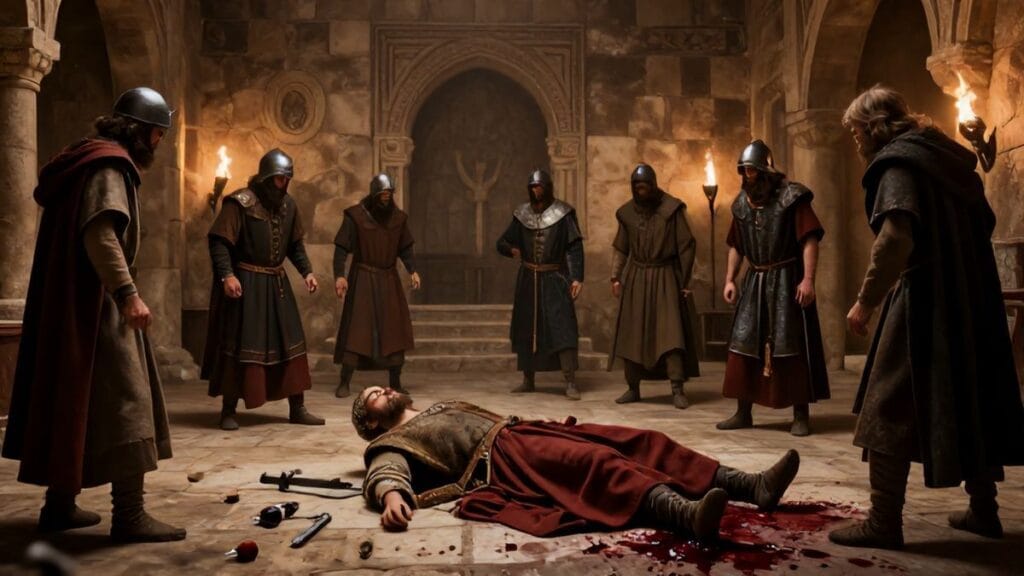
When they moved, they moved swiftly. Some accounts suggest that Agila was killed by his own soldiers, perhaps in his tent or chamber, perhaps as he prepared for bed. There is no record of a desperate struggle or loyal last stand; the emphasis in later chronicles is on the stark fact of betrayal. The death of visigothic king agila i came not in the thick swirl of battle, sword in hand, but in the shadows, struck down by men sworn to protect him.
By dawn, the city knew. Word traveled along the stone corridors, over the city walls, into the markets. The king is dead, people whispered. Some crossed themselves and murmured prayers, half in fear, half in relief. Others, particularly among the elites, moved quickly to align themselves with the inevitable successor. The conspirators had not acted blindly; they almost certainly coordinated with Athanagild’s supporters. In killing Agila, they cleared the path for a negotiated submission to the rival king—a submission that would save their own lives and properties, even as it destroyed the man they had once hailed as lord.
So the death of visigothic king agila i in Mérida in 555 closed one chapter of Visigothic history—not with a heroic last cry on the battlefield, but with the muffled, intimate violence of assassination. It was a fitting end for a reign marked by civil war, religious scandal, and the erosion of trust between king, nobles, and church.
After the King’s Blood: Athanagild, Legitimacy, and a Divided Realm
With Agila’s corpse cooling in Mérida, Athanagild could at last present himself as the undisputed king of the Visigoths. Yet victory did not bring him the untroubled rule he might have imagined in the early days of rebellion. His legitimacy, though now uncontested by a rival claimant, was still built on fragile foundations: foreign intervention, internal betrayal, and the grim precedent of regicide. If one king could be murdered by his men, what protection did the new monarch truly enjoy?
Athanagild had to move quickly. He needed to secure oath-swearing ceremonies, distribute rewards to the very conspirators who had slain Agila, and reassure a church wary of yet another violent transfer of power. He also had to confront the uncomfortable reality of Byzantine troops still holding territories along the coast. The price of his alliance with Justinian was not simply moral; it was territorial. Spania, the Byzantine enclave, existed because the emperor had answered the rebel’s call. Now a portion of Hispania no longer answered to Toledo or Mérida but to distant Constantinople.
In the short term, Athanagild’s reign stabilized the kingdom compared to the chaotic years of civil war, but the scar of Agila’s death remained. Noble factions remembered that a king could be replaced when he ceased to be useful or tolerable. Bishops, in their letters and sermons, mulled over the moral of the story: one king who had profaned a church at Córdoba, another who had risen with the aid of a foreign, perhaps heretical empire. Among common people, the distinction between the two rulers may have seemed less important than the continuous burden of war, taxation, and uncertainty.
Thus, the death of visigothic king agila i did not usher in a golden age. It traded one set of problems for another, while reinforcing an ominous pattern: Visigothic kingship was precarious, dependent not only on martial skill but on the volatile goodwill of nobles and clergy. This pattern would repeat in later generations, as monarchs were blinded, exiled, or killed by those who believed the realm—or their own interests—demanded it.
Churchmen, Chroniclers, and Memory: How Agila Was Judged
In the decades and centuries after 555, Agila’s life was distilled into a handful of lines in chronicles, yet those lines were sharp as daggers. Churchmen, above all, shaped his posthumous reputation. Isidore of Seville, writing in the early seventh century in his Historia Gothorum, portrayed Agila as a king whose sacrilegious act in Córdoba led inexorably to his downfall, a moral exemplum of divine justice. By framing the king’s violent end as a punishment for offenses against the Church, Isidore turned political history into a sermon: monarchs who violated sacred spaces would see their rule crumble.
Other sources, such as the later Chronicle of John of Biclaro, were more concerned with subsequent reigns, yet even their sparse mentions reinforced the narrative of Agila as a failed ruler. Modern historians, reading between the lines, have tried to rehabilitate him slightly by highlighting the structural challenges of his time: chronic civil wars, tensions between Arian and Catholic communities, and the explosive impact of Justinian’s reconquest. Still, the dominant medieval tradition painted him in dark colors.
This moralistic framing had consequences. The death of visigothic king agila i at the hands of his own troops was not interpreted simply as political treachery but as the fulfillment of a divine script. In sermons and council debates, bishops could point to Agila as a cautionary tale. Here was a monarch who had dared to despoil a church, who had spilled blood where the faithful sought refuge—and who had died horribly, betrayed and abandoned. The implicit lesson: respect the Church, or risk sharing his fate.
Citation of Isidore’s work in later centuries—“Agila, defiled by many crimes, especially against the Church, was cast down by God’s judgment” (paraphrased from Historia Gothorum)—reaffirmed this image. Even where the historical Agila may have been more complex, the remembered Agila became a symbol. That symbol, etched in manuscripts copied in quiet monastic scriptoria, influenced how later generations of rulers in Iberia understood the limits of their power and the boundaries they crossed at their peril.
Wounds That Never Healed: Social and Political Consequences Across Hispania
The immediate effect of Agila’s death was to crown Athanagild, but the wider consequences radiated outward through Hispania’s social and political fabric. Civil war had already devastated vast regions; with the king’s assassination, many communities faced the painful task of rebuilding under a new, not entirely trusted monarch. Fields left uncultivated during the fighting had to be reclaimed; ruined churches and houses needed repair. Peasants, who had borne the brunt of requisitions and plundering, were left poorer and more suspicious of any authority claiming to act for their benefit.
The aristocracy, for its part, emerged both strengthened and fractured. Individual nobles who had backed the winning side, or who had skillfully timed their defections, gained lands and influence. Yet the collective institution of kingship was weakened by the precedent that a failing king could be eliminated with relative impunity. This emboldened future conspiracies, ensuring that later monarchs always ruled under the shadow of potential betrayal.
Religiously, the impact of the death of visigothic king agila i was subtle but significant. The Church in Hispania learned that its moral judgments could shape political narratives powerfully. By presenting Agila’s fate as the result of sacrilege, bishops reinforced their claims to special protection and elevated their role as guardians of the realm’s spiritual health. Over time, this would lay part of the groundwork for the close alliance between the Visigothic monarchy and the Catholic Church, especially after the kingdom’s formal conversion from Arianism under later rulers.
Meanwhile, the Byzantine foothold gained during Athanagild’s rebellion remained a constant reminder of the cost of civil strife. Coastal populations adapted to a new reality in which imperial officials, Byzantine troops, and local elites navigated complex arrangements of power and loyalty. Trade may have benefited from the imperial presence, but the idea of a cohesive, uncontested Visigothic sovereignty over all Hispania had been permanently compromised. The ghost of Agila, murdered in Mérida while foreign banners flew along the shore, haunted this fractured political landscape.
Mérida Remembers: Local Legends, Ruins, and Echoes of a Fallen King
Centuries passed, but Mérida kept her memories, some written in stone, others carried in stories passed from grandparent to grandchild. The royal residence where Agila once brooded and where he likely died was repurposed, demolished, or built over as new powers claimed the city. Yet the older layers persisted. The basilica of Saint Eulalia, the city’s martyred patroness, remained a focal point of devotion. It is easy to imagine local legends emerging that tied the death of visigothic king agila i to the protection of the saint, as if Eulalia herself had interceded to end the rule of a king who had profaned another city’s sanctuary.
Archaeological traces—fragments of fortifications, reused Roman blocks, hints of early medieval occupation layers—suggest a city in constant transformation. After the Visigoths came new rulers: Islamic emirs, Christian kings, and finally the modern Spanish state. Each wave looked back at Mérida’s monumental past with a different gaze: some as conquerors, others as restorers, still others as careful preservers of a shared heritage. Yet woven into this layered urban memory was the faint echo of a night in 555 when armed men padded down stone corridors and changed the destiny of their kingdom.
Visitors walking today along Mérida’s Roman bridge or sitting in the shade of the old theater can sense, amid the touristic bustle, that this was once a stage for dramas far darker than any scripted performance. In a city guide or a scholarly article, one might stumble upon a brief mention: “Here, in Mérida, the Visigothic king Agila I met his death at the hands of his own troops.” It is a terse line, yet behind it lies a cascade of emotions—fear, desperation, betrayal—that remain as universal now as they were in the sixth century.
Thus, Mérida is not just a backdrop; it is an active participant in this historical narrative. The city’s enduring stones testify to the fragility of human schemes. Kings rise and fall, churches are profaned and reconsecrated, banners change, but the urban landscape persists, holding within it the memory of the night when the king’s blood mingled with the dust of an old Roman town.
From Agila to Reccared: How a Murdered King Shaped a Future Catholic Kingdom
At first glance, the line from Agila’s assassination in 555 to the famous conversion of King Reccared to Catholicism in 589 may seem tenuous. Yet, the threads are there, woven through decades of subtle change. The death of visigothic king agila i, justified in ecclesiastical narratives as a punishment for sacrilege, sent a message that resonated through court and cloister alike: the Church’s moral authority could make or break kings. Athanagild, his successors, and ultimately Reccared learned from this.
In the years following Agila’s demise, Visigothic rulers gradually tightened their alliance with the Catholic Church, even while many of them remained personally Arian. They granted privileges to bishops, confirmed church properties, and increasingly relied on synods and councils to legitimize their decisions. By the time Reccared came to the throne, the logic of this alliance had matured. He recognized that to unify his kingdom—ethnically diverse, religiously divided, and still wary after generations of civil conflict—he needed a single, authoritative faith that appealed to the majority of his subjects.
When Reccared publicly renounced Arianism and embraced Catholicism at the Third Council of Toledo, he did so in a landscape already shaped by episodes like Agila’s fall. The specter of a king judged and overthrown for offending the Church loomed large. By contrast, a king who embraced the Church could hope for a more stable and sacralized authority. As one historian has noted, “the memory of Agila’s sins and fate likely hovered in the background as Reccared and his advisors charted a new religious course for the realm” (paraphrasing from a modern study on Visigothic Spain).
Thus, while Agila himself remained a negative example, his fate indirectly contributed to a long-term transformation. The Visigothic kingdom that emerged in the late sixth and early seventh centuries was one in which the Church stood firmly beside the throne, legitimizing kings and, in turn, receiving protection and privileges. A murdered king in Mérida had helped teach the cost of ignoring that partnership.
Debating the Sources: What Really Happened in 555?
No historian can approach the death of visigothic king agila i without wrestling with the sources—and their silences. Our principal early narratives come from authors writing decades after the events, such as Isidore of Seville and John of Biclaro. They were not disinterested chroniclers. Isidore, especially, had a didactic purpose, presenting history as a sequence of moral lessons. His emphasis on Agila’s sacrilege at Córdoba and divine punishment at Mérida reflects that agenda.
Modern scholars question some details. Was the massacre in Córdoba exactly as gruesome and targeted as medieval authors claim, or did later churchmen amplify the story to make a more vivid warning for future kings? Did Byzantine troops cooperate extensively with Athanagild, or were they more opportunistic, exploiting the civil war to seize coastal towns while both Visigothic factions were distracted? And in Mérida itself, were the conspirators primarily motivated by piety, politics, or survival?
Archaeology offers tantalizing but limited help. We can trace changes in fortifications, patterns of coin circulation, and signs of urban contraction or renewal. These material traces confirm the broad outlines of instability in mid-sixth-century Hispania, but they cannot tell us exactly what words passed between the conspirators on the night of Agila’s murder. They cannot preserve the tone of the king’s voice when he heard the last rumors, or the expressions on the guards’ faces as they stepped into his chamber.
Nonetheless, by comparing texts, considering archaeological data, and placing events in the broader context of Justinian’s western campaigns, historians can assemble a plausible narrative. It is one in which a pressured king, stained by a brutal act in Córdoba, confronted a rising rival supported by foreign power, until disillusioned followers decided that assassination was their best option. The core fact—that Agila died violently in Mérida in 555, killed by his own troops—stands firm. Around it swirl interpretations, moralizations, and scholarly debates that remind us how every historical event is both an occurrence in time and a story told afterward, with all the distortions and meanings that storytelling entails.
Conclusion
The story of King Agila I is the story of a kingdom at a crossroads. His reign encapsulates the strains pulling sixth-century Hispania apart: the lingering fracture lines between Gothic elites and Roman populations, the tension between Arian and Catholic communities, and the gravitational pull of a resurgent Byzantine Empire seeking to reclaim lost western provinces. In this fraught landscape, Agila tried to assert royal power through military force and harsh measures, only to discover that fear can rule for a time, but it cannot sustain a crown indefinitely.
The death of visigothic king agila i in Mérida in 555, at the hands of his own soldiers, was both a personal catastrophe and a political verdict. It expressed the exhaustion of a realm worn down by civil war and scandal, and the willingness of noble and military elites to change masters when a ruler lost credibility. For the Church, his fate became a parable about sacrilege and retribution; for later kings, a warning about the costs of defying ecclesiastical authority and alienating powerful factions. Yet his death also opened the way for transformations that would shape the future of Iberia, from the consolidation of Byzantine enclaves to the eventual Catholicization of the Visigothic monarchy.
In the end, Agila is remembered not for monuments or laws, but for the manner of his fall. The king who once marched on rebellious Córdoba, who dared to violate a sanctuary, died unshriven in the shadowed halls of Mérida, betrayed by those closest to him. His story reminds us that history’s turning points are often not the result of grand battles alone, but of quiet decisions made in chambers at night—moments when fear, faith, ambition, and fatigue converge in a single, irrevocable act. Through the long echo of chronicles and ruins, that night in 555 continues to speak, telling us how fragile the structures of power can be when they rest on foundations of blood and mistrust.
FAQs
- Who was King Agila I?
Agila I was a sixth-century Visigothic king who ruled parts of Hispania from around 549 until his violent death in 555. He emerged from the Visigothic military aristocracy and faced immediate internal opposition, culminating in a civil war with the rival claimant Athanagild. - What led to the rebellion against Agila I?
The rebellion was triggered by a combination of factors: Agila’s military defeat near Córdoba, his alleged massacre and sacrilege in a city church, long-standing tensions between Arian Gothic elites and Catholic populations, and the ambitions of rival nobles such as Athanagild who capitalized on his weakened position. - How did the Byzantines become involved in Visigothic Hispania?
Athanagild, seeking an advantage over Agila, appealed to the Eastern Roman (Byzantine) emperor Justinian for support. Justinian, pursuing his policy of western reconquest, sent forces that seized parts of the southeastern and southern Iberian coast, creating the province later known as Spania and further destabilizing the Visigothic kingdom. - How and where did King Agila I die?
King Agila I died in 555 in Mérida, a key city in Lusitania. He was assassinated by his own troops—likely members of his personal guard or officers disillusioned with his rule—during the ongoing civil war with Athanagild. The killing appears to have been coordinated with supporters of the rival king to facilitate a smooth transition of power. - Why is the death of Agila I considered significant?
The death of visigothic king agila i marked the end of a particularly violent phase of Visigothic civil conflict and symbolized the vulnerability of kingship in Hispania. It also underscored the growing influence of the Church, which portrayed his assassination as divine punishment for sacrilege, and solidified the Byzantine foothold in the peninsula, altering Iberia’s political map for decades. - What role did religion play in Agila’s downfall?
Religion played a major symbolic and practical role. Agila’s reported desecration of a church in Córdoba outraged ecclesiastical authorities and provided a powerful moral narrative for his enemies. Later bishops and chroniclers framed his assassination as a direct consequence of his offenses against the Church, reinforcing their own authority and warning future kings about crossing sacred boundaries. - How reliable are the historical sources on Agila I?
The primary sources—especially Isidore of Seville and John of Biclaro—were written decades after Agila’s death and often had moral or theological agendas. While the broad outlines of events (civil war, Byzantine intervention, Agila’s assassination) are widely accepted, details such as the scale of the Córdoba massacre and the precise motives of the conspirators remain subjects of scholarly debate. - What were the long-term effects of Agila’s death on the Visigothic kingdom?
Agila’s death reinforced the pattern of unstable, violence-prone successions and highlighted the need for tighter cooperation between the crown and the Catholic Church. It also cemented the presence of the Byzantine province of Spania, weakened the idea of a unified Visigothic Hispania, and indirectly contributed to later decisions—such as King Reccared’s conversion to Catholicism—to seek greater religious and political unity. - Did the people of Mérida benefit from Agila’s assassination?
In the short term, Mérida may have experienced a reduction in immediate military pressure and a chance to realign with the victorious Athanagild. However, the city had already suffered from war, disruptions to trade, and political turmoil. Any benefits were tempered by the lasting instability of the kingdom and the broader economic and social damage caused by years of conflict. - How is Agila I viewed by modern historians?
Modern historians tend to see Agila I less as a uniquely wicked ruler and more as a monarch trapped in exceptionally difficult circumstances—facing internal divisions, religious tensions, and external imperial pressure. While they acknowledge the brutality of his reported actions, they also emphasize structural factors that made his reign precarious from the outset.
External Resource
Internal Link
Other Resources
- Encyclopaedia Britannica – general search for the exact subject
- Google Scholar – academic search for the exact subject
- Internet Archive – digital library search for the exact subject