Table of Contents
- A City Between War and Peace: London in the Summer of 1604
- From Armada to Exhaustion: The Long Shadow of Anglo-Spanish War
- A Scottish King on an English Throne: James VI and I Dreams of Peace
- Secret Letters, Open Wounds: The Road Toward Negotiation
- Envoys at the Gates: How the Delegations Reached London
- Inside Somerset House: Ceremonies, Suspicions, and Small Gestures
- Faith, Trade, and Empire: The Hard Bargains Behind the Words
- The Treaty of London 1604 Takes Shape: Articles, Clauses, and Compromises
- August 19, 1604: The Day the Pens Replaced the Cannons
- Reactions in the Streets: Joy, Resentment, and Uneasy Silence
- Merchants, Sailors, and Exiles: Human Lives Rewritten by Peace
- Spain’s New Gamble: Honor Preserved, Supremacy Questioned
- England Between Papists and Puritans: Religious Tensions After the Treaty
- Across the Narrow Seas: Dutch Disillusion and European Calculations
- Ink That Reached the New World: Imperial Consequences of the Peace
- Memory, Myth, and Revision: How Historians Read the Treaty of London 1604
- Conclusion
- FAQs
- External Resource
- Internal Link
Article Summary: In the late summer of 1604, the treaty of london 1604 brought to a close nearly two decades of grinding war between England and Spain, reshaping the balance of power across Europe and the oceans. This article follows the story from the ashes of the Spanish Armada and the turmoil of Elizabeth I’s last years to the careful peacemaking of her successor, James VI and I. It recreates the tense atmosphere inside Somerset House, where envoys argued over faith, trade, and empire while Londoners waited outside, wondering what peace would cost them. The narrative explores how merchants, sailors, religious minorities, and colonial adventurers all saw their futures changed by the treaty’s quiet words. It also examines Spain’s calculations, Dutch anxieties, and the treaty’s far-reaching impact on the emerging Atlantic world. Along the way, it shows how rumor, personal ambition, and fear of civil strife helped push both crowns toward negotiation. Finally, the article reflects on how historians have interpreted the treaty of london 1604 over the centuries, weighing its reputation as both a prudent act of statesmanship and a controversial strategic retreat. The result is a cinematic journey into a single August day whose signatures helped shape the seventeenth century.
A City Between War and Peace: London in the Summer of 1604
On a humid August morning in 1604, London smelled of tar, river mud, and old gunpowder. War hung in the air even as peace crept, almost shyly, into the corridors of power. For nineteen years, the Anglo-Spanish War had been the harsh drumbeat beneath daily life in the city: whispered news of distant battles, ships limping into the Thames, widows in black scanning the waterline for sails that never appeared. Yet now, on the north bank of the river, in the stately rooms of Somerset House, men in black velvet, brocade, and lace were preparing to do something astonishing. They were about to end it all with a handful of signatures.
The treaty of london 1604 did not arrive as a thunderclap but as a slow, hesitant roll of distant thunder, gathering strength over exhausted kingdoms. By the time the delegations met in London, the war between England and Spain had become a tired affair, fought more out of habit than hope. In the taverns of Southwark and along the wharves at Billingsgate, talk about Spain had changed. There were still tales of brave sea dogs and golden prizes captured in the Caribbean, but there were also stories of ships that never returned, of taxes that bit deeper each year, of a navy that could no longer live on legend alone.
London itself bore the scars of two reigns and two very different visions of war. Under Elizabeth I, the war had been wrapped in a cloak of romance and Protestant destiny; now, under James VI and I, a new language was in the air—words like “peace,” “amity,” and “traffic of merchants.” The streets reflected this change in subtle ways. Spanish wine once seized as contraband now found its way, more quietly, into the cellars of the well-connected. Foreign merchants—Italians, Flemings, and even a few Spaniards—watched the negotiations with a calculating calm, knowing that their fortunes might rise or fall with the stroke of a feathered quill.
Yet behind this veneer of composure, the city trembled with uncertainty. Preachers thundered from pulpits against any reconciliation with “papist Spain,” warning that peace would open the door to the Antichrist. Others, more cautious, asked their congregations to pray for the king and his counselors, and to remember that even God had rested on the seventh day. In crowded parishes, where plague came and went with grim regularity, parents cared less about grand theories of confessional war than about bread, fuel, and the hope that their sons would not be pressed into service at sea.
As messengers hurried between Whitehall and Somerset House, bearing folded letters sealed in wax, curious Londoners gathered outside the great gates. They could not hear the Latin and French phrases traded by the diplomats within, but they could read the smallest changes in the guards’ faces, the carriage traffic, the tilt of a nobleman’s hat. This, after all, was how subjects measured politics: not in the sentences of treaties but in glimpses, gestures, and rumors caught like smoke in the crowded air of the city.
It is in this tense, expectant London that the story of the treaty of london 1604 truly begins—not just as a legal document, but as a fragile hope that war, so long taken for granted, might finally be set aside.
From Armada to Exhaustion: The Long Shadow of Anglo-Spanish War
To understand why the pens were poised in London in 1604, one must look back to a different, darker summer: 1588. The defeat of the Spanish Armada has been so often retold that it belongs partly to legend. Lantern-lit English ships, smaller and nimbler, harrying the great crescent of galleons; storms crashing upon the northern coasts; the proud Catholic king Philip II brought low by Protestant winds. In the English imagination, the war with Spain began and ended there, in a single season of triumph. Reality, however, was far harsher and longer.
After the Armada’s failure, the conflict did not evaporate; it changed shape. Instead of a decisive campaign, it became a grinding, almost shapeless war fought in raids, privateering expeditions, and proxy conflicts across Europe and the Atlantic. English captains, many of them half-pirate and half-patriot, cruised the sea lanes looking for Spanish and Portuguese prizes, hoping for gold and silver that would make their fortunes in one voyage. Some succeeded, and their exploits were sung in London’s playhouses. Many more vanished into storms, enemy prisons, or the quiet forgetting of financial ruin.
For Spain, the war with England was only one front in a far larger struggle. Madrid’s coffers groaned under the cost of campaigns in the Low Countries, against the Ottoman Empire, and in defense of its sprawling American dominions. Silver fleets from the New World, glittering symbols of imperial wealth, increasingly arrived already spent, their treasure promised in advance to bankers and soldiers. The monarchy defaulted on its debts more than once. Behind the stern Catholic piety of Philip II and his successor Philip III, there lurked an unrelenting fiscal nightmare.
England fared little better. Elizabeth’s government had fought much of the war on the cheap, leaning heavily on privateers who funded their own expeditions in exchange for the right to seize enemy goods. The Crown’s revenues were limited, and parliamentary subsidies came only after tense negotiations. As the 1590s wore on, bad harvests, plague, and rising prices pushed many ordinary people close to the edge. War, once a rallying cry, became a burden that weighed on every hearth.
Those who had cheered for national glory in 1588 now watched as taxes rose and veterans, some maimed and destitute, limped through the streets. Irish campaigns, part of the wider struggle against Spain, consumed men and money in appalling quantities. Many English families had at least one relative who had gone to Ireland and never returned. “The Queen’s wars” no longer seemed remote; they had entered the homes and emptied the purses of her subjects.
By the late 1590s, even the great war heroes of Elizabeth’s reign, such as the Earl of Essex, were entangled in failure and controversy. Essex’s unsuccessful expedition to Ireland, his quarrels with the aging queen, and his ultimate execution in 1601 left a bitter aftertaste. His supporters whispered that the war, once noble, had been mismanaged and exploited for courtly favor. Others simply concluded that England could not fight endlessly without tearing itself apart.
Spain, too, was weary. The dream of crushing English heresy and restoring Catholic unity had given way to grimmer arithmetic. Each year of war risked further naval losses, more strain on mines and merchants, and greater instability across the Habsburg realms. Philip III was no less pious than his father, but his counselors were increasingly men who spoke in the language of balance sheets and strategic necessity rather than crusading zeal.
Thus, by the time Elizabeth died in March 1603, the Anglo-Spanish War was held together less by conviction than by inertia. It was a habit of hostility, not a burning cause. Both sides had become like boxers leaning on each other in the eleventh round, too proud to fall, too exhausted to land a final blow. What they needed was a pretext—a change of scene, a new monarch, a shift in the weather of politics—to withdraw with dignity. That pretext arrived in the form of a Scottish king with a different vision.
A Scottish King on an English Throne: James VI and I Dreams of Peace
When James VI of Scotland learned that he would also be James I of England, he saw more than a change of title. He saw, in his own mind’s eye, a chance to play the role he most cherished: that of the peacemaker. Raised amid the brutal factionalism of Scottish noble politics, James had developed a deep distrust of war and political violence. He called himself rex pacificus, the king of peace, and believed that by uniting the crowns of England and Scotland he could also calm the tempests that had engulfed Europe for decades.
James had never been an enemy of Spain in the visceral way Elizabeth was portrayed to be. While he was a Protestant monarch, his theological views were more moderate than those of many English Puritans, and he had long been accustomed to negotiating across confessional lines. In Scotland, survival had often meant talking with men whose religious views he did not share. This experience made him more willing to consider rapprochement with Catholic powers than many of his new subjects.
Even before he rode south to claim his English throne, James had hints from Spain that peace was possible. Spanish agents had followed the English succession question closely, and some had already opened discreet channels to the Scottish court. They understood that a change of monarch might allow for a change of policy without either side appearing to retreat. In a Europe obsessed with honor and reputation, this mattered as much as territory or treasure.
Arriving in London in the spring of 1603, James found a kingdom filled with expectations and anxieties. To many ordinary English men and women, the end of Elizabeth’s reign felt like the end of an era. Their “Gloriana” had been on the throne for forty-five years; few adults now living could remember any other ruler. Court factions looked nervously at the unfamiliar Scots who accompanied the new king, wondering how patronage and power would be redistributed. Merchants, however, thought of something else entirely: markets.
For the commercial community, the war with Spain was both danger and opportunity. Privateering had made some fortunes, but it had also closed off the richest Catholic markets in the Mediterranean and Iberia. English cloth, the backbone of the nation’s trade, could find new customers if relations improved. The thought of peace—of open ports instead of seized cargoes—sparkled in the dreams of London’s merchant houses.
James, acutely aware of the financial pressures on his new crown, listened carefully. The English monarchy was not wealthy by continental standards. The cost of court, defense, and governance pressed against the limits of its revenue. Fresh from Scotland, where royal authority had often been precarious, James knew the danger of ruling a discontented and overtaxed populace. Peace with Spain offered not only international prestige but the possibility of fiscal breathing space.
There were, of course, those who hated the idea. Hardened veterans of the sea war, men whose identities and incomes were tied to anti-Spanish conflict, muttered darkly in taverns about betrayal. Puritan ministers, already suspicious of James’s comparatively moderate religious stance, feared that any rapprochement with Spain would be interpreted abroad as a sign of Protestant weakness. They saw the Habsburg monarchy not just as a political rival but as the spearhead of a global Catholic offensive.
Yet James pressed on. In his mind, the very extremism of religious partisans proved the necessity of royal arbitration. If Protestant and Catholic fanatics were allowed to dictate policy, Europe would never know rest. Even in his political writings, he argued that kings had a sacred duty to calm and reconcile. In the context of 1604, that sacred duty pointed toward a table, a document, and a set of negotiations that would culminate in the treaty of london 1604.
It’s astonishing, isn’t it, how much can hinge on the temperament of a single individual? Had the English crown passed instead to a hawkish, warlike prince, the conflict might have dragged on for another decade. Instead, London gained a monarch who fancied himself a theologian of peace, eager to test his theories on the shifting map of Europe.
Secret Letters, Open Wounds: The Road Toward Negotiation
Peace does not spring fully formed from a monarch’s wish. It grows out of hesitation, calculation, and often deceit. In the months following James’s accession, the first steps toward negotiation moved quietly, in the margins of official policy. Ambassadors hinted; merchants carried messages; priests and exiles, ever moving between realms, became reluctant intermediaries.
Spain’s interest in peace was no less real than England’s, though cloaked in more ceremony. Philip III, who had come to the throne in 1598, inherited his father’s wars along with his empire. In Madrid, the council chambers were filled with maps marked by losses as well as conquests. The war in the Low Countries, against the Dutch rebels, consumed Spanish troops and treasure. Naval rebuilding after the Armada and subsequent defeats remained an urgent task. To continue the war with England indefinitely was to invite financial collapse.
Yet open approaches were dangerous. Spain’s honor—and the dignity of its Catholic mission—could not appear to waver. English diplomats, likewise, had to navigate the fierce Protestant identity that had been crafted during Elizabeth’s reign. A sudden, unprepared leap into peacemaking might spark popular unrest or embolden Spain in other theaters. The path forward, therefore, was threaded through cautious, even ambiguous, gestures.
Letters crossed the Channel, sometimes in cipher, sometimes wrapped in layers of politeness that barely concealed their real intent. Spanish envoys sounded out English courtiers receptive to the idea of peace. Certain English nobles, eager to distinguish themselves in the new reign, argued that James could secure his reputation more surely with a treaty than with any battle. The French court—always keen to see its two rivals entangled in negotiation rather than united in war—watched and occasionally nudged events along.
In the background, the Netherlands loomed. The Dutch, fighting for independence from Spain, had counted on English support, both open and clandestine. For them, the prospect of Anglo-Spanish peace was deeply unsettling. If England stepped back, would the rebels find themselves alone against the might of the Habsburg armies? Dutch emissaries petitioned and pleaded, reminding James of Protestant solidarity and of the debts of honor inherited from Elizabeth’s policies.
The English king listened, but his priorities were different. He saw the Low Countries not only as a battleground of confessions but as a knot in the wider web of European politics. If he could disentangle England from direct confrontation with Spain, he believed, he might actually be in a stronger position to mediate, to become the arbiter rather than the combatant. Whether this hope was realistic is another question; at the time, it glowed brightly in his imagination.
As the summer of 1603 turned to autumn and then winter, the mood across Europe shifted almost imperceptibly. The war between England and Spain, though not formally ended, became less aggressive. Great fleets were not dispatched; large expeditions were postponed. There was a sense, among those who followed such matters, that both sides were watching and waiting. The real moment would come when formal, face-to-face talks could be justified before the world.
That justification arrived through a combination of pragmatism and ceremony. Early in 1604, it was agreed that peace conferences would be held in London, the heart of James’s new realm. It was a symbolic choice: the very city whose citizens had so long been urged to fear Spanish invasion would now host Spaniards as honored guests. Somerset House, a royal palace by the river, was chosen as the site. Its walls, which had known courtly revels and royal grief alike, would become the confines of one of Europe’s most significant diplomatic encounters.
Envoys at the Gates: How the Delegations Reached London
They arrived by water and by road, their retinues trailing behind like the tails of comets. To Londoners, the sight of Spanish envoys gliding up the Thames must have been surreal, like watching a long-hated specter step suddenly into daylight. Galleys and barges bore them, richly dressed officials of the very power that had once vowed to bring England to its knees. Now, under flags of truce, they were greeted with formal salutes, ceremonial escorts, and the wary curiosity of a thousand onlookers.
The Spanish delegation was carefully chosen to balance rank, expertise, and a sense of unyielding dignity. Among its members was Juan de Tassis, Count of Villamediana, a seasoned diplomat with a keen sense of theater; and Juan Fernández de Velasco, Constable of Castile, who served as the head of the embassy. Their mission was both simple and impossible: to secure peace with honor, to end a ruinous war without admitting defeat. Every gesture, every word, had to convey that Spain came not as a supplicant but as a magnanimous power choosing peace.
On the English side, the delegation reflected both continuity and change between the Elizabethan and Jacobean orders. Prominent among them were Lord High Treasurer Robert Cecil, son of Elizabeth’s great minister William Cecil, and Charles Howard, Earl of Nottingham, a veteran of the Armada campaign. Their presence signaled that the men who had fought Spain were now prepared to parley. They carried with them not only the authority of the new king but the weight of England’s recent martial history.
Protocol mattered enormously. When the Spanish envoys disembarked, they were met with elaborate corteges, liveried servants, and the gaze of half of London. The exact number of guns fired in salute, the order in which noblemen rode, the richness of the lodgings provided—all were freighted with diplomatic meaning. For a society that lived and breathed hierarchy, negotiation began before a single word was spoken in the council chamber.
Ordinary people, however, saw something else. They saw foreign tongues in the streets, unfamiliar coats of arms hanging from the balconies where the envoys lodged, and an unusual flutter of activity at the palace on the Strand. They argued among themselves in markets and alehouses: Was this peace a blessing from God or a betrayal of the Protestant cause? Was the king wisely ending an unwinnable war, or was he selling out England’s honor for Spanish gold?
The Dutch representatives, too, shadowed the proceedings. They were not full parties to the conference, but they sought to influence it at every turn. In private meetings and informal gatherings, they reminded English officials of Spanish atrocities in the Low Countries, of the shared Protestant struggle, of contracts and promises made by Elizabeth. Their tone combined pleading with warning: if England abandoned them, the Dutch would remember.
By the time all the envoys had been installed, Somerset House became a microcosm of Europe’s rivalries. Its corridors echoed with Latin, French, Spanish, and English; servants from different countries eyed one another suspiciously over trays of food; scribes sharpened their quills in anticipation of long, draft-filled days. The treaty of london 1604 was still only a possibility, but its outlines, like a ship in fog, could already be dimly seen.
Inside Somerset House: Ceremonies, Suspicions, and Small Gestures
Within Somerset House, diplomacy unfolded in a choreography as intricate as any court masque. Before the envoys could even approach the substance of peace, they had to solve the problem of how to sit, how to speak, how to be seen. Rank was everything. Who entered a room first, who was placed near the fireplace, whose chair stood slightly higher—these details could derail negotiations if mishandled.
Robert Cecil understood this better than most. Short in stature but towering in influence, he moved through the rooms with an eye both on the conversation at hand and on the deeper theater of appearances. He had to balance English pride with Spanish sensitivity, James’s desire for peace with domestic fears of capitulation. To the Spanish, he projected measured courtesy; in private with his English colleagues, he weighed every concession like gold on a scale.
The Spanish envoys, for their part, carried the gravitas of an empire that spanned continents. They wore rich fabrics, heavy with embroidery, and carried themselves with a formality born of long service in the tightly ritualized court of Madrid. If they felt unease at being in the heart of a once-hostile heretic kingdom, they did not show it. Their demeanor said: we are here by choice, not necessity.
And yet, beneath the polished surface, suspicion flowed like an underground river. English negotiators did not forget Catholic plots, Spanish support for Irish rebels, or the alarming memory of the Armada. The Spanish did not forget English raids on their treasure fleets, incitement of Dutch rebels, or the insults once flung at their king in printed pamphlets. Each side had a ledger of grievance; the art of the peace conference lay in partially closing that ledger without pretending to erase it.
There were also those absent from the table whose presence was constantly felt. English Catholics watched anxiously, wondering if peace would ease the restrictions under which they lived. Exiled English Catholics in Spain and the Low Countries, many of whom had pinned their hopes on a Spanish victory that never came, feared being left in limbo. Dutch representatives, as always, waited to hear if their cause was being bartered away.
Even small gestures took on outsized significance. When an English negotiator complimented a Spanish envoy’s command of French, was it a simple courtesy or a subtle dig at Spain’s reliance on foreign languages? When a Spanish diplomat expressed admiration for London’s churches, was he hinting at hopes for future Catholic worship, or merely observing architecture? Each side read between lines that sometimes had no subtext at all.
Still, amid the tightly wound tension, there were moments of human connection. Shared jokes over the unpredictability of the English weather, stories of long sea voyages, memories of mutual acquaintances in other European courts—these glimpses reminded the participants that they were not abstract representatives of warring confessions but men with families, careers, and private fears. In those quieter conversations, the possibility of peace felt less like a legal construct and more like a humane necessity.
Faith, Trade, and Empire: The Hard Bargains Behind the Words
As formal sessions began in earnest, three great themes dominated the discussions: religion, commerce, and empire. Each was fraught; each was non-negotiable in principle yet desperately in need of compromise in practice.
Religion came first, if only because it had been such a powerful banner during the war years. Protestant England and Catholic Spain had cast their conflict as a cosmic struggle for souls. In pamphlets and sermons, each side portrayed the other as the vanguard of error, even of Satan’s work on earth. Yet in the council chambers of Somerset House, that apocalyptic language had to be toned down into something on which lawyers could place a seal.
Spanish envoys could not demand that England restore Catholicism; such a demand would have destroyed the talks before they began. English representatives could not expect Spain to renounce its role as defender of the Catholic faith. The best that could be hoped for were modest, carefully worded clauses that might protect, or at least mitigate the plight of, Catholics in England, while reassuring English Protestants that their established church was not under threat.
Trade, by contrast, offered more obvious grounds for agreement. Here, interests overlapped. English merchants longed for access to Spanish and Portuguese ports in Europe and the New World; Spanish officials saw value in restoring a degree of normal commercial interaction with a kingdom that produced high-quality textiles and other goods. War had turned many merchant ventures into military gambles; peace could turn them back into ordinary business. The language of “free traffic” and “mutual benefit” crept into draft articles.
Yet even commerce was entangled with empire. Could English ships enter Spanish American ports? Almost certainly not; Spain guarded its American monopoly jealously. Would England agree to restrain privateers and pirates who preyed on Spanish shipping in the Caribbean and Atlantic? That question cut deeply into the pockets and prestige of many English sea captains. A commitment to suppress or punish such ventures would signal a real change of course from the wild maritime adventurism of the preceding decades.
Empire also meant the Low Countries, though they were not explicitly an English possession. Spain wanted England to cease formal alliances with the Dutch rebels and to adopt a position of neutrality. English negotiators, mindful of domestic opinion, could not be seen to betray a Protestant ally outright. Words had to be chosen carefully, crafting a stance that reduced England’s active military involvement without openly disowning the Dutch cause.
Throughout these discussions, the memory of past campaigns and atrocities loomed. English envoys remembered the sack of Antwerp and Spanish intervention in France; Spanish diplomats recalled English support for French and Dutch Protestant forces, and attacks on their treasure ships. Each side invoked history selectively, sometimes to win a point, sometimes to justify a hardened line. As one later historian would note, “They came armed not only with papers, but with memories sharpened into weapons.”
The treaty of london 1604, when it finally emerged from this crucible, would bear the marks of these struggles. Its clauses on religion would be cautious, its provisions on trade both promising and limited, its implications for empire profound but often implicit. In the drafting room, compromise looked like carefully balanced sentences; outside, in the wider world, it would look like ships changing course, soldiers sent home, and exiles reconsidering their futures.
The Treaty of London 1604 Takes Shape: Articles, Clauses, and Compromises
Bit by bit, article by article, the treaty of london 1604 began to assume a definite shape. Drafts circulated between rooms, their margins crowded with annotations in different hands. Translators moved ceaselessly between English, Spanish, Latin, and French formulations, seeking phrases that would carry the same meaning—and the same level of ambiguity—in every tongue.
At its core, the treaty did what all peace treaties must do: it declared an end to hostilities and promised a future of amity. England and Spain agreed to cease military operations against one another, to recall letters of marque that had justified privateering, and to treat each other henceforth as friends rather than foes. On paper, it seemed straightforward. In practice, it meant asking hundreds of shipowners, captains, and colonial adventurers to abandon a way of life predicated on the legal looting of Spanish property.
The articles addressed navigation and commerce with particular care. English ships would be allowed to trade in Spanish ports under conditions of reciprocity, and vice versa, though restrictions remained regarding the Spanish American colonies. The Atlantic world was not, in 1604, a free sea; Spain’s claim to its American monopoly was still largely recognized by other powers, if only under protest. Nonetheless, the treaty opened possibilities. English merchants could hope to rebuild networks in Iberia and the Mediterranean that had frayed during the war years.
Religious clauses, though limited, carried heavy symbolic weight. Spain sought assurances that English Catholics would not be persecuted solely for their faith. England, wary of granting any rights that might seem to undermine royal supremacy over the church, offered language that hinted at a softer enforcement without locking the crown into binding commitments. James wanted flexibility. He hoped to appear merciful without provoking a fierce backlash from Protestant subjects who equated Catholic tolerance with national betrayal.
On the Dutch question, the treaty trod a delicate line. England did not abandon the United Provinces, but it agreed not to use its territory as a base for launching offensive operations against Spain. The message, if not spelled out in blunt prose, was clear enough: England would no longer be the spearhead of anti-Spanish warfare in the Low Countries. For the Dutch, this felt like a sudden chill after years of warm, if imperfect, support.
Other clauses dealt with restitution of captured goods, treatment of prisoners, and the handling of future disputes. Mechanisms were devised—commissions, consultations, agreed procedures—to ensure that minor incidents at sea or in colonial outposts did not immediately escalate back into major war. Here, the treaty showed a forward-looking pragmatism. Both crowns had learned, at great cost, how easily a seizure or skirmish could snowball into a cause célèbre.
It is striking how modern some of these concerns sound: freedom of trade, protections for subjects abroad, dispute resolution by negotiation rather than immediate resort to arms. Yet one must not overstate the treaty’s liberalism. It operated within a world still dominated by monarchs, confessional boundaries, and imperial monopolies. It promised peace, not equality.
As final drafts circulated, the atmosphere inside Somerset House grew both tense and weary. Negotiators had invested months of their lives and their reputations in the process. To fail now, over a word or a phrase, would be almost unthinkable. And so, through late sessions and painstaking revisions, they pressed on, shaping a document that both sides could present at home as a victory of reason over ruin.
August 19, 1604: The Day the Pens Replaced the Cannons
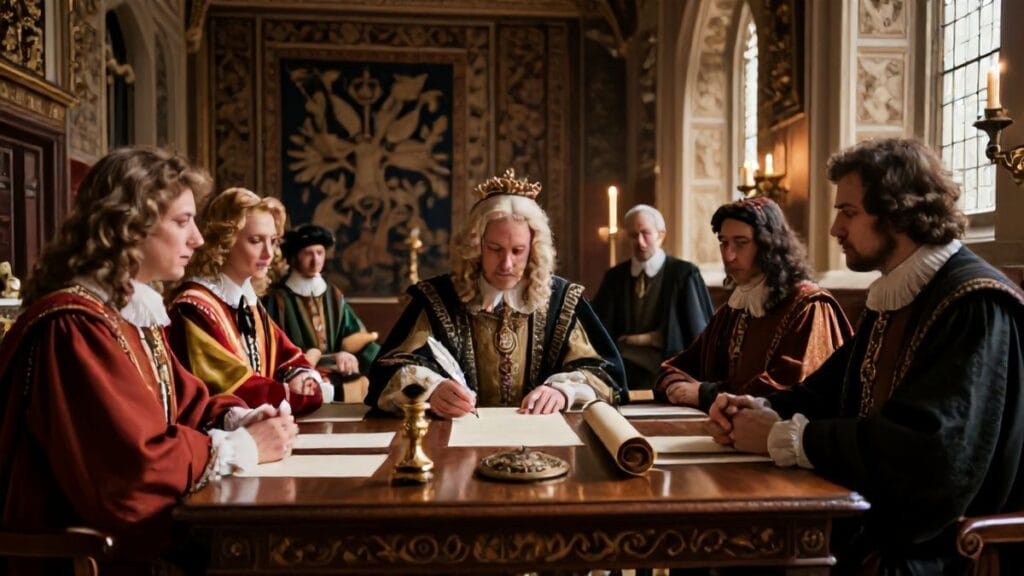
The morning of August 19, 1604, dawned over the Thames with a sky of pale, uncertain blue. Inside Somerset House, servants moved quietly through the corridors, laying fresh rushes, checking inkpots, arranging tables. Today the words would cease to be drafts; today they would be bound by signatures and seals. After years of blood and smoke, the end of the Anglo-Spanish War would come not with a roar, but with the scratching of quills.
The signatories gathered in formal attire that seemed, in its opulence, to deny the exhaustion of their kingdoms. Sable-lined cloaks, embroidered doublets, high ruffs starched to rigid perfection—this was not the dress of defeat. It was the costume of ceremony, designed to send a message to all who would later read the treaty: peace, yes, but on terms that preserved royal majesty.
Robert Cecil and his colleagues took their places, their expressions composed, their minds likely racing through the implications of each clause. Across from them, the Spanish envoys presented a front of solemn dignity. Translators stood ready; scribes arranged parchment sheets, weighted at the corners to prevent any stray breeze from flipping the pages at a crucial moment.
When the time came, one by one, the envoys bent over the treaty and inscribed their names. The sound of pen on parchment, almost inaudible outside the immediate circle, nevertheless marked a turning point in European history. With each signature, decades of enmity were formally set aside. The treaty of london 1604 passed from the realm of hope into that of law.
Witnesses watched closely. For later historians, some of whom would reconstruct this scene from official records and personal accounts, the ceremony encapsulates the age’s paradox: a world of muskets and burning ships quietly steered, at decisive moments, by men in paneled rooms. As one contemporary observed in a letter, “The thunder of guns is but the servant of the pen, which commandeth when it shall sound and when it shall be silent.”
Outside the palace, word spread unevenly. Messengers carried news to court, to the City, to foreign embassies. Rumor leapt ahead of them, as rumor always does. Some Londoners heard that a peace had been signed before they knew its terms; others only sensed that something momentous had occurred when they saw unusual movement on the river or more torches lit than usual at Somerset House that evening.
For James, though the treaty bore his authority, the day’s drama was filtered through reports and ceremonial acknowledgments. Monarchs often played their roles at one remove: they empowered their ministers, then received the fruits of their labors as accomplished facts. Yet there can be little doubt that the king savored this success. To be the ruler who ended a wearying war with the greatest Catholic power in Europe was to claim a place on the continental stage. The man who fancied himself rex pacificus could, at last, point to a tangible achievement.
Reactions in the Streets: Joy, Resentment, and Uneasy Silence
News of the peace traveled faster than the details. In London’s streets, the first reactions were visceral rather than analytical. Some cheered openly, particularly among merchants and artisans whose livelihoods had suffered from disrupted trade. A cessation of hostilities promised cheaper imports, safer voyages, and fewer abrupt losses at sea. In the ports, shipowners who dreaded the ever-rising cost of outfitting armed vessels saw hope for a different kind of commerce.
Others responded more cautiously. In parishes where Puritan sentiment ran deep, there were murmurs of discontent. Sermons that had long framed Spain as the archenemy of true religion did not suddenly shift tone overnight. For years, Protestant identity in England had been tied to opposition to “popish” powers, with Spain at the forefront. To hear that the crown now called Spain a friend struck some as a betrayal not of policy but of faith.
Yet even among the godly, reactions were mixed. Not a few had lost sons and brothers to the long war; others had seen their communities strained by repeated levies and taxes. When the initial shock of the announcement faded, some quietly admitted that peace offered a respite that their congregations sorely needed. God’s will, they reminded themselves, was not for endless war. If the Lord had moved the king to secure peace, perhaps it was a mercy rather than a compromise.
At the playhouses, dramatists and players sensed new material. Wars made for stirring rhetoric; peacemaking made for subtle, ironic commentary. Though the censorship regime limited direct debate about current affairs on stage, the shift in international relations would slowly filter into allegories and historical dramas, reshaping how Spain was depicted in the English imagination.
Perhaps the most intense immediate reactions came from those directly invested in the war economy. Privateers, who had sailed under letters of marque, now faced a stark recalibration of their prospects. Ships built for speed and armed to the teeth were less useful as peaceful traders. Crews accustomed to violence and sudden riches had to adapt to regular commerce or turn, more dangerously, to outright piracy without state sanction.
In the alehouses near the docks, these men spoke of the peace with a bitterness that seldom made it into official chronicles. They had risked their lives under the banner of national defense and Protestant zeal; now, they were told, that banner must be furled. Stories once celebrated as patriotic might soon be retold as awkward reminders of a less civilized age. Such shifts in narrative do not happen without resentment.
Still, what dominated the broader public mood in the weeks after August 19 was not jubilation or outrage, but a kind of cautious relief. The kingdom remained Protestant; no Spanish army had landed; the church bells still rang as before. But there was a sense that the constant background hum of fear—of invasion, of escalation, of financial collapse—had quieted. Life, hard as it remained, might be lived now with one less shadow at the door.
Merchants, Sailors, and Exiles: Human Lives Rewritten by Peace
As the terms of the treaty of london 1604 slowly became known, their human impact unfolded in a thousand private stories. For merchants, the treaty offered a fresh set of calculations. Long-closed routes to Iberia began to reopen. Agents in Seville, Lisbon (then under Spanish rule), and other ports sent cautiously optimistic letters: English cloth might once again find ready buyers; English ships might be welcomed rather than fired upon—provided, of course, they respected Spanish colonial boundaries.
London’s trading companies, ever on the lookout for advantage, held hastily convened meetings. Should capital be redirected from high-risk privateering ventures to more stable trade? Which families would stake their fortunes on renewed commerce with Spain, and which would remain wary, fearing that hostilities might flare up again? Behind the scenes, networks of credit, insurance, and partnership shifted to accommodate the new reality.
For sailors, peace was more ambiguous. War had offered them employment, adventure, and, in some cases, spectacular plunder. It had also offered death, mutilation, and penury. Now, with privateering sharply curtailed, many found themselves competing for places on a reduced number of commercial voyages. Wages fell; discipline aboard ship tightened. The old tales of glory began to sound, even to their own ears, like stories from another world.
Some ships turned their attention ever more firmly toward the Atlantic, seeking fortunes not in raiding Spanish possessions but in planting English ones. Jamestown was still a few years away, but the impulses that would create it were already stirring. If Spain could no longer be treated as an open enemy, perhaps the best way to outflank it was not to fight its fleets but to rival its colonies. The treaty, by closing certain doors, pushed ambitious men to look for others.
Exiles and religious minorities experienced the peace in ways that were at once intimate and fraught. English Catholics, long suspected as potential fifth columnists for Spain, hoped that the relaxation of external hostility might ease their lives. If Spain was no longer an active military foe, perhaps the English state would temper its fear of Catholic conspiracies. Some priests returned cautiously from abroad, testing the waters of James’s tolerance.
But the story was not so simple. The infamous Gunpowder Plot of 1605, which would soon follow, suggests how easily some Catholic extremists interpreted the peace as a sign that lawful channels of redress had failed. While many lay Catholics welcomed the easing of diplomatic tensions, a radical minority saw in James’s policies evidence that the crown would never genuinely restore their faith’s status. For them, peace between England and Spain did not resolve their grievances; it sharpened them.
Exiled English Catholics who had settled in Spanish territories or the Low Countries faced difficult decisions. Should they remain abroad, tied to hopes of a Catholic restoration that now seemed ever more remote? Or should they risk returning home, accepting a compromised status in a Protestant kingdom that professed peace with their chosen champion, Spain? Their letters, preserved in fragments, speak of disorientation and disillusionment.
The Dutch, too, lived the treaty in personal ways. Merchants in Amsterdam and Middelburg recalculated their expectations, wondering if English ships would now be more cautious in supporting Dutch ventures that antagonized Spain. Soldiers who had fought alongside English allies in the Low Countries knew that reinforcements might no longer come so readily. In their conversations, one hears not only political analysis but the sting of abandonment.
Spain’s New Gamble: Honor Preserved, Supremacy Questioned
On the other side of Europe, in the cool, echoing halls of Madrid, the treaty of london 1604 was read as both vindication and warning. Spain had achieved what Philip III’s counselors had long desired: the removal of one enemy from its crowded battlefield. With England neutralized, at least for the moment, the Habsburg monarchy could focus more attention and resources on the Dutch revolt and on maintaining its grip on its far-flung dominions.
Spanish accounts of the treaty emphasized the preservation of honor. Official narratives stressed that Spain had not been defeated; rather, it had chosen peace out of a magnanimous desire to spare Christendom further bloodshed. The documents’ language, rich in religious invocations, cast the peace as an act of Christian wisdom, in which a powerful Catholic king extended an olive branch to a wayward but important Protestant realm.
Yet beneath this spiritual veneer lay hard strategic calculations. English privateers had been a persistent thorn in Spain’s side, harassing treasure fleets and raising insurance costs on transatlantic shipping. Even a modest reduction in such attacks promised significant financial relief. Moreover, peace with England reduced the risk that France, too, might reenter open conflict against Spain, encouraged by a Protestant ally.
Still, not all Spaniards were satisfied. Military men who had spent their careers fighting the English, especially at sea, grumbled that the treaty signaled weakness. They pointed to the long, bitter memory of the Armada and its aftermath, arguing that England’s heresy remained as grave a threat as ever. Religious hardliners worried that treating with a Protestant king as an equal might encourage compromise on other fronts, diluting Spain’s sense of Catholic mission.
In the broader European context, the treaty subtly undermined Spain’s reputation for irresistible might. While it did not amount to a confession of overextension, it confirmed what many observers suspected: the Habsburg monarchy, for all its silver and grandeur, could not indefinitely sustain war on every front. It had to choose. By choosing peace with England, it implicitly acknowledged limits.
Some Spanish commentators, writing decades later, would look back on this decision with a mixture of admiration and regret. Admirable, because it demonstrated prudent statesmanship in the face of fiscal reality. Regrettable, because it allowed England to consolidate at home, to redirect its energies overseas, and eventually to emerge as a rival empire. At the time, of course, no one could see that far ahead. They saw only a necessary respite, a chance to catch breath in an era of suffocating conflict.
England Between Papists and Puritans: Religious Tensions After the Treaty
In England, the treaty’s religious implications unfolded along fault lines that were already deep and jagged. James had hoped that peace with Spain would allow him to moderate the kingdom’s confessional politics, easing persecutions without provoking panic. Instead, he found himself navigating a landscape where any move was interpreted by some faction as evidence of treachery.
Puritans, who had long pressed for further reformation of the English church and for a harder line against Catholics, watched the treaty with narrowed eyes. To them, Spain was not just one Catholic power among many but the spearhead of a global Counter-Reformation. Any political concession to Madrid looked like theological backsliding. They feared that diplomatic niceties might be the first step down a slippery slope toward toleration, or worse, compromise with Rome.
Moderate Protestants were more divided. Some welcomed the reduction in external enemies, hoping it would lessen the sense of siege that had often been used to justify harsh internal measures. Others, aware of the precarious position of Protestant states on the continent, worried that England’s retreat from active military resistance to Spain might embolden Catholic advances elsewhere. For them, peace did not guarantee security; it merely shifted the battleground.
English Catholics experienced the treaty in an even more ambivalent way. On the one hand, peace with Spain removed a powerful justification for seeing them as potential traitors. If their co-religionists abroad were no longer in open arms against the English crown, could they not be treated as loyal subjects despite their faith? Some royal proclamations after the treaty hinted at a desire to enforce the laws against Catholics with a lighter touch.
On the other hand, the years immediately following the treaty, especially after the discovery of the Gunpowder Plot, saw renewed suspicion and repression. For many Protestants, the plot confirmed their worst fears: that peace with Spain and leniency toward Catholics only encouraged deeper conspiracies. The fact that some of the plotters had imagined Spanish support for their scheme linked the treaty, in the public imagination, to treachery, even if the connection was more emotional than factual.
James’s attempt to walk a middle path satisfied no one completely. To strict Protestants, he was too accommodating; to Catholics, he remained the head of an officially hostile church. In this sense, the treaty of london 1604 achieved what it set out to in foreign policy while inadvertently intensifying certain domestic religious tensions. Peace abroad did not automatically translate into unity at home.
Across the Narrow Seas: Dutch Disillusion and European Calculations
For the Dutch Republic, the treaty was a cold wind from across the Channel. Since the days of Elizabeth, English support—men, money, and ships—had been a crucial component of the rebels’ struggle against Spanish rule. While that support had never been wholly reliable or sufficient, it had symbolized a broader Protestant front. The news that England had made its separate peace forced Dutch leaders to confront a harsher reality.
Officially, England did not renounce its sympathies for the Dutch cause. James continued to express concern for the plight of co-religionists in the Low Countries and to speak of the importance of Protestant solidarity. Unofficially, however, the meaning of the treaty was unmistakable: England would no longer be a belligerent power in the conflict between Spain and its rebellious provinces. Dutch envoys who had lobbied vigorously in London realized that their appeals had been outweighed by James’s desire for broader continental peace and domestic stability.
Reactions in the United Provinces varied. Some political leaders, particularly those inclined toward negotiation with Spain themselves, saw England’s move as an unwelcome but manageable shift. Others, especially military commanders and staunch Calvinists, interpreted it as desertion. They feared that Spain, now freed from hostilities with England, would concentrate its might on crushing the Dutch revolt once and for all.
The broader European scene shifted as well. France, under Henry IV, watched England’s peace with Spain with a mixture of relief and anxiety. Relief, because it reduced the likelihood of a massive, coordinated Habsburg onslaught using England as a pawn. Anxiety, because it also signaled that great powers might increasingly seek separate peaces rather than collective security. The logic of raison d’État—state interest above confessional loyalty—was asserting itself more clearly, and not everyone welcomed that trend.
Smaller states and princely territories on the fringes of these great struggles adjusted accordingly. Protestant princes in Germany, Catholic rulers in Italy, and the complex polities of the Swiss Confederation all had to rethink their assumptions about alliances and threats. The treaty of london 1604 did not redraw borders, but it changed the mental map of who might stand with whom in the next crisis.
In this sense, the treaty foreshadowed the diplomatic patterns that would dominate the seventeenth century: flexible coalitions, temporary alignments, and the gradual decoupling of religious identity from foreign policy. Faith still mattered immensely, but it no longer explained everything. Trade routes, dynastic marriages, and the arithmetic of debt and revenue increasingly wrote their own verses in the song of European politics.
Ink That Reached the New World: Imperial Consequences of the Peace
Although the treaty’s text dealt primarily with European theaters, its implications rippled out across the Atlantic. For nearly two decades, English and Spanish vessels had contested not only waters around the British Isles and the Iberian Peninsula, but the vast, contested spaces of the Caribbean and the American coasts. Privateers like Francis Drake had become legendary for striking at Spain’s American lifelines. With the treaty of london 1604, that era of licensed predation officially ended.
In theory, English captains were no longer to attack Spanish shipping or colonial settlements. Spanish colonial authorities, in turn, were to treat English vessels with the courtesy due to subjects of a friendly power, at least in European waters. The Caribbean, however, remained a gray zone. Officially closed to foreign traders by Spanish law, it continued to attract interlopers who might now operate under thinner legal cover, as smugglers rather than privateers.
Some historians have argued that the treaty, by reducing open conflict, ironically enabled a more systematic English expansion into the Atlantic world. Freed from diverting so many resources into direct naval warfare with Spain, English investors could concentrate on colonization schemes. The Virginia Company, chartered in 1606, emerged in a context shaped by the new peace: its backers could imagine a permanent settlement in North America without immediately provoking a full-scale Spanish military response.
For Spain, the peace provided an opportunity to stabilize its own American frontiers, but only partially. Indigenous resistance, internal corruption, and sheer geographic vastness posed challenges that no European treaty could resolve. Still, the reduced threat from English-sponsored raids eased some pressure on colonial administrators and allowed resources to be directed toward fortifications, missions, and civic development rather than constant emergency defense.
The New World was also where the treaty’s ambiguities proved most evident. While London and Madrid could agree in principle to peace and mutual respect, thousands of miles away, local officials, opportunistic captains, and competing settlers might interpret those principles loosely. One governor’s “friendly visit” could look to another like an unauthorized incursion. Reports of such incidents traveled slowly back to Europe, where they were filtered through political needs before being folded into broader narratives of compliance or violation.
In this way, the treaty served less as a rigid blueprint for imperial behavior than as a framework within which new contests would be waged. It confirmed that England and Spain recognized each other as legitimate imperial powers—an acknowledgment that would shape how both approached negotiations, conflicts, and covert maneuvers in the Atlantic for years to come.
Memory, Myth, and Revision: How Historians Read the Treaty of London 1604
Over the centuries, the treaty of london 1604 has been read, reread, and reinterpreted in light of later events. For some early historians, particularly in England, it appeared as a somewhat inglorious coda to the heroic age of Elizabeth. They contrasted the dazzling defiance of 1588 with what they saw as James’s timid conciliation, casting the treaty as a retreat from Protestant militancy into cautious, calculating diplomacy.
Others, especially those writing with the hindsight of later, even more devastating wars, took a different view. To them, the treaty represented a clear-eyed recognition of limits and a humane effort to spare both kingdoms further suffering. In an age when religious rhetoric could so easily inflame passions, the willingness of both sides to sit down and compromise over issues of trade, faith, and empire appears as an act of political maturity.
Modern scholarship tends to emphasize context. It notes that by 1604, neither England nor Spain was in a position to achieve decisive victory. The war had become a drain, not a source of glory. In this light, the treaty looks less like an abandonment of a righteous cause and more like the inevitable outcome of a long, unsustainable struggle. As one twentieth-century historian observed, “The remarkable thing is not that peace came in 1604, but that war had endured so long before exhaustion compelled words where shot and shell had failed.”
There is also growing recognition of the treaty’s role in shifting England’s strategic horizons. By stepping back from direct confrontation with Spain, James’s government opened space for a different kind of rivalry, one that would play out increasingly in colonies, trade routes, and naval power. Seen from this angle, the treaty is less the end of a story than the pivot between two chapters: from religiously framed dynastic war to commercial and imperial competition.
Spanish perspectives add further nuance. For historians looking back from the vantage point of Spain’s later imperial decline, the treaty can appear as an early indicator of overstretch, a moment when the Habsburg monarchy tacitly acknowledged that its reach exceeded its grasp. Yet it can also be read as a prudent consolidation, buying time for internal reforms and shoring up defenses where they mattered most.
Today, in a world where diplomacy often unfolds under the glaring light of instant media, there is something almost foreign about the pace and secrecy of the 1604 negotiations. And yet, the fundamental dynamics—balancing honor with necessity, domestic politics with international pressures, ideals with the arithmetic of power—remain strikingly familiar. The treaty of london 1604, when stripped of its antique language and courtly trappings, speaks to enduring questions about how states choose war or peace.
Conclusion
On that August day in 1604, when pens moved across parchment in the cool rooms of Somerset House, no one present could foresee the full consequences of their work. They knew they were ending a long and weary war; they sensed that they were reshaping European alignments; they hoped, perhaps, that future generations would remember them as architects of peace rather than mere functionaries. What they could not see was how the treaty of london 1604 would echo through the seventeenth century: in the measured rise of English colonial ambitions, in the evolving strategies of Spanish power, in the shifting loyalties and fears of Protestant and Catholic communities alike.
The treaty did not answer every question or heal every wound. It left Dutch grievances raw, English religious divisions unresolved, and Atlantic rivalries reconfigured rather than pacified. It was, as all great diplomatic settlements are, a compromise born of fatigue and necessity as much as of high principle. Yet for countless individuals—merchants spared bankruptcy by renewed trade, sailors saved from another call to arms, families who no longer saw their sons marched off to distant campaigns—it meant something immediate and profound: the possibility of ordinary life continuing without the constant drumbeat of war.
Looking back, we can see the treaty as both an ending and a beginning. It closed the chapter of open Anglo-Spanish hostilities that had defined the later Elizabethan years, but it opened the way for new forms of competition that would shape the modern world. The guns did not fall silent forever; they were merely turned in new directions. Still, the decision to seek peace when victory was impossible remains a sober lesson in political realism. Between the cannons and the quills, the men of 1604 chose the quills, and in doing so they offered a reminder that even in an age of burning faiths and embattled empires, negotiation could still edge out annihilation.
FAQs
- What was the Treaty of London 1604?
The Treaty of London 1604 was a peace agreement signed on August 19, 1604, between England and Spain, formally ending nearly two decades of intermittent warfare that had begun in 1585. Negotiated at Somerset House in London, it reestablished diplomatic relations, curtailed privateering, and laid out new rules for trade and navigation between the two crowns. - Why did England and Spain decide to make peace in 1604?
Both kingdoms were exhausted financially and militarily after years of inconclusive conflict. England faced heavy war costs, social strain, and the transition to a new monarch, James VI and I, who favored peace. Spain was overextended by multiple fronts, including the Dutch revolt, and needed to reduce its enemies. Peace allowed each to reallocate resources and stabilize their realms. - Did the treaty change religious policy in England?
The treaty did not overhaul English religious policy, but it had indirect effects. Spain sought better treatment for English Catholics, and some language in the treaty hinted at moderation. However, James I remained committed to a Protestant state church, and after the Gunpowder Plot of 1605, suspicion of Catholics intensified again, limiting any practical relaxation of persecution. - How did the treaty affect the Dutch Republic?
The Dutch Republic, then fighting for independence from Spain, felt diplomatically isolated by the treaty. England’s withdrawal from active military confrontation with Spain meant the Dutch could no longer count on the same level of English support. This increased their sense of vulnerability and forced them to adjust their military and diplomatic strategies, even as they continued their struggle. - What impact did the Treaty of London 1604 have on overseas expansion?
By reducing direct naval conflict with Spain, the treaty freed England to focus more on colonization and long-distance trade. While it did not grant England access to Spanish American ports, it lowered the risk of major war at sea, encouraging ventures like the later Virginia Company. Spain, in turn, could concentrate on consolidating its own empire rather than constantly defending it from English raids. - Was the treaty seen as a victory or a defeat at the time?
Perceptions varied. In England, some saw it as a prudent and necessary peace that ended a burdensome war, while hardliners viewed it as a retreat from Protestant militancy. In Spain, it was presented as an honorable peace chosen from a position of strength, though critics worried it exposed imperial limitations. In practice, it was a mutual acknowledgment that neither side could win decisively. - Where exactly was the treaty signed?
The treaty was signed at Somerset House, a royal palace on the Strand in London, which served as the venue for the Anglo-Spanish peace conference. Envoys from both sides, along with interpreters and scribes, met there over several months to negotiate and finalize the terms. - How long did the peace created by the treaty last?
The peace established by the Treaty of London 1604 held for several decades, though tensions and rivalries persisted, especially in colonial and maritime arenas. Open war between England and Spain did not resume on a large scale until later in the seventeenth century, by which time the European political landscape had changed significantly.
External Resource
Internal Link
Other Resources
- Encyclopaedia Britannica – general search for the exact subject
- Google Scholar – academic search for the exact subject
- Internet Archive – digital library search for the exact subject

