Table of Contents
- A Frontier On Fire: Setting the Stage in 8th‑Century Saxony
- Charlemagne Before Saxony: A King Forged in Earlier Wars
- The Saxons: Fragmented Tribes, Fierce Traditions
- From Irminsul to Iron Will: The Road to Renewed War
- Spring 779: The Muster of the Frankish Host
- Crossing the Threshold: The Army Marches into Saxony
- Sieges, Skirmishes, and Raids: The Military Campaign of 779
- Charlemagne’s War Council: Strategy, Faith, and Ruthlessness
- Captive Oaths and Broken Vows: Saxon Submission in 779
- Baptism at Swordpoint: Conversion and Coercion
- Life Under the Banner of the Frankish Eagle
- Women, Children, and the Silent Suffering of War
- Rebellions Smoldering Beneath the Ashes
- The Long Shadow: Laws, Capitularies, and Control
- Memory and Myth: How the Expedition Was Remembered
- From Saxony to Empire: The Wider Consequences for Europe
- Historians at Work: Sources, Silences, and Bias
- Conclusion
- FAQs
- External Resource
- Internal Link
Article Summary: In the late 8th century, the charlemagne expedition into saxony in 779 marked a decisive turning point in the long and brutal struggle between the Frankish kingdom and the pagan Saxon tribes. This article explores how the campaign unfolded as both a military operation and a spiritual crusade, aimed at expanding Frankish power and imposing Christianity along a volatile frontier. It follows the king’s army as it marches across rivers and forests, besieging strongholds and compelling oaths from reluctant Saxon nobles. Yet behind the apparent successes of 779 lay a fragile peace, maintained by fear, forced baptisms, and draconian laws that would soon provoke further uprisings. Through narrative detail and careful historical analysis, we see how everyday people—warriors, villagers, women, and children—experienced this violent transformation of their world. Returning repeatedly to the charlemagne expedition into saxony, the article reveals how this single campaign fits into a decades‑long cycle of conquest and resistance. In doing so, it connects the local events of 779 to the broader birth of a Christian empire in Western Europe and the enduring memory of Charlemagne as both a unifier and a destroyer.
A Frontier On Fire: Setting the Stage in 8th‑Century Saxony
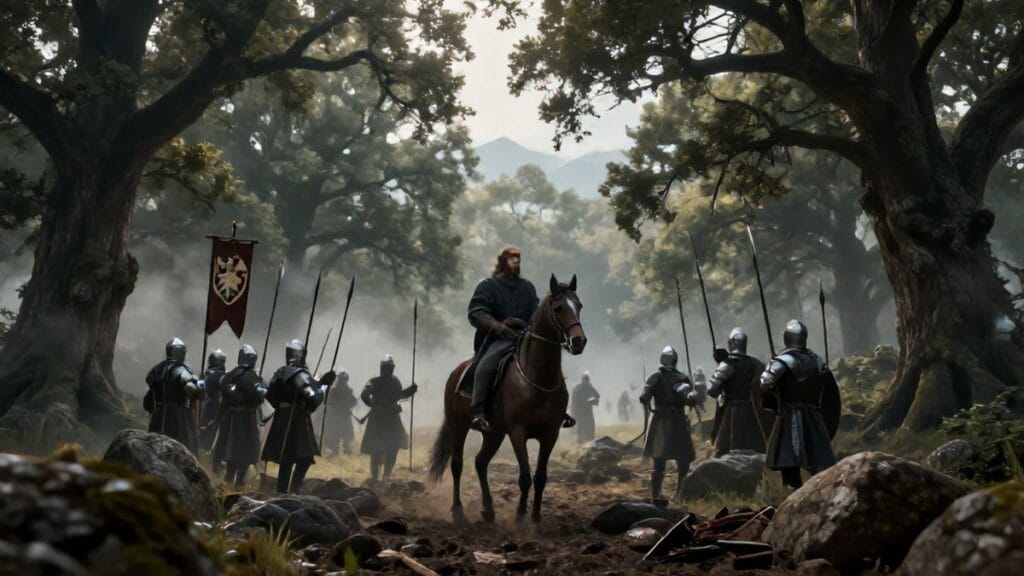
The forests were the first thing the Franks saw as they approached Saxony: a dark wall of oak and beech, broken only by narrow tracks and muddy streams. To them, these woods were more than landscape; they were the edge of the known world, the outer limit of Christian rule. Somewhere beyond those trees lay villages that still burned sacrifices to old gods, warriors who swore by spirits that had no saints’ names, and shrines like Irminsul—mysterious, terrifying, and, above all, defiant.
By 779, this frontier had already been soaked in blood for years. Raids went both ways. Saxon warbands slipped south to burn churches, seize cattle, and humiliate Frankish border garrisons. Frankish counts retaliated by torching farmsteads, dragging hostages back across the Rhine, and erecting wooden churches where sacred groves once stood. The charlemagne expedition into saxony in 779 did not erupt from a tranquil peace; it emerged from a simmering conflict stretching back generations, a conflict of faiths, customs, and power.
The political geography of the region only deepened the tension. To the south and west stood the Kingdom of the Franks, a force rapidly consolidating under Charlemagne, crowned king in 768. To the north and east stretched the lands roughly known as Saxony: Westphalia, Eastphalia, Engria, and Nordalbingia. These were not centralized states but clusters of free communities led by nobles whose authority was fragile and constantly negotiated. No single ruler could speak for all Saxons, which made treaties unstable and truces painfully temporary.
Yet this was the border where worlds collided. Christian missionaries were pushing north with books and crosses; Saxon priests or seers guarded old rites by firelight. The rivers—the Weser, the Lippe, the Ems—served as both commercial lifelines and invasion routes. Each ferry crossing might usher in traders and pilgrims, or mail‑clad horsemen prepared to kill for their king and their Christ. In this charged landscape, a single spark—an insult, a raid, an execution—could ignite a new war.
By the late 770s, that war had settled into a grim rhythm. Charlemagne’s previous campaigns in Saxony, particularly in 772 and 774, had smashed sacred sites and forced significant Saxon lords to swear oaths of loyalty. Irminsul, a towering wooden symbol of Saxon religion, had fallen to Frankish axes. But destroying a shrine is easier than dismantling a culture, and Saxon resistance had not disappeared; it had merely retreated into the woods, waiting, plotting, grieving. The expedition of 779 would be Charlemagne’s attempt to turn this restless frontier into a subdued province—whatever human cost that might require.
Charlemagne Before Saxony: A King Forged in Earlier Wars
When Charlemagne turned his full attention once more toward Saxony in 779, he was not an inexperienced warlord chasing glory. He was already a seasoned ruler, hardened by campaigns stretching from Aquitaine to Lombardy. Born around 742, the eldest son of Pepin the Short, he grew up watching his father replace the last Merovingian “do‑nothing” king and claim the crown for the Carolingian family. Violence and legitimacy were intertwined from the beginning of his life; power was something one seized with both sword and blessing.
In the 760s and early 770s, Charlemagne learned that to rule the Frankish kingdom effectively required more than brute force. It demanded a network of loyal counts, a literate clergy, and a careful dance with the papacy. His wars in Aquitaine had taught him how stubborn local identities could be, and his conquest of the Lombard Kingdom of Italy in 774 revealed the prize of controlling major trade routes and church politics. In each theater, war had been followed by negotiation, lawmaking, and the building of institutions—monasteries, bishoprics, new royal estates.
So, when considering the charlemagne expedition into saxony, we must see it not as an isolated impulse but as part of a larger strategy. The northern frontier, with its defiant pagan tribes, was a glaring weak point in an otherwise expanding realm. Saxon raids threatened monasteries that supplied not only prayer but also administrators and scribes. The very idea of a Christian king tolerating pagan neighbors, who routinely desecrated churches and captured Christians for sacrifice or slavery, seemed almost a contradiction in terms to the Frankish elite.
Charlemagne’s court was also steeped in an idea that would shape his decisions in 779: the fusion of kingship and religious duty. Bishops and royal advisers argued that the king bore responsibility for the salvation of his subjects, and even of those on his borders. To leave the Saxons in error was not only politically dangerous but spiritually negligent. Seen through this lens, the campaign of 779 was more than a punitive expedition. It was a mission—a drive to fold a resistant people into the Christian order, through sermons if possible, but through steel if necessary.
Yet Charlemagne was no mere fanatic. He was calculating, methodical, and often pragmatic, willing to negotiate with pagans when it served his ends. The Royal Frankish Annals, one of the key sources for his reign, show a king who blended ruthlessness with administrative genius. As historian Janet L. Nelson has noted, he could be “brutal and pious, a sincere Christian and a relentless conqueror” at the same time. This duality would define his actions in Saxony, especially in the harrowing events of 779.
The Saxons: Fragmented Tribes, Fierce Traditions
To the Franks, the Saxons were often portrayed as a single people: savage, restless, obstinate in their paganism. But in reality, they were a patchwork of tribes and regions with their own customs and rivalries. Westphalians, Eastphalians, Angrians, Nordalbingians—each group had its own noble families, its own meeting places, its own ways of settling disputes. Authority did not flow down from a crowned king but rose up, unevenly, from local assemblies and warrior bands.
Saxon society revolved around kinship and honor. Free men—warriors who could bear arms—gathered in council to decide matters of war and peace. Oaths, sworn before gods and men, bound people together in bonds of fealty and vengeance. The old religion—polytheistic, deeply tied to the landscape—sanctified groves, stones, and rivers. Sacrifices, animal and occasionally human, were offered to secure victory, fertility, and protection. To abandon these rites was not just a spiritual betrayal but a rupture of community identity.
When the charlemagne expedition into saxony pressed north again, it collided with this world of kin groups and sacred landscapes. To the Saxons, the Franks were not merely foreign invaders; they were agents of a God who demanded exclusive worship and an obedience that seemed to erase ancestral ways. Baptism meant more than a quick splash of water—it meant renouncing the bonds that had defined life for generations. Little wonder that so many Saxons accepted it under duress, only to rebel as soon as Frankish troops withdrew.
Materially, the Saxons were no match for the Frankish war machine. They had fewer heavily armed cavalry, less access to fine weapons from distant workshops, and no dense network of fortified cities. But they knew their land intimately. They were experts in forest warfare, ambushes, and fast raids. Villages could be abandoned and rebuilt, herds hidden in the woods, and fugitives sheltered by kinfolk across wide regions. This resilience gave them a flexibility that often frustrated Frankish attempts at permanent control.
Yet internal divisions also undermined Saxon resistance. Some nobles found accommodation with Charlemagne attractive; the rewards of peace—Frankish gifts, trade, a measure of security—tempted them. Others were uncompromising, organizing rebellions that punished collaborators. In the end, Saxony was not a monolithic block defending ancient freedom, nor merely a set of small communities crushed beneath a mighty empire. It was a battlefield of choices, fears, and divided loyalties, all of which would be tested fiercely in 779.
From Irminsul to Iron Will: The Road to Renewed War
The immediate background to the 779 campaign lay in the earlier waves of conflict. In 772, Charlemagne had launched a major offensive into Saxony, culminating in the infamous destruction of Irminsul, a sacred pillar or tree that symbolized Saxon faith and identity. The Royal Frankish Annals recorded this act almost triumphantly: the king “destroyed the place and took all the treasure that was there.” To Frankish chroniclers, this was a blow against idolatry; to the Saxons, it was a sacrilege that would echo for years.
Subsequent campaigns, including operations in 774 and 775, had forced portions of the Saxon elite to submit. They swore oaths of loyalty, handed over hostages, and sometimes accepted baptism. But submission, in a world without permanent garrisons and with limited communication, was fragile. Charlemagne’s attention was divided—Italy, Spain, Bavaria, and internal reforms all demanded his presence. Every time he turned away, the frontier softened, and Saxon defiance rose.
In 777, a crucial assembly was held at Paderborn, deep in Saxon territory. Many Saxon nobles came, perhaps calculating that some compromise was better than endless destruction. Here, Charlemagne held court, dispensed justice, heard appeals, and oversaw mass baptisms. Monks from England and the Frankish heartlands pushed north with him, eager to convert new souls. For a moment, it might have seemed that a peaceful integration of Saxony into the Frankish realm was possible.
But the peace was illusory. Not all Saxons attended Paderborn, and many who did went home to communities that resented their apparent surrender. Whispered accusations of treachery and cowardice followed. At the same time, Charlemagne began to weave Saxony into his administrative web: new churches, royal estates, imposed counts. To those who had never invited him north, this felt like an occupation.
Somewhere in this tense atmosphere, the decision for renewed war ripened. Raids and localized uprisings convinced Charlemagne that leniency had failed. The charlemagne expedition into saxony in 779 would therefore be harsher, more systematic, and more determined than many of his previous strikes. This time, the aim was not simply to punish a few rebellious groups but to reorder the entire region through force, oath, and sacrament.
Spring 779: The Muster of the Frankish Host
Imagine the spring of 779 on the Frankish side of the frontier. Messengers on horseback race along dirt roads, bearing wax‑sealed orders to counts, abbots, and bishops: the king is calling the host. In halls from the Loire valley to the Rhine, armored warriors pull down spears hung on rafters, fit helmets to their heads, and test the balance of swords that have been whet for the first time since the last campaign season.
The Frankish army that assembled for the charlemagne expedition into saxony was no chaotic mob. By this point in his reign, Charlemagne had created a reasonably structured system for raising and supplying troops. Local magnates were responsible for mustering contingents of mounted warriors, often owing their service as part of a network of benefices and royal patronage. Some came as vassals, others as free men fulfilling their obligation to the king. Monasteries and churches contributed pack animals, wagons, and sometimes even fighters, their abbots as eager for royal favor as any secular lord.
This army was diverse. There were seasoned veterans who had followed Charlemagne to Italy and back, bearing scars and stories of sieges and mountain passes. There were fresh recruits—young men tasting fear and excitement in equal measure as they imagined their first clash of shield on shield. There were also non‑Frankish allies and subject peoples, drawn from recently subdued regions, whose presence reminded everyone that today’s conquerors could be tomorrow’s cannon fodder.
Logistics, though rarely sung by chroniclers, were crucial. Campaigning in Saxony meant crossing rivers, marching through forests, and pushing into regions with few large settlements to forage. Grain, salted meat, wine, and fodder had to be stockpiled. Blacksmiths accompanied the host, ready to repair weapons and shoe horses. Provisions moved on carts and barges, shadowing the army’s advance along navigable waters.
At the core of this host rode Charlemagne himself. He was not a distant monarch sending generals in his place; he led in person. The sight of the king—towering, broad‑shouldered as Einhard would later describe him, surrounded by his guards—was itself a weapon. It signaled to allies and enemies alike that this was not a mere raid. It was the focused will of a kingdom bent on reshaping its northern frontier.
Crossing the Threshold: The Army Marches into Saxony
When the Frankish army finally crossed into Saxon territory in 779, it did so with deliberate ceremony and grim resolve. Chroniclers, always keen to stress the righteousness of the king’s actions, imply that the campaign began with prayer and mass. Bishops and priests would have blessed the troops, invoking divine favor for a war that was framed as both political necessity and holy cause.
The march itself must have been a spectacle of sound and dust. Horses snorted, leather creaked, iron rang as shields brushed against mail. Horns signaled orders. Scouts rode ahead, probing for ambushes or hidden fords. The charlemagne expedition into saxony pressed along known routes toward key river crossings and strategic settlements, following a pattern established in earlier campaigns but now refined by experience.
To the Saxon villagers watching from the tree line, the sight must have been terrifying. A Frankish host meant not only danger to warriors but to everyone: homes burned as a warning, grain stores emptied or torched to prevent their use by rebels, hostages seized to guarantee obedience. Smoke rising from one village could be seen by the next, a grim signal of what was coming if resistance was offered.
Yet the army’s progress was not simply a trail of devastation. Charlemagne was careful to stage acts of justice and mercy where it suited him. He heard petitions, settled disputes, and sometimes restored property to those who pledged loyalty. His presence was a mobile court, a reminder that submission did not only mean fear—it could also bring security under an increasingly powerful law.
Still, everyone knew that beneath the rituals of law and piety lay the hard steel of conquest. Every negotiation took place with the unspoken awareness that refusal could bring swift and violent reprisal. The Franks advanced deeper into Saxon lands, following rivers like the Weser, aiming at regions whose allegiance had wavered in recent years. The expedition was unfolding as both a military thrust and a carefully staged demonstration of royal authority.
Sieges, Skirmishes, and Raids: The Military Campaign of 779
Details of the specific battles of 779 are frustratingly sparse in our surviving sources. The Royal Frankish Annals, so central to our understanding, compress entire campaigns into a handful of sentences. “The king went into Saxony and subdued the people there,” they might say, as if the subduing of a people were no more complex than a swift ride across an open field. Yet when we read between the lines, we can reconstruct the kind of warfare that shaped this expedition.
The Saxons rarely met the Franks in open, large‑scale pitched battles on flat plains; they knew that heavily armed Frankish cavalry and disciplined infantry would likely crush them. Instead, they relied on fortified places—hilltop enclosures, ringforts, stockaded villages—where families and livestock could seek shelter. The campaign of 779 likely involved systematic assaults on such strongpoints, with Frankish troops besieging them, cutting off supplies, and staging sudden attacks by night or dawn.
Skirmishes would have been constant. Saxon warbands, swift and lightly armed, harried the flanks of the Frankish columns, striking at stragglers, supply carts, and isolated detachments. To counter this, Charlemagne probably organized flying columns of his own—fast units sent out to chase and crush these raiders. The forests became a deadly maze of cat‑and‑mouse pursuit, each tree a possible hiding place, each path a potential trap.
Raids by the Franks served dual purposes: military and psychological. Burning a village did not simply deprive the Saxons of shelter and food; it spread terror and divided their leadership. Some nobles, seeing their lands ravaged again and again, must have questioned whether defiance was worth the cost. Others, seeing their people suffer, felt only a deeper fury and resolve. The charlemagne expedition into saxony thus became a pressure cooker, testing the breaking point of communities.
We also know that hostages played a role in this campaign. Sons of Saxon nobles, and sometimes the nobles themselves, were taken back to Frankish territory as guarantees of future obedience. These were not mere prisoners; they were bargaining chips and future tools of assimilation, often raised at the Frankish court, baptized, taught Latin prayers, and steeped in the culture of their captors. Every successful siege or raid added new names to this silent ledger of human collateral.
For the average Frankish soldier, these operations blended together into a blur of mud, fear, and exhaustion. Long days of marching, nights under makeshift shelters, the stench of unwashed bodies and horses, the constant tension of waiting for an unseen arrow. For the Saxon defenders, the experience was even more precarious: a desperate attempt to survive while caught between a relentless external enemy and internal pressures demanding either defiance or accommodation.
Charlemagne’s War Council: Strategy, Faith, and Ruthlessness
At the center of all this movement and violence stood the king and his closest advisers. Charlemagne did not wage war alone; he operated through a council of trusted nobles, bishops, and experienced commanders. Around evening fires, maps and reports—such as they existed in the 8th century—would have been spread out and discussed. Which valley to advance up next? Which chieftain’s loyalty was suspect? Where to place garrisons, if any?
Strategy in the charlemagne expedition into saxony blended short‑term military logic with long‑term political goals. Militarily, the aim was to break organized resistance, secure river crossings, and ensure that supply lines were not cut. Politically, Charlemagne wanted to create a web of obligations and dependencies that bound Saxon elites to him personally. This meant carefully choosing whom to punish and whom to reward, whom to humiliate and whom to elevate.
Faith was never far from these calculations. Bishops urged the king to see victory as a sign of God’s favor and to seize every opportunity for conversion. After a fortress surrendered, were its defenders to be spared if they accepted baptism? Were oaths sworn on Christian relics to be considered more binding than traditional Saxon vows? Each decision shaped not only the immediate outcome but the religious landscape of Saxony for generations to come.
Yet Charlemagne could be shockingly ruthless. Although the most notorious episode of Saxon repression—the mass execution of rebels at Verden in 782—lay in the future, the mentality that enabled it was already present in 779. The king believed that stubborn resistance to his rule and to Christianity could merit extreme punishment. Mercy was a tool, not an instinct; it was granted when it served the glory of God and the stability of his realm, and withdrawn when it did not.
There must have been voices of caution in his council—advisers worried that harsh measures would only fuel rebellion. But there were also hardliners, convinced that only overwhelming force could bring these forest‑dwelling pagans to heel. The expedition of 779 thus became a proving ground for methods that would characterize the entire Saxon war: cycles of violent repression, forced conversion, arranged submissions, and ultimately, the attempt to fuse a conquered people into a Christian empire.
Captive Oaths and Broken Vows: Saxon Submission in 779
As the campaign wore on, more Saxon leaders came forward to negotiate. Reduced harvests, dead relatives, burned farms—these were the heavy arguments that pushed them to Charlemagne’s camp. Submission ceremonies during the 779 expedition would have followed a pattern already familiar along the frontier but still charged with emotion and risk.
A Saxon noble, perhaps accompanied by kin and a few retainers, would approach the Frankish encampment under a flag of truce. There, in the king’s presence and before assembled warriors and clerics, he would kneel and place his hands between those of Charlemagne, swearing loyalty. Oaths might be sworn not only by the gods he had once revered but now, increasingly, by the Christian God and the saints whose relics the bishops carried. In some cases, the Saxon might accept immediate baptism, taking a Christian name and symbolically shedding his past.
In return, Charlemagne extended his “protection” and, in many instances, spared the man’s lands from further devastation. But there was always a price. Hostages were taken—often sons, brothers, or close kin—sent back into Frankish territory. These hostages, living in what might be described as gilded captivity at court or in monasteries, were both guarantees and instruments of future influence. If their families rebelled, their lives could be forfeit.
The charlemagne expedition into saxony thus produced a patchwork of local deals. Some regions came under firmer control, with counts or royal envoys installed to oversee them. Others remained in a grey zone of nominal submission but real autonomy, their loyalty wavering with every rumour of Frankish setbacks elsewhere.
Yet even in 779, beneath the surface of these agreements, doubts and resentments simmered. How binding was an oath taken under such duress? Could a man truly abandon the gods of his ancestors because a foreign king demanded it? Many who submitted that year likely did so with their fingers metaphorically crossed, intending to bide their time until an opportunity for revolt presented itself. The story of 779 cannot be told as a simple narrative of conquest and conversion; it was also a story of grudging accommodation and calculated delay.
Baptism at Swordpoint: Conversion and Coercion
One of the most striking—and disturbing—aspects of the 779 campaign was the fusion of military conquest with Christian mission. Missionaries had been active in Saxony for decades, sometimes with Frankish backing, sometimes on their own initiative. But the charlemagne expedition into saxony gave this process a new, sharper edge. Now, the choice for many Saxons was not between paganism and Christianity in a realm of free belief; it was between baptism and the risk of death, exile, or loss of lands.
Mass baptisms likely followed in the wake of major surrenders. Rivers that had long played host to pagan rituals became the scene of Christian rites. Men, women, and children were led into the water, sometimes after only the briefest instruction in the new faith. Latin words flowed over people who did not understand them, while sponsors—often Frankish warriors or Christianized Saxons—stood by to guarantee their new life in Christ.
To the clergy at Charlemagne’s side, this was a moment of triumph. The kingdom of God was expanding; the darkness of idolatry was receding. But for many of the baptized, it was a bewildering and traumatic experience. Their old gods were not simply theological options; they were woven into seasonal festivals, family rituals, and the very meaning of life and death. To renounce them publicly, under pressure, must have felt like both a betrayal and a desperate survival strategy.
Sources such as the later Capitulatio de partibus Saxoniae, a legal text imposing draconian penalties for pagan practices, show how far Charlemagne was willing to go to eradicate traditional religion. Even if that capitulary dates a few years later, the mentality it reflects was present in 779: the idea that burning the dead according to pagan rites, refusing baptism, or attacking priests could merit execution. Conversion was thus a legal obligation backed by the sword.
This raises uncomfortable questions that historians still debate. Can we call such a process “evangelization” in any meaningful sense? Or was it primarily an instrument of imperial control, a way to bind Saxony more tightly to the Carolingian state by erasing competing religious authorities? The answer, inevitably, is complex. Some Saxons did genuinely embrace Christianity over time, adapting its stories and symbols into their own culture. Others complied outwardly while maintaining older beliefs in secret. The 779 expedition accelerated this collision of faiths, leaving scars that would take generations to heal.
Life Under the Banner of the Frankish Eagle
After the campaigns and ceremonies of 779, what did everyday life look like for those Saxons now living under Frankish rule? For many, the most immediate changes were practical rather than spiritual. New obligations appeared: tribute in the form of grain, livestock, or labor; military service when called upon; attendance at church on major feast days. Royal envoys arrived to survey lands, settle disputes, and ensure that local leaders toed the line.
Settlement patterns began to shift. In some regions, Frankish settlers moved in, rewarded with estates carved out of rebel lands. They brought different building styles, new agricultural techniques, and a familiarity with the monetary economy that was slowly taking root in the Carolingian world. Markets emerged along major routes, where Saxons and Franks traded goods and, warily at first, stories.
For those who had accepted baptism, the presence of priests and monks became a daily reality. Wooden churches rose where sacred groves once stood, their bells calling people to unfamiliar prayers. Children learned the sign of the cross instead of the gestures once used to invoke older gods. Still, the blending of traditions was not neat or linear. Ancestral burial mounds coexisted uneasily with Christian graveyards; charms invoking saints overlapped with whispered references to older spirits.
The charlemagne expedition into saxony had also left psychological imprints. Memories of burned villages, slaughtered kin, and terrifying marches into exile lingered. Older generations recalled a time before the Franks dominated their horizon, while younger people grew up knowing no other overlord. Identity became a complicated tangle: Saxon by blood, Christian by law, subjects of a distant king who spoke a slightly different tongue but whose authority loomed over every aspect of life.
For Frankish administrators and clergy, Saxony was both a challenge and an opportunity. They could build monasteries in newly “pacified” lands, securing endowments and influence. But they also walked a fine line, aware that too heavy a hand might reignite revolt. The frontier remained tense, and rumors of yet another uprising always seemed only a winter away.
Women, Children, and the Silent Suffering of War
Official chronicles, written by male clerics close to power, rarely dwell on the experiences of women and children. Yet if we shift our gaze away from royal tents and battlefield maneuvers, the human cost of the 779 expedition becomes painfully clear. For every warrior, there were family members who waited, feared, and, all too often, mourned.
Saxon women bore the brunt of the disruption. When the Frankish host approached, many had to decide whether to flee into the forests with their children and what they could carry, or to remain and hope that submission would spare them the worst. Some saw their homes burned, food stores looted, and fields trampled. Husbands, fathers, and brothers taken as hostages or killed in battle left behind households struggling to survive in a shattered economy.
For those in regions that submitted, new burdens emerged. Women were drawn into the Christianization process, attending baptisms, learning prayers, and navigating new expectations of moral behavior promoted by clerics. Marriage customs could be challenged or condemned; practices such as arranged bridewealth or divorce might be scrutinized through a Christian legal lens. The change was not instantaneous, but 779 marked a step in the long, often painful reconfiguration of family life.
Children experienced the war in fragmentary, terrifying glimpses: the sight of armed strangers, the sound of crackling thatch, the taste of hunger when stores ran low. Some were taken as hostages along with their fathers, growing up far from home in Frankish courts or monasteries. There, they learned a different language, a new religion, and perhaps came to see their homeland through foreign eyes. Others were orphaned, their futures tied to the charity of relatives or the uncertain mercy of conquerors.
Even on the Frankish side, the war left marks. Wives and mothers feared for men who marched north each spring, returning months later—or not at all. The cost of campaigning strained local communities, as men were pulled away from fields and workshops. The charlemagne expedition into saxony, so often remembered in terms of royal success, also wrote itself into the quiet tragedies of households on both sides of the frontier.
Rebellions Smoldering Beneath the Ashes
By the time Charlemagne withdrew his main forces at the end of the campaign season in 779, Saxony was outwardly pacified in many regions. Oaths had been sworn, hostages taken, churches planted like seeds of a new order. Yet beneath this surface lay embers of resistance that the king’s victories had not extinguished, only buried.
Some Saxon leaders had submitted reluctantly, calculating that survival today might enable resistance tomorrow. Others had been forced into compliance while harboring a deep hatred for the conqueror who had humiliated them. Their followers, less involved in the diplomatic dance of oaths, often felt the injustice even more keenly. Each new royal edict limiting traditional practices, each demand for tribute, stirred murmurs of defiance.
The very mechanisms of control put in place after the charlemagne expedition into saxony contributed to future unrest. Hostages were a powerful tool, but also a dangerous one; if their families judged that rebellion was worth even that ultimate cost, the moral barrier to rising up was already half‑broken. The spread of Christian teachings created its own tensions, drawing some into closer alignment with the Franks while alienating others who saw converts as traitors.
In the years following 779, these tensions would erupt in renewed warfare, culminating in some of the darkest episodes of Charlemagne’s reign, like the massacre at Verden in 782. The seeds of that future violence were sown in campaigns like the one we are tracing. Every surrendered fortress, every coerced baptism, every confiscated field left behind memories and grievances that could be called upon by new leaders of resistance.
Yet it would be too simple to imagine Saxon society as uniformly bent on rebellion. Many were exhausted by war and willing, if not enthusiastic, to adjust to the new reality. Others began to see opportunities in cooperation: positions in the new hierarchy, access to trade networks, protection against local rivals. The frontier was thus a mosaic of attitudes—submission, collaboration, quiet resentment, and open hatred—shifting year by year as events unfolded.
The Long Shadow: Laws, Capitularies, and Control
Military campaigns alone could not secure Saxony. Charlemagne understood that to hold what the sword had won, he needed law—harsh, explicit, backed by the threat of renewed violence. Over the following years, he issued a series of capitularies, royal decrees that spelled out obligations and punishments in brutal detail. Although some of these texts postdate 779, the mindset behind them crystallized during campaigns like the charlemagne expedition into saxony.
The most infamous of these, the Capitulatio de partibus Saxoniae, prescribed death for a range of offenses linked to paganism and resistance. Sacrificing to the old gods, burning the dead according to traditional rites, attacking churches, or killing clergy—all could merit execution. Refusing baptism or plotting against the king’s representatives were treated not just as religious or political missteps but as crimes against the very order Charlemagne was building.
These laws served multiple purposes. They were instruments of terror, reminding Saxons that the consequences of defiance were dire. They were also tools of social engineering, attempting to reshape customs and beliefs by outlawing key practices. And they were a way of writing into formal language what the armies of 779 had already demonstrated in practice: that the king’s authority reached deep into Saxon life.
Implementation varied. In some places, local rulers—now dependent on Frankish support—enforced the new rules with zeal, eager to prove their loyalty. In others, enforcement was sporadic, undermined by community solidarity or sheer distance from royal oversight. Priests and monks found themselves in the uncomfortable position of both preaching salvation and reporting pagan infractions that could lead to savage punishment.
The shadow of these laws extended far beyond their immediate enforcement. They signaled a new reality in early medieval Europe: a king claiming not just military dominance but the right to regulate the spiritual and cultural life of conquered peoples. It is astonishing, isn’t it, how a campaign like that of 779, waged along half‑cleared forest tracks and muddy rivers, could contribute to such a sweeping transformation of political theology?
Memory and Myth: How the Expedition Was Remembered
Unlike some later medieval battles, the 779 campaign into Saxony did not acquire a single, famous name. No “Battle of X” stands out in the sources. Instead, its memory is woven into broader narratives of Charlemagne’s reign, especially in texts like the Royal Frankish Annals and Einhard’s Life of Charlemagne. These works, written from the victor’s perspective, cast the king as a divinely guided ruler bringing order and faith to a stubborn, pagan people.
From this angle, the charlemagne expedition into saxony appears almost as an inevitability—a necessary step in the march toward a Christian empire. Victories are compressed into lines, rebellions reduced to moral failings of the conquered, and the sufferings of ordinary people largely ignored. By the time Einhard wrote in the early 9th century, Charlemagne’s campaigns had become part of a carefully curated legacy, highlighting his piety, wisdom, and martial success.
On the Saxon side, memory would have taken different forms, many of them never written down. Epic songs, laments, tales told around winter fires—these may have preserved stories of heroic resistance, betrayal, and endurance. But Christianization and political subjugation eroded these oral traditions, or at least transformed them. Later Germanic legends sometimes echo Saxon defiance in veiled ways, but the direct voices of those who lived through 779 have been mostly lost to time.
Modern historians, working with fragmentary evidence, have had to reconstruct the campaign from these one‑sided sources. Some, like the 20th‑century historian Heinrich Brunner, saw Charlemagne’s actions as a grim but necessary stage in the creation of Europe. Others, more critical, emphasize the violence, cultural destruction, and coercion involved. As one scholar has put it, “Charlemagne’s greatness cannot be separated from the suffering he inflicted”—a judgment that applies acutely to his operations in Saxony.
In popular memory, the king’s image has swung between saintly emperor and brutal conqueror. The truth, as always, lies in a complex middle ground. The 779 expedition was both: an assertion of a new political and religious order, and a human catastrophe for many who endured it. Remembering it honestly means holding these two realities together without flinching.
From Saxony to Empire: The Wider Consequences for Europe
The events of 779 did not end in the forests where they began. They rippled outward, shaping the political and religious map of Western Europe. Each campaign that tightened Frankish control over Saxony brought Charlemagne closer to ruling a vast, cohesive realm spanning much of modern France, Germany, and Italy. Without the consolidation of the northeast frontier, it is hard to imagine the coronation of Charlemagne as “Emperor of the Romans” by Pope Leo III in 800 unfolding as it did.
Controlling Saxony secured vital trade routes linking the North Sea to the heart of the continent. It also created a springboard for further expansion and missionary work toward the Slavic peoples beyond. In this way, the charlemagne expedition into saxony was part of a larger eastward shift of Latin Christendom—a movement that would, over centuries, lead to the Christianization of much of central and eastern Europe.
The integration of Saxony also contributed to the development of what historians call the Carolingian “reform”—a broad program of educational, liturgical, and administrative changes. Monasteries in former Saxon territories became centers of learning and manuscript production, participating in the Carolingian Renaissance that spread new standards of writing, scholarship, and church practice. Ironically, lands once denounced as barbarous and pagan became, within a few generations, pillars of Christian intellectual life.
Yet the price of this transformation was high. Cultural diversity was narrowed by force; local pantheons were suppressed; social structures that had functioned for centuries were reconfigured under the weight of royal and ecclesiastical authority. The story of 779 thus raises questions that resonate even today: How does an expanding power justify its actions? Can cultural and religious “progress” excuse the means by which it is achieved?
For medieval contemporaries loyal to Charlemagne, the answer was clear: victory showed God’s favor. For modern observers, the judgment is more ambivalent. What cannot be denied is that the expedition of 779, along with the broader Saxon wars, helped lay the foundations of medieval Europe as we know it—a patchwork of Christian kingdoms, sharing Latin liturgy and legal ideas, yet still marked by the echoes of older, conquered worlds.
Historians at Work: Sources, Silences, and Bias
Reconstructing what really happened in 779 is an exercise in humility. Our main narrative sources—the Royal Frankish Annals, other Carolingian chronicles, hagiographies of missionaries—were all produced from within or close to Charlemagne’s court. They have clear agendas: to glorify the king, to record divine favor, to justify the expansion of Christian rule. They tell us a great deal about how the Franks wanted the story told, and much less about how it felt to those on the receiving end.
Archaeology helps fill some gaps. Excavations in former Saxon regions have uncovered burned layers in settlements, abrupt changes in burial practices, and the sudden appearance of churches and Christian graves. Weapon finds, hoards of coins, and the pattern of fortifications provide clues to the scale and nature of warfare. Archaeologists can sometimes pinpoint destruction horizons that match, roughly, the timeline of campaigns like the charlemagne expedition into saxony, offering a physical counterpoint to the terse written accounts.
Yet silences remain. We do not have Saxon diaries, letters, or chronicles from 779. We have to infer their experiences from hostile descriptions or from patterns discernible in material culture. This asymmetry forces historians to be cautious, to resist the temptation to fill every silence with our own assumptions. As the medievalist Matthew Innes has argued in another context, the task is not to surrender to the sources’ bias but to read them “against the grain,” attentive to what they omit or gloss over.
Even among modern historians, interpretations differ. Some maps of the 8th century still represent Frankish expansion as a steady, almost inevitable process, with colored arrows pushing into sparsely labeled regions. Others emphasize contingency, pointing out the moments when campaigns like that of 779 could have failed or taken different turns. Debates continue over questions such as the exact dating and scope of certain laws, or the degree of coercion involved in conversion.
One thing is clear: the charlemagne expedition into saxony was not just a chapter in a triumphalist story of “nation‑building.” It was a complex, deeply human event, experienced in radically different ways by different people. To do it justice, historians must balance narrative, analysis, and empathy, acknowledging both the achievements and the atrocities entwined in its legacy.
Conclusion
By the time winter closed in on Saxony in late 779, the immediate clash of arms had subsided. Charlemagne and his main host withdrew, leaving behind garrisons, clergy, and a network of oaths and hostages intended to hold the region in check. On the surface, he had succeeded. Key Saxon leaders had submitted; Christianization had advanced; the frontier looked more secure. Yet beneath this veneer of order, the cost and fragility of that success were immense.
The charlemagne expedition into saxony was not just a military campaign; it was a turning point in a decades‑long struggle between a rising Christian empire and a cluster of fiercely independent pagan societies. It brought rivers of blood and waves of coerced baptisms, tore families apart, and reshaped landscapes both physical and spiritual. It also opened pathways for the spread of learning, law, and institutions that would help define medieval Europe.
To view 779 solely through the lens of Charlemagne’s later imperial glory is to miss the smaller, harder truths: the village burned because its chieftain hesitated to submit; the child taken south as a hostage, growing up speaking a new tongue; the woman standing in a river, baptized into a faith she barely understood, simply because there was no alternative that did not involve a blade. These human stories are as much a part of history as the royal decrees and victory annals.
And yet, history rarely offers simple moral verdicts. The very structures that emerged from campaigns like this—the fusion of royal and ecclesiastical power, the consolidation of territories, the spread of a shared religious and cultural framework—also made possible artistic, intellectual, and legal developments that we continue to study and, in some respects, cherish. Remembering the expedition of 779 in full demands that we hold this contradiction in mind: that what was built for some was experienced as destruction by others.
Standing back from the forests and rivers of 8th‑century Saxony, we can see the expedition of 779 as both an ending and a beginning: the end of a certain kind of Saxon autonomy and religious practice, and the beginning of their long, often reluctant integration into the Carolingian—and later European—world. It is a story worth telling not because it is simple, but precisely because it is not.
FAQs
- What was Charlemagne’s main goal in his 779 expedition into Saxony?
Charlemagne aimed to secure his northeastern frontier by crushing periodic Saxon revolts and binding local elites more firmly to his rule. This goal was inseparable from his desire to impose Christianity, so the expedition blended military conquest with a determined push to convert Saxon communities and integrate them into the Carolingian political and religious order. - How did the Saxons resist the Frankish invasion in 779?
The Saxons relied on fortified sites, forest warfare, and hit‑and‑run raids rather than open pitched battles. Local chieftains organized defense from hillforts and stockaded villages, used their knowledge of the terrain to ambush Frankish forces, and shifted between resistance and negotiation as circumstances changed. - Were conversions to Christianity during the campaign voluntary?
Some individuals and communities likely embraced Christianity sincerely, especially those attracted by the protection and advantages that came with Frankish favor. However, many conversions during and after the 779 campaign were clearly coerced, taking place under the threat of military reprisal or legal penalties, making them as much instruments of control as acts of faith. - What role did hostages play in Charlemagne’s strategy?
Hostages—often the sons or close kin of Saxon nobles—were taken to Frankish territory to guarantee future obedience. They served both as collateral, whose safety depended on their families’ loyalty, and as means of cultural assimilation, being raised in Christian, Frankish environments that might later make them more reliable collaborators. - Did the 779 expedition end the Saxon wars?
No. While the campaign of 779 temporarily strengthened Frankish control and brought about new submissions, it did not end Saxon resistance. Major uprisings followed in subsequent years, including the rebellion that led to the mass execution at Verden in 782, showing that the peace of 779 was fragile and contested. - How do historians know what happened during the expedition?
Historians draw on written sources such as the Royal Frankish Annals and later biographies of Charlemagne, combined with archaeological evidence from former Saxon regions. These materials are biased toward the Frankish perspective and often terse, so scholars must read them critically and supplement them with material culture to reconstruct events. - Why is the 779 campaign significant in European history?
The expedition was a key step in Charlemagne’s long war to subdue Saxony, which in turn helped secure the northeastern flank of his kingdom and paved the way for his later imperial coronation. It contributed to the spread of Latin Christianity, the consolidation of a large Carolingian realm, and the emergence of structures that would shape medieval European politics and culture.
External Resource
Internal Link
Other Resources
- Encyclopaedia Britannica – general search for the exact subject
- Google Scholar – academic search for the exact subject
- Internet Archive – digital library search for the exact subject

