Table of Contents
- A Winter Morning in Mainz: The Child Bride from England
- From Royal Nursery to Imperial Betrothal: Matilda’s Early Years
- Henry V and the Restless Empire He Ruled
- Diplomacy Across the Channel: How the Match Was Made
- Journey to a New World: Matilda Crosses to the Continent
- The Stage Is Set in Mainz: City, Cathedral, and Ceremony
- The Wedding Day: Ritual, Spectacle, and Silent Fears
- An English Empress in a German Court
- The Investiture Controversy and Matilda’s Political Education
- Power without Heirs: The Personal Trials of the Imperial Marriage
- Between Two Crowns: Anglo-Imperial Alliances and Rivalries
- Widowhood and Return: From Empress to Heiress of England
- The Anarchy: How a Marriage Shaped a Civil War
- Legacy of a Union: Law, Ceremony, and the Idea of Queenship
- Remembering Matilda: Chronicles, Myths, and Modern Historians
- Conclusion
- FAQs
- External Resource
- Internal Link
Article Summary: On a bitter January day in 1114, the marriage of matilda of england to Henry V in Mainz united a child princess from the rising Norman dynasty with the seasoned ruler of the Holy Roman Empire. This article follows her journey from the nursery at Westminster to the echoing vaults of imperial cathedrals, showing how a seemingly dynastic arrangement carried immense political and spiritual weight. It explores how the marriage of matilda of england became a hinge between kingdoms, embroiling her in the Investiture Controversy and drawing England into the tense politics of the Empire. We trace how the role she learned as empress armed her for later battles over the English throne and helped define the rules of medieval queenship. Through chronicles, letters, and later interpretations, we see how the marriage of matilda of england left its mark on diplomacy, ceremony, and ideas of female power. Along the way, the story uncovers the emotional human cost behind this alliance—the isolation of a child bride, the strain of a childless union, and the stubborn resilience of a woman trained to rule. By the end, the marriage of matilda of england appears not as a footnote to bigger events, but as a central thread in the history of England, the Empire, and medieval Europe. It is a tale of ambition, piety, and endurance that still resonates whenever we ask what it meant, and what it cost, to be a queen in an age of kings.
A Winter Morning in Mainz: The Child Bride from England
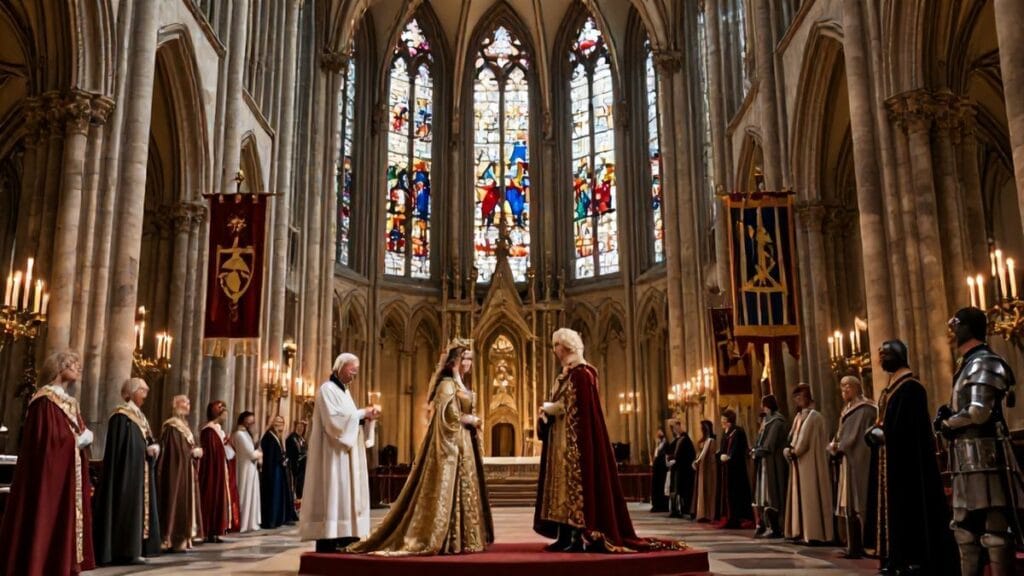
On the morning of 7 January 1114, the city of Mainz woke under a crust of ice. The Rhine moved sluggishly below its frozen banks, and smoke from a thousand hearths lay low over the rooftops. Yet by the cathedral, the cold air crackled with a different energy: bells pealed, banners snapped in the wind, and the stone forecourt filled with armored men, court officials, clergy in rich vestments, and townspeople craning their necks for a glimpse of history. At the heart of this spectacle, almost swallowed by the fur-lined cloaks of her attendants, stood a girl of barely twelve years old—Matilda of England, daughter of King Henry I.
She had been dressed that day not as a child but as an empress-in-waiting. Gold thread, painstakingly stitched by anonymous hands, caught the weak winter light in a shimmer that made her seem almost unreal. The veil that framed her face, imported silk dyed with precious pigments, covered hair that had once been combed by her mother, Queen Matilda, in the quieter mornings of an English court long behind her now. The girl did not look like a conqueror of kingdoms; she looked, if the chroniclers are to be believed, small, pale, and grave. Yet around her, men spoke of alliances, of Church and Empire, of the balance of power between the papacy and the rulers of Christendom. The marriage of matilda of england to Henry V was no private vow but a public instrument, an event shaped by decades of conflict and ambition.
Inside Mainz Cathedral, candles crowded the altars, their flames bending in the draughts that slipped through the stone. The vaults, already ancient by the standards of the time, had seen coronations, councils, synods, and the solemn oaths of emperors. Now they prepared to witness what seemed, on its surface, the solemn union of bride and groom, but in truth was a negotiation set to music and prayer. The bridegroom, Henry V, Holy Roman Emperor, was a man in his late twenties—battle-tested, shrewd, burdened with the legacy of a fractious realm and a war with the Church that had shaken Europe for a generation.
In that moment, when he stepped forward to meet the girl from the western island kingdom, the clash between youth and experience, innocence and calculation, could scarcely have been sharper. Yet this was how power passed in the Middle Ages: through oaths sworn at stone altars, rings slipped onto small hands, and nuptial blessings uttered in Latin to the thunder of organ and choir. The people of Mainz, jostling for a view at the doors or packed into the side aisles, may not have known every nuance of imperial policy, but they understood that the day’s ceremony had meaning far beyond romance. They understood that when a king’s daughter married an emperor, the world itself seemed to tilt, ever so slightly, on its axis.
But this was only the beginning of Matilda’s story, and of the complex tale of how this union would shape not just her own fate, but the future of England and the Empire.
From Royal Nursery to Imperial Betrothal: Matilda’s Early Years
To understand how a child could stand at the center of such a moment, we must return to the quieter, more intimate world of her birth. Matilda of England entered life in 1102, probably in the royal palace at Winchester or in London, a product of the still-young Norman dynasty that had seized England only a generation earlier. Her father, Henry I, was the youngest son of William the Conqueror, a man determined to consolidate his hold over a restive kingdom and project his power across the Channel to Normandy and beyond. Her mother, Matilda of Scotland, brought with her the aura of the old Anglo-Saxon royal line and the pious reputation of her upbringing at the Scottish court and English religious houses.
In these early years, Matilda’s life would have looked, to an outside observer, almost sheltered. She was surrounded by the routines of a royal household: the murmur of prayers, the rustle of embroidered cloth, the clatter of servants, the coming and going of clerics and courtiers. Tutors instructed her in Latin prayers and the basics of reading; she would have absorbed stories of saints and kings from the lips of both clerics and the women around her. Yet even in the royal nursery, politics seeped in. Visitors from Normandy, Flanders, and Anjou came seeking favor. The name of the pope was spoken with a mixture of reverence and frustration. The marriages of other noble children were discussed, weighed, and agreed upon in the same rooms where Matilda played.
Henry I did not raise his daughter for a quiet life. From the beginning, he understood that his children—legitimate and otherwise—were tools of policy as much as heirs of his blood. He had sons and daughters born outside wedlock whom he would later marry into baronial families, weaving a net of loyalty across his realms. But Matilda, legitimate daughter of a reigning king and queen, was different. She carried in her veins the legacy of both Norman conquerors and English kings of old. She would not be bartered to a mere count or duke. From the moment her birth was announced, possibilities must have flickered before Henry’s mind: a match with France, perhaps, or with one of the powerful German princes, or even—if fortune favored him—with the empire itself.
The chronicles rarely pause to show us Matilda the child: the girl who might have climbed the worn stone steps of royal chapels, who perhaps listened wide-eyed to sailors’ tales of the North Sea storms, who watched with curiosity as scribes bent over their parchment. Yet we can imagine, from the patterns of her later life, a mind attuned early to ceremony and language, to the unspoken hierarchies of the hall and the church. The marriage of matilda of england, when it came, would demand from her the ability to move between cultures, to speak and think in several tongues, to read not only texts but people. Those skills had their roots in the subtle education of her youth.
Her mother, Queen Matilda, was known for her intelligence, piety, and involvement in the king’s affairs. Monastic chronicler William of Malmesbury praised her as a woman “remarkable for her prudence and beauty,” a queen who patronized churches and who, in some accounts, acted as a mediator between King Henry and his more rebellious subjects. Growing up under such a figure, young Matilda absorbed a living example of queenship: a model in which a woman could be more than a decorative presence at court, instead a counselor, patron, and symbol of dynastic continuity. That example would leave its mark when Matilda, much later, refused to accept a passive role in her own struggle for the English crown.
In this domestic world, still reeling from the shock of Norman conquest but slowly knitting itself together, news arrived that would change the course of the girl’s life: Henry I had opened negotiations with the Holy Roman Emperor.
Henry V and the Restless Empire He Ruled
While Matilda took her first faltering steps across the stone floors of English palaces, another child, far away in the German lands, was learning his own lessons in power. Henry V, born around 1081 or 1086, had grown up in a world dominated by two towering forces: his father, Henry IV, and the papacy that contested the emperor’s right to control the Church within his realms. The Empire over which the Salian dynasty ruled was immense in theory—stretching from the North Sea down to Rome—but restless and fractured in practice. Dukes, bishops, and city councils all jostled for influence; loyalties were loosely bound by oath and easily broken.
Henry IV’s reign had been defined by the thunderous clash known as the Investiture Controversy. At stake was the question of who held the right to invest bishops with the symbols of their office: the pope or the emperor. Spiritual independence versus imperial oversight; papal tiaras versus royal crowns. The conflict saw Henry IV excommunicated, forced to stand barefoot in the snow at Canossa in 1077, begging the Pope for absolution in a scene that imprinted itself on Europe’s memory. Though he later regained power, his authority emerged permanently tarnished, and his relationship with his eldest surviving son, Henry V, was corroded by suspicion.
By 1105–1106, the younger Henry had rebelled against his father, encouraged by princes and churchmen who saw in him a fresher alternative. He promised to reconcile with the Church, to end the abuses that had stained his father’s reign. Instead, when he finally deposed Henry IV and took up the crown himself, Henry V quickly discovered how hard it was to steer between papal demands and the hard realities of imperial politics. He needed bishops loyal to him to govern the sprawling territories; he needed money from royal and ecclesiastical lands to fund his campaigns; he needed the outward show of divine favor to bolster his legitimacy.
By the time Henry V looked westward and considered an alliance with England, he was a man fighting on several fronts. He had marched into Italy to secure his imperial coronation; he had clashed again with Pope Paschal II; he had been excommunicated and reconciled, then excommunicated yet again. His early hopes of an easy solution to the investiture dispute had turned sour. He was learning, in the hardest way, that the emperor of the Romans—so exalted in name—was often constrained more tightly than many lesser lords.
Within this tangled context, marriage became a tool of survival and ambition. A bride from England promised more than a companion: she promised money, ships, and the prestige of an alliance with a king who ruled a rich, compact realm and who had shown himself an astute manager of nobles and clergy. The marriage of matilda of england to Henry V would provide the emperor with a handsome dowry and, perhaps more importantly, an anchor in the politics of the western seaboard, a counterbalance to the power of France and the papacy.
For Henry V, whose adult life had been shaped by betrayals within his own family and the Church’s deep mistrust of his office, the idea of binding himself to a young, unblemished princess may have held a symbolic appeal as well. She represented a fresh connection, a new chapter, a chance to craft an image of pious imperial rule blessed by God and reinforced through dynastic legitimacy. If emperors were “vicars of Christ on Earth,” as some ideologues insisted, then what better than a marriage celebrated in a great cathedral, witnessed by the leading clergy and nobles of Germany, and underwritten by an alliance with another crowned head?
Diplomacy Across the Channel: How the Match Was Made
The road to Mainz did not begin in a single proposal but in a long diplomatic dance. Sometime around 1109–1110, as Henry V consolidated his rule and King Henry I of England tightened his grip on Normandy, envoys moved back and forth across the Channel and through northern Europe. Letters carried not only greetings but carefully weighted suggestions: a royal daughter of England might be offered in marriage; an emperor might signal his openness; informal pledges might precede formal betrothals.
Behind the scenes, bishops played a critical role. The medieval Church, far from being an isolated spiritual sphere, was a key arena of politics. English bishops friendly to Henry I, such as Bishop Roger of Salisbury, who was rising as the king’s administrative mastermind, maintained contact with their counterparts in the Empire. Imperial bishops, valuing an alliance that might strengthen Henry V’s hand against the papacy, supported the match. Papal representatives watched cautiously, worried that a closer tie between king and emperor might embolden secular rulers in their disputes with Rome.
Henry I’s calculations were as sharp as his reputation suggests. The Norman monarchy he had inherited was powerful, but far from unassailable. He had quarreled bitterly with his elder brother Robert Curthose over Normandy and had only secured control of the duchy after battle and imprisonment. Across his Channel-facing counties, castles bristled with the flags of barons whose loyalty had to be continually purchased or coerced. An alliance with the Holy Roman Emperor promised more than prestige: it signaled to his nobles that their king spoke as an equal to the most august ruler in Christendom and that he could bring transcontinental weight to bear in his disputes.
For the imperial side, the dowry was no small matter. Henry I pledged a substantial sum of silver and possibly future payments from English revenues—hard cash that Henry V needed desperately to pay mercenaries, reward allies, and fund his Italian expeditions. Some sources suggest that the emperor effectively mortgaged part of his political future on the English girl’s dowry, drawing it down in stages over the course of the marriage. The marriage of matilda of england thus functioned as a financial transaction as much as a union of hearts or bloodlines.
By 1110, when Matilda was around eight years old, the arrangement had moved from possibility to certainty. Envoys arrived at Henry I’s court with formal proposals and sealed charters. Chroniclers such as Orderic Vitalis note the solemnity with which King Henry accepted them, and the mixture of pride and sorrow that must have attended the moment when he consented to send his daughter away. In an age when royal children were primarily instruments of policy, there was nonetheless a human cost: a father and mother agreeing to part with a child long before she had reached adulthood, to a land whose language she did not yet speak, to a husband more than twice her age.
Betrothal came first, ceremonially binding the two without yet completing the sacrament of marriage. In 1110, Matilda was sent to the Empire, effectively surrendered into Henry V’s keeping as both ward and future wife. The eight-year-old girl who left England that year would not see her homeland again for nearly two decades. The chronicles record the event with typical medieval brevity, but between their lines lies a story of partings—of a queen blessing her daughter, of servants packing chests with clothing and books, of ships prepared to cross uncertain seas.
Journey to a New World: Matilda Crosses to the Continent
When Matilda stepped aboard the ship that would take her away from England, she was leaving behind more than family. She departed a world of Norman French and Anglo-Saxon accents, of familiar churches whose saints’ names she knew, of weather patterns and tastes and small routines that shape any childhood. Ahead lay the vast, patchwork empire of Henry V, strung together by rivers and roads like a loosely stitched cloak.
The Channel crossing itself, always at the mercy of wind and wave, must have seemed a miniature trial. Medieval ships creaked and groaned, their timbers flexing as they rode the swells. Salt spray lashed their decks. Passengers prayed to be spared storms and reefs. Below decks, chests held her trousseau: finely woven garments, rich cloths for future ceremonial use, perhaps a few treasured objects from home. Above, sailors and escorts scanned the horizon for land—or for pirates.
On reaching the Continent, probably landing in a Norman or Flemish port, the girl was absorbed into a carefully choreographed procession. She traveled inland along roads that had borne Roman legions centuries before. By riverboat and horseback, her retinue wound through towns whose churches and townhouses must have seemed both strange and familiar. In each, local magnates hosted the emissary of the English king, calculating what favors they might gain from her future influence at the imperial court.
For Matilda, these journeys were a mobile classroom. She heard dialects shift from one region to another; she saw the political geography of the Empire not as abstract lines on a map but as castles perched on hills, marketplaces humming with trade, and abbeys where monks bent over illuminated books. Somewhere along the road, she likely met Henry V in person for the first time—this man who was to be her guardian and, in due course, her husband.
Contemporary accounts of Henry’s character vary, colored by the politics of their authors. Some imperial-friendly chroniclers emphasize his dignity, his sense of order, his commitment to the majesty of the imperial office. Church-aligned writers paint a harsher picture, stressing his campaigns against the pope and portraying him as a stern, even ruthless, ruler. To a child like Matilda, he must have been imposing in either case: tall, armored, surrounded by retainers, every movement signaling that here was the center of a very different world.
In the years between her arrival and the final ceremony in Mainz in 1114, Matilda lived effectively as an imperial princess. She was educated in the languages of the court—Latin for church and law, various forms of German for daily interactions, perhaps Italian for southern campaigns. She learned the subtle protocols that governed contact between emperor and princes, between empress and bishops. The marriage of matilda of england was still, technically, incomplete, but in practice her transformation into an imperial figure had already begun.
It’s astonishing, isn’t it, that in an age with no concept of adolescence as we know it, an eight-year-old could be treated as both a pawn and a potential political player? Yet this was Matilda’s reality. As the years passed, she came to understand the deep fissures running through Henry’s realm: the grievances of Saxon nobles, the ambitions of rival dynasties, the ever-present tension with Rome. These lessons would later serve her well when England itself descended into civil war.
The Stage Is Set in Mainz: City, Cathedral, and Ceremony
By late 1113, preparations for the wedding in Mainz gathered pace. The choice of Mainz was itself heavy with symbolism. As one of the oldest and most important archbishoprics in the German lands, the city was a spiritual and political hub. Its archbishop was traditionally archchancellor of Germany and a kingmaker in imperial elections. To marry there was to wrap one’s union in the legitimacy of both Church and Empire.
Mainz, perched on the banks of the Rhine, thrummed with anticipation as news of the impending ceremony spread. Merchants eagerly prepared goods for the crowds: cloth dyed in bright colors, leatherwork, food and drink for feasting, small religious tokens that might serve as souvenirs of such a grand event. The city’s Jewish community, already well established along the Rhine, may have watched the preparations with a mixture of curiosity and wary distance, keenly aware that great Christian gatherings could be times of both opportunity and danger.
In the cathedral, liturgical planning proceeded in earnest. Clerics selected appropriate readings and chants; choirs rehearsed the musical settings that would accompany the nuptial mass. Scribes prepared charters that would be issued to commemorate the occasion: confirmations of privileges, perhaps grants to monasteries or to the city itself. These documents, heavy with wax seals, formed the legal echo of the spoken vows, tying the personal act of marriage to the larger fabric of imperial governance.
The emperor’s household officials arranged lodging for the influx of nobles, envoys, and dignitaries. Among them were surely representatives from England, sent by Henry I to witness the fulfillment of the agreement he had forged years before. They brought gifts, tokens of English craftsmanship and wealth, to be displayed in the imperial halls. For the English observers, the event was also an intelligence-gathering mission: a chance to gauge the strength of Henry V’s position, to listen to the undercurrents of rumor in the corridors, to see which princes were conspicuously present—or absent.
Matilda herself would have been at the center of intense personal and ceremonial preparations. Her garments for the day were chosen with care, combining English and imperial fashions to project both her origin and her new status. Jewels, likely part of her dowry, were arranged to catch the eye: pearls from distant seas, colored stones from alpine mines. The marriage of matilda of england was to be seen and remembered as an event that radiated authority. Every stitch, every polished surface, every candle flame contributed to that visual grammar.
The Wedding Day: Ritual, Spectacle, and Silent Fears
On 7 January 1114, the cold could not quell the heat of bodies pressed together in the cathedral’s nave. Eyewitness descriptions are sparse, but by piecing together liturgical practices and chronicle entries, we can reconstruct the broad contours of the day. Henry V, in ceremonial robes that signaled both his kingship and his imperial rank, entered to the thunder of organ and the sonorous voices of the choir. Matilda, escorted by high-ranking lords and ladies, followed in a procession suffused with incense and candlelight.
Before the altar, beneath painted saints and looming crucifixes, the couple exchanged vows according to the rites of the time. These vows emphasized not romantic love but duty, fidelity, and alliance. The priest—or perhaps the archbishop himself—blessed the union, joining not only two persons but two realms in the eyes of God. Rings were exchanged, their circular perfection a symbol of eternity. Hands were joined, sometimes under a ceremonial cloth. Bread and wine were consecrated, linking their new bond directly to the sacrament of the Eucharist.
Behind the celebrations, however, lay unspoken fears. Matilda was still very young, even by medieval standards, for the consummation of marriage, and custom often allowed a delay until the bride matured further. The expectation of heirs loomed over the couple from the very instant they emerged from the church. In whispered conversations among nobles that day, one question underpinned all others: would this union produce a child who could bind England and the Empire more tightly together, perhaps even one day ruling both?
And then there was the matter of the Church. Henry V, though outwardly reconciled for the occasion, remained an excommunicated ruler in the eyes of some churchmen, his conflict with Rome unresolved. The wedding mass, celebrated with full splendor, did not erase that stain. Some priests might have muttered that the sacrament itself was overshadowed by the emperor’s defiance. Others, more pragmatic, saw in the marriage an opportunity for renewed negotiation with the papacy, hoping that English influence might temper Henry’s stance.
Once the church ceremony ended, the city outside erupted into feasting. Tables groaned under roasted meats, loaves of bread, and barrels of wine. Minstrels played, jugglers performed, and the streets filled with noise and movement. For common townspeople, the day was a rare spectacle: a chance to see their emperor and his new bride, to taste the excess of court life in small, fleeting bites. For the couple at the center of it all, the festivities may have felt overwhelming, the clamor barely covering the private reality that two people who scarcely knew each other were now bound for life.
Yet behind the celebrations, a new chapter had opened. The marriage of matilda of england was now a fact accomplished, a sacrament sealed by ritual and public acclaim. Whatever lay ahead—in politics, in personal happiness or sorrow—would play out under the shadow of that January day in Mainz.
An English Empress in a German Court
After the candles burned low and the feasting ended, Matilda’s true work began. As empress-consort, she occupied a role both highly visible and curiously constrained. She was expected to accompany Henry on major ceremonial occasions, to intercede with him on behalf of churches and nobles, to embody piety and dynastic legitimacy. Yet the machinery of power remained largely in male hands: emperors, dukes, bishops, and abbots.
Even so, Matilda quickly made her mark. Imperial charters from the following years begin to mention her presence, her name appearing alongside Henry’s in grants and confirmations. This was no mere formality. When an empress confirmed a charter, she lent to it a second seal of legitimacy, an assurance that the royal household as a whole supported the transaction. In an age when written records were precious and contested, this additional layer could matter a great deal.
Matilda also cultivated relationships with monastic houses and cathedrals. Donations made in her name or at her request spread her reputation as a pious benefactor, a guardian of the Church even while her husband’s relationship with the papacy remained fraught. One monastery might remember her as the giver of a silver chalice; another, as the sponsor of a new chapel or liturgical book. These acts were more than generosity; they were a form of soft power, weaving a network of spiritual obligation that might, at need, translate into political support.
The court itself was a moving world. Henry and Matilda traveled relentlessly, as imperial tradition required, holding assemblies (diets) in different regions, hearing petitions, and reaffirming bonds with local elites. From the Rhineland to Saxony, from Swabia to the alpine passes leading toward Italy, the empress’s presence signaled continuity. When she processed into a cathedral, when she stood beside Henry as he dispensed justice, she embodied the idea that rule was not the personal whim of a single man but part of a broader, divinely ordained order in which family and sacrament played central roles.
The marriage of matilda of england thus helped to stabilize Henry’s image at a time when his political course was anything but smooth. Chroniclers loyal to the Empire could point to the imperial couple as a symbol of unity, an echo of the great Christian royal pairings of earlier centuries. Yet for Matilda herself, the years after Mainz were also a time of loneliness and adaptation. She was far from her birth family; her mother died in 1118, and her brother William in 1120, both losses that must have reached her in the form of sparse, formal news, tinged with grief she had to endure in a foreign land.
The Investiture Controversy and Matilda’s Political Education
To live as Henry V’s wife was to live inside one of the central conflicts of the age. The Investiture Controversy, though often depicted in textbooks as a dry constitutional dispute, was in practice a rolling crisis that touched nearly every aspect of political and spiritual life. Bishops were not only pastors of souls but major landholders and powerbrokers. Whoever controlled their appointment controlled a significant portion of the realm’s machinery.
Henry V had inherited a tangle of promises and grudges from his father’s clashes with Rome. Early in his reign, he had appeared conciliatory. In 1111, he traveled to Rome seeking imperial coronation and struck an agreement with Pope Paschal II that would have renounced lay investiture in exchange for a sweeping surrender of Church lands to the crown. When the Roman clergy rebelled against this bargain, chaos ensued; Henry ultimately seized the pope, forced concessions, and left Italy crowned but excommunicated and mistrusted.
Matilda joined this drama more fully after their marriage. She witnessed, at close range, the delicate balancing act Henry attempted: negotiating with German bishops, placating princes who feared papal interference, and seeking pathways back to papal favor without surrendering the core of imperial prerogatives. In councils and diets, she watched arguments unfold in Latin and German, with canon law and custom invoked like weapons.
One can imagine her sitting at the margins of such gatherings, listening as bishops quoted Gregory VII’s fierce letters on papal authority, or as imperial lawyers cited ancient Roman practices to defend the emperor’s rights. The marriage of matilda of england placed her at the intersection of these traditions: the English Church under Henry I had its own complicated relationship with Rome, one that balanced royal control with a façade of papal obedience. Matilda could draw on that background to understand the stakes and the possible compromises.
In 1122, the conflict reached a turning point with the Concordat of Worms, a compromise between Henry V and Pope Calixtus II. The emperor renounced the right to invest bishops with ring and staff—symbols of spiritual authority—but retained a place in their election and the right to grant secular regalia. It was an intricate solution, preserving the dignity of both sides while acknowledging limits on imperial power. Matilda, by then an experienced empress in her twenties, must have recognized its significance. The world in which she had come of age was one of open warfare between throne and altar; now, a fragile peace had been achieved through negotiation rather than conquest.
These experiences would later inform her own approach to governance. When, after Henry V’s death, she returned to England and pressed her claim to the throne, Matilda carried with her not only the prestige of an imperial title but a hard-won education in the arts of compromise, legal argument, and symbolic politics. The girl who had been sent to Mainz to secure her father’s foreign policy had become a woman seasoned in the great contest over the soul of medieval government.
Power without Heirs: The Personal Trials of the Imperial Marriage
Yet even as Matilda’s political stature grew, a private shadow lengthened over her marriage: the absence of children. For a royal couple in the twelfth century, fertility was not merely a personal matter; it was a litmus test of divine favor and a cornerstone of dynastic strategy. Courtiers watched the empress’s body as closely as they followed the emperor’s campaigns. Every reported illness, every extended seclusion, could spur rumors of pregnancy—or of failure.
Years passed and no child appeared. In the whispered conversations of the court, blame may have drifted from one spouse to the other, though such judgments were risky when applied to an emperor. Some might have recalled biblical figures like Sarah and Elizabeth, who bore children late in life; others, more cynical, may have quietly resigned themselves to the reality that this marriage, for all its splendor, would likely remain childless.
For Matilda, the emotional toll must have been profound. She had been raised with the expectation that she would be a mother of kings, that her body would be the vessel through which alliances were cemented and bloodlines extended. Instead, she found herself an empress without an heir, her role as dynastic lynchpin undercut. The marriage of matilda of england, once envisioned as the potential foundation of a joint Anglo-Imperial lineage, seemed destined to remain an alliance of adults, not generations.
Some historians have speculated that this childlessness may have influenced Henry V’s willingness to grant Matilda a degree of independence and respect unusual for a consort. With no direct imperial heirs to complicate matters, their partnership could focus more squarely on governance and diplomacy. Whatever the truth, the records that survive show an empress increasingly involved in formal acts of rule, her name appended to charters and treaties, her status as consort slowly shading into that of political collaborator.
The lack of children also altered the long-term calculations of both courts. In England, Henry I gradually realized that, barring a miracle of late fertility or the production of legitimate sons by another marriage, his dynastic hopes would have to rest not on imperial grandchildren but on Matilda herself as heir. In the Empire, princes eyed the question of succession with growing interest. When Henry V died, who would claim the throne? Without a direct son, the path was open to rivals, making every political misstep potentially fatal.
Between Two Crowns: Anglo-Imperial Alliances and Rivalries
The public effects of the marriage extended far beyond the couple’s personal life. In the years after 1114, relations between England and the Empire took on a new texture. Diplomatic correspondence flowed more easily. English clerics and nobles found a warmer reception at the imperial court, their petitions perhaps eased by the fact that the empress spoke their language and remembered their homeland. Imperial envoys, in turn, could count on Matilda’s presence as a symbol of good faith when they approached Henry I.
Yet the alliance was never simple friendship. England and the Empire both had to reckon with France, whose Capetian kings were slowly extending their power from the Île-de-France into surrounding regions. For Henry I, the marriage of matilda of england to Henry V served as a counterweight to French ambitions, a reminder to King Louis VI that the English monarch could call on the prestige and, at least in theory, the military support of the emperor. For Henry V, the English connection offered a tool in his dealings with Lotharingian and Burgundian nobles, who often looked both east and west when calculating their loyalties.
Conflicts within the Empire itself sometimes reverberated back across the Channel. If a German prince who had supported Henry V fell out of favor, he might seek refuge or new alliances in the west. If Henry I found himself at odds with a French or Flemish neighbor, he might hint that imperial displeasure could follow any attack on English interests. The web of interlocking threats and promises thickened, woven ever tighter by the fact that the same woman sat at the heart of both realms’ dynastic plans.
There were also ecclesiastical dimensions. English churchmen followed the progress of the investiture negotiations with keen interest. A compromise acceptable to the emperor and pope might provide a template for settling similar disputes in England. Conversely, any papal sanction or censure directed at Henry V had to be weighed carefully by Henry I. Support for his son-in-law could appear to Rome as tacit endorsement of imperial excess; too much distance might be read in Germany as a slight to the empress.
In this uneasy dance, Matilda’s presence acted as a quiet stabilizer. She wrote letters home—few of which survive, but their existence is inferred from later references—carrying information and emotional nuance that no formal envoy could convey. She received English emissaries in private as well as in public, allowing problems to be aired candidly before they reached the level of official negotiation. The marriage of matilda of england thus functioned as a living channel of communication, bridging not only lands but sensibilities.
Widowhood and Return: From Empress to Heiress of England
In 1125, the imperial edifice that had defined Matilda’s adult life suddenly cracked. Henry V, aged about forty, fell ill—likely with cancer or a wasting disease—and died at Utrecht on 23 May. His death sent a shockwave through the Empire. With no legitimate heirs, his closest male relative, Frederick of Hohenstaufen (later known as Frederick II of Swabia), and other princes began maneuvering for advantage. The imperial crown, so jealously guarded by the Salian line, was now up for election.
For Matilda, the loss was both personal and political. Whatever the nature of their private relationship—something the sources leave frustratingly opaque—she had shared more than a decade of life and duty with Henry. Now she found herself a widow at around twenty-three years old, bearing the title of empress but lacking a fixed power base of her own. Some suggested she might retire to a convent, a common path for highborn widows. Others floated potential remarriages within the Empire or beyond.
But events in England pulled her future in another direction. In November 1120, five years before Henry V’s death, disaster had struck King Henry I’s plans. His only legitimate son and heir, William Ætheling, had drowned in the wreck of the White Ship off Barfleur, along with many young nobles. The tragedy not only plunged the king into grief—chroniclers report that he “never smiled again”—but also shattered the neat scheme of succession that had underpinned his reign.
In the years between the White Ship disaster and Henry V’s death, Henry I scrambled to secure his realm. He remarried, hoping for another legitimate son, but no child survived. Gradually, his attention turned back to Matilda. The empress, though childless, possessed unmatched prestige, the living embodiment of a successful, if heirless, union with the Holy Roman Emperor. As his only surviving legitimate child, she represented his best chance to keep the crown within his bloodline.
And so, after Henry V’s passing, Henry I extended an urgent summons: Matilda was to return to England. She complied, relinquishing much of her imperial property but retaining the title and dignity of an empress. When she landed once more on English shores in 1125 or early 1126, after nearly fifteen years away, she was no longer the child who had left. She walked now as a woman trained in the highest forms of statesmanship, steeped in the rituals and expectations of imperial power.
At a Christmas court in 1126, Henry I gathered his nobles and clergy and presented Matilda publicly as his heir. Chroniclers report that he required them to swear oaths acknowledging her right to succeed him should he die without a legitimate son. This, too, was a legacy of the marriage of matilda of england: the queen-in-waiting who now stood before the English barons had once been crowned empress in Mainz. Her claim was buttressed not only by blood but by the aura of empire.
The scene was unprecedented. Medieval Europe knew of powerful queens and regents, but the open designation of a woman as immediate heir to a crown was rare and controversial. Still, under Henry’s iron will, most barons complied. They bent their knees and swore, perhaps muttering reservations under their breath, but formally bound themselves to the woman who had once walked the aisles of Mainz Cathedral as a girl-bride and now returned as a would-be sovereign.
The Anarchy: How a Marriage Shaped a Civil War
Henry I died in 1135, reportedly after gorging himself on lampreys his doctors had forbidden. With his death, the fragile edifice he had built around Matilda’s succession began to crumble. While she was in Anjou, married by then to Geoffrey Plantagenet, Count of Anjou, her cousin Stephen of Blois moved swiftly. Crossing the Channel with the backing of influential nobles and the Church in London, he seized the treasury and had himself crowned king.
The oaths sworn in 1126, the carefully crafted recognition of Matilda as heir, suddenly appeared to many barons as negotiable. Some claimed they had sworn under duress; others argued that female rule was contrary to custom. The marriage of matilda of england to Henry V, once a trump card in her favor, cut two ways. On the one hand, her experience as empress gave her unmatched legitimacy and confidence. On the other, some suspects whispered that her “imperial” manner was too proud, too distant for the more rough-and-tumble politics of the Anglo-Norman baronage.
When Matilda launched her bid to reclaim the crown in 1139, bringing with her a small contingent of loyalists, England was already sliding toward chaos. Over the next two decades—a period known simply as “the Anarchy”—the kingdom fractured. Castles changed hands, allegiances shifted, and the countryside suffered. Chronicler Henry of Huntingdon wrote that “Christ and his saints slept,” a bitter verdict on the breakdown of order. Another, the anonymous author of the Gesta Stephani, painted a grim picture of warlords and burned fields.
Throughout this prolonged struggle, the skills and status Matilda had gained as Henry V’s wife remained central to her cause. She styled herself not merely as “the lady” or “the countess” but as “Empress Matilda,” a title that conveyed both her previous rank and her continuing sense of destiny. In charters issued during her control of parts of England—particularly after she captured Stephen at the Battle of Lincoln in 1141—she used formulae reminiscent of imperial documents, emphasizing divine sanction and legal continuity.
It was during these years that her imperial poise impressed and sometimes alienated her supporters. One oft-cited anecdote describes how, after Stephen’s capture, when Matilda entered London in triumph, she failed to temper her demands for money and obedience, provoking a backlash that drove her from the city. Some modern historians, such as Marjorie Chibnall, have argued that this portrayal is colored by hostile chroniclers, but it is clear that many contemporaries perceived her demeanor as haughty. One might say that the lessons of Mainz—where rulers stood above the crowd, aloof in splendor—did not always translate smoothly to a realm where shrewd compromise was vital.
Yet without the stature bestowed by her earlier marriage, would her cause have survived at all? The marriage of matilda of england to the Holy Roman Emperor had endowed her with a unique blend of authority and mystique. Even Stephen, her rival, could never entirely erase the fact that she had once been anointed and crowned in the imperial tradition. When, eventually, a negotiated settlement emerged, it was not by denying her legitimacy, but by channeling it toward the future: her son Henry, born of her second marriage to Geoffrey, would be recognized as Stephen’s heir.
Thus, the civil war that tore England apart in the 1130s and 1140s was profoundly shaped by events that had begun three decades earlier in Mainz. The oaths sworn on English soil owed some of their force to vows once spoken in a German cathedral. The woman who challenged a usurper king had been molded, decisively, by her years as a young empress.
Legacy of a Union: Law, Ceremony, and the Idea of Queenship
When historians look back on the twelfth century, the marriage of matilda of england can seem, at first glance, a prelude to the “real” drama of the Anarchy and the rise of the Plantagenets. Yet a closer look reveals that this union left deep and lasting marks on law, ceremony, and the very conception of queenship in medieval Europe.
First, there is the question of dynastic strategy. Henry I’s attempt to designate a female heir, backed by her imperial credentials, created a precedent that reverberated for centuries. Later disputes over female succession—from the claims of Isabella of France in the early fourteenth century to those that swirled around the Tudor queens—were often debated against a remembered backdrop in which powerful women like Matilda had asserted their rights, even if they did not ultimately wear the crown. Legal arguments in these later periods sometimes invoked the twelfth century as a formative time when the boundaries of succession law were tested.
Ceremonially, Matilda’s life helped blend imperial and Anglo-Norman practices. The court she knew in Germany valued elaborate processions, grand liturgical symbolism, and a strong emphasis on the sacral character of rule. When her son, Henry II, came to the throne in 1154, he inherited not only the pragmatic administrative reforms of his grandfather Henry I but also a family tradition imbued with imperial ideas of majesty. Some of the splendor that would later characterize Plantagenet kingship—its use of royal charters, its careful staging of oaths and assemblies—owed something to the imperial habits his mother had absorbed.
In terms of queenship, Matilda stood at a crossroads. She was simultaneously a wife who had failed to produce heirs in her first marriage and a woman who, in her second, became the matriarch of a dynasty that would rule England and vast swathes of France. The empress who once seemed a dead end for Salian hopes became, retrospectively, a progenitor. This duality reshaped expectations for royal women: they were seen not merely as bearers of children but as transmitters of titles, claims, and cultures.
Later chroniclers and legal minds grappled openly with these themes. The thirteenth-century jurist Bracton, for example, praised kingship as a fusion of law and lineage, a formulation that implicitly recognized women’s role in carrying and legitimizing dynastic blood. While he did not speak of Matilda directly, his framework emerged in a world where her story was still remembered and debated.
One contemporary witness, the chronicler William of Malmesbury, writing early in Matilda’s career, had already sensed that she was no ordinary princess. In the early version of his Gesta Regum Anglorum, he describes her as a woman “of good character, of beautiful decision,” words that echo down the centuries as a testament to the impression she made even before her English wars. The fact that he, an English monk, stressed her imperial dignity shows how the marriage of matilda of england had recast her in the minds of those who had first known her only as Henry I’s little girl.
Remembering Matilda: Chronicles, Myths, and Modern Historians
How we know Matilda today is inseparable from how she was remembered—or misremembered—by those who wrote her story. The medieval chroniclers who mention her came with their own biases. Imperial writers tended to treat her with respect, noting her piety and statecraft. English churchmen were divided: some admired her persistence in claiming the throne; others, aligned with Stephen or wary of female rule, painted her as overbearing.
The anonymous author of the Gesta Stephani, hostile to her cause, describes moments when Matilda allegedly spurned the counsel of Londoners, refused customary concessions, and insisted on her own prerogatives in a tone he considered unseemly. He writes of her “insufferable pride,” a phrase that has echoed through some later depictions. Yet, as historian Marjorie Chibnall has pointed out, such descriptions must be weighed against the political interests of their authors. A woman who refused to bow, literally or figuratively, to a usurper might easily be labeled proud by those who benefited from her humiliation.
Modern historians have increasingly returned to Matilda’s imperial years as the key to understanding her later life. The marriage of matilda of england to Henry V is no longer treated as a mere prelude but as a crucible that shaped her intellect and temperament. The legal historian H. G. Richardson, for instance, noted how her charters during the Anarchy reveal an acute awareness of imperial precedents, suggesting that she consciously drew on her earlier experience to frame her authority. Biographers have explored how the emotional scars of childlessness and exile may have influenced her steadfast refusal to concede her rights in England.
Popular memory, by contrast, has often simplified her into archetypes: the “She-Wolf” or the stubborn claimant. Historical novels and dramas have alternately romanticized her marriage to Henry V as a tragic love story or dismissed it as a cold transaction. The truth, as usual, lies between extremes. It was a union negotiated by men, sealed in stone churches, and freighted with political expectations—but lived by a woman whose inner life, though partly veiled from us, can be glimpsed in the tenacity and sophistication of her later actions.
Today, as historians grow more attentive to the roles women played in medieval politics, Matilda stands out as a figure of complexity rather than caricature. The marriage of matilda of england emerges as one of those events where the personal and the political are so tightly entangled that they cannot be separated. Her walk up the nave of Mainz Cathedral on that cold January morning set in motion a chain of consequences that reached all the way to the Plantagenet empire and the legal controversies of later centuries.
And in the quiet spaces between chronicles and charters, we can almost imagine her looking back across the years—from the turmoil of civil war in England to the measured ritual of her wedding day—recognizing that both moments were chapters in a single, intricate story: her own.
Conclusion
The marriage that brought a twelve-year-old English princess to the altar of Mainz Cathedral in 1114 was more than a glittering ceremony. It was a turning point in the political life of Europe and in the personal trajectory of one of the most formidable women of the Middle Ages. Through that union, Matilda of England became not only an empress but a student of empire, learning firsthand the arts of negotiation, legal argument, and symbolic power while standing beside Henry V amid the storms of the Investiture Controversy.
Childless, she might easily have slipped into obscurity after her husband’s death, remembered only as a minor figure in imperial genealogies. Instead, the experience and prestige she gained from the marriage of matilda of england made her the natural heir to Henry I’s troubled realm and set the stage for the bitter civil war that followed his death. Her imperial title lent weight to her claims; her training gave her the resolve to press them against daunting odds. The foundations of the later Plantagenet dynasty—so central to English and European history—were laid, in part, by a woman who had once walked the corridors of imperial palaces as a foreign bride.
In tracing this story from the royal nursery to the wintry streets of Mainz, from imperial chapels to the battle-scarred fields of England, we see how dynastic marriages in the Middle Ages were never mere footnotes. They were levers by which kings and emperors sought to move the world, and they often exacted a heavy price from the women at their center. Matilda’s life, shaped and reshaped by her marriage to Henry V, reminds us that the great turning points of history are frequently written not only in treaties and battles, but in the quiet endurance of those who are asked to bear crowns.
FAQs
- Who was Matilda of England?
Matilda of England, also known as Empress Matilda, was the daughter of King Henry I of England and Queen Matilda of Scotland. Married first to Henry V, Holy Roman Emperor, and later to Geoffrey of Anjou, she became a central figure in the English succession crisis known as the Anarchy. Her son by her second marriage, Henry II, founded the Plantagenet dynasty. - Why was the marriage of Matilda of England to Henry V important?
The marriage of matilda of england to Henry V in 1114 forged a powerful alliance between England and the Holy Roman Empire, strengthening Henry I’s position against both French rivals and internal opposition. It also gave Matilda invaluable political training and prestige, which later underpinned her claim to the English throne after her brother’s death and her father’s decision to name her his heir. - Did Matilda and Henry V have any children?
No, the union between Matilda and Henry V was childless. Their lack of offspring meant the Salian imperial line ended with Henry V’s death in 1125, and it forced Henry I of England to rethink his dynastic plans. This childlessness heightened the importance of Matilda herself as heir and contributed to the later conflict over the English crown. - How did Matilda’s imperial marriage affect the English civil war (the Anarchy)?
Her years as empress shaped her claim and her conduct during the Anarchy. She returned to England as “Empress Matilda,” a title that set her above ordinary noblewomen and even above many male rivals. The authority, legal experience, and ceremonial habits acquired during her marriage of matilda of england to Henry V colored her leadership style, both helping to legitimize her cause and, in some eyes, making her seem imperious. - What role did the Church play in Matilda’s marriage to Henry V?
The Church was deeply involved because the wedding occurred during the Investiture Controversy, a major struggle between secular rulers and the papacy over control of ecclesiastical appointments. Bishops promoted the match as a way to stabilize Henry V’s position, and the grand cathedral ceremony at Mainz projected an image of harmony between Empire and Church—even though underlying tensions with Rome remained unresolved for years. - Did Matilda ever become queen of England?
Matilda never achieved a universally acknowledged coronation as queen of England, though she came very close. During the Anarchy she captured King Stephen and briefly controlled much of the kingdom, issuing charters and acting as ruler. However, opposition in London and renewed fighting forced her to withdraw. A later compromise recognized her son Henry as Stephen’s heir, effectively securing the throne for her line rather than for herself personally. - How do we know about the events surrounding Matilda’s marriage?
Our knowledge comes from medieval chronicles, royal charters, and later legal and historical writings. Chroniclers such as Orderic Vitalis, William of Malmesbury, and the author of the Gesta Stephani provide narrative accounts, though often with partisan biases. Imperial and English charters that include Matilda’s name corroborate her presence at key events and reveal how she was integrated into governance. - What happened to Matilda after Henry V died?
After Henry V’s death in 1125, Matilda returned to England at her father’s summons and was declared his heir. She later married Geoffrey of Anjou to secure support on the Continent. Following Henry I’s death, she fought a prolonged civil war against her cousin Stephen for the English throne, eventually securing recognition of her son Henry as Stephen’s successor. She spent her later years in Normandy, advising her son once he became Henry II. - Why is Matilda sometimes called “Empress” even after leaving the Empire?
Once crowned, the title of empress remained part of her identity for life. In medieval political culture, such titles were powerful symbols of legitimacy and prestige. Even in England, far from the Rhineland and Rome, “Empress Matilda” evoked her earlier consecration in Mainz and linked her to the wider Christian world, reinforcing the seriousness of her claim to rule. - How has modern scholarship changed our view of Matilda’s marriage?
Modern historians emphasize that the marriage of matilda of england was central, not peripheral, to her story. Rather than seeing it as an early, irrelevant episode, scholars now highlight how her imperial experiences shaped her political style, her understanding of law and ceremony, and the way contemporaries perceived her. This shift has helped move Matilda from the margins of kings’ biographies into focus as a major political actor in her own right.
External Resource
Internal Link
Other Resources
- Encyclopaedia Britannica – general search for the exact subject
- Google Scholar – academic search for the exact subject
- Internet Archive – digital library search for the exact subject

