Table of Contents
- A Winter Day in Compiègne: The Last Hours of a Frankish King
- From Warrior Prince to Sole Ruler: The Making of Chlothar I
- A Kingdom of Brothers: Partition, Blood, and Reluctant Unity
- The Royal Court at Compiègne: Power, Faith, and Fear in 561
- The Death of King Chlothar I: A November Night That Changed Europe
- Succession Without a Script: The Four Sons and the Fracturing of Power
- Queens, Bishops, and Warriors: The Human Drama After the King’s Passing
- The Church and the Crown: Sanctity, Sin, and the Memory of a King
- The People’s Kingdom: How Common Folk Lived Through a Dynastic Crisis
- Burial and Remembrance: From Compiègne to Saint-Médard of Soissons
- From Unity to Fragmentation: The Political Legacy of Chlothar’s Final Breath
- Bloodlines, Vengeance, and Inheritance: The Merovingian Family Curse
- Chroniclers and Legends: Gregory of Tours and the Shaping of Memory
- Long Shadows: How 561 Prepared the Ground for the Carolingians
- Historians at Work: Interpreting a King’s Death Fourteen Centuries Later
- Echoes of Compiègne: Geography, Landscape, and the Stage of Power
- Conclusion
- FAQs
- External Resource
- Internal Link
Article Summary: On 29 November 561, in the royal residence of Compiègne, the death of king chlothar i brought to an abrupt end the last unified rule over the Frankish kingdoms by a son of Clovis. This article follows his life from ambitious prince to hardened conqueror, then slows to linger over his final days, his last decisions, and the quiet but seismic moment of his passing. It reconstructs the political geography of the Frankish realms, the atmosphere of his itinerant court, and the fears and hopes of bishops, queens, warriors, and peasants as power shifted overnight. The narrative explores how the death of King Chlothar I shattered a fragile unity, triggering new partitions, rivalries, and wars among his sons. It also examines the role of the Church in sanctifying his memory, while chroniclers like Gregory of Tours preserved—and sometimes reshaped—the story for later generations. Through careful historical analysis woven into a cinematic narrative, the death of king chlothar i emerges not as an isolated event, but as a hinge between the world of Clovis and the future dominance of the Carolingians. In tracing these threads, the article shows how a single winter night in Compiègne helped redraw the map of early medieval Europe.
A Winter Day in Compiègne: The Last Hours of a Frankish King
On a chill late autumn day in the year 561, mist clung low over the forests and marshes around Compiègne. The Oise River moved sluggishly, its surface a dim mirror for a sky the color of iron. Within the timbered and stone buildings of the royal villa, braziers smoked, dogs stirred in the rushes on the floor, and servants moved with uncharacteristic quiet. Something was happening, something that stilled even the coarse laughter of warriors and the usual bustle of petitioners: King Chlothar I was dying.
The royal residence at Compiègne was not a palace in the later sense, but a fortified complex—halls, chapels, storerooms, stables—built as much for movement and war as for comfort. The king’s household, always half in motion across the sprawling Frankish realms, had chosen this spot for a brief winter halt. Mounted messengers still clattered in and out, cloaks swirling, but their faces were drawn, wary. They brought news from Neustria, Austrasia, Burgundy, from the frontiers pressing against Saxons and Thuringians, from restless estates along the Loire. Yet the greatest news being formed that day came not from a distant border, but from the royal bedchamber.
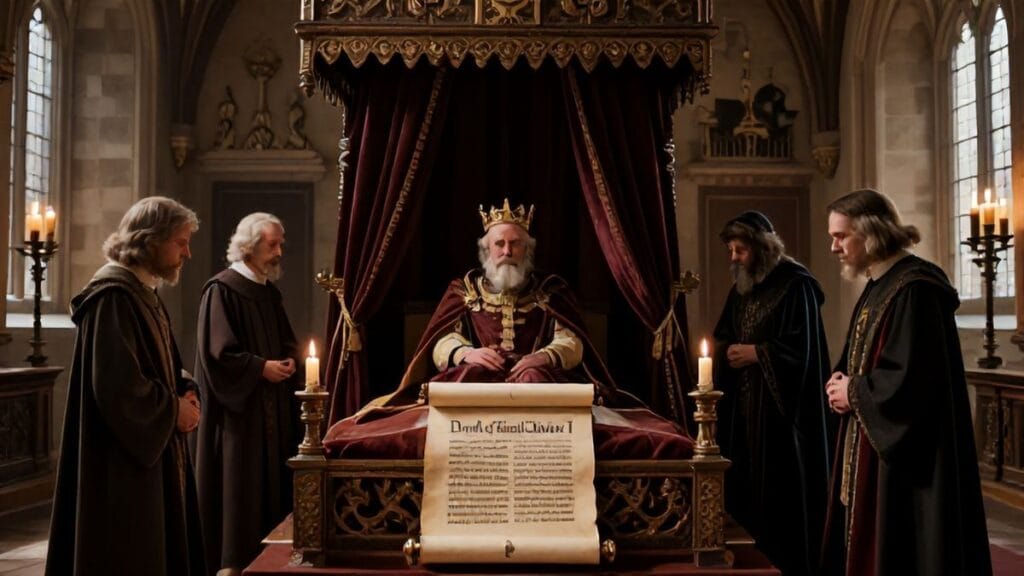
Inside, behind heavy doors and woolen hangings, the atmosphere was thick with the warmth of bodies and the cool dread of uncertainty. Chlothar, son of Clovis, had been king in one form or another for more than half a century. He had grown old in a world that rarely allowed rulers to grow old. The death of King Chlothar I would mean more than the ending of a life; it would mean the ending of a precarious unity that had briefly bound the patchworked Frankish kingdoms into a single crown.
Those gathered around his bed knew this, each in their own way. Bishops, robed in simple wool but radiating an authority beyond soldiers’ steel, murmured prayers in Latin that the king, raised in a still half-pagan age, might not fully understand but had long since learned to respect. Great nobles in furs and gleaming belt fittings shifted their weight, hands resting on sword-hilts more from habit than threat. Women, some of them widowed queens of previous kings or powerful royal consorts, hovered at the edges—eyes sharp, calculating futures that might open or close with the last beats of Chlothar’s heart.
Outside, life went on, but more quietly. Cooks ladled thin stews from iron cauldrons, stable-boys checked the horses, and smiths in the royal entourage mended a mail shirt that might never again be worn for a campaign led by Chlothar himself. The soundscape of a Merovingian court—clatter, low conversation, a sudden burst of laughter, the crackle of fires—felt muffled, as if the entire complex were holding its breath. People did not yet speak of the death of king chlothar i in the past tense, but they could feel the moment rushing toward them.
For many of those present, the king had simply always been there: Chlothar the fierce, Chlothar the cunning, Chlothar who rode with them against Saxons and Visigoths, who dealt with magnates and bishops with equal ruthlessness or favor. He was the last surviving son of Clovis I, the Frankish warlord who had taken baptism and seized a Roman province to build a new kind of kingdom. To stand in Compiègne that November was to sense a generation passing away. The world was changing again, and those who survived would have to decide whether to cling to the old order or improvise a new one in the wake of a king’s final departure.
Yet this was only the beginning of the story. To understand the shock waves of that day in 561, one must travel back through decades of conquests and betrayals, through partitions and reunifications, to see how Chlothar had become the kind of king whose death could shake the foundations of the Frankish realms.
From Warrior Prince to Sole Ruler: The Making of Chlothar I
Chlothar’s last hours at Compiègne were the culmination of a life shaped by the rough, improvisational politics of the early Merovingian dynasty. Born around 497, a few years after his father’s baptism and decisive victories, he entered a household where power was both a gift and a weapon. Clovis had forged a kingdom through war—against rival Franks, against the last remnants of Roman authority in Gaul, and against Arian Visigoths to the south. In this world, sons were not simply heirs; they were tools and potential threats.
As a young prince, Chlothar would have grown up amid the shifting smells of sweat, iron, incense, and wet wool—the sensory palette of a royal camp and villa. He watched as his father dealt with bishops one day and had rival leaders assassinated the next. The Christian faith that Clovis adopted after his victory at Tolbiac did not tame the Merovingian appetite for blood; it simply gave it new frameworks, new justifications. To the boy Chlothar, this mixture of piety and violence would have seemed natural. It was the air he breathed.
When Clovis died in 511, the great kingdom he had carved out did not pass intact to a single successor. Instead, in keeping with Frankish custom, it was divided among his four surviving sons: Theuderic, Chlodomer, Childebert, and Chlothar. Chlothar received a portion that included Soissons and lands stretching toward the north. But in the Merovingian world, a division of territory was never permanent. It was an invitation to renegotiate borders with sword and intrigue.
It is astonishing, isn’t it, how often the story of early medieval kingship turns on brothers at war? Chlothar’s rise to sole rule would only be achieved through the elimination, one by one, of these siblings or their heirs. He fought alongside them in some campaigns, particularly in the wars against the Burgundian kingdom and the Visigoths. Yet he also joined in the conspiracy that led to the murder of his own nephews after their father Chlodomer fell in battle.
Gregory of Tours, the sixth-century bishop who would later write the “History of the Franks,” provides a chilling account of that episode. After Chlodomer’s death, his sons were entrusted to their grandmother, Clotilde, who wished to see them preserved and perhaps elevated. But Chlothar and Childebert, seeing in the boys possible rivals to their own holdings, sent a message: the children must either be shorn and consecrated to the Church, renouncing royal claims, or killed. Clotilde, according to Gregory, replied in bitter desperation that she would rather see them dead than excluded from kingship. Taking her words as license, or perhaps seizing the excuse, Chlothar is said to have seized one boy by the arm and struck him down, while the other clung to Childebert’s knees until he too was given over to death.
This act, whether precisely as Gregory narrates it or not, reveals the brutal calculus of Merovingian succession. Family ties were no shield; if anything, they sharpened ambition. Chlothar, still a relatively young king, had already demonstrated a willingness to cross boundaries that even hardened warriors might hesitate to approach. The road to his later position as sole ruler over the Frankish realms was paved with the blood of kin, neighbors, and rivals alike.
Over the following decades, he expanded his holdings through campaign and inheritance. The death of Theuderic’s son Theudebert and grandson Theudebald opened Austrasia to redivision. Gradually, sometimes with the cooperation of his surviving brother Childebert, sometimes against him, Chlothar pulled more of the Frankish territories under his influence. When Childebert died in 558 without surviving sons, Chlothar at last stood alone: king over all the Franks, heir—if a tarnished one—to the united vision of Clovis.
The man who lay dying in Compiègne in 561 was thus not simply a weary elder. He was the product of half a century of war, negotiation, and ruthless consolidation. The death of king chlothar i would therefore mean not only the end of Clovis’s last son, but the end of the only experiment in reunited Frankish rule since 511.
A Kingdom of Brothers: Partition, Blood, and Reluctant Unity
To the modern eye, the frequent partition and reunion of the Frankish kingdoms seems chaotic, even self-destructive. But for men like Chlothar, division was both tradition and opportunity. The fourfold partition after Clovis’s death had carved the old Roman province of Gaul into overlapping spheres: Austrasia in the east, Neustria in the northwest, Burgundy in the southeast, and various contested regions along the Loire and beyond.
These were not neat, rational states but overlapping realms defined by personal ties, oaths, and the ability to extract loyalty from local elites. Each brother king traveled constantly, visiting estates, dispensing justice, and rewarding allies. They shared an ethnic identity as Franks and a largely common Christian faith, but they competed like rival predators over the same carcass of the old Roman West.
Chlothar navigated this world with a mix of martial skill and opportunism. When war broke out against the Burgundian rulers Sigismund and Godomar, he and his brothers saw in it not only a religious conflict—Catholic Franks against Arian Burgundians—but a chance to inherit yet another kingdom. Battles like those near Vézeronce in 524, where Chlodomer lost his life, were turning points not only on the field but in the family. Every casualty among the royal brothers shifted the balance of future inheritance.
Politically, the Merovingian pattern resembled a dangerous game of stones on a board where pieces could suddenly merge or shatter. Theuderic died and passed his lands to Theudebert. Theudebert died, his young son Theudebald succeeded briefly, then also died, opening his territories to claims by Chlothar. Childebert held his own powerful realm until 558, but even he could not produce a surviving male heir. One by one, the obstacles between Chlothar and reunited Frankish rule simply ceased to exist.
The extraordinary thing is that this “unity” was not a carefully planned constitutional outcome. It was an accident filtered through custom and violence, a directionless arrow that happened to land in Chlothar’s hand. Once he became sole king, he did not abandon the practice of itinerant kingship or the division of royal estates among his kin. He was not a nation-builder with a grand design; he was a survivor playing a familiar game on a now larger board.
Still, for three brief years from 558 to 561, most of Gaul, stretching from the North Sea to the Pyrenees and from the Atlantic to the borders of Bavaria and Thuringia, acknowledged one ruler. Far from the Roman ideal of unity under a distant emperor, this was a rough, personal dominion held together by oaths, gifts, fear, and the thin binding thread of the Catholic Church’s hierarchy.
It was this fragile, uneasy unity that existed when the royal court paused at Compiègne in late 561. The men and women around Chlothar’s bed knew their recent history well. They understood that the death of King Chlothar I would most likely trigger yet another partition, another cycle of rivalry. The pattern had been set from the moment Clovis’s lands were first broken into pieces, and no royal hand had attempted to rewrite the rules.
The Royal Court at Compiègne: Power, Faith, and Fear in 561
To grasp the atmosphere of that November in Compiègne, one must step inside the spaces where power physically moved. The royal villa sat in a landscape of forests and river crossings—ideal terrain for hunting and for controlling key routes between northern Gaul and the interior. Compiègne was not the permanent capital of a sedentary monarchy; it was one stop on a circuit of estates that allowed the king to project presence across his realm.
Inside the great hall, panels of wood and sometimes tapestry displayed symbols of rank: perhaps trophies from past campaigns, fine weapons, or gifted textiles from distant allies. At one end stood the king’s seat, less a throne than a designated place where he dispensed justice and heard petitions. In recent years, bishops had become more common sights at such gatherings, bringing charters, complaints, requests for privileges, and, most importantly, the weight of Christian moral authority.
As Chlothar’s health failed, these bishops gained influence. The earliest medieval sources are hazy about the precise nature of his final illness—perhaps a fever, a sudden internal crisis, or simply the cumulative toll of age and campaign. But they are unanimous that he turned toward the Church in his final days, ordering the foundation or endowment of monasteries, seeking a pious legacy to balance a life filled with harsh decisions.
At Compiègne, then, the atmosphere mixed holy anxiety with political calculation. Courtiers asked quietly: Which sons would receive which lands? Which bishops would align themselves with which prince? Which nobles would shift allegiance the instant Chlothar stopped breathing? The royal entourage, hundreds strong, was not united by shared idealism; it was bound by necessity, ambition, and the hope of stability.
Yet behind the calculations, fear lurked. No one knew how quickly the news would travel, how soon distant regions might shrug off imperial oversight, or how foreign enemies would react. A ruler like Chlothar embodied more than law; he was the linchpin of an entire network of obligations. Once removed, the machine might grind and scream or fall apart entirely.
In that sense, the death of king chlothar i was also a test of the Frankish political order. Could it survive the loss of its central figure without descending into chaos? The answer would depend less on formal institutions—still rudimentary—and more on personalities: the four sons who now circled the dying king’s bed in body or in thought, each considering how the coming days and weeks might shape their futures.
The Death of King Chlothar I: A November Night That Changed Europe
As November 29, 561, darkened over Compiègne, the cold crept more insistently through gaps in the walls and under doors. Oil lamps flickered in the hallways; the chapel bells, if they rang, would have sounded dull against the heavy sky. Within the king’s chamber, voices dropped to whispers. Attendants adjusted cloaks and furs, but no comfort could mask the frailty of the man lying before them.
According to later tradition, Chlothar had been seized by a sudden illness while traveling—perhaps a fever that worsened, perhaps a stroke. His famed vigor had eroded rapidly. The same hands that had gripped swords, reins, and scepters now trembled or lay still on the linen. He who had once ridden at the head of armies across half a continent now strained for breath in a darkened room, encircled by anxious faces.
The bishop—some sources associate the moment with local ecclesiastical figures such as the clergy of Soissons—intoned prayers commending the soul of the king to God. In Latin phrases, the petitioners begged mercy for sins known and unknown. Chlothar, who had seen churches burn in battle and had himself ordered violent acts that would appall later Christian sensibilities, now clung to the only promise available: that after confession and penance, a baptized ruler might find a more merciful judge than any he had known on earth.
Nearby, his sons—Charibert, Guntram, Chilperic, and Sigebert—waited. Whether all four were physically present is uncertain; travel over hundreds of kilometers in late autumn was not swift. Yet even if some were absent, their agents, their supporters, and their imagined futures hovered in that room. The question that hung unspoken was simple but brutal: how much of Chlothar’s authority could be inherited, and how much would die with him?
One can imagine a silence falling as the king’s breathing grew shallower, the pauses between each breath stretching into seconds that felt like hours. A servant might have brushed back the hair from his forehead; a queen or concubine might have gripped his hand. The bishop’s words flowed on, but the attention in the room narrowed to the rise and fall of Chlothar’s chest. Then, finally, the rhythm stopped.
The death of King Chlothar I—there, in that instant—was not accompanied by thunder or omens recorded in the sky. No comet streaked across the heavens in our surviving sources. Instead, it was marked by the small, human reactions that signify the end of a presence: a sob stifled, a muttered prayer, perhaps a noble stepping back as if struck. And almost at once, the machinery of succession began.
Servants closed the king’s eyes. A priest might have traced a cross on his brow. Outside, word passed from lip to lip. In the stables, someone whispered it as they tightened girths for swift riders. In the kitchens, a woman, ladle in hand, froze as the message reached her: the king is dead. For many, the emotional reaction was mixed. Sorrow, yes, but also dread, curiosity, even relief that a long twilight had finally ended.
With the death of king chlothar i, the brief experiment of reassembled Frankish unity collapsed at the level of the person. The title “king of all the Franks” would not automatically adhere to a single heir. Instead, the centrifugal forces of family custom and territorial ambition would whirl back into motion. Even as the body cooled, decisions were already being made: who would guard the treasury, who would ride to inform distant cities, who would secure the church where the king’s remains would lie.
In that moment, somewhere between the last breath and the first formal announcement, a line was crossed. The age of Chlothar ended; the age of his sons began.
Succession Without a Script: The Four Sons and the Fracturing of Power
The Frankish kingship in 561 had no clear constitutional mechanism for succession beyond custom and force. Unlike the later Capetians or the more bureaucratized Byzantine emperors, the Merovingians did not operate with written laws of primogeniture or election by fixed councils. Instead, inheritance was part tradition, part negotiation, and part raw power.
Chlothar left behind four adult sons, each already familiar with government and war: Charibert, ruling around Paris; Guntram, associated with Burgundy; Chilperic, whose interests would center on Soissons and Neustria; and Sigebert, linked to the eastern regions of Austrasia. Even before their father’s death, they had built entourages, carved out territorial bases, and cultivated alliances with bishops and nobles. In some ways, Chlothar’s final years resembled a rehearsal for the coming partition.
Within days—or even hours—of the death of King Chlothar I, these princes moved to secure their claims. Chronicles suggest that they met and divided the kingdom among themselves, following in broad outline the precedent set after Clovis’s death. Guntram received much of Burgundy; Charibert took lands in the west, including Paris; Chilperic, always ambitious, seized Soissons and other core Frankish territories; Sigebert retained Austrasia.
Yet the division was not as simple or as peaceful as a signed treaty might suggest. Each brother knew the others’ ambitions. Each understood that the pattern of the previous generation could repeat: cooperation today, assassination and war tomorrow. The map drawn after 561 was less a stable settlement than a truce line across a smoldering battlefield.
This fracturing had immediate political consequences. Cities and regions now found themselves on new borders. Bishops who had once appealed directly to a single king now weighed which prince might best defend their interests. Magnates with land in more than one sub-kingdom suddenly had to navigate conflicting loyalties or gamble on a favorite. The entire Frankish elite entered a period of negotiation, hedging their bets as they assessed which royal house seemed most likely to prevail in the long run.
For the sons themselves, the partition was both an inheritance and a provocation. Charibert’s realm included the growing prestige of Paris, giving him a symbolic edge. Guntram’s control of Burgundy brought resources from a once-independent kingdom, along with its distinctive legal traditions. Sigebert’s eastern position exposed him to frontier raids and to the influence of the old Roman cities along the Rhine. Chilperic, restless and often portrayed by Gregory of Tours as violent and impulsive, felt himself shortchanged and would soon begin campaigns to alter the settlement by force.
Thus, the death of king chlothar i ushered in not a peaceful transition but the opening of a new chapter of rivalry. The very energy that had allowed Chlothar to rise above his brothers now diffused across the next generation, ready to ignite in fresh conflicts that would scar the Frankish world for decades.
Queens, Bishops, and Warriors: The Human Drama After the King’s Passing
Political maps tell only part of the story. Behind every line drawn between Charibert’s and Chilperic’s territories, behind every contested border town, stood individuals whose lives were suddenly altered by the king’s death. Among the most influential were royal women and bishops—figures who did not formally inherit land like the sons, yet whose roles could tip the balance of power.
Chlothar’s marital history was complex even by Merovingian standards. Following in the footsteps of his father, he married multiple wives—Guntheuca, Chunsina, Radegund, and others—sometimes simultaneously, sometimes successively, often for political reasons. These unions produced children, wove alliances, and also planted seeds of future conflict. Some of the women retired into religious life, like the famously pious Radegund, who would later be venerated as a saint in Poitiers. Others remained at court, advising sons and influencing factions.
When the king died at Compiègne, these women faced a sudden shift in status. As widows of a reigning monarch, they might claim dower lands or demand protection. They might align with a particular son, seeking to secure their own position in a new court. In a world where literacy was concentrated among clerics, queens and noblewomen often exercised soft power: arranging marriages, mediating disputes, patronizing monasteries, and shaping the narratives whispered in the royal hall.
Bishops, too, were quick to interpret and act upon the new landscape. Men like Germanus of Paris and Nicetius of Trier—some contemporaries, some near contemporaries—saw in royal deaths moments to press their moral agenda and their institutional interests. The Church depended on royal support for privileges, legal immunities, and land grants; in return, kings needed bishops to sanctify their rule and to present them as Christian shepherds over a once-pagan flock.
The death of King Chlothar I therefore activated a web of episcopal maneuvering. Who would secure the goodwill of the next generation? Who would be the first to commemorate the late king in official prayers, framing his legacy as either just or cruel? Who would dare remind the new rulers of their duty to maintain Church rights amid the horse-trading of partition?
Meanwhile, the warriors—those leather-clad, mail-shirted men whose swords had been the main instrument of Merovingian policy—had to reconsider their trajectories. A retainer bound to Chlothar personally now needed to decide which of the sons to follow. Men with estates in multiple territories were particularly vulnerable; whichever choice they made might anger another prince. Their livelihoods, honor, and sometimes their lives depended on reading the winds of power correctly.
This was the human landscape into which news of the death of king chlothar i spread outward from Compiègne. It was not simply the fall of a ruler but the opening of a vast, uncertain marketplace of allegiances and memories, where queens, bishops, and warriors all jostled to define their places in the new order.
The Church and the Crown: Sanctity, Sin, and the Memory of a King
From the perspective of the Church, Chlothar’s passing posed a theological and political puzzle. Here was a king baptized into the Catholic faith, a supporter of monasteries and churches, yet also a man whose life had been marred by fratricide, ruthless campaigns, and episodes like the murder of his nephews. How should such a life be remembered from the pulpit?
In sermons delivered in the months after 561, bishops may have emphasized the mysterious workings of divine providence. The death of King Chlothar I could be framed as a reminder that even the mightiest are dust, that Christ’s kingdom is not of this world. Yet at the same time, they could hardly risk alienating his living heirs by painting him as a tyrant. The solution, refined across generations, was to present him as a flawed instrument of God’s will: a Davidic figure whose sins were grave but whose support for the Church merited ongoing prayer.
Monastic foundations tied to Chlothar’s patronage became focal points for this memory-work. The monastery of Saint-Médard at Soissons, which he had richly endowed, took on special importance as the chosen resting place for his remains. In the liturgy of such houses, the name of Chlothar would be woven into cycles of commemoration: anniversaries of his death marked by masses, almsgiving, and the reading aloud of charters.
At the same time, hagiographers and chroniclers began to position him within a longer Christian narrative. His association with Radegund, who rejected the violence of court and chose a life of asceticism, created a moral contrast that writers could not ignore. Some texts hinted that even in her withdrawal from worldly power, Radegund prayed for the souls of kings like Chlothar, interceding for those caught in the snares of power.
The uneasy dance between sanctity and sin is visible in later historical writing. Gregory of Tours, who lived through part of this period and wrote within a few decades of Chlothar’s death, records both his violent deeds and his religious acts. In one passage, he notes Chlothar’s attempt late in life to atone through almsgiving and church-building, though he does not spare criticism of the king’s earlier crimes. By preserving these tensions, Gregory exemplifies the Church’s ambivalent stance: neither wholesale condemnation nor unqualified praise.
But this was only the beginning of Chlothar’s posthumous career. Over centuries, as Merovingian memory gave way to the ideologies of the Carolingians and later dynasties, his image would be reshaped again and again—sometimes as a symbol of a crude, half-barbarian past, sometimes as a legitimate predecessor in a long line of Christian rulers over Gaul.
The People’s Kingdom: How Common Folk Lived Through a Dynastic Crisis
For the vast majority of people living in the Frankish realms, the death of a king was a distant event, felt first in rumor rather than proclamation. Peasants in small villages along the Seine, the Meuse, or the Garonne might learn of Chlothar’s death weeks or months after it happened, from a passing merchant, a traveling monk, or a royal tax collector whose demands had shifted in tone.
To them, the king was more idea than person: a remote arbiter of justice, a name intoned in church prayers, the figure whose rule justified the collection of taxes or military levies. When the news arrived that the death of king chlothar i had occurred at Compiègne, many would have asked first: what does this mean for us? Will the next king—whoever that is—demand more tribute? Will border raiders seize the opportunity to push into our lands? Will we be summoned to fight in wars born of princely rivalry?
In rural communities, change often came slowly. Fields still had to be plowed and sown, flocks tended, local disputes mediated by village elders or minor landholders. The rhythms of the liturgical year—Advent, Christmas, Lent, Easter—continued unaffected by shifts in the royal household. Yet even in these quotidian patterns, the monarchy made itself felt. Royal messengers bearing charters might arrive at monasteries, whose tenants were the local peasants’ lords. Coins bearing the names or symbols of different kings circulated, subtly reminding people which prince held sway in their region.
Dynastic crises had a way of amplifying long-standing vulnerabilities. In borderlands, particularly along the Rhine or the Pyrenees, foreign raids could intensify when kings were preoccupied with internal struggles. In contested cities, rival factions might clash, drawing in commoners as pawns or collateral damage. The violence that erupted between Chlothar’s sons in later years—especially in the bitter feuds involving Chilperic and Sigebert—would have lasting repercussions for ordinary people: looted villages, burned crops, and widows left to fend for families alone.
Yet it would be misleading to see these populations as mere victims. Some communities learned to play princely rivals against each other, bargaining for lighter burdens or protection. Urban merchants might shift trade routes to avoid unstable zones. Local elites, including lesser nobles and abbots, could extract concessions from desperate kings in exchange for loyalty. In this sense, the aftermath of the death of King Chlothar I opened spaces, however dangerous, for negotiation from below.
Burial and Remembrance: From Compiègne to Saint-Médard of Soissons
No royal death in the early Middle Ages was complete until the body had been translated—literally carried—to its final resting place. For Chlothar, that destination was Soissons, a city heavy with Merovingian history. There, at the Abbey of Saint-Médard, his corpse would be interred in a setting designed both to honor his memory and to bind his legacy to the Church.
The journey from Compiègne to Soissons, roughly fifty kilometers, likely unfolded as a solemn procession. The king’s body, perhaps laid in a coffin borne by attendants or set upon a wagon draped with cloth, moved slowly along muddy roads. Riders escorted it, banners drooping in the damp air. Villagers along the route may have gathered silently to watch the cortège pass, crossing themselves as the king’s remains went by.
In Soissons, clergy prepared the church: candles, incense, the chanting of psalms. The abbey of Saint-Médard held special significance. Founded with royal patronage, it stood as a visible testament to the alliance between Merovingian kings and the monastic ideal. To bury Chlothar there was to weave his memory into the fabric of ongoing prayer and monastic life. Every chant of the office, every mass for the dead, would take place in proximity to a royal tomb, making the political personal and the personal eternal.
Funerary liturgy in this period was still evolving, drawing on late Roman, Gallic, and Frankish traditions. The emphasis, however, was clear: intercession for the soul of the departed. Monks and priests would have prayed that God pardon the king’s sins and admit him to rest alongside the saints. At the same time, the physical presence of his tomb, likely marked with a stone inscription or a simple sarcophagus, served as a site of memory. Future kings visiting Soissons could not help but be reminded of both their continuity with Chlothar and the fate that awaited them.
Over time, stories would gather around such a tomb. Pilgrims might attribute healings or answered prayers to visits there, even if no formal cult of Chlothar as a saint arose. Royal tombs had a way of becoming focal points for both devotion and politics. To honor a predecessor was to claim his mantle; to neglect his grave could be read as disrespect not only toward the dead but toward the lineage itself.
And so, while the moment of the death of king chlothar i was a fleeting instant in Compiègne, the long afterlife of that event stretched through centuries of monastic chanting in Soissons. In the dim light filtering through church windows, among the smell of wax and stone, the late king remained present, not as a living ruler but as a name in the liturgy and a stone in the floor.
From Unity to Fragmentation: The Political Legacy of Chlothar’s Final Breath
The immediate political effect of Chlothar’s death was fragmentation—a reversion to divided rule that mirrored the situation after Clovis. Yet the deeper legacy of his reign and its end is more complex. By briefly reuniting the Frankish kingdoms, Chlothar had demonstrated that such consolidation was possible. The idea of a single Frankish monarchy did not die with him; it went into abeyance, waiting for another dynasty to revive it with greater institutional strength.
In the short term, however, the partition among Charibert, Guntram, Chilperic, and Sigebert institutionalized regional identities. Burgundy, Austrasia, and Neustria, once fluid concepts tied to territories under brothers’ control, began to harden into recognizable political and cultural zones. Local elites developed loyalties and expectations tied to particular sub-kingdoms, even as they remained part of a wider Frankish world.
This regionalization had both stabilizing and destabilizing effects. On one hand, smaller realms could be more responsive to local conditions, allowing kings to cultivate distinct bases of support. On the other, rivalries between these realms regularly exploded into open conflict, particularly when questions of succession or marriage alliances touched raw nerves. The famous wars between Chilperic and Sigebert, fueled in part by the fierce personalities of queens like Fredegund and Brunhild, can be traced back to the fault lines exposed by the death of King Chlothar I.
By the late sixth and early seventh centuries, the Frankish political scene resembled a shifting mosaic: kings dying young or violently, child rulers dominated by powerful mayors of the palace, and constant maneuvering among aristocratic families. The memory of a united kingdom under Chlothar and, before him, Clovis, remained a standard against which contemporaries could measure this turbulence. Even critics of Merovingian brutality acknowledged the strength that such unity had projected, especially in the face of external threats.
In this sense, Chlothar’s final breath did more than distribute lands among heirs. It handed later generations a paradox: unity achievable but unstable; division durable but dangerous. The unresolved tension between these poles would define Frankish—and later French and German—politics for centuries.
Bloodlines, Vengeance, and Inheritance: The Merovingian Family Curse
To speak of a “family curse” is, of course, metaphor. Yet in reading the history of the Merovingians, from Clovis through Chlothar and down to later generations, one is struck by the relentless recurrence of themes: brothers at war, child heirs murdered, queens plotting revenge, noble families destroyed or elevated in sudden turns of fortune.
Chlothar’s own life encapsulated much of this pattern. His participation in the killing of his nephews, his opportunistic grabs for his brothers’ territories, and his late-life efforts to present himself as a pious benefactor of the Church all feed a sense of moral drama. It is as if the dynasty itself moved in cycles of sin and attempted expiation, never fully escaping the shadow of earlier crimes.
The consequences of this pattern became fully apparent in the generation after his death. Chilperic’s murder of Sigebert, the bloody vendettas between the supporters of queens Fredegund and Brunhild, and the eventual overthrow of certain royal branches by aristocratic coalitions all trace their lineage back through Chlothar’s example. In a world where power was deeply personal, the memory of what a king might do to a brother or nephew served as both warning and blueprint.
Inheritance customs did little to soften these conflicts. By dividing lands among multiple sons, the Merovingians ensured that rival claimants with roughly equal legitimacy would face off in each generation. Attempts to secure monogamous dynastic marriages, especially with foreign houses, competed with the entrenched practice of polygamy or serial marriage, further multiplying potential heirs. In the absence of a strong, impartial mechanism for adjudicating disputes, violence was always an option.
And yet, it would be too simple to blame everything on bloodthirsty kings. Noble families, sensing opportunities, encouraged or exploited these divisions. Some clans aligned with one royal house, others with another, creating factional landscapes in which the death of a ruler like Chlothar triggered not only a dynastic crisis but a reshuffling of aristocratic fortunes. The very success of some families in this game would later position them to challenge the Merovingian line itself.
Chroniclers and Legends: Gregory of Tours and the Shaping of Memory
Our knowledge of Chlothar’s life and death comes to us principally through the filter of later writers, above all Gregory of Tours. Writing in the 570s and 580s, Gregory produced a ten-book “History of the Franks” that served, in effect, as both national chronicle and moral commentary. His proximity to the events—he lived through the reigns of Chlothar’s sons—gave him access to oral traditions, letters, and perhaps even eyewitnesses to some episodes.
Gregory’s portrayal of Chlothar is multifaceted. He does not flinch from recounting shocking acts, such as the killing of the nephews, but he also attributes to Chlothar moments of piety and generosity toward churches. His interest is not in fairness by modern standards but in highlighting the workings of God in history. Kings who oppose the Church or commit egregious sins may flourish for a time, but they will, in Gregory’s telling, meet fitting ends or see their lines suffer misfortune.
In one passage, Gregory notes how Chlothar fell ill and died shortly after ordering the persecution of certain individuals, hinting that divine retribution may have played a role. While we cannot accept such causal links as literal, they reveal how contemporaries framed the death of King Chlothar I: not merely as a biological event but as a moral climax. The chronicler’s choices of which details to include, which rumors to repeat, shape our own sense of that November in Compiègne.
Later medieval and early modern writers built on Gregory’s foundation, sometimes embellishing stories or recasting Chlothar through their own ideological lenses. To Carolingian historians, seeking to justify the rise of a new dynasty, Merovingian rulers like Chlothar could be portrayed as crude, semi-barbaric forerunners—necessary ancestors but morally inferior to the reformist Carolingians. Nineteenth-century nationalists, in turn, sometimes reclaimed Merovingian kings as early “French” rulers, smoothing over the rough edges to fit them into modern narratives of state-building.
Modern scholarship, drawing on archaeology, numismatics, and critical readings of texts, has attempted to peel back some of these layers. Historians like Ian Wood and Patrick Geary, for example, have emphasized the sophistication of Merovingian political culture and the deeply Roman elements in their administration. Yet even they must return, again and again, to Gregory, that bishop with his pen, whose description of Chlothar’s deeds and the death of king chlothar i remains the indispensable starting point for any reconstruction.
Long Shadows: How 561 Prepared the Ground for the Carolingians
It might seem a long leap from the chilly halls of Compiègne in 561 to the coronation of Charlemagne as emperor in 800. Yet the pathways of history are often threaded through such leaps. The political culture that emerged from the fragmentation after Chlothar’s death created both the opportunities and the problems that the Carolingians would later exploit and promise to solve.
As the Merovingian line continued, kings increasingly relied on powerful officials known as mayors of the palace. Initially household managers, these men—often drawn from prominent aristocratic clans—gradually accumulated military and political authority. In Austrasia, in particular, families like the Pippinids rose to prominence, commanding armies and adjudicating disputes even as Merovingian kings remained the symbolic apex of the system.
The pattern of repeated partitions and the scandals of royal courts weakened the prestige of the Merovingian name over time. While kings like Dagobert I briefly restored some measure of central authority, the overall trajectory tended toward decentralization. By the mid-eighth century, a new narrative had taken root: that the Merovingians, descended from kings like Clovis and Chlothar, had become “rois fainéants”—do-nothing kings—leaving real power to the mayors.
This narrative, partly constructed and certainly exploited by the Carolingians and their supporters, justified a dramatic shift. In 751, Pepin the Short, descendant of the Austrasian mayors, deposed the last Merovingian king with papal approval and took the crown for himself. The idea that a unified Frankish kingdom needed a strong, active monarch rather than a divided, quarreling dynasty owed much to the memory, however distorted, of earlier eras like that of Chlothar.
In this light, the death of King Chlothar I can be seen as an early turning point in a long process. His brief reunification of the Frankish realms provided a model of centralized rule, while the fragmentation that followed highlighted the dangers of dynastic division. The Carolingians would, in effect, present themselves as solving a problem that had become evident in the century after 561: how to maintain unity without descending into fratricidal chaos.
Thus, through a chain of events stretching across centuries, a winter night in Compiègne casts a shadow over the coronation in Rome where Charlemagne knelt before Pope Leo III. The Frankish kingdom that Charlemagne ruled and transformed into an empire was, in some sense, the ultimate heir to both the achievements and the failures of Chlothar’s generation.
Historians at Work: Interpreting a King’s Death Fourteen Centuries Later
For modern historians, reconstructing the death of King Chlothar I and its consequences is an exercise in disciplined imagination. The primary sources are sparse and partial; archaeology offers suggestive but often mute evidence; later narratives reflect their own agendas as much as the events they describe. To write about that November day in 561 is to walk a line between narrative flair and evidentiary restraint.
Scholars debate, for example, the precise motives behind Chlothar’s late-life religious benefactions. Were they sincere acts of piety from an aging king confronting his mortality, or calculated moves to secure political support from the Church? The answer may be, as so often, both. Human beings are rarely guided by a single, pure motive, and early medieval rulers were no exception.
Similarly, historians scrutinize the partition that followed his death. To what extent did the sons’ division reflect careful planning by Chlothar before he died, and to what extent was it the result of hurried negotiations after his passing? The surviving evidence does not allow definitive answers. Yet by comparing patterns across generations, scholars can identify continuities in inheritance practices that suggest Chlothar likely anticipated some form of shared rule among his heirs.
Modern methodologies—such as prosopography, which reconstructs networks of individuals across documents, or landscape archaeology, which reads political shifts in patterns of settlement—contribute to this picture. Coins bearing Chlothar’s name or those of his sons map the changing centers of economic and political gravity. Burial sites and church foundations trace the spread of Christian piety and royal patronage. From these materials, historians build a textured, if incomplete, account.
In citing both Gregory of Tours and later interpreters, contemporary scholars remain aware that every retelling, including this one, is itself an intervention. To emphasize the drama of the death of king chlothar i is to risk overshadowing the long, slow processes that also shaped the Frankish world: demographic change, environmental shifts, the evolution of legal customs. Good history must hold both together: the sharp edges of individual events and the deep currents that flow beneath them.
Echoes of Compiègne: Geography, Landscape, and the Stage of Power
The setting of Chlothar’s death is not incidental to its meaning. Compiègne, nestled amid forests and waterways, lay at a strategic crossroads in northern Gaul. Its proximity to the Oise and Aisne rivers linked it to broader networks of trade and communication, while its wooded surroundings provided game for royal hunts and natural defenses in troubled times.
Royal villas like Compiègne functioned as more than residences. They were nodes in a web of power, places where the king could summon local elites, muster troops, and display his authority through ceremonies and banquets. Their locations reflected practical concerns—access to resources, defensibility—but also symbolic ones. To die at Compiègne was to die at the heart of a landscape of rulership, not in some peripheral outpost.
Over the centuries, Compiègne would retain its association with monarchy. Later Carolingian and Capetian rulers would also use it as a residence, building and rebuilding structures that layered new meanings atop old. The memory of Chlothar’s death may or may not have remained vivid in local tradition, but the pattern—a king dying, a court in suspense, messengers speeding out along river valleys—would repeat in various forms as other rulers met their ends.
If one were to stand in modern Compiègne on a late November day, listening to the muted sounds of a contemporary town, one might strain to hear echoes of that November in 561. The specific timbers and tapestries of Chlothar’s villa are long gone, but the contours of the land remain: the line of the river, the low hills, the proximity of forests. Geography endures even as dynasties rise and fall. The death of King Chlothar I, for all its drama, was also just one of many human dramas that this landscape has absorbed, recorded not on paper but in the accumulated layers of settlement and memory.
Conclusion
On 29 November 561, in the royal villa of Compiègne, an old warrior-king drew his final breath, and with him passed the last living son of Clovis. The death of King Chlothar I ended a brief and precarious experiment in reunited Frankish rule, opening the door once more to partitions, rivalries, and the deepening of regional identities. Around his deathbed clustered the figures who would shape the future: sons ready to carve the kingdom into new realms, bishops prepared to reinterpret his life as a Christian morality tale, queens and nobles calculating the angles of survival and advantage.
In tracing the arc from Chlothar’s youth as a minor prince to his late-life predominance and eventual demise, we glimpse a world in transition: from pagan warbands to Christian kingdoms, from Roman provincial structures to Merovingian courts, from local feuds to the early stirrings of entities that would one day be called France and Germany. His life was marked by cruelty and ambition, but also by attempts at piety and at least a partial sense of responsibility for a vast, diverse realm.
The shock waves of his death traveled through monastic choirs, aristocratic assemblies, peasant villages, and, ultimately, the imaginations of chroniclers like Gregory of Tours. They set in motion a chain of events whose consequences reached far beyond his sons’ quarrels, helping to shape the political ecology that would eventually produce the Carolingians and, later still, the medieval European order. In the end, Chlothar’s story reminds us that history is rarely a straight line from one great man to another; it is instead a tapestry of lives, landscapes, institutions, and ideas, all converging in moments of crisis like that winter day in Compiègne.
FAQs
- Who was King Chlothar I?
King Chlothar I was a Merovingian ruler, born around 497, and one of the four sons of Clovis I. Over several decades he expanded his share of the Frankish kingdoms through war, inheritance, and political maneuvering, eventually becoming sole king of all the Franks from 558 until his death in 561. - When and where did King Chlothar I die?
He died on 29 November 561 in the royal residence at Compiègne, within the Frankish Kingdom. His death there marked the end of the temporary reunification of the Frankish realms under a single ruler. - What happened to the Frankish kingdom after his death?
After the death of King Chlothar I, his territories were divided among his four surviving sons—Charibert, Guntram, Chilperic, and Sigebert—following Merovingian custom. This partition led to renewed rivalry and conflict between the sub-kingdoms of Neustria, Austrasia, and Burgundy. - Why is Chlothar I considered important in early medieval history?
Chlothar I is significant because he briefly reunited the Frankish kingdoms that had been divided after Clovis’s death, demonstrating the possibility of a single Frankish monarchy. His life and death also exemplify the violent politics of the Merovingian dynasty and set the stage for later developments that would lead to the rise of the Carolingians. - How do we know about the death of King Chlothar I?
Our main narrative source is Gregory of Tours’s “History of the Franks,” written in the later sixth century. Gregory provides accounts of Chlothar’s deeds and reports that he died at Compiègne, while later sources and modern scholarship corroborate and interpret this information through charters, archaeology, and numismatic evidence. - Where was King Chlothar I buried?
He was buried at the Abbey of Saint-Médard in Soissons, a monastery that he had endowed. This burial site linked his memory to the Church’s liturgical life and reinforced the alliance between Merovingian kingship and monastic patronage. - Did Chlothar I have a peaceful reign?
No. Although he achieved a measure of stability toward the end of his life, Chlothar’s reign was marked by frequent wars, internal family conflicts, and territorial expansion. Acts such as the killing of his nephews illustrate the harsh and often violent nature of Merovingian power struggles. - How did the Church view Chlothar I?
The Church’s view was ambivalent. On one hand, Chlothar was a baptized Catholic king who founded and endowed churches and monasteries. On the other, his life included actions that Christian writers considered sinful, such as fratricide and ruthless warfare. Bishops like Gregory of Tours portrayed him as a morally complex figure, whose sins required ongoing prayer and whose reign showed the workings of divine providence.
External Resource
Internal Link
Other Resources
- Encyclopaedia Britannica – general search for the exact subject
- Google Scholar – academic search for the exact subject
- Internet Archive – digital library search for the exact subject