Table of Contents
- A Summer Day in Canterbury: The World into Which Lanfranc Stepped
- From Pavia to Normandy: The Making of a Reluctant Archbishop
- The Ruined See of Canterbury after 1066
- Kings, Popes, and Politics: Why Lanfranc Was Chosen
- The Road to Consecration: Trials, Synods, and Accusations
- 15 August 1070: The Ceremony in Canterbury Cathedral
- Lanfranc and William the Conqueror: A Partnership of Steel and Scripture
- Rebuilding a Church in Ruins: Architecture, Wealth, and Authority
- Reforming the English Church: Councils, Canons, and Conflicts
- Rome, Relics, and Rivalries: Canterbury versus York
- The Human Cost of Reform: Monks, Priests, and the Displaced English
- Law, Learning, and the Birth of a New Intellectual Culture
- Crisis and Loyalty: Revolt, Repression, and Episcopal Power
- Lanfranc’s Final Years and the Legacy He Tried to Secure
- Memory, Myth, and the Long Shadow over English Christianity
- Conclusion
- FAQs
- External Resource
- Internal Link
Article Summary: This article follows the dramatic moment when lanfranc consecrated archbishop of canterbury became a turning point not only in one man’s life, but in the destiny of the English Church after the Norman Conquest. Moving from Lanfranc’s origins in Italy and Normandy to the devastated landscape of post-1066 England, it traces how his consecration in 1070 crystallized a new alliance between crown, church, and papacy. The narrative explores the ceremony itself in Canterbury, then widens to show how this appointment reshaped law, monastic life, architecture, and political power. Throughout, it considers how lanfranc consecrated archbishop of canterbury symbolized the replacement of an Anglo-Saxon hierarchy with a disciplined, Latin-educated Norman elite. It also weighs the human cost of reform: displaced English clergy, strained loyalties, and tensions between Canterbury and York. By the end, readers see how the moment when lanfranc consecrated archbishop of canterbury established a model of royal-ecclesiastical partnership that would echo through English history for centuries, even as later generations reinterpreted and sometimes resisted his legacy.
A Summer Day in Canterbury: The World into Which Lanfranc Stepped
On 15 August 1070, the air in Canterbury would have carried the familiar scents of late summer in Kent: crushed grass under hurried feet, traces of smoke from cooking fires, and the tang of lime and stone dust where masons still patched the scars of war. Four years earlier, in 1066, the old Anglo-Saxon world had cracked open at Hastings. Now the city, once a proud center of English Christianity, bore the marks of conquest—houses reassigned, languages colliding in the streets, and the cathedral itself still echoing with the absence of its disgraced archbishop and the men who had served under him.
On that day, the cathedral precincts filled with a different sound: the measured Latin of Norman clerics, the shuffle of mailed guards in the service of William the Conqueror, and the low murmur of the curious who pressed as close as they dared. They came not simply to witness a religious ceremony but to see embodied, in flesh and vestments, the new order of things. When Lanfranc consecrated Archbishop of Canterbury, it represented more than the elevation of a single monk. It signaled that the time of uncertain transition was ending and that a new architecture of power—spiritual and political—was about to be built upon the ruins of the old.
It would have felt strange, almost unreal, for older English priests who still remembered the days of King Edward the Confessor and the learned Archbishop Stigand. Now banners marked with Norman devices fluttered where English standards had once hung. The tongues of the clergy were largely Norman French and Latin; even the gestures of deference, the way courtiers bent their heads or knelt, bore the stamp of a continental court culture abruptly transplanted into Kentish soil. The ceremony that would unfold inside the cathedral bound these threads together. It would consecrate not only a man, but a vision of what the English Church should become under its new rulers.
This world into which Lanfranc stepped was fractured and uncertain, yet vibrating with possibility. The violence of conquest had created a vacuum: monasteries emptied of leaders, bishoprics awaiting replacement, an entire legal and spiritual framework suddenly subject to revision. Those who watched as lanfranc consecrated archbishop of canterbury might have asked themselves: would this foreign scholar heal the wounds of war, or deepen them in the name of reform? The answer, like the man, would prove complex—part mercy, part iron, all wrapped in the solemn dignity of a monk who never forgot how fragile order could be.
From Pavia to Normandy: The Making of a Reluctant Archbishop
Lanfranc did not begin his life expecting to remake a kingdom’s church. Born in Pavia in northern Italy around 1010 or 1015, he grew up in a bustling city where Roman law, Lombard traditions, and the energies of a rising merchant class collided. Educated in law and the liberal arts, he might well have spent his days as a teacher or jurist in the Italian city-states. Instead, sometime in the 1030s or early 1040s, he abandoned that path and moved north—first to Normandy, then into the seclusion of monastic life at Bec.
At Bec Abbey under Abbot Herluin, Lanfranc’s genius blossomed. He became a renowned teacher of dialectic and theology, drawing students from across Europe. In an age hungry for clarity on questions of faith, his sharp mind and ordered teaching made him famous. A contemporary described his school at Bec as “a river watering many lands,” an image that would later seem prophetic. Anselm of Aosta (later Anselm of Canterbury) studied under him; so did numerous men who would occupy important posts in church and state. When lanfranc consecrated archbishop of canterbury in 1070, this earlier life as master and logician would shape every decision he made.
Yet Lanfranc was no mere cloistered scholar. His time in Normandy drew him into the tangled politics of dukes and bishops. He famously clashed with Berengar of Tours over the doctrine of the Eucharist, defending the real presence of Christ’s body and blood with a rigorous logic that impressed even his enemies. In the mid-1050s, his opposition to Duke William’s disputed marriage to Matilda of Flanders led to his temporary exile; but his eventual reconciliation with William, and his skill in securing a papal dispensation for the marriage, forged a lasting bond between the monk and the future king of England.
Appointed abbot of the powerful abbey of Saint-Étienne in Caen, Lanfranc learned to manage large estates, supervise building projects, and navigate the delicate balance between spiritual ideals and temporal necessities. He oversaw the construction of monastic churches, supervised scribes, and defended his abbey’s rights in court. Each of these experiences became a rehearsal for what awaited him across the Channel. When William seized England in 1066, he brought with him not only soldiers and nobles, but a mental list of those he trusted to secure his rule. Near the top of that list stood the jurist-monk from Pavia who had already mediated between duke and pope.
The Ruined See of Canterbury after 1066
Before Hastings, Canterbury had been the heart of the English Church for centuries, its primacy stretching back to Augustine’s mission in 597. By 1070, that heart was diseased, at least in the eyes of both William and the reforming papacy. Archbishop Stigand, who had held the see during the last years of Edward the Confessor and the brief, doomed reign of Harold Godwinson, was a controversial figure. He had accepted the pallium—the symbol of archiepiscopal authority—from an antipope, and he held multiple bishoprics at once. To reformers, he personified the abuses they were determined to uproot.
The conquest had ravaged Kent. In the wake of Hastings, Norman forces had burned parts of Canterbury, and the city never forgot the terror of that autumn. The cathedral church, though still standing, required repairs and reorganization. Monastic discipline had slackened. Patronage networks woven through generations of Anglo-Saxon nobility had been abruptly severed when those nobles fell on the battlefield or were dispossessed after the conquest. Priests and monks who had relied on those networks found themselves exposed, their futures uncertain, their loyalty under suspicion.
In 1070, a royal and papal inquest turned its gaze toward Stigand. At the Easter council in Winchester that year, with papal legates present, his position collapsed. He was condemned for holding multiple sees, for receiving the pallium unlawfully, and for persisting in schismatic practices despite repeated warnings. He was deposed and later imprisoned. The archiepiscopal throne of Canterbury, once the seat of great English churchmen, now stood vacant, and into that vacancy poured both fear and expectation. Who would sit there next? A compliant Norman courtier, or a true reformer? The answer, as William and Rome both knew, would shape the very character of post-conquest England.
Ordinary English clergy felt the ground shift beneath them. They understood that the removal of Stigand was not a mere administrative change; it was the signal that the old order of English bishops and abbots could be overturned at will. Some hoped that a just and godly archbishop might defend them against arbitrary dispossession. Others, more cynical or more wounded by the violence of the conquest, expected only further humiliation. In this tense atmosphere, when lanfranc consecrated archbishop of canterbury, every word of his sermons, every appointment he made, would be read as a message about whether the English had any place in the future of their own church.
Kings, Popes, and Politics: Why Lanfranc Was Chosen
Lanfranc’s election as Archbishop of Canterbury was not inevitable, but in retrospect it appears almost logical. William the Conqueror needed someone he could trust absolutely, someone whose loyalty had been proven in Normandy and whose mind could match both noble and papal envoys. At the same time, Rome—deep in the throes of what historians call the Gregorian Reform—wanted an English church stripped of its local entanglements and brought into closer alignment with Roman standards of discipline, clerical celibacy, and central authority.
The papacy’s interest in England had grown in the decades before 1066, but the conquest offered a unique opening. Pope Alexander II had, according to several sources, blessed William’s invasion and sent him a banner, framing the campaign at least partly as a holy war to punish perjury and restore order. Now that William ruled, Rome expected him to cooperate in purging the English church of simony, pluralism, and lay interference in episcopal elections. Lanfranc, who had already mediated between William and the papal court over the duke’s marriage, was the perfect bridge between these two powerful institutions.
Yet Lanfranc did not leap at the chance. The surviving sources depict him as reluctant, even resistant, to abandoning his monastic life. Whether this reluctance was wholly sincere or partly an expected gesture of humility is difficult to know. But the pattern fits the era’s ideal of the holy man compelled, rather than craving, high office. In a letter preserved by later writers, Lanfranc is said to have expressed fear at the burden of ruling such an embattled church, aware that the archbishop of Canterbury would be asked not simply to lead spiritually but to adjudicate land disputes, manage vast estates, and mediate between fiercely competing Norman magnates.
William would not be denied. For the king, the symbolism mattered as much as the practicality. When lanfranc consecrated archbishop of canterbury, William could present himself as a monarch who, while undeniably victorious by force of arms, respected the proper forms of ecclesiastical legitimacy. By selecting a renowned reformer approved by Rome, he signaled that his conquest was no mere act of brute force but the beginning of a moral and institutional renovation of a supposedly corrupt realm. The choice of Lanfranc thus bound three projects together: Norman rule, papal reform, and the reordering of English Christianity.
The Road to Consecration: Trials, Synods, and Accusations
The path from vacancy to consecration was not smooth. The process unfolded amid a swirl of councils, accusations, and legal arguments, for in the eleventh century, the consecration of an archbishop was a highly charged political event. Before lanfranc consecrated archbishop of canterbury, it was necessary to ensure that no lingering claims or rival candidates could jeopardize his authority.
First, there was the matter of Stigand. His deposition at Winchester, under the watchful eyes of papal legates, needed to be framed as canonical and indisputable. Any hint that his removal was merely a Norman purge rather than a legitimate ecclesiastical act could taint his successor’s claim. So the charges were laid out meticulously: unlawful pallium, pluralism, and stubborn defiance of repeated admonitions. The scandal of Stigand became, in reforming narratives, the justification for a complete housecleaning of the English episcopate.
At the same time, the sees displaced by the conquest had to be redistributed. Norman allies and reform-minded clerics from the continent were installed in bishoprics across the country. The replacements, sometimes chosen for their loyalty as much as their spiritual qualities, formed a new Norman clerical aristocracy that would look to Canterbury’s archbishop for leadership. That archbishop, therefore, could not be a minor figure. He would stand at the intersection of Rowan and Norman ambitions.
Lanfranc’s own canonical status came under scrutiny. Some critics, likely English sympathizers or rival Normans, might have raised questions about his own entanglements with temporal powers, his past clashes with duke and papacy, even the speed with which he seemed to move from monastic office to primatial throne. These doubts were not crippling, but they had to be addressed. The solution was clear: surround his election and consecration with as much pomp, legality, and participation from respected bishops as possible, and stage it in Canterbury itself, on a day resonant with symbolism and liturgical weight.
The date chosen—15 August—was the Feast of the Assumption of the Blessed Virgin Mary, one of the great solemnities of the church year. By fixing the ceremony to such a feast, the organizers drew a parallel between Mary, lifted into heavenly glory, and a church in England that would, it was hoped, be lifted from the fallen state attributed to it under previous rulers. It is astonishing, isn’t it, how carefully liturgical symbolism could be woven into political calculation? When the day came, the ceremony would speak in the language of prayer and chant, yet behind the words lay months of negotiations and quiet, sometimes ruthless, decisions.
15 August 1070: The Ceremony in Canterbury Cathedral
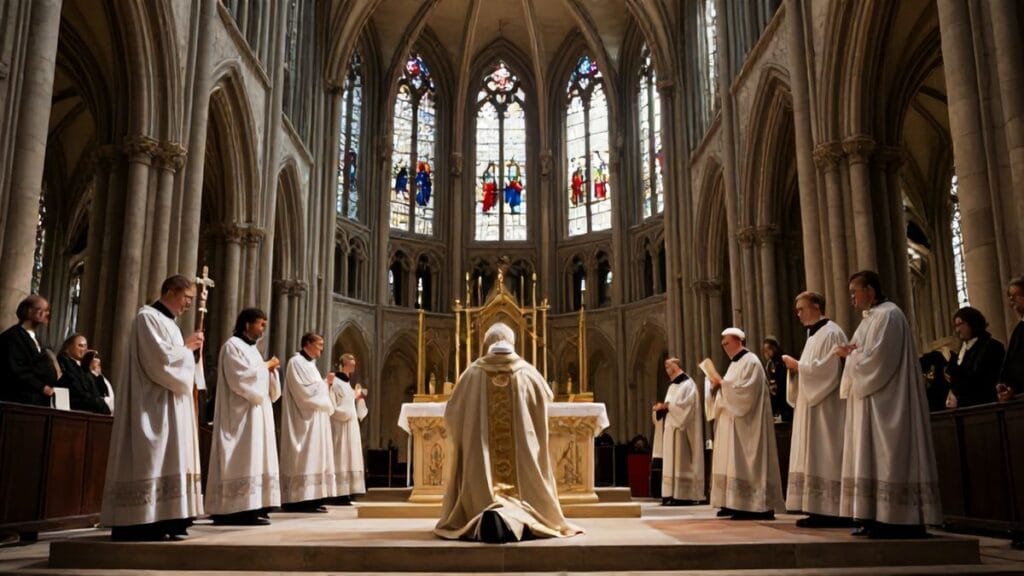
Imagine the cathedral that morning: not the soaring Gothic structure tourists see today, but an earlier, more compact Romanesque building, still bearing the imprint of Anglo-Saxon craftsmanship. Light angled through narrow windows, striking motes of dust that swirled above the gathered clergy. The nave filled with the mingled colors of vestments, banners, and the muted tones of wool and linen garments worn by lay witnesses. At the sanctuary, near the high altar, ecclesiastical dignitaries took their places, some from distant sees, others from recently conquered territories now firmly under Norman control.
Lanfranc would have worn simple, though dignified, monastic garb as he entered, yet already the eyes of all present recognized him as the chosen man. When lanfranc consecrated archbishop of canterbury, the ritual unfolded according to a liturgy that bound this particular moment to centuries of Christian practice: the presentation of the candidate, the questioning about faith and duties, the laying on of hands by other bishops, the anointing with holy oils, the fitting of ring and pallium, the enthronement. Each step marked another layer of meaning: personal humility, acceptance of burden, investiture with spiritual authority.
As the Latin prayers rose, some of the older English monks might have thought of their predecessors—Dunstan, Ælfheah, and others whose bones lay near the altar. Their memories were woven into the stones beneath their feet. Now the future turned abruptly toward the continent. The chants were familiar, but the accents of those who sang them carried the rippling “r” and clipped consonants of Normandy, Anjou, and Brittany. To some listeners, this foreign sound would have signaled renewal and order. To others, it was the audible sign of dispossession.
At the climactic moment, when Lanfranc was seated on the archiepiscopal throne of Canterbury, a murmur must have passed through the congregation. In that instant, authority flowed toward him—from the bishops who consecrated him, from the papal pallium that symbolized Rome’s blessing, from the royal will that had selected him, and from the long tradition of Augustine’s mission that claimed, even now, a special dignity for Canterbury. It was here that the formula by which lanfranc consecrated archbishop of canterbury entered the living memory of England: a foreigner taking up the staff once held by English saints, with the promise—or threat—of profound transformation.
Outside, after the ceremony, bells pealed across Canterbury. The sound spread over a town where English and Norman lived uneasily side by side. To some, the bells proclaimed peace after years of uncertainty; to others, they tolled the end of an era. Within the cloister walls, celebratory meals were served, gifts exchanged, messages dispatched. From this day forward, letters, charters, and decrees would be dated and sealed in the name of a new archbishop whose mind had been trained in the schools of Italy and Normandy but whose fate was now tied irreversibly to the still-smoldering landscape of post-conquest England.
Lanfranc and William the Conqueror: A Partnership of Steel and Scripture
In the years that followed, the relationship between William the Conqueror and his archbishop became one of the central axes around which English governance turned. Their partnership was built on mutual utility and a cautious respect. William saw in Lanfranc a man who could clothe royal decisions in the language of canon law and moral necessity, while Lanfranc found in the king a patron strong enough to enforce reforms that would otherwise have remained pious aspirations.
Lanfranc quickly became more than a spiritual leader. He acted as royal adviser, judge, and, during William’s absences in Normandy, even as a sort of regent. His letters—some of which survive—reveal a man deeply concerned with both the king’s soul and the stability of his realm. One famous letter admonishes a bishop to obey the king in temporal matters but insists that spiritual jurisdiction belongs to the church. This delicate balancing act—affirming royal rights while carving out a sphere for ecclesiastical autonomy—would later echo in the far more explosive conflicts between Henry II and Thomas Becket.
William, for his part, supported Lanfranc’s reforms even when they struck at the practices of Norman lay lords. Royal backing enabled the archbishop to demand that bishops hold regular synods, to separate spiritual and lay courts, and to insist that serious church matters not be handled in secular assemblies. Yet William never ceded what he regarded as his royal prerogatives. He controlled the flow of papal letters into England, refused to let bishops excommunicate great lords without his consent, and ensured that no papal legate entered the kingdom without royal approval. Within this framework, lanfranc consecrated archbishop of canterbury navigated with impressive skill, securing significant reforms while avoiding direct confrontation with his formidable king.
There were moments of tension. Disputes over church lands, questions about the treatment of English rebels, and the handling of sensitive trials all tested the limits of cooperation. Yet the two men shared a fundamental interest: an orderly, disciplined realm where king and church mutually reinforced one another’s claims to authority. In this sense, their partnership was a prototype for the medieval English monarchy, in which royal legitimacy rested not merely on conquest or inheritance but on a visible alliance with a morally authoritative, reform-minded church hierarchy.
Rebuilding a Church in Ruins: Architecture, Wealth, and Authority
Once the ceremonies ended and royal charters were sealed, the daily work of rebuilding began. Canterbury’s physical and institutional structures needed repair and reimagining. Lanfranc approached this task with the eye of both a lawyer and a builder. At Caen he had overseen major construction projects; now, he brought that experience to bear on the mother church of England.
The old cathedral, though venerable, no longer suited the scale of Norman ambition. Under Lanfranc’s direction, substantial rebuilding took place, laying the foundations for the grander structures that would later rise under his successors. Stone by stone, laborers transformed the skyline of Canterbury. The new architecture was not just functional; it was ideological. Thick-walled Romanesque towers and vast, orderly cloisters announced Norman permanence, discipline, and might. Where the Anglo-Saxon church had often favored smaller, more local expressions of piety, Lanfranc’s Canterbury signaled centralization: a great ecclesiastical fortress radiating authority through the land.
Rebuilding required wealth, and Lanfranc attacked the problem with a jurist’s precision. He reviewed the charters, privileges, and landholdings of the see, recovering properties lost in the chaos of conquest, defending ecclesiastical rights in royal courts, and, when necessary, confronting powerful laylords who encroached on church estates. The archbishop’s register grew thick with documents that testified not only to piety but to a relentless will to secure the economic base of his reforms.
The physical reconstruction of Canterbury was mirrored in the reorganization of its monastic community. Lanfranc strengthened discipline among the monks, tightened liturgical observance, and introduced a more rigorous interpretation of the Benedictine Rule. He imported customs and practices from Norman monasteries, bringing a sharper sense of hierarchy and order to the cloister. The daily rhythm of prayer, reading, and manual labor was recalibrated not simply to save souls but to create an efficient, unified community that could serve as a model for other houses throughout England.
Visitors arriving in Canterbury in the 1080s would have seen a place transformed from the uncertain days when lanfranc consecrated archbishop of canterbury. The buildings rose taller, the chanting of the monks followed carefully regulated patterns, and the administrative offices hummed with the copying of charters, the compilation of records, and the quiet but determined defense of ecclesiastical privilege. In stone and parchment alike, Lanfranc inscribed his vision of what a Norman, reformed, royal church should look like.
Reforming the English Church: Councils, Canons, and Conflicts
Lanfranc did not intend Canterbury to be an isolated island of reform. From the start, he worked to reshape the entire English church in the image of the new order favored by Rome and Normandy. The tools at his disposal were synods and councils, where bishops and abbots were summoned to hear, debate, and ultimately accept new norms for ecclesiastical life.
Soon after lanfranc consecrated archbishop of canterbury, provincial councils began to meet more regularly. These gatherings issued canons that touched every level of church life. Clerical celibacy was reinforced, though enforcement would vary and often provoke resistance among priests long accustomed to marriage. Simony—the buying and selling of church offices—was condemned, and steps were taken to ensure that episcopal and abbatial appointments followed canonical election, even if under the heavy shadow of royal influence.
Lanfranc also took aim at the old entanglement between secular and spiritual courts. In one important move, often cited by historians, he helped to separate ecclesiastical jurisdiction from the shire courts that had previously handled both types of cases. Henceforth, many matters involving clergy and canon law were to be judged in episcopal courts. This shift not only enhanced the autonomy of the church but also professionalized its legal culture, requiring bishops and their staffs to grow more literate, more versed in the complexities of canon law, and more capable of maintaining detailed records.
Reform, however, always had a human face, often furrowed in worry or anger. English priests who had long served small parishes found themselves summoned, questioned, and sometimes displaced if they could not meet new standards of learning or discipline. The promotion of foreign, often Latin-educated clergy to positions of power created resentment. Yet to reformers, these measures were necessary. The old ways, they believed, had allowed corruption to take deep root; only a sharp, sometimes painful pruning would allow health to return.
Not all conflicts were open or dramatic. Many unfolded quietly, in visitations, in whispered warnings, in the steady replacement of one set of customs with another. Through it all, Lanfranc’s authority as the man who had once, on that August day, stood before altar and throne when lanfranc consecrated archbishop of canterbury, gave weight to his edicts. Whether admired or resented, he could not be ignored.
Rome, Relics, and Rivalries: Canterbury versus York
No archbishop of Canterbury could ignore the north. Since the early Middle Ages, the see of York had claimed a degree of independence, sometimes even asserting primatial rights that challenged Canterbury’s supremacy. Under Norman rule, these old rivalries flared again. For Lanfranc, securing Canterbury’s primacy over all England—and, he insisted, over Wales and Scotland as well—became a critical part of his mission.
The contest centered on questions of tradition and papal privilege. York could point to ancient foundations and regional autonomy; Canterbury invoked Augustine’s mission and a long-standing, if sometimes contested, precedence. Lanfranc took the fight to Rome itself, marshalling historical arguments and appealing to papal support. A telling episode occurred at a council in Rome where representatives of both sees laid their cases before the pope. According to one later account, Lanfranc’s side presented evidence that the archbishop of York had long sworn obedience to Canterbury, a custom that should be maintained.
The eventual outcome, while not resolving every detail, strengthened Canterbury’s hand. York’s archbishop was obliged to make a profession of obedience to Canterbury, at least under certain conditions. This diplomatic victory reinforced Lanfranc’s broader project: a hierarchically ordered church with a clear, unquestioned center in the south. The see of Canterbury, enriched with relics, pilgrims, and royal patronage, became an unmistakable symbol of both spiritual leadership and Norman power.
Relics and saints played their part in this struggle. The cults of earlier English saints—Dunstan, Ælfheah, and eventually Thomas Becket, though he came after Lanfranc—gave Canterbury a charisma that no amount of dry legal argument could replace. Pilgrims arriving to venerate relics encountered not only shrines but a functioning demonstration of the reformed, Latin-literate church Lanfranc had labored to build. In this way, the rivalry with York energized a deeper process: the creation of an English Christian identity that was increasingly Roman and Norman in style, yet still rooted in local memory and devotion.
The Human Cost of Reform: Monks, Priests, and the Displaced English
Every structural reform casts long shadows, and Lanfranc’s were no exception. Behind the impressive councils, elegant new buildings, and neatly written charters lay stories of loss and disorientation, particularly among the English clergy. The replacement of English bishops with Normans—a process accelerated in the years immediately after lanfranc consecrated archbishop of canterbury—was nearly complete by the end of William’s reign. By some counts, out of more than a dozen bishoprics, only a single English bishop remained by 1087.
At the local level, priests who had served parishes for decades sometimes found themselves under scrutiny for their lack of Latin or for being married. They were not always immediately removed; pragmatic considerations and pastoral needs often tempered the zeal of reform. But the writing was on the wall. Promotions increasingly went to men who shared the new archbishop’s cultural world—Norman, Breton, Lotharingian clerics whose education matched the demands of a more legalistic, centralized ecclesiastical structure.
Monasteries, too, felt the strain. Older customs were replaced by stricter observance. English monks who had grown used to certain freedoms found themselves under a new regime that insisted on uniformity and obedience. Some adapted, learning French or Latin, embracing the new monastic culture that spread from Normandy. Others faded into the background, their names preserved only in the margins of charters or the necrologies of their houses.
Yet it would be wrong to see Lanfranc solely as a destroyer of English tradition. He valued learning wherever he found it and, on occasion, protected English clerics who proved capable and loyal. The transformation he oversaw was not a simple erasure but a complex layering of Norman forms over Anglo-Saxon foundations. Still, for those who saw their communities altered beyond recognition, the reforms could feel like a kind of cultural conquest that continued the work of Hastings by other means.
The human cost extended beyond the clergy. As ecclesiastical courts grew more powerful and better organized, laypeople found themselves subject to new procedures and expectations. Marriage law, penance, and the handling of moral offenses all passed increasingly under the oversight of church officials. For peasants and townspeople, this could mean greater protection from arbitrary secular justice, but it also meant that the private details of their lives were drawn into a more intrusive moral order. In this sense, the day when lanfranc consecrated archbishop of canterbury marked the beginning of a centuries-long process in which the church’s reach into daily life expanded, sometimes as a source of solace, sometimes as a source of anxiety.
Law, Learning, and the Birth of a New Intellectual Culture
One of Lanfranc’s most enduring contributions lay in the realm of learning. Trained in the schools of Italy, renowned as a teacher in Normandy, he brought to England a deep respect for systematic study. Under his guidance, Canterbury became both a spiritual center and a school of thought. The cathedral monastery nurtured scriptoria where texts were copied, glossed, and debated. The careful study of Scripture, the Fathers, and canon law gave rise to a new generation of English clerics who could navigate the intricate demands of reform and governance.
Lanfranc himself wrote legal and theological works, though only some survive. Among them is his collection of ecclesiastical canons, often called “Lanfranc’s Canons,” which laid down rules for monastic life and discipline. These texts, though aimed at monks, influenced broader patterns of church governance in England. They exemplified a style of thought that prized clarity, order, and consistency—qualities that would become hallmarks of the emerging scholastic tradition.
The intellectual culture Lanfranc fostered bore fruit in his successor, Anselm of Canterbury, whose philosophical and theological writings have overshadowed Lanfranc’s own in later memory. But Anselm’s work did not appear in a vacuum. The environment that made it possible—the network of students, the discipline of monastic schools, the expectation that reason could serve faith—was in large part a legacy of the man who, years earlier, had stood in the sanctuary when lanfranc consecrated archbishop of canterbury.
Legal thinking also evolved under his influence. The separation of ecclesiastical and secular courts required trained personnel and a new kind of record keeping. Over time, this contributed to the development of a distinct English canon law tradition, intertwined with but not identical to continental practice. The tension between common law and canon law that would later define many of England’s great constitutional struggles can trace some of its roots to the reforms and reorganizations initiated in Lanfranc’s era.
Schools associated with cathedrals and monasteries multiplied. Young clerics learned not only to chant and to memorize but to argue, to distinguish, to parse subtle points of doctrine and law. It is no exaggeration to say that the intellectual seeds sown in late eleventh-century Canterbury helped prepare the ground for the flowering of universities in the next century. Thus the moment when lanfranc consecrated archbishop of canterbury radiated outward into the very fabric of European thought, linking a Kentish cathedral to lecture halls in Paris, Bologna, and beyond.
Crisis and Loyalty: Revolt, Repression, and Episcopal Power
Reform did not take place in a vacuum; it unfolded amid repeated crises that tested the loyalties of bishops and magnates alike. England in the 1070s and 1080s was not a settled kingdom but a land still wrestling with the aftermath of invasion. Rebellions flared in the north; Danish fleets threatened the coasts; discontent simmered among dispossessed English nobles.
Lanfranc’s role in these crises was both spiritual and political. He supported William’s harsh suppression of rebellion, seeing it as necessary to secure peace and protect the church. In one anecdote preserved by later chroniclers, the archbishop is said to have urged mercy when possible but ultimately backed the king’s right to punish traitors. His theological justification for royal authority—grounded in a belief that even a conquering monarch could be God’s instrument—bolstered William’s claim to rule not as a usurper, but as a legitimate, divinely sanctioned king.
At the same time, Lanfranc did not hesitate to rebuke, at least in private, those whose actions threatened the moral order he tried to uphold. He admonished bishops who grew too entangled in secular ambition; he scolded abbots who neglected monastic discipline. One might see in his letters the outline of a man walking a tightrope: supportive of royal power yet determined to maintain a distinct moral voice for the church.
These crises hardened the structures he had helped to create. Each rebellion justified new measures to centralize authority, to ensure that bishops and abbots owed their positions not to local magnates but to king and archbishop. Over time, this reduced regional autonomy but increased the capacity of the church to act as a coherent institution. In the process, it also became more deeply implicated in the mechanisms of power and repression. The delicate ideals present on the day when lanfranc consecrated archbishop of canterbury—of a church standing above temporal conflict—gave way to a grittier reality in which miters and swords operated in uneasy partnership.
Lanfranc’s Final Years and the Legacy He Tried to Secure
By the 1080s, the monk from Pavia was an old man. He had outlived many of the initial witnesses to the conquest, overseen the nearly complete replacement of the English episcopate, and watched as the institutions he rebuilt began to settle into a new normal. Yet he knew that no settlement was permanent. The very reforms he championed—greater learning, stronger ecclesiastical courts, a more assertive sense of canonical rights—contained within them the seeds of future conflict.
Lanfranc spent his final years consolidating. He confirmed charters, adjusted diocesan boundaries, and refined monastic statutes. He also took an active interest in succession, both spiritual and temporal. William’s sons—particularly the troublesome Robert Curthose and the more reliable William Rufus—posed questions about the future stability of the realm. The archbishop’s counsel aimed to preserve unity, but he could not control the ambitions and rivalries of princes.
Inside Canterbury, he continued to shape the education of monks and clerics. He encouraged the copying of authoritative texts and, where possible, the preservation of older English materials. It is a testament to his relative moderation that significant portions of the Anglo-Saxon Chronicle, for example, survived in monasteries that had undergone Norman reform. The past was not entirely erased; it was reframed, sometimes subordinated to new narratives, but not wholly silenced.
Lanfranc died in 1089, leaving behind a church markedly different from the one he had inherited nineteen years earlier. When later chroniclers like Eadmer of Canterbury or Orderic Vitalis wrote about him, they painted a picture of a just, learned, and determined leader. Eadmer, the Anglo-Saxon monk who admired Anselm above all, still acknowledged the foundation Lanfranc had laid. Orderic, writing from the Norman monastery of Saint-Évroult, placed him among the principal architects of the new Anglo-Norman world.
In the years after his death, his legacy was both honored and contested. His immediate successor, Anselm, would push further on questions of ecclesiastical independence, clashing with King William Rufus in ways Lanfranc had carefully avoided. In those conflicts, some looked back to Lanfranc’s era as a time of relative harmony between crown and church, a fragile balance that seemed, in retrospect, almost idyllic. Yet even that harmony had been forged in conquest and maintained through disciplined, sometimes ruthless reform.
Memory, Myth, and the Long Shadow over English Christianity
Centuries later, when pilgrims walked the roads to Canterbury to venerate Thomas Becket’s shrine or when Reformation preachers thundered against “papist” abuses, few thought consciously of the day when lanfranc consecrated archbishop of canterbury in 1070. Yet his shadow lay across every stone and statute of the medieval English church. The very assumption that Canterbury was the unquestioned head of the realm’s ecclesiastical structure, that archbishops might admonish kings and shape law, that learned monks might sit in judgment on the morals of laypeople—all these owed much to the settlement he had engineered.
Historians have long debated how to judge him. Some see him as a stern but necessary reformer who dragged a complacent English church into closer conformity with the wider Latin West. Others emphasize the violence of the Norman Conquest and argue that his reforms were inseparable from a broader process of cultural domination. The truth, as so often, lies in the tension between these views. Lanfranc did participate in a conquest, but he also sought to impose standards he genuinely believed were just and holy.
Modern scholarship, drawing on charters, letters, and chronicles, has painted an increasingly nuanced portrait. Scholars such as H. E. J. Cowdrey and Frank Barlow, in their detailed studies of the period, have shown how Lanfranc’s reforms were at once typical of the wider Gregorian movement and uniquely shaped by the particular conditions of post-conquest England. They remind us that even a figure so apparently confident and authoritative operated within constraints: royal power, local resistance, and the ever-shifting politics of the papal court.
The memory of Lanfranc also evolved liturgically and architecturally. Later generations of monks at Canterbury looked back to his time as a foundational era, preserving stories of his stern justice and quiet charity. The stones he helped raise were reworked and expanded, yet later builders honored him as an essential link in a chain stretching from Augustine to their own day. Even when the cathedral’s focus shifted to the martyred Becket, the institutional scaffolding that made Canterbury such a potent symbol had been largely constructed under Lanfranc’s guidance.
Standing today in the precincts of Canterbury, a visitor can still sense the layering of times: Romanesque foundations beneath Gothic arches, Anglo-Saxon memory under Norman stone. Somewhere in that palimpsest, the echo of August 1070 persists: the day when a monk from Italy, seasoned in Norman courts and cloisters, stepped into the ruined heart of English Christianity and, by accepting consecration, set in motion a transformation whose repercussions would be felt long after his own name faded from popular remembrance.
Conclusion
The consecration of Lanfranc as Archbishop of Canterbury on 15 August 1070 was a hinge in English history, swinging the church decisively from its Anglo-Saxon past into a Norman and Roman future. It was not merely a liturgical act but a carefully staged settlement joining king, pope, and prelate in a shared project of reform and control. From that moment when lanfranc consecrated archbishop of canterbury, a new pattern emerged: a hierarchically ordered church, intimately linked to royal power, yet increasingly conscious of its own legal and moral authority.
Lanfranc’s life bridged worlds—Italian cities and Norman monasteries, battlefield kingdoms and quiet scriptoria. The reforms he championed reshaped dioceses, monasteries, parish life, and the very language of authority. In the process, they inflicted real suffering and dislocation, especially on the English clergy and laity whose customs were overridden. Yet they also laid foundations for an intellectual and institutional vitality that would allow English Christianity to play a major role in the medieval West.
To reflect on his consecration is to see how a single ceremony can crystallize vast, unseen forces: papal reform, dynastic ambition, the aspirations of scholars, the fears of the conquered. It reminds us that history often turns on moments at once deeply symbolic and intensely practical. Inside Canterbury’s walls that August day, chants and prayers rose to heaven; outside them, a transformed realm slowly took shape in their wake.
FAQs
- Who was Lanfranc before he became Archbishop of Canterbury?
Lanfranc was born in Pavia in northern Italy and trained in law and the liberal arts. He became a renowned teacher and theologian at the abbey of Bec in Normandy and later served as abbot of Saint-Étienne in Caen. His reputation as a scholar and reformer, as well as his close relationship with William the Conqueror, paved the way for his appointment to Canterbury. - Why was Lanfranc’s consecration in 1070 so significant?
The moment when lanfranc consecrated archbishop of canterbury marked the consolidation of Norman control over the English Church after the conquest of 1066. It symbolized a shift to a reformed, Roman-aligned ecclesiastical structure and cemented a powerful alliance between the crown and the church, with Canterbury at the center. - How did Lanfranc change the English Church?
Lanfranc reorganized dioceses, reformed monastic life, promoted clerical celibacy, and helped separate ecclesiastical from secular courts. He replaced many English bishops with Norman or continental clergy and strengthened Canterbury’s primacy over other sees, particularly York. His reforms integrated England more closely into the wider Latin Christian world. - What was Lanfranc’s relationship with William the Conqueror like?
Lanfranc and William maintained a close, mutually beneficial partnership. Lanfranc provided theological and legal justification for William’s rule, acted as his adviser, and even served as a kind of regent during the king’s absences. William, in turn, supported Lanfranc’s reforms and defended church property and privileges, while carefully guarding royal prerogatives. - Did Lanfranc preserve any aspects of the Anglo-Saxon church?
Yes. While he oversaw a sweeping transformation, Lanfranc did not completely erase the Anglo-Saxon past. He allowed the preservation of important texts and some local traditions, and he could be pragmatic in retaining capable English clergy. However, the overall direction of his reforms clearly favored Norman structures, personnel, and customs. - How did Lanfranc’s reforms affect ordinary people?
For laypeople, Lanfranc’s reforms meant that more aspects of daily life—especially marriage, sexual behavior, and moral conduct—fell under ecclesiastical jurisdiction. This sometimes offered protection from arbitrary secular justice but also increased the church’s scrutiny and control. Parish priests faced new expectations of learning and discipline, which altered the character of local religious life. - What was the rivalry between Canterbury and York about?
The rivalry centered on primacy: whether Canterbury or York held ultimate ecclesiastical authority in England. Lanfranc argued that York’s archbishop owed obedience to Canterbury, citing historical precedent and seeking papal support. Though the issue was never fully settled, Lanfranc’s efforts significantly strengthened Canterbury’s claim to national leadership. - How is Lanfranc viewed by modern historians?
Modern historians tend to see Lanfranc as a key architect of the Anglo-Norman church and a major figure in the wider Gregorian Reform. They acknowledge both his administrative genius and the harsh effects of his policies on the English clergy. His legacy is understood as both constructive and disruptive, foundational to medieval English Christianity yet rooted in the violence of conquest. - What legacy did Lanfranc leave for later archbishops like Anselm and Becket?
Lanfranc created the institutional and intellectual framework within which later archbishops operated. Anselm built on his emphasis on learning and canon law but pushed further toward ecclesiastical independence, while Becket’s famous clash with Henry II unfolded in a church whose authority and self-understanding had been shaped by Lanfranc’s reforms. - Are there any surviving writings by Lanfranc?
Yes. Several works survive, including theological treatises against Berengar of Tours and collections of monastic and ecclesiastical statutes often referred to as Lanfranc’s Canons. His letters, preserved in later collections, provide valuable insight into his ideas on church governance, royal power, and reform.
External Resource
Internal Link
Other Resources
- Encyclopaedia Britannica – general search for the exact subject
- Google Scholar – academic search for the exact subject
- Internet Archive – digital library search for the exact subject