Table of Contents
- A Spring Day in Constantinople: The Coup That Toppled an Emperor
- From Marginal Prince to Plotter: The Early Life of Alexios Angelos
- The House of Angelos and a Fragile Empire on the Edge
- The Road to 1195: Intrigues, Rumors, and the March to Adrianople
- The Night Before Treason: Camps, Campfires, and Secret Oaths
- 8 April 1195: The Moment Alexios III Angelos Was Proclaimed Emperor
- The Fall of Isaac II: Blinding, Chains, and the Politics of Betrayal
- Coronation and Celebration: Splendor in the Hagia Sophia
- An Empire of Debts: Money, Patronage, and the Buying of Loyalty
- War on the Frontiers: Bulgarians, Serbs, and the Waning Byzantine Sword
- The Palace and the Streets: Daily Life Under Alexios III Angelos
- Venetians, Crusaders, and the Shadow Gathering in the West
- Family, Rivals, and Pretenders: The Angeloi Against Themselves
- Storm over the Golden Horn: The Approach of the Fourth Crusade
- Flight from Constantinople: The Last Days of the Angelos Regime
- After the Fall: Exile, Obscurity, and the Death of Alexios III
- Legacy of Weakness: How Alexios III Helped Doom Byzantium
- Memory, Blame, and the Historian’s Verdict on Alexios III Angelos
- Conclusion
- FAQs
- External Resource
- Internal Link
Article Summary: On a spring day in 1195, the Byzantine camp near Adrianople became the unlikely stage for a coup that would reshape the fate of the empire, as Alexios III Angelos was proclaimed Byzantine emperor in the place of his own brother. This article traces how alexios iii angelos byzantine emperor rose from a minor prince of a troubled dynasty to the man who seized the purple amid shouts of “Basileus!” and the clatter of shields in a military camp. It follows his rule in Constantinople, examining the corruption, financial desperation, and diplomatic miscalculations that hollowed out the empire even as its ceremonies gleamed with ancient splendor. We move from the drama of the coup itself to the suffering of ordinary people facing heavier taxes, fearsome raids, and inflation. Along the way, we explore the growing menace of the Bulgarians, the ambitious Venetians, and the Crusaders whose gaze turned unexpectedly toward the Queen of Cities. The narrative culminates in the catastrophe of the Fourth Crusade and the emperor’s cowardly flight, showing how his reign became synonymous with failure in later memory. Ultimately, the story of alexios iii angelos byzantine emperor is less about a single man than about the slow unraveling of Byzantine power. Yet behind every political decision lie human choices, and this account lingers on the moments of doubt, fear, and greed that turned a crisis into a disaster.
A Spring Day in Constantinople: The Coup That Toppled an Emperor
On the morning of 8 April 1195, the streets of Constantinople stirred as they always did. Hawkers called out beneath the shadow of church domes, fishermen hauled their catch up from the Golden Horn, and the first bells rang from the great churches, echoing across the city’s hills. Yet, without knowing it, the people of the Byzantine capital were about to receive news that their world had changed. Far away, in a military camp near Adrianople in Thrace, their emperor had been betrayed, their dynasty shaken, and a new ruler had been raised on the shields of his soldiers.
The proclamation of alexios iii angelos byzantine emperor did not unfold in the majestic Hagia Sophia but amid tents, mud, and the restless murmur of an army. Isaac II Angelos, the reigning emperor, believed himself secure, preparing to campaign against internal and external enemies. He had survived uprisings, faced Norman invaders, and outmaneuvered court rivals. Yet he underestimated the ambition and resentment that simmered within his own bloodline. His elder brother, Alexios, long overshadowed and marginalized, decided that April would be the moment to seize what he believed should have been his from the start: the imperial crown.
Back in the capital, the symbols of imperial power—the purple shoes, the jeweled loros, the golden crown—were waiting, ready to grace whomever the soldiers and the powerful would accept as emperor. Byzantium had seen coups before. Emperors had been smothered in their sleep, shorn and sent to monasteries, blinded, or paraded through streets in chains. The empire survived each crisis with ritual and pageantry, as if the ancient ceremonies could stitch together every rupture. This time, however, the rupture would run deeper. The elevation of Alexios III Angelos on that distant field was more than a change of ruler; it marked a slide into weakness from which Byzantium would struggle to recover.
As the day wore on and rumors drifted back toward the capital—of shouting in the camp, of Isaac’s guards melting away, of a prince being garbed in imperial purple—merchants paused in their dealings to listen. Clerics whispered to one another in cloisters, wondering what this would mean for their privileges, their safety, and their souls. Women fetching water in crowded courtyards repeated the stories in half-belief, testing the shape of the name on their tongues: Alexios, Alexios, the emperor is now Alexios. They could not yet see the full cost that this decision, taken far from the city, would exact upon their children and grandchildren.
But this was only the beginning. To understand why that April coup mattered so much, we must step back from the shocked faces in Constantinople and the tumult in the army camp. We must trace the path that brought Alexios Angelos, a second-tier noble from a beleaguered dynasty, to the edge of power—and then follow the consequences of his decision as they rippled outward, reshaping the fortunes of an entire civilization.
From Marginal Prince to Plotter: The Early Life of Alexios Angelos
Long before alexios iii angelos byzantine emperor strode into the palace as ruler, he was simply Alexios, a scion of the Angelos family, trying to find his place in a fractious court. The Angeloi were not one of the oldest or most illustrious families of the empire, but by the mid-12th century they had climbed into the highest circles of power through careful marriages, military service, and, not least, luck. Alexios was born in the 1150s, under the rule of the Komnenoi, at a time when Byzantium still appeared formidable—wealthy cities, disciplined armies, and a sophisticated court culture that dazzled even its enemies.
Alexios’ father, Constantine Angelos, had married into the imperial Komnenos family, giving his sons a tenuous link to the purple. Yet links were not the same as rights. In a court obsessed with rank, precedence, and rumor, Alexios and his brothers occupied an awkward position: close enough to power to dream of it, but not quite close enough to command it. As a young man, Alexios learned that survival in Constantinople demanded not only a keen mind but a flexible conscience. Alliances shifted rapidly; a patron who today seemed unshakable could tomorrow be disgraced, exiled, or dead.
Unlike some emperors-in-waiting who proved themselves on distant frontiers, Alexios’ early career was not marked by spectacular military success. He served in various secondary commands, appeared in ceremonies, and enjoyed the comforts of aristocratic life: silk garments, servants, the subtle flattery that greeted any man with a possible claim to higher status. Yet he was overshadowed by more dynamic figures. His younger brother Isaac, more charismatic and daring, seized the political stage in 1185 when he led a revolt against the deeply unpopular Andronikos I Komnenos, a ruler whose brutal purges had alienated the aristocracy and the church.
Isaac’s sudden rise to the throne as Isaac II Angelos must have cut Alexios to the core. His younger brother was acclaimed in the Hagia Sophia, crowned amid chants of “Many years to the Emperor!” and saluted by the very magnates who had recently cowered under Andronikos’ terror. Alexios, who by seniority might have seen himself as the natural head of the family, found himself relegated to a role in the background—honored, yes, but never central. He watched as Isaac showered offices, estates, and influence upon favorites and in-laws. The new emperor’s court, described by the later historian Niketas Choniates, was full of “frivolity, drunkenness, and extravagance,” and Alexios could not ignore the growing chorus of criticism directed at his brother.
This mixture of envy and genuine political concern proved combustible. Over the years, as Isaac’s reign lurched from one crisis to another—foreign invasions, rebellions, financial shortfalls—Alexios began to cultivate his own network of supporters: officers dissatisfied with Isaac’s leadership, aristocrats slighted in the distribution of favors, courtiers who believed the emperor was squandering the empire’s legacy. Whether Alexios saw himself as a savior or simply as a man claiming his due, his path bent steadily toward treason.
By the early 1190s, the life of the once-marginal prince had taken on a new rhythm. He met discreetly with allies in shadowed corridors of the Great Palace, traded whispered promises in the colonnades of aristocratic mansions along the Bosporus, and measured the mood of soldiers and provincial governors. The stage was being set, though neither he nor Isaac yet knew precisely when the curtain would rise.
The House of Angelos and a Fragile Empire on the Edge
To understand why the seizure of power by alexios iii angelos byzantine emperor proved so disastrous, one must look beyond the ambitions of a single man and examine the condition of the empire he sought to rule. By the late twelfth century, Byzantium was no longer the confident superpower it had been under emperors like Basil II or even under the early Komnenoi. Its borders were frayed, its enemies emboldened, and its ruling elite increasingly fragmented.
The Angelos dynasty emerged at this moment of strain. Isaac II, who had ascended in 1185 on a wave of popular relief after the tyranny of Andronikos I, inherited a realm facing threats on multiple fronts. In the west, the Normans of Sicily had ravaged Greek lands and even briefly captured Thessaloniki. In the Balkans, the Bulgarians, once subjugated by Basil II, were rising again under energetic leaders like Asen and Peter. To the east, the Seljuk Turks pressed against imperial territories in Anatolia, slowly eroding Byzantine control.
Internally, the empire was even more fragile. An elaborate bureaucracy and a fearsome tax system still functioned, but increasingly as instruments of exploitation rather than efficient governance. Powerful landowners carved out semi-independent domains, while the central government struggled to extract revenue. Corruption was no mere moral failing; it was a structural problem. Offices were bought and sold, legal decisions swayed by bribes, and military posts treated as invitations to plunder local populations.
The Angeloi, including Alexios III, were products of this environment. They had grown up in an aristocracy that took imperial wealth for granted while resenting any attempt at central discipline. They watched as Italian merchants—especially Venetians and Pisans—secured profitable trading privileges that undercut local interests but brought ready cash to the treasury. They learned that short-term advantage often mattered more than long-term stability.
In theory, the empire still possessed the institutions to correct its course: an educated civil service, the moral authority of the Orthodox Church, and the ideological power of the imperial office itself, which was still clothed in the language of Roman universalism. In practice, however, those institutions were being hollowed out. Emperors relied on factions at court rather than on the common good. Bishops aligned themselves with patrons rather than with abstract principles. Ordinary people, ground down by taxes and the depredations of local magnates, increasingly saw the state less as protector and more as predator.
Amid this decay, the Angelos family represented both continuity and decline. They were not tyrants without lineage nor heroic reformers. Instead, they were middling aristocrats raised to supreme power in a time of crisis, lacking both the talent and the discipline that earlier emperors had shown. When Alexios III finally took the throne, he would inherit not only the diadem but also all the unresolved tensions that had been accumulating for decades.
The Road to 1195: Intrigues, Rumors, and the March to Adrianople
The years leading up to 1195 unfolded like a slowly tightening noose around Isaac II’s reign. Each fresh crisis seemed to reveal yet another weakness, another missed opportunity, another enemy emboldened by imperial hesitation. As the empire faltered, whispers about alternative leaders began to circulate more openly. Alexios, the emperor’s elder brother, became one of the names mentioned when courtiers spoke in lowered voices.
Isaac’s rule oscillated between attempts at reform and bursts of conspicuous generosity funded by desperate fiscal measures. To raise money, he sold offices, imposed extraordinary taxes, and debased the coinage—practices that alienated both the poor and the rich. Peasants groaned under added burdens; aristocrats fumed as their gold coins lost value. At the same time, Isaac lavished estates and titles on in-laws from his marriage to the Hungarian princess Margaret, further angering long-established Byzantine families.
By the early 1190s, the empire’s northern frontier was aflame. The Bulgarians, under Tsar Ivan Asen I, unleashed a series of raids and victories that shocked Constantinople. Constantineople’s chronicler Niketas Choniates records with bitter clarity how imperial forces were repeatedly outmaneuvered, and how the morale of the army deteriorated under leaders more secure in the intrigues of court than in the chaos of the battlefield. Isaac II could not ignore the threat, and in 1195 he planned a major campaign to reassert imperial authority in Thrace and beyond.
The march toward Adrianople in early spring was meant to be a show of strength. The imperial standard fluttered over columns of infantry and cavalry. Supply caravans swayed under loads of grain, dried meat, and wine barrels. Officers discussed strategies in their tents at night, tracing roads and rivers on rough maps lit by oil lamps. To the casual observer, the empire still looked formidable: thousands of soldiers under arms, imperial banners, the presence of the basileus himself at the head of the host.
Beneath this veneer, however, loyalties were frayed. Many officers resented Isaac personally or doubted his capacity to lead. They remembered his defeats, his erratic decisions, and the burdensome levies they had been forced to collect from the provinces. Some had long-standing ties to Alexios, who had cultivated friendships and alliances with quiet persistence. Others saw in a change of emperor the opportunity for new favor, promotion, and enrichment.
Rumors traveled faster than the army’s vanguard. As the imperial host neared Adrianople, stories of Isaac’s supposed incompetence and Alexios’ alleged superiority as a commander spread from tent to tent. These were not random grumblings; they were shaped and encouraged by men who had already decided the emperor must fall. Alexios did not yet declare his intentions openly, but his camp, figuratively speaking, grew larger by the day.
When the imperial host encamped near Adrianople, it created a temporary city of canvas and rope, smoke and noise. Here, with the emperor physically surrounded yet politically vulnerable, the conspirators saw their chance. They would not strike in the formal setting of the capital, where Isaac could rally bureaucrats, clergy, and city-based regiments. Instead, they would act where loyalties were fluid and swords plentiful. The road to Adrianople had become a road to usurpation.
The Night Before Treason: Camps, Campfires, and Secret Oaths
The night of 7 April 1195 settled over the imperial camp near Adrianople with a deceptive calm. Torches flickered along the lines of tents; sentries paced with spears in hand, their breath faint in the cool air. Fires crackled as soldiers warmed themselves, exchanged jokes, and grumbled about rations, officers, and the difficulties of life on campaign. They talked of home, of families far away, and of the coming battles against the Bulgarians. Few of them knew that, before another dawn rose, their oaths of loyalty would be put to the test in a way they had never imagined.
In more secluded quarters, men of higher rank spoke in a different tone. Gathered in the tents of key commanders, Alexios and his co-conspirators weighed the final details of their plan. They needed to move swiftly, to prevent Isaac from appealing to other officers or escaping. They also needed a clear ritual moment to mark the transition from discontent to open rebellion. In a world steeped in ceremony, even treason required a choreography.
Alexios, now in his forties, was no longer the marginalized prince of his youth. Though not renowned as a general, he had earned the trust of enough officers to make his bid plausible. Yet he must have felt the tension, the nagging awareness that once the step was taken, there would be no return. Blinding, exile, or death awaited failed usurpers. His heart likely raced as he listened to his supporters swear their loyalty—not to the reigning emperor, but to him, the would-be ruler-in-waiting.
The conspirators decided to strike in the morning, when the camp would be awake but still disorganized, the soldiers dispersed about their normal duties. The plan was simple but risky: seize Isaac in his tent, declare him deposed on the grounds of incompetence and broken oaths, and immediately proclaim Alexios as emperor. Success depended upon controlling the narrative in those first chaotic hours. If they could persuade the troops that the change was necessary, or at least inevitable, resistance would melt away.
As the night deepened, some conspirators slept uneasily, others not at all. Isaac, oblivious to the danger, may have reviewed campaign plans with trusted advisers, or perhaps retired early, tired from the day’s travel. He had survived plots before and had long believed that threats came from the city’s labyrinthine court. The open expanses of a military camp, full of men sworn to protect him, would have seemed far from the perfumed poison of palace corridors.
Somewhere in that camp, a priest chanted the evening prayers, invoking God’s protection on emperor and army alike. The ancient words rose and fell in the cool night air, hovering briefly over the tents of loyalists and traitors alike. Then they faded, leaving behind only the restless murmur of men on the brink of history.
8 April 1195: The Moment Alexios III Angelos Was Proclaimed Emperor
Dawn came pale and uncertain on 8 April 1195, filtering through the mist that clung to the Thracian plain. Soldiers stirred, stamping the chill from their limbs, tightening belts, cinching saddles. Somewhere a trumpet blared, calling officers to their duties. It seemed like any other day on campaign.
Then, in the heart of the camp, the conspirators moved.
Isaac II, roused from sleep or morning preparations, found his tent suddenly crowded with armed men whose faces he recognized—but whose allegiance had shifted in the night. There was no dramatic duel, no heroic last stand. The emperor was overpowered, perhaps with a brief struggle, perhaps with pleading words cut off mid-sentence. Within moments, the man who had worn the crown for a decade was a prisoner, staring into a future that had narrowed to a few terrible possibilities.
Outside, the news spread like a fire in dry brush. Officers shouted orders, some in confusion, others with deliberate intent. The conspirators began the crucial next step: crafting the spectacle of a new emperor. Alexios was brought forth, no longer merely the emperor’s brother but now the focus of a calculated performance. The soldiers were assembled as best the officers could manage. Standards were raised. Banners that had once symbolized Isaac’s legitimacy were reinterpreted on the spot as emblems of continuity now embodied in Alexios.
What followed was a scene familiar in Byzantine political culture but uniquely charged by the circumstances. As described in later accounts, Alexios was lifted upon a shield—a gesture inherited from both Roman and barbarian traditions—and acclaimed by the troops. Voices cried out “Alexios Augustus! Basileus!” Swords and spears clashed against shields, creating a thunderous metallic chorus that washed away hesitation. In that moment, the army defined the empire’s reality: the man they hailed as emperor, was emperor.
There was no formal coronation yet—no patriarch, no anointing oil, no procession to the Hagia Sophia. But the essence of power had shifted. Alexios, now alexios iii angelos byzantine emperor in fact if not yet in ritual, had crossed the invisible line between pretender and ruler. As he looked out over the assembled ranks, he saw the faces of men who expected him to be everything his brother had not been: strong, generous, victorious. They did not yet know that he would fail them.
Nearby, Isaac waited to learn his fate. A dethroned emperor was dangerous as long as he lived and could see. In Byzantine practice, blinding was a tool of political neutralization as much as cruelty. An emperor who could not see was considered unfit to rule. Sometime after the acclamation of Alexios, Isaac was seized again, and hot irons were brought. The act itself took only minutes, but it severed a decade of imperial rule and transformed a man into a cautionary tale. Chains soon followed. The empire now had a blind, deposed emperor and a newly raised one, both from the same family, divided by ambition, fortune, and blood.
News of these events rushed back toward Constantinople with couriers riding hard. By the time envoys reached the city, Alexios’ supporters there were ready to receive the announcement and smooth the transition. The people, confronted once more with an accomplished fact, saw their future bound to a man who had seized power far from the sacred precincts where emperors were supposed to be made. The coup of 8 April was complete, but its repercussions were only beginning.
The Fall of Isaac II: Blinding, Chains, and the Politics of Betrayal
For Isaac II Angelos, the transformation from emperor to prisoner must have felt like a plunge from a bright marble cliff into cold, swirling darkness. The rituals that had once affirmed his authority—the prostrations of courtiers, the chants of choruses, the deference of generals—were replaced by the brutal ritual of blinding, a single irreversible act in which fire and iron declared that his reign was over.
In Byzantine political logic, this mutilation was a grim sort of mercy. It spared Isaac’s life while effectively excluding him from the contest for power. A blinded emperor could be displayed, pitied, used as a bargaining chip, but not easily restored—at least in theory. The practice also reflected a deep anxiety about legitimacy. By ensuring that deposed rulers were rendered ineligible to return, usurpers like Alexios III hoped to stabilize their own positions.
Yet no act of violence could entirely erase the memory of a dethroned emperor. Isaac still had sympathizers in the capital and in the provinces, people who remembered his early popularity and viewed his later failures as misfortunes more than sins. Some saw him as a victim of fate rather than villain. Others, including members of the clergy, recoiled at the bloodshed within the imperial family itself. The church, though often accommodated to political realities, preserved an ideal of Christian rulership that made fratricidal coups disturbing, even when justified by talk of saving the empire.
Alexios III, meanwhile, faced a paradox. His victory required that Isaac be neutralized, yet harming him too openly risked scandal, especially among pious observers. The solution—a common Byzantine compromise—was to confine the ex-emperor, sometimes in comfortable but secure quarters, and allow rumors to spread that emphasized Isaac’s supposed incompetence, excesses, or even heresies. Narrative became another weapon of power. If Isaac could be painted as a failed ruler whose fall was almost providential, then Alexios’ seizure of power could be recast not merely as ambition but as necessity.
The personal dimension of this betrayal haunts the story. Two brothers, bound by blood and shared childhood memories, ended up as antagonist emperor and blinded captive. Did Alexios, now alexios iii angelos byzantine emperor, ever feel a stab of remorse? Did Isaac, in his darkness, rehearse the decisions that had brought him to this point? Sources are silent on their inner lives, but they leave us with the stark image of one brother enthroned in the Great Palace while another languished behind walls, eyes destroyed, future erased.
Behind the palace façade, courtiers adjusted with practiced speed. Many who had sworn loyalty to Isaac the day before now affected a grave loyalty to Alexios. A few, perhaps, mourned quietly or retreated from public life. Most, however, did what aristocracies do in times of upheaval: they survived by translating principles into pragmatism. The empire had a new emperor; they would serve him. Whether that emperor could serve the empire in turn was a question that would soon be put to the test.
Coronation and Celebration: Splendor in the Hagia Sophia
Once the army had proclaimed Alexios and Isaac’s fate was sealed, it remained to complete the transformation with the full majesty of ceremonial. No usurpation in Byzantium was truly secure until it echoed under the domes of the Hagia Sophia. In the weeks following 8 April, while the new ruler settled his grip on the army and arranged his entry into the capital, preparations began for a coronation that would drape naked power in sacred legitimacy.
When Alexios returned to Constantinople as emperor, the city put on its well-practiced mask of joy. Processions wound through the streets, past workshops, churches, and crowded balconies where commoners craned their necks to glimpse the new ruler. Purple banners fluttered from windows; incense smoke rose not only from churches but from censers hastily lit along the route. For the people who watched, such spectacles were both familiar and unsettling. They had cheered Isaac not so long before. Now they cheered his brother, wondering privately whether this Alexios would truly be different.
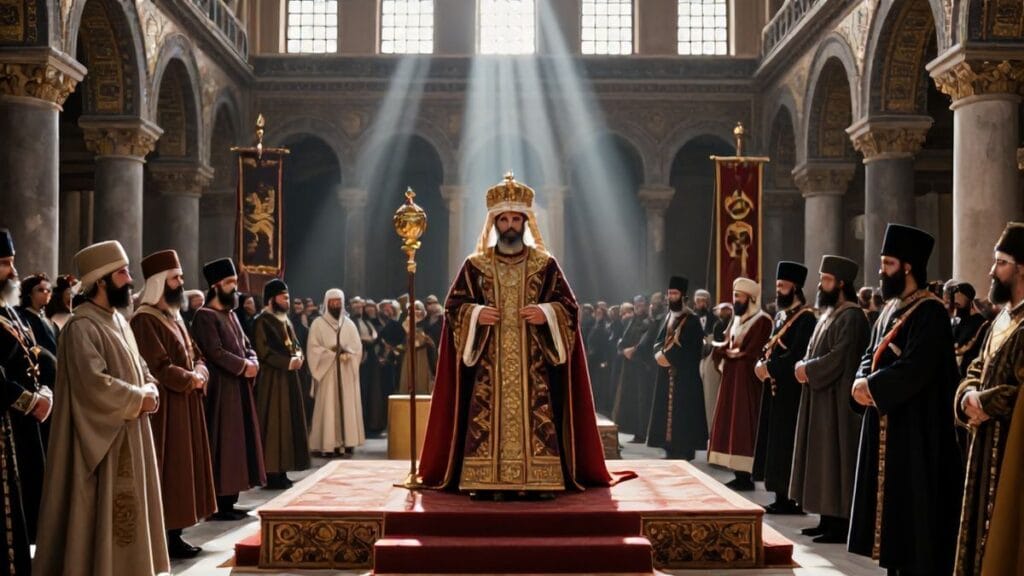
Inside the Hagia Sophia, the ceremony unfolded with the weight of centuries behind it. The patriarch, having assessed the political winds, stood ready with the holy oils. Alexios, clad in splendid garments, walked down the vast nave, past glittering mosaics of Christ Pantocrator and the Virgin, past columns that had seen storms of doctrine and power. The choir sang hymns that linked imperial authority to divine favor: the emperor was still, in official ideology, God’s anointed, the earthly guardian of the Orthodox faith.
The crown, heavy with jewels and history, was placed upon Alexios’ head. The patriarch proclaimed him basileus and autokrator of the Romans. The crowd responded with acclamations carefully choreographed but no less thunderous for their ritualized form. At that instant, any lingering doubts about his status—was he merely a successful rebel? a passing accident of politics?—were officially silenced. He was, in the fullest Byzantine sense, emperor.
It’s astonishing, isn’t it? In a matter of weeks, a man could travel from conspiratorial tent to enthroned majesty, from whispered oaths to public adulation. The very institutions that supposedly guarded continuity had absorbed yet another violent rupture and presented it as the unfolding of divine will. Later historians such as Niketas Choniates would pierce the illusion, describing Alexios III as indolent and self-indulgent, “a man whose hands were always stretched out to receive but rarely to give.” But those harsh verdicts came later. On the day of his coronation, hopes were still possible, illusions still intact.
When the ceremony ended, the emperor left the great church amid renewed cheers and entered the palace whose labyrinth of halls and gardens would become his world. Banquets followed, with platters of roasted meat, fish from the Bosporus, honeyed pastries, and endless cups of wine. Gifts were distributed, especially to officers whose swords had made the coup possible. The great families of the city measured their words carefully, offered their formal congratulations, and waited to see what their new ruler would do.
All the while, beneath the golden mosaics and painted ceilings, the realities of imperial decline persisted, quiet but relentless. Changing the man who sat on the throne had done nothing to remove the pressures at the frontiers, the corruption in the bureaucracy, or the rising enmity of powers to the west and north. Those problems would soon test whether alexios iii angelos byzantine emperor could be more than a well-dressed usurper.
An Empire of Debts: Money, Patronage, and the Buying of Loyalty
Power in Byzantium, as in so many empires, ran on coin as much as on faith or fear. Alexios III quickly discovered that to secure his rule he had to pay—handsomely. The army that had raised him to power expected rewards. The court, ever hungry, demanded new honors, estates, and stipends. Foreign mercenaries, on whom emperors increasingly depended, would not fight for promises alone.
The treasury Isaac II left behind was not in good health. Years of war, mismanagement, and lavish donations to favorites had drained the reserves. Under alexios iii angelos byzantine emperor, the situation worsened. Rather than impose strict austerity or attempt systemic reform, he opted for the more immediately gratifying path of selling offices, granting monopolies, and extorting wealthy subjects. Gold and silver objects from the palaces and churches were melted down. Even precious relics and religious treasures were, on occasion, pawned or sold—a scandalous act in a pious society.
Taxation grew heavier and more arbitrary. Provincial governors took their cue from the center, extracting additional “gifts” from the local population under the guise of supporting imperial needs. Peasants, artisans, and small landowners felt the squeeze most sharply. For them, the grand ceremonies in Constantinople brought little solace when a tax collector appeared at the door demanding coin they did not possess. Some fled their lands, seeking refuge in the estates of great magnates who could offer protection in exchange for dependence, further undermining the tax base.
At the same time, the emperor’s reliance on Italian merchants deepened. Venetians, in particular, secured favorable trading privileges in exchange for immediate funds or naval support. These agreements filled short-term gaps in the treasury but granted long-term commercial advantages to foreign interests. Byzantine merchants, squeezed between higher internal burdens and external competition, saw their fortunes decline. The empire’s wealth, once the envy of Europe and the Islamic world, seemed to flow steadily outward.
Within the palace, patronage networks flourished. Access to the emperor meant access to money, titles, and influence. Those who had risked the most in the coup were eager to cash in their political capital. Alexios, by temperament and habit, was not inclined to refuse. He earned a reputation as a ruler who preferred comfortable indulgence and splendid display to the hard work of governance. His banquets were rich, his hunts elaborate, his gifts generous—when the funds could be found.
The deeper logic of the regime was unsustainable. Every crisis was met with another short-term fix, another sale of privilege, another tax increase. The empire became like a mansion being gradually stripped of its furnishings to pay off mounting debts. From the outside, the façade could still impress; inside, rooms grew barer each year. By the end of his reign, alexios iii angelos byzantine emperor presided over a state more brittle than it had been when he seized the throne—a state that would shatter at the first truly massive blow.
War on the Frontiers: Bulgarians, Serbs, and the Waning Byzantine Sword
While the court in Constantinople feasted and schemed, the empire’s frontiers told a different story—one of retreat, humiliation, and missed chances. The northern Balkans, once securely under Byzantine control, had become a contested zone where imperial authority was challenged by resurgent Bulgarians and ambitious Serbs.
The Bulgarian rulers Asen and Peter, and later Ivan Asen I and his brother Kaloyan, built a new state on lands that had for generations been considered part of the Byzantine sphere. Isaac II’s earlier failures had emboldened them, and under alexios iii angelos byzantine emperor, little was done to reverse the trend. Imperial armies were still mustered and campaigns announced, but they were often poorly led, inadequately supplied, or undermined by internal divisions among the commanders. Soldiers who had once believed in the inevitability of Byzantine victory now fought with lowered expectations.
Defeats and inconclusive campaigns had cumulative effects. Each lost battle reduced not just territory but prestige. Vassals hesitated to send troops or taxes; border communities hedged their bets, sometimes paying tribute to both Constantinople and its enemies. In the west, Serbian leaders like Stefan Nemanja took advantage of imperial distraction to expand their own influence, nibbling at the edges of Byzantine control.
In this context, the army’s earlier acclamation of Alexios on that April day near Adrianople took on a bitter irony. The emperor who had risen on military support proved unable to restore military confidence. Instead, he relied increasingly on defensive postures and local accommodations. Fortresses that had once symbolized imperial might now became islands of tenuous authority in a sea of shifting allegiances.
To the east, the Seljuk Turks of the Sultanate of Rum continued to pressure Byzantine holdings in Anatolia. The empire still held important cities and fortresses there, but its capacity to launch decisive offensives had withered. Alexios’ focus remained largely on the Balkans and on internal security; Anatolia’s slow erosion continued almost by default. Each lost district meant fewer recruits, fewer taxes, fewer resources to draw upon when new threats emerged.
Ordinary soldiers bore the brunt of these failures. Many were poorly paid, sometimes forced to buy their own equipment or forage for supplies. Veterans who had once marched in disciplined ranks under the Komnenoi now watched their units deteriorate in quality and morale. Mercenaries—Varangian guardsmen, western knights, Turkic horse-archers—filled the gaps, but their loyalty was as contingent as their wages.
One can imagine older officers looking back to the days of Manuel I Komnenos, when the imperial host had been a formidable instrument, and then looking around at the threadbare forces under Alexios III. The question must have haunted them: How had the empire of the Romans, once terror and pivot of the Mediterranean world, come to this fragile state?
The Palace and the Streets: Daily Life Under Alexios III Angelos
For the people who lived in Constantinople during the reign of alexios iii angelos byzantine emperor, politics was both omnipresent and strangely distant. They heard the proclamations, saw the processions, and felt the effects of imperial policies in their purses and on their tables. Yet the intrigues that determined those policies took place in spaces most would never see: secluded gardens, marbled halls, and richly furnished chambers of the Great Palace.
Inside the imperial complex, life moved according to strict protocols. Attendants dressed in colored silks moved silently along mosaic floors. Emissaries from foreign courts waited in antechambers, listening to the soft splash of fountains while wondering how much they could extract from or offer to this latest emperor of the Romans. Eunuchs, who served as guardians of the inner palace, wielded quiet influence, connecting courtiers on the periphery with decision-makers at the center.
Alexios III, by contemporary accounts, enjoyed this world of comfort and display. He presided over banquets where rare wines flowed freely and delicacies from across the empire—fish from the Black Sea, fruits from Asia Minor, spices brought by Italian ships—were laid out in abundance. The emperor hunted in imperial preserves, delighted in music and entertainment, and surrounded himself with flatterers who praised his generosity while downplaying his shortcomings. His court was a theatre where appearances counted for more than achievements.
Outside the palace walls, however, the tone was different. The city’s artisans struggled with rising costs and unstable coinage. Bakers found that the price of grain fluctuated wildly; cobblers discovered their customers postponing purchases, patching old shoes rather than buying new ones. The poor, packed into crowded neighborhoods near the harbors or along the ancient land walls, relied on charity from the church and occasional distributions from the state—distributions that became less frequent as the treasury emptied.
Still, Constantinople remained a city of wonder. Pilgrims and traders from as far as England and Kievan Rus marveled at its ancient monuments: the column of Constantine, the Hippodrome with its monuments stolen from distant lands, the vast silhouette of the Hagia Sophia dominating the skyline. Even in decline, Byzantium’s capital outshone any city in western Europe in size, material splendor, and cosmopolitan diversity. Markets buzzed with Greek, Armenian, Italian, Arabic, and Slavic tongues. The smells of spices, fish, incense, and human sweat mixed into a heady urban perfume.
For many citizens, the reign of Alexios III meant a slow adjustment to lowered expectations. The empire still functioned; roads were repaired, ships sailed, courts heard disputes. Yet there was a sense, hard to define but widely felt, that things were not as they had been—that the state cared more about supporting its luxuries than defending its people, that the emperor was more interested in the pleasures of the palace than the burdens of rule. This gap between the shining surface and the corroding core defines much of the human experience of his reign.
Venetians, Crusaders, and the Shadow Gathering in the West
While alexios iii angelos byzantine emperor struggled to maintain control at home, forces were gathering in western Europe that would ultimately determine his fate. The idea of crusade, born at the end of the eleventh century, still held powerful sway over knights, princes, and popes. By the late twelfth century, crusading had become an established institution: a blend of sincere piety, feudal ambition, and economic opportunity.
The Fourth Crusade, launched officially in 1202, was conceived not as an attack on Byzantium but as a renewed effort to strike at Muslim power in the eastern Mediterranean, particularly Egypt. Western lords contracted with Venice, the maritime republic whose fleets dominated the Adriatic and beyond, to transport their armies. When fewer crusaders than expected arrived in Venice and could not pay the full agreed sum, the Venetians—under Doge Enrico Dandolo, himself no friend of Byzantium—proposed alternative targets to recoup their losses and expand their power.
Meanwhile, in Constantinople, relations between Byzantines and westerners, especially Venetians, were strained. Previous emperors had granted Italian merchants generous concessions in return for naval support. These privileges had bred resentment among local merchants and sometimes erupted into violence, such as the notorious massacre of Latins in Constantinople in 1182 under Andronikos I. Memories of that bloodshed still lingered in Venetian minds; resentment had become part of political calculation.
Alexios III did little to repair these relations. Suspicious of western intentions, he alternated between half-hearted diplomacy and nervous hostility. At the same time, a new factor entered the equation: Isaac II’s son, Alexios IV Angelos, had escaped imprisonment and fled west. He arrived in the courts of Europe with a potent plea: restore me and my blinded father to the throne of Constantinople, and we will reward you with tribute, aid to the Crusade, and submission to papal authority.
This offer, though wildly optimistic in its promises, proved irresistible to leaders of the Fourth Crusade and to Venice. It gave moral cover to an attack on a Christian empire: they were not assaulting a fellow Christian state, they claimed, but intervening to right a political wrong and restore the “legitimate” emperor. As historian Jonathan Phillips and others have noted, the convergence of Venetian economic interests and the crusaders’ financial desperation made Byzantium an attractive alternative target.
From Constantinople, these maneuvers were not seen clearly. Information was fragmentary, rumors contradictory. Alexios III and his advisers knew that a new Crusade had formed, but they underestimated the danger it posed to them directly. Focused on internal problems and closer threats, the emperor did not imagine that the “warriors of the cross” would soon be encamped outside his own walls, arrows and stones slamming into the very towers from which he had watched so many ceremonial processions.
Family, Rivals, and Pretenders: The Angeloi Against Themselves
The Angelos family, which had risen together, soon turned against itself in a web of rivalries and shifting alliances. The proclamation of alexios iii angelos byzantine emperor had already set brother against brother; the next phase of the story would turn father against son, uncle against nephew, and cousin against cousin.
Isaac II’s son, Alexios IV, had lived in the shadow of his uncle since the 1195 coup. Initially imprisoned with his father, he eventually escaped—with western help or through Byzantine sympathizers—and made his way to the courts of Europe. There, amid the banners and tents of the crusading lords, he became a living symbol of both Byzantine legitimacy and opportunity. His presence allowed western leaders to cloak their pragmatic ambitions in the language of restoration and justice.
Within Constantinople, Alexios III had to manage not only distant threats but also internal discontent among the extended Angelos clan and other aristocratic families. The more he rewarded his closest allies, the more excluded others felt. Grievances accumulated, sometimes expressed as whispered criticisms in palace corridors, sometimes as outright conspiracies. Some relatives saw themselves as better suited to rule; others simply feared being next in line for a purge if suspicions fell upon them.
The emperor’s response vacillated between indulgence and paranoia. He could be generous to his kin, granting them estates and offices. Yet he was also capable of harsh reprisals when he sensed danger. The result was an atmosphere of mistrust. Family gatherings that should have been occasions of celebration carried an undertone of tension. Every success by one branch of the family could be read as a stepping stone to a bid for the throne.
This internecine strife weakened Byzantium’s capacity to present a united front to the outside world. When news arrived that the crusading host, with Isaac’s son in its train, had turned its sails toward Constantinople, the Angeloi and their allies should have closed ranks. Instead, old resentments and fears persisted. The empire was about to face one of the greatest military threats in its history with its ruling house divided, its army demoralized, and its treasury depleted.
Storm over the Golden Horn: The Approach of the Fourth Crusade
In the summer of 1203, sails appeared on the horizon of the Sea of Marmara: the fleets of Venice and the Fourth Crusade. Word spread quickly through Constantinople. From the heights of the land walls and the towers of the sea walls, watchmen and curious citizens alike saw a sight both awe-inspiring and terrifying—hundreds of ships, bristling with masts and painted shields, gliding steadily toward the greatest city of Christendom.
Alexios III and his advisers scrambled to respond. The city was not unfortified; its walls were famous throughout the medieval world, triple lines of stone along the land side and strong defenses along the water. The capital had repelled Avars, Arabs, Bulgars, and Russians in earlier centuries. Many believed, perhaps naively, that it would prove impregnable again. The emperor ordered forces to the walls, mustered what troops he could, and attempted to project confidence. Yet those who watched him closely saw uncertainty in his eyes.
The crusaders, for their part, sent envoys to demand the restoration of Isaac II and Alexios IV, presenting themselves as champions of justice rather than invaders. From their camp across the Bosporus, they could see the domes and towers of the city shimmering in the sun, and they knew its wealth was unimaginable by western standards. Still, attacking a Christian metropolis of such size was no small step. They needed a justification acceptable to their men and, ideally, to posterity.
Inside Constantinople, the people were torn. Some resented Alexios III and felt no deep loyalty to a ruler they saw as incompetent and self-indulgent. Others feared the Latins more than they disliked their emperor, remembering the brutalities of previous western “allies.” The presence of Alexios IV with the crusaders further complicated matters. Was he a legitimate claimant seeking justice or a traitor inviting barbarians to plunder his own city?
The initial assaults and naval maneuvers of 1203 tested the city’s defenses. Venetian ships, with castles built upon their decks, pressed close to the sea walls. Crusader knights attempted landings and probing attacks. Amid the clash of arms and the roar of siege engines, Constantinopolitans watched their emperor for signs of resolve. What they saw instead was hesitation and, soon, panic.
Alexios III attempted sorties and negotiations, but he lacked the steel that moments of existential threat demand. The army, underpaid and underconfident, did not fight with the disciplined fury of past generations. In one infamous episode, when an opportunity arose to strike a major blow against the crusader host, the emperor is said to have held back, fearful of risking his dwindling forces. Whether out of cowardice, caution, or calculation, his inaction sent a clear message: the man who had seized the throne on a surge of military confidence could not now command his troops’ absolute loyalty or awe.
Flight from Constantinople: The Last Days of the Angelos Regime
The turning point came not with a single decisive battle but with a series of failures—of nerve, of leadership, of imagination. As the crusaders pressed their advantage and parts of the city caught fire in the fighting, the sense of crisis deepened. Negotiations resulted in the temporary restoration of Isaac II and the co-emperorship of Alexios IV, while Alexios III was sidelined. Yet this arrangement was inherently unstable, resting on fragile trust between Latins, Byzantines, and the divided Angelos family.
For a brief period, the unusual spectacle of a blinded former emperor sharing power with his son unfolded in the palace. Alexios IV struggled to fulfill the extravagant promises he had made to the crusaders—vast sums of gold, military support, and religious concessions. To gather the funds, he imposed even more severe taxes and ordered the stripping of treasures from churches, confirming in many Byzantines’ eyes that Latin influence in the palace meant sacrilege and exploitation.
Amid this turmoil, Alexios III plotted his own return but lacked the support to make it happen. His earlier power base had eroded; officers who had once hailed him now doubted his capacity. As factions multiplied and the city’s mood darkened, another coup erupted—this time elevating Alexios V Doukas, known as Mourtzouphlos, a figure seen by some as more willing to fight the crusaders.
In the chaos that followed, Alexios III chose the path he had often taken in moments of danger: he fled. Gathering what portable wealth he could—jewels, coin, small objects of great value—he slipped out of the city before its final agony. Behind him, the empire he had misruled stood on the brink of catastrophe. Ahead lay a life of wandering, bargaining, and eventual obscurity.
The final sack of Constantinople in April 1204 by the crusaders and Venetians, though occurring after Alexios III had lost direct power, cannot be understood without acknowledging his role in weakening the empire. The walls were still tall, the churches still magnificent, the people still numerous and resilient. But the state that should have organized and inspired them had been hollowed out by years of mismanagement and short-sighted policies.
When the Latin soldiers finally burst into the city, looting palaces and desecrating sanctuaries, they encountered little organized resistance. The Queen of Cities, which had survived sieges for centuries, fell in a matter of days. As one western eyewitness, the chronicler Geoffrey of Villehardouin, marveled, “No one alive has ever seen or heard tell of so great a conquest”—a conquest made possible, in no small part, by the failures of men like alexios iii angelos byzantine emperor.
After the Fall: Exile, Obscurity, and the Death of Alexios III
In exile, Alexios III became a ghost of his former self—a wandering figure haunting the edges of the states that had once dealt with him as emperor. He sought refuge first in Thrace, then in lands under the control of emerging powers like the Despotate of Epirus and the Seljuk Sultanate of Rum. Wherever he went, he carried the intangible baggage of his past: the memory of the coup that had made him, the misrule that had defined him, and the catastrophe that had followed.
Diplomats and rulers who encountered him saw in Alexios a potential pawn rather than a serious claimant. The Byzantium he had once ruled no longer existed in its old form; the Latin Empire of Constantinople had replaced it, while Greek successor states in Nicaea, Epirus, and Trebizond competed to inherit the Byzantine legacy. In this fractured landscape, a deposed Angelos emperor was useful mainly as a bargaining chip, a name to invoke when convenient and discard when not.
Sources diverge on some details of his final years, but the broad outline is clear. He attempted to secure support for a return to power, engaging in negotiations and minor intrigues, but none of these efforts gained decisive traction. The world had moved on. New leaders, new crises, and new structures of power defined the eastern Mediterranean. Alexios III, once raised on the shields of an army near Adrianople, ended his days as a dependent, his claims to majesty reduced to memories and tattered symbols.
He died around 1211, reportedly after being captured by the forces of Theodore I Laskaris, the Nicaean emperor who was building one of the most promising Byzantine successor states in western Anatolia. If this account is accurate, then Alexios’ last chapter closed in the custody of a man whose vision and energy sharply contrasted with his own. Theodore, unlike Alexios, was committed to rebuilding imperial institutions and resisting Latin encroachment. The juxtaposition of their lives underscores the tragedy of Byzantium under the Angeloi: at a time when the empire needed reformers, it had received instead a ruler of narrow horizons and limited courage.
No grand monuments commemorate Alexios III. He left behind no famous churches, no triumphant military campaigns, no enduring works of law or theology. His legacy resides primarily in the negative space he carved out in history—the opportunities missed, the defenses neglected, the debts piled high. When later Byzantines searched for culprits to blame for the loss of Constantinople in 1204, his name stood near the top of the list.
Legacy of Weakness: How Alexios III Helped Doom Byzantium
History rarely turns on a single individual, yet some rulers exert a gravitational pull that bends events in particular directions. Alexios III Angelos was one such figure—not because of his brilliance, but because of his mediocrity at a critical moment. The reign of alexios iii angelos byzantine emperor crystallized tendencies that had been building for decades and accelerated the empire’s slide toward catastrophe.
Financially, his reliance on selling offices, stripping treasures, and squeezing the provinces undermined both the economic and moral foundations of the state. When the crusaders arrived demanding vast payments, the empire had already devoured much of its own wealth. Militarily, his failure to reform and inspire the army left Byzantium vulnerable not only to external enemies but also to internal fragmentation. Commanders thought of their own safety and profit rather than of a larger imperial mission.
Politically, Alexios contributed to a culture of short-term calculation. His own seizure of power in 1195 taught ambitious men that coups could succeed with sufficient backing from the army and key nobles. This lesson reverberated in the years that followed, making it harder to build stable coalitions to face the unprecedented threat from the Fourth Crusade. The fractured Angelos family embodied this dynamic: each member saw the throne as a prize to be grabbed, not a burden to be shouldered for the common good.
On the diplomatic front, his mishandling of relations with both western powers and neighboring states squandered opportunities to build alliances or at least neutralize potential foes. A more astute ruler might have mended ties with Venice, managed the crusader threat through concessions paired with firm limits, and balanced between Bulgarian and western pressures. Alexios, however, too often reacted rather than planned, letting events dictate his choices.
It would be unfair to blame him alone for the fall of Constantinople in 1204. Structural problems—overmighty aristocrats, economic shifts, long-term military decline—preceded and outlasted him. Yet as one modern historian has put it in a stark phrase, he was “the wrong emperor at the worst possible time.” His reign exemplified the gap between Byzantium’s magnificent self-image and its increasingly fragile reality.
In the centuries that followed, when Byzantine refugees and chroniclers looked back on the empire’s sorrows, Alexios III became a symbol of what had gone wrong. His name evoked not simply personal failings but an entire era’s inability to live up to its own ideals.
Memory, Blame, and the Historian’s Verdict on Alexios III Angelos
The image of alexios iii angelos byzantine emperor preserved in the sources is largely unflattering. Niketas Choniates, the most important contemporary chronicler of the period, portrays him as a man given to luxury, sloth, and avarice—a ruler more interested in feasting and ornaments than in justice or strategy. Later writers followed this lead, turning Alexios into a convenient scapegoat for the calamities that befell Byzantium at the turn of the thirteenth century.
Yet historians must always read such portraits critically. Choniates himself was a high official who suffered from the fall of Constantinople; his anger and grief color his account. He wrote with the sharp pen of one who had seen his world collapse and sought explanations in the moral failings of those who had led it. While his testimony is invaluable, it is also a product of its time—a mixture of observation, literary convention, and personal judgment.
Modern scholarship, while largely confirming the negative assessment of Alexios’ reign, places it within a broader context. Some historians emphasize the structural pressures that limited any emperor’s options: the financial strain of maintaining a vast empire, the growing power of Italian maritime states, the demographic and military losses following earlier defeats. Others explore the cultural and ideological factors that made coherent reform difficult, including a deep-seated reluctance among the aristocracy to accept limits on their wealth and autonomy.
In this light, Alexios appears not as a monstrous aberration but as an extreme version of trends that had been present for decades. His personal weaknesses—indecisiveness, greed, lack of strategic vision—magnified those trends, but they did not create them. One might say that if a more capable emperor had ruled between 1195 and 1203, Byzantium might have survived the Fourth Crusade as a territorial state, even if diminished. Under Alexios, however, the empire faced its supreme test with its defenses—moral, financial, and military—at their feeblest.
There is a grim poignancy in this verdict. The same rituals that once crowned warriors like Basil II now crowned a man who could enjoy the trappings of power but not bear its responsibilities. The same city that had boasted of being the “New Rome” was, in his time, governed in ways that made it vulnerable to forces it had once effortlessly outmaneuvered. When we remember Alexios III today, we do so not to gloat over his failures but to understand how even a mighty civilization can falter when its leaders lack the qualities their age demands.
Conclusion
The proclamation of Alexios III Angelos as Byzantine emperor on 8 April 1195 began as a familiar drama of ambition, betrayal, and power. A noble with a plausible claim, discontented officers, a discredited ruler—these elements had appeared before in Byzantine history and would appear again. What made this moment different was not the form of the coup but its timing and its consequences. Alexios seized the throne at a point when the empire could least afford a ruler more interested in display than discipline.
From that camp near Adrianople to the burning streets of Constantinople in 1203–1204, we have followed the arc of a reign that intertwined personal choices with structural decline. Alexios III inherited an empire already burdened by debt, threatened on multiple frontiers, and divided internally. Instead of confronting these challenges with courage and reform, he amplified the worst tendencies of his age: selling offices, plundering church treasures, neglecting the army, and mismanaging diplomacy. His very usurpation taught dangerous lessons about the fragility of legitimacy. When the Fourth Crusade arrived, drawn toward Byzantium by debts, Venetian strategy, and the appeals of his rival nephew, the empire found itself without the reserves—material or moral—to withstand the blow.
Yet this story is more than a ledger of failures. It is also a reminder of how human decisions, made under pressure and often with incomplete information, can compound into historical turning points. The soldiers who raised Alexios on their shields in 1195 did not intend to open the road to the sack of Constantinople; the emperor who pawned treasures to buy temporary loyalty did not foresee the fires that would soon consume his capital. Nevertheless, the chain of cause and effect is there to trace, as historians have done with mounting clarity, from that April coup to the catastrophe of 1204.
In the end, alexios iii angelos byzantine emperor stands in our memory less as a villainous monster than as a cautionary figure: a ruler out of his depth, elevated by circumstance, and unequal to the demands of his office. His reign invites us to think about leadership in times of crisis, about the cost of short-term thinking, and about the ways great institutions can be hollowed out while their façades still shine. The story of his rise and fall is inseparable from the larger story of Byzantium’s struggle to survive in a changing medieval world—and from the sobering recognition that even the mightiest of empires can be undone as much from within as from without.
FAQs
- Who was Alexios III Angelos?
Alexios III Angelos was a member of the Byzantine Angelos dynasty who seized the imperial throne from his brother Isaac II in a military coup on 8 April 1195. He ruled as Byzantine emperor until he was effectively displaced in 1203, just before the Fourth Crusade captured Constantinople. His reign is widely regarded by historians as a period of financial mismanagement, military weakness, and political short-sightedness. - How did Alexios III become Byzantine emperor?
Alexios III became emperor through a coup staged in the imperial camp near Adrianople. Taking advantage of widespread dissatisfaction with Isaac II’s rule, he conspired with key officers, had Isaac seized and blinded, and was then proclaimed emperor by the army. This acclamation, followed by a formal coronation in the Hagia Sophia, secured his position as alexios iii angelos byzantine emperor. - What were the main problems facing the Byzantine Empire during his reign?
The empire under Alexios III faced severe financial strain, declining military effectiveness, and territorial pressures from Bulgarians, Serbs, and Seljuk Turks. Internally, corruption was rampant, powerful aristocratic families resisted central authority, and relations with western powers—especially Venice—were tense. These problems had deep roots but were exacerbated by Alexios’ policies. - How did Alexios III’s rule contribute to the fall of Constantinople in 1204?
Alexios III’s mismanagement weakened the empire’s finances and armed forces, leaving Constantinople ill-prepared for the arrival of the Fourth Crusade. His failure to maintain strong alliances, his inability to inspire effective resistance, and his earlier usurpation—which normalized violent changes of ruler—created a brittle political environment. While he had lost power shortly before the final sack, his reign significantly undermined the empire’s ability to defend itself. - What happened to Isaac II and his son Alexios IV?
Isaac II was deposed and blinded during Alexios III’s coup in 1195 and imprisoned in Constantinople. His son, Alexios IV, eventually escaped to the West, where he persuaded leaders of the Fourth Crusade to support his restoration. In 1203, the crusaders forced the partial reinstatement of Isaac II with Alexios IV as co-emperor. However, this arrangement collapsed amid financial and political tension, and both Isaac and Alexios IV were soon overthrown and killed during a palace revolution led by Alexios V Doukas. - Did Alexios III ever try to regain the throne after losing power?
Yes. After fleeing Constantinople, Alexios III sought support among various regional powers, hoping to reclaim the throne. He engaged in negotiations and minor intrigues but lacked the necessary backing. With the empire fragmented and the Latin Empire established in Constantinople, his chances of restoration dwindled, and he spent his final years as a political exile. - How do historians today view Alexios III Angelos?
Most historians view Alexios III as a weak and ineffective ruler whose personal failings intensified existing structural problems in the Byzantine Empire. While they recognize that many of the empire’s difficulties predated his reign, they generally agree that his leadership at a critical moment helped pave the way for the crises of 1203–1204. He is often cited as an example of how poor governance can hasten the decline of even long-established states. - What is the main historical significance of Alexios III’s reign?
The reign of alexios iii angelos byzantine emperor is historically significant because it marks the final phase of the united Byzantine Empire before the watershed of the Fourth Crusade. His rule illustrates the interplay between internal decay and external pressure in the empire’s decline, and his actions—especially the 1195 coup and subsequent policies—form a crucial link in the chain of events that led to the sack of Constantinople in 1204.
External Resource
Internal Link
Other Resources
- Encyclopaedia Britannica – general search for the exact subject
- Google Scholar – academic search for the exact subject
- Internet Archive – digital library search for the exact subject

