Table of Contents
- Across the Narrow Sea: The Moment William the Conqueror Returns to Normandy
- From Bastard Duke to Conquering King: The Road to 1067
- Normandy Awaits Its King: Rumors, Preparations, and Silent Fears
- The Channel Crossing of March 1067: Ships, Storms, and Sacred Relics
- A Triumphal Entry: How William Was Received When He Reached Normandy
- Displaying a Captive King: Edgar the Ætheling and the Theater of Power
- Gifts of Blood and Stone: English Treasure Flows into Norman Hands
- The Duke’s Council: How Normandy Was Governed While William Seized a Crown
- Between Mont-Saint-Michel and Rouen: Ceremonies, Oaths, and Silent Calculations
- The Human Cost of Glory: What William’s Return Meant for Norman Families
- Echoes Across the Channel: England Under Regent Rule While William Feasted in Normandy
- The Forging of a Dual Realm: How England and Normandy Were Bound Together
- Churchmen and Chroniclers: How 1067 Was Remembered and Justified
- Dissent in the Hall: Whispers of Resistance Among Norman Barons
- From Celebration to Calculation: William’s Strategy as He Prepared to Return to England
- Women, Children, and Hostages: The Invisible Web of Loyalty
- After the Triumph: How 1067 Shaped the Anglo-Norman World
- Conclusion
- FAQs
- External Resource
- Internal Link
Article Summary: In March 1067, when william the conqueror returns to normandy after his victory at Hastings, he is not simply coming home; he is building a new kind of realm that will bind England and Normandy together under one iron will. This article traces the journey of the Norman duke-turned-king as he crosses the Channel, parades his English captives, and unfurls his newfound wealth in the streets and halls of his homeland. It explores how william the conqueror returns to normandy as both savior and danger, welcomed with awe yet watched with unease by barons who suspect that power, once expanded, rarely retreats. Through narrative scenes and documentary-style analysis, we follow the ceremonies, gift-giving, councils, and private conversations that defined this pivotal visit. We examine what it meant for Norman peasants, knights, churchmen, and the families who had risked everything to follow William. As william the conqueror returns to normandy, the social and political fabric of the duchy begins to stretch, reshaped by English silver, English land, and English enemies. The article also shows how his absence from England stirred unrest, forcing him to think of his crown as a problem that could never again be left alone. By the time william the conqueror returns to normandy for the last great gatherings of his life, the bridge he forged in 1067 between Rouen and London has become the foundation of an Anglo-Norman empire. Yet behind the triumphal banners of that first return lies a quieter story—of fear, calculation, and the uneasy birth of a new order.
Across the Narrow Sea: The Moment William the Conqueror Returns to Normandy
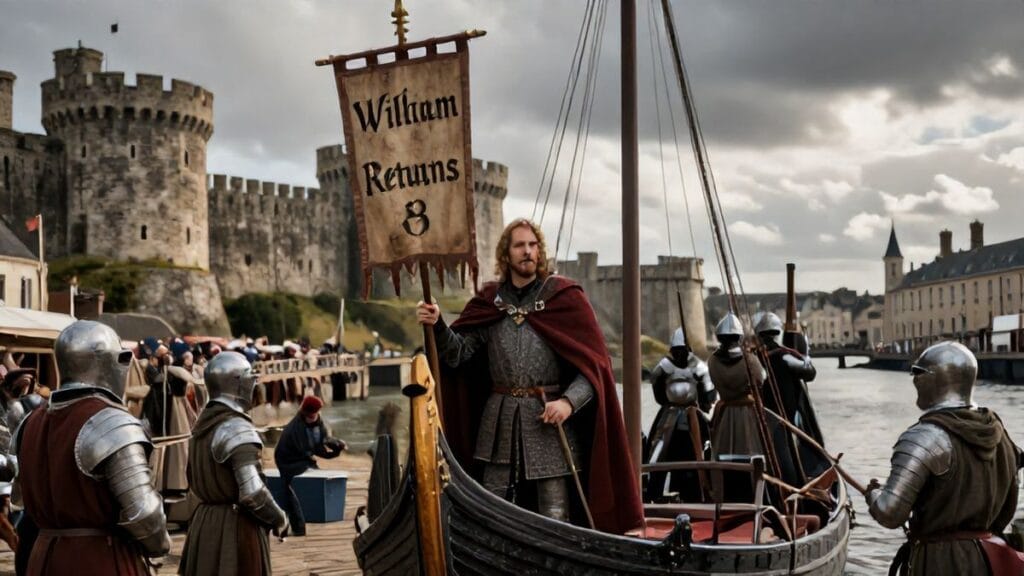
On a cold, wind-thickened March morning in 1067, the Norman coast rose from the mist like a revelation. The Channel, that narrow moat between two worlds, lay churned and gray behind the fleet. At the prow of the flagship stood a man who had left his homeland as a duke and now returned as a king. This was the moment william the conqueror returns to normandy, the instant when victory in a foreign land had to be translated into authority at home. Behind him, the sails snapped and bellied with the same stiff breeze that had once pushed his invasion fleet toward Hastings. Before him, the towers of Rouen and the rough palisades of Norman ports waited, bristling with men who had gambled everything on his boldness.
Those who watched him that day had known him by many names over the years: William the Bastard, William the Duke, William the invader. Now they would test the newest of his titles—King of the English—against the hard realities of Norman politics. The ships creaked, thick with treasure and captives that would turn his return into a spectacle of dominion. Chests of English coin and gilded church plate crouched in the holds like silent witnesses. Among the prisoners was Edgar the Ætheling, the teenage heir of the ancient royal house of Wessex, whose very presence embodied the old order that William had shattered. As william the conqueror returns to normandy, the shadows of burned English villages and bloodied fields crossed the water with him.
Yet for the people lining the shores, for the fishermen who hauled in their nets and the peasants who paused in muddy fields to squint at the sails, the scene held a simpler meaning: their duke had come home alive. Many had sent husbands, sons, or lords across the sea the previous autumn. Some had never again seen those faces. Others had waited through the winter with half-whispered prayers and half-spoken fears. Now, at last, a line of black sails cut toward the harbors of Normandy, promising answers—glorious, terrible, or both. When william the conqueror returns to normandy in March 1067, it is not simply a political event; it is a moment that reaches into kitchens and chapels, into the deep anxieties of a society that had wagered its future on victory abroad.
Standing on that deck, William would have understood this. He had grown up amid Norman turbulence, a child duke surrounded by conspiracies and knives. The sea wind, cold on his scarred face, must have reminded him that triumph is never secure, and that the acclamation of the crowds can flip, almost overnight, into rebellion. And so, even as the bells of the coastal churches began to ring, as the first cries of welcome drifted out over the water, William’s mind was already working ahead. His return to Normandy could not be a mere homecoming. It had to be a calculated performance, a carefully choreographed display of wealth, might, and divine favor. If william the conqueror returns to normandy as just another warlord who got lucky overseas, the fragile structure of his new kingship might crack. He had to return as the chosen instrument of God, the man who had subdued England and, by doing so, had lifted Normandy onto a new plane of history.
From Bastard Duke to Conquering King: The Road to 1067
To understand why March 1067 mattered so utterly, one has to step back into the smoke and swirling loyalties of William’s youth. Born around 1027 to Duke Robert of Normandy and Herleva, a tanner’s daughter from Falaise, William had entered the world with the indelible stigma of illegitimacy. In the rough codes of eleventh-century Europe, “bastard” was more than an insult; it was a weapon, an argument against a man’s right to rule. Yet from the moment his father died on pilgrimage in 1035, leaving the boy as heir to the duchy, William’s survival and eventual ascent depended on an ability to outfight, outthink, and outlast enemies who despised him.
His early life was punctuated by palace coups, assassination attempts, and sudden eruptions of violence. Norman nobles, smelling opportunity in the vulnerability of a child ruler, raised rebellions again and again. One chronicle grimly notes that his guardians were “killed almost in succession,” leaving the young duke to navigate a court where support could vanish overnight. These storms forged in William a constant awareness that authority must be demonstrated relentlessly. When he fought at Val-ès-Dunes in 1047 with the help of King Henry I of France, or crushed rivals in the 1050s, he was not merely defending his title—he was rehearsing a repertoire of intimidation and calculated mercy that would later characterize his rule in England.
By the time he set his gaze across the Channel, William had spent decades building a tightly controlled Norman state. He rewarded loyalty with land and offices, revived ducal control over castles, and tied the church to his cause by supporting reform-minded clergy. The Norman aristocracy that crossed to England in 1066 did so not as a loose rabble of adventurers but as the hardened product of this system. They trusted William because he had proven himself ruthless but predictable. In Normandy, his justice might be severe, but it was understood. This background matters when william the conqueror returns to normandy in 1067. Those who greet him see not only the fresh laurels of Hastings but the long shadow of a ruler who has weathered every storm thrown at him since childhood.
His claim to the English throne rested, in his telling, on promises and an oath: a supposed offer from King Edward the Confessor, and a sworn pledge from Harold Godwinson, who later took the crown himself. Whether or not the details are as William’s propagandists insisted, what matters is that by the mid-1060s, he had conceived a vision of himself as the rightful, God-supported heir to England. The invasion of 1066 was thus framed not simply as conquest but as “restoration.” When william the conqueror returns to normandy in 1067, he must prove to skeptical Norman barons that this grand ideological edifice has yielded concrete rewards. They will want to see English lands granted, English treasure piled high, English rivals trampled underfoot. William understands this. His entire life has trained him to know exactly what his followers expect from him after such a gamble.
Normandy Awaits Its King: Rumors, Preparations, and Silent Fears
Throughout the winter of 1066–1067, news from England filtered into Normandy in ragged fragments. A monk at Bec might hear that Harold had fallen with an arrow in his eye; a merchant at Rouen’s riverfront might learn that London had yielded, “more from fear than from love.” Letters and messengers carried more formal updates, but in the dim hearth-lit halls of Norman fortresses, it was rumor that truly shaped expectation. Stories grew in the telling. Some insisted that England was so rich that a man could walk from Dover to York on golden coins. Others swore the English had fought like demons, that God alone had bent the battle in William’s favor. For those whose sons and brothers had crossed with the duke in September, each rumor could quicken or break a heart.
Norman lords waited with a mixture of excitement and unease. They had backed William’s invasion not just out of loyalty, but from expectation of reward. Land-hungry knights dreamed of stone halls on English soil; abbots imagined their monasteries endowed with new estates and tithes across the sea. But for every man who anticipated fortune, another worried about the consequences. If William remained too long in England, would Normandy’s governance falter? If, on the other hand, he returned but centered his ambitions there, would the duchy become a mere staging ground, its old autonomy eroded by a distant king’s preoccupations?
The ducal administration tried to project stability. William had entrusted the rule of England to trusted lieutenants—his half-brother Odo of Bayeux and William fitzOsbern—which implied a parallel question: who, in turn, would ensure that Normandy did not drift? Some of the duchy’s leading magnates, such as Roger of Montgomery, had stayed behind, acting as anchors of ducal interest. Yet their very prominence raised another fear: might success in England inflate these men’s ambitions at home? When william the conqueror returns to normandy, would he find a hierarchy as obedient as when he departed, or one subtly reshaped by his absence?
In villages and small towns, the mood was simpler but sharper. Families whose men had not returned from England tried to draw meaning from the silence. Was the lack of message a sign of glorious death or meaningless slaughter? Priests wove the events into sermons, presenting William’s campaign as a righteous mission blessed by God. Victory, they insisted, would redound to Normandy’s benefit. But peasants knew that glory above rarely lessened the tax demanded below. For them, william the conqueror returns to normandy meant the possible raising of levies, the confirmation of new lords, perhaps a tightening of obligations as the duke sought to fund his new kingship. Awe and anxiety braided together as the duchy waited for its king to come home.
The Channel Crossing of March 1067: Ships, Storms, and Sacred Relics
The decision to leave England, even briefly, was not one William took lightly. Having been crowned in Westminster on Christmas Day 1066, he had spent the next months trying to establish his grip on a wary and smoldering kingdom. Yet by early 1067, he recognized that his new authority needed to be sanctified not only among the beaten English but also among those who had raised him. He could not let tales of victory suffice; he needed to present himself in person, with the tangible spoils of conquest. And so, as winter thinned, he gathered a fleet for the return voyage.
The crossing itself carried echoes of the earlier invasion, but this time the emotional weight was different. Instead of anxious expectation, there was a heavy, almost solemn fulfillment. The ships bore not only men but symbols. On board were relics and banners that had flown over Hastings, relics through which William believed he had sworn to uphold justice in England. According to later accounts, when william the conqueror returns to normandy now, he does so with a heightened sense of having fulfilled a divine pact: he had fought under the sign of holiness, won, and now came back to display that victory as proof of God’s favor.
But the fleet also carried a darker cargo: hostages and captives meant to guarantee obedience on both sides of the Channel. Edgar the Ætheling traveled among them, along with other English nobles of importance. Their presence served multiple purposes. First, they were insurance. If unrest flared in England while William was away, their lives could be weighed against rebellion. Second, they were living trophies, to be shown in Normandy as evidence that the old English dynasty had been subdued. It is astonishing, isn’t it, how often medieval rulers compressed complex political messages into the mute bodies of human beings? When william the conqueror returns to normandy with an English prince effectively in chains, he communicates in an instant what pages of charters could not: that the old line of Wessex now travels at his command.
Weather always played a role in Channel crossings, and chroniclers later remark on the favor the elements seemed to show William. That does not mean, of course, that the journey was easy. Ships could splinter on unseen shoals; a sudden squall could turn triumph into mass drowning. Men aboard would have watched the horizons with anxious eyes, clutching small relics or talismans. In such fraught moments, even veterans of battle found themselves thinking of home, of whether their faces would be recognized when they stepped again on Norman soil. For them, the phrase william the conqueror returns to normandy carried a personal resonance: if their lord came back, perhaps so would they. Survival was as much a part of the glory as victory itself.
A Triumphal Entry: How William Was Received When He Reached Normandy
When at last the leading ships appeared off the Norman coast, signal fires climbed into the sky. Messengers raced inland; bells began ringing in scattered churches and, soon, in a widening cascade of sound that swept toward Rouen and Caen. People poured onto roads and riverbanks, eager for a glimpse of the returning ruler. Chroniclers describe his reception in language reserved for coronations and saints’ festivals. Orderic Vitalis, writing decades later but drawing on living memory, depicts a duchy exultant at the success of its duke turned king, celebrating “with great rejoicing and thanksgiving to God” the safe return of their lord.
William understood spectacle. He would not have stepped ashore quietly. This was theater as much as politics. He likely landed at a carefully chosen point, with banners unfurled, trumpets sounding, and high-ranking clergy ready to greet him with relics and blessings. Torchlit processions, formal entries into key cities, and public thanksgivings at major churches would have followed in quick succession. When william the conqueror returns to normandy, he crafts his arrival as a narrative: Normandy had sent her duke forth to claim a distant inheritance; now he brought that inheritance back as a shared triumph.
The imagery mattered. The king wore English regalia, or at least some marks of his new status, so that his altered rank could not be missed. Before the doors of cathedrals, bishops and abbots intoned prayers, praising the victory as proof that God had smiled on both Normandy and its ruler. For common onlookers, it must have been dizzying—a familiar figure now wrapped in unfamiliar majesty. He was still their duke, the man whose officers collected dues and enforced judgments, but he was also something else, something larger. In his person, the boundaries of their world had stretched, reaching across the sea to envelop another kingdom.
Yet behind the celebrations lay subtler calculations. Noble faces in the crowd were not just turned upward in awe; they watched, measured, compared. How lavish were the processions? How many English captives walked in the train? How heavy did the chests of treasure appear when lowered from the ships? This choreography would signal William’s willingness and ability to share the fruits of conquest. Every gleam of gold hinted at estates to be granted, every powerful prisoner at new leverage to be exploited. As william the conqueror returns to normandy, he must balance the image of invincible monarch with that of generous lord. Too much emphasis on royal splendor, and his followers might see a king withdrawing into distant magnificence; too little, and they might doubt the scope of what had been won.
Displaying a Captive King: Edgar the Ætheling and the Theater of Power
Among the many images that seared themselves into Norman memory that spring, one stood out: the sight of Edgar the Ætheling, the last male descendant of the old English royal line, walking in William’s entourage as a subdued, almost decorative presence. In March 1067, the boy was likely no more than fifteen or sixteen, a thin, pale figure with the weight of a shattered kingdom on his shoulders. Once offered the crown by desperate English nobles after Harold’s death, he now followed in William’s wake, his very youth magnifying the pathos of his situation.
William did not humiliate Edgar openly. That was not his style. He preferred subtler dominance, the kind that let onlookers draw conclusions for themselves. Placing Edgar in his retinue, perhaps near the rear, richly but modestly dressed, sent a powerful signal. The old line of Wessex had not been eradicated; it had been captured and domesticated. When william the conqueror returns to normandy with Edgar at his side, he invites his subjects to observe a living symbol of legitimacy bent to his will. If anyone in Normandy doubted whether the conquest truly extinguished English resistance, the quiet presence of this would-be king answered them.
For Edgar himself, the journey must have felt like a funeral without a corpse, his exile the burial of his family’s centuries-long dominion. The Norman courtiers around him would have spoken their own tongue, laughed at jokes he could not always follow, treated him with a careful mixture of courtesy and containment. He was a guest, but of the kind who could never leave without permission. Later histories sometimes portray Edgar as a shadowy, almost passive figure, but in 1067 his very existence was still politically charged. William could not risk either his death, which might create a martyr, or his freedom, which might furnish a banner for rebellion. Keeping him close, especially when william the conqueror returns to normandy for the first time, was the safest course.
Norman eyes appraised the young English prince not only as a symbol but as a man. Was he strong-willed? Cowed? Intelligent? Such judgments mattered because they shaped the imagined future. If, by chance, William’s own line failed, might someone, decades hence, try to revive Edgar’s claim? Unlikely, perhaps, but not unthinkable. Medieval politics was haunted by the persistence of bloodlines long thought extinguished. For now, however, Edgar’s presence worked in William’s favor. He had turned a potential rival into living proof of his victory, and as he paraded him through Normandy’s churches and halls, he wove the conquest of England into the duchy’s own story of itself.
Gifts of Blood and Stone: English Treasure Flows into Norman Hands
In the great halls of Normandy, the clatter of feasting that spring was underscored by the softer, more telling sounds of treasure being counted. Chests were dragged in from storerooms, lids pried open, and out spilled the tangible consequences of war—silver pennies from English mints, gilded chalices from monasteries, jewel-studded reliquaries, embroidered hangings stripped from noble houses. To those who had followed William since his precarious youth, this wealth felt like vindication. The long years of service, the dangers faced in battle, finally turned into something concrete beneath their hands.
William used these riches carefully. He knew that raw plunder, however dazzling, could not hold a kingdom together. But distributed as gifts and endowments, it could bind his followers more tightly to him. So the ceremonies of welcome became also ceremonies of reward. He granted English estates on parchment, promising stone castles where there had once been timber halls. He donated English spoils to Norman abbeys, transforming loot into piety. When william the conqueror returns to normandy, English gold begins to rest on Norman altars and above Norman hearths, a quiet but permanent shift in the duchy’s material culture.
Yet such giving was never free. Every glittering gift carried with it an expectation of future service. A knight who received an English manor would soon learn that he was expected to defend it, to extract rents from a sullen foreign population, to be ready to sail at his king’s command when unrest flared. A monastery that accepted jeweled plate taken from an English church implicitly endorsed the conquest’s legality and morality. Over time, these bindings accumulated. By turning English wealth into Norman dependency, William ensured that his followers’ fortunes were now tied not just to his ducal authority but to the continued success of his rule in England.
There were darker stories whispering beneath the clink of coins. Some treasures bore the invisible stains of their origins: torches thrust into thatched roofs, villages harried for refusing to submit, monks driven from cloisters while soldiers rifled through the sacristy. Few in Normandy dwelled on such details during the spring feasts. War’s cruelties lay conveniently across the sea. Yet an uneasy question lingered in some hearts: if their lord could do this in England, what might he demand at home if challenged? When william the conqueror returns to normandy weighted down with riches wrung from another land, he announces, intentionally or not, that he is no longer bound by the old scale of ducal power. The rewards were magnificent—but so were the stakes.
The Duke’s Council: How Normandy Was Governed While William Seized a Crown
Behind the visible pageantry of William’s return lay a quieter reckoning: Normandy had survived his absence. The machinery of government had not fallen apart when the duke assembled his invasion fleet; castles had not changed hands en masse; rival claimants had not risen to seize his throne. This stability was an accomplishment in itself, the fruit of two decades of consolidation. When william the conqueror returns to normandy and convenes his councils, he can look upon a political landscape that bears the marks of his earlier reforms.
Key to this resilience were trusted magnates who had remained behind. Men like Roger of Montgomery and others helped to anchor Norman authority, administering justice, overseeing fortifications, and dampening the ambitions of those who might have used the duke’s absence as an excuse for disorder. Their task was delicate: to act with sufficient firmness to keep the peace, yet with enough restraint that no one could accuse them of usurping ducal authority. In the sessions that followed William’s return, these men would have to account for their stewardship—explaining decisions, defending judgments, perhaps facing subtle reproaches where they had overreached or faltered.
In formal assemblies, bishops and abbots joined lay lords to advise the duke-king. Charters were confirmed, disputes adjudicated, and policies for the governance of the expanded realm debated. These councils were not parliaments in the later sense, but they were crucial arenas where consensus was forged and tested. William needed his Norman power base intact and loyal if he was to continue subduing England. Any hint that his return had exposed cracks—any sign that barons had grown too independent—would embolden enemies across the Channel.
It is here that the fact of dual rule first becomes sharply apparent. When william the conqueror returns to normandy, he must suddenly see with dual vision: each decision affects not just a duchy but a kingdom. Grant too much to a Norman lord, and he risks weakening his own hand in Rouen; grant too little, and that lord might sulk in his new English castle, half-hearted in crushing local resistance. In council, voices would have urged caution, others boldness. Some churchmen, mindful of canonical law, might have fretted about the brutality of the Domesday yet to come. Others, less scrupulous, saw only opportunity. William, sitting at the center of this web, measured, listened, and decided—always with the memory of his dangerous childhood reminding him never to let factions coalesce against him.
Between Mont-Saint-Michel and Rouen: Ceremonies, Oaths, and Silent Calculations
William’s itinerary in 1067 likely swept him between the great symbolic sites of Normandy: Rouen, the ducal capital; Caen, where he and his wife Matilda were building vast new abbeys; and perhaps Mont-Saint-Michel, where the archangel’s sanctuary had lent divine glamour to his cause. At each stop, ceremonies stitched the conquest of England into the duchy’s fabric. Masses of thanksgiving were sung. Processions wound through streets, weaving the bodies of nobles, clergy, and commoners into momentary unity. Oaths of loyalty were renewed or freshly sworn, not only to William as duke but now as king.
Oaths in the eleventh century were not casual. They were sworn on relics, on the Gospels, on the very bones of saints. To perjure oneself was to risk not just earthly punishment but eternal damnation. William knew the power of this belief; it had formed part of his propaganda against Harold, whom he accused of breaking a sacred oath. Now, when william the conqueror returns to normandy, he uses oaths again, binding his Norman vassals to accept, defend, and profit from the new Anglo-Norman order. Each right hand placed on a reliquary was another thread in the web he spun across the Channel.
Yet beneath the solemn ritual there was calculation. Every baron who knelt to pledge fealty weighed his own position. How much did he stand to gain from further campaigns in England? How much did he risk if William’s English adventure faltered? Some may have quietly wondered whether the duke-king’s growing entanglements abroad would distract him from local grievances, allowing rivalries to fester. Others saw the opposite: a ruler whose enhanced prestige made it even more dangerous to oppose him. The mood in these gatherings flickered between genuine piety, opportunistic enthusiasm, and a wary prudence that did not quite dare speak its name.
The church, too, evaluated the moment. Norman abbeys like Bec and Fécamp had long been centers of learning and reform, and many of their clerics saw in William’s success an opening to extend their influence into England. Already, plans were forming to send Norman prelates across the Channel, to replace or overshadow their English counterparts. The ceremonies of 1067 thus carried a second, quieter meaning: they were auditions for men who hoped soon to occupy English sees, to preside over cathedrals from Canterbury to York. When william the conqueror returns to normandy to give thanks, some of the hands raised in blessing are already reaching out, in imagination, toward distant altars in a conquered land.
The Human Cost of Glory: What William’s Return Meant for Norman Families
For all the grandeur unfolding in cathedrals and great halls, March 1067 also unfolded in kitchens and courtyards, in the private spaces where women and children reckoned with the cost of the conquest. Not every man who had sailed with William in 1066 stepped off the returning ships. In rural Normandy, widows listened for news that never came, then slowly absorbed the implication of the silence. Some received confirmation—a comrade who had survived brought back a cloak, a weapon, a final message. Others had to infer loss from absence alone, the ache of waiting endless but for the cold practicality of need: fields had to be tilled, animals tended, children fed.
Victory brought some families advancement. A younger son, once landless, might now be promised an English manor, his future transformed by another people’s defeat. But this also meant change for those who stayed behind. Wives faced the prospect of uprooting, following husbands across the Channel to alien landscapes where the language was strange and the neighbors resentful. Elderly parents contemplated the likelihood that they would never again see sons who took up residence in distant English shires. When william the conqueror returns to normandy and proclaims opportunity, that opportunity is tinged with the bittersweet realization that Normandy may no longer contain the whole of one’s life or lineage.
There was fear, too, that the appetite awakened by English lands might not be satisfied by distant conquest. War-hardened men, returning to Norman villages for a season, carried new expectations of wealth and authority. Having helped to burn English manors, would they accept traditional limits on their behavior at home? Would quarrels between neighbors now escalate more quickly, both sides imagining themselves as petty conquerors in miniature? The social fabric of Normandy had been woven in a world where the duchy’s boundaries naturally constrained ambition. Now, with those boundaries stretched, the threads strained in ways subtle but profound.
Yet amid all of this, pride was genuine. Songs and tales began to circulate, recounting the deeds of knights at Hastings. Children listened with wide eyes as their elders claimed, or embellished, roles in the great battle: “Your uncle held the line when the English charged,” “Your father was one of the first to reach the hill.” In these stories, the Channel was not a barrier but a backdrop to family legend. William’s return gave such narratives an anchor point. The day william the conqueror returns to normandy, marching through familiar streets in foreign regalia, many in the crowd would have felt that history—distant, impersonal—had suddenly passed very close to their own doors.
Echoes Across the Channel: England Under Regent Rule While William Feasted in Normandy
While Normandy rang with celebration, England simmered. William had not left his new kingdom unattended; he appointed regents, notably his half-brother Odo of Bayeux and William fitzOsbern, to govern in his stead. These men wielded immense power, tasked with maintaining order in a land still reeling from invasion and dispossession. Yet their rule, untempered by the steady presence of the king, sometimes veered toward excess. Contemporary accounts speak of harsh exactions, arbitrary seizures of land, and a hauteur that stoked resentment among the English.
The Anglo-Saxon Chronicle, compiled by English monks struggling to preserve their people’s perspective, records with bitter succinctness the pressures of Norman rule. “He made many castles,” one entry laments, “and poor men were sorely oppressed.” William had barely crossed the Channel when pockets of resistance began to stir. In the West Country, in the north, and in the Welsh marches, uprisings flared. None yet threatened to unseat the Conqueror, but they signaled that his dominion was fragile. Every act of overreach by his regents was a small spark in a landscape of smoldering grievances.
From Normandy, reports of these disturbances reached William amid banquets and councils. The very triumphalism of his return sharpened the contrast. Here, he walked adored through streets he had known since childhood; there, his name was muttered in English churches with dread and anger. It is one of the ironies of 1067 that the moment william the conqueror returns to normandy to display the glory of his English crown is also the moment when the limitations of that crown become clearest. A kingdom cannot be ruled by proxy for long when its people do not yet accept the new order.
This tension shaped William’s strategy. The spring sojourn in Normandy was not an abdication of responsibility, but a calculated interlude. He needed to extract from his homeland the resources—military, financial, spiritual—that would enable him to return to England with the means to crush resistance. The chill English spring and summer of 1067 thus unfolded in a lopsided echo of Norman celebration: while prayers of thanksgiving rose from one side of the Channel, pleas for relief and muttered curses seeped from the other.
The Forging of a Dual Realm: How England and Normandy Were Bound Together
By stepping ashore in March 1067 as both duke and king, William inaugurated a political arrangement that would shape centuries of Western European history. He was no longer merely the ruler of a compact, fiercely independent duchy; he had become the master of a cross-Channel polity whose core territories faced one another across an often-troubled sea. The very fact that william the conqueror returns to normandy at all, rather than establishing his permanent residence in England, speaks volumes. He conceived his authority as fundamentally rooted in Normandy, extended but not overshadowed by his English crown.
This duality created both strength and vulnerability. On the one hand, William could draw upon the combined resources of two rich lands: the military traditions of Norman chivalry and the agricultural wealth of English shires. He could reward his followers with fiefs on either shore, weaving a nobility whose interests spanned the Channel. On the other hand, his enemies could exploit the gap. A rebellion in England might be timed to coincide with unrest in Normandy; foreign rivals like the kings of France and the rulers of Scotland or Denmark could play one side of his realm against the other.
Institutionally, the union was personal, not bureaucratic. There was no single “Anglo-Norman empire” in a formal sense, no unified set of laws or administrative structures. Normandy retained its ducal customs; England kept much of its existing legal framework even as Norman lords took control of its land. But over time, the flow of men and ideas blurred distinctions. Norman architects introduced new church styles in England; English silver underwrote the construction of massive Norman abbeys. Clerics shuttled between sees, barons attended courts on both sides, merchants followed the itinerant court. The act by which william the conqueror returns to normandy in 1067 is thus not an isolated episode but the first of many journeys that stitched these worlds together.
In this context, March 1067 appears as a hinge. Before it, William is primarily a Norman duke staking a claim abroad. After it, he is irrevocably a ruler whose domain cannot be mapped without tracing a line across the water. Future crises—the rebellion of 1075, the harrying of the north, the tensions with the French crown—would all be shaped by this structural reality. The narrow sea that had once protected England now acted as both moat and bridge. And at the center of this transformation stood the man whose footsteps, that spring, echoed in the cloisters and council chambers of Rouen and Caen.
Churchmen and Chroniclers: How 1067 Was Remembered and Justified
The story of william the conqueror returns to normandy comes down to us largely through the pens of churchmen, men whose own positions were tied to the fate of rulers. Orderic Vitalis, writing in the early twelfth century, paints William as a stern but essentially just monarch, a man whose harshness was at times “necessary” for the maintenance of order. William of Poitiers, the duke-king’s biographer and a partisan voice, celebrates his patron as chosen by God, portraying the conquest of England as a righteous act that brought a barbarous land into closer alignment with divine order. These perspectives were not disinterested. Many of the monasteries that preserved and copied such accounts had themselves benefited from William’s patronage, receiving English estates and lavish gifts.
In their narratives, William’s return in 1067 becomes a natural, almost inevitable scene in a providential drama. The duke who had won a kingdom comes home to give thanks, to share the fruits of victory with his faithful, to be acclaimed as the instrument through whom God chastised and reformed the English. The awkward details—the suffering of the conquered, the overbearing behavior of regents, the anxieties of Norman peasants—slip into the background, reframed as temporary pains on the path to a higher good. When one reads, for instance, the triumphal tone in which William of Poitiers describes the display of English captives in Normandy, it is clear that he sees no moral ambiguity in turning human defeat into spectacle.
Yet not all voices were so untroubled. The Anglo-Saxon Chronicle, though inevitably limited in its view of events in Normandy, hints at a very different emotional landscape. From the English perspective, William’s returns across the sea signaled not homecoming but dread—the comings and goings of a conqueror whose absences might provide brief respite, but whose reappearances often presaged new demands. Even some Norman writers, with the benefit of hindsight, allowed themselves to criticize aspects of William’s reign. Orderic Vitalis, for example, while deeply respectful, does not hesitate to condemn the ravaging of northern England as an act that left the land “bare of inhabitants and beasts” for years, a judgment that throws a retrospectively harsh light on the celebrations of 1067.
These conflicting memories remind us that history, even when carefully chronicled, is a contested space. The scene in which william the conqueror returns to normandy in March 1067 can be read as a moment of rightful glory or as the quiet prelude to further oppression, depending on whose gaze we adopt. For the men holding quills in scriptoria from Caen to Canterbury, making sense of such events required weaving them into stories that reassured as much as they recorded. By framing the conquest as divinely sanctioned and its fruits as justly distributed, they helped to legitimize a new order that, in lived reality, remained sharp-edged and uncertain.
Dissent in the Hall: Whispers of Resistance Among Norman Barons
Not all Norman nobles greeted William’s transformation into a cross-Channel monarch with unalloyed joy. In the corners of great halls, in the half-private space between the hearth and the dais, doubts were voiced in low tones. Some barons had gained magnificently from the conquest; others, who had taken equal risks, found themselves with less than they had hoped. Resentment flickered wherever expectations and reality diverged. When william the conqueror returns to normandy in 1067, bringing gifts and honors, he also brings the first clear evidence of how he intends to rank his followers in this new Anglo-Norman hierarchy.
There were deeper concerns as well. A duke whose main preoccupations lay across the sea might become inattentive to the delicate balances of power within Normandy itself. Ambitious men could exploit such inattention, carving out near-independent spheres of influence while William rushed troops back and forth to quell English uprisings. Others worried about succession. Which of William’s sons would inherit which part of his composite realm? Would the duchy and the kingdom be kept together or eventually divided, forcing Norman barons to choose sides?
Some of these anxieties would surface more openly later in William’s reign, and especially after his death, when his sons fought over their inheritances. But the seeds were planted early, in moments like those spring gatherings in 1067. A baron who felt slighted in the distribution of English lands might, in the future, prove lukewarm in supporting a risky campaign. A magnate who disliked the rising influence of certain royal favorites—men like Odo or fitzOsbern—might quietly cultivate alternative alliances. William, seasoned by decades of political survival, sensed such undercurrents. His demeanor in council, his choice of rewards and reprimands, all aimed to forestall the coalescence of any organized opposition.
Still, no ruler can hear every whisper. In the flicker of candlelight on hall walls, men weighed the benefits of unparalleled opportunity against the loss of a simpler, more contained political world. The year 1067 was not a year of open Norman rebellion—that would come much later in different forms—but it was a year in which the mental map of possibility shifted. The return of their duke as a king suggested that power itself could be reimagined, its scale enlarged. For a few, perhaps, that realization inspired loyalty; for others, it planted a stubborn, if silent, resolve not to be forever content with the roles William assigned them.
From Celebration to Calculation: William’s Strategy as He Prepared to Return to England
By late spring or early summer of 1067, the initial euphoria of William’s homecoming had given way to more sober deliberation. Reports from England made it clear that the kingdom would not simply acquiesce to Norman rule. Local uprisings, the maneuverings of exiled nobles, and the interest of foreign powers like Denmark all hinted at the fragility of his grip. William began to plan his return with the same cold attention to logistics and psychology that had characterized his invasion the year before.
He needed men—more soldiers to garrison restive regions, more administrators to oversee vast new estates. He needed money—taxes from Normandy, gifts redirected from churches, loans from wealthy merchants. He needed spiritual endorsement—a steady chorus of prayers from Norman monasteries to frame his stern measures in England as necessary acts of discipline rather than mere brutality. When william the conqueror returns to normandy in 1067, his gaze sweeps not only over what has been won but what must be done next. Conquest, he knows, is an event; rule is a process.
Strategically, William’s task was twofold. He had to prevent England from becoming a quagmire that would drain Norman strength indefinitely, and he had to ensure that his Norman base remained loyal while large numbers of its elite lived semi-permanently abroad. One solution was to tie Norman and English holdings together, making it so that a baron’s fortunes rested equally on both shores. This reduced the likelihood that any major magnate could treat England as a disposable adventure or Normandy as a fallback in case of failure. It also meant that when William next crossed the Channel, he would do so accompanied by men whose personal interests demanded the success of his campaigns.
Gradually, the feasts of thanksgiving gave way to quieter, more focused meetings. Messengers were dispatched with new orders; scribes drew up fresh grants of land; shipwrights and captains were contracted for further crossings. The moment when william the conqueror returns to normandy had been about demonstrating what had been accomplished. The preparations for going back to England were about acknowledging what remained precarious. Beneath the outward confidence of a crowned conqueror lay the restless mind of a man who had spent his entire life fighting for security and knew it could never be entirely achieved.
Women, Children, and Hostages: The Invisible Web of Loyalty
In accounts of kings and battles, it is easy to overlook the quieter instruments of power: marriages arranged to cement alliances, children sent to other households for fostering, hostages held to ensure good behavior. In 1067, these tools were very much at work. William’s wife, Matilda of Flanders, played her own role in Normandy’s political theater, presiding over courts and religious foundations while her husband traveled. Her presence reassured barons who valued continuity, even as it subtly reminded them that the ducal family was a dynasty, not a solitary warrior.
Children became living bridges across the Channel. Sons of Norman lords who had been granted English estates might be raised partly in Normandy, partly in England, or fostered in circles close to the royal family. Daughters became bargaining chips in an expanded marriage market, promised to men whose allegiance in either land needed to be secured. When william the conqueror returns to normandy, he does so as the patriarch of a clan whose future marriages and inheritances would shape the map more surely than any single campaign.
Hostageship, too, played its part. Some English nobles, allowed to retain partial holdings after submitting, saw their sons or brothers taken into Norman custody, whether in England or across the sea. These men lived under a suspended sentence of death or disfigurement, their safety contingent on their kin’s obedience. At the same time, William could not entirely dispense with traditional forms of trust; a regime based solely on fear would be brittle. So hostages sometimes found themselves integrated—cautiously—into court life, learning Norman customs, tongues, and expectations. Over years, such men might shift from coerced guests to genuine participants in the Anglo-Norman world.
Women of the ducal and baronial families moved at the edges of formal chronicles, but their influence was real. Matilda’s patronage of Caen’s abbeys, for instance, helped to frame the conquest as part of a divinely endorsed project of reform and piety. Noblewomen managing estates in their husbands’ absence sustained the economic base without which no military venture could stand. While william the conqueror returns to normandy to display the masculine drama of victory, these less visible figures maintain the social and domestic structures that make such displays possible. Their stories, mostly unrecorded, flowed beneath the surface of public events like an underground river.
After the Triumph: How 1067 Shaped the Anglo-Norman World
Looking back from the vantage point of later centuries, March 1067 appears as a hinge in more than one sense. It was the moment when a bold gamble—an overseas invasion justified by a contested claim—crystallized into a new, enduring political configuration. The scene in which william the conqueror returns to normandy with English spoils, English captives, and an English crown previewed many of the themes that would dominate the next century of Anglo-Norman history: the balancing act between cross-Channel commitments, the intertwining of church and state, the strained loyalties of a nobility with divided homes.
In the immediate years that followed, William would face serious tests: uprisings in the north of England, the threat of Danish intervention, conspiracies among disaffected nobles. His response was often brutal. The Harrying of the North in 1069–1070 left whole regions devastated, a fact even sympathetic chroniclers like Orderic Vitalis could not entirely justify. Yet the deep structures laid in 1067—the distribution of land, the binding of Norman fortunes to English holdings, the enmeshment of church institutions in the new regime—gave him a foundation from which to act. Because william the conqueror returns to normandy early in his reign to secure these bonds, he is able later to throw English and Norman resources together in crushing resistance.
Over decades, the cultural consequences unfolded. An Anglo-Norman aristocracy emerged, comfortable on either shore, its members speaking a French-inflected tongue at home and hearing Latin in church, while the English language persisted and evolved among the common people. Architectural styles crossed the sea: heavy Romanesque arches and massive stone keeps rose in English towns, bearing the imprint of Norman masons. Legal practices blended elements from both traditions, producing, eventually, a distinctive English common law under Norman kings. None of this was inevitable in 1066 alone; it required the continued, deliberate weaving of connections that began in earnest when william the conqueror returns to normandy with his new crown.
By the time William died in 1087, fatally injured during a campaign in France, the outlines of the Anglo-Norman world were firmly set. His sons would squander some of his achievements in fraternal conflict; the eventual loss of Normandy to the French crown in 1204 would redraw the map once more. Yet the memory of that first return—of ships heavy with treasure, of a captured English prince walking in a Norman entourage, of chants of thanksgiving rising in Rouen’s churches—lingered. It symbolized not just a personal victory but the beginning of a shared, if uneasy, history between two lands that might otherwise have remained separate worlds.
Conclusion
In March 1067, as the gray waters of the Channel slid past his returning ships, William of Normandy stood at the intersection of past struggle and future empire. His life up to that point—marked by illegitimacy, rebellions, and hard-won consolidation—had equipped him to gamble for a crown across the sea. The moment william the conqueror returns to normandy, crowned and laden with English spoils, he transforms that gamble into a new political reality. This was more than a victorious general coming home; it was a duke recasting himself as a king, a regional strongman stepping onto a broader continental stage.
The return crystallized multiple layers of consequence. For Norman elites, it validated their loyalty and opened vast new horizons of land and wealth, even as it sowed the seeds of later tensions and rivalries. For ordinary Normans, it mingled pride with loss, opportunity with uncertainty, altering the rhythm of daily life in ways they could scarcely have anticipated. For the English, many of whom saw none of the celebrations in Rouen or Caen, it signaled the consolidation of a conquest whose harsh edge they knew all too well.
Politically, the 1067 homecoming cemented the dual nature of William’s rule. From then on, England and Normandy formed a single, if fragile, unit of power, its coherence resting not on shared institutions but on the person and progeny of one man. Spiritually, church rituals and chroniclers’ narratives wove the conquest into a story of divine favor, even as dissenting voices recorded the suffering it entailed. The image of ships crossing the narrow sea, bearing a ruler who straddled two worlds, would echo in the careers of his successors until the eventual sundering of the Anglo-Norman realm.
In the end, that spring’s ceremonies, councils, and quiet conversations remind us that history’s turning points are rarely contained in a single battle. The Battle of Hastings decided who could claim the English throne; William’s return to Normandy helped determine how that victory would be interpreted, shared, and sustained. It was in those weeks, as treasure was counted, oaths were sworn, and future campaigns were planned, that the Anglo-Norman world truly began to take shape. The story of 1067, of how william the conqueror returns to normandy and redefines both his homeland and his new kingdom, is thus not a footnote to conquest but its essential second act.
FAQs
- Why did William the Conqueror return to Normandy in 1067 after being crowned in England?
William returned to Normandy in March 1067 to consolidate his authority at home, display the tangible fruits of his English conquest, and reassure Norman elites that their risks had been rewarded. By presenting treasure, captives like Edgar the Ætheling, and new titles, he turned his personal victory into a shared triumph for the duchy. The visit also allowed him to secure additional resources—men, money, and ecclesiastical support—for the continuing task of pacifying England. - How was William received when he arrived back in Normandy?
He was welcomed with great ceremony and religious celebration. Processions, masses of thanksgiving, and formal entries into cities like Rouen underscored his new status as king as well as duke. Chroniclers describe widespread rejoicing and gratitude to God, although beneath the surface some nobles were already calculating how his changed position would affect their own power and prospects. - Who was Edgar the Ætheling, and why did William bring him to Normandy?
Edgar the Ætheling was the last male descendant of the ancient English royal house of Wessex and briefly a candidate for the English throne after Harold’s death. William brought him to Normandy as a prestigious captive, symbolizing the subjugation of the old dynasty. Displaying Edgar at court allowed William to demonstrate that potential rivals to his claim were under his control, turning the young prince into a potent piece of political theater. - What impact did William’s return have on ordinary people in Normandy?
For commoners, William’s return meant both pride and anxiety. Families who had sent men to fight at Hastings finally learned who had survived and who had not. Some saw their fortunes rise through kin who were granted English lands, while others faced the prospect of loved ones living permanently abroad. The influx of wealth and new obligations also hinted at higher taxes and tighter control, reminding people that the glory of conquest often came at their expense. - What was happening in England while William was back in Normandy?
While William was in Normandy, England was governed by regents, notably Odo of Bayeux and William fitzOsbern. Their harsh methods of tax collection and castle-building stirred resentment among the English population. Small uprisings and growing unrest signaled that Norman rule was far from secure, and news of these disturbances shaped William’s preparations to return, prompting him to gather more troops and resources for renewed campaigns of pacification. - How did William’s 1067 visit contribute to the creation of an Anglo-Norman realm?
The visit helped bind Normandy and England together by distributing English lands to Norman followers, endowing Norman monasteries with English wealth, and tying aristocratic fortunes to estates on both sides of the Channel. It also set the precedent for a ruler whose authority spanned two distinct territories linked by his person. Over time, this dual structure fostered a shared Anglo-Norman elite culture, even though the two lands retained separate legal and administrative traditions. - Did all Norman nobles benefit equally from William’s English conquest?
No, the rewards of conquest were unevenly distributed. Some leading nobles received vast estates and important offices in England, while others got less than they had hoped. This unequal distribution created undercurrents of resentment that would later contribute to tensions and conspiracies. William was aware of these risks and tried to manage them through careful grants and ongoing displays of favor and discipline, but dissatisfaction never fully disappeared. - How do we know about William’s return to Normandy and its significance?
Information comes primarily from medieval chronicles written by churchmen, such as Orderic Vitalis and William of Poitiers, as well as from the Anglo-Saxon Chronicle on the English side. These texts, though biased and incomplete, offer overlapping accounts of events and motivations. Modern historians compare these narrative sources with charters, legal documents, and archaeological evidence to reconstruct the political and social impact of William’s 1067 return.
External Resource
Internal Link
Other Resources
- Encyclopaedia Britannica – general search for the exact subject
- Google Scholar – academic search for the exact subject
- Internet Archive – digital library search for the exact subject