Table of Contents
- A Winter Morning in Palermo: The Spark of Rebellion
- Sicily Before the Storm: Bourbon Rule and Growing Discontent
- Memories of 1812: A Constitution That Refused to Die
- Europe on the Boil: 1848 and the Age of Revolutions
- January 12, 1848: Street by Street, Hour by Hour
- Voices of Palermo: Aristocrats, Artisans, and the Urban Poor
- From Uprising to Revolution: Palermo Takes Control
- Building a New Order: The Provisional Government and Its Dreams
- The Parliament of Sicily: Old Island, New Sovereignty
- Kings Without Thrones: Dethroning Ferdinand II and Seeking a New Monarch
- War in the Shadows: The Bourbon Counteroffensive and Military Campaigns
- Women, Priests, and Peasants: The Hidden Actors of the Revolution
- Between Palermo and the Countryside: Social Tensions Inside the Revolution
- International Echoes: London, Paris, and the Mediterranean Question
- The Fall of the Revolutionary Regime: Fire, Shells, and Surrender
- After the Cannons: Repression, Exile, and Broken Lives
- From Defeat to Myth: How 1848 Shaped the Risorgimento
- Memory, Monuments, and the Streets of Today’s Palermo
- Conclusion
- FAQs
- External Resource
- Internal Link
Article Summary: In the chill of a January morning in 1848, the streets of Palermo erupted into a revolt that would ignite one of the most compelling chapters of the European Springtime of Peoples. This article traces the origins, course, and consequences of the sicilian revolution 1848, from the weight of Bourbon absolutism to the brief, blazing experiment in self-government that followed. It explores the grievances of nobles, artisans, peasants, and intellectuals who, for a fleeting moment, believed that a different Sicily was possible. Moving chronologically, it recreates the barricades, the debates in the revolutionary parliament, the diplomatic games in distant capitals, and the brutal Bourbon reconquest. Yet behind the military and political narrative, it also follows individual lives—anonymous insurgents, exiled patriots, and families caught between hope and terror. The article then examines how this failed revolt helped prepare the ground for Italian unification a little more than a decade later. In doing so, it shows how the sicilian revolution 1848 became both a tragedy and a seed of the future, a lost cause that continued to burn in memory, monuments, and the very names of Palermo’s streets.
A Winter Morning in Palermo: The Spark of Rebellion
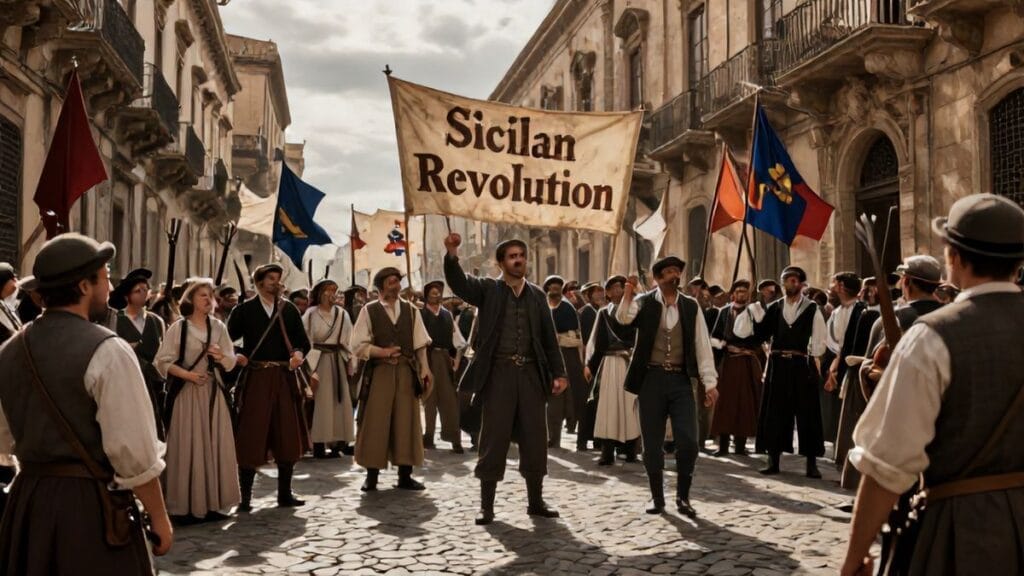
On the morning of January 12, 1848, Palermo woke under a gray winter sky that held the smell of the sea and the tension of unspoken defiance. It was the birthday of King Ferdinand II of the Two Sicilies, a day meant to be draped in loyalty and celebration. Instead, it became the opening scene of the sicilian revolution 1848, a day when the city chose gunpowder over fireworks and banners of revolt over royal flags.
The streets that had so long echoed with the clatter of carts and the cries of vendors now held a strange, expectant quiet. Doors were half-closed, thresholds watched. In the cramped quarters of the Kalsa, in the narrow arteries around the Quattro Canti, whispers traveled faster than the church bells: “Today.” Messengers had moved through the city over the preceding nights, slipping between taverns and workshops, passing coded phrases and folded scraps of paper. Palermo’s uprising was not a sudden irritation; it was the eruption of years of bitterness, rehearsed in secret and timed to strike on the very day the Bourbon monarchy wished to bask in its own glory.
That morning, as the sun began pushing light into the alleys, small knots of men appeared at key corners. Some carried muskets so old that they seemed to belong to another century; others clutched pistols, knives, or even farming tools. A few had nothing but stones and the certainty that if they did not rise that day, they might never find the courage to rise again. Window shutters were edged open by anxious eyes; behind them, women watched, children peered, old men murmured prayers over rosary beads worn smooth by decades of disappointment.
It is astonishing, isn’t it, how a revolution can begin almost quietly—no grand music, no formal declaration, just the sharp crack of the first gunshot. Somewhere not far from the city center, a volley broke the silence. A patrol of royal troops, startled and outnumbered, fired back. Within minutes, the clash spread like fire through dry brush. Church bells began tolling, some as alarms, others as signals. The people of Palermo understood what those bells meant: the long-dreamed rebellion had begun.
In that instant, the island’s fate bent in a new direction. The sicilian revolution 1848 would soon draw in every layer of society: aristocrats hungry for autonomy, professionals whispering about constitutions, artisans yearning for work and dignity, and peasants who only dimly understood the word “parliament” but knew too well the meaning of hunger and injustice. The spark lit in Palermo on that morning did not belong to one man or one party; it was a chorus of grievances, brought to a single explosive note.
Sicily Before the Storm: Bourbon Rule and Growing Discontent
To understand why Palermo rose in 1848, one has to step back from that charged winter morning and move through the suffocating decades that preceded it. Sicily, jewel of the Mediterranean, had passed in 1816 under the unified crown of the Kingdom of the Two Sicilies, ruled from Naples by the Bourbon dynasty. On maps, the name suggested harmony; in reality, it meant domination. To most Sicilians, the new order felt like an annexation more than a union.
Bourbon rule was not merely conservative—it was, in many respects, aggressively reactionary. Ferdinand II, who ascended the throne in 1830, centralized power with a mixture of piety, suspicion, and iron will. The island’s old institutions, which had once given Sicilian elites a voice, had been steadily stripped of authority. A distant bureaucracy in Naples controlled taxation, appointments, and the judicial system. Money flowed outward: grain, citrus, sulfur, and the hard-earned taxes of Sicilian subjects continued their steady journey toward the capital across the sea, while little investment returned.
Economic discontent seeped into every crevice of Sicilian society. The countryside was dominated by great landlords, some resident, many absent, who rented land to intermediaries and squeezed the peasantry through a chain of exploitation. In the cities, artisans and small traders faced rising costs and unreliable work. Recurrent harvest crises, compounded by speculation and corruption, meant that in lean years bread was dear and anger cheap. The Bourbon police watched the discontent closely, but they watched more for seditious ideas than for genuine misery.
Yet poverty alone rarely makes a revolution. What gave the sicilian revolution 1848 its particular intensity was the coexistence of social suffering with a vivid memory of lost liberties and a growing culture of political thought. In salons and cafes of Palermo and Catania, in clandestine reading circles, people read of the French Revolution, the American Republic, and the experiments in constitutional monarchy in Britain and elsewhere. They read, too, of their own past—when Sicily had briefly possessed a modern constitution that made it the envy of reformers across Europe.
The Bourbon regime, fearful of exactly this kind of intellectual ferment, tried to smother it with censorship and surveillance. Newspapers were muzzled; the postal service became a net for catching dangerous correspondence. Police informants haunted public spaces, listening for any critique of the king that dared show itself above a whisper. Prisons on the mainland and in the islands took in political suspects, some of whom would later reappear as seasoned revolutionaries in 1848. The result of this repression was not obedience but a grim accumulation of hatred, hidden behind formal courtesies and outward religious observance.
In such a climate, every insult, every arbitrary arrest, every tax rise became more than an isolated injustice; it became another bead on a necklace of grievances that, once complete, would choke the old regime. All that was needed was a moment when these complaints could be spoken aloud together—when, as one contemporary later wrote, “the island’s heart decided that silence had become more dangerous than revolt.”
Memories of 1812: A Constitution That Refused to Die
Long before the first barricade went up in 1848, Sicily had already experienced a taste of constitutional life, one that haunted the Bourbons like a specter. In 1812, while Europe still trembled under the shadow of Napoleon, Sicily had adopted a liberal constitution inspired by the British model. It introduced a parliament with legislative powers, recognized certain civil liberties, and promised a balance of authority between king and representatives. For a time, under the protection of the British fleet, Sicily had seemed poised to become a modern constitutional monarchy.
That experiment ended with the restoration of Bourbon power after Napoleon’s fall. In 1816, the Kingdom of the Two Sicilies was created, and the Sicilian constitution was swept aside. Official decrees tried to bury it as an embarrassing anomaly, a temporary aberration. But paper is not so easily burned in memory. Among the Sicilian nobility and the educated middle classes, the constitution of 1812 turned into a legend of lost possibilities, a living argument that Sicily had once been—and therefore could be again—more than a mere province under Neapolitan tutelage.
By the 1840s, some of the same families whose fathers and uncles had sat in that short-lived parliament were nurturing younger generations on stories of those days. In dimly lit drawing rooms, young lawyers, writers, and professionals listened as elders described the debates of 1812, the hopeful passes of legislation, the sense that Sicily had briefly stood at the forefront of European reform. For these listeners, the sicilian revolution 1848 would not be an outburst of blind rage, but the deliberate attempt to restore a constitutional order stolen from them a generation earlier.
This memory was sharpened and weaponized by secret societies. Carbonari lodges and later, in some cases, circles sympathetic to Giuseppe Mazzini’s ideas, took the legacy of 1812 as both precedent and justification. They argued that the king had broken a fundamental pact with the Sicilian people when he abolished the constitution and dissolved their parliament. The language of contracts and betrayals, of ancient rights and violated compacts, infused the pamphlets that circulated clandestinely in the late 1840s.
When the conspirators of Palermo thought about their demands, they often framed them not as revolutionary novelties but as the restoration of an order that history and justice already endorsed. Even moderates who distrusted radical republicanism could support the call for the reestablishment of the 1812 constitution or something modeled on it. This allowed the cause to reach across divisions—between nobles and professionals, between aging notables and fiery students. As one pamphlet, preserved in a Palermo archive, declared, “We do not aspire to be innovators; we aspire to be faithful to the liberty we tasted and that was taken from us.”
Thus, beneath the visible tensions of taxes and troops, there flowed a powerful undercurrent: the conviction that Sicily possessed an identity and a political tradition distinct from Naples. The sicilian revolution 1848 would rise on that undercurrent like a ship on a hidden tide, carried forward by a collective memory that refused to fade.
Europe on the Boil: 1848 and the Age of Revolutions
The events in Palermo were not isolated sparks in a dark sky; they were the first bursts of a continental wildfire. The year 1848 would later be remembered as the “Springtime of Peoples,” a season when old thrones trembled and the word “nation” surged from the lips of crowds across Europe. But it is crucial to recall that on January 12, when Sicilians rose in arms, most of Europe had not yet erupted. The rebellion in Palermo was among the opening shots of a year of revolutions that would reach from Paris to Vienna, from Milan to Berlin.
Across the continent, the forces driving change shared familial similarities: demands for constitutions, national independence or autonomy, civil liberties, and relief from economic hardship. News traveled slowly compared to today, but it traveled enough. Sicily’s elites read foreign newspapers, heard of the Chartists in Britain, the tremors of unrest in the Habsburg lands, and the mounting frustrations in the Italian peninsula under Austrian dominance. The rising Italian nationalist movement, the Risorgimento, had already begun to articulate the dream of a united or at least federated Italy, free from foreign rule and absolute monarchies.
In this wider context, the sicilian revolution 1848 looked both local and international at once. Locally, it was about the island’s autonomy and the restoration of a lost constitution. Internationally, it belonged to the wave of constitutionalism and national self-assertion that swept the era. The double nature of the revolt would make its diplomacy complex: should Sicily present itself primarily as an autonomous kingdom returning to its historic status, or as a partner in the broader Italian national struggle? That tension would haunt the revolution from its moment of triumph to its hour of defeat.
News of Paris’s February Revolution, which overthrew King Louis-Philippe, would inspire and validate movements elsewhere, but by then Palermo had already acted. Some contemporaries in Europe were astonished that the first stones had been thrown not in the great capitals of the north, but on a Mediterranean island often caricatured as backward and passive. The Sicilian uprising thus became, in the words of one British observer, “the unexpected herald of a European year of reckoning.”
Diplomats in London, Paris, and Vienna watched the events on the island with a mixture of curiosity and alarm. The Mediterranean was a vital corridor of commerce and strategy. A destabilized Sicily, perched in the center of the sea, could become either a beacon of liberal constitutionalism or a pretext for foreign intervention. The British, still remembering their wartime alliance and influence in Sicily during the Napoleonic period, kept careful track of developments, weighing sympathy for constitutionalism against the need for stability.
Thus, from its first days, the revolution in Palermo was entangled in a web of international expectations and fears. Its success or failure would not be judged solely in Neapolitan palaces or Sicilian piazzas, but also in the embassies and foreign ministries of Europe, where men in uniforms and frock coats measured the island’s fate against their own interests.
January 12, 1848: Street by Street, Hour by Hour
Reconstructing that first day of revolt in Palermo is like piecing together a tapestry from frayed, biased threads. Yet from memoirs, official reports, and later histories, a vivid mosaic emerges. At dawn, the plan was known only to a limited circle: they aimed to seize weapons, rally the population, and drive the royal troops from strategic points in the city. They counted on surprise and on the fact that the garrison was not as numerous as it might have been; Naples, confident in the apparent calm of recent years, had not flooded Palermo with reinforcements.
The first clashes broke out in poorer districts, where anger against the Bourbon state was especially raw. Groups of insurgents attacked patrols, cut off communication routes, and set up makeshift barricades with overturned carts, stones, and furniture. These rudimentary defenses were as much psychological markers as military assets: they carved the city into zones of revolutionary control and royal resistance. Smoke began to rise where gunfire had sparked fires; confusion spread among those who had not expected the day to turn so suddenly to war.
As the hours passed, more and more citizens were drawn in. Some joined willingly, fired by long-nurtured hatreds or swept up in the contagious courage of the moment. Others participated out of fear, or because the rebel forces demanded that men of each quarter take part. But there is no doubt that a genuine enthusiasm beat in many hearts. “I saw old men loading muskets with trembling hands,” one eyewitness recalled, “and boys barely bearded running through the streets with cartridges and water as if they had been born for this turmoil.”
The royal troops responded with force. They fired into crowds, tried to clear streets, and temporarily held certain squares and government buildings. Yet the geography of Palermo, with its labyrinth of alleys and tight corners, favored the defenders of their own neighborhoods. Supporters of the movement used church towers and rooftops as vantage points, while courtyards and convents became refuge and hiding places. By midday, the city was no longer a coherent space administered from a central authority; it was a patchwork of contested zones, where the flag of the Bourbons and the signs of rebellion faced each other across streets littered with debris and, increasingly, with bodies.
What must it have felt like for an ordinary inhabitant—the cobbler, the washerwoman, the clerk—to live those hours? The records speak of trembling floors as cannons rumbled, of children huddling in corners, of mothers torn between keeping their sons inside and allowing them to “defend the honor of the quarter.” Some churches opened their doors to the wounded, transforming altars into improvised infirmaries. Priests moved between the fallen, administering last rites or, as some conservative critics later complained, offering moral support to the insurgents.
By late afternoon, it was clear that this was no minor riot to be dispersed by a few firm volleys. The city had risen. Naples would need more than a few detachments of infantry to bring Palermo back under secure control. Somewhere in the thick of the fighting, ideas long pondered in secret—about constitutions, parliaments, and national dignity—were taking on physical form at the cost of blood spilling onto the cobblestones.
Voices of Palermo: Aristocrats, Artisans, and the Urban Poor
The uprising was not a single voice shouting against the Bourbons; it was a choir of different tones and sometimes clashing rhythms. At its forefront stood segments of the Sicilian aristocracy and bourgeoisie, especially those who felt that Naples had robbed them of their political status. Many great families, proud of their island lineage, resented being reduced to courtiers or supplicants in a royal system that favored Neapolitan favorites. For them, the sicilian revolution 1848 was an opportunity to reclaim not only liberties but prestige.
Alongside them were lawyers, doctors, teachers, and writers—men of the professions who had been reading liberal texts and who could translate vague anger into political programs. Some dreamed of a constitutional monarchy with broad civil rights; others were tempted by republican ideals circulating through the writings of Mazzini and other radicals. Many of these figures would soon occupy posts in the provisional government and the revolutionary parliament, giving shape to the insurrection’s demands.
But the uprising would have been impossible without the participation of the artisans and the urban poor. The blacksmith whose hands knew the weight of metal, the shoemaker who heard every rumor passing through his shop, the dockworker who carried ships’ cargo and overheard sailors’ stories—all these men and more provided the bodies and bravery needed to challenge armed troops in the streets. Their motivations were more immediate: better living conditions, less arbitrary authority, relief from taxes, and an end to the constant sense that decisions about their lives were made far away by men who neither knew nor cared about them.
There were tensions within this alliance. Some aristocrats viewed the lower classes with paternalistic charity at best, contempt at worst. Some artisans and laborers suspected that any new order would merely replace Neapolitan officials with local lords and professionals, leaving their own misery untouched. Yet in the flames of January and the weeks that followed, these differences were—if not erased—at least temporarily overshadowed by a common enemy: Bourbon absolutism.
Women, too, played roles often underreported in traditional narratives. They cooked for fighters, carried messages, hid weapons beneath shawls and skirts, and in some cases took up arms themselves. There are scattered accounts of women leaning from balconies to throw tiles or stones on the heads of advancing soldiers; others became the emotional centers of households fractured by political choice. A mother bidding her son to the barricades, a sister sewing a makeshift banner, a wife pleading for mercy at a soldier’s feet—these are the quiet but essential images that complete the more visible heroism of the men in arms.
What united these diverse actors was not a fully coherent ideology but a shared sensation that the old order had exhausted all patience. They did not all imagine the same future Sicily, but they were convinced that the present one could not be tolerated a day longer. That fragile unity would later come under strain, yet in the early months of 1848 it endowed the revolution with a broad base of support that astonished both its leaders and its enemies.
From Uprising to Revolution: Palermo Takes Control
Insurrections flicker and die every year in history; only some become enduring revolutions. In January 1848, Palermo crossed that threshold. Within days of the first clashes, insurgent forces consolidated their hold over large parts of the city. Royal troops, facing fierce resistance and unable to count on overwhelming reinforcements, gradually lost ground. Key arsenals and depots were captured or neutralized. The city’s revolutionary committees, many of which had existed as clandestine networks, now stepped into the open.
One crucial development was the emergence of leadership—figures willing to negotiate, to issue proclamations, to set a political course. They formed a provisional committee that spoke in the name of Palermo and, increasingly, of Sicily as a whole. The rebels sent messages to other towns on the island, calling for solidarity and coordinated insurrections. Word spread rapidly: from Messina to Catania to the interior, men began to consider whether the hour for their own local revolts had sounded.
The Bourbon authorities, attempting to salvage the situation, alternated between repression and half-hearted concessions. Ferdinand II, faced with unrest not only in Sicily but soon also on the mainland, juggled decrees and threats, trying to keep a grip on his composite kingdom. At moments, he seemed prepared to grant some form of constitution, at least for the Neapolitan part of his domain, but the fundamental question of Sicilian autonomy remained explosive. The rebels in Palermo, empowered by their victories on the ground, were not inclined to trust vague promises from a king whose word had meant little in the past.
In February, one of the defining decisions of the revolutionary leadership emerged: to transform the uprising into an island-wide political project. This meant proclaiming not merely a set of local demands but a new order in which Sicily would no longer be a passive province. The banner of the 1812 constitution, symbolically and literally, was raised again. The city was not just free in the sense of having expelled royal troops from many quarters; it was attempting to be sovereign in its own right.
Markets reopened under improvised regulations, guards patrolled under the authority of revolutionary committees, and the apparatus of daily life began to adjust to a world where the Bourbon bureaucracy was absent or discredited. Bills needed to be paid, food needed to be distributed, conflicts needed resolution. The insurgents discovered something that revolutionaries throughout history have faced: overthrowing is one thing, governing is another entirely.
Still, there was a prevailing sense of euphoria. Foreign observers arrived by ship and were struck by the crowds in the streets, the tricolor flags, the posters and broadsides taped to walls, the speeches in squares. Palermo had become, at least for a moment, a city that believed it stood at the center of the world. For men and women who had lived under the monotony of repression, this sudden fever of political life must have felt like breathing after years of suffocation.
Building a New Order: The Provisional Government and Its Dreams
Once the initial fighting ebbed, the revolutionaries turned to the daunting business of crafting a government. In March 1848, a provisional executive authority was formed in Palermo. It was composed mainly of nobles and professionals whose social standing and education had prepared them, in their own eyes, to speak for the island. Many of them saw themselves as patriots in the mold of earlier constitutionalists: men who could reconcile order with liberty, tradition with modernity.
Their first acts combined symbolism and pragmatism. Proclamations were issued in the name of the Sicilian nation, affirming that the island reclaimed its ancient rights and renounced its forced integration into the Kingdom of the Two Sicilies. They declared the abolition of previous taxes considered abusive, promised reforms in justice and administration, and called for the convening of a national parliament. The language of these documents was often exalted, invoking God, history, and honor. One proclamation famously claimed that “Sicily rises not to innovate but to restore the natural order violently overturned.”
The provisional government also needed to maintain the momentum of military defense. Though Palermo was largely in their hands, Bourbon forces still held strong positions elsewhere on the island, especially in Messina, whose fortress would prove particularly stubborn. The authorities in Palermo tried to organize a regular army, transforming volunteers and irregular bands into a disciplined force. They named commanders, attempted to provision troops, and struggled with the chronic shortages of weapons, ammunition, and funds that plague many revolutionary regimes.
Behind all these measures hovered a crucial question: what exactly did the revolutionaries want Sicily to become? Some advocated a fully independent kingdom, separate from Naples, perhaps under a new monarch chosen from a friendly European dynasty. Others preferred a looser arrangement—autonomy within a federation of Italian states, or a dual monarchy that would recognize Sicily’s distinct status. A smaller number entertained republican ideas, but they were, for the moment, politically marginal within the official structures.
These competing visions sometimes surfaced in heated debates within the provisional government. Yet, for the outside observer, what stood out was the sheer audacity of the enterprise. In a matter of weeks, a people long dismissed as passive had constructed a political apparatus that spoke the language of nationhood and rights. The sicilian revolution 1848 was reinventing Sicily not merely as a place on the map but as a subject of history, a community claiming the right to decide its own destiny.
Foreign consuls in Palermo reported home with a mixture of admiration and skepticism. Some doubted that the island’s elites could maintain unity or manage the social pressures bubbling from below. Others warned that without foreign recognition and support, Sicily’s brave assertions might end in tragic isolation. But within the city itself, hope still outweighed fear. The sound of cannon fire had grown more distant, replaced by the murmur of speeches, the scratch of pens drafting laws, and the excited chatter of citizens discussing politics in public as if it had always been their birthright.
The Parliament of Sicily: Old Island, New Sovereignty
In April 1848, the dream that had animated so many conspirators and nostalgic elders finally took shape again: a Sicilian parliament convened in Palermo. The event was profoundly theatrical as well as political. Deputies from various parts of the island arrived to attend the opening sessions, greeted by crowds that saw in them the embodiment of a renewed nation. The ceremonies were draped in historical references, consciously linking the present body to the 1812 parliament and, more distantly, to the medieval assemblies that had once symbolized Sicilian autonomy.
Inside the parliamentary hall, under high ceilings and the gaze of portraits and saints, men rose to speak in tones that mixed passion with oratorical flourish. They debated everything: the nature of sovereignty, relations with Naples, the appropriate balance between executive and legislative powers, and the social reforms needed to answer the cries of peasants and workers. Some speeches soared beyond practical politics into the realm of prophecy, promising a Sicily that would be, in one deputy’s phrase, “a beacon of liberty in the heart of the Mediterranean.”
One of the parliament’s most significant acts was the formal dethronement of Ferdinand II as king of Sicily. By this decision, the chamber declared that the bond between the island and the Bourbon dynasty had been irrevocably broken due to the monarch’s violations of Sicilian rights. In its place, the parliament sought a new monarch—discussing the possibility of inviting a member of the House of Savoy or another European royal house to take the Sicilian throne under a constitutional charter. It was a stunning move, both defiant and precarious, for it signaled to Europe that Sicily did not simply want reforms from Ferdinand; it wanted to exit his kingdom entirely.
At the same time, the parliament attempted to legislate on economic and social matters. It faced demands for agrarian reform, calls for the dismantling of feudal remnants, and pressures to improve taxation and administration. Here the unity of the revolution’s social coalition began to fray. Aristocratic deputies were often wary of sweeping land reforms; urban liberals, though sympathetic to peasant suffering, feared that too radical an agenda would alienate property owners and frighten potential foreign allies. The gap between the rhetoric of popular liberation and the cautious steps of parliamentary deliberation widened with every passing week.
Still, for many Sicilians, to see a parliament speaking in their name was itself a revolution in consciousness. Newspapers published summaries of debates; pamphlets carried the words of leading orators to the far corners of the island. Even peasants who could not read felt the presence of this new institution in the form of traveling emissaries and shifting local authorities. The old monotone of royal decrees had been replaced by the polyphony of political contention.
One modern historian has aptly described this parliament as “an island of speech in a sea of war.” Surrounded by the reality of ongoing military conflict and the threat of reconquest, the chamber tried to legislate as if it had all the time in the world, while in fact time was running dangerously short.
Kings Without Thrones: Dethroning Ferdinand II and Seeking a New Monarch
The decision to depose Ferdinand II was both the boldest and riskiest move of the revolution. It delighted those who saw in the Bourbon king the very embodiment of tyranny and perjury. But it also committed Sicily to a path that left little room for compromise. Once the bridge was burned, could any negotiated return to the previous status quo be imagined? Hardly. The revolution had transformed a domestic rebellion into a question of international legitimacy.
In the search for a new monarch, Sicilian leaders turned their eyes to the House of Savoy, rulers of the Kingdom of Sardinia-Piedmont, who had already adopted a relatively liberal constitution known as the Statuto Albertino. Some deputies and ministers in Palermo reasoned that a Savoyard prince on the Sicilian throne, bound by a constitution, could anchor the island within the broader Italian movement while guaranteeing its autonomy from Naples. Others considered alternative European dynasties that might provide a king acceptable to both Sicily and the great powers.
Behind these maneuvers lay a hard reality: many revolutionaries, even those who admired republican ideals, believed that a monarchy would be more likely to attract foreign recognition and support. The conservative courts of Europe were more inclined to tolerate a constitutional king than a radical republic in the middle of the Mediterranean. In seeking a crowned head, then, the Sicilians were attempting to reconcile their own aspirations with the diplomatic sensibilities of the age.
Negotiations, however, moved slowly and encountered obstacles. The Savoyards, engaged in their own war against Austria in northern Italy, hesitated to entangle themselves too deeply in the Sicilian question, especially when doing so might provoke the wrath of other powers or overextend their resources. Potential candidates for the throne weighed the prestige of ruling Sicily against the risk of becoming the figurehead of a vulnerable, embattled state.
Meanwhile, Ferdinand II and his ministers in Naples used the revolutionary decision as propaganda. They portrayed the Sicilian parliament as reckless rebels, ungrateful subjects who had bitten the hand of a paternal but misunderstood monarch. Appeals were made to European courts to support the restoration of legitimate authority. For the Bourbons, the dethronement was not only an insult; it was an opportunity to frame the coming reconquest as the defense of monarchical order against dangerous precedents.
The paradox grew clearer as the months advanced: in order to secure its long-term future, the revolution believed it needed a new king, but the time required to find and enthrone one allowed its enemies to regroup. Between the throne that had been rejected and the one that had not yet been found, Sicily floated in a perilous vacuum of authority.
War in the Shadows: The Bourbon Counteroffensive and Military Campaigns
While parliamentarians debated in Palermo, cannons spoke along the coasts and in the mountains of Sicily. The Bourbons had no intention of letting the island slip away without fight. Ferdinand II, who would later earn the grim nickname “King Bomba” for his indiscriminate bombardments, began preparing a reconquest. He reorganized his forces, sought to secure loyalist strongholds, and waited for the right moment to strike with maximum force.
The war unfolded unevenly across the island. In some areas, local revolts had succeeded in expelling royal authorities and establishing revolutionary committees. In others, especially where garrisons were stronger or local elites more cautious, the Bourbon presence persisted. The fortress of Messina became a symbol of stubborn royal resistance. Commanders there, backed by the navy and heavy artillery, resisted sieges and used their guns to punish the rebellious city beneath their walls.
The revolutionary army, brave but often poorly equipped and irregularly supplied, faced daunting challenges. Volunteers from different towns and backgrounds did not always mesh smoothly into coherent units. Weapons were scarce; ammunition, sometimes improvised. Training was rushed or nonexistent. There were inspiring episodes—small bands holding strategic passes, daring raids on enemy supply lines—but also costly missteps and failures of coordination.
Foreign powers watched the conflict with interest but also caution. The British navy maintained a visible presence in Sicilian waters, partly to protect its own nationals and partly to ensure that no rival power, such as France or Austria, used the turmoil as a pretext to seize control of the island. British officers reported on the conduct of both sides, sometimes expressing disgust at the Bourbon bombardments and pity for the suffering civilians. Yet London refrained from formal recognition of the revolutionary government, preferring to keep channels open with Naples and to avoid a direct challenge to legitimist principles.
As 1848 turned into 1849, the tides of revolution were shifting across Europe. Many uprisings that had initially triumphed were now being beaten back by restored or reconstituted forces of order. In this wider context, Sicily’s prospects darkened. Naples, relieved by the suppression of revolts on the mainland, could devote more attention to the island. A formidable expeditionary force was assembled, equipped with artillery and supported by a powerful fleet.
The ensuing campaign was brutal. Bourbon troops, often commanded by officers hardened against any idea of compromise, advanced town by town, combining direct assault with terror meant to break the population’s will. Villages suspected of aiding revolutionaries risked pillage or worse. In some places, resistance crumbled quickly; in others, desperate defenders fought on against hopeless odds. The sicilian revolution 1848, which had begun with the clamor of hopeful crowds, now echoed with the grim sounds of retreat and bombardment.
Women, Priests, and Peasants: The Hidden Actors of the Revolution
History often remembers revolutions through the names of generals and ministers, but in Sicily, as elsewhere, much of the story was carried by those whose names seldom entered official records. Women, priests, and peasants formed the connective tissue of the revolutionary experience, linking the high ideals of Palermo’s parliament to the daily reality of villages and neighborhoods.
Women’s participation varied by class and location. In Palermo, some women of the aristocracy and bourgeoisie hosted salons where political discussions flourished; they offered financial support, mediated disputes, and, through their social networks, spread revolutionary ideas. Middle-class and poorer women played indispensable roles in logistics—preparing food, nursing the wounded, stitching uniforms and flags, and, crucially, maintaining households while men fought. There are accounts of women smuggling messages or ammunition under layers of clothing, outwitting guards who underestimated them as harmless.
The clergy, officially tied to the Bourbon state through concordats and privileges, responded in complex ways. Some bishops and high-ranking churchmen denounced the revolution, urging obedience to the king and casting the insurrection as a sin against divinely ordained authority. Yet at the parish level, the picture was more nuanced. Many village priests shared the hardships of their flocks and sympathized with demands for justice. Some offered moral and spiritual support to local rebels; others tried to soften the blow of repression by interceding with royal officers on behalf of the accused. The revolution thus revealed a church divided between institutional conservatism and pastoral compassion.
Among the peasants, who formed the bulk of Sicily’s population, political awareness often mingled with more immediate concerns. Land, rents, and taxes loomed larger in their minds than abstract questions of sovereignty or the finer points of constitutional design. In regions where revolutionary leaders addressed these concrete grievances—by promising lower taxes, fairer leases, or the dismantling of feudal obligations—peasant support could be fervent. In areas where such promises were vague or absent, enthusiasm was weaker, and some villagers remained indifferent or even hostile to what they saw as an elite-driven game.
The revolutionary leadership never fully resolved how far it was willing to go in satisfying rural demands. Fear of social upheaval, of a countryside in flames, restrained many parliamentarians from endorsing radical agrarian reform. This caution may have reassured property owners, but it also limited the depth of the revolution’s roots in the countryside. When the Bourbon counteroffensive intensified, this partial disconnect between Palermo’s politics and rural expectations made it harder to sustain a unified island-wide resistance.
Still, in countless small ways, peasants, priests, and women contributed to the revolution’s endurance. They hid fugitives, passed intelligence, refused to betray neighbors, and preserved stories. It is through their recollections, later gathered by historians and memoirists, that we can still hear the human heartbeat behind the grand narratives of battles and decrees.
Between Palermo and the Countryside: Social Tensions Inside the Revolution
No revolution is free from internal tensions, and Sicily’s was no exception. The early months of triumph had woven together a diverse coalition, but by late 1848, the seams were showing. The most persistent fault line ran between the urban, educated elites directing the revolution from Palermo and the countryside, where the majority of Sicilians lived in poverty under the shadow of large estates.
Urban revolutionaries frequently spoke the language of national rights, constitutional liberties, and historical restorations. Peasant communities, while not indifferent to these ideals, were more focused on the terms of their leases, the behavior of landlords, the availability of commons, and access to water and pasture. When peasants joined local uprisings, they sometimes assumed that sweeping changes in land ownership would follow. When such changes failed to materialize, disappointment quickly set in.
There were episodes—sporadic but revealing—of rural unrest directed not only against royal representatives but also against local notables who supported the revolution in Palermo while maintaining harsh practices on their estates. These incidents alarmed the revolutionary government, which saw in them the specter of social revolution, a prospect many deputies had never intended to unleash. They worried that the movement, instead of uniting Sicilians, might fracture into class conflict, weakening the island’s defense against the Bourbons.
The situation was further complicated by regional differences within Sicily itself. Coastal cities had different economic structures and political cultures from interior towns. Old rivalries between provinces, local feuds, and patronage networks all shaped responses to the revolution. A decree from Palermo that seemed logical in the capital could be greeted with indifference or hostility in a remote village where old loyalties and resentments ran deep.
These tensions affected military organization as well. Some local bands of fighters were more attached to their community or their charismatic local leader than to the abstract authority of the provisional government. Coordinating campaigns, enforcing discipline, and ensuring adherence to central strategy became increasingly difficult. The Bourbons exploited these fractures, offering selective amnesties or privileges to wavering communities and punishing the most defiant with exemplary violence.
In hindsight, historians often see in these fractures one of the reasons why the sicilian revolution 1848, despite its impressive start, ultimately could not withstand the reconquest. The island was united in its hatred of certain aspects of Bourbon rule, but it was not uniformly aligned on what should replace it. The question of whether a national revolution can succeed without a profoundly shared social agenda remains a haunting lesson from Sicily’s experience.
International Echoes: London, Paris, and the Mediterranean Question
From the first gunshot in Palermo to the last shell fired on the island, the Sicilian question resonated beyond its shores. Diplomats, journalists, and intellectuals across Europe watched events closely, each interpreting them through the lens of their own political hopes and fears. Some saw Sicily as a test case for constitutionalism in a Catholic, Mediterranean society. Others viewed it as a pawn on a strategic chessboard, relevant mainly for its ports and shipping lanes.
British interest was particularly sustained. The island’s position on the route to India, combined with memories of the wartime alliance during the struggle against Napoleon, made Sicily a familiar reference in London. British newspapers reported on the bombardments and the parliamentary debates, sometimes with sympathy for the islanders’ cause. The liberal press tended to praise the revolution’s constitutional aspirations and condemn the harshness of Bourbon repression. Yet the British government, guided by Lord Palmerston’s careful pragmatism, stopped short of formal recognition of the Sicilian regime. Official dispatches, like those later cited by historians Lucy Riall and Denis Mack Smith, oscillated between admiration of Sicilian bravery and concern about destabilizing the balance of power in Italy.
In France, the February Revolution of 1848 and the subsequent establishment of the Second Republic created a domestic whirlwind that overshadowed foreign events. Still, French observers noted the parallels between the Paris barricades and those of Palermo. Some radical republican circles embraced the Sicilian struggle as part of a broader fight against monarchical tyranny. However, the French state, like Britain, refrained from direct intervention, wary of provoking a larger conflict with conservative powers by openly supporting secession from a recognized monarchy.
Austria, Russia, and other conservative courts viewed the Sicilian revolution 1848 with suspicion or hostility. To them, it was another dangerous contagion emanating from the liberal and nationalist fever of the times. The idea of a subject population expelling its king and seeking a new one of its own choosing offended their sense of dynastic legitimacy. They had no desire to encourage similar outbreaks in their own multi-ethnic empires.
Italy’s other states—particularly the Kingdom of Sardinia-Piedmont and the Papal States—followed events with mixed feelings. On one hand, the Sicilian revolt contributed to the broader weakening of reactionary forces in the peninsula and could serve as an ally in the struggle against Austria. On the other, the instability and radical potential of the revolt raised fears that Sicily might become a breeding ground for republican or socially radical ideas beyond the control of cautious constitutional monarchs.
In the end, Sicily received moral support, sympathetic press, and occasional behind-the-scenes encouragement—but no decisive foreign backing. Its revolution unfolded under the gaze of Europe, but largely without its helping hand. The island remained, tragically, both a symbol and a solitary combatant.
The Fall of the Revolutionary Regime: Fire, Shells, and Surrender
By mid-1849, the storm that had once seemed to blow in the revolution’s favor had turned against it. Across Europe, the counter-revolution was advancing: Vienna reconquered by imperial troops, uprisings crushed in the German states, the Roman Republic overthrown with French help. Sicily, too, now faced the concentrated might of a regime that had learned from its early miscalculations.
The Bourbon reconquest began in earnest with combined naval and land operations. Coastal cities felt the first blows. Bombardments rained shells onto urban neighborhoods, sparing neither homes nor churches. Ferdinand II’s willingness to use massive artillery against his own subjects shocked even some of his allies and would later earn him condemnation in liberal circles throughout Europe. Yet from his perspective, terror was a weapon: by making the cost of resistance unbearably high, he hoped to break the will of both fighters and civilians.
The defenders fought back with courage but lacked the heavy weaponry and disciplined regular forces needed to resist such an onslaught indefinitely. In some cities, after days or weeks of bombardment, local leaders faced impossible choices: continue a hopeless defense that would mean more civilian deaths and ruined homes, or negotiate surrender in the hope of sparing lives. Those who chose to yield were not always rewarded; reprisals varied from place to place, but they were often harsh.
Palermo, where it had all begun, endured an especially traumatic experience. As royal forces advanced and the prospect of a full-scale siege loomed, the city braced for catastrophe. People fortified buildings, dug improvised shelters, and hoarded what food they could. The once-exhilarating bustle of revolutionary politics now gave way to a quieter, more somber mood. There were still fiery speeches and appeals to honor, but beneath them lay a growing awareness that the island might be entering the final act of its tragedy.
When the decisive moment came, the defenders were simply outmatched. Superior artillery, professional troops, and the exhaustion of the population combined to make continued resistance nearly impossible. Negotiations, mediated in part by foreign consuls anxious to limit bloodshed, led to terms of capitulation. Some revolutionary leaders went into exile; others accepted amnesty, hoping to salvage something from the wreckage or simply to survive.
As Bourbon banners rose again over key positions, the sounds of cannon fire receded, replaced by the dull routine of occupation. The experiment in Sicilian self-government had lasted little more than a year. Its dream of a constitutional, autonomous Sicily—perhaps even a truly independent kingdom—lay in ruins amid the rubble of bombarded districts and the silent halls of a dissolved parliament.
But this was only the beginning of another story: that of memory and consequence.
After the Cannons: Repression, Exile, and Broken Lives
The return of Bourbon rule did not bring immediate peace. It brought trials, imprisonments, and the heavy silence of fear. The regime sought not only to reassert authority but to make an example of Sicily, to ensure that the island would think twice before rising again. Political prisoners filled jails; some were tried in courts that left little room for genuine defense, others languished for years without clear charges. There were executions, though not on the scale of the bloodiest European reprisals, and there were innumerable lesser punishments: beatings, confiscations, expulsions from offices and professions.
Exile became the fate of many of the revolution’s leading figures. They dispersed to various European cities, joining a growing community of Italian émigrés who dreamed of returning someday under better banners. In London, Paris, and Turin, Sicilian exiles met with other patriots, shared stories, and plotted future struggles. They wrote memoirs and pamphlets, turning the sicilian revolution 1848 into a narrative of martyrdom and prophetic failure, an episode that had not achieved its aims but had revealed the true nature of Bourbon despotism.
On the island itself, ordinary families bore the scars. Homes destroyed by bombardments were rebuilt slowly, if at all. Widows and orphans adapted to reduced means. Those who had marched to the barricades returned, if they returned at all, to lives marked by the knowledge that they had once glimpsed a different world. Some were embittered, convinced that future resistance would be useless. Others nursed a quiet, enduring hatred that would later find expression in new movements.
The regime reimposed censorship, strengthened the police apparatus, and tightened control over local administration. Yet beneath this apparent restoration of order, the ground was less solid than before. Confidence in Bourbon legitimacy had been irreparably damaged. The very need for such heavy-handed repression betrayed a lack of genuine consent. As one Sicilian commentator later observed, “They had won back the island, but they had lost its heart.”
Internationally, the harshness of the reconquest left a mark on opinion. Reports of bombardments and prison conditions circulated in foreign presses. Ferdinand II’s nickname “King Bomba” reflected not only his actions in Sicily but the broader perception of his rule as brutal and backward. This image would matter when, in the next decade, the cause of Italian unification sought allies and sympathetic audiences abroad. The story of 1848 became a powerful indictment used by the advocates of change.
For those who had lived through the year of revolution, however, these larger political currents were often distant. They moved through more intimate landscapes: memories of fear, glimpses of heroism, losses that could not be undone. A generation of Sicilians carried within them the knowledge that they had once stood, if only for a moment, on the threshold of self-rule.
From Defeat to Myth: How 1848 Shaped the Risorgimento
It might be tempting to view the defeat of the Sicilian revolution as a simple failure, but history rarely moves in such straight lines. The events of 1848–1849, though crushed, played a vital role in the broader movement known as the Risorgimento—the struggle for Italian unification and independence. In Sicily, as elsewhere, the legacy of that tumultuous year became a reservoir of experience and a powerful symbol.
Militarily, the revolution exposed the vulnerabilities of scattered, poorly coordinated insurrections facing centralized monarchies. Strategists in later years, including those who planned the famous expedition of Giuseppe Garibaldi in 1860, learned from these lessons. They understood the importance of timing, of linking local uprisings to broader campaigns, and of securing at least tacit foreign acquiescence. Several veterans of 1848 would reappear as commanders, organizers, or guides in subsequent conflicts.
Politically, the revolution demonstrated both the potential and the limits of moderate constitutionalism in a context of deep social inequality. The attempt to build a constitutional monarchy in Sicily had faltered not only because of external repression but also because of internal hesitations about social reform. This realization fed debates among Italian patriots about the necessary relationship between national liberation and social justice—a debate that would continue long after the formal unification of Italy.
Mythically, the sicilian revolution 1848 became a foundational story. Songs, poems, and popular tales glorified the heroes of the barricades, especially in Palermo and other rebellious cities. Anniversary commemorations, even under the watchful eye of Bourbon authorities, kept memories alive in semi-clandestine ways. Families passed down stories of relatives who had fought or died in the cause. In the minds of many Sicilians, the year 1848 became a moral compass: a standard by which to judge rulers and a reminder that the island had not always accepted its fate without protest.
When Garibaldi’s redshirts landed in Marsala in 1860, they encountered a population already familiar with the language of revolt. Old networks, first tested in 1848, stirred back to life. Some former revolutionaries welcomed the new opportunity with cautious hope; others, hardened by past disappointment, remained skeptical until success seemed assured. But there is no doubt that the earlier experience had primed the island for a receptive response. The defeat of 1848 thus became, paradoxically, one of the ingredients of the triumph of 1860.
Historians today often view the Sicilian chapter of 1848 as a “prelude” to unification, but this should not obscure its intrinsic significance. For the people who lived it, it was not a rehearsal; it was their present, their gamble with destiny. Its transformation into a myth of sacrifice and prophecy came later, as subsequent generations sought to weave a coherent national story from many strands of regional struggle.
Memory, Monuments, and the Streets of Today’s Palermo
Walk today through Palermo, and if you know where to look, the ghosts of 1848 still walk beside you. Street names, plaques, and statues pay homage to figures of the revolution. Squares that now host cafes and traffic once saw barricades of barrels and stones. In certain churches, memorial tablets bear the names of those who fell “for the fatherland and liberty,” reminders that piety and patriotism could coexist on the same walls.
Monuments, of course, tell only part of the story. They reflect the choices of later governments and cultural elites about whom to celebrate and how. But popular memory persists in more elusive forms: in family stories, in local legends, in the half-remembered verses of old songs sung during festivals or protests. In some neighborhoods, older inhabitants still point to particular buildings and say, “Here my grandfather’s grandfather fought,” or “From that balcony they waved the tricolor when the cannons roared.”
Museums and archives in Palermo and other Sicilian cities preserve documents from the revolutionary period: handwritten proclamations, minutes of parliamentary sessions, letters from exiles, and even sketches of barricades. Scholars who pore over these materials bring to life the complex reality behind the simplified myths. They remind us that alongside the courage and idealism, there were also miscalculations, rivalries, and contradictions. The work of historians such as Rosario Romeo and, in a broader Italian context, Denis Mack Smith, has helped frame the sicilian revolution 1848 as both a noble effort and a case study in the challenges of building a modern nation.
For contemporary Sicilians, the memory of 1848 intersects with more recent histories of struggle and disappointment—emigration, underdevelopment, the fight against organized crime, and ongoing debates about autonomy within the Italian Republic. Some see in the revolution an early expression of a distinct Sicilian identity that continues to seek recognition and respect. Others emphasize its contribution to the Italian national story, highlighting the island’s role in the birth of the unified state.
Yet behind these interpretations lies a simpler, more universal resonance. The men and women of 1848, in their imperfect and often improvised way, tried to take ownership of their collective fate. They did so in a world where power was heavily stacked against them, where kings and cannons stood ready to crush dissent. That they failed in the short term does not erase the fact that, for a year, they transformed their island from an object of rule into a subject of history. To walk the streets of Palermo with this knowledge is to see, beneath the noise of modern life, the faint outline of barricades.
Conclusion
The Sicilian Revolution that erupted in Palermo on January 12, 1848, began with the crack of gunfire in narrow streets and the tolling of church bells, but it quickly grew into something far larger: an island’s bid to reclaim its voice. Born from a mix of economic hardship, wounded autonomy, and the tenacious memory of the 1812 constitution, the sicilian revolution 1848 occupied a pivotal place in the wider European upheaval of that year. For more than twelve months, Sicily experimented with its own parliament, its own government, and its own vision of constitutional order, standing at once alone and within the rising tide of the Risorgimento.
Its defeat, sealed by the brutal Bourbon reconquest and the bombardments that earned Ferdinand II eternal infamy as “King Bomba,” did not erase its impact. Instead, repression and exile scattered its veterans and ideas into broader Italian and European currents. The revolution exposed the difficulties of reconciling elite constitutionalism with deep social grievances, the dangers of foreign isolation, and the high price of confronting entrenched monarchies without overwhelming force. Yet it also showed how quickly a people long consigned to silence could find its political language and act upon it.
In the end, the revolution’s greatest legacy may lie in the stories it left behind—stories of courage and miscalculation, of barricades defended with antique muskets and parliaments debating under the shadow of cannon fire. These stories fed the imagination of those who, a dozen years later, would attempt once more to remake the map of Italy, this time with more lasting success. Today, as one walks through Palermo’s sunlit streets, the memory of 1848 whispers that even on a seemingly peripheral island, the desire for liberty and dignity can erupt with a force that resonates far beyond its shores.
FAQs
- What was the main cause of the Sicilian Revolution of 1848?
The primary causes were the combination of long-standing resentment against Bourbon centralization, economic hardship, and the memory of the liberal Sicilian constitution of 1812. Sicilians felt that their historic autonomy had been stripped away when the Kingdom of the Two Sicilies was created in 1816, and they were angered by heavy taxation, poor governance, and the lack of political representation. The broader wave of European liberal and national movements in the 1840s helped turn these grievances into open revolt. - Why did the revolution start on January 12, 1848, in Palermo?
The uprising was carefully planned to coincide with the birthday of King Ferdinand II, a symbolic date meant to turn a celebration of royal power into a statement of defiance. Conspirators in Palermo had spent months preparing networks, weapons, and signals. On that morning, street fighting broke out between insurgents and royal troops, and within hours the city was engulfed in a coordinated rebellion that marked the beginning of the sicilian revolution 1848. - Did Sicily declare independence from the Kingdom of the Two Sicilies?
Yes. The revolutionary parliament convened in Palermo formally deposed Ferdinand II as king of Sicily and asserted the island’s right to choose its own monarch under a constitutional system. While the revolutionaries struggled to secure a new king and international recognition, their actions effectively amounted to a declaration of political separation from Naples, even though this independence was never fully consolidated due to the Bourbon reconquest. - How did the Sicilian revolutionary government function?
The revolutionary government consisted of a provisional executive authority and a parliament elected from across the island. It issued proclamations, passed laws, and tried to organize military defense, taxation, and administration. Its agenda included restoring constitutional rights, reforming aspects of the legal and fiscal systems, and negotiating Sicily’s future status. However, internal divisions over social reforms and foreign policy, combined with limited resources and ongoing war, weakened its effectiveness. - Why did the revolution ultimately fail?
The revolution failed for several interconnected reasons: the military superiority of the Bourbon forces, the lack of decisive foreign support or recognition, internal divisions between urban elites and rural populations, and hesitation over deep social reforms that might have mobilized broader peasant backing. As counter-revolution triumphed across Europe in 1849, Naples was able to concentrate its strength on retaking Sicily, using heavy bombardments and harsh reprisals to break resistance. - What role did Sicily’s 1812 constitution play in the events of 1848?
The 1812 constitution, inspired by the British model, became a powerful historical reference for Sicilian elites and liberals. Although it had been abolished in 1816, its memory persisted as proof that Sicily had once enjoyed a modern constitutional framework. In 1848, revolutionaries invoked it constantly, presenting their demands as a restoration rather than a radical innovation. The idea of reviving or adapting that constitution helped unify moderate forces around a shared political goal. - How did the Sicilian Revolution of 1848 influence Italian unification?
The revolt shaped the Risorgimento in several ways. It provided experience in military organization and political mobilization, created networks of exiles who later supported unification efforts, and damaged the legitimacy and reputation of the Bourbon dynasty, especially abroad. The memory of 1848 helped prepare Sicily to respond to Garibaldi’s arrival in 1860, and many veterans of the earlier struggle took part in the campaign that ultimately joined Sicily to the emerging Kingdom of Italy. - What was the international reaction to the Sicilian uprising?
Foreign powers, particularly Britain and France, watched events closely. Their liberal public opinion often sympathized with Sicilian constitutional aspirations and condemned Bourbon repression, but their governments avoided formal recognition of the revolutionary regime. Strategic concerns, fears of destabilizing Italy, and respect for monarchical legitimacy led them to maintain relations with Naples while exerting occasional diplomatic pressure to limit the harshness of the reconquest. - Who were some notable figures in the Sicilian Revolution?
A number of aristocrats, lawyers, and professionals played leading roles in organizing the uprising, running the provisional government, and sitting in the parliament, although their names are less famous internationally than those of figures like Garibaldi or Mazzini. Local commanders, journalists, and intellectuals also contributed to shaping the movement. Many of them later joined the broader Italian national cause or lived out their days in exile, recounting their experiences in memoirs and correspondence. - How is the Sicilian Revolution of 1848 remembered today?
Today, the revolution is commemorated in street names, monuments, and occasional ceremonies in Palermo and other Sicilian towns. Historians and cultural institutions highlight it as a key chapter in both Sicilian and Italian history, illustrating the island’s early and determined struggle for constitutional rights and autonomy. While not as widely known internationally as some other episodes of 1848, the sicilian revolution 1848 remains a powerful symbol locally of resistance against oppression and of the enduring quest for self-government.
External Resource
Internal Link
Other Resources
- Encyclopaedia Britannica – general search for the exact subject
- Google Scholar – academic search for the exact subject
- Internet Archive – digital library search for the exact subject