Table of Contents
- A Spring Afternoon in Paris Turned to Tragedy
- From Turbulent Childhood to the Throne of France
- Wars of Religion and a Kingdom on the Brink
- The Path Toward Reconciliation and the Edict of Nantes
- A King of Contrasts: Henry IV the Man Behind the Crown
- France in 1610: Tensions, Prophecies, and Premonitions
- Ravaillac: Fanatic, Visionary, or Pawn?
- The Fateful Carriage Ride Through the Streets of Paris
- The Moment of the Assassination on the Rue de la Ferronnerie
- Chaos After the Blows: Panic, Blood, and Capture
- Anatomy of a Regicide: Reactions Inside the Louvre Palace
- The Interrogation and Torture of François Ravaillac
- Rumors, Plots, and Suspicions: Who Really Wanted Henry Dead?
- Regicide on Display: The Public Execution at the Place de Grève
- A Widow, a Child-King, and a Fractured Court
- The Shockwaves Through Europe and the Balance of Power
- From Sainthood to Damnation: The Memory of Henry IV
- Historians, Myths, and the Long Shadow of 14 May 1610
- Conclusion
- FAQs
- External Resource
- Internal Link
Article Summary: On 14 May 1610, the assassination of Henry IV in Paris transformed a bustling spring afternoon into one of the most pivotal and haunting moments in French history. This article traces Henry’s journey from a beleaguered Huguenot prince to a pragmatic Catholic king who dreamed of peace and prosperity for a war-torn kingdom. It explores the charged atmosphere of early 17th‑century France, where religious hatred, political intrigue, and apocalyptic fears set the stage for the fatal attack. Through vivid narrative, we follow François Ravaillac into the narrow Rue de la Ferronnerie and stand beside Henry in his open carriage at the instant steel met flesh. The piece then examines the brutal aftermath, from frenzied crowds to cruel tortures, from courtly panic to the fragile regency of Marie de’ Medici. It asks what forces truly lay behind the assassination of Henry IV: lone fanaticism or a wider conspiracy. Finally, it shows how this regicide reshaped French politics, influenced European diplomacy, and gave birth to a legend—“Good King Henry”—whose contested memory still colors our understanding of monarchy, tolerance, and terror.
A Spring Afternoon in Paris Turned to Tragedy
The sun fell gently over Paris on 14 May 1610, a spring afternoon that should have passed into memory as nothing more than a day of bustling streets and idle chatter along the Seine. Market stalls crowded the narrow lanes, vendors called out prices for fruit and cloth, and the smell of river mud mixed with roasting meat. Somewhere above this ordinary city, bells marked the hours, steady and indifferent. Yet hidden inside the familiar rhythm of that day was the prelude to an event that would enter the darkest annals of royal history: the assassination of Henry IV, King of France and Navarre.
Henry had ridden through these streets many times. He loved Paris in its noise and humanity, its quarrels and its jokes. That afternoon, he climbed into an open carriage in the courtyard of the Louvre, intending a short and seemingly harmless ride to visit his finance minister, the Duke of Sully, who lay ill. He wore no armor, no hidden mail, only the assurance that his people adored him and that his reign, marked by the promise of “a chicken in every pot,” had soothed the anger of years of civil war. It was a measure of his confidence that, on the very day after his queen’s magnificent coronation, he ventured out with minimal escort into crowded streets.
But this was only the beginning of the story. In the same city, walking with a different purpose, moved a man from Angoulême: François Ravaillac. He clutched beneath his garments a long, narrow knife, recently purchased, its point sharpened not merely by grindstone but by fanatical conviction. While Henry thought about letters, finances, and perhaps the preparations for war with Spain, Ravaillac contemplated visions of a king who betrayed God by tolerating heresy and dreaming of foreign conquest. The lives of the monarch and the would‑be murderer were about to intersect in a small, congested artery of Paris—the Rue de la Ferronnerie—where traffic bottlenecks were as common as curses.
It’s astonishing, isn’t it, how a kingdom’s fate can hinge on such mundane details? A blocked cart. A narrow street. A carriage forced to halt under the hem of a building’s shadow. The assassination of Henry IV was not planned on a battlefield or in the marble corridors of a palace; it occurred at arm’s length, in the crush of everyday life. To understand that moment, we must step back, far beyond the Rue de la Ferronnerie, into the long and brutal apprenticeship of a man formed by religious war, and a France that had learned to live with the taste of blood.
From Turbulent Childhood to the Throne of France
Henry of Bourbon was born in 1553 into a world that had already begun to fray along the sharp lines of confessional hatred. His early years in Pau, in the kingdom of Navarre, were marked by simplicity and roughness rather than the polished luxury one might expect for a future king of France. His mother, Jeanne d’Albret, Queen of Navarre, was a fierce Calvinist, steeped in Reformed theology and determined to raise her son as a Huguenot prince. Instead of delicate courtly exercises, Henry learned to ride hard, to hunt in difficult terrain, and to understand the stubborn independence of the southern provinces.
As he grew, the young Henry watched France sink deeper into cycles of massacre and retaliation. The Wars of Religion—beginning in 1562—were not a single conflict but a decade‑spanning series of brutal eruptions that shattered the illusion of a unified kingdom. Catholics and Protestants, nobles and commoners, foreign powers and domestic factions all tore at the fabric of the realm. Henry’s own position was precarious: heir to a minor throne, cousin to the Valois kings of France, and increasingly a symbol for those who dreamed of a Protestant future for the kingdom.
The turning point came with the catastrophe of St. Bartholomew’s Day in August 1572. Henry, by then a young man, had been summoned to Paris to marry Marguerite de Valois, sister of King Charles IX, in a union meant to reconcile the faiths. Instead, the city awoke to slaughter. Huguenots were hunted in their houses and in the streets; the Seine carried the bodies of the dead. Henry barely survived, forced to choose between death and conversion. Under pressure, he nominally embraced Catholicism and remained at court as a kind of gilded hostage. The massacres of 1572 etched themselves into his memory, feeding both his skepticism about religious zeal and his determination to someday bring peace.
By the late 1580s, the Valois line was faltering. After the assassinations of the ultracatholic Duke of Guise and then King Henry III himself, the crown passed, by the logic of blood, to Henry of Navarre. The Huguenot leader, excommunicated and shunned by many Catholic nobles, suddenly became Henry IV of France. Yet a title did not equal power. He had to fight for his crown in a kingdom that seemed to prefer endless civil war to acceptance of a Protestant king. It was in this crucible of resistance and negotiation that Henry learned the art of survival—a practical, unromantic skill that would define his reign and eventually give both meaning and tragedy to his assassination.
Wars of Religion and a Kingdom on the Brink
By the time Henry claimed the throne, France was exhausted. Since the first spark of conflict in 1562, at least eight wars of religion had ravaged cities and countryside alike. Some chronicles estimate that between two and four million people died from violence, famine, and disease exacerbated by the hostilities—a staggering toll for a population of roughly twenty million. Whole regions were scarred: villages burned, fields abandoned, families forever divided along lines of faith that had not existed a century before.
The conflict was never only about religion. It also channeled anxieties about royal authority, regional autonomy, and foreign influence. Spain, under Philip II and his successors, backed the militant Catholic League, hoping to weaken France and keep Protestantism confined. The papacy weighed in with bulls and excommunications. In France itself, powerful noble families used the language of doctrine to mask power struggles. The Guise family led the League and posed as defenders of the “true faith,” but they also sought to control the monarchy or replace it entirely.
Henry of Navarre, a Protestant claimant, became the lightning rod of this multi‑layered crisis. His early military campaigns against the League showed both his courage and his limitations. Victories such as Coutras (1587) and Arques (1589) demonstrated his tactical skill, but they did not bring immediate legitimacy in Catholic eyes. Pamphlets portrayed him as a heretic and usurper. French cities closed their gates against him. Paris, in particular, despised him and endured a siege under his armies rather than open itself to a Calvinist king.
By 1593, the stalemate was unbearable. France risked permanent partition, with the north in League hands and the south under Henry’s tenuous control. Foreign armies crisscrossed the territory in the name of religion, but the deeper motive was power. It was at this moment that Henry made the decision that would define his legacy and set the stage, paradoxically, for the assassination of Henry IV: he would convert, publicly and definitively, to Catholicism. The choice was practical, shrewd, and scandalous. “Paris is well worth a Mass,” he is supposed to have said, a phrase remembered by contemporaries like the chronicler Pierre de l’Estoile, although historians debate its authenticity. Whether or not he spoke those exact words, the gesture symbolized his willingness to bend personal conviction to the survival of the state.
The Path Toward Reconciliation and the Edict of Nantes
Henry’s public conversion in 1593 did not instantly pacify the kingdom, but it unlocked political doors that had remained barred. Gradually, the Catholic League fractured; major nobles reconciled with the new king, often in exchange for pensions, offices, or pardons. In 1594, Henry finally entered Paris as its legitimate sovereign. The city that had once cursed his name now watched him ride in, a victor not by force alone but by compromise.
Yet conversion was only the beginning. The deeper challenge lay in crafting a durable settlement for France’s religious minorities—above all, the Huguenots who had fought for him for decades. Henry owed them personal loyalty and political debts, but he also knew that granting them too much autonomy could fuel renewed Catholic backlash. The answer came in the form of a sprawling legislative compromise: the Edict of Nantes, issued in 1598.
The Edict did not proclaim freedom of conscience in the modern sense, but it went astonishingly far for its time. It recognized Catholicism as the official religion while granting Protestants rights to worship in specified areas, access to public office, and even fortified “places of safety” where they could defend themselves. In some towns, Huguenots could hold their own courts; in others, mixed chambers ensured at least a semblance of fairness. The text ran to dozens of articles, so detailed that one historian would later call it “a constitution for Protestants within a Catholic kingdom.”
For Henry, this was an act of statecraft more than of doctrine. He wanted a France where former enemies could live side by side under his authority. Peace, he believed, was the only soil in which prosperity could grow. In the first decade of the 17th century, he and his ministers, particularly Maximilien de Béthune, Duke of Sully, focused on rebuilding: repairing roads and bridges, encouraging agriculture, reducing the crushing weight of some taxes. The king became known for earthy sayings and gestures of generosity. He supposedly promised to make sure that every peasant would have “a chicken in the pot on Sunday.” Whether entirely accurate or crafted by later memory, these words encapsulated his ambition to heal a kingdom tired of funerals.
Yet behind the celebrations of peace, resentment simmered. Militant Catholics saw the Edict of Nantes as a betrayal, an open door to heresy. Some Huguenots, for their part, suspected that Henry’s conversion was too convenient and that the edict might one day be revoked. Extremists on both sides resented his centrism. This fragile equilibrium—so carefully built—would provide the backdrop against which the assassination of Henry IV would unfold in 1610, proving how thin the line remained between reconciliation and renewed civil war.
A King of Contrasts: Henry IV the Man Behind the Crown
To understand why Henry’s death struck such a deep emotional chord, we must look beyond the treaties and decrees and see the man himself. Henry IV was not a distant, aloof monarch locked in the etiquette of Versailles—indeed, Versailles did not yet exist. He was earthy, jovial, and often startlingly informal. Contemporary accounts describe him moving among his subjects with an ease that shocked foreign ambassadors. He was known to banter with market women, listen to the complaints of peasants, and address nobles and servants alike with the same rough familiarity.
Physically, he cut an imposing yet approachable figure: sturdy rather than elegant, with a prominent nose and a beard that would later become iconic in portraits. His white plume—“la poule blanche”—worn into battle at Ivry, symbolized both his bravado and his desire to be visible to his men. In war, he courted danger; in peace, he courted affection. He had a genuine appetite for life: for food, for wine, for conversation, for love. His amorous adventures were the stuff of Parisian gossip, and his complicated marriage to Marguerite de Valois, followed by his union with Marie de’ Medici, did little to tame his passions.
Yet this convivial monarch also possessed a calculating mind. He could be ruthless when necessary, dismissing or sidelining those who opposed him. His humor often concealed sharp judgment. He understood the machinery of the state and relied heavily on Sully to manage finances, reorganize the army, and oversee infrastructure. If Henry was the charismatic face of the restored monarchy, Sully was its efficient, sometimes dour backbone. Together they formed one of the most effective political duos in early modern Europe.
For many common people, Henry became “le bon roi Henri”—Good King Henry—a figure who seemed to stand slightly closer to them than other monarchs. Stories circulated of him intervening directly to help the poor, of his tears over the sufferings of his people during the wars. Not all these tales can be verified, but their abundance suggests a powerful emotional bond. When news of his assassination spread through Paris, the wails and public lamentations were not entirely staged. A real sense of intimacy had been torn, as if a boisterous, flawed, but loving relative had been struck down.
This same relatability made the assassination of Henry IV even more shocking. He did not seem like a distant, untouchable demigod but like a man who might ride past your door, nodding his head in greeting. To murder such a king was to violate not only the sanctity of monarchy but the fragile trust that he had built between ruler and ruled. The knife that pierced his chest pierced, in the minds of many, the very possibility of a gentler, more tolerant France.
France in 1610: Tensions, Prophecies, and Premonitions
By the spring of 1610, Henry IV appeared at the height of his power—and yet, beneath the surface, currents of anxiety and foreboding swirled. France was more stable than it had been for decades, but that stability was new, thin, and easily threatened. The Edict of Nantes held, but not without grumbling. The Huguenot strongholds still maintained fortified towns and independent military structures. Catholic preachers denounced them from pulpits, warning that God would punish a kingdom that tolerated heresy.
Internationally, Henry was preparing for a major shift. For years he had toyed with the idea of confronting the Habsburgs, whose territories encircled France from Spain to the Holy Roman Empire. Tensions in the Low Countries, the Jülich-Cleves succession crisis in the Rhineland, and the Spanish presence in Italy all suggested the possibility of a grand European conflict. Some later writers would even portray Henry as the visionary architect of a future “European balance of power,” a notion that may owe more to hindsight than to documented plans. Still, it is clear he was moving toward military intervention which, for a portion of his subjects, looked suspiciously like an unnecessary foreign war.
Within the royal household, things were also uneasy. Henry’s relationship with Queen Marie de’ Medici was functional rather than affectionate. She had recently been crowned in an opulent ceremony in Paris on 13 May 1610, partly to ensure that, should anything happen to Henry while he was at war, she could claim the regency without contest. Henry himself spoke with a remarkable lightness about his own mortality, at times joking, at times confiding in close companions that he would probably not die in his bed. Prophecies and astrological predictions—ubiquitous in early modern Europe—circulated around the court, some hinting darkly at impending disaster.
Rumors of plots against the king were common. In an age when religious zeal often justified violence against rulers, pamphleteers and preachers sometimes walked dangerously close to inciting regicide. The memory of past assassinations, such as that of Henry III by the fanatic Jacques Clément, hung in the air like a warning. The assassination of Henry IV, when it came, thus seemed both unthinkable and, to some, grimly inevitable, as if the pattern of bloodshed in French political life still had one more chapter to write.
Ravaillac: Fanatic, Visionary, or Pawn?
François Ravaillac was, on the surface, an unremarkable man: a minor clerk, poorly connected, of modest means, from the province of Angoulême. Yet behind his ordinary façade lurked an intense religiosity that bordered on obsession. Born around 1577 into a Catholic family, he grew up in a world shaped by the Wars of Religion, where sermons, rumors, and apocalyptic visions mingled in the minds of the devout. In adulthood, he attempted to join religious orders but was rejected, perhaps because his fervor seemed more troubling than edifying.
According to later testimony, Ravaillac experienced visions in which God, or voices he interpreted as divine, commanded him to persuade Henry to wage war against the Huguenots and crush heresy once and for all. In his mind, the king’s policies—especially the Edict of Nantes—were not gestures of wise toleration but monstrous offenses against heaven. When news reached him that Henry was preparing military action abroad, potentially against the Catholic Habsburgs, Ravaillac grew convinced that the king was about to turn his armies not against heretics but against fellow Catholics. This, he felt, was the last straw.
Sometime in 1609, he traveled to Paris, hoping to approach the king and deliver his plea. But the court was not a place where anonymous provincials gained easy access. Guards turned him away. His attempts to contact influential figures failed. As rejection piled upon rejection, his sense of divine mission twisted into the belief that Henry was deaf to God’s commands. If the king would not listen, then perhaps the only way to fulfill God’s will was to remove him.
Modern historians have debated Ravaillac’s mental state. Was he a lone fanatic, driven by delusions? Was he manipulated by others who fed his obsessions and pointed him toward regicide? Or did his actions merely align, by dark coincidence, with the interests of those who wanted Henry gone? Under torture, he denied having accomplices, insisting that he alone conceived and carried out the deed. Some scholars take him at his word; others detect in his story the shadows of deeper intrigue. Regardless, when he bought a knife in Paris and began to observe the king’s movements, the assassination of Henry IV ceased to be an abstract possibility and became a looming, deadly plot.
The Fateful Carriage Ride Through the Streets of Paris
On 14 May 1610, the day after Marie de’ Medici’s glittering coronation, Paris still buzzed with the memory of ceremony. Tapestries had adorned public spaces, masses had been sung, cannons had fired salutes. Henry, meanwhile, balanced celebrations with the routine burdens of governance. That afternoon, he decided on a seemingly ordinary outing: a visit to the ailing Sully at the Arsenal. The trip was short, and the king, impatient as ever, refused a large escort.
His companions in the carriage were few: notably, the Duke of Épernon and a small retinue of gentlemen. The coach itself was open; its leather top had been folded back to relieve the heat and allow the king a better view of his beloved city. Two pages sat at the front, while a handful of guards rode ahead and behind, more ceremonial than protective. Henry’s trust in his people, combined with a certain fatalistic streak, had often led him to disregard security recommendations. That day would be no exception.
The carriage rolled out from the Louvre and made its way along the bustling streets. Witnesses later recalled seeing the king leaning outward, calling out to acquaintances, pointing at buildings, engaged in animated conversation. At some point during the ride, he is said to have fallen into a pensive mood, lapsing into silence as if weighed down by invisible concerns. Whether this was mere coincidence or a premonition, no one could say. Chroniclers, ever eager for meaningful omens, would later highlight these moments of contemplation as if Henry sensed the end approaching.
Meanwhile, Ravaillac stalked the neighborhood where he knew the king often passed. He hovered near the Rue de la Ferronnerie, a narrow street skirting the cemetery of the Church of the Innocents, lined with ironmongers’ shops. The road was notorious for congestion, especially when carts and coaches tried to navigate its tight curve. Here, Ravaillac waited, knife concealed, eyes scanning the flow of traffic for the royal carriage he had trailed before. When he at last spotted it approaching, his heart must have pounded like a drum of war. In a few moments, the fate of France would pass within arm’s reach.
The Moment of the Assassination on the Rue de la Ferronnerie
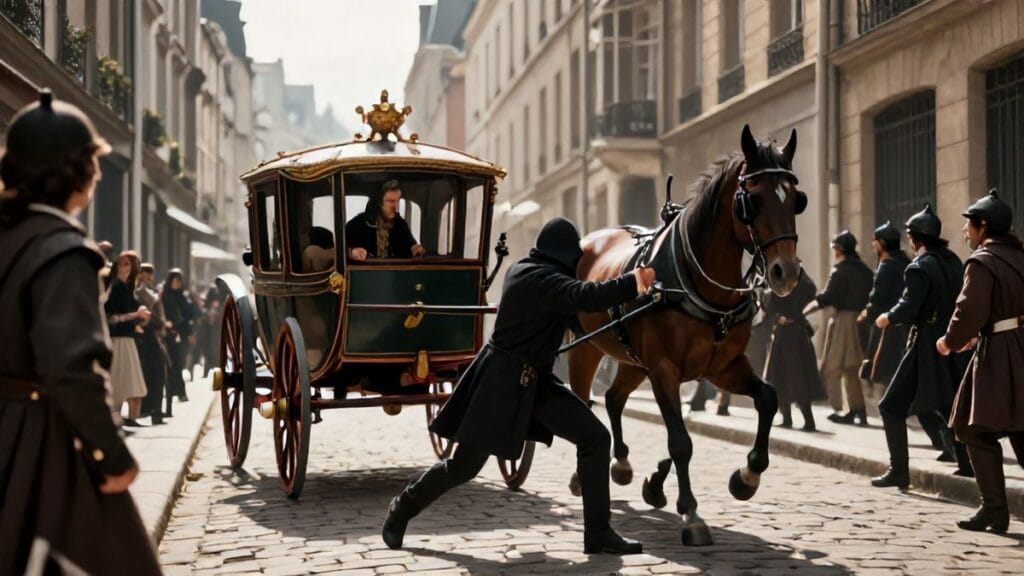
As Henry’s carriage entered the Rue de la Ferronnerie, the predictable happened: it met an obstacle. A cart, perhaps delivering goods, blocked the way. In the crush of people, horses, and stalls, maneuvering was difficult. The royal coach slowed, then stopped. The pages at the front, distracted, failed to react with the speed that modern sensibilities might demand. Guards rode slightly ahead or behind, leaving a brief but catastrophic gap around the king.
In that pocket of vulnerability, François Ravaillac moved. He slipped between passersby, pressing himself close to the carriage. Some accounts claim he climbed onto a wheel’s spoke; others suggest he simply leaned inward. What is certain is that he found Henry’s chest within striking distance. In a swift motion, he drove his knife into the king’s side, near the ribs. The blade penetrated deep, but in the chaos of the moment, Henry did not cry out. The first blow, though serious, was not immediately fatal.
Perhaps sensing this, Ravaillac struck again. The second thrust found a more deadly path: piercing the lungs, slicing through vital organs. Blood welled up, soaked Henry’s doublet, and spilled into the carriage. One of the gentlemen beside him, the Duke of Épernon, felt the king slump heavily against him. For a heartbeat, the street did not understand what had happened. Then someone shouted, “The king is killed!”—a cry that sliced through the noise like a knife through cloth.
The assassination of Henry IV was over in seconds, the work of a single arm and a narrow blade, yet its echo would last for centuries. The street erupted. Some tried to flee, others to see. The guards finally reacted, surging toward the carriage just as Ravaillac, astonishingly, made no attempt to escape. Instead, he stood there, knife still in hand, perhaps stunned, perhaps resigned. A soldier grabbed him; others began beating him, nearly killing him on the spot. Only the intervention of authorities who demanded a living prisoner—someone to question, to dissect for answers—saved him from instant lynching.
Inside the carriage, Henry’s body lay motionless. Blood filled his mouth; his eyes, once lively and shrewd, stared ahead without seeing. In a narrow Parisian street crowded with iron shops and onlookers, the longest reign France had known in years of peace ended not with a battle or a siege but with two silent wounds beneath a gray spring sky.
Chaos After the Blows: Panic, Blood, and Capture
The moments following the attack were a blur of disbelief and horror. The royal entourage, whose duty was to shield the king from precisely such dangers, found itself stunned into frantic, belated action. Some tried to stem the bleeding, but it was already clear to those closest to Henry that nothing could be done. The position of the wounds, the sheer volume of blood, and his lifeless expression told their own brutal truth. Within minutes, whispers grew into a grim certainty: the king was dead.
The carriage turned back toward the Louvre, bearing its royal corpse like a dark omen. Along the way, people glimpsed the slumped figure and began to realize what had happened. Cries of grief, curses, and prayers mixed in the air. Some knelt in the street, crossing themselves. Others, fearing that the king’s death signaled an immediate return to war and chaos, rushed home to barricade doors or arm themselves. The fragile sense of peace that Henry had painstakingly cultivated cracked in an instant.
Meanwhile, Ravaillac, battered but alive, was dragged to the nearest guardhouse. Officials, among them representatives of the Châtelet, recognized the enormity of what had occurred. Regicide was not merely murder; it was an assault on the mystical body of the kingdom, an act that demanded exemplary punishment and exhaustive investigation. The assassin had to be preserved from the mob, at least for a time, so that his motives and any potential accomplices could be uncovered.
News sped faster than any official messenger. By the time the carriage reached the Louvre, the rumor had preceded it: “The king is dead, the king is dead!” Inside the palace, courtiers scrambled for information, torn between genuine grief and immediate concern for their own positions. Marie de’ Medici, crowned queen only the day before, found herself catapulted into the terrifying role of widowed regent. Somewhere in the building, the eight‑year‑old Dauphin, the future Louis XIII, played unaware that his world had changed forever.
The assassination of Henry IV in that cramped street thus sent out concentric circles of trauma: from the corpse in the carriage, to the queen and princes, to the city of Paris, and finally to all of France and Europe. Everyone asked the same questions: How could this have happened? Who was this man who had dared to kill the king? And, beneath the fear, a more anxious thought: What would come next?
Anatomy of a Regicide: Reactions Inside the Louvre Palace
At the Louvre, the return of the carriage transformed corridors usually filled with ritual into spaces of stunned disarray. Henry’s body was lifted out and laid upon a bed for examination. Physicians, hastily summoned, could do little except confirm the obvious. Clerics muttered prayers for his soul. Those who had stood close to him in life now crowded the chamber, some in tears, others already calculating how best to navigate the new political landscape.
Marie de’ Medici, overcome by grief and terror, is said to have wept bitterly. Yet she and her advisors understood that the monarchy’s survival depended on immediate action. A power vacuum in a kingdom still haunted by civil war could invite chaos or even renewed attempts at partition. The first priority was to secure the succession and assert the authority of the young Louis XIII, under his mother’s regency. Within hours, the court was preparing formal declarations, summoning the Parlement of Paris, and arranging for the customary recognition of the new king.
Not everyone mourned with equal sincerity. Some Catholic hardliners, while publicly condemning the murder, privately felt a grim satisfaction that a monarch perceived as too lenient toward heresy and too eager for war against Catholic powers had been removed. Others, especially those who had benefited from Henry’s patronage, feared they might lose influence under a Medici‑led regency more sympathetic to Spanish interests and to conservative Catholic factions.
Inside the palace, one could almost feel the temperature shift from warm familiarity—Henry’s characteristic informality—to the colder, more ceremonial style that would soon dominate under his successors. In that sense, the assassination of Henry IV did more than remove a single man; it marked the end of a particular way of being king, a style that mixed personal charisma with political pragmatism. The France that emerged from that bloody day would slowly slide toward the more rigid, absolutist monarchy that culminated in Louis XIV—the Sun King—whose very distance from his subjects was the opposite of Henry’s easy camaraderie.
The Interrogation and Torture of François Ravaillac
While the court regrouped, the city’s magistrates turned their focus to the assassin. Ravaillac was taken to the Conciergerie, the grim prison on the Île de la Cité. There, interrogations began almost immediately. Judges, scribes, guards, and clerics gathered to hear his story. At first he spoke calmly, explaining his convictions, his visions, and his belief that God had commanded him to punish the king for tolerating heresy and planning war against the House of Austria.
The authorities, however, wanted more than a confession of personal guilt. They sought proof of conspiracy. Had the Jesuits encouraged him, as some of their enemies claimed? Had Spanish agents supplied money or promises? Had discontented nobles whispered in his ear? The idea that a mere provincial fanatic could, on his own initiative, slay a king was almost too frightening to accept; it suggested that no level of security could truly protect the monarch from solitary zealots.
As Ravaillac persisted in declaring that he had acted alone, the judges turned to torture in hopes of forcing a broader confession. He was subjected to the infamous “question ordinaire” and “question extraordinaire”: methods involving cords that crushed limbs, the pouring of water to simulate drowning, and other excruciating techniques sanctioned by law for cases of regicide. His flesh was torn, his joints strained, yet he did not name accomplices. Whether this was because he indeed had none or because he stubbornly refused to betray them—if they existed—remains unresolved.
The official records of his interrogations, preserved in fragments and cited by later historians, show a man fixed on religious themes, convinced that he had rid France of a king who offended God. One 17th‑century commentator, reflecting on these documents, wrote that Ravaillac’s “spirit was so inflamed with zeal that no torment could extinguish it,” a statement that illustrates how quickly his image became a canvas for broader debates about fanaticism and obedience. The more he insisted on his solitude, the more some observers suspected hidden hands guiding his.
For the monarchy, however, it was politically convenient to close the case. A lone madman was easier to condemn and less dangerous to admit than a vast plot implicating powerful factions. In the evolving narrative of the assassination of Henry IV, Ravaillac thus became both the central culprit and, in some ways, a screen behind which the more complex tensions of the realm could be partially concealed.
Rumors, Plots, and Suspicions: Who Really Wanted Henry Dead?
From the moment news of the king’s death reached the broader public, speculation about deeper conspiracies erupted. The idea that a man like Ravaillac could act in total isolation clashed with the political imagination of the time, steeped in tales of cabals, poisoned chalices, and secret treaties. Many asked: Who whispered in his ear? Whose interests were served by Henry’s removal?
Some pointed to the Jesuits, already controversial in France because of their fervent defense of papal authority and their support for militant Catholic causes. Pamphleteers hostile to the order accused its members of having inspired Ravaillac with sermons that exalted the killing of tyrants or heretical rulers. Yet investigations failed to produce concrete evidence connecting any Jesuit directly to the assassin. The order officially condemned the murder, and later scholarship has generally concluded that, while the intellectual climate of the time might have made such an act thinkable, there was no clear Jesuit plot.
Others suspected foreign powers, especially Spain, which had every reason to fear Henry’s military ambitions and resent his support for enemies of the Habsburgs. If he had lived, France might have intervened more forcefully in the brewing conflicts that would soon explode into the Thirty Years’ War. Removing him, critics argued, bought Madrid precious time. Yet again, direct proof is lacking. Ambassadors may have celebrated quietly in some circles, but historians have found no decisive document ordering or funding the regicide.
Another line of suspicion turned inward, toward the French nobility and even the queen’s entourage. Some of Henry’s own courtiers reportedly resented his plans, his mistresses, or his shifting alliances. The Duke of Épernon, who was in the carriage at the moment of the attack and who quickly took charge of arresting Ravaillac, became an object of whispered accusations. The speed with which he and others rallied around Marie de’ Medici fed rumors that they had wanted Henry out of the way in order to shape the regency. Yet, once more, historians have found no conclusive evidence linking them directly to the crime.
In the absence of proof, the assassination of Henry IV remains, for many, a tantalizing mixture of documented fact and unresolved mystery. Was it the inevitable collision of a lone religious fanatic with a king who symbolized moderation and pragmatism? Or the visible tip of a submerged iceberg of elite conspiracy? The answer may lie somewhere between: a man like Ravaillac, steeped in a culture of extremist rhetoric, might have required only the slightest nudge—or none at all—to take a step that others secretly desired but dared not openly plan.
Regicide on Display: The Public Execution at the Place de Grève
If the murder was swift, the punishment was slow, spectacular, and deliberately cruel. In early modern France, the execution of a regicide was not meant merely to remove a criminal; it aimed to send an unmistakable message to all who might contemplate such an act. On 27 May 1610, thirteen days after the assassination, François Ravaillac was brought to the Place de Grève—the main square for public executions in Paris—to face a sentence carefully crafted to reflect the enormity of his crime.
First, he was subjected to symbolic penance. He was forced to apologize publicly before the Church of Notre‑Dame, holding a torch and wearing only a shirt, as if exposed in spiritual nakedness. Then he was transported to the scaffold at the Grève, where crowds had gathered in anticipation, their emotions a volatile mix of anger, curiosity, and morbid fascination. Witnesses would later write of how difficult it was to get close enough to see, the press of bodies so dense that some feared being crushed.
The execution unfolded in stages, each more gruesome than the last. Ravaillac’s flesh was torn with red‑hot pincers in several places, including his arms, chest, and thighs. Molten lead, boiling oil, and resin were poured into the wounds, a ritual meant to cleanse by fire as much as to punish. Throughout, he is said to have cried out in pain but refused to implicate anyone else. Finally came the ultimate punishment: he was bound to four horses, harnessed in different directions, and his limbs were pulled until his body was literally torn apart—a death known as “écartèlement,” or quartering.
The scene horrified even some hardened spectators. According to one eyewitness account, the horses initially failed to dismember him, and the executioner had to cut into joints and sinews to weaken the body before the final tearing. The suffering seemed endless. The authorities intended it that way; the slow destruction of the regicide’s body mirrored, in symbolic form, the political and religious rupture his act had inflicted upon the kingdom.
In a grim irony, this public display of judicial violence also fed the very culture of spectacle and martyrdom that helped sustain political extremism. Some radicals might have secretly admired Ravaillac’s endurance under torture; others would use his execution as a cautionary tale about the dangers of unbridled religious zeal. For most of Paris, however, the day confirmed that the assassination of Henry IV was not only a personal tragedy or political crisis but a sacrilege that demanded blood in return.
A Widow, a Child-King, and a Fractured Court
While Ravaillac’s body was being destroyed in the Place de Grève, the royal family grappled with its own ordeal. Marie de’ Medici’s transformation from queen consort to regent was rapid and fraught. On the very night of Henry’s death, key figures gathered to confirm her position as the guardian of young Louis XIII and effective ruler of France. The Parlement of Paris registered royal edicts naming her regent; noble factions jockeyed for influence over the new regime.
Marie’s priorities diverged in important ways from Henry’s. Where he had been wary of Spanish power and broadly supportive of Protestant allies, she leaned more heavily toward an accommodation with the Habsburgs and a reinforcement of Catholic orthodoxy. Surrounded by advisors, some of them Italian and distrusted by segments of the French nobility, she quickly faced criticism. The delicate balance Henry had cultivated between faiths and factions began to shift.
For the young Louis XIII, the trauma was intimate as well as political. He had adored his father, who, despite his busy schedule and numerous affairs, reportedly showed genuine affection for the boy. The sudden loss, combined with the heavy mantle of kingship, pressed on a child not yet ten years old. Psychologists and historians alike have speculated that this early experience of violence and instability helped shape Louis’s later character: introverted, suspicious, and easily swayed by strong personalities such as Cardinal Richelieu.
At court, Henry’s death unleashed a scramble for positions and favor. Old alliances frayed; new ones formed. Some of the king’s closest companions found themselves marginalized as the regent favored her own network. The possibility that France might drift back toward the kinds of factional struggles that had torn it apart in earlier decades loomed large. Though outright civil war did not immediately resume, the assassination of Henry IV removed a stabilizing figure whose personal authority had often papered over deeper divisions.
In the countryside, ordinary people reacted with a mixture of grief and fatalism. Many peasants had known only war and hardship before Henry’s reign and had begun to taste a modest but real improvement in their lives under his policies. To them, his death felt like the cruel interruption of a necessary recovery. “Now we will starve again,” one contemporary peasant was reported to have said, a bitter prophecy that captured the widespread anxiety about what the future might hold without “Good King Henry” at the helm.
The Shockwaves Through Europe and the Balance of Power
Beyond France’s borders, courts and chancelleries received the news of Henry’s assassination with a complex mix of public mourning and private recalculation. In London, King James I of England, who had maintained cautious but cordial relations with Henry, recognized that the removal of such a powerful player would alter the diplomatic chessboard. In Madrid, where fear of French intervention against the Habsburgs had been rising, the news was met with poorly concealed relief among some advisors, even as official statements condemned the regicide.
Henry had been on the verge of launching—or at least seriously considering—a series of military moves that could have prefigured the broader conflicts of the Thirty Years’ War. By supporting Protestant princes in the Holy Roman Empire and opposing Spanish dominance in the Low Countries, he might have accelerated the clash between Catholic and Protestant coalitions. His death, therefore, did not simply remove a monarch; it delayed or reshaped the timetable of European war.
Under Marie de’ Medici’s regency, France tilted toward a more cautious, even timid foreign policy. Diplomatic efforts focused on securing the young king’s position and avoiding major confrontations. The regent arranged marriages that bound France more closely to the Habsburgs, including the future union between Louis XIII and Anne of Austria. This turn inward and toward compromise helped preserve short‑term peace but arguably ceded initiative to other powers. When France eventually plunged into the Thirty Years’ War under Richelieu, it did so from a different position and with a different set of priorities than Henry might have had.
Historians have debated how significantly the assassination of Henry IV altered European history. Some argue that, had he lived, he might have forged a more coherent anti‑Habsburg coalition earlier, potentially shortening or transforming the later conflicts. Others caution against such counterfactual speculations, pointing out the constraints he faced at home and the unpredictability of international politics. Still, the timing of his death—on the eve of what many perceived as a new phase of great‑power rivalry—makes it hard not to see in that knife thrust on the Rue de la Ferronnerie a decisive turning point for the continent.
From Sainthood to Damnation: The Memory of Henry IV
In the years and centuries following his death, Henry IV’s image underwent remarkable transformations. Almost immediately, nostalgic narratives began to circulate, portraying him as a near‑saintly figure of moderation and paternal care. Poets and chroniclers dwelt on his supposed simplicity, his love for the common people, and his desire to feed and protect them. One 17th‑century panegyric called him “the father of his people, whose kindly heart beat for the smallest of his subjects,” a line that has been often quoted, if rarely scrutinized.
This idealization served political purposes. Later monarchs, especially during periods of crisis, invoked “Good King Henry” as a model of benevolent kingship. Even Napoleon, centuries later, would reportedly express admiration for Henry’s ability to reconcile factions and restore order. The contrast between Henry’s jovial pragmatism and the cold austerity of some of his successors made him an attractive symbol whenever the crown needed to project an image of humanity and care.
Yet not everyone remembered him so fondly. Militant Catholics continued to view him with suspicion, if not outright hostility, seeing his Edict of Nantes as an unforgivable compromise with heresy. Some reformers on the Protestant side, meanwhile, regarded his conversion as cowardice or treachery. In their eyes, the assassination of Henry IV could be interpreted—not endorsed, but interpreted—as divine judgment on a man who had abandoned the true faith for political gain. Such views remained marginal but illustrate how contested his legacy remained.
Over time, cultural memory smoothed out many of these conflicts. Paintings standardized his features: the pointed beard, the noble brow, the warm eyes. Statues of Henry on horseback, like the one erected on the Pont Neuf in Paris (destroyed during the Revolution and later rebuilt), reinforced his association with the capital he had loved and restored. Schoolbooks in the 19th century depicted him handing out coins to children or speaking kindly to peasants, emphasizing his role in making France prosperous after a long night of civil war.
In this evolving iconography, the assassination itself became both a tragedy and a moral lesson. It warned of the dangers of fanaticism and intolerance, of the way a single extremist act could undo years of careful statecraft. At the same time, it allowed later generations to dramatize the fragility of peace and the sanctity of royal authority. The Rue de la Ferronnerie, once just a cluttered street lined with ironmongers, entered the symbolic geography of the nation as the stage of a martyrdom that helped define what the French expected from their kings—and from their assassins.
Historians, Myths, and the Long Shadow of 14 May 1610
The assassination of Henry IV has attracted historians like moths to a flame. Each generation has reexamined the sources—court records, eyewitness accounts, pamphlets, diplomatic correspondence—in search of new answers to lingering questions. Was Ravaillac the tool of a conspiracy or a solitary fanatic? How transformative were Henry’s policies, really? Did his death decisively alter France’s path toward absolutism and religious uniformity?
In the 19th century, romantic historians often cast Henry as a hero of tolerance and proto‑liberal values, a monarch tragically ahead of his time. They framed his murder as the victory of reactionary forces—clericalism, fanaticism, foreign influence—over enlightenment and national unity. In this narrative, Ravaillac appears almost as a dark instrument of history’s worst impulses, while Henry stands as a martyr to progress. Such interpretations aligned conveniently with the political agendas of their era, which sought to promote secularism and limit the Church’s influence on state affairs.
Later scholars have complicated this picture. They have emphasized Henry’s own authoritarian streak, his readiness to use force, and the limitations of the Edict of Nantes, which did not create genuine equality for Protestants but merely carved out a precarious coexistence. They have also highlighted how deeply embedded Henry remained in the mental world of his time—one still saturated with religious assumptions, dynastic ambitions, and hierarchical social structures. From this perspective, portraying him as a modern liberal is anachronistic, however appealing the myth may be.
Recent work has also revisited the psychological and cultural dimensions of the assassination. By examining sermons, prophetic texts, and the circulation of rumors, historians have shown how ordinary people absorbed and reinterpreted the event. Some saw it as evidence that God remained actively involved in punishing rulers and peoples; others took it as a sign that human violence could rupture even the most sacred bonds. The line between political history and cultural anthropology blurs here, as scholars explore how the story of 14 May 1610 was told and retold in taverns, churches, and family circles.
Yet, for all the nuanced interpretations, the core drama remains compellingly simple: a king, weary of war and striving for a measure of peace, cut down in the middle of his city by a man convinced that violence in God’s name was justified. In that stark opposition—the pragmatist versus the fanatic—many readers still find a mirror for contemporary anxieties about terrorism, extremism, and the fragility of political order. That is why the assassination of Henry IV continues to fascinate: it is at once a distinctly early‑modern episode and a timeless cautionary tale.
Conclusion
On that May afternoon in 1610, the knife that pierced Henry IV’s chest did more than still the heartbeat of a single man; it pierced the tenuous fabric of a kingdom emerging from decades of religious war. Henry’s life had been a long apprenticeship in survival, from the massacres of St. Bartholomew’s Day to the battlefields where he fought the Catholic League, from his controversial conversion to Catholicism to the careful drafting of the Edict of Nantes. His reign, though imperfect, offered France a rare interval of reconstruction and relative calm. The assassination of Henry IV shattered that fragile equilibrium in a matter of seconds.
Yet his death did not plunge France back into immediate chaos. Through swift political maneuvering and the institutional momentum of the monarchy, Marie de’ Medici and her supporters secured the succession of Louis XIII. The wars of religion did not resume on the same scale; instead, the kingdom drifted toward a different kind of conflict—less overtly confessional, more driven by questions of state power and international rivalry. In that sense, Henry’s legacy endured in the structures he helped consolidate, even as his personal style of rule vanished with him.
The lingering mystery surrounding Ravaillac—whether he acted wholly alone or as the tip of a hidden spear—remains unresolved and perhaps unresolvable. But the broader lesson, visible in both the event and its aftermath, is stark: societies that cultivate or tolerate extremist rhetoric court the possibility that a single individual, inflamed with a sense of divine or ideological mission, can change the course of history with a few inches of steel. The France of Henry IV, steeped in sermons that exalted holy violence, paid that price on the Rue de la Ferronnerie.
At the same time, the memory of “Good King Henry” and the stories told about him across the centuries remind us that political leadership can also be a force for reconciliation. His willingness to compromise, to convert for the sake of peace, and to grant limited rights to a persecuted minority mark him as a ruler who, within the constraints of his age, chose moderation over fanaticism. That choice did not save his life, but it helped save his kingdom from further immediate ruin. In the end, the assassination of Henry IV stands as both a tragedy and a warning—a moment when fear and hatred prevailed over a fragile, necessary peace, leaving a wound that history still traces with uneasy fascination.
FAQs
- Who was responsible for the assassination of Henry IV?
Henry IV was killed by François Ravaillac, a Catholic fanatic from Angoulême. Ravaillac approached the king’s open carriage in the narrow Rue de la Ferronnerie in Paris on 14 May 1610 and stabbed him twice with a knife. Although many contemporaries suspected broader conspiracies involving religious orders, foreign powers, or discontented nobles, Ravaillac insisted under torture that he acted alone, and no definitive evidence has ever proven the existence of a larger plot. - Why did François Ravaillac assassinate Henry IV?
Ravaillac claimed that he killed Henry IV because he believed the king offended God by tolerating Protestantism through the Edict of Nantes and by preparing to wage war against Catholic Habsburg powers. Convinced he had received divine visions, he first tried to persuade the king to change course. After failing to gain access, he concluded that the only way to fulfill what he saw as God’s will was to eliminate the monarch. His motives combined religious fanaticism, apocalyptic thinking, and resentment of Henry’s policies. - What were the immediate consequences of Henry IV’s assassination for France?
The immediate consequence was a sudden transfer of power to Henry’s young son, Louis XIII, under the regency of his widow, Marie de’ Medici. Although there was widespread fear that the kingdom might slide back into civil war, institutions held, and large‑scale religious conflict did not immediately resume. However, the balance of power at court changed: Marie favored pro‑Spanish and more conservative Catholic advisors, and some of Henry’s policies and ministers, notably Sully, lost influence. The assassination also deepened public anxiety about religious extremism and the vulnerability of kings. - How did Henry IV’s death affect European politics?
Henry IV’s death removed a key player at a moment when tensions across Europe were rising and conflicts that would feed into the Thirty Years’ War were brewing. He had been preparing, or at least considering, military interventions that might have checked Habsburg power more aggressively. Under Marie de’ Medici’s regency, France pursued a more cautious foreign policy and forged closer ties with Spain, delaying a major French entry into continental war until the time of Cardinal Richelieu. Many historians believe that Henry’s survival might have produced a different configuration of alliances and perhaps altered the timing and nature of subsequent conflicts. - What was the Edict of Nantes, and how is it related to the assassination?
The Edict of Nantes, issued by Henry IV in 1598, was a far‑reaching edict of toleration that granted French Protestants (Huguenots) limited rights of worship, access to certain public offices, and fortified places of safety. While it did not establish full religious equality, it marked a major attempt to end the French Wars of Religion by institutionalizing coexistence. For Catholic extremists like Ravaillac, the edict was proof that Henry was too favorable to heresy, a key grievance that helped justify, in their minds, the decision to kill him. In that sense, the assassination of Henry IV was directly connected to the compromises he made to pacify his kingdom. - How was François Ravaillac punished for killing the king?
Ravaillac was subjected to one of the harshest punishments in French law, reserved for regicides. After being interrogated and tortured in prison, he was sentenced to public execution at the Place de Grève. There, on 27 May 1610, he endured the tearing of his flesh with red‑hot pincers, the pouring of molten lead and boiling oil into his wounds, and finally quartering by four horses, which tore his body apart. His execution was designed to serve as a terrifying spectacle and a deterrent to anyone contemplating similar crimes. - Did Henry IV foresee or fear his own assassination?
Contemporary sources suggest that Henry sometimes spoke with a kind of dark humor about the possibility of dying violently, aware of the fate of his predecessor Henry III and of the climate of fanaticism that still lingered. Before his death, various prophecies and astrological predictions circulated around the court, hinting at danger. However, he continued to move relatively freely among his subjects and repeatedly ignored security advice, such as traveling with a small escort and in an open carriage. Whether this reflected fatalism, confidence in his popularity, or simple impatience is still debated. - How is Henry IV remembered today in France?
Today, Henry IV is widely remembered as “Good King Henry,” a monarch associated with reconciliation after religious war and with efforts to improve the lives of ordinary people. His promotion of the Edict of Nantes and his reputation for personal warmth have made him a relatively popular figure in French historical memory. Statues, notably the equestrian statue on the Pont Neuf in Paris, and schoolbook narratives have reinforced this image. At the same time, modern historians stress the complexities and limits of his policies, reminding us that his toleration was pragmatic and partial rather than fully modern in spirit. - What role did the assassination play in the development of royal absolutism?
Henry IV’s death contributed indirectly to the rise of royal absolutism in France. His more personal, flexible style of kingship—marked by easy contact with subjects and negotiated compromises—gave way under his successors to a more distant, ceremonial monarchy. The trauma of repeated regicides (Henry III and Henry IV) and the memory of civil war encouraged rulers and their advisors, like Richelieu and later Louis XIV, to centralize power, reduce the autonomy of noble factions, and control religious dissent more tightly. Thus, the assassination of Henry IV forms part of the broader story of how fear and instability helped justify a stronger, more centralized state. - Where can I learn more about the assassination of Henry IV?
For a deeper dive, you can consult detailed academic works on the late French Wars of Religion and early Bourbon monarchy. Many histories of early modern France devote significant chapters to Henry’s reign and death, often citing primary sources such as the memoirs of the Duke of Sully and the diaries of Pierre de l’Estoile. Modern biographies of Henry IV provide rich context on his personality, policies, and the circumstances of his assassination, while specialized studies examine Ravaillac’s trial, the culture of religious violence, and the event’s long‑term impact on French political thought.
External Resource
Internal Link
Other Resources
- Encyclopaedia Britannica – general search for the exact subject
- Google Scholar – academic search for the exact subject
- Internet Archive – digital library search for the exact subject