Table of Contents
- A City Between Worlds: Constantinople in the Year 517
- Shadows of Schism: From Chalcedon to the Acacian Crisis
- Pope Hormisdas Before the Mission: A Roman Bishop in a Broken Christendom
- The Emperor Anastasius and the East: Power, Piety, and Suspicion
- Choosing the Envoys: How the pope hormisdas legates constantinople Mission Took Shape
- Departure from Rome: Oaths, Scrolls, and Silent Fears
- Across Land and Sea: The Journey to the Queen of Cities
- First Impressions of the New Rome: Constantinople Through Western Eyes
- Negotiating Faith: Inside the Imperial Palace and Patriarchal Residence
- The Formula of Hormisdas: A Parchment Meant to Heal an Empire
- Resistance and Intrigue: Court Factions, Monks, and Diplomats
- Whispers in the Streets: How Ordinary People Lived the Schism
- From Failure to Turning Point: The Legacy of the 517 Embassy
- From Anastasius to Justin: New Emperor, New Hopes for Reunion
- Echoes Through Centuries: Papal Primacy, Eastern Autonomy, and Memory
- Historians, Chronicles, and the Sources Behind the Story
- Human Portraits: The Legates, the Emperor, and the Silent Crowds
- Conclusion
- FAQs
- External Resource
- Internal Link
Article Summary: In 517, the journey of pope hormisdas legates constantinople unfolded against a backdrop of bitter schism and imperial anxiety, as Rome and Constantinople struggled to define both right belief and rightful authority. This article follows those envoys from their solemn commissioning in Rome to their fraught audiences in the Great Palace, where theology was inseparable from politics. We explore how the Acacian Schism had torn Christendom apart for decades, why the Formula of Hormisdas became a flashpoint, and how Emperor Anastasius weighed faith against stability. Through narrative, analysis, and close attention to human experiences, the story shows how the mission of pope hormisdas legates constantinople nearly failed, yet still laid foundations for later reunion under Justin I. Along the way, we meet monks, courtiers, dockworkers, and bishops whose lives were shaped by distant doctrinal debates. The article also examines how later historians remembered the embassy of pope hormisdas legates constantinople, refracting it through their own ecclesiastical agendas. Ultimately, what began as a diplomatic venture to heal a schism became a defining chapter in the long, uneasy relationship between the papacy and the eastern emperors.
A City Between Worlds: Constantinople in the Year 517
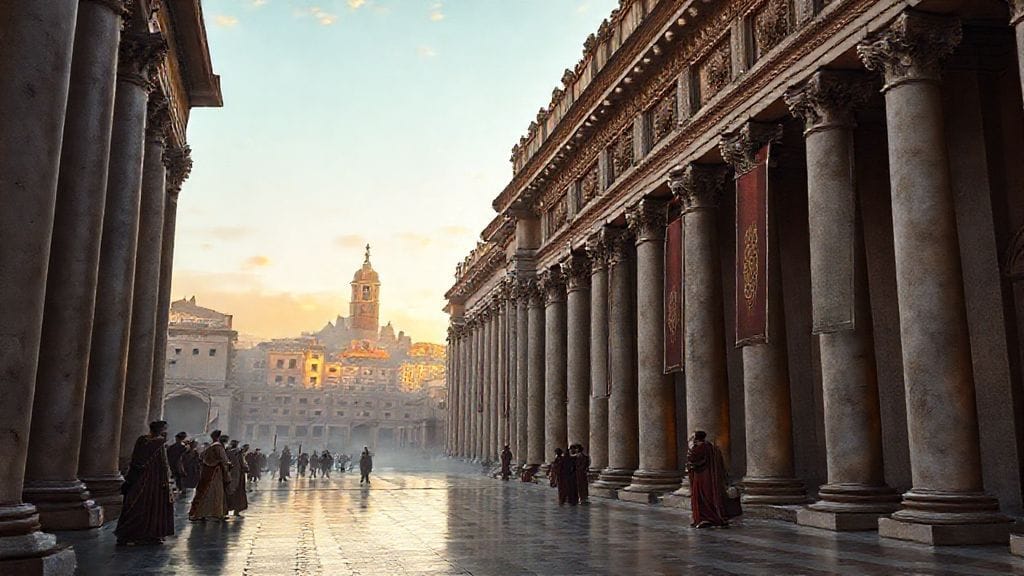
On a cold morning in early 517, a pale light settled over Constantinople, the city that called itself the New Rome. The domes of churches caught the first glow of the sun, while the long line of walls—the Theodosian ramparts—loomed like a stone horizon between the city and the world beyond. Fishermen hauled their nets along the Golden Horn. Sailors shouted in a dozen languages on the quays: Latin, Greek, Coptic, Syriac, Gothic. And far from the noise, in the shadowed corridors of the Great Palace, scribes and courtiers were already whispering about a mission that had set out from distant Rome—an embassy that might, at last, mend or worsen the rift splitting the Christian world.
The city seemed, in that year, balanced on a hinge between eras. The emperor Anastasius, old but still sharp, sat on the throne. He presided over a capital rich in marble and mosaics, yet riven by theological factions and regional loyalties. The scars of earlier riots had not entirely faded; stones still showed blackened traces where fires had once run like a fever through the streets. In the Hippodrome, the rival racing factions, the Blues and the Greens, carried not only sporting passions but also deep religious and political sympathies. A shout for one team could be a veiled shout for a doctrine.
Into this world would soon step the men history remembers as the pope hormisdas legates constantinople: envoys bearing the authority of the bishop of Rome, the weight of a century of controversy, and a handful of carefully inked lines on parchment that could change the course of an empire. Yet even before those legates disembarked, the city itself told a story. It was a city that looked west toward Rome and east toward Antioch and Jerusalem, a city that claimed to hold the empire’s center even while the edges of that empire strained under pressure from Persia and barbarian kingdoms.
Life in Constantinople was dense and layered. In crowded insulae—the tall tenement blocks—families huddled together, sharing stories about bishops and emperors as if they were neighbors rather than distant powers. Markets overflowed with grain from Egypt, silk threads from the East, and the slower, invisible traffic of ideas and rumors. Though only a minority could read, nearly everyone could listen, and homilies thundered from the pulpits of great churches and humble chapels alike. A single word spoken by a patriarch could ripple out in astonishing ways, transforming a subtle theological nuance into a street slogan or a reason to riot.
By 517, trust between East and West had thinned to almost nothing. Rome and Constantinople were still, in theory, sister sees of one Church, but the Acacian Schism had formalized a estrangement that already lurked beneath the surface. Many in the city had never seen a Latin bishop, let alone a Roman legate. When dockworkers heard that envoys from “Old Rome” were coming to demand submission to their pope’s terms, some laughed, some spat into the water, and some crossed themselves anxiously. It was as though a long-forgotten relative had suddenly announced a visit, and no one was sure whether to welcome him or bolt the doors.
Yet even those who suspected that this visit would end badly could not have guessed how deeply entwined it was with the drama of their age: church councils, creeds, imperial laws, and the memories of long-dead bishops whose names—Chalcedon, Acacius, Zeno—still crackled with life in the marketplaces and monasteries of Constantinople. The stage was set for a story in which the beating heart of the empire would be tested by the words carried on a few fragile scrolls.
Shadows of Schism: From Chalcedon to the Acacian Crisis
To understand why pope Hormisdas sent legates to Constantinople in 517, one must step back several decades, into the swirl of events that began at the Council of Chalcedon in 451. Chalcedon, held just across the Bosporus from Constantinople, tried to answer a question at once esoteric and urgent: how, precisely, were divinity and humanity united in Christ? The council’s formula—Christ as one person in two natures, “without confusion, without change, without division, without separation”—would become a cornerstone of orthodox belief in the West. But in parts of the East, especially in Egypt and Syria, it was met not with relief, but with suspicion and rebellion.
There, many Christians feared that the Chalcedonian definition compromised the true unity of Christ. Their preference for the language of “one incarnate nature of the Word of God,” associated with Cyril of Alexandria, had already shaped local devotion. To them, Chalcedon looked like a betrayal, a step back toward the Nestorianism they believed Cyril had defeated. Monks rioted, bishops were expelled, entire provinces slipped into religious unrest. Theology became the grammar of revolt.
The emperors in Constantinople could not ignore this turmoil. They needed Egypt and Syria: for grain, for taxes, for soldiers, for the fragile sense that the empire still encircled the Mediterranean. When Emperor Zeno issued his famous Henotikon (“Act of Union”) in 482, he meant it to be a healing compromise. It deliberately sidestepped Chalcedon’s contentious phrasing, condemned both Nestorius and Eutyches, and attempted to unify the faithful around a more basic confession. But what looked like pragmatic statesmanship to the emperor appeared, in Rome, as a dangerous evasion—and in some regions of the East, as a veiled Chalcedonian concession.
The climax of this crisis came with Patriarch Acacius of Constantinople, who supported Zeno’s Henotikon and entered into communion with bishops who rejected Chalcedon. For the bishop of Rome, this was an outrage. Pope Felix III excommunicated Acacius in 484, and Acacius in turn struck the pope’s name from the diptychs, the lists of those commemorated in the liturgy. Thus began the Acacian Schism, which would persist for more than three decades, outlasting both men and leaving open wounds in the body of the Church.
It is astonishing, isn’t it? A few lines of liturgical commemoration, a few signatures attached or withheld, and suddenly the Christian world found its great sees—Rome, Constantinople, Alexandria, Antioch—divided into camps that no longer prayed for one another. In the West, the papacy cultivated an increasingly sharp sense of its own authority, citing the heritage of Peter and the decisions of earlier councils. In the East, the emperor and his bishops insisted on their right to manage theological disputes in ways suited to the empire’s needs.
By the time Anastasius took the throne in 491, the schism was a grim fact of life. Popes came and went in Rome; patriarchs were installed and deposed in Constantinople; yet the break persisted. Latin and Greek Christians traded accusations of heresy. Diplomatic overtures faltered. The name “Acacius” became less the name of a man than a symbol of defiance against Roman claims. When news reached Rome of yet another Eastern formula, another imperial compromise, it was often greeted with a weary cynicism: here we go again, another document that says much but refuses to say the one thing Rome believed necessary—that Chalcedon was final and Rome’s judgment, irreversible.
In this bleak landscape, the mission of pope hormisdas legates constantinople would stand as one more attempt to cross the widening gulf. But to many in both camps, the rift seemed already too deep for parchment to bridge. Faith, identity, and imperial interest had fused, and every concession to one side looked like a betrayal to the other.
Pope Hormisdas Before the Mission: A Roman Bishop in a Broken Christendom
Hormisdas did not begin his life as a pope at the center of controversy. Born in Frosinone in Campania, probably to a modest background, he had lived through the turmoil of the Western empire’s collapse and the rise of the Ostrogothic kingdom in Italy. By the time he was elected pope in 514, Rome was no longer the political capital of an empire but a battered city in a Gothic realm, its imperial monuments now sharing space with ruined forums and repurposed temples. Yet the papal office itself was growing in stature, precisely because the pope could speak as a moral and spiritual authority in a world where political power had shifted elsewhere.
Hormisdas inherited a church strained by internal tensions and external pressures. Inside Italy, he had to navigate the often subtle expectations of the Ostrogothic king Theodoric the Great, an Arian Christian ruling over a mostly Nicene population. Theodoric, shrewd and pragmatic, generally allowed the Roman Church considerable freedom, but he kept a close eye on any papal initiative that might threaten order in his domains. Beyond Italy, Hormisdas faced the long-running Acacian Schism, which had deprived the papacy of communion with large parts of the East. As a man formed in the tradition of Leo the Great and Gelasius I, Hormisdas believed profoundly in the special primacy of the Roman see.
Yet he was no mere ideologue. Letters from his pontificate reveal a figure at once firm and careful, capable of insisting on principle while calculating the possible costs of each diplomatic move. When reports from the East reached Rome—of shifts in imperial policy, of new patriarchs in Constantinople, of angry disputes in Antioch and Alexandria—Hormisdas weighed them with a mixture of hope and distrust. Where earlier popes had sometimes despaired of Anastasius entirely, Hormisdas glimpsed possibilities in small openings: a conciliatory comment, a half-hearted proposal, a hint that not all Eastern bishops remained fully loyal to the Henotikon.
What he could not ignore was the growing sense among Latin clergy that Rome had been sidelined from the great theological debates of the empire. To restore communion with the East on terms that compromised the legacy of Chalcedon, or the memory of his predecessors’ stand against Acacius, would be unthinkable. But to insist on Roman conditions and fail was equally dangerous, for it might confirm Eastern suspicions that Rome sought not unity but dominion. Hormisdas occupied a lonely middle ground, both more ambitious and more cautious than many of his allies.
In his private moments—those we can only imagine, since no diary remains—he must have felt the weight of history pressing on his shoulders. He knew the names of councils, the intricate catalogs of heresies, the carefully lettered acts of synods stored in Roman archives. They testified to a Church that had always struggled, argued, defined and redefined itself across centuries. And yet, as he looked eastward across the sea, he must have wondered whether this struggle had now reached a point of no return. When he finally decided to send the pope hormisdas legates constantinople, it was neither a rash gamble nor a simple gesture. It was a calculated leap, made with the awareness that one misstep might solidify the schism forever.
The Emperor Anastasius and the East: Power, Piety, and Suspicion
While Hormisdas considered his options in Rome, Emperor Anastasius I ruled over a restless empire from Constantinople. Born to humble origins in Dyrrachium, he had reached the throne late in life in 491, after the brief and tumultuous reign of Zeno. Anastasius was not a soldier-emperor in the old Roman style but a meticulous administrator and a devout, if controversial, Christian. His reforms in taxation and coinage filled the imperial treasury; his military expeditions kept external threats at bay. Yet it was his religious policy that defined his memory in the eyes of many contemporaries.
Anastasius leaned toward the anti-Chalcedonian side in the ongoing Christological dispute. He did not openly renounce the council, but he viewed the Henotikon as a wise attempt at reconciliation and tolerated, even favored, bishops who opposed Chalcedon in practice. This made him a target for the many in Constantinople who had come to accept Chalcedon as non-negotiable. Several times, riots broke out in the capital over liturgical phrases or rumored changes in doctrine. In 512, a particularly violent uprising led by the military officer Vitalian shook the regime; the insurgents demanded a return to Chalcedonian orthodoxy and communion with Rome.
For Anastasius, Rome represented at once a potential ally and a dangerous rival. On the one hand, peace with the West would strengthen his legitimacy and stabilize relations with the Ostrogothic kingdom. On the other, to accept the conditions Rome now seemed poised to demand—especially a full, explicit rehabilitation of Chalcedon and a condemnation of Acacius—would alienate influential anti-Chalcedonian bishops and monks, particularly in Egypt and Syria. He was trapped between two fires: the papal insistence on clear doctrinal formulas and the Eastern desire for a broader, less rigid approach to unity.
When news reached Anastasius that pope Hormisdas intended to send legates, he hesitated. Should he welcome them as envoys of peace or treat them as representatives of a rival power, using theology as a cloak for political ambitions? His advisors, divided among themselves, gave conflicting counsel. Some argued that dialogue could buy time and calm Western anxieties; others warned that any concession might embolden domestic opponents who already accused him of heresy. The emperor’s nights must have been restless, haunted by the possibility that a few bishops in distant lands could one day endanger his throne more than any barbarian tribe.
And yet, as much as Anastasius mistrusted Rome, he did not wish to be remembered as the emperor who hardened a temporary schism into permanent division. If peace could be achieved without humiliating the East, he would consider it. His stance oscillated between chilly reserve and cautious openness. This ambiguity ensured that when the pope hormisdas legates constantinople finally arrived, they would find both doors half-open and potential allies already at work in the city’s churches and monasteries.
Choosing the Envoys: How the pope hormisdas legates constantinople Mission Took Shape
In the winter leading up to 517, Hormisdas gathered a small circle of trusted clergy in Rome. They pored over letters and reports from the East, copies of imperial edicts, and the acts of long-ago councils. The pope knew that the choice of legates was not a mere administrative detail; the success or failure of the mission could hinge on the character and talents of the men he sent. They would need to argue complex theology in Greek, maneuver among Byzantine courtiers skilled in flattery and intrigue, and yet remain utterly steady in their obedience to the Roman see.
The historical record preserves only some of their names, and even those through the often-partial lens of later chroniclers. But we can be certain that they included men familiar with both canon law and diplomacy—bishops or priests who had already proved themselves under pressure. Hormisdas likely balanced age and youth, sending at least one older, venerable bishop whose very presence conveyed gravitas, alongside younger clerics whose energy and linguistic skills made them agile negotiators.
Before their departure, a solemn rite would have taken place in Rome. In the Lateran basilica, or perhaps in the more ancient church of St. Peter on the Vatican hill, the pope addressed them in sober tones. He reminded them of the tortured path that had led to this day: the Council of Chalcedon, the revolt of Peter the Fuller in Antioch, the excommunication of Acacius, the bitter years when the name of the Roman pope had been omitted from Eastern liturgies. He unfolded the document that would become the focal point of their discussions in Constantinople—the Formula of Hormisdas—and explained its crucial clauses.
They were to insist that the Eastern bishops, and ultimately the emperor himself, accept this formula as the condition for reunion. It proclaimed, among other things, that the apostolic see of Rome had always preserved the true faith and that those condemned by Rome, like Acacius of Constantinople, were to be rejected. By attaching his name to the text, Hormisdas staked not only his authority but his entire legacy on its reception. The legates were not negotiators in the modern sense, free to bargain clause by clause. They were bearers of a finished thesis, entrusted with its safe delivery and faithful presentation.
Before the assembled clergy, the legates likely swore oaths. They promised to add nothing and subtract nothing from the instructions given them, to uphold the honor and doctrine of the Roman see, and to report all events upon their return. The atmosphere, we can imagine, was tense but charged with a sense of mission. These men would cross seas and kingdoms, move through the corridors of an alien court, stand before an emperor in whose presence few Western clergy had stood in living memory. Their every word could tip the balance between reunion and renewed estrangement.
Such was the fragile human element at the core of the pope hormisdas legates constantinople mission. It was not simply a clash of institutions or doctrines; it was the story of a handful of individuals, chosen from among many, who would carry the hopes and anxieties of a divided Christendom in their satchels and in their consciences.
Departure from Rome: Oaths, Scrolls, and Silent Fears
When the legates finally left Rome, the city itself seemed to watch them go. Departures in that age were less hurried than they are now; ships waited for favorable winds, animals had to be fed and watered, and letters to distant friends were squeezed in at the last minute. At the Tiber’s banks, among creaking hulls and the shouts of stevedores, the Roman clergy escorted the delegation with chants and prayers. The air smelled of tar, river mud, and the faint incense that clung to the legates’ garments.
Each man carried with him several roles: ambassador, theologian, witness. Among their belongings, securely wrapped in leather and wax, were the crucial documents of their mission: the Formula of Hormisdas, letters to the emperor, and letters to various Eastern bishops who might prove sympathetic. Copies were made in case of loss or capture, but the authoritative originals were treated almost like relics. In an age when the written word could not be duplicated at a keystroke, every letter was precious—months of work by scribes and advisers, every line weighed and reweighed.
As the ship pushed off from the quay, a hush may have fallen among the legates. The city of Peter, with its relics and basilicas, shrank behind them. Ahead lay many days of travel along a coast still dotted with the faded emblems of an empire that no longer ruled the world. They might stop at ports where Latin was still heard in law courts but Greek filled the churches; at others where Gothic soldiers drilled outside city walls. At each stage, the legates gauged the temper of the local Church: Did the clergy there commemorate the pope in their liturgies? Did they side with Chalcedon, the Henotikon, or some uneasy middle?
Travel by sea in the sixth century was never entirely safe. Storms could rise without warning; pirates lurked in less-patrolled waters. Even the best-prepared voyage risked delays that could ruin carefully timed diplomatic plans. As the wind filled the sails, some of the envoys may have stood at the prow, muttering prayers to God and perhaps to St. Peter, guardian of the Church and fisherman of Galilee, whose successor had sent them on this perilous errand. Nights they would lie awake on rough pallets, the creaking of the ship mingling with their rehearsed arguments, imagined confrontations, and secret fears.
They knew that in Constantinople they would face not only an emperor but also patriarches and bishops who believed Rome had overstepped its rightful bounds. They might be accused of arrogance, of ignorance of Eastern traditions, of treating a complex theological crisis as if it were a simple matter of obedience to Rome. Some even feared that, should the negotiations sour, they might be detained or expelled in disgrace. The shadow of earlier embassies hung over them: legates whose words had been twisted, whose letters were ignored, whose efforts had led only to deeper misunderstanding.
Yet, as the coasts of Greece and Asia Minor came into view in the following weeks, another feeling must have mingled with their anxiety: a sober hope. For decades, Christians in East and West had lived in partial estrangement. If their mission succeeded—even partially—it could reopen channels of communication and prayer that had long been blocked. The name of the pope might once again be heard in the litanies of Constantinople; the great sees might once more regard each other as fellow guardians of a single orthodoxy. That possibility was worth the risks, and it was this hope, as much as duty, that carried them across the winter seas toward the Bosporus.
Across Land and Sea: The Journey to the Queen of Cities
From Italy to Constantinople, the paths of the ancient world converged like threads in a vast tapestry. The pope hormisdas legates constantinople traversed routes laid down centuries earlier by merchants and legions: through the straits of Otranto, along the coasts of Epirus and Greece, then around into the Aegean, where islands rose suddenly from the water like stepping stones. At some ports, imperial officers checked their credentials with polite suspicion; in others, bishops greeted them with warmth or guarded reserve.
These stops were not mere pauses in an otherwise uneventful voyage. Each offered the legates glimpses into the religious and political climate of the East. In Thessalonica, for instance, they may have heard grumblings about imperial favorites and heavy taxation. In Nicomedia or Nicaea, they might have visited churches where the memory of earlier councils still loomed large—councils that had set the pattern for Christian doctrine but now seemed remote to many ordinary believers. Shipboard conversations with local clergy helped them refine their sense of what arguments might play well in Constantinople, and which might meet immediate resistance.
Some bishops they encountered, though in communion with Constantinople, were privately sympathetic to Chalcedon and even to Rome’s principled stand. They whispered about colleagues who had been deposed for pro-Chalcedonian views or for refusing to endorse the Henotikon. Others were unabashedly hostile, denouncing Roman “pride” and accusing the papacy of undermining imperial unity. This living mosaic of opinions reminded the legates that the Eastern Church was no monolith. It was an intricate network of loyalties: to local traditions, to powerful sees like Alexandria and Antioch, and to the emperor himself.
As they drew nearer to Constantinople, the traffic on the sea thickened. Grain ships from Egypt; merchant vessels from the Black Sea; transports carrying soldiers to frontier garrisons in Thrace or Isauria. Each sail on the horizon was a reminder of the sheer scale of the empire and of how small, in purely material terms, their mission seemed. Yet the faith of late antiquity endowed such embassies with a spiritual weight that no armada could match. A single signed formula might transform the religious life of millions more profoundly than any victory in battle.
They would have approached the capital from the Sea of Marmara, rounding the southern tip of the city where the old walls met the water, then turning into the sheltered sweep of the Golden Horn. There, before them, rose Constantinople—the Queen of Cities—with its line of fortifications, its forest of towers and churches, its gantries and jetties swarming with life. Smoke rose from a thousand hearths. The great column of Constantine stabbed the sky like a man-made mountain. Somewhere beyond all this, hidden from their eyes, lay the Great Palace where Anastasius held court.
For Latin clergy who had never before seen the New Rome, the sight must have been overwhelming. Rome still possessed a majestic, timeworn grandeur, but Constantinople radiated a more immediate energy: new buildings, new mosaics, courts thronged with petitioners, a senate and bureaucracy humming with business. As the anchor dropped and ropes were thrown to waiting hands on the quay, the legates must have wondered: would this city receive them as brothers in the faith or as interlopers from a declining West?
First Impressions of the New Rome: Constantinople Through Western Eyes
Disembarking in Constantinople, the pope hormisdas legates constantinople found themselves engulfed in a world at once familiar and strange. Latin legal formulas still appeared on some inscriptions, but the language of the streets was overwhelmingly Greek. Vendors hawked their goods in rhythms that sounded almost musical to Latin ears. Children ran between stalls selling spices, oil, and icons; soldiers clanked past in armor that blended Roman design with local adaptations. Above it all loomed the city’s great churches: the Church of the Holy Apostles, where emperors were buried, and the cathedral of Hagia Sophia in its pre-Justinian form, smaller than the later marvel but already a landmark of the Christian East.
Escorted by imperial officials, the legates were led through the bustling Mese, the city’s main thoroughfare, toward their temporary lodgings. They passed the Hippodrome, its long arena empty at that hour but still heavy with memories of earlier chariot races and riots. Statues of horses and emperors looked down impassively on the stream of humanity below. Here, Latin poets and Greek chroniclers had both celebrated the city as a “world within a world,” where the fortunes of the empire were played out in stone and spectacle.
In their quarters—likely a house or guest establishment near one of the major churches—the legates finally had a moment to breathe. Local clergy called on them, some with genuine respect, others with stiff politeness. They brought news of the latest theological skirmishes: a monk censured here, a bishop deposed there, sermons that had set entire neighborhoods buzzing. The legates listened carefully, trying to discern how far the city’s leadership, both ecclesiastical and lay, would be willing to go in negotiations with Rome.
Perhaps the most jarring experience for the newcomers was to attend liturgy in Constantinople. The rites, though rooted in the same Christian faith, had already taken on distinct Eastern flavors. The chant, the processions, the ordering of prayers—all spoke of a living tradition that had evolved somewhat independently of Rome’s. When the diptychs were read and the names of the bishops commemorated, one name was conspicuously absent: that of the bishop of Rome. In that omission the legates heard not silence but a kind of sustained denial, a reminder that the schism was not merely theoretical but woven into daily worship.
Yet behind the celebrations of the city’s wealth and piety lurked tensions that any perceptive visitor could sense. Graffiti scrawled on walls denounced certain bishops as heretics. Market gossip hinted at plots against imperial favorites. Monastic communities that opposed the emperor’s religious policies flourished in the city’s outskirts, some of them revered as sanctuaries of “true faith” by discontented citizens. The legates quickly realized that Anastasius did not preside over a unified religious landscape. Rather, he balanced precariously between competing visions of orthodoxy, each backed by its own spiritual heroes and political patrons.
In this charged environment, their mission took on a new color. It was no longer a straightforward attempt to repair communion between two distant sees. It was an intervention, however reluctant, into a teeming local drama in which Rome’s terms could serve as a banner for some and a provocation for others. Every conversation, every shared meal, every whispered aside in the corridors of power would now matter.
Negotiating Faith: Inside the Imperial Palace and Patriarchal Residence
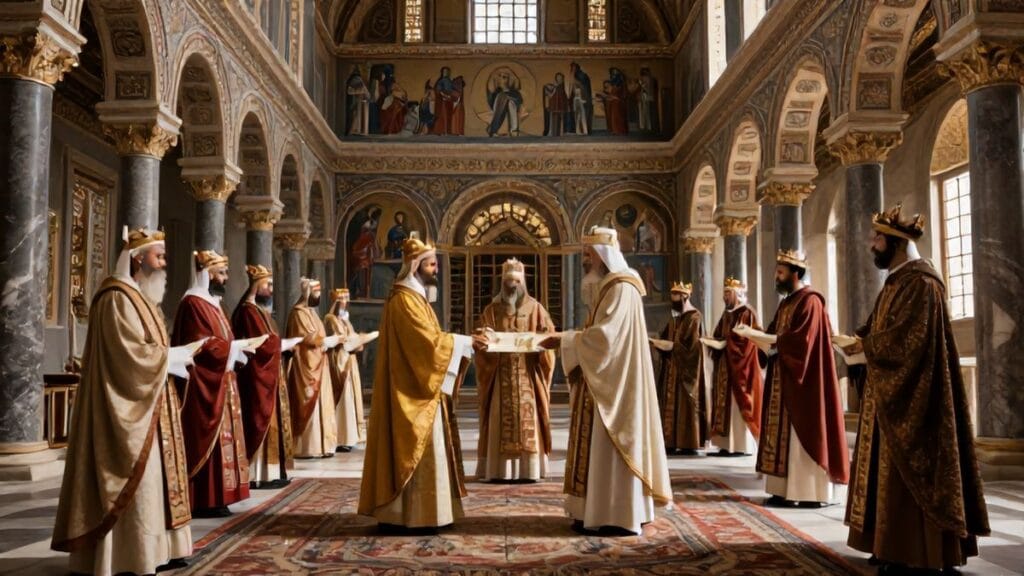
Soon after their arrival, the pope hormisdas legates constantinople were summoned to the Great Palace. They passed through gilded halls and colonnaded courtyards where marble gleamed under colored glass windows, an architecture designed to impress visitors with the almost cosmic majesty of the imperial office. Even seasoned diplomats from Persia or the barbarian kingdoms found themselves awed by this display. For Roman clerics accustomed to the solemn but relatively austere spaces of the Lateran, the effect must have been almost disorienting.
In the audience hall, Emperor Anastasius waited, robed and crowned. Around him stood his officials: the magister officiorum, the praetorian prefect, court eunuchs who wielded subtler forms of influence. The legates bowed deeply, presenting the pope’s letters. An interpreter, or perhaps one of the legates fluent in Greek, read out the contents. The words were carefully chosen—respectful but firm, appealing to shared faith while insisting on Rome’s understanding of orthodoxy.
Anastasius listened, face unreadable. He responded in measured tones that emphasized his concern for unity and peace in the Church, his desire not to disturb the fragile equilibrium the Henotikon had achieved in some regions. He signaled willingness to discuss doctrine, but he avoided any outright commitment to the pope’s terms. It was a dance, as much diplomatic as theological. Both sides knew that this first encounter would set the tone for everything that followed.
Outside the formal audiences, the legates met with the patriarchal clergy of Constantinople. At this time, the patriarch’s relationship with the emperor was intricate—a mixture of genuine spiritual partnership and dependence on imperial favor. In 517, the patriarch was John of Cappadocia, an able but cautious figure who inherited the delicate situation left by his predecessors. He, too, wished for unity, but not at the cost of alienating powerful anti-Chalcedonian constituencies.
Discussions with the patriarch and his synod revolved around crucial questions: Could the East explicitly reaffirm the Council of Chalcedon without provoking catastrophe in Egypt and Syria? Could Acacius and others like him be quietly left in the past, neither fully honored nor explicitly condemned? Might some formula be crafted that satisfied Rome’s insistence on doctrinal clarity while leaving the emperor free to manage his restive provinces? The legates, bound by Hormisdas’ instructions, had limited room to maneuver. They could explain, elaborate, and plead, but they could not alter the substance of the Formula they carried.
Evenings occasionally brought more informal conversations. A sympathetic deacon might invite them to share wine and bread in a quiet courtyard, where, out of earshot of courtiers, a more personal exchange could unfold. In those candid hours, the legates glimpsed something often hidden by official protocols: the weariness of men who had spent their lives contending with one Christological controversy after another, the yearning for a peace that did not feel like surrender.
One chronicler, writing decades later, described the atmosphere of such negotiations as “a smoke-filled room where words were weapons and silence was armor.” Though perhaps embellished, the phrase captures an underlying reality. In those rooms, the fate of creeds and the memory of councils were shaped not only by abstract theology but by the very human art of conversation: raised voices, careful pauses, sidelong glances. These were the crucibles in which later historians would find the raw material for their narratives of triumph or tragedy.
The Formula of Hormisdas: A Parchment Meant to Heal an Empire
At the heart of the mission of pope hormisdas legates constantinople lay a document: the Formula of Hormisdas. Written initially in Latin and then translated into Greek, it was not a long text, but it was densely charged with meaning. It hailed the apostolic see of Rome as the unerring guardian of the true faith, explicitly connected orthodoxy to communion with that see, and insisted that those once condemned by Rome—above all Acacius of Constantinople—could not be regarded as orthodox bishops of the Church.
The formula also reaffirmed the authority of the Council of Chalcedon and earlier ecumenical councils. In doing so, it positioned itself against the more ambiguous stance of the Henotikon. To sign the Formula of Hormisdas was, in effect, to renounce the entire compromise policy of Zeno and Anastasius and to acknowledge, at least in principle, Rome’s decisive role in guarding doctrinal purity. For Hormisdas, this was a necessary re-centering of the Church’s life around the apostolic tradition. For many in the East, it looked uncomfortably like a demand for submission.
Imagine a group of bishops in Constantinople gathered around a copy of the formula, each man tracing the lines with his eyes, measuring every phrase against the factors he knew too well: the emperor’s temper, the monks’ passions, the mood in the provinces. One might mutter that the doctrine itself posed no problem—he could affirm Chalcedon, after all—but balk at the political implications of condemning Acacius or formally admitting that Rome’s judgment was irreversible. Another, more pro-Chalcedonian at heart, might find in the formula a welcome anchor after years of doctrinal uncertainty, and quietly support its acceptance.
The legates understood that this parchment was a dividing line. In some sense, it turned an abstract schism into a concrete choice of allegiance. That is why they repeated, insisted, and clarified its clauses in meeting after meeting. They reminded their interlocutors that, in their view, the unity of the Church could not be built upon blurred lines and half-silences. Unity required truth, and truth required the courage to name past errors.
A later historian, writing in the West, would praise the Formula of Hormisdas as “a clear trumpet blast in the confusion of heresies.” By contrast, some Eastern historians regarded it as an overreach, one that aggravated tensions by tying reunion to an unyielding assertion of papal primacy. Both perspectives contain a grain of truth. The formula was indeed clear, perhaps more clear than the Eastern Church was ready to accept under Anastasius. It was a text forged in the papacy’s own struggle for identity amid the ruins of the Western empire, and it bore the marks of that struggle in every line.
As copies of the formula circulated discreetly among bishops and imperial advisors, its fate hung in the balance. Signatures could not be compelled lightly; forced assent would ring hollow and risk backlash. Yet if too many balked, the legates would leave empty-handed, and the schism would continue to harden. The parchment itself lay on tables in candlelit rooms, its ink dark against the page, while men argued late into the night over what it truly demanded of them.
Resistance and Intrigue: Court Factions, Monks, and Diplomats
Not everyone in Constantinople greeted the arrival of the pope hormisdas legates constantinople with pious neutrality. Around Anastasius clustered advisors who saw the mission as a direct threat to their influence. Some had built their careers on supporting the Henotikon compromise, mediating between court and anti-Chalcedonian bishops in the provinces. If the Formula of Hormisdas were accepted, their policies—and perhaps their reputations—would be discredited. Others simply disliked the idea of a foreign bishop, especially one from the now-barbarian West, dictating terms to the emperor of the Romans.
In the shadowy corners of the palace, these figures murmured against the legates. They highlighted potential dangers: Would accepting Rome’s formula provoke Egyptian monasteries into revolt, cutting off the empire’s grain supply? Would Syrian cities rise in protest? Could rival claimants to the throne exploit religious unrest? In an empire where theological disputes had already sparked riots and civil wars, such fears could not be dismissed as mere excuses.
Monastic networks played a crucial role in spreading both enthusiasm and alarm. The city boasted a dense constellation of monasteries: some quietly loyal to Chalcedon, others fiercely opposed, many simply weary of imperial interference. Emissaries from these communities circulated rumors. One day, it was said that the legates had insulted an Eastern saint; another day, that they had secretly promised favors to pro-Chalcedonian bishops. None of this may have been true, but in a society where oral transmission was powerful, perception often counted more than fact.
Meanwhile, foreign diplomats watched events with keen interest. Envoys from the Ostrogothic court of Theodoric, from the Persian shah, and from various barbarian rulers understood that religious unity or disunity within the empire could affect their own bargaining positions. A reunited Church under strong imperial and papal leadership might present a more formidable diplomatic front. A Church at odds with itself would leave emperors distracted and vulnerable. These observers dined with courtiers who had their own agendas, and the resulting swirl of gossip only heightened the sense that much more than theology was at stake.
At times, the legates found doors suddenly closing. A meeting scheduled with a high official was postponed indefinitely. A bishop who had seemed friendly avoided them in public, fearful of being branded a traitor to Eastern autonomy. Letters they tried to send westward might be delayed by unsympathetic officials, or copied and scrutinized before being allowed to proceed. The open hospitality that greeted them on their arrival slowly mutated into a more cautious, hedged politeness.
And yet, the picture was not entirely dark. For each hostile faction, there was another group—whether in the senatorial class, among the urban clergy, or even within the military—who saw potential benefits in reconciliation with Rome. They quietly lobbied the emperor to keep lines of communication open. Some who had relatives or estates in the West understood that a healed schism could ease trade, travel, and family ties. These cross-cutting loyalties made the court a complicated chessboard. The legates were pieces on that board, but not the only ones in motion.
Whispers in the Streets: How Ordinary People Lived the Schism
While high theology and courtly intrigue dominated official records, the schism also filtered down into the lives of ordinary Constantinopolitans. In workshops and taverns, on quays and in tenement courtyards, people argued about matters they barely understood in technical terms but felt keenly nonetheless. For many, the question of whether Christ had “two natures” or “one incarnate nature” was not an abstract point. It colored the way they prayed, the saints they venerated, the preachers they trusted.
Imagine a dockworker named Theodoros, who had grown up hearing fiery sermons against Chalcedon. To him, the council’s definition sounded dangerously close to dividing Christ. When news spread that envoys from Rome—champions of Chalcedon and papal primacy—had arrived, he muttered to his companions that foreign prelates were once again trying to impose alien doctrines on the East. If riots broke out, he would be among the first to hurl stones, less out of deep theological conviction than out of loyalty to his local holy men and a lifetime of hearing Rome painted as arrogant.
In another part of the city, a widow named Juliana might have cherished the opposite view. Her late husband had died fighting in one of the empire’s eastern campaigns, and a Chalcedonian priest had comforted her by stressing Christ’s full humanity, able to share in human suffering. For her, Rome’s insistence on Chalcedon was an affirmation that the God she worshipped truly knew her grief. She lit candles in a church known to favor the council and secretly hoped the legates would succeed in bringing the capital firmly back into the Chalcedonian fold.
Children overheard fragments of these debates and turned them into taunts or jokes. “Your Christ has two natures!” one might shout, to be met with the retort, “At least ours is not divided!” Street preachers and monks used vivid images to make complex doctrines accessible to illiterate crowds, stirring emotions that could be channeled into support for or against imperial religious policies.
Yet behind all this noise, many people longed for stability more than for doctrinal victory. Traders wanted predictable markets, not boycotts driven by theological rage. Parents wanted their children baptized and buried in peace, without wondering whether the priest’s confession would put them on the wrong side of the next imperial decree. Pilgrims who traveled to the shrines in and around Constantinople prayed for healing of physical ailments, not for victory of one Christological faction over another.
The arrival of the pope hormisdas legates constantinople added another layer to this complex social tapestry. Some saw them as exotic holy men from the West, their Latin prayers and slightly different vestments marking them out. Others regarded them with suspicion, even hostility. A few curious onlookers attended the liturgies they celebrated in Latin, straining to catch familiar phrases amid the foreign sounds. Stories about them circulated, embellished with each retelling. In this way, a mission conceived in the palaces of Rome and Constantinople became fodder for the imaginations of the city’s bakers, sailors, and weavers.
From Failure to Turning Point: The Legacy of the 517 Embassy
In strictly immediate terms, the mission of 517 did not achieve its primary goal. Emperor Anastasius did not sign the Formula of Hormisdas. The schism did not end during his lifetime. After protracted negotiations and growing mutual frustration, the legates departed without the triumphant reunion that Rome had hoped for and some in Constantinople had feared.
To many contemporaries, it must have seemed like yet another disappointment in a long series of failed attempts to bridge the East–West divide. In Rome, critics of Anastasius seized on the outcome as proof that the emperor was unserious about orthodoxy. In Constantinople, hardliners against Rome felt vindicated: they had resisted external pressure and preserved what they saw as the rightful autonomy of the Eastern Church. It would have been easy, in the months after the legates left, to file this mission away as a brave but fruitless episode.
Yet history often moves in ways that are invisible to those who live through it. The embassy of pope hormisdas legates constantinople planted seeds whose fruit would ripen only a few years later. The formula had now been thoroughly discussed, dissected, and circulated among Eastern bishops and theologians. Even those who opposed it could not ignore it. Pro-Chalcedonian circles in Constantinople and beyond had seen, up close, that Rome was serious in its commitment to them. They had heard the legates’ arguments and been heartened by their steadfastness. Networks of correspondence had been strengthened; sympathizers had recognized one another.
Moreover, the mission clarified the terms on which reunion might one day occur. There would be no return to vague formulas and deliberate ambiguities. Any future healing of the schism would likely involve acknowledgment of Chalcedon and some form of reconciliation with Rome’s judgments regarding figures like Acacius. Anastasius’ refusal to accept these terms hardened the lines in the short term, but it also ensured that the debate could no longer hide behind the rhetoric of “union at any cost.” The costs were now clear, and each side would need to reckon with them.
From a broader perspective, the embassy also contributed to the evolving self-understanding of the papacy. Hormisdas’ insistence on a robust statement of Roman primacy reflected not only theological conviction but also the new realities of a world where the bishop of Rome was no longer overshadowed by a Western emperor. The mission’s partial failure did not weaken that emerging vision; if anything, it reinforced the sense in Rome that its path might sometimes be lonely but must remain uncompromised.
When, a few years later, Anastasius died and Justin I came to the throne with a more favorable disposition toward Chalcedon and Rome, the groundwork laid in 517 would prove invaluable. The formula was ready, the channels established, the debates already fought. What had seemed a setback would be reinterpreted, in hindsight, as a necessary prelude to success.
From Anastasius to Justin: New Emperor, New Hopes for Reunion
In 518, less than a year after the legates’ mission, Emperor Anastasius died. His passing was not mourned by all; in Constantinople and beyond, many who had opposed his religious policies greeted the news with thinly veiled relief. Into the breach stepped Justin I, an illiterate but shrewd soldier from Thrace who had risen through the ranks of the imperial guard. His religious sympathies lay firmly with the Chalcedonian party, and from the outset he signaled a new course.
One of Justin’s early acts was to seek an end to the Acacian Schism. Unlike Anastasius, he was willing to consider accepting the Formula of Hormisdas, or something close to it, as the basis for reunion. The memory of the earlier embassy now returned with renewed relevance. The legates had introduced the formula, explained its rationale, and tested Eastern reactions. Many bishops and court officials were already familiar with its contents. Some who had hesitated under Anastasius now felt free to support it openly, confident that the new emperor would not punish them for their alignment with Rome.
Pope Hormisdas, still alive and active, seized the opportunity. New legates were sent, building on the work of their predecessors. This time, negotiations proceeded under far more favorable auspices. The patriarch of Constantinople, John of Cappadocia, and later his successor Epiphanius, cooperated with Rome and the emperor. Eventually, in 519, a solemn reunion was proclaimed. The name of the pope was once more added to the diptychs of Constantinople; the names of Acacius and other tainted figures were struck out; Chalcedon was firmly reaffirmed.
It would be a mistake to attribute this success solely to the change of emperor. Justin’s accession provided the necessary conditions, but the content and contours of the agreement were shaped by earlier struggles. The mission of pope hormisdas legates constantinople in 517 had defined the agenda and tested the red lines. Without that prior effort—its partial defeats and its quiet successes—the process under Justin might have been slower, more confused, or prone to new forms of compromise.
Of course, the reunion was not the end of the story. Tensions between East and West persisted, and new controversies would arise in centuries to come: about icons, about the filioque, about jurisdiction. But the episode of 519 marked a genuine, if temporary, healing of a breach that many had feared permanent. It showed that even after decades of schism, communication could be rebuilt and common ground discovered—provided that both theological conviction and political will aligned.
In this later context, the 517 embassy took on the aura of a “necessary failure,” a stage in a longer drama whose final act Hormisdas lived just long enough to see. What had once seemed a misstep now appeared, in Roman and some Eastern narratives, as prophetic: a bold stand that the future would vindicate.
Echoes Through Centuries: Papal Primacy, Eastern Autonomy, and Memory
The story of pope hormisdas legates constantinople did not end with the reunion of 519. Over the centuries, it became a touchstone in larger debates about the meaning of papal primacy and the proper relationship between Rome and Constantinople. Western canonists pointed to Hormisdas’ formula as evidence that even the Eastern Church had once explicitly acknowledged Rome’s unique authority. Eastern theologians, while accepting the historical facts, often framed the episode as a moment conditioned by particular political pressures, not a timeless and universal template.
Medieval Latin chroniclers tended to romanticize the legates’ mission. They portrayed the envoys as courageous champions of truth, undaunted by imperial pomp or Byzantine subtlety. In some accounts, they verge on the superhuman, calmly dismantling heresies and confounding opponents. These narratives, while often edifying to their audiences, smoothed over the complexities and compromises that real diplomacy always entails.
On the other side, some Eastern writers downplayed the episode or cast it in a more ambivalent light. They acknowledged that Jerusalem, Antioch, and Alexandria had eventually joined Constantinople in accepting the reunion, but they highlighted the strain that the formula placed on traditional Eastern understandings of synodality and the collective authority of councils. For them, the ninth-century and eleventh-century ruptures between Rome and the East would demonstrate that the uneasy balance achieved in Hormisdas’ time had never been fully stable.
Modern historians, drawing on a wider range of sources and more critical methodologies, have tried to break free from these confessional polemics. They examine the mission in the context of late antique imperial politics, communication networks, and local religious cultures. Some emphasize the role of language barriers and cultural assumptions—how Latin legal categories and Greek theological rhetoric sometimes passed each other like ships in the night. Others note the importance of economic and military factors: the need to secure frontiers, maintain grain supplies, and manage subject populations.
Yet even the most secular analyses cannot entirely strip the episode of its spiritual dimension. For the participants themselves, this was not merely about institutional power. They believed, with varying degrees of clarity, that the truth about Christ was at stake and that the unity of the Church mattered profoundly for the salvation of souls. Their willingness to risk careers, reputations, and, at times, personal safety on the outcome of theological debates may seem distant from modern sensibilities, but it was deeply real to them.
Today, when ecumenical dialogues between the Roman Catholic Church and the Eastern Orthodox churches seek to overcome later divisions, the events of 517–519 are often revisited. They serve as both inspiration and warning. Inspiration, because they show that even entrenched schisms can be healed. Warning, because they also reveal how quickly unity can fray when authority is asserted without adequate mutual understanding. The memory of pope hormisdas legates constantinople thus continues to reverberate, a distant but not forgotten echo in contemporary conversations about Christian unity.
Historians, Chronicles, and the Sources Behind the Story
Our knowledge of these events rests on a patchwork of sources, each with its own perspective and limitations. Papal letters preserved in the Collectio Avellana and other medieval compilations give us direct access to Hormisdas’ voice. In these missives, we see a careful blend of pastoral concern and institutional firmness. They describe, sometimes in blunt terms, his conditions for reunion and his view of Eastern policies. These letters are indispensable, but they are also self-conscious artifacts, crafted to project authority and to serve as precedents in future disputes.
In the East, chroniclers such as Evagrius Scholasticus and later Theophanes the Confessor mention the schism and its resolution, though not always in satisfying detail about the 517 mission itself. Their works, written decades or even centuries after the events, weave the embassy into larger narratives of imperial history. As one modern scholar has noted, “For Evagrius, councils and embassies are episodes in the long struggle between piety and impiety, emperors and their own consciences.” The embassy of Hormisdas’ legates appears in this light as one more skirmish in a protracted war over true faith.
Secular historians like Procopius, better known for their accounts of Justinian’s wars and building projects, provide precious context rather than direct commentary. Their descriptions of court politics, imperial personalities, and city life in Constantinople help us imagine the world in which the legates operated. The bustling Hippodrome, the labyrinthine palace, the tensions between military and civil elites—all these backdrops are vital for understanding how religious decisions were made and contested.
Modern scholarship, especially since the nineteenth century, has sifted these materials with increasing rigor. Critical editions of papal letters, careful dating of imperial edicts, and comparative analysis of Greek and Latin sources have clarified the chronology of events and the evolving positions of the main actors. Disagreements remain: some historians argue that Hormisdas pushed papal claims to an unprecedented height; others see continuity with earlier popes like Leo the Great. There is debate, too, about how widespread support for Chalcedon truly was in various Eastern regions and how representative the voices recorded in our sources actually are.
Crucially, the study of this period has been enriched by attention to social and cultural history. Rather than focusing solely on bishops and emperors, scholars have begun to ask how ordinary believers received and interpreted theological controversies. Archaeological findings—inscriptions, church foundations, monastic ruins—offer clues to the spread of different doctrinal camps. Such work helps fill in the silences left by elite narratives, giving us a fuller picture of the world in which pope hormisdas legates constantinople acted.
Even with all these tools, our view remains partial. We lack transcripts of many crucial conversations, diaries of the participants, or detailed reports from those who opposed the mission. What we have is a chorus of voices, some loud and confident, others faint and indirect. The task of the historian is to listen carefully to this chorus, distinguish its harmonies and dissonances, and then, humbly, attempt to narrate the story anew.
Human Portraits: The Legates, the Emperor, and the Silent Crowds
Behind the formal titles—pope, emperor, patriarch, legate—stood human beings with fears, hopes, and memories. To truly grasp the significance of 517, it helps to imagine them not as distant icons but as persons caught up in events larger than themselves.
Consider one of the legates, perhaps an older bishop named Ennodius or something akin. In his youth, he had seen barbarian warriors march into Italian cities that once echoed with the footsteps of senators. He had watched churches serve simultaneously as refuges for the poor and stages for doctrinal showdowns. When Hormisdas asked him to go to Constantinople, he accepted not as an adventurer but as a man who knew how fragile both empires and churches could be. Each time he stood before Anastasius or debated with Greek bishops, he carried with him the weight of those memories.
Anastasius, too, deserves to be seen in his full human ambiguity. He was not a cartoon villain scheming against the true faith. Contemporary accounts suggest a conscientious ruler, deeply concerned with justice and good administration, who sincerely believed the Henotikon could secure religious peace. His reluctance to embrace the Formula of Hormisdas came not only from pride or stubbornness, but from a real fear that doing so would tear the empire apart. We may disagree with his judgment, but we cannot dismiss the gravity of the choice before him.
Among the unnamed clergy of Constantinople were men torn between different loyalties: to their patriarch, to their emperor, to the theological heroes of their tradition, and to the broader ideal of a united Christendom. Some had studied under teachers who reviled Chalcedon; others had been secretly reading Latin theological works and found in them a compelling logic. To sign or not to sign the formula was not, for them, a simple matter of obedience; it cut to the heart of their vocational identity.
Then there were the crowds. The artisans who packed the Hippodrome on race days, cheering themselves hoarse for the Blues or the Greens, may have thought little about the finer points of Christology. Yet their passions could be mobilized for or against religious policies, often with devastating consequences. A rumor that the emperor favored “heretics” or that foreign legates had insulted a beloved saint could transform sporting factions into mobs. Many such people likely died in street clashes, their names unrecorded, their role in the great debates reduced to a line in some chronicler’s report of “disturbances in the city.”
Among the monks who watched events unfold, some cultivated inner detachment, retreating to their cells to pray that God would guide the Church. Others engaged more directly, writing letters, exhorting bishops, or even leading protests. For them, the embassy of pope hormisdas legates constantinople was another test of whether those in power would heed the voice of ascetic holiness or bow to political expediency. Their memories, preserved in hagiographies and monastic chronicles, sometimes paint the legates as heroes, sometimes as meddlers. In both cases, they remind us that holiness and orthodoxy, in this age, were not abstract ideals but ways of life fiercely defended.
To weave these human threads back into the narrative is not to dilute its theological or political significance. On the contrary, it deepens our appreciation of what was at stake. Roe and Constantinople were not faceless institutions. They were communities of flesh and blood, of beating hearts and anxious minds, trying to be faithful in a world whose certainties were rapidly shifting.
Conclusion
In the year 517, when the pope hormisdas legates constantinople set foot on the quays of the New Rome, they stepped into a drama already decades in the making—a drama of councils and creeds, of emperors and monks, of empires rising and fragmenting. Their mission did not immediately heal the schism that had divided East and West, yet it shaped the possibilities of what healing could look like. By articulating, with uncompromising clarity, Rome’s understanding of orthodoxy and primacy, Hormisdas and his envoys forced both sides to confront the true cost of unity.
Their embassy unfolded amid the glitter of imperial ceremony and the grime of everyday city life, amid whispered intrigues and shouted slogans, in candlelit councils and in the echoing vastness of great basilicas. It was as human as it was doctrinal. Men hesitated, reconsidered, stood firm or wavered under pressure. Some saw in the legates the promise of restored communion; others feared foreign domination and the loss of local traditions. All, in their different ways, bore the imprint of a time when theology and politics were inseparable threads in a single fabric.
Looking back, we can see that 517 was not an isolated episode but a hinge moment that would soon swing open under Justin I, leading to the momentary healing of the Acacian Schism in 519. The groundwork laid by Hormisdas’ legates made that later success possible, even if they themselves did not live to see all its fruits. Their story reminds us that historical change often comes through efforts that seem, at first, to fail—through arguments that fall on deaf ears, documents that are rejected before they are finally embraced.
Across the centuries, the embassy has continued to echo in debates about papal authority, Eastern autonomy, and the meaning of Christian unity. It stands as a testimony to the courage required to seek reconciliation without abandoning conviction, and to the humility needed to recognize that no single mission, however well planned, can resolve all fractures. In their journey from Rome to Constantinople and back again, the legates of Hormisdas traced a path that later generations still walk: between fidelity to inherited truth and the ever-renewed task of understanding that truth together.
FAQs
- Who was Pope Hormisdas?
Pope Hormisdas was the bishop of Rome from 514 to 523, a former deacon from Campania who became a key figure in ending the Acacian Schism between Rome and Constantinople. He is best known for formulating the doctrinal text known as the Formula of Hormisdas and for sending legates to Constantinople to negotiate reunion with the Eastern Church. - What was the main goal of the legates sent to Constantinople in 517?
The primary goal of the legates was to secure the acceptance of the Formula of Hormisdas by Emperor Anastasius, the patriarch of Constantinople, and the Eastern bishops. Acceptance of this formula would have restored full communion between Rome and the Eastern Churches by reaffirming the Council of Chalcedon and recognizing the authority of the Roman see. - Did the 517 mission succeed in ending the Acacian Schism?
No, the 517 mission did not immediately end the schism. Emperor Anastasius refused to accept the Formula of Hormisdas, and the legates returned to Rome without achieving complete reunion. However, their efforts laid important groundwork, and under Anastasius’ successor, Justin I, a new round of negotiations led to the formal healing of the schism in 519. - What was the Formula of Hormisdas?
The Formula of Hormisdas was a doctrinal statement drafted under Pope Hormisdas that emphasized the primacy of the Roman see and affirmed the authority of the Council of Chalcedon and earlier ecumenical councils. It required the condemnation of Patriarch Acacius of Constantinople and others deemed to have deviated from orthodox teaching, making it both a theological and political document. - Why was Emperor Anastasius reluctant to accept Rome’s terms?
Anastasius feared that explicitly endorsing Chalcedon and condemning figures like Acacius would alienate powerful anti-Chalcedonian factions, especially in Egypt and Syria, and destabilize his empire. He also wished to preserve a degree of autonomy for the Eastern Church and was wary of being seen as submitting to papal authority in a way that might weaken imperial control over religious affairs. - How did ordinary people in Constantinople experience the schism?
Ordinary believers encountered the schism in sermons, liturgical practices, rumors, and occasional street violence. Many may not have grasped the fine points of Christology but aligned themselves with local clergy, monasteries, or factions in the Hippodrome that symbolized particular doctrinal stances. For most, the conflicts were less about abstract theology than about loyalty, identity, and the desire for social and spiritual stability. - What is the long-term significance of the 517 embassy?
In the long term, the 517 embassy helped define the parameters of East–West relations by making clear Rome’s expectations for reunion and by familiarizing Eastern leaders with the Formula of Hormisdas. It contributed to the eventual healing of the Acacian Schism under Justin I and became an important reference point in later debates about papal primacy and ecclesial unity.
External Resource
Internal Link
Other Resources
- Encyclopaedia Britannica – general search for the exact subject
- Google Scholar – academic search for the exact subject
- Internet Archive – digital library search for the exact subject