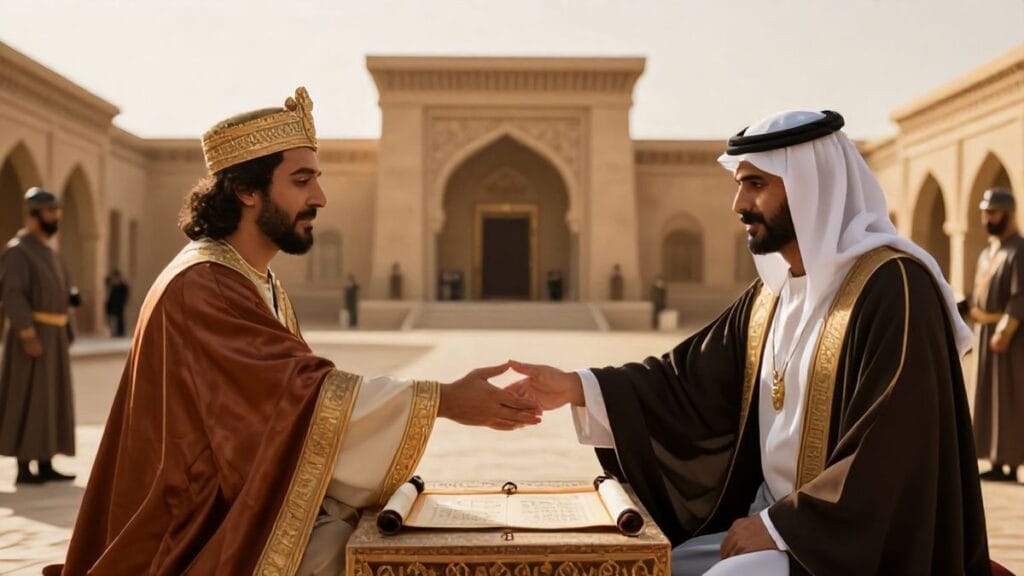
Table of Contents
- Shifting Sands of Empire: The Near East on the Eve of 659
- From Roman Legacy to Umayyad Ambition: Two Worlds Collide
- Civil War in the Caliphate: The First Fitna and Its Echo in Constantinople
- Constans II and Muʿawiya: Portraits of Reluctant Peace-Makers
- The Road to the Byzantine Umayyad Truce 659
- Terms at the Edge of the Sword: What the Truce Actually Meant
- Borderlands in Suspension: Life Along the Frontier During the Truce
- Gold, Grain, and Tribute: The Economic Logic of an Uneasy Peace
- Cities Between Cross and Crescent: Constantinople, Damascus, and the New Balance
- Faith and Rivalry: Christians, Muslims, and the Meaning of Compromise
- Witnesses of the Pause: Chroniclers, Legends, and Silences in the Sources
- Militaries at Rest, Not Idle: Armies, Fleets, and Fortresses in a Time of Truce
- Human Stories in a Fragile Calm: Traders, Refugees, and Captives
- Cracks in the Pact: Renewed Conflict and the Limits of 659’s Peace
- From Brief Armistice to Long Frontier: How 659 Shaped Centuries of Rivalry
- Conclusion
- FAQs
- External Resource
- Internal Link
Article Summary: In the middle of the 7th century, amid civil war in the Islamic world and strain in the Byzantine state, the byzantine umayyad truce 659 emerged as an unexpected pause in a relentless struggle for the Near East. This article traces the intertwined crises of Emperor Constans II and the Umayyad governor Muʿawiya, explaining why both men, hardened by war, chose negotiation over conquest. It explores how this truce reshaped frontiers, redirected resources, and created a breathing space for both empires to rebuild their militaries, economies, and political legitimacy. The story moves from imperial courts to dusty frontier towns, revealing how common soldiers, merchants, and captives experienced this fragile calm. We examine economic arrangements, religious tensions, and the way chroniclers—Byzantine, Syriac, and Arabic—remembered or distorted events. The byzantine umayyad truce 659 appears not merely as a diplomatic footnote, but as a hinge moment that stabilized borders and gave birth to a long-standing confrontation line between Christianity and Islam. Though the peace was temporary, its logic of limited war and negotiated coexistence outlived the agreement itself. Returning to the byzantine umayyad truce 659 allows us to understand how empires choose when to fight and when, reluctantly, to share a world they cannot fully conquer.
Shifting Sands of Empire: The Near East on the Eve of 659
In the year 659, the Near East was a landscape of exhausted armies, burned fields, and tense watchtowers. For decades, the region had been a prize that no single power could fully hold. The Byzantine Empire—what remained of the eastern Roman world—had lost Syria, Palestine, and Egypt to forces that, only a generation earlier, its emperors had barely heard of: the armies of Islam marching under the banner of the Rashidun Caliphs, and then the Umayyad faction. The old imperial roads still ran from Antioch to Damascus and from Alexandria to Jerusalem, but the hands that controlled them had changed, and the loyalties of cities were torn between old imperial habits and new religious and political realities.
Just twenty-five years earlier, Emperor Heraclius had marched triumphantly into Jerusalem with the relic of the True Cross, celebrating victory over the Sasanian Persians. The Roman–Persian War of 602–628 had been a conflict of terrifying intensity, devastating Anatolia, Syria, and Mesopotamia. When that struggle ended, both empires were crippled—fields untended, fortresses ruined, treasuries drained. Into this vacuum swept Arab tribes unified by the message of Islam and galvanized by a sense of religious mission and material opportunity. By 659, the Near East bore the scars of this double catastrophe: first the clash of Rome and Persia, then the sudden avalanche of Arab conquests that dismantled Persia and sliced away the richest provinces of Byzantium.
The people of the region moved carefully through this new world. Greek-speaking Christians who had once called themselves “Romans” now paid taxes to Muslim officials in Damascus; Syriac- and Coptic-speaking communities, already estranged from imperial theological policies, found that the empire that had long oppressed their church councils was too distant—or too weakened—to interfere. Jews, Samaritans, and the mixed urban populations of ports and caravan cities adapted with wary pragmatism. War was not an abstraction for them; it was the farm burned last year, the missing son, the new tax collector at the city gate.
And yet, 659 was not a year of simple conquest. The first wave of expansion had slowed. The frontiers had become lines of skirmishes, raids, and seasonal campaigns. Both the empire and the caliphate needed something they had not dared admit: time. The byzantine umayyad truce 659 was born from this shared exhaustion and hard calculation. It was not a grand settlement etched in marble, but rather a practical ceasefire negotiated at spear’s length, with the blood of the previous two decades still drying in the dust.
Still, this was only the beginning of the story. To understand how a Christian emperor in Constantinople and a Muslim governor in Damascus could agree—even briefly—to stop trying to destroy each other, we must step back and follow the long arc that brought them to the bargaining table, each convinced that a temporary peace could, in its own way, secure a future victory.
From Roman Legacy to Umayyad Ambition: Two Worlds Collide
The Byzantines saw themselves not as a new empire but as the continuation of Rome, baptized in Christian faith. Their ceremonies in Constantinople echoed rituals that, in another age, had honored Jupiter and Mars; their laws traced their roots back to Justinian and, further still, to ancient jurists. The imperial court of the 7th century had inherited a vast bureaucratic machine, two centuries of Christian theology, and a deep conviction that the emperor was God’s chosen ruler on earth, “equal of the Apostles” and guardian of the true faith.
Across the eastern Mediterranean, however, a new political language was taking shape. The Muslim community that had emerged in the Arabian Peninsula had rapidly transformed from a small group around the Prophet Muhammad into a conquering state. Under the first four caliphs, the armies of Islam had destroyed the Sasanian Empire and stripped Byzantium of its Levantine and Egyptian territories. What had begun as tribal coalitions pledged to Medina—then Damascus—was becoming something more structured, more conscious of its destiny.
The Umayyads, a powerful Meccan clan, understood power with a keen, almost ruthless realism. Muʿawiya ibn Abi Sufyan, their leading figure in Syria, had served as governor for years, building ties with local Arab tribes and even with some Christian elites. Unlike many of his contemporaries, he had watched the decaying frontiers of the great empires closely. He knew the strength of Byzantine walls, the challenge of attacking across the sea, and the value of holding a comparatively undamaged province like Syria as the base for future operations.
When these two worlds collided in the 630s and 640s, they did so with a shocking speed. Byzantine armies that only a decade before had marched victoriously against the Persians now broke under the onslaught of fast-moving Arab cavalry. The old defensive system—fortified cities, strategic roads, locally recruited troops—buckled. At Yarmouk in 636, Byzantine forces suffered a catastrophic defeat on the very frontier that once divided them from the Persians. The fall of Damascus, Jerusalem, and eventually Alexandria signaled that this was no mere border raid. A new power structure had arrived, and it was not going away.
The Byzantines fought back with the fury of a wounded giant, using their fleets to harass the Mediterranean coasts and their remaining Anatolian strongholds to launch counterattacks. Yet even they had to recognise that the playing field had changed. Their opponents were no longer Persians who shared roughly similar military traditions and imperial logics; they were tribal armies energized by faith, enriched by plunder, and led by men like Muʿawiya who understood both Arab tribal politics and the vulnerabilities of the old imperial world.
By the 650s, the relentless collisions gave way to something more complex. The Umayyad leadership was no longer just seizing cities; it was learning to administer them. Tax registers were copied, garrisons installed, local elites courted or sidelined. In response, the Byzantines retrenched in Anatolia, turning that rugged peninsula into a protective shield for Constantinople. It was within this shifting, unstable balance that the byzantine umayyad truce 659 would take shape, as each side realized that total victory—at least for now—was out of reach.
Civil War in the Caliphate: The First Fitna and Its Echo in Constantinople
Power rarely moves in straight lines. While the Arab conquests had seemed unstoppable, the 650s and late 650s unveiled a different truth: the conquerors, like the empires they had overrun, were vulnerable to internal conflict. The assassination of Caliph ʿUthmān ibn ʿAffān in 656 ignited the first great civil war of the Islamic community, known as the First Fitna. Rival claimants to leadership, grievances over the distribution of spoils, and deep disputes about justice and legitimacy split the Muslim world.
For Muʿawiya, governor of Syria and a relative of ʿUthmān, the crisis was both a challenge and an opportunity. He positioned himself as the avenger of the slain caliph, refusing to recognize ʿAlī ibn Abī Ṭālib, the new caliph in Kufa. Armies that only years before had ridden together against Byzantium now formed opposing battle lines at Siffīn (657) along the Euphrates. The memory of these fratricidal clashes would echo for centuries in Islamic memory, but in 659 they presented a very immediate, practical problem: the caliphate could not fully concentrate on external expansion while it was tearing itself apart from within.
This internal Muslim conflict did not go unnoticed in Constantinople. Emperor Constans II and his advisers read reports of the First Fitna with a mixture of fascination and calculation. Imperial diplomats, local Christian bishops in the Levant, and spies embedded in frontier towns all carried back scraps of information: which tribes had defected, where battle lines lay, whether Syrian troops remained loyal to Muʿawiya. Each rumor could signal a potential shift in the strategic balance.
Constans II was no naïve spectator, though his own empire was in trouble. He had come to the throne as a child, inheriting a state that had survived total annihilation only to face a new, sharper danger. The loss of Egypt—its grain, its tax revenue—had been a blow from which Byzantium had not recovered. Armies had mutinied, cities had been sacked, and religious disputes within Christianity still simmered. Yet the First Fitna seemed, to some in Constantinople, almost like divine intervention: God had allowed the new Muslim power to be divided, just as He had once used the Persians to chastise the Romans, then overthrown them in turn.
Still, hope was not a strategy. If the Byzantines struck too early, they risked driving the warring Muslim factions back into unity against a common enemy. If they waited too long, Muʿawiya might emerge from the civil war stronger than before, with his power over Syria and its Arab garrisons even more secure. In this delicate moment, the byzantine umayyad truce 659 appealed to both sides for starkly different reasons. For Muʿawiya, a pause in hostilities with Byzantium allowed him to focus on defeating his Muslim rivals. For Constans II, a negotiated truce provided breathing space to strengthen Anatolia and the fleet, and perhaps to sow further discord within the caliphate.
It is astonishing, isn’t it? The very moment when ideology and faith seemed to demand uncompromising struggle—Christians against Muslims, Romans against Arabs—was precisely the moment when political necessity drove the leaders of both camps to an agreement that, on the surface, contradicted their larger ideological narratives. But behind the slogans of holy war and imperial mission, rulers had to balance ledgers, reassure soldiers, and quell unrest at home. The First Fitna, then, was not just an Islamic civil war; it was a turning point in the wider Mediterranean, forcing both great powers to rethink how and when to fight.
Constans II and Muʿawiya: Portraits of Reluctant Peace-Makers
To understand the byzantine umayyad truce 659, we must look closely at the two men whose signatures—or at least whose consent—made it possible: Emperor Constans II and Muʿawiya ibn Abi Sufyan. They were, in many ways, products of different universes. One ruled from a palace whose foundations stretched back to Constantine the Great; the other from a burgeoning power center in Damascus, a city that had once served as a provincial outpost of the very empire he now challenged. And yet they shared certain brutal lessons of rule: that survival sometimes demanded compromise, and that an army unpaid or overused could destroy a regime faster than any foreign foe.
Constans II, known in Greek sources as Konstantinos Pogonatos (“the Bearded”), ascended the throne as a boy in 641 amid dynastic turmoil and military humbling. His grandfather Heraclius had saved Byzantium from the Persians but had left behind a state that, while victorious, was stretched to breaking. During Constans’s youth, Arab armies carved away the empire’s southern and eastern provinces. He came of age watching cities fall and frontiers crumble. In time, he developed a reputation as a stubborn, sometimes ruthless ruler—one who exiled or executed opponents and personally led campaigns in the West, even relocating the imperial court to Syracuse late in his reign.
Muʿawiya, by contrast, emerged from the political labyrinth of Quraysh tribal leadership. As a member of the Umayyad clan, he had once been an opponent of the Prophet Muhammad, but after Mecca’s submission, he entered the new Muslim community and quickly proved his value as a statesman. Appointed governor of Syria under Caliph ʿUmar, he built what later historians would see as an Umayyad power base: loyal tribal formations, a network of local notables, and a pragmatic attitude toward the Christian majority in his province. By the time of the First Fitna, he was one of the most experienced commanders in the Islamic world.
Neither man, it must be stressed, was predisposed to trust the other. Constans II presided over a court steeped in the memory of martyrs and holy wars against Zoroastrian Persia. Muʿawiya led armies that had become accustomed to winning battles against Byzantines and collecting increasingly large shares of booty and land. To their soldiers, “peace” risked sounding suspiciously like weakness or betrayal. Yet both leaders had seen what uncontrolled conflict could do. Constans knew that pushing his Anatolian troops too hard risked rebellion; Muʿawiya, facing rivals within the Muslim community, could not afford a crushing defeat on his northern frontier while still struggling to secure the caliphate.
So they did what seasoned rulers have done throughout history: they swallowed their ideological pride in the name of practical advantage. The truce they agreed upon in 659—its details preserved only partially and with contradictions in our sources—was not a romantic gesture of mutual respect. It was a hard bargain born from necessity, signed by men who would have gladly destroyed each other under different circumstances. Yet, paradoxically, this cynically calculated agreement would do more to stabilize the Near Eastern frontier than many grander sounding campaigns.
The Road to the Byzantine Umayyad Truce 659
The byzantine umayyad truce 659 did not appear out of thin air; it was the endpoint of a series of encounters—military, diplomatic, and psychological—that gradually convinced both sides that a temporary settlement was the least bad option. The early 650s had seen significant naval clashes, including the famous Battle of the Masts (or Battle of Phoenix) around 655, in which the Arab fleet inflicted a shocking defeat on the Byzantines. That loss confirmed something Constantinople had long feared: the sea, once a moat of safety, was no longer exclusively Roman.
In the years that followed, raiding continued along the Anatolian frontier and the Mediterranean coasts, but large-scale campaigns became harder to sustain. The First Fitna tied down many of the best Arab fighting men in Iraq and Syria, while the Byzantines faced mutinies and religious unrest in their remaining territories. Both leaderships also had to recalculate their expectations. The Muslims realized that conquering Constantinople itself would require more than a victorious fleet and a few years’ campaigning; the Byzantines reluctantly conceded that retaking Syria and Egypt was, for the moment, beyond their means.
In this context, exploratory contacts emerged. Some were probably informal: messages passed via local Arab Christian intermediaries, or through merchants with access to both courts. Others took a more official shape, involving envoys who could speak the languages of both worlds—Greek, Arabic, and perhaps Syriac or Armenian. Byzantine diplomats were veterans of complex dealings with Persians, Armenians, and steppe nomads; they understood that a frontier war could be modulated, not only won or lost. On the Muslim side, Muʿawiya had long employed Christian secretaries and understood the value of stable taxation and orderly trade.
The truce of 659 seems to have emerged at a moment when Muʿawiya needed to neutralize the Byzantine front while he consolidated his position against other Muslim factions. Some sources indicate that he had already begun calling himself “amir al-muʾminin” (Commander of the Faithful), a title associated with the caliphate, even before universal recognition followed. Peace with Byzantium would give him a valuable propaganda point: he could present himself as the protector of Syria and the architect of a deal that kept Arab tribes well supplied with revenue and security.
For Constans II, the road to agreement was lined with painful concessions, but he too saw advantage. A truce could stabilize the eastern frontier and buy time to reorganize the empire’s internal administration. Already the “theme” system—regional military-administrative districts in Anatolia—was beginning to take shape. The emperor also needed to demonstrate to his subjects that he could secure peace as well as wage war; the memory of endless defeats weighed heavily on imperial morale.
When envoys finally met to draft the terms, the atmosphere must have been taut with mistrust. Each side carried not only royal instructions but also the hopes and fears of border communities. The scribes recorded agreements in two languages and two legal cultures, knowing that any ambiguity could, later on, become a pretext for renewed hostilities. Yet that fragility did not prevent the truce from being real. In the months and years that followed, raids along parts of the frontier diminished, caravans moved more freely, and both empires redirected their gaze inward, toward consolidation rather than conquest.
Terms at the Edge of the Sword: What the Truce Actually Meant
Reconstructing the exact terms of the byzantine umayyad truce 659 is difficult. Our sources—mostly later chronicles written from confessional perspectives—offer fragments and, at times, contradictions. Yet certain outlines emerge with notable consistency. At its heart, the truce appears to have been a practical arrangement: Byzantium recognized, at least de facto, Muslim control over Syria and parts of Armenia, while the Umayyads agreed to halt major incursions into Anatolia and to regulate the frequency and scope of raids.
One of the most intriguing aspects of the agreement concerns money. Several medieval authors suggest that the Byzantines consented to pay a regular tribute to Muʿawiya. The 9th-century Arabic chronicler al-Ṭabarī, for instance, describes an arrangement during Muʿawiya’s time in which the Byzantines paid annual sums and even delivered certain luxury goods, such as silk garments or trained artisans, in exchange for peace. Whether these exact details apply to the 659 truce or to a later renewal is debated by modern historians, but the underlying logic stands: gold could substitute, at least temporarily, for blood.
From the Byzantine perspective, paying tribute to a Muslim ruler was humiliating yet not unprecedented. Earlier emperors had paid off steppe nomads or even, at times, Persian kings to avoid simultaneous wars on multiple fronts. Inside the palace, the transaction could be framed not as acknowledgment of inferiority but as a cost-efficient military strategy. Better, some might argue, to buy time with coin than to lose soldiers and cities in campaigns the empire was not yet ready to win.
The truce also appears to have addressed issues of prisoners and captives. After decades of war, thousands of individuals—soldiers, civilians, clergy—languished in captivity on both sides. Negotiated exchanges or ransoms not only eased personal suffering but also served as visible symbols of the new, if fragile, arrangement. A market town on the frontier might, for a brief season, become the stage for reunions: a mother recognizing a son who had been believed dead; a monk returning, scarred, to his monastery; an Arab fighter coming home after years in a Byzantine fortress.
Territorial boundaries, meanwhile, remained somewhat fluid. The Near Eastern frontier was less a single clear line than a wide belt of contested zones: mountain valleys in eastern Anatolia, steppe corridors in northern Syria, and coastal stretches along Cilicia. The truce did not map every hill and village. Instead, it set general expectations: certain districts would no longer be targets of annual raiding; fortified frontier towns would be left in relative peace; trade routes would remain open under agreed conditions. Inevitably, local commanders sometimes violated these expectations, whether through eagerness, greed, or miscommunication. The truce was never perfectly observed. But it was real enough to change daily life along the frontier.
Behind these terms lay an unspoken understanding: this was not permanent peace, only a pause. Both Constans II and Muʿawiya knew that future generations might once again push for total victory. Yet the document they sealed—whether at the border or through exchanged letters—acknowledged something profound. The world after the Arab conquests would not simply snap back to the late antique order. Two rival imperial structures now shared the Near East, and neither could erase the other overnight.
Borderlands in Suspension: Life Along the Frontier During the Truce
If we shift our gaze from palace chancelleries to the dusty streets of frontier towns, the byzantine umayyad truce 659 acquires a more intimate texture. In places like Melitene, Germanikeia, or the highland villages of Cilicia and northern Syria, the frontier was not an abstract line on a map. It was the ridge of hills from which raiders sometimes appeared, the river where patrols exchanged tense stares across the water, the marketplace where caravans from both empires converged to trade cloth, grain, and gossip.
During the years of the truce, these communities lived in a state of cautious relief. Farmers who had grown used to planting crops with one eye on the horizon could, for a time, hope to see their fields through to harvest without torch or trample. Local bishops and priests found their congregations slightly less depleted by conscription or capture. In Muslim-held towns, Christian notables—many of them still tied culturally to the Byzantine world—discovered that stability under Umayyad protection could be preferable to the uncertainty of constant warfare.
Frontier life, however, never became truly peaceful. Garrison troops remained, their watchfires glowing each night on the ridges. Training continued, and fortifications were not dismantled but improved. In some segments of the border zone, informal truces and personal understandings between commanders had long limited the worst excesses of raiding; the 659 settlement formalized what many locals already practiced. Tribal groups who had benefited from the plunder economy of earlier campaigns now had to adjust to a more regulated world, relying increasingly on stipends and tax shares rather than unrestrained booty.
Cultural exchanges also deepened in this suspended conflict. Bilingual merchants and scribes shuttled between the two worlds, learning to navigate both Christian and Muslim festivals, both imperial decrees and caliphal edicts. Stories passed across the frontier and changed as they traveled: a Muslim hero became a bandit in a Byzantine tale, while an emperor’s victory morphed into a narrow escape in an Arabic anecdote. Even food and fashion crossed over. Archaeological finds in later centuries—ceramics, coins, and ornaments—hint at networks of trade that ignored ideological boundaries in favor of profit.
Yet behind the surface calm lay lingering fears. Older people remembered sieges and massacres; younger ones heard, in sermons and poetic recitations, that the struggle between cross and crescent was not finished. The truce allowed life to resume certain rhythms, but it did not erase trauma. In that sense, the borderlands became a living archive of the great transition of the 7th century, where every stone house and terraced field testified to the resilience of communities wedged between empires too powerful to ignore and too evenly matched to eliminate one another quickly.
Gold, Grain, and Tribute: The Economic Logic of an Uneasy Peace
Wars are costly, but so is peace. One of the most revealing angles from which to view the byzantine umayyad truce 659 is economic. Both sides had to weigh the financial burden of continued campaigning against the price—literal, in the form of tribute—of stepping back. The calculations, though brutal, were clear: a single failed expedition could cost more than several years of regular payments.
The Byzantine Empire in the mid-7th century was particularly sensitive to fiscal pressures. The loss of Egypt had severed its primary grain artery and stripped the treasury of a key tax base. Maintaining garrisons in Anatolia, paying the salaries of officers and bureaucrats, repairing walls and roads: all these required reliable income. Prolonged war in the East limited Constantinople’s ability to respond to threats on the Balkans or in Italy. A truce allowed the court to reallocate funds—strengthening the navy, for example, or subsidizing fortifications along the Danube.
For Muʿawiya and the emerging Umayyad regime, the economic picture was different yet equally complex. The early conquests had generated immense booty, fueling a culture of expectation among the Arab tribal warriors who formed the backbone of the new order. But as the initial wave of expansion slowed, the caliphal administration had to transition from a war-plunder economy to a more systematic taxation of settled populations. Syria and the former Byzantine provinces it now controlled were rich, but destabilizing them through constant raiding into Anatolia—inviting retaliation—could jeopardize long-term revenue.
Tribute from Byzantium, whether large or modest in absolute terms, had symbolic as well as practical value. It represented a tangible stream of income that could be allocated to pay stipends to Arab troops or to subsidize public works. Some historians have speculated that such payments may have funded the beginnings of a more regular standing army system under Umayyad leadership. At the same time, trade across the frontier generated customs fees, tolls, and opportunities for patronage that enriched local elites on both sides.
Grain, livestock, and textiles moved along caravan routes that crossed the uneasy boundary between the empires. Merchants, often belonging to religious minorities—Jews, Syriac Christians, Armenians—played a key intermediary role. They navigated tax systems both Byzantine and Umayyad, exploiting differences in currency and tariff rates to turn profits. Their fortunes rose and fell with the stability of the frontier. In periods of high tension, caravans were vulnerable to sudden confiscations or attack; under the truce, risk diminished, even if it never vanished entirely.
One can imagine a scene in a frontier khan: a Syrian Christian trader from Damascus bargaining with a Greek-speaking broker from Cappadocia, both calculating not only prices but also the likelihood that the current peace would hold long enough for their next journey. Behind them, in the same hall, imperial and caliphal tax agents might quietly assess their ledgers, counting on the continuation of the truce to balance their accounts. The decision to maintain or break such an agreement, then, was not only a matter for emperors and caliphs but one in which entire webs of economic interests became, in subtle ways, stakeholders.
Cities Between Cross and Crescent: Constantinople, Damascus, and the New Balance
At the macro level, the byzantine umayyad truce 659 redefined the relative positions of two great urban centers: Constantinople and Damascus. Each city embodied a vision of empire, and their reactions to the truce illuminate how politics and urban culture intertwined in this period of transition.
Constantinople in the mid-7th century remained a marvel of the Mediterranean: massive land walls stretching across the peninsula, harbors crowded with merchant vessels, and the great dome of Hagia Sophia glinting above the skyline. Yet beneath the glitter, the city bore signs of strain. Population may have declined compared to the 6th century; refugees from lost provinces crowded certain districts; and the memories of the 626 siege by Persians and Avars were still fresh. The imperial court, however, used the truce to project an image of regained control. The mere fact that the empire could sign an agreement with its most dangerous enemy and hold its remaining territories was framed as a sign of divine favor.
In preachers’ sermons and palace ceremonies, the truce could be cast as a kind of strategic patience: God permitting a temporary respite so that the Christian empire might purify itself, resolve doctrinal disputes, and prepare for a future vindication. Official art and inscriptions continued to depict the emperor as triumphant, stepping on the necks of enemies; the ideological machinery of victory did not pause simply because the armies could not advance. Yet in quieter conversations, some Constantinopolitans must have asked whether their city would ever again bestride a vast, unified Mediterranean world, or whether it had entered a new era of being one great power among others.
Damascus, meanwhile, was being transformed from a provincial Byzantine city into the beating heart of an Islamic polity. Its streets echoed with Arabic as well as Greek and Aramaic. The Umayyad leadership increasingly invested in its infrastructure: palaces, mosques, administrative buildings, and markets. The city’s Christian majority did not disappear; instead, it adapted, sometimes reluctantly, to a new elite. The decision to seek and uphold a truce with Byzantium bolstered Damascus’s status, positioning it not merely as a garrison town on a frontier but as a capital capable of shaping the wider balance of power.
From Damascus’s point of view, the truce confirmed that the former imperial overlord to the north now recognized—however unwillingly—the permanence of Muslim rule in Syria. Local Christian magnates who had once looked anxiously toward Constantinople for intervention had to adjust to the reality that such intervention was unlikely to come soon. Some collaborated with Umayyad administrators, becoming part of a new hybrid governing class. Others withdrew into monastic communities, cherishing the memory of a Byzantine order that seemed, from their vantage point, to be fading into the past.
In both cities, then, the truce was more than a diplomatic line in a chronicle. It was a psychological marker of a world rearranged: Constantinople, still magnificent but curtailed; Damascus, rising and confident, yet anxious to consolidate its legitimacy. The Near East would never again revert to the old Roman–Persian duality. Instead, the long contest between these two centers—one Christian and Roman, the other Muslim and increasingly Arabized—would define the strategic imagination of the region for centuries.
Faith and Rivalry: Christians, Muslims, and the Meaning of Compromise
How does a religious community committed to ultimate truths respond when its political leaders sign truces with ideological adversaries? The byzantine umayyad truce 659 forced both Christian and Muslim thinkers to grapple, implicitly or explicitly, with this dilemma. Official rhetoric on both sides often framed conflict in religious terms: holy war for the faith, defense of the true religion, resistance to unbelief. Yet the realities of rule demanded that emperors and caliphs occasionally make deals with those they had been telling their people to resist.
Within the Christian world, the truce intersected with ongoing theological controversies. The mid-7th century saw fierce debates over Christology—Monothelitism versus Dyothelitism—consume bishops and monks. Some believers interpreted the empire’s military setbacks as divine punishment for doctrinal errors or moral decline. A peace with Muslim rulers could be seen in this light as either a merciful reprieve or as a further sign of weakened imperial zeal. Certain hagiographical texts from the period, while not naming the truce directly, speak of holy men lamenting Christian compromises even as they pray for protection against “the Ishmaelites” or “Saracens.”
In the Islamic world, jurists and storytellers confronted their own set of questions. The early conquests had been experienced as a sign of divine favor: proof that God supported the Islamic community against its adversaries. But what did it mean if the caliph or his representatives agreed to staunch expansion and accept tribute from, or pay tribute to, non-Muslim powers? Some traditions would later emphasize that treaties were permissible when they served the long-term interests of the community, citing the Prophet Muhammad’s own Treaty of Ḥudaybiyya with Mecca as a precedent. Muʿawiya’s pragmatism thus found justification within an existing, though not uncontested, religious framework.
Ordinary believers navigated these dilemmas in their own ways. A Christian peasant in Cappadocia might give thanks at liturgy for the cessation of raids, even as the hymns spoke of Christ as the cosmic conqueror of death and enemies. A Muslim soldier from an Arab tribe settled in Syria might grumble that the truce deprived him of opportunities for booty, while still accepting that his loyalty to Muʿawiya required obedience to political necessity. Over time, religious narratives adjusted, enfolding these episodes of pragmatic compromise into larger stories about divine providence and the unfolding of sacred history.
The interplay of faith and politics is perhaps captured best in the silences of the sources. Chroniclers rarely admit that rulers were motivated by sheer exhaustion, budgetary constraints, or fear of mutiny. Instead, they prefer to attribute successes to piety and failures to sin. Yet between the lines, we can glimpse a more nuanced reality in which holy texts were quoted in councils not only to inspire, but also to justify tactical retreats and negotiated truces. The 659 agreement thus stands as an early example of a pattern that would repeat across the medieval Mediterranean: theological certainty coexisting uneasily with the diplomatic art of compromise.
Witnesses of the Pause: Chroniclers, Legends, and Silences in the Sources
What we know about the byzantine umayyad truce 659 comes to us through a prism of partial, often biased, witnesses. No original diplomatic document has survived; instead, later generations reconstructed the event from snippets preserved in chronicles, letters, and legal compendia. Each narrator had an agenda, a community to defend, and a vision of history to promote.
Byzantine sources, such as the chronicle traditionally attributed to Theophanes the Confessor (though written in the early 9th century), look back on the 7th century as an age of trials and divine chastisement. Theophanes and others mention truces and tax payments to Muslim rulers, but often in compressed form, as if embarrassed to linger on episodes that undercut the narrative of imperial glory. Still, in their brief references, they acknowledge the hard realities of the era. Modern historians mine such notices carefully, cross-referencing them with Eastern Christian and Arabic accounts to reconstruct a more balanced picture.
Syriac chroniclers, writing from Christian communities now largely under Muslim rule, offer another angle. Texts like the Chronicle of Thomas the Presbyter and later compilations by writers such as Michael the Syrian speak of the Arab conquests and subsequent settlements with a mixture of fear, resignation, and, later, accommodation. They sometimes preserve details overlooked by Constantinopolitan authors, particularly about local impacts in Syria and Mesopotamia. One can sense in their lines the shock of communities that found themselves no longer on the margins of the empire but outside it altogether, looking at the Byzantine–Umayyad relationship from the vantage point of conquered subjects.
Arabic and Islamic sources—al-Ṭabarī being one of the most important, though he wrote in the 9th–10th century—frame the era through the lens of the rise of Islam and the legitimacy of different caliphs. They detail battles, successions, and internal disputes, occasionally noting agreements with Byzantium as milestones in Muʿawiya’s consolidation of power. These accounts tend to stress Muslim agency and victory, portraying truces as clever moves that secured advantage rather than as concessions to a formidable enemy. Yet, taken cumulatively, they reveal the extent to which the early caliphate had to engage with its Byzantine counterpart as something more than a mere relic of the past.
Modern scholars, such as Walter Kaegi and Hugh Kennedy, have sifted through these fragmented testimonies, adding to them the evidence of archaeology and numismatics. The circulation patterns of coins, the layers of destruction and rebuilding in frontier settlements, and changes in fortification strategies all bear witness to a period of intense pressure followed by relative stabilization. As one historian has noted, “The 7th century Near East was not simply devastated; it was rearranged” [Kennedy, The Great Arab Conquests]. The truce of 659 forms one of the key hinges in that rearrangement.
Still, gaps remain. We do not possess the voices of the envoys who actually rode under flags of truce to negotiate the agreement, nor of the scribes who penned the bilingual documents. Their words, their hesitations, their private doubts are lost. All that is left are the broad outlines: there was a truce; it listed tribute, boundaries, and prisoners; it lasted long enough to matter. Into the silence between those facts, historians cautiously insert interpretations, always aware that a future discovery—a buried archive, a new reading of an old text—could reshape the story once again.
Militaries at Rest, Not Idle: Armies, Fleets, and Fortresses in a Time of Truce
For soldiers, a truce does not mean retirement; it means reorientation. The byzantine umayyad truce 659 changed the tempo and nature of military life without abolishing it. Armies that had grown used to yearly campaigns now shifted to drilling, fortification work, and occasional policing actions. Fleets, recently tested in major naval battles, continued to patrol coasts and sea lanes, but with fewer large-scale engagements—at least temporarily.
On the Byzantine side, the Anatolian “themes” gradually matured into a system in which land was granted to soldiers in exchange for hereditary military service. A pause in major eastern hostilities gave this arrangement time to solidify. Troops could train in local contexts, learning the terrain they would one day defend. Fortresses along the Taurus and Anti-Taurus mountains were rebuilt or reinforced, serving not only as military strongpoints but also as administrative centers. This entrenchment of the frontier would have lasting consequences, shaping the Byzantine military response to Muslim raids for centuries.
For the Umayyads, the truce allowed the redeployment of elite units to more pressing theaters, especially in Iraq and Arabia, where internal opposition persisted. Syria’s Arab garrisons, however, did not simply demobilize. They continued to receive stipends and to participate in limited “summer and winter” raids (ṣawāʾif and shawātīʾ) that, in some cases, respected the boundaries established by the truce, and in others pressed them. The fine line between officially sanctioned campaigns and rogue operations by ambitious commanders was not always clear.
Naval forces also used the respite to improve their capabilities. Both Byzantium and the Umayyads understood that future conflicts would hinge not only on control of land but on mastery of the sea. Shipyards in Constantinople, along the Aegean coasts, and in Syrian ports like Acre and Tyre worked to repair and build vessels. Crews trained in maneuvering, boarding tactics, and the use of incendiary materials—precursors, perhaps, to the famed “Greek fire” that would later play such a pivotal role in Byzantine defenses.
From the perspective of a common soldier, the truce might have been a mixed blessing. On the one hand, the risk of sudden death on a distant battlefield diminished; on the other, opportunities for plunder and rapid promotion contracted. Some veterans likely welcomed the chance to return more regularly to family life, tending plots of land or small businesses near garrison towns. Others chafed at reduced action, telling stories in barracks about past glories and imagining future campaigns when, as they hoped, the empire or caliphate would once more march decisively against the foe.
In this way, the 659 truce did not demilitarize the region; it professionalized and regularized its violence. War became less a matter of existential, apocalyptic invasions and more of measured, seasonal operations along a relatively stable boundary. The frontier changed from a zone of constant flux into a hardened edge—still dangerous, but increasingly predictable in its rhythms.
Human Stories in a Fragile Calm: Traders, Refugees, and Captives
Beyond the abstractions of imperial strategy, the byzantine umayyad truce 659 reshaped thousands of individual lives in ways at once tender and tragic. Consider, for instance, the fate of captives. Before the truce, prisoners taken in battle or in raids often disappeared into a distant world: sold as slaves, pressed into forced labor, or, in some cases, converted and integrated into the capturing society. Families on both sides lit candles or recited prayers without knowing if their loved ones lived or died.
Truce negotiations frequently included clauses on prisoner exchange. In a dusty clearing near a frontier river, delegations might line up opposite each other, each with lists of names and ranks. Uncertain eyes scanned the other side for familiar faces. Not all the missing were returned; some had died, others resisted coming home after years of adaptation. Yet for those who did, the scenes of reunion must have been emotionally overwhelming. A father embracing a son now grown into a hardened man; siblings recognizing scars that proved identity; clerics counting how many monks and priests had come back to their flocks.
Traders, too, felt the shift. Before the truce, merchants risked their lives transporting goods across a frontier prone to sudden eruptions of violence. A caravan might set out from Aleppo hoping to reach a market town in Cappadocia, only to be ambushed by a roving band or have its route cut by troop movements. Under the truce, risk remained but lessened. New commercial partnerships formed, often involving cross-confessional alliances: a Muslim caravan leader might employ Christian brokers familiar with Byzantine weights and measures; a Jewish merchant might rely on both Muslim and Christian protection letters.
Refugees occupied a more ambiguous position. Some had fled earlier waves of conquest—Byzantine officials, Greek landowners, or devout Christians unwilling to live under Muslim rule—settling deeper in Anatolia or in the islands. Others moved in the opposite direction: Monophysite and other non-Chalcedonian Christians who, feeling persecuted by Constantinople’s religious policies, found greater freedom in Muslim-ruled Syria or Egypt. The truce did not reverse these migrations, but it gave some displaced people the confidence to travel back and forth, visiting relatives or reclaiming property where that was still possible.
For children born around 659 in the Near East, the world of their parents—where “Romans” and “Persians” had been the dominant categories—already seemed distant. They grew up hearing not of the Sasanian shahanshahs but of the caliphs in Damascus and the emperor beyond the mountains. The coexistence, however fragile, fostered by the truce meant that some of them would learn both Greek and Arabic, both Christian hymns and Quranic phrases, at least by ear. Their lives embodied, in miniature, the hybrid reality that the high politics of the time were only beginning to acknowledge.
These human stories, though only faintly reflected in the chronicles, are crucial for understanding the true impact of the truce. Empires rise and fall in textbooks, but on the ground, what people remember most are the years when they could plant without fear, travel without constant dread, and hope—however cautiously—that their children might see more days of peace than they had.
Cracks in the Pact: Renewed Conflict and the Limits of 659’s Peace
No truce lasts forever, and the byzantine umayyad truce 659 was no exception. As Muʿawiya tightened his grip on the caliphate and Constans II pursued his own agenda—including controversial ventures in the West—the strategic calculations that had justified the agreement began to shift. The very success of the truce in stabilizing the frontier made renewed conflict, when it came, more structured and, paradoxically, more sustainable.
By the 660s and 670s, a new phase of Byzantine–Umayyad rivalry emerged, culminating in the great Arab sieges of Constantinople (traditionally dated to 674–678, though modern scholarship nuances this chronology). Fleets launched from Syrian ports probed the defenses of the Bosporus, while Byzantine counterattacks harassed supply lines and coastal bases. The earlier truce had given both sides time to improve their naval capabilities and to better understand the logistical demands of long-range operations. When they returned to full-scale war, they did so with a clearer grasp of each other’s strengths and weaknesses.
Internally, shifts in leadership also affected the durability of peace. Constans II’s decision to move his court to Syracuse in the 660s, and his subsequent assassination there in 668, destabilized Byzantine politics. His son Constantine IV would shoulder the burden of resisting the renewed Umayyad push toward Constantinople. On the Muslim side, Muʿawiya’s eventual success in founding a dynastic caliphate meant that future rulers inherited not only his victories but also his unfinished projects—including the ambition to break Byzantine power for good.
The frontier, once again, flared with increased raiding. Yet it did not revert to the chaotic flux of the early conquest period. The memory and precedent of the 659 truce lingered. Commanders on both sides knew that, under certain conditions, negotiation and limited ceasefires were possible. Even during intense phases of war, local agreements continued to regulate issues like prisoner exchange and seasonal access to pastures. The idea that the Byzantine and Umayyad states formed a long-term, structural opposition—rather than a simple zero-sum contest that would end with one side’s total annihilation—had taken root.
Still, the cracks in the pact were real and widening. Religious rhetoric hardened at times, especially as each side sought to rally support during existential moments such as the siege of Constantinople. The earlier, somewhat pragmatic tone expressed in the 659 deal sometimes gave way to a language of ultimate war between faiths. Yet even then, the lessons of the truce remained in the background: rulers who had seen the benefits of limited peace did not forget them, and in quieter corridors, their advisers could always point back to 659 as an example of how, when the stakes demanded, diplomacy might again serve as a weapon in its own right.
From Brief Armistice to Long Frontier: How 659 Shaped Centuries of Rivalry
In isolation, the byzantine umayyad truce 659 might appear to be just one more medieval treaty, destined to be broken and forgotten. Yet its significance lies not merely in its immediate terms but in the model it set for the centuries that followed. The agreement marked one of the earliest clear recognitions—however tacit—of a durable frontier between a Christian Roman empire and a Muslim caliphate. From that point forward, both sides increasingly behaved as if this boundary, though contested and porous, was a structural feature of their world.
Over time, this frontier developed its own institutions and rhythms. Annual raids, known in Byzantine sources as “strategiai” and in Arabic as “ṣawāʾif,” became almost ritualized events. Fortresses along the Taurus and Anti-Taurus mountains, as well as in northern Syria and Mesopotamia, turned into semi-permanent military communities, with families, markets, and religious institutions tailored to life under constant, limited threat. The strict dichotomy between war and peace blurred; instead, a spectrum of conflict intensity emerged, ranging from full-scale campaigns to nominal truces punctuated by small-scale clashes.
The memory of 659 informed later negotiations. When, for example, Caliph Hārūn al-Rashīd and Emperor Nikephoros I exchanged letters and negotiated payments in the early 9th century, they were acting within a tradition that stretched back to the first decades of contact between Islam and Byzantium. Tribute, prisoner exchanges, restricted zones, and the recognition—if not formal acceptance—of each other’s spheres of control had all been part of that tradition since Constans II and Muʿawiya first chose negotiation over annihilation.
Culturally, the existence of a recognized frontier facilitated what we might call “controlled exchange.” Scholars, artisans, and merchants moved across it more often than older narratives of civilizational clash would suggest. Medical texts, philosophical works, and technical knowledge passed through conduits that the stability of the frontier helped maintain. The slow translation movement that would eventually see Greek science and philosophy enter the Arabic intellectual world had many causes, but it was certainly aided by a world in which Byzantium and the caliphate coexisted as neighboring powers rather than warring to the point of mutual ruin.
Even in the realm of identity, the legacy of the truce can be felt. Byzantine self-understanding as the “Roman” and Christian bulwark against Islam crystallized in the centuries after 659, just as Islamic notions of jihad and dar al-Islam versus dar al-harb evolved in part in response to the persistent presence of a powerful, non-Muslim empire next door. The possibility of truces, alliances with mutual enemies, and long-term coexistence all had to be theorized against the backdrop of this enduring confrontation.
Modern historians, looking back across this long arc, now see the 7th century not only as an age of collapse but as one of foundational reconfiguration. The truce of 659 belongs to that reconfiguration. It did not end the conflict between Byzantium and the Umayyads—far from it. But it helped fix the contours of a new geopolitical reality: two great powers sharing the Near East, each adapting to the other’s presence, each building institutions designed to manage a rivalry that neither could entirely win nor afford to abandon.
Conclusion
The moment when envoys rode out in 659 to negotiate the byzantine umayyad truce 659 captured, in a single fragile gesture, the transformation of an entire world. In the wake of catastrophic wars, the fall of empires, and the rise of new faith-fueled polities, two hardened leaders—Constans II in Constantinople and Muʿawiya in Damascus—chose to pause the cycle of violence. Their decision was not born of idealism. It was a calculation grounded in exhaustion, fiscal reality, and the pressing demands of internal politics. Yet its consequences reached far beyond their immediate horizons.
The truce stabilized a frontier that had been in turmoil for decades. It allowed communities on both sides to breathe, rebuild, and reimagine their place in a reordered Near East. Farmers returned to their fields, captives to their homes, merchants to their routes, and commanders to the painstaking work of fortification and training. At a higher level, the agreement set an enduring precedent: that the Christian Roman empire and the Muslim caliphate could, under certain circumstances, negotiate formal arrangements recognizing each other’s power and territory, even while maintaining ultimate ideological enmity.
In this sense, 659 was less an ending than a beginning. The peace was temporary, but the patterns it crystallized—the notion of a structural frontier, the tools of tribute and prisoner exchange, the possibility of coexistence without reconciliation—would define the Byzantine–Islamic encounter for centuries. Later sieges, treaties, and alliances all unfolded in a world already shaped by the compromises of that year. To revisit the truce today is to glimpse the moment when the Near East stepped decisively into a medieval order in which Christians and Muslims, Romans and Arabs, would share a landscape neither could fully command.
Perhaps that is the deepest lesson of the byzantine umayyad truce 659. Even in eras animated by absolute religious claims and imperial ambitions, political communities find ways to live with rivals they cannot overcome. Peace, however imperfect and precarious, becomes another weapon in the arsenal of statecraft. In a region that has continued, down to the present, to witness both devastating wars and uneasy compromises, the story of 659 reminds us that the choice between total conflict and negotiated coexistence has always been, and remains still, a matter of historical agency—and of human imagination.
FAQs
- What was the byzantine umayyad truce 659?
The byzantine umayyad truce 659 was a negotiated ceasefire between the Byzantine Empire under Emperor Constans II and the Umayyad leadership in Syria under Muʿawiya ibn Abi Sufyan. It marked a temporary halt to decades of intense warfare in the Near East, recognized existing territorial realities, and established terms for tribute, prisoner exchanges, and regulated frontier activity. Though not a permanent peace, it significantly stabilized the region and set a precedent for later Byzantine–Islamic treaties. - Why did Constans II and Muʿawiya agree to a truce instead of continuing the war?
Both rulers faced serious constraints. Constans II governed an empire weakened by the loss of major provinces like Egypt and by internal religious and political tensions. Muʿawiya was embroiled in the First Fitna, the first great Islamic civil war, and needed to secure his Syrian base. A truce allowed each to conserve resources, focus on internal consolidation, and avoid risky campaigns that could trigger rebellions or catastrophic defeats. - Did the truce involve Byzantine payment of tribute to the Umayyads?
Many medieval sources, especially Arabic chronicles such as al-Ṭabarī, indicate that the truce included a financial component, with Byzantium paying tribute to Muʿawiya in exchange for peace. While details on exact sums and goods vary and remain debated among modern historians, the consensus is that some form of regular payment or material concession was part of the agreement, reflecting a pragmatic willingness on the Byzantine side to use gold to buy time. - How did the truce affect everyday people living along the frontier?
For frontier communities, the truce brought a measure of relief. Farmers could cultivate fields with less fear of sudden raids, marketplaces grew busier as trade resumed, and some captives were returned through organized exchanges. Garrison life continued, and the region remained militarized, but the frequency and intensity of large-scale attacks decreased. This relative stability allowed local societies to adapt to the new geopolitical order and to develop cross-border commercial and cultural links. - Did the byzantine umayyad truce 659 end the conflict between Byzantium and the caliphate?
No, the truce did not end the broader conflict; it merely paused it and reshaped its contours. After Muʿawiya consolidated his position and new leaders emerged on both sides, warfare resumed, culminating in major events like the Arab sieges of Constantinople in the late 7th century. However, the 659 agreement influenced how future conflicts were conducted, encouraging more structured frontiers, recurring raids rather than permanent invasions, and recurring negotiation over issues like prisoners and tribute. - How do historians know about the terms and existence of the truce?
Information about the truce comes from a combination of Byzantine, Syriac, and Arabic chronicles, as well as from later historical syntheses. No original treaty document survives, but cross-referencing different narrative sources and examining archaeological and numismatic evidence allows historians to reconstruct the basic outline. Scholars such as Hugh Kennedy and Walter Kaegi have analyzed these materials in depth, highlighting both convergences and discrepancies in the medieval accounts to build a plausible picture of the 659 settlement. - What long-term impact did the truce have on Byzantine–Islamic relations?
In the long term, the 659 truce helped establish the idea of a relatively stable frontier between the Byzantine Empire and the Islamic world. It showed that, despite ideological hostility, both sides could enter into structured agreements involving tribute, territorial recognition, and regulated conflict. This pattern would persist for centuries, shaping a distinctive frontier culture of seasonal raids, periodic truces, and ongoing diplomatic engagement that framed the broader Christian–Muslim encounter in the eastern Mediterranean.
External Resource
Internal Link
Other Resources
- Encyclopaedia Britannica – general search for the exact subject
- Google Scholar – academic search for the exact subject
- Internet Archive – digital library search for the exact subject

