Table of Contents
- A November Morning in Reims: Setting the Stage for a Boy King
- From Child of War to Heir of a Troubled Crown
- Reims, City of Kings and Saints
- The Journey to Reims: Processions, Prayers, and Political Theater
- Inside the Cathedral: Relics, Regalia, and Sacred Spaces
- Dawn of 4 November 1380: The Coronation Begins
- Anointing the Boy: Oil, Oaths, and the Sacred Body of the King
- Crown, Sword, and Scepter: The Moment of Kingship
- Trumpets, Te Deum, and Tumult: The Public Face of the Ceremony
- Feasts, Pageants, and Promises: Celebrating a New Reign
- Uncles in the Shadows: The Regents Behind the Crown
- The People’s Hopes and Burdens: Taxes, War, and Revolt after the Coronation
- Prophecies, Omens, and the Fragile Mind of a Future Mad King
- From Coronation Glory to Royal Madness: A Kingdom Unraveling
- Memory of a November Day: How Chroniclers Shaped Charles VI’s Image
- Reims and the Long Shadow of French Kingship
- Conclusion
- FAQs
- External Resource
- Internal Link
Article Summary: On 4 November 1380, a frail boy entered the cathedral of Reims and emerged as King of France, an event remembered as charles vi of france coronation, one of the most symbolically charged moments of late medieval Europe. This article reconstructs that day in all its sensory detail, from the chill of the November air to the booming chants and glittering regalia within the vaulted nave. It explores how coronation ritual in Reims linked the French monarchy to sacred legend, political power, and the precarious hopes of a war‑torn kingdom. Yet behind the incense and pageantry lurked ambitious uncles, simmering social tensions, and the unresolved traumas of the Hundred Years’ War. We follow Charles VI from his early childhood to the threshold of madness, tracing how the promise of his coronation gradually dissolved into civil war and suffering. The narrative also examines how chroniclers and later historians used that coronation to craft the king’s image—both sanctified child-king and tragic “Charles the Mad.” In doing so, it shows how a single ritual day in Reims became a turning point, casting a long, flickering light over the fate of the French monarchy and the wider history of medieval Europe.
A November Morning in Reims: Setting the Stage for a Boy King
The fourth of November 1380 rose gray and cold over the city of Reims. Low clouds hung above the Champagne plain, swallowing sound and breath in the damp air. In the streets, the first bells began to toll, slow and heavy, beating like a distant heart. From every alleyway, from wooden houses and stone mansions, people emerged in cloaks and furs, gloved hands wrapped tightly against the chill, all of them moving toward one place: the great cathedral whose towers pierced the sky like stone lances.
Inside those walls, a boy of barely twelve years was preparing to change the fate of a kingdom. History would remember the spectacle simply as charles vi of france coronation, but to those who lived it, the moment felt less like an entry in a chronicle and more like the fragile crossing of a bridge built of ritual, rumor, and hope. The Kingdom of France in 1380 was tired—tired of war, of taxes, of the unpredictable cruelty of fate. It had only just buried King Charles V, a monarch hailed by some as “the Wise,” whose careful governance had slowed, though not stopped, the bleeding of the Hundred Years’ War.
Now his son, Charles VI, stepped forward to claim that heavy crown. Around him circled powerful men—his uncles from the houses of Burgundy, Berry, and Anjou—each looking at the same golden diadem and seeing not just sacred duty but opportunity. Outside, below the cathedral’s carved facade of angels and kings, shoemakers and butchers, merchants and widows, pilgrims and petty thieves thronged in the square. They could not see the oaths that would be sworn or the holy oil that would be poured, yet they understood that something irreversible would be done that day.
It is tempting, with the knowledge of hindsight, to let the future dominate this November morning—to see in the clear eyes of the boy king the shadow of the madman he would become, to trace on his brow the threads of civil war and foreign invasion. But to stand with those who actually gathered in Reims in 1380 is to inhabit another reality, one alive with anxious anticipation. Trumpets glinted in the hands of musicians; torches sputtered; clerics whispered as they adjusted vestments lined with gold thread. Somewhere behind a guarded door, the crown of Charlemagne waited, its weight unchanging, indifferent to the small trembling of the child destined to wear it.
In a Europe where kings fell in battle, were captured, or died unexpectedly of disease, the theater of coronation mattered. It was not a mere ceremony but a public rewriting of the world, a statement that God himself had chosen to reorder power through the body of this particular boy. The cold sunlight inching over the stones of Reims on 4 November 1380 lit more than a city; it illuminated a moment when ritual, faith, and politics converged into a single, shimmering point in time.
From Child of War to Heir of a Troubled Crown
Charles VI entered life in 1368 already entangled in war. The Hundred Years’ War had been grinding on for more than three decades, flashing hot and cold across the fields of northern France. Only twelve years earlier, at Poitiers, King John II of France had been captured by the English, throwing the realm into chaos and humiliation. Charles’s father, the Dauphin Charles—later Charles V—had clawed back legitimacy and territory through patient diplomacy, shrewd taxation, and careful use of mercenaries. The child who would be crowned in 1380 was born into a kingdom still haunted by that trauma.
As a boy, Charles was surrounded by the instruments and echoes of war. Stories of the great English victories—Crécy, Poitiers—still hung in the air like smoke, and the specter of another disaster was never far. Yet Charles V protected his heir as best he could, building a circle of tutors and guardians around the prince. The king knew he would not live forever. Chronic illness gnawed at his body, and the burden of kingship wore him down. Even as he orchestrated campaigns that reconquered swathes of territory from English and Navarrese hands, he worked to shape his son into a worthy successor.
Contemporaries remarked on the young prince’s serious demeanor. Unlike his dazzling, martial grandfather John II, or his flamboyant uncles, Charles VI was raised in a court where calculation mattered more than bravado. He learned to read the heavy Latin of legal documents and the more fluid French of chivalric tales. Accounts mention that he listened attentively to men such as the royal clerks, and later he would be associated with scholars and moralists. It is one of history’s bitter ironies that a boy molded amid such careful planning would grow into a king crushed by inner storms no tutor could foresee.
By 1380, as his father’s health visibly deteriorated, Charles stood on the threshold of power but not of independence. Medieval kings did not rule alone, especially when they were children. Around the prince circled three key figures: Louis, Duke of Anjou; John, Duke of Berry; and Philip, Duke of Burgundy. These royal uncles, brothers of the late King Charles V, represented a powerful coalition of blood, territory, and ambition. They posed as protectors of their nephew, and in a sense they were—but protectors whose hands already extended toward the coffers and offices of the crown.
When Charles V died in September 1380, the question of succession was not in doubt. The law of France, increasingly articulated as the Salic Law, had crystallized around male primogeniture. The boy Charles automatically became king—Charles VI—at the moment his father breathed his last. But the ritual enactment of that kingship still awaited him. He would not merely inherit the throne; he had to be made into a sacred monarch in the eyes of God and his people. That transformation could happen only in one place, and in one carefully scripted way. Thus, as autumn advanced, the machinery of coronation began to turn, and the eyes of France shifted eastward, toward Reims.
Reims, City of Kings and Saints
Reims was not the largest or wealthiest city in France, nor was it the seat of royal government. Yet as the year 1380 waned, it again became the beating heart of the kingdom. For centuries, its cathedral had stood as the chosen stage where French kings were anointed and crowned. Its importance was born of legend and nurtured by politics. According to a cherished tradition, it was in Reims that Clovis, the Frankish chieftain who unified much of Gaul, had been baptized around the year 496 by Saint Remigius. This act symbolized the fusing of Frankish power with Roman Christianity, and it cast an aura of sacred antiquity over the city.
The centerpiece of this aura was the Sainte Ampoule, the “Holy Ampulla,” a small vial said to contain oil miraculously delivered by a dove from heaven for Clovis’s baptism. Whether one believes the story or not, the fact remains that by the late fourteenth century this relic had become indispensable to the ideology of French monarchy. To be anointed with that oil—or at least with oil to which a drop from the ampulla had been added—meant more than receiving an ecclesiastical blessing. It meant that the king participated in a special relationship with the divine, akin to that of the Old Testament kings of Israel.
The cathedral of Reims embodied that narrative in stone and glass. Its facade displayed an army of carved kings and saints, some weathered, some still sharp, all of them silent witnesses to the procession of rulers. Above the main portal, angels smiled with enigmatic serenity, their lips just slightly parted, as if about to speak a secret only kings could hear. Light streaming through the high stained glass windows colored the interior in blues and reds, while the vast nave echoed every sound tenfold. It is there, beneath this soaring vault, that charles vi of france coronation unfolded, weaving another thread into the tapestry of Reims’s history.
But Reims was more than a stage set. It was a living city whose merchants thrived on the champagne trade, whose artisans carved and wove for local and distant clients. Its canons and archbishops held both spiritual authority and very temporal lands, jealous of their privileges. When word came that the new king would be crowned there, the city braced itself. Streets had to be cleared, lodgings prepared, supplies of food and wine amassed. Hostels filled with delegations from across the realm: bishops, nobles, envoys from towns, even foreign observers. The population of Reims swelled, tensions along with it. Prices rose; so did expectations.
For the clergy of Reims, the event reaffirmed their own centrality. The archbishop who would anoint the king did not just perform a rite; he enacted a theology of power. His hand would bridge heaven and earth, tracing oil on the boy’s forehead and hands, chest and shoulders, transforming flesh into the living symbol of the res publica. In later centuries, observers would sometimes scoff at such claims, but in 1380, when the plague could return without warning and war might erupt with a border raid, people clung fiercely to rituals that seemed to weld order onto chaos.
The Journey to Reims: Processions, Prayers, and Political Theater
Before the incense and chants of the cathedral came the dust and chatter of the road. The journey to Reims, undertaken by the royal entourage and its many satellites, was itself a piece of political theater. From the royal domains nearer to Paris, the company wound its way eastward along rivers and across muddy roads, passing villages that had tasted war, famine, and the cold scrutiny of tax collectors. Wherever the boy king appeared, people gathered, curious to gaze upon the child whose face would soon be stamped on coins and whose name would appear on decrees.
Contemporary chroniclers, like the meticulous Jean Froissart, dwelt on the magnificence of such processions. Banners fluttered in the chilly air, emblazoned with lilies of France, the devices of royal princes, and the heraldry of great lords. Mounted knights in glittering armor rode alongside more modest squires and pages. There were wagons laden with household goods, trunks of clothing, tapestries ready to adorn bare stone walls. Priests and friars accompanied them, some tasked with singing the offices during the journey, others offering counsel and confession.
At each stop, the clergy of local churches received the future crowned king with formal greetings. Bells pealed; church doors opened; townsmen offered bread, salt, and wine, tokens of hospitality and submission. In some places, the young Charles dismounted to kneel before major relics, kissing the cold glass or gold of reliquaries that held fragments of saints. Every step of this progression reminded observers that the king did not travel alone. He moved within an invisible web of saints, ancestors, and divine favor.
Yet behind the polished choreography lurked more prosaic negotiation. Hosts bargained over the cost of feeding so many mouths; royal officers complained about shortages or inflated prices. The great princes who rode near Charles eyed one another as much as they watched the crowds. Louis of Anjou had his own designs on kingdoms in Italy; Philip of Burgundy tended a power base that stretched from Flanders to the heart of France. Each calculated how best to emerge from the coming months with greater influence over the royal council.
For the people along the route, the sight of their young sovereign offered at least momentary distraction from hardship. Some knelt as he passed, murmuring prayers for peace or for an end to crushing levies. The crown, they knew, needed money to pay troops and rebuild. But after years of fiscal innovation under Charles V, resentment bubbled in many places. The approaching coronation was not only a sacred moment; it was also a re‑opening of the question of who should pay the price of royal authority. In the press of the roads leading toward Reims, hopes and fears walked side by side.
Inside the Cathedral: Relics, Regalia, and Sacred Spaces
By the time the royal party reached Reims and the day of charles vi of france coronation drew near, the cathedral had already been transformed. Workmen had labored for days erecting wooden platforms, seating for dignitaries, and temporary structures by which the king would be seen more clearly by the spectators packing the nave. Tapestries were hung along the choir, their woven figures—biblical scenes, legendary battles, and allegories—forming a kind of painted commentary on the events to come.
Within the sacristy, behind heavy doors, lay the regalia. There was the crown attributed to Charlemagne, though already in Charles VI’s time it was more mythic than authentic, altered and reworked by generations of goldsmiths. There was the sword of state, Joyeuse, whose name echoed the legendary weapon of the emperor in chansons de geste. Close by rested the royal scepter and the hand of justice, a staff topped with an ivory hand, symbolizing the king’s duty to judge rightly. Each object had its story, but together they formed a material language of power.
Separate, even more jealously guarded, was the Sainte Ampoule. Stored in the abbey of Saint-Remi in Reims, the ampulla was brought in solemn procession to the cathedral before the coronation, wrapped in silk and accompanied by monks chanting hymns. The people of Reims watched this approach with special pride; this was their relic, their guarantee that every king of France would have to pass through their city and bow, implicitly, before their spiritual prestige.
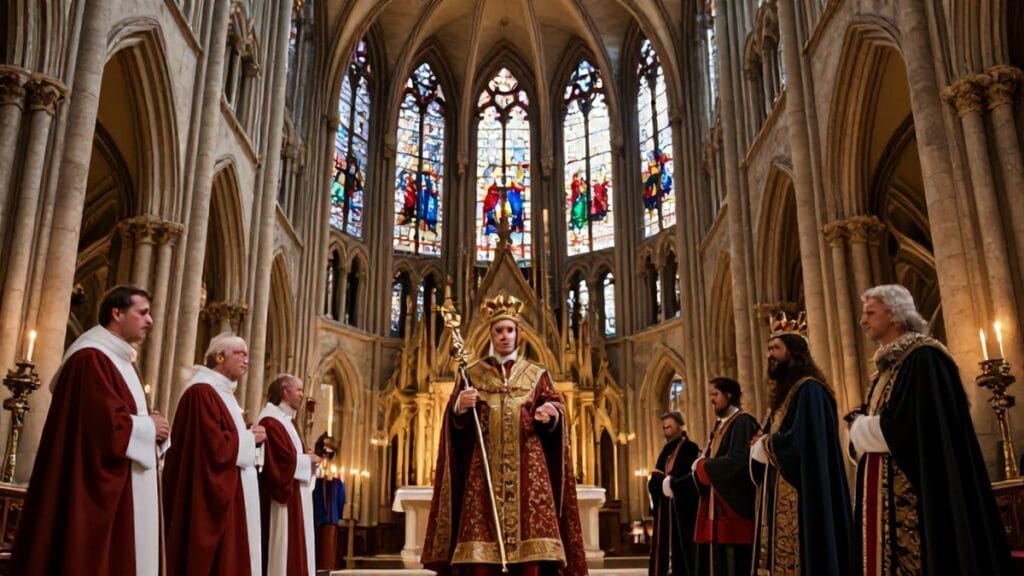
The cathedral itself, emptied of everyday worshippers and filled again with invited guests, must have seemed both familiar and utterly strange. Torches and candles multiplied in number, casting a wavering golden light across stone columns. The smell of wax mixed with the sweetness of incense. Platforms along the nave held nobles and prelates; ambassadors from foreign courts, some representing allies, others enemies, took their places. The poor of Reims and common spectators, when allowed inside, were pushed to the margins, craning their necks to see anything at all.
As the minutes ticked toward the ceremony, choirboys rehearsed their responses under the watchful eye of canons. Priests arranged liturgical books on the altar, marked with silk ribbons at the proper chants and prayers. In one corner, a clerk gently unfolded the text of the king’s oath, written in elegant script, ready to be read aloud and sworn upon. Every detail had been anticipated; every movement rehearsed. Yet human beings, not automata, would carry it all out, and the possibility of misstep—of a forgotten line, a dropped object, even a sudden illness—hovered, ghostlike, at the edges of the sacred drama.
Dawn of 4 November 1380: The Coronation Begins
When dawn finally broke on 4 November 1380, the sky above Reims was a pale sheet of iron. Inside the royal lodgings, servants moved quietly, laying out garments that glittered with threads of gold. The boy who was already, in law, King Charles VI woke into a day that would fix his image forever in the memory of his kingdom. He was dressed in tunics and mantles that weighed more than his own childhood clothes ever had, heavy with embroidery and fur. A sense of unreality must have hung about him; how could any twelve‑year‑old fully grasp what this day would mean?
The procession from the palace or lodging to the cathedral was itself a carefully arranged ceremony. Trumpeters led the way, sounding bright, brassy notes that bounced off the stone facades of the city. Behind them came heralds in tabards emblazoned with the fleur‑de‑lis. Then nobles and prelates, each group according to its rank. The people of Reims filled windows, rooftops, and every vantage point along the route. Cries of “Noël! Noël!”—a shout of acclamation often used for kings—rippled through the crowd as they caught sight of the royal figure.
Charles, small within his rich garments, walked or was borne under a canopy held by leading lords. The canopy, a square of fabric richly decorated, was more than mere shelter; it symbolized the honor of the king and emphasized his central place in the procession. Around him, his uncles and counselors formed a protective ring. They were careful, no doubt, to display an appearance of unified devotion. But observers attuned to court politics would have seen the subtle jockeying for position, each prince trying to stand just a little closer to the royal person than the others.
Upon reaching the steps of the cathedral, Charles paused. This was the threshold between ordinary space and sacred time. Inside, the archbishop and clergy waited, vested in their richest liturgical garments. The boy king bowed, then advanced into the dim, incense‑laden interior, where the ceremony of making a king would unfold step by step, prayer by prayer. It is here, in the long nave of Reims, that charles vi of france coronation truly began to inscribe itself as one of the most emblematic rituals of late medieval France.
The opening rites evoked humility as much as exaltation. Charles may have prostrated himself before the altar, lying flat on the stone floor as litanies of the saints were sung above him. In that posture, the person called to be the highest in the realm assumed the position of the lowest, a reminder—to the extent ritual could remind—that royal greatness came with obligations under God. The contrast between this image and the glittering crown nearby was stark, almost jarring. But such paradox lay at the heart of medieval kingship: the king was at once servant and sovereign, a sinner and a quasi‑sacred figure.
Anointing the Boy: Oil, Oaths, and the Sacred Body of the King
The central act of the coronation was not the crowning itself, but the anointing. After the readings and prayers that framed the beginning of the rite, the archbishop approached the young king with the oil deemed more precious than gold or silver. According to custom, the holy oil from the Sainte Ampoule was mixed with chrism, consecrated oil the Church used in other sacraments. The mixture signaled continuity with both biblical kings and Christian rites.
Charles VI, having taken off certain outer garments, exposed parts of his body—his head, chest, shoulders, back, even the joints of arms and hands—to receive the holy oil. Each touch of the archbishop’s thumb traced a cross upon flesh, accompanied by formulae that invoked the example of Saul, David, and Solomon. In those moments, the body of the boy was symbolically remade as the body of the king: a living instrument through which God was supposed to govern the people of France.
The oath followed, anchoring this mystical transformation in concrete promises. Holding perhaps the Gospels or swearing upon relics, Charles vowed to protect the Church, to administer justice, to defend the weak, and to uphold the customs of the kingdom. The words would have been dictated to him, and he repeated them, his young voice echoing through the nave. One might imagine the murmur among those listening: would this child, manipulated by powerful lords, ever be able to honor such vows?
The political dimension of the oath cannot be overstated. In a France bruised by war and heavy taxation, the coronation represented both continuity and the chance—illusory or real—for adjustment. Some in the nobility hoped for rollback of certain fiscal policies of Charles V. Others, especially townsmen and royal officers, feared a weakening of central power. The oaths, phrased in traditional language, were heard differently by each group. But all projected onto them their own desires, as if words alone could guarantee a better future.
In the theology of the time, the anointed king bore a kind of invisible mark. To harm him was not simply treason against a temporal ruler; it bordered on sacrilege. This belief would later complicate the efforts to restrain Charles VI during his bouts of madness, when his very inviolability as a sacred king clashed with the need to protect others from his rages. On the day of his anointing, however, none of this was yet visible. The oil shone faintly on his skin, smelled faintly of balm and spice, and the people in the cathedral saw in it not a harbinger of tragedy but a seal of divine favor.
Crown, Sword, and Scepter: The Moment of Kingship
Only after the anointing and oath did the regalia advance, borne by high‑ranking nobles. The sword Joyeuse came first, unsheathed, gleaming in the candlelight. It was presented to the archbishop, then handed to the king as a sign of his duty to defend the realm and uphold justice. Then followed the scepter and the hand of justice, each placed in the boy’s hands with solemn words that linked royal authority to the righteous governance of people and lands.
At last came the crown, heavy with metal and gemstones. Witnesses would later recall that the crown was so weighty that it could scarcely rest upon the thin neck of a child. Some traditions held that great princes or the archbishop himself helped to support it during the ceremony, a detail that encapsulates the reality of Charles VI’s early reign: the image of solitary majesty propped up by the powerful shoulders of others. As the crown descended onto his head, a shiver ran through the assembly. Trumpets blasted, choirs broke into the Te Deum, and those in attendance cried out in acclamation.
This was the climactic instant of charles vi of france coronation, the moment many chroniclers fixate upon as if time itself paused to register it. Yet coronation ritual did not happen in a vacuum. The symbol of Charlemagne’s crown spoke to an imagined, sometimes exaggerated continuity between the Capetian and Valois kings of France and the great emperor of the early Middle Ages. To wear that crown was to claim not only hereditary right but an almost cosmic destiny as leader of Christendom. In the fourteenth century, when the papacy had only recently returned from its long exile in Avignon and the western Church was sliding toward schism, such claims glowed with particular urgency.
For those close enough to see Charles’s face, the scene must have been poignant. His features, still soft with youth, now under a circlet associated with conquest and gravitas. Did his eyes widen as the metal touched his brow? Did he struggle to keep his posture straight under the weight, physical and symbolic, pressing down upon him? Accounts from the time speak generally of the “great devotion and solemnity” of the occasion, but the intimate emotions of the individuals remain largely unrecorded. We are left to reconstruct them from the logic of the moment, from our knowledge of how human beings tremble at thresholds.
Trumpets, Te Deum, and Tumult: The Public Face of the Ceremony
As the final prayers rose and the echo of the Te Deum rolled along the vaults, the cathedral burst into a soundscape of triumph. Trumpeters blew from elevated platforms; bells rang out with a fervor that reverberated through every street of Reims. Inside, nobles moved forward to pay homage, kneeling before the newly crowned Charles VI and swearing fealty. One by one, they placed their clasped hands within his, sealing bonds of loyalty that were as much about population control and landholding as about personal devotion.
The ceremony did not end neatly with the crowning. The Mass continued, the consecrated host lifted before the eyes of the king and the people, merging the mystery of the Eucharist with the concept of the king’s own quasi‑sacred status. For some observers, this layering of sacred onto sacred must have been overwhelming, a reminder that in late medieval thought, religious and political life were not clearly separated spheres but entwined halves of a single whole.
Outside the cathedral, the crowd awaited signs that the ritual inside had reached its climax. The intensifying bells, the surge of music drifting through the doors, and the first reports from those who slipped out to spread the news sent a wave of excitement through the square. Wine sellers did brisk business; children tried to weave through the legs of adults to get closer to the entrance. Pickpockets, the shadowy companions of any dense crowd, quietly plied their trade, harvesting purses and knives from the distracted.
When at last the doors opened and the king emerged, crowned and robed, the roar that met him was visceral. “Noël! Noël! Vive le roi!” Such cries were not empty. In a world where written words remained inaccessible to most, these shouted acclamations were a crucial part of the politics of recognition. The people claimed their king with their voices, and the king’s presence affirmed that the realm still had a beating heart after the death of Charles V.
Yet behind the noise lay questions that the coronation could not answer. Would this child rule as wisely as his father? Would he lead armies, negotiate treaties, or become a puppet in the hands of stronger men? Those in the crowd who had lost relatives in the wars against England, who feared the return of mercenary bands ravaging the countryside, or who struggled under the weight of taxes must have felt a complicated mix of elation and unease. Ceremonies could dazzle the eyes, but they could not on their own mend a fractured kingdom.
Feasts, Pageants, and Promises: Celebrating a New Reign
No medieval coronation was complete without feasting, and charles vi of france coronation was no exception. In the halls prepared for the occasion, long tables groaned under the weight of roasted meats, spiced pies, fish dishes, and sugared confections. Cooks had to feed not only the royal household but also an army of nobles, courtiers, clergy, and foreign envoys. To be admitted to the main feast was itself a sign of status, as telling as any heraldic device.
The seating plan expressed hierarchy with brutal clarity. The king sat in a place of honor, his uncles and key officers close by, followed by descending ranks of dukes, counts, lords, and officials. Minstrels played, poets declaimed verses tailored to the new monarch, and interludes of spectacle punctuated the courses. There might have been allegorical pageants—figures representing virtues, France personified as a noble lady, scenes of biblical kings and prophets—staged to flatter Charles VI and remind him of his perceived role in salvation history.
In such feasts, excess was not a vice but a signal: the realm, represented by its ruler, could afford abundance. Barrels of wine were opened not only for the elite but also, in more limited fashion, for the people of Reims. Bread and meat were distributed to the poor outside the halls, acts of royal largesse meant to bind hearts as much as to fill stomachs. For one day, if only fleetingly, the rigid social order seemed softened by sharing.
Yet these very displays consumed immense resources. The money spent to glorify the crown on coronation day had to come from somewhere: from taxes, loans, and the revenues of royal lands. Some among the urban elites, especially in towns that had recently suffered heavy levies, watched the reports of the splendor in Reims with a more critical eye. They did not reject the idea of kingship, but they wondered at its cost. As historian Jules Michelet would much later observe in the nineteenth century, “Every illumination thrown upon the crown cast a shadow somewhere upon the people.” This romantic formulation captures a truth that contemporaries also dimly sensed.
Promises infused the speeches and toasts that accompanied the feasting. The new reign would bring justice, peace, a fairer administration—so claimed those around the king. Some spoke of reform, of correcting abuses that had crept into governance during the long emergencies of war. Others, particularly the royal uncles, were more circumspect, focused on consolidating their own power rather than on grand visions of good government. In the haze of wine and music, sincerity and calculation blended in equal measure.
Uncles in the Shadows: The Regents Behind the Crown
While the public narrative of 4 November 1380 centered on the young king’s divine anointing, a parallel story unfolded in quieter rooms, behind tapestry‑covered walls. There, Louis of Anjou, John of Berry, and Philip the Bold of Burgundy measured the advantages and risks of the new situation. The coronation gave their nephew unparalleled legitimacy, but his youth ensured that they would, for years to come, wield the actual levers of power.
Charles V, wary of the ambitions of his brothers, had tried to limit their future influence by establishing a regency council and prescribing certain constraints. But death, like war, often scrambles the intentions of even the wisest planners. The uncles, experienced politicians and lords in their own right, moved quickly to interpret and bend these provisions to their benefit. They assumed key posts in the royal household and government, arguing that only close kin could protect the interests of a boy king.
Philip of Burgundy, already a central figure thanks to his marriage into the wealthy Flemish territories, emerged as particularly influential. The vast resources at his disposal, combined with his personal abilities, allowed him to pull the strings of royal policy in ways that historians would later scrutinize with fascination and reproach. John of Berry cultivated cultural patronage and managed lands in the center of France, while Louis of Anjou looked toward Italy, chasing dreams of a Neapolitan crown.
The effect of this triumvirate on the early reign of Charles VI was profound. Decisions about taxation, war, and administration reflected not just the needs of France but the competing agendas of these princes. In the short term, their control may have provided a degree of stability; after all, an ungoverned kingdom under a child monarch could easily fall into factional chaos. But their appetite for revenue and patronage contributed to a growing sense among commoners and lesser nobles that the crown—now sanctified anew in Reims—served the interests of a few great lords more than the common good.
Thus, the image of the crowned child, surrounded by men who literally and figuratively supported his crown, became an emblem of a deeper political reality. The sacred oil on his skin could not wash away the calculations that hummed, ceaseless and often ruthless, in the background of royal decision‑making.
The People’s Hopes and Burdens: Taxes, War, and Revolt after the Coronation
In the weeks and months following charles vi of france coronation, the euphoria of the ceremony confronted the hard edges of daily life. For the majority of the French population—peasants tied to the land, artisans laboring in cramped workshops, small merchants juggling debts—the central political question was not the theological significance of royal anointing. It was whether the new regime would ease or intensify the burdens that had accumulated over a generation of war.
Under Charles V, a complex fiscal system had evolved, including direct taxes like the taille. These levies funded armies that, it must be said, managed to reclaim important territories from the English. But to many taxpayers, the distinction between necessary defense and exploitative exaction blurred. They saw money flow upward, toward royal projects and noble lifestyles, while their own fields remained vulnerable to raids by “free companies” of routiers—disbanded soldiers turned marauders.
The regency government that formed after Charles VI’s coronation faced a choice: maintain the unpopular yet effective fiscal policies of Charles V, or seek short‑term popularity by reducing taxes. They attempted a complicated balancing act, canceling some levies to win favor, then reimposing others when financial reality bit back. Unsurprisingly, this vacillation satisfied no one. Discontent simmered, particularly in urban centers where guilds and corporations had enough organization to articulate grievances.
Before long, open revolt flared. In 1382, just two years after the coronation, Paris itself erupted in the uprising known as the Maillotins, named for the iron mallets some rebels used. Similar revolts occurred in Rouen and other cities. Protesters attacked tax collectors, destroyed records, and demanded an end to what they saw as fiscal tyranny. The memory of the splendid ceremonies in Reims clashed violently with the realities of soldiers marching through streets to restore order.
For those rebels, the king’s sacred status was a double‑edged symbol. Some invoked him as a potential ally, claiming they rose not against the king but against evil counselors who betrayed his oaths. Others implicitly challenged the idea that an anointed monarch could do no wrong, arguing that the pain inflicted by taxation and war contradicted the promises made at Reims. The coronation, which had been meant to weld king and people together, now became a reference point in arguments over broken trust.
The suppression of the revolts was harsh. Executions, fines, and punitive measures reasserted royal authority but deepened the rift between central power and parts of the populace. The boy who had walked humbly into the cathedral of Reims now appeared, in the stories passed among the discontented, as a distant figure surrounded by grasping uncles and indifferent officials. The sacred oil had not immunized his reign against the corrosive forces of economic and social strain.
Prophecies, Omens, and the Fragile Mind of a Future Mad King
Looking back at 4 November 1380, historians and storytellers have sometimes searched for omens of the tragedy that would later define Charles VI’s reign: his descent into recurrent bouts of madness. Anecdotes multiply in later sources—whispers of strange portents in the sky, of animals behaving oddly, of prophets muttering dark predictions. Though many of these stories are likely embroidered or invented after the fact, they reveal a deep human impulse to read destiny backward into the past.
What we know with more certainty is that medieval people lived in a world where prophecy and astrology held significant weight. Court astrologers cast horoscopes for princes; clerics debated the signs of the times in sermons and treatises. Thus, it is highly plausible that some observers in Reims, watching the frail boy absorb the weight of the crown, wondered privately whether his youth and temperament suited the violent, unstable age in which he had to reign.
The first clear signs of Charles VI’s mental breakdown appeared in the early 1390s, more than a decade after his coronation. In 1392, while leading a campaign against a rebellious vassal, the king suffered an episode in the forest of Le Mans, attacking his own companions in a delirious rage. From then on, periods of lucidity alternated with episodes of confusion, paranoia, and loss of identity—famously, on one occasion, he believed he was made of glass and might shatter. The sacred body anointed in Reims had become a site of terrifying vulnerability.
This later history inevitably colors how we imagine his coronation. The child kneeling before the altar in Reims appears, in our mind’s eye, already haunted by the specter of his future self, disoriented and dangerous. But to his contemporaries in 1380, such a future was unknowable. They would have read any signs they perceived—his quietness, his seriousness—as virtues, perhaps as indications that he would continue his father’s tradition of thoughtful rule. The contrast between those expectations and the cruel twists of fate that followed heightens the pathos of that November day.
One could argue, as some modern scholars of medieval political theology do, that the tragedy of Charles VI forces us to confront the limitations of the very ideology his coronation embodied. If the king’s person is sacrosanct, what happens when that person cannot fulfill the basic functions of rule? The more sacred the monarch, the more paralyzing his incapacity. Seen in this light, the anointing oil of Reims appears double‑edged, a source of both legitimacy and paralysis, magnifying the crisis instead of resolving it when madness came.
From Coronation Glory to Royal Madness: A Kingdom Unraveling
The distance between the bright solemnity of charles vi of france coronation and the dim horror of his later years is one of the most striking arcs in medieval European history. The boy crowned in Reims as hope incarnate grew into a man intermittently lost to himself, leaving a vacuum that rival factions rushed to fill. His wife, Queen Isabeau of Bavaria, his brother Louis, Duke of Orléans, and his cousin John the Fearless of Burgundy, among others, maneuvered for influence over the king’s person and the machinery of the state.
The result was an increasingly polarized political landscape. On one side coalesced the Armagnacs, supporters of the Orléans line, named after the Count of Armagnac who became their prominent leader. On the other side stood the Burgundians, heirs to the power base Philip the Bold had so carefully constructed. The sacred unity symbolized on that autumn day in Reims fractured into bitter rivalry. Assassinations, street battles in Paris, and regional civil wars ensued, weakening the kingdom at precisely the moment when the English crown, under Henry V, revived its claims on French territory.
The catastrophe at Agincourt in 1415, where French nobility fell in heaps before English longbowmen, and the subsequent treaty of Troyes in 1420—in which Charles VI, under the influence of the Burgundian party, disinherited his own son in favor of Henry V—cannot be understood apart from the king’s madness. The man anointed as the embodiment of France had become, in effect, a pawn, his wax‑like signature used to seal decisions others made. The symbolism of Reims inverted: instead of the king unifying the realm, his broken mind legitimized its further dismemberment.
Yet the memory of the coronation did not simply fade. For those who opposed the treaty of Troyes—above all, supporters of the Dauphin Charles, future Charles VII—the fact that Charles VI had once been properly crowned and anointed in Reims mattered. It allowed them to argue that sacred kingship was not transferable by treaty or conquest; that the line anointed at Reims possessed a kind of indelible legitimacy that even a mad king could not destroy. This conviction would later help fuel the movement around Joan of Arc, who herself led the Dauphin to Reims for his own coronation in 1429, explicitly reenacting and reclaiming the tradition that had sanctified his father.
Thus, the 1380 coronation lived on as both example and warning. It showed the splendor of sacral monarchy and the fragility of its human vessel. It reminded observers that while a crown could be carefully placed upon a boy’s head, no one could control the storms that might one day rage within that head. The very rituals designed to secure the realm’s stability could, in certain circumstances, entangle it more deeply in disaster.
Memory of a November Day: How Chroniclers Shaped Charles VI’s Image
Our understanding of 4 November 1380 comes to us filtered through the pens of chroniclers, clerks, and later historians. Medieval writers such as Jean Froissart and, somewhat later, Enguerrand de Monstrelet, wrote with particular aims and audiences in mind: to instruct, to entertain, to legitimize certain factions, to preserve a sense of continuity amid chaos. Their descriptions of charles vi of france coronation linger on the liturgical details, the finery of the participants, and the general sense of order and magnificence.
Yet even within these relatively formal accounts, certain tensions surface. Froissart, for example, often balanced admiration for chivalric display with a clear‑eyed awareness of political manipulation. Some chronicles hint at popular discontent even as they describe noble ceremony, acknowledging that the same reign which began in ritual glory also witnessed upheavals sparked by resentments against taxation and misrule. Later writers, especially in the fifteenth and sixteenth centuries, would further dramatize this contrast, painting Charles VI as a figure of tragic irony.
By the time of the early modern era, French historians such as Étienne Pasquier and, much later, the romantic Michelet, reinterpreted the coronation through their own lenses. For Michelet, writing in the nineteenth century, Charles VI’s story symbolized both the grandeur and the dangers of absolute monarchy. He saw in the boy king’s anointing a moment when the people’s hopes were raised only to be dashed by the twin forces of aristocratic greed and royal incapacity. In one evocative passage, Michelet muses that the “holy oil of Reims” could not heal the sickness at the heart of French society, a sickness that would only be cured, in his view, by the revolutionary upheavals centuries later.
Modern scholarship has, in turn, nuanced these judgments. Historians emphasize the structural pressures weighing on late fourteenth‑century France: demographic decline due to plague, the economic dislocations of war, and the complex interplay of local and central powers. Within this framework, the coronation appears less as a naive burst of hope doomed to fail and more as a ritualized attempt to stitch together a political community under immense strain. A recent historian of medieval kingship remarked that “the Reims coronation was not the illusion of unity, but its performance”—a performance necessary precisely because unity was always precarious.
Even so, the enduring fascination with Charles VI’s coronation day reveals our own preoccupation with beginnings. We are drawn to origin stories, to the moment when a figure steps from private life into public myth. The fact that we know how Charles’s story ended only intensifies this fascination; the light of that November morning seems, in retrospect, heartbreakingly bright against the shadows that followed.
Reims and the Long Shadow of French Kingship
The coronation of Charles VI in 1380 was one episode in the long history of Reims as the cradle of French kings. Yet it occupies a special place because it stands at the hinge between two eras. On one side lies the relative consolidation achieved under Charles V, the belief—however fragile—that wise monarchy could steer France through the storms of the Hundred Years’ War. On the other side stretches the troubled landscape of Charles VI’s madness, internal civil war, and renewed English invasion.
Reims itself would again become a stage for this national drama. In 1429, nearly half a century after Charles VI’s coronation, Joan of Arc led the Dauphin Charles to the same cathedral to be crowned Charles VII. The deliberate echo could not have been stronger: in repeating the journey and the rite, Joan’s party reclaimed the symbolism that had first sanctified Charles VI’s line. The city’s stones thus held within them the memory of both promise and betrayal, of an anointed father who signed away his son’s rights and of a son who returned to sanctify his contested claim.
Across the centuries, the Reims ritual continued to evolve even as it kept its core elements: anointing with holy oil, bestowal of regalia, solemn oaths. Later monarchs of the Bourbon line, such as Louis XIII and Louis XV, also received their crowns there, perpetuating the idea that true French kingship required the touch of the Sainte Ampoule. Even revolutionary iconoclasm could not entirely erase the mystique. When the French monarchy flickered back to life in the nineteenth century, some royalists dreamed of reviving the Reims coronation to restore a sense of historical continuity.
In this long perspective, charles vi of france coronation appears less as an isolated event than as a particularly charged node in a chain. It illustrates how ritual can both reflect and shape politics, how cities acquire symbolic capital that outlives individual rulers, and how collective memory selects certain days to stand in for entire eras. A single November morning in 1380 comes to represent not only the hopes placed in a boy king, but also the deep ambivalence of a society that wanted salvation through monarchy while suffering under its failings.
Today, visitors to Reims can stand in the cool dimness of the cathedral, gaze up at the smiling angel on the facade, and imagine the clang of armor and the swell of chants that once filled the space. No crown hangs in the air above them; no king waits to be anointed. But the absence itself is eloquent. It reminds us that the rituals of power, however enduring they seem, are ultimately contingent, dependent on human belief and participation. The story of Charles VI, from coronation to madness, stands as a poignant testament to that fragile bond between ceremony and reality.
Conclusion
On 4 November 1380, as the bells of Reims tolled and incense drifted through the cathedral, a boy knelt on cold stone and rose a king. That day, remembered as charles vi of france coronation, compressed into a few ritual hours the larger aspirations and anxieties of late medieval France. It bound royal power to sacred myth through the Sainte Ampoule, asserted continuity with Charlemagne through the crown and sword Joyeuse, and invited the people to acclaim their sovereign in a great, orchestrated chorus. Yet, as we have seen, the splendor of the ceremony could not predetermine the trajectory of the reign it inaugurated.
The years that followed exposed the gulf between the ideal of sacral monarchy and the messy realities of governance. Taxes, war, and factional rivalries gnawed at the bonds between crown and subjects. The very uncles who solemnly supported the child’s crown in Reims turned the regency into a battleground of private ambition. Most tragically, the king’s own mind, anointed as a vessel of divine authority, fractured under pressures we can only partly reconstruct, transforming him from a hoped‑for restorer of order into a helpless pivot of chaos.
And yet, the coronation also generated resources for resistance and renewal. The memory of the Reims anointing underpinned later arguments against the Treaty of Troyes, nourished the ideology of those who rallied to the Dauphin, and shaped the path that Joan of Arc would follow when she led Charles VII to the same cathedral. The oil, the oaths, the crown—these elements, once deployed, could not be fully controlled by any single faction. They became part of the shared symbolic arsenal of the French political community.
Seen from our own age, the story of Charles VI’s coronation invites a double reflection. It urges us to appreciate the power of ritual and narrative in sustaining political systems, and it warns us about their limits when they rest on fragile human shoulders. Ceremony can sanctify authority, but it cannot guarantee wisdom, justice, or mental stability. In the vaulted spaces of Reims, the echo of that November day remains: a beautiful, unsettling reminder that the highest sacralization of power may coexist with, and even conceal, its deepest vulnerabilities.
FAQs
- When and where did Charles VI of France’s coronation take place?
Charles VI of France was crowned on 4 November 1380 in the cathedral of Reims, in the Kingdom of France. Reims was the traditional coronation site for French kings, renowned for its association with the baptism of Clovis and the holy anointing oil of the Sainte Ampoule. - How old was Charles VI at the time of his coronation?
Charles VI was about twelve years old when he was crowned. His youth meant that, although he was fully anointed and crowned king, real power was initially exercised by a regency dominated by his uncles from the houses of Anjou, Berry, and Burgundy. - What was the significance of being anointed with the Sainte Ampoule?
The Sainte Ampoule was believed to contain holy oil miraculously provided for the baptism of Clovis, the first Christian king of the Franks. Anointing a French king with oil from this vial, mixed with chrism, symbolized a special divine election, likening him to the kings of Israel and giving his authority a sacred dimension that went beyond mere heredity or military success. - Why was Reims so important for French coronations?
Reims was central to French royal ideology because of its link to Saint Remigius and the baptism of Clovis. Over time, it became the fixed stage for coronations, where ritual, relics, and architecture combined to create a powerful image of sanctified monarchy. Being crowned in Reims signaled full legitimacy in the eyes of both the Church and the political community. - Did the coronation ceremony reflect the political realities of the time?
Yes, the coronation was deeply political. While it presented an image of divine harmony and hierarchical order, it unfolded amid serious tensions: ongoing conflict with England, heavy taxation, and the ambitions of powerful princes. The presence and roles of Charles VI’s uncles during the ceremony foreshadowed their dominant influence in his early reign. - How did Charles VI’s later madness affect the meaning of his coronation?
Charles VI’s mental breakdowns, which began in the early 1390s, cast a retrospective shadow over his coronation. The sacred anointing that once seemed to guarantee stable kingship now made it more difficult to limit or replace a king who could not rule effectively. His madness turned the symbol of an inviolable, God‑chosen monarch into a tragic paradox at the heart of French politics. - What were the social consequences of Charles VI’s reign after his coronation?
Social consequences included urban revolts against taxation, such as the Maillotins uprising in Paris, and a general erosion of trust in royal governance. Factional struggles between the Armagnacs and Burgundians, intensified by the king’s incapacity, led to civil war, devastation of regions, and vulnerability to renewed English intervention during the Hundred Years’ War. - How do historians today view charles vi of france coronation?
Modern historians see the coronation as a key ritual moment that reveals the ideological foundations of French monarchy, but they place it within a broader context of structural crises—war, plague, and fiscal strain. They emphasize both its performative power in creating a sense of unity and its inability to resolve the underlying problems that would later destabilize the realm. - Was there any direct link between the coronation and Joan of Arc’s later actions?
Indirectly, yes. The tradition that a true French king should be crowned and anointed at Reims, using the ritual associated with Charles VI and his predecessors, strongly influenced Joan of Arc’s mission. One of her central goals was to bring the Dauphin Charles to Reims for coronation, thereby reclaiming the symbolic legacy that had been compromised by the Treaty of Troyes. - What primary sources describe the coronation of Charles VI?
Primary descriptions can be found in contemporary or near‑contemporary chronicles such as those of Jean Froissart and Enguerrand de Monstrelet, as well as in liturgical texts and royal ordinances that preserve the structure of the coronation rite. These sources must be read critically, as they blend eyewitness detail, conventional formulas, and the authors’ own political and moral agendas.
External Resource
Internal Link
Other Resources
- Encyclopaedia Britannica – general search for the exact subject
- Google Scholar – academic search for the exact subject
- Internet Archive – digital library search for the exact subject