Table of Contents
- Storm on the Danube: Setting the Stage in 766
- The World of Constantine V: Empire Under Siege and in Transformation
- Bulgaria Before the Tempest: A Young Power on Byzantium’s Northern Frontier
- Old Wounds and Smoldering Frontiers: Byzantium and Bulgaria Before 766
- The Emperor’s Dilemma: Why Constantine Turned North
- Musters and War Councils: Preparing the Constantinopolitan War Machine
- The Fleet on the Bosporus: From Capital to Campaign
- Through the Black Sea Gales: Disaster Before the Battle
- Beneath the Balkan Sky: The Bulgarian Side of the Story
- Warriors, Horses, and Icons: Life in the Ranks on the Eve of Invasion
- Words and Wounds: The Politics of Propaganda in Constantinople and Pliska
- The Long Shadow of Iconoclasm on the Campaign
- After the Storm: Political Repercussions in Constantinople
- Bulgaria Ascendant: Confidence, Caution, and State-Building
- Memory, Chronicle, and Myth: How Later Ages Told the Tale
- The Human Cost of Imperial Ambition
- Why the Constantine V Bulgaria Campaign Still Matters
- Conclusion
- FAQs
- External Resource
- Internal Link
Article Summary: In the year 766, Emperor Constantine V of Byzantium launched a bold but ultimately ill-fated expedition against Bulgaria, a rising power to the north of the empire’s Balkan frontiers. This article unfolds the constantine v bulgaria campaign as a cinematic narrative, following the emperor’s decisions, the mobilization of fleets and armies, and the sudden maritime catastrophe that shattered his plans. It places the event within a broader tapestry of religious conflict, especially iconoclasm, and long-standing diplomatic tensions between Constantinople and the Bulgarian khanate. At the same time, the story draws closer to the lives of soldiers, sailors, peasants, and courtiers whose fates were tied to an emperor’s strategic gamble. We explore how this failed campaign shaped Bulgarian confidence and Byzantium’s self-perception, contributing to centuries of rivalry and uneasy coexistence. The constantine v bulgaria campaign also left deep marks on the way later Byzantine and Bulgarian chroniclers judged Constantine’s reign, amplifying debates over his character and piety. By following this campaign from preparation to aftermath, we see both the vulnerability and resilience of medieval polities on the Black Sea rim. And in the end, the 766 expedition becomes a lens on how empires remember their failures as fiercely as their triumphs.
Storm on the Danube: Setting the Stage in 766
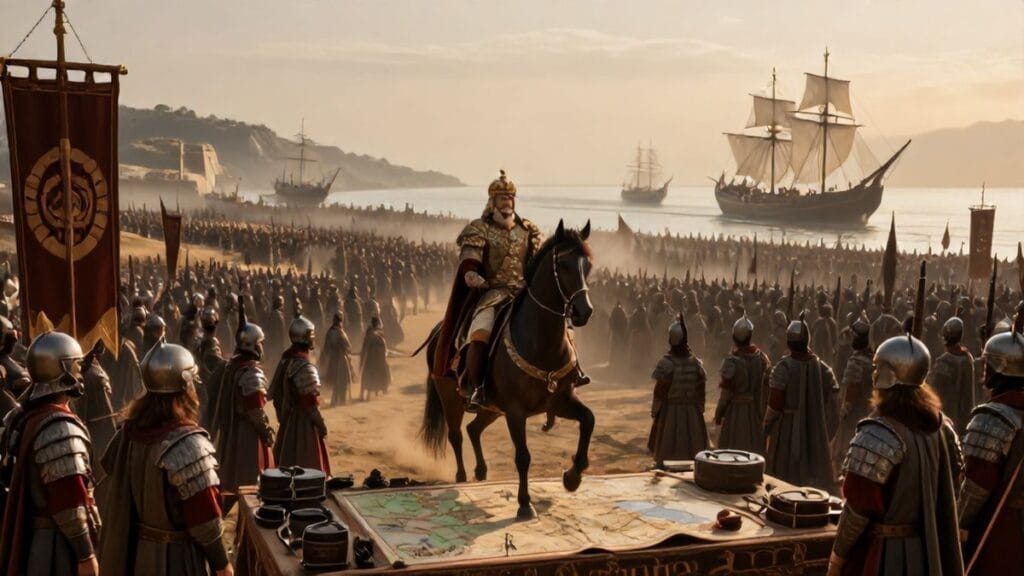
The year 766 dawned over Constantinople with the kind of brittle light that seems to reveal every crack in the city’s once-unassailable majesty. Frost clung to the marble colonnades of the Great Palace, and the mosaics of the Hippodrome glittered beneath a pale winter sun. Down in the harbors, sailors moved among ships heavy with pitch and rope, their breath ghosting in the air as they prepared for a campaign whose scale few could fully grasp. From the imperial quarter, word spread like a ripple through stone and water: Emperor Constantine V was turning his gaze north, toward Bulgaria.
This was not a sudden whim. The constantine v bulgaria campaign in 766 was the crystallization of years of frustration, fear, and ambition along Byzantium’s Balkan frontier. Bulgaria, seated beyond the Danube and entrenched in the forested valleys south of the river, had grown from a loose confederation of steppe warriors and Slavic tribes into a state formidable enough to menace imperial provinces. For Constantine, who ruled a realm already torn by religious struggle and Arab pressure in the east, the thought of an assertive Bulgaria gnawing at his northern borders was intolerable.
On the surface, that winter in 766 glittered with imperial confidence. Constantine V had enjoyed significant military successes in Anatolia against Arab forces; his armies were disciplined, his cavalry feared, his logistics corps more coherent than any his predecessors had commanded in decades. In the city’s taverns and market stalls, rumors swirled that this new expedition would break Bulgarian power once and for all, restoring the security of Thrace and the prestige of the Macedonian and Thracian themes. Yet beneath the surface lay a tension that shivered through the empire’s spine: the growing sense that God’s favor might be uncertain, that icon-smashing emperors walked a perilous line between reform and blasphemy.
It is within this charged atmosphere, between the thunder of war drums and the whispers of monks, that the constantine v bulgaria campaign took shape. It was not merely a clash of armies but the collision of two emerging visions of statehood in southeastern Europe. On one side stood the centuries-old Eastern Roman Empire, heir to Roman law and Christian orthodoxy, trying to renew itself through religious and military centralization. On the other side rose Bulgaria, a younger, harsher power built on the adaptability of steppe traditions, Slavic village life, and shrewd diplomacy with Constantinople itself.
To understand why war again erupted along the Danube frontier in 766, we must step back into the wider world of Constantine V: a world of siege towers and synods, tax ledgers and border raids, dockyards filled with shipwrights, and smoky council chambers where the fate of thousands could pivot on the turn of a single phrase.
The World of Constantine V: Empire Under Siege and in Transformation
Constantine V, son of Leo III, ruled an empire that lived forever in the shadow of loss. Only a century earlier, Byzantium had watched entire provinces—Syria, Egypt, Palestine—fall one by one to the armies of Islam. Once-wealthy cities like Antioch and Alexandria slipped from imperial hands, and with them the tax revenues and grain flows that had sustained the old Roman order. Even as Constantine walked the corridors of the Great Palace, that memory lingered like grief in the stones, a reminder that what had been lost might never return.
Yet by the mid-eighth century, the empire had stabilized. The Arab-Byzantine frontier in Anatolia had hardened into a zone of annual raids rather than existential conquest. The thematic system—military-administrative districts that stationed landholding soldiers close to home—gave Constantine a ready pool of troops. It also tethered the emperor’s authority to provincial elites who expected protection for their lands in exchange for their loyalty. The emperor’s duty, in their eyes, was simple: keep enemies beyond the frontier.
But enemies surrounded Byzantium like a ring of wolves. To the east stood the Caliphate. To the north and west stretched a patchwork of Slavic communities and new barbarian polities. Chief among them loomed Bulgaria, whose khans, from Asparukh onward, had carved out a durable realm south of the Danube. Byzantine emperors had long alternated between buying peace through subsidies and launching punitive campaigns to keep Bulgarian rulers in their place. Rarely did either side achieve a decisive, enduring advantage.
Overlaying all of this was religious controversy. Constantine V was one of the most ardent iconoclast rulers in Byzantine history. Building on his father’s edicts, he condemned the veneration of icons as idolatry and promoted a reordering of religious life across the empire. Monasteries, bastions of icon-veneration and often of opposition to imperial policies, found themselves under pressure. Some were dissolved; others saw their wealth confiscated. To supporters, Constantine was a second Hezekiah, purifying the faith. To opponents, especially in monastic circles, he was a tyrant and a persecutor.
This matters for the constantine v bulgaria campaign because religious tension seeped into every aspect of imperial life, including the army. Some soldiers and officers shared the emperor’s iconoclastic convictions. Others kept their own counsel, venerating icons in secret or in remote shrines. The sense that the emperor’s soul might be at risk could color how later chroniclers—almost all of them churchmen—described his military exploits. A victory could be reluctantly acknowledged as the work of a divinely permitted usurper; a defeat could be interpreted as God’s chastisement.
In this charged arena, Constantine acted as both general and reformer. His policies strengthened central authority and improved logistical capabilities; his religious stance fractured the very moral consensus he hoped to defend. When he turned to confront Bulgaria in 766, he brought with him not only the strength of a reorganized army but the moral contradictions of his reign.
Bulgaria Before the Tempest: A Young Power on Byzantium’s Northern Frontier
Across the Black Sea winds, to the north of Thrace and Moesia, Bulgaria had taken root among forest, river, and wide plains. The state founded by Khan Asparukh around 681 fused the steppe traditions of the Bulgar warrior elite with the slower, agrarian rhythms of the Slavic and Romanized populations already living in the Balkans. By the mid-eighth century, Bulgaria was young in comparison with the Byzantine Empire, but it was not fragile.
The khan ruled from fortified centers—later chronicles would remember Pliska as an early capital, a place of earthen ramparts and wooden hall-palisades. The khan’s power rested on loyalty pledged by tribal leaders and on the imposition of tribute from Slavic communities. Horses were central to Bulgarian military culture: fast, sturdy steppe mounts that could be driven across rivers and through forests with a discipline born of hard campaigns. Armed with compound bows, lances, and sabers, Bulgarian cavalry could harry an enemy column for days, fading into wooded ravines and reappearing like ghosts.
But Bulgaria was not purely a mounted warrior society. It was also a land of farmers who coaxed barley, wheat, and millet from the earth; of artisans who worked iron and leather; of traders who passed along furs, wax, and slaves to Byzantine merchants in return for silk, wine, and metalwares. The Danube itself was a highway of sorts, and its crossings were guarded both by garrisons and by memory—memory of previous Byzantine invasions, of treaties sworn and broken, of embassies that arrived with gold and departed with grudges.
Religion in eighth-century Bulgaria was fluid. Tengriist and steppe pagan elements coexisted with Slavic and local cults, while Christianity hovered at the edges, carried by captives, traders, and diplomats. It would not be until a century later that Bulgaria would formally adopt Christianity, but even in 766, Constantinople’s faith was known in the north. Bulgarians understood that the empire’s spiritual life was in turmoil. Some may have watched the iconoclast controversy with a strategist’s eye, discerning weakness in what should have been Byzantium’s greatest source of unity.
Bulgarian relations with the empire oscillated between warfare and wary peace. Tributes agreed upon in one reign might be refused in the next; fortresses taken in one campaign might be abandoned later for lack of garrisons. Bulgaria’s rulers learned quickly that confronting Byzantium directly in large pitched battles could be perilous. Their strength lay in mobility, knowledge of terrain, and the ability to exploit imperial missteps. As the constantine v bulgaria campaign loomed, Bulgarian leaders likely listened closely to the wind from the south, asking not whether the emperor would strike, but when and how.
Old Wounds and Smoldering Frontiers: Byzantium and Bulgaria Before 766
By 766, the relationship between Constantinople and Bulgaria was already layered with decades of suspicion. The Danubian frontier, for all its impressive rivers and marshes, was less a wall than a membrane. Slavic tribes slipped across, sometimes raiding, sometimes settling, sometimes serving as buffers between the empire and the Bulgar core. Byzantine diplomacy had long sought to play different groups against one another, buying temporary stability at the cost of long-term resentment.
Earlier emperors had marched north in hopes of reimposing direct control over lands lost after the great Slavic incursions of the 6th and 7th centuries. Some campaigns achieved temporary success; others ended in humiliating defeats or inconclusive stalemates. The memory of such efforts weighed on imperial planners in 766. Constantine V was no stranger to Balkan warfare. He had, earlier in his reign, conducted operations that pressured Bulgarian rulers and asserted imperial strength in Thrace. But true submission had remained elusive.
There were also more immediate provocations. It is difficult to reconstruct the exact tapestry of raids, counter-raids, and diplomatic slights that preceded the constantine v bulgaria campaign, because our sources are fragmentary and often partisan. Yet it is clear that Bulgaria had not been a quiet neighbor. Whether through direct attacks on imperial subjects or through the sheltering of refugees and rebels hostile to Constantinople, the Bulgar khanate had asserted its independence in ways that struck at the empire’s sense of dignity.
Each raid, each murdered frontier official, each caravan intercepted on a forest road contributed to a climate in which war seemed not only desirable but necessary. In the imperial council chambers, generals and ministers argued that a decisive blow might deter Bulgarian audacity for a generation. From their perspective, to tolerate continued harassment would erode the very foundations of imperial authority along the Balkans. If farmers in Thrace believed the emperor could not protect them, why pay taxes? Why send sons to serve in the thematic armies?
So the frontier smoldered, never entirely at peace, never in open flames for long. That uneasy balance might have persisted for years had Constantine not decided that the time had come for something greater: an expedition overwhelming in scale, involving not just land forces but a powerful naval component. That decision would shape the fate of countless men who, in 766, were still plowing their fields or repairing their nets, unaware that their lives would soon be consumed by the demands of imperial war.
The Emperor’s Dilemma: Why Constantine Turned North
Why did Constantine V, whose energies were often fixed on the Anatolian frontier and on religious reform, commit to a major operation against Bulgaria in 766? The answer lies at the intersection of strategy, prestige, and domestic politics.
Strategically, an active northern threat limited Constantine’s freedom of movement. To wage large-scale campaigns against the Arabs, the emperor needed security in the Balkans. Fortresses in Thrace and Macedonia could not be bled dry of garrisons if Bulgarian cavalry might descend at any moment. A successful campaign promising to cripple Bulgaria’s military capacity would, in theory, allow Constantine to redistribute forces eastward with greater confidence.
Prestige also loomed large. Imperial authority in the eighth century still drew deeply on Roman traditions of conquest. Even as resources dwindled and borders contracted, emperors were expected to take the offensive. Victory was not merely a military goal; it was a spectacle of legitimacy. The constantine v bulgaria campaign offered an opportunity to stage that spectacle close to home, within relatively easy reach of the capital’s chroniclers and populace.
Then there was domestic politics. Iconoclasm had earned Constantine fervent supporters among certain circles of the army and bureaucracy, but bitter enemies among many clergy and lay believers. Military success could drown some of that opposition in the jubilation of victory. A triumphant emperor returning from the north, bearing Bulgar captives and treasure, would be harder to challenge in synods or in whispered monastic letters.
Some historians, using the circumstantial evidence preserved in later chronicles, suggest that Bulgarian actions gave Constantine a convenient casus belli. Perhaps a particularly brazen raid, the murder of imperial envoys, or a refusal to honor treaty obligations pushed him beyond the point of patience. John Skylitzes, writing centuries later, presents Constantine as an aggressive, almost relentless foe of Bulgaria, though we must read such testimony through the thick veil of time and theological bias. Yet even if the exact trigger remains hazy, the emperor’s resolve to act is not.
By 766, Constantine believed he had an army and fleet capable of projecting power deep into Bulgarian territory. He had rebuilt naval capacity, ensuring that grain, horses, and troops could move rapidly across the Black Sea littoral. The Danube, traditionally a barrier, might be turned into a conduit. A coordinated operation—land armies advancing through Thrace while a fleet ascended the western Black Sea coast—held the promise of surprise and overwhelming force.
To contemporaries in the palace, the campaign must have seemed, if not inevitable, then at least reasonable. No one knew that the greatest blow in this war would not fall on Bulgarian soil but upon the emperor’s own fleet before it had even reached the enemy.
Musters and War Councils: Preparing the Constantinopolitan War Machine
Preparation for the constantine v bulgaria campaign transformed daily life in and around Constantinople. The city’s great harbors—Prosphorion, Neorion, and above all the harbors lining the Golden Horn—filled with the creak and groan of warships taking shape or undergoing repair. Dromons, the sleek oared vessels that formed the backbone of the Byzantine navy, were hauled up on wooden supports as shipwrights checked their planking for leaks. Cauldrons of boiling pitch bubbled beside the quays. Ropes were stretched, oars measured, hulls tarred until they gleamed in the winter light.
In the barracks of the tagmata, the professional regiments stationed near the capital, officers read out orders. Men from the excubitors, the scholai, and other elite formations learned that they would be embarking on a northern expedition of unusual scale. Some had fought in Anatolia, others in previous Balkan campaigns; all knew that service in the field meant months away from families, uncertain pay, and the constant specter of disease or death. Still, they buckled on their armor—lamellar cuirasses, helmets with nasal guards, round shields painted with unit insignia—and began their drills.
Beyond the city walls, in the themes of Thrace and Opsikion, farmers-turned-soldiers received summons to muster. The thematic system demanded that landholders provide military service; many had long expected a call to contain Slavic raiders or to fortify passes through the Haemus (Balkan) Mountains. A grand offensive, however, required more than ordinary mobilization. Draft animals were requisitioned, wagons assembled, grain stores counted and packed. The roads leading toward the capital and the Balkan front filled with lines of men and animals stretching for miles.
War councils met in the palace, their deliberations hidden from the common eye but not from common rumor. How many ships would be needed? Should the main thrust be by sea or by land? Where would the army cross into Bulgarian-held territories? Constantine listened to his generals, weighing audacious proposals against logistical realities. His experience had taught him that sound planning could offset numerical disadvantages. In 766, he believed the odds were on his side.
Religion, too, colored the preparations. In some churches, priests offered prayers for victory, invoking Christ and the archangels to guide the emperor’s forces. Yet in monastic circles opposed to iconoclasm, whispers ran a different direction. Was it right to pray for the success of a ruler who stripped holy images from sanctuaries and sent monks into exile? Some chroniclers would later argue that the disaster to come was divine retribution, a sign that God would not bless an iconoclast’s arms.
But in the taverns by the harbors, theology mattered less than wages. Sailors, many drawn from the islands and coastal towns, cursed or laughed as they loaded amphorae of water, barrels of salted fish, sacks of grain, and bundles of spare rigging aboard the waiting dromons. Contracts were sealed; advances paid. For them, the constantine v bulgaria campaign was a job, perilous but potentially profitable if loot were taken and stipends honored. They did not yet know how quickly the sea could swallow their hopes.
The Fleet on the Bosporus: From Capital to Campaign
When at last the imperial fleet was ready to sail, the Bosporus became a stage for imperial theater. One can imagine the banks of the strait crowded with onlookers: merchants, artisans, women with children perched on their hips, old men leaning on canes, all straining to see the warships glide past. Sails billowed; oars dipped in perfect rhythm. Standards bearing the imperial monogram and crosses snapped in the wind. Trumpets sounded from the prows, their calls echoing against the hills of Asia and Europe alike.
At the heart of the formation rode the most heavily armed dromons, equipped perhaps with the siphons of the legendary Greek fire, that combustible mixture capable of turning enemy ships into floating pyres. Around them clustered troop transports, low in the water from the weight of infantry, horses, and equipment. On some decks, cavalrymen stood in tight ranks, helmets clipped beneath their chins, eyes scanning the water as if already expecting danger in the waves themselves.
Constantine V may or may not have personally sailed with this fleet—sources differ, and later writers sometimes embroidered events to suit their narrative purposes. Some place him in command, emphasizing both his courage and his responsibility for what followed. Others suggest he remained ashore, coordinating land movements while trusted admirals led the naval arm. Whichever version is closer to the truth, the campaign’s success depended heavily on the fleet’s safe passage and coordination with land forces marching through Thrace.
As the ships passed the sea walls of Constantinople, crews might have glimpsed the silhouettes of churches and palaces etched against the sky. Perhaps some sailors crossed themselves; others, drawn from different creeds or more worldly in their concerns, simply tightened the knots on ropes and checked the lashings securing the horses below decks. The city receded behind them, its domes and towers dwindling until they were only memories against the horizon.
The fleet’s route would take it northward along the western shores of the Black Sea, toward the mouths of rivers feeding into Bulgarian and neighboring territories. There, the plan went, troops would disembark to join land columns pressing in from the south. The Danube delta and its adjacent coasts were treacherous grounds for navigators unfamiliar with shifting currents and sudden storms. But Byzantine mariners had traversed these waters for centuries. They trusted their experience—and perhaps trusted too much.
From a distance, the sight of so many imperial ships cutting through the Black Sea must have been intimidating. Bulgarian scouts, whether stationed along the coast or aboard small craft, would have raced to carry news inland. The empire was coming north again, in force. Yet, as events would show, nature had prepared its own ambush, one no Bulgarian commander could have matched.
Through the Black Sea Gales: Disaster Before the Battle
Somewhere along that northward sweep of coast, as the fleet moved beyond the more sheltered reaches of the Bosporus and the Sea of Marmara into the rougher embrace of the Black Sea, the weather turned. The Black Sea has always been a capricious neighbor—sudden squalls can shred calm skies, and waves can rise with little warning. For the sailors of Constantine’s fleet, the first signs might have been subtle: a shift in wind direction, a darkening band on the horizon, a swell beneath the hulls that felt different, more insistent.
The storm, when it struck, did not care for imperial plans. Winds howled across the water, snapping masts and ripping sails. Waves slammed against the sides of the dromons, water surging over decks, soaking soldiers who clung desperately to ropes and railings. Horses panicked in the holds below, their screams mingling with the shouts of officers struggling to maintain order. Torches, hastily lit in the gloom, flared and died, leaving men cursing in near-darkness.
Later Byzantine chroniclers, describing the constantine v bulgaria campaign, speak of a great naval disaster, a sudden tempest that destroyed a significant portion of the fleet before it ever sighted Bulgarian shores. Theophanes the Confessor, a ninth-century monk and one of our key narrative sources, records that many ships sank and countless men were lost. Though his hostility to iconoclast emperors colors his account, the scale of the disaster he reports is supported by the fact that Constantine’s campaign never achieved its intended momentum.
Imagine, for a moment, a single ship in that chaos. Rowers strain at their benches, trying to keep the vessel’s prow pointed into the waves. An officer bellows orders to cut away a shattered mast before it can drag the ship under. A soldier, far from home, vomits seawater and clutches at the side as another man beside him is swept overboard, disappearing between walls of grey-green water. There is no enemy in sight, no Bulgar arrow or spear—only the relentless, impersonal fury of the sea.
Survivors would later tell stories of comrades vanishing within arm’s reach, of ships that simply never reappeared when the storm subsided. In the hierarchy of imperial loss, these were nameless men, recorded at best in muster lists and pay registers. But for their families—wives left without husbands, children without fathers—the disaster was intimately, painfully personal. The constantine v bulgaria campaign, conceived as a blow against a northern foe, had first claimed its most terrible casualties from among the emperor’s own forces.
When the winds weakened and the sky finally cleared, the remaining commanders had to assess the damage. Hulls were battered; supplies had been lost; units were scattered. Even if some ships reached their assembly points, the cohesion necessary for a large-scale coordinated landing had been shattered. The fleet had been not merely bloodied but broken in spirit.
Strategically, the catastrophe forced a reckoning. Could the expedition proceed in reduced form, risking further attrition in hostile waters and on foreign shores? Or must the emperor accept that the sea itself had ruined his best-laid plans, and that to press on would be to hazard an even greater disaster? The sources suggest that the campaign, as originally envisioned, never unfolded. What had been intended as a decisive offensive became instead a bitter lesson in the limits of imperial power over nature.
Beneath the Balkan Sky: The Bulgarian Side of the Story
While storms raged at sea, the lands to the north remained, at least for a time, deceptively peaceful. In Bulgarian camps and villages, word of the imperial fleet’s departure and of troop movements in Thrace would have arrived in fragments, carried by scouts, merchants, or spies within the empire. Bells were not ringing in Pliska; horses were not yet fully saddled for a final stand. But there was tension in the air, a sense that the empire’s next move could bring devastation or opportunity.
From the Bulgarian perspective, the constantine v bulgaria campaign was not merely another raid to repel but potentially a struggle that could reshape the balance of power in the Balkans. If they survived intact—or better yet, inflicted a defeat—the khan and his boyars might claim increased authority over border Slavic tribes and bolster their standing as equals, not clients, to Constantinople. Conversely, a crushing loss at the hands of the emperor’s elite forces could fracture their relatively young state.
Unfortunately, Bulgarian sources from this period are sparse. Much of what we think we know of their reactions comes through Byzantine eyes or later Bulgarian chronicles written centuries afterward, when memory had already turned to legend. Yet certain constants of political life allow us to sketch the outlines. The khan would have convened his council, discussing whether to concentrate forces along expected invasion routes through the Haemus passes or to adopt a more flexible, shadowing defense. Scouts would have been sent toward the Danube and down into Thrace, trying to gauge the scale of the threat.
When news finally arrived that the imperial fleet had been mauled by storms, Bulgarian leaders may have reacted with a mix of relief and sober curiosity. To rejoice too loudly in an enemy’s misfortune at sea might invite hubris. Still, the implications were clear: an empire that had intended to strike with a double-edged sword—land and sea—now found one edge dulled, if not snapped. This could encourage bolder Bulgar actions along the frontier, raids deeper into imperial territory, or tighter control over Slavic groups whose loyalties might waver if Byzantine forces seemed invincible.
Among ordinary Bulgarians, farmers sowing fields or tending livestock beneath the austere Balkan sky, the campaign’s failure would not be etched in grandiose terms of geopolitical strategy. What mattered was that there was no sudden blaze of war crashing down from the south. Rivers continued to flow; hills retained their silent watch. Yet the longer-term consequence—a growing sense of confidence in the face of imperial wrath—would seep slowly into Bulgaria’s political culture, enabling later khans to negotiate and confront the empire from a position of less fear and more parity.
Warriors, Horses, and Icons: Life in the Ranks on the Eve of Invasion
To speak of the constantine v bulgaria campaign only in terms of emperors and khans is to miss its human texture. In the ranks of the Byzantine army, far from the palace walls, the approaching expedition carried a different weight. For many soldiers, war was both profession and burden. They drilled relentlessly, practicing complex maneuvers that combined infantry, archers, and cavalry into tight, coordinated formations. Yet behind the discipline lay anxieties about pay, loot, and survival.
A soldier from the Anatolian themes, drafted for service in the Balkans, might have found the northern forests alien and unsettling. He was used to the stony plateaus and ridges where Arab raiders rode. Now he studied maps of rivers and passes he had never seen, wondering how his horse would fare on muddy woodland paths. Around the campfires, veterans of past Balkan campaigns told stories of Bulgar ambushes, of arrows hissing from tree lines, of villages burned and quickly abandoned. The enemy, they said, did not fight like the Arabs; they appeared and vanished like phantoms, striking at supply lines before melting into the dark.
Religion shaped life in camp as well. Some soldiers carried with them small painted icons or crosses, heirlooms from mothers or wives, hidden perhaps when officers sympathetic to iconoclasm passed nearby. Others embraced the emperor’s policy, convinced that smashing images was an act of purity that would earn divine favor. This tension did not erupt into open conflict among the ranks—shared hardship can bind men more tightly than creed separates them—but it contributed to whispered debates and secret prayers.
On the Bulgarian side, warriors prepared according to their own rhythms. Saddle straps were checked, bowstrings waxed, quivers inspected. Young men eager to prove themselves listened to older fighters recount battles against Avars, Slavs, and Byzantines alike. They knew the empire had the advantage in siegecraft and heavy infantry; their hope lay in speed, cunning, and intimate knowledge of the terrain. Horses were not just beasts of burden; they were partners in war, as carefully cared for as any soldier cared for his weapons.
In both camps—from the Thames of Byzantium to the river villages of Bulgaria—families watched those preparations with heavy hearts. The constantine v bulgaria campaign meant separation, hunger, and the possibility that letters might stop coming, that a familiar voice would never be heard again. In a world without modern communication, absence itself was a kind of slow, gnawing wound. Wives might go months with no word of whether their husbands lived or lay beneath foreign soil—or, as it turned out in 766, beneath foreign waves.
Words and Wounds: The Politics of Propaganda in Constantinople and Pliska
When news of the naval disaster reached Constantinople, it did not arrive in a neat report. Fragments of information spread first: a battered ship limping into harbor with torn sails; a survivor staggered ashore in a distant port, babbling about waves that swallowed men and masts alike. Gradually, the scale of the catastrophe became clear. Yet how to explain it to a populace primed to expect victory?
For Constantine V and his circle, controlling the narrative was vital. An emperor could not appear helpless before capricious seas. Official proclamations may have framed the event as a tragic act of nature, unforeseeable and unpreventable. Heroism could be emphasized: men who held their posts to the last, officers who sacrificed themselves to save comrades. The campaign’s goals might have been downplayed or described as postponed rather than abandoned. The empire, it would be said, remained strong, its resolve unbroken.
Among the emperor’s critics, especially in monastic communities, the story took on a different cast. Theophanes the Confessor, writing decades later but echoing sentiments already present among iconophile circles in his time, presented the disaster as a divine judgment. In his chronicle, the constantine v bulgaria campaign becomes a stage on which God rebukes an impious ruler. The storm is not mere weather; it is providence lashing out. Such interpretations reveal as much about the chronicler’s theology as about the event itself, but they shaped how later generations understood the campaign.
In Bulgaria, the propaganda battle ran along other lines. The empire’s failure was proof that the southern colossus could bleed. Even if the Bulgarians had not directly caused the disaster, they could claim that their steadfastness and the justice of their cause had drawn divine or natural favor. Court poets or storytellers—if any such traditions flourished in the khan’s retinue—would have spun this into a tale of Bulgarian endurance: the empire launched its mightiest fleet, and the sky itself refused to let it pass.
Propaganda is, at its core, an attempt to heal or weaponize wounds with words. In Constantinople, officials sought to bind the empire’s shame with rhetoric of resilience. In monasteries and among the poor, whispers instead reopened those wounds, arguing that a ruler who defied holy images could not expect holy protection. In Bulgaria, the emperor’s misfortune became a cautionary chronicle for future emperors who might consider daring the north again.
The Long Shadow of Iconoclasm on the Campaign
No account of the constantine v bulgaria campaign can ignore the heavy shadow of iconoclasm. The religious struggle that convulsed the empire in the 8th century threaded itself through political decisions, military morale, and later historical memory. Constantine’s policies had alienated many monasteries, those powerful institutions that not only owned land and wealth but also functioned as intellectual and spiritual hubs. When monks wrote about the emperor, they did so from the perspective of men who believed they had suffered for conscience’s sake.
For such writers, a naval disaster could not simply be the result of flawed seamanship or bad luck. It had to mean something. In a providential worldview, every major event in the life of the empire was part of an unfolding divine script. Theophanes and later chroniclers interpreted Constantine’s misfortune as punishment. By tearing down icons and persecuting their defenders, the emperor had invited judgment. The storm on the Black Sea was the answer—a cosmic veto on his ambitions.
Yet we must also consider the more subtle ways in which iconoclasm might have influenced the campaign itself. Did religious division undercut the cohesion of the army and navy? It is hard to measure. Soldiers often possess a practical piety that adapts to the demands of survival. They might grumble about theological edicts but still obey orders in the field. Still, the sense that one’s ruler had broken faith with the church could erode trust, particularly among officers and provincial elites whose identity was closely tied to traditional piety.
Conversely, iconoclast supporters within the army might have viewed the campaign as a chance to prove that God was indeed on Constantine’s side. A victory over Bulgaria could be held up as proof that purging icons had restored divine favor. The disaster at sea reversed that logic, empowering the emperor’s enemies. This is why later iconophile writers, such as those shaping narratives in the ninth century after iconoclasm’s formal defeat, highlighted the failure of the 766 expedition with almost grim satisfaction. As one modern historian has observed, drawing on both Theophanes and Skylitzes, “Constantine’s military prowess was grudgingly acknowledged, but where fate turned against him, his religious enemies saw only the handwriting of heaven.”
Thus, iconoclasm did not merely provide a background color; it determined the palette through which the entire constantine v bulgaria campaign would be painted for posterity. Even today, when historians sift through the sources, they must constantly peel back layers of theological polemic to glimpse the more prosaic realities of weather, logistics, and human error beneath.
After the Storm: Political Repercussions in Constantinople
The immediate political aftermath of the failed expedition played out within the corridors of power in Constantinople. Constantine V was not a ruler easily cowed by setbacks. Even his enemies acknowledged his energy and determination. Yet the loss of ships and men on such a scale could not be ignored. It weakened his hand, at least temporarily, in debates over future policy and in the ongoing tug-of-war with religious opponents.
Some within the court may have urged caution, warning that further adventures in the Black Sea could sap the empire’s already strained resources. Others, especially military hardliners, might have argued that only a renewed and more carefully prepared campaign could erase the stain of 766. To do nothing would be to signal vulnerability not only to Bulgaria but to other watching powers—Arabs, Slavs, and internal factions eager to exploit imperial weakness.
Constantine’s overall reign, however, remained marked by military success, particularly in the east. In that broader context, the constantine v bulgaria campaign stands as a jarring discord in an otherwise martial symphony. The emperor continued to pursue his iconoclastic policies with fervor, using the state’s machinery to enforce religious conformity. Some scholars suggest that the disaster may have intensified his zeal, as if an angry ruler could compensate for failed arms by tightening control over doctrine and monastic life.
Among ordinary citizens, the memory of the dead lingered longer than high politics. The harbors that had once teemed with warships now witnessed the quiet return of damaged vessels and maimed survivors. Mutilated veterans became living memorials to the storm, their missing limbs or clouded eyes reminders that the emperor’s ambitions were paid for in flesh. Widows petitioned officials for relief; orphans begged at church doors.
Opposition circles, particularly those clustered around iconophile monks, might have drawn quiet encouragement from the campaign’s failure. Here was proof, they believed, that God’s favor could not be coerced by imperial decree. Yet they also knew well that such schadenfreude was dangerous. The emperor still controlled the army, the police, and the levers of punishment. To say too much, too loudly, was to invite attention from men who could make a critic disappear into distant prisons or forced labor.
Bulgaria Ascendant: Confidence, Caution, and State-Building
For Bulgaria, the failed Byzantine expedition of 766 did not immediately translate into a golden age. The young khanate still faced internal challenges: integrating diverse populations, managing succession, and holding together a warrior elite whose loyalty was often personal and conditional. Yet the constantine v bulgaria campaign nonetheless marked an important psychological and strategic moment.
First, it showed that even a determined, militarily competent emperor like Constantine V could be thwarted before Bulgaria’s heartlands were truly exposed. The empire’s navy, long feared as an instrument of distant projection, had proved vulnerable to the very environment it sought to master. Future Bulgarian rulers, reflecting on this episode, could reasonably infer that caution, patience, and the exploitation of the empire’s logistical strain might be more effective than reckless confrontation in open country.
Second, the campaign’s outcome allowed Bulgaria to maintain its grip on the territories south of the Danube that it had gradually secured since the late 7th century. This continuity, free from sudden devastation by a successful invasion, helped solidify the structures of governance. The khanate could continue the slow work of transforming from a migratory, clan-based power to a more settled state with fortifications, administrative norms, and rudimentary institutions.
We must imagine, in the years following 766, Bulgarian envoys traveling to and from Constantinople with a slightly different bearing. They represented a state that had not merely survived but weathered a major imperial strike. Treaties negotiated in this period likely reflected that growing parity, even if the empire still wielded greater wealth and prestige. Over time, this evolving balance would contribute to Bulgaria’s capacity, in the 9th and 10th centuries, to become a major Christian kingdom and a cultural rival to Byzantium.
Yet it would be a mistake to cast Bulgaria simply as triumphant. The weight of existing in the empire’s shadow always pressed down. Border skirmishes did not cease; economic dependence on trade with Byzantine markets continued; and the allure of imperial recognition remained powerful. But the memory of the constantine v bulgaria campaign became part of Bulgaria’s internal political vocabulary—a precedent to cite when counselors argued that patience toward imperial aggression could be rewarded by the missteps of an overconfident foe.
Memory, Chronicle, and Myth: How Later Ages Told the Tale
Centuries after the waves of 766 subsided, the story of Constantine V’s failed Bulgarian expedition continued to ripple through texts and traditions. Theophanes the Confessor, writing in the early 9th century, gave one of the most influential accounts. His chronicle, though terse in places, framed Constantine’s life largely through the lens of religious controversy. Victories were treated sparingly, defeats often highlighted. For him and his spiritual heirs, the naval disaster off the Black Sea coast was more than a mishap; it was an exemplum, a moral story about arrogance brought low.
Later Byzantine authors such as John Skylitzes, composing their works in the 11th century, drew on Theophanes and other now-lost sources, layering their own perspectives onto the narrative. In Skylitzes’ richly illustrated chronicle, Constantine appears at times as a capable but deeply flawed ruler, a man of great military skill whose theological choices marred his legacy. The constantine v bulgaria campaign is one episode among many, yet its dramatic character—a grand fleet wrecked by tempest—made it ripe for retelling.
On the Bulgarian side, medieval historiography emerges more fully only later, particularly in the 12th and 13th centuries, with works like the so-called “Bulgarian Apocryphal Chronicle.” While these texts often blur myth and history, they preserve a sense of long-standing struggle with Byzantium in which episodes like the 766 expedition form a hazy but potent background. Oral traditions, now lost, may have embroidered the story of how the empire’s wrath was turned back by the elements, folding it into a larger narrative of Bulgarian endurance and divine favor.
Modern historians, from the 19th century onward, have wrestled with these sources. Some nationalistic Bulgarian writers highlighted the failure of Constantine’s expedition as a vindication of Bulgaria’s right to exist as an independent entity. Greek and Russian scholars, focusing on Byzantine resilience, tended to contextualize the disaster within Constantine’s broader record of military competence. As one recent study succinctly noted, “The emperor’s strike against Bulgaria in 766 failed less because of his strategic miscalculation than because of meteorological chance, yet chance itself became, in the hands of later chroniclers, a theological verdict.”
Thus, the memory of the campaign has been continually reshaped—by monks seeking moral lessons, by national historians seeking heroes and villains, and by modern scholars seeking causality. The bare facts—a fleet, a storm, an unrealized invasion—are simple enough. What they mean has never been simple at all.
The Human Cost of Imperial Ambition
Behind the chronicles, beneath the rhetoric of emperors and khans, lies the quiet, often invisible ledger of human loss. The constantine v bulgaria campaign, though it ended before a major land battle could be fought, consumed lives on a scale that is difficult to quantify but easy to imagine. Shipwrecks in the 8th century rarely produced survivors in large numbers. Men who could not swim were dragged down by armor or boots; those who found floating planks might succumb to cold or exhaustion before reaching shore.
In port cities from Constantinople to smaller Black Sea harbors, bodies washed up in the days and weeks after the storm. Locals hauled them onto beaches, stripped them of useful gear—belts, knives, boots—then buried or burned them as best they could. Few names would be recorded. A dead soldier from the Anatolian themes might be identified only by an accent or a tattoo, if at all.
Economic costs rippled outward as well. Ships represented not just wood and canvas but years of labor and the investment of imperial treasuries. Replacing lost vessels strained shipyards already tasked with maintaining defenses elsewhere. Families who had seen sons conscripted in hopes of advancement now faced the prospect of selling land or entering debt to survive. The empire’s taxation system, unforgiving but methodical, did not easily adjust to widows and orphans; arrears could lead to confiscations, forcing some into dependence on large landowners or even into slavery.
On the Bulgarian side, even though the main brunt of the disaster fell on the Byzantines, the looming threat and its aftermath were not without cost. Communities kept on alert, delaying harvests or devoting manpower to fortification work, suffered economically. Khans who had prepared to mobilize may have extracted additional levies of grain or cattle from subject populations to support potential campaigns, burdening peasants who were already living close to subsistence. War, even when it fails to materialize on the battlefield, still gnaws at the edges of civilian life.
It’s astonishing, isn’t it, how a single strategic decision—an emperor’s determination to humble a northern neighbor—can cascade into thousands of individual tragedies? To read about the constantine v bulgaria campaign is to touch only faintly the grief of a mother in Bithynia who never learns where her son drowned, or the loneliness of a sailor’s wife who watches the horizon for a ship’s return until she no longer has the strength to climb the harbor hill.
Why the Constantine V Bulgaria Campaign Still Matters
The events of 766 might appear, at first glance, as a marginal episode in the long, convoluted history of Byzantium and Bulgaria. Others wars loomed larger: great sieges of Constantinople, epochal battles like Kleidion in 1014, the conversion of Bulgaria to Christianity, the later flowering of Bulgarian literature and culture. Yet the constantine v bulgaria campaign retains a peculiar relevance for how it illuminates the fragility of power and the ways in which history is remembered.
First, it underscores the limits of even the most competent regimes. Constantine V was no decadent incompetent; he was a forceful, often effective military leader. His administrative reforms and tactical innovations helped stabilize an empire that had nearly collapsed a century earlier. And yet, in 766, all that competence could not guarantee the success of a risky naval expedition. Weather and chance intervened, reminding rulers then and historians now that grand strategies can be undone by factors beyond human control.
Second, the campaign reveals the tight interweaving of religion and politics in medieval societies. The same event could be seen as mere accident by one observer and as deliberate divine judgment by another. Iconoclasm did not cause the storm, but it shaped how the storm’s consequences were understood and recorded. This interplay warns us, as modern readers, to approach our sources critically, aware that chroniclers often wrote not just to record, but to persuade and to vindicate.
Third, the 766 expedition marks a turning point—if not a cataclysmic one—in the developing relationship between Byzantium and Bulgaria. By surviving yet another imperial attempt at coercion, Bulgaria edged closer to a position of enduring parity in the Balkans. Later Bulgarian rulers could look back at episodes like this and draw encouragement for their defiance, whether diplomatic or military. The Balkans would remain a contested, complex region where neither side could fully dominate the other.
Finally, the constantine v bulgaria campaign invites us to think about failure itself as a force in history. Victories often shout; defeats whisper. Yet it is frequently in the aftermath of failure that states reassess, adapt, or double down on existing paths. Constantine’s response to 766—his continued military campaigns elsewhere, his intensified iconoclastic policies—helped set the course for the remaining years of his reign. Bulgaria’s measured consolidation in the shadow of that failed invasion set the stage for its later emergence as a formidable Christian kingdom.
In that sense, 766 is not merely a date but a vantage point, a cliff edge from which we can look down into the turbulent currents of medieval Southeastern Europe and trace the intertwining destinies of empire and khanate, faith and sword, victory and loss.
Conclusion
When Emperor Constantine V set his sights on Bulgaria in 766, he did so with the confidence of a ruler who had already steered his empire through crisis and reform. The constantine v bulgaria campaign was conceived as a decisive gesture—a strike that would secure the northern frontier, reaffirm imperial prestige, and perhaps even sanctify iconoclast policies with the imprimatur of victory. Instead, it became a cautionary tale.
The storm that shattered the imperial fleet before it reached Bulgarian shores did more than wreck wood and drown men. It exposed the vulnerability at the heart of imperial ambition: the simple fact that no matter how carefully planned, human enterprises remain at the mercy of elements, of miscalculations, and of unseen contingencies. For contemporaries, the disaster fed into passionate debates about God’s favor, the legitimacy of iconoclasm, and the righteousness of Constantine’s rule. For Bulgarians, it offered proof that the mighty Eastern Roman Empire could be checked, not only on battlefields but in its very attempt to project force.
Across the centuries, chroniclers, theologians, national historians, and modern scholars have revisited this episode, each time refracting it through their own concerns. Yet some core realities persist beneath the interpretations: the roaring of the Black Sea winds, the terror of sailors clinging to sinking decks, the grief of families awaiting news that never came. These are the human constants that give the past its enduring emotional charge.
To remember the constantine v bulgaria campaign is to be reminded that history is as much about plans that fail as about plans that succeed, as much about storms as about battles. It is to see how a single expedition, aborted by forces beyond an emperor’s control, could still reshape perceptions, harden frontiers, and leave a lasting imprint on the evolving relationship between Byzantium and Bulgaria. And it is to recognize that, in every era, power walks hand in hand with uncertainty, no matter how invincible it appears from a distance.
FAQs
- What was the main objective of Constantine V’s 766 campaign against Bulgaria?
The primary goal of Constantine V’s 766 expedition was to assert Byzantine dominance over Bulgaria by launching a large-scale, coordinated offensive using both land forces and a substantial naval fleet. He sought to punish Bulgarian incursions, stabilize the Balkan frontier, and free up resources for campaigns elsewhere, particularly against the Arabs in the east. The constantine v bulgaria campaign was intended to deliver a decisive blow that would deter future Bulgarian aggression and reaffirm imperial prestige. - Why did the campaign fail before a major land battle occurred?
The campaign failed largely because a severe storm struck the Byzantine fleet in the Black Sea as it sailed north toward Bulgarian territory. Many ships were wrecked, and a significant number of soldiers and sailors were drowned before they even reached the theater of operations. This naval disaster crippled the expedition’s logistical backbone and forced Constantine V to abandon or drastically scale back his plans, preventing the campaign from developing into the intended full-scale land invasion. - How did religious controversy (iconoclasm) influence the interpretation of the campaign?
Iconoclasm, the imperial policy against the veneration of icons, deeply shaped how contemporaries and later chroniclers interpreted the campaign’s failure. Supporters of icons, especially monastic authors like Theophanes the Confessor, portrayed the storm and the fleet’s destruction as divine punishment for Constantine V’s impious policies. While iconoclasm did not cause the disaster itself, it framed the narrative: what might have been seen as bad luck or poor timing instead became, in many accounts, a moral lesson about the fate of an iconoclast emperor. - What impact did the failed expedition have on Bulgaria?
For Bulgaria, the failure of Constantine’s offensive bolstered confidence in the khanate’s ability to survive imperial pressure. It reinforced the perception that even a strong and aggressive Byzantine ruler could be thwarted, whether by nature or by Bulgarian resistance. This contributed to Bulgaria’s gradual consolidation as a durable state south of the Danube, encouraging its rulers to negotiate and, when necessary, confront Byzantium from a position of increasing parity rather than pure vulnerability. - Did Constantine V undertake further campaigns against Bulgaria after 766?
Constantine V’s reign included multiple conflicts with Bulgaria, both before and after 766, though the details and chronology are sometimes difficult to reconstruct precisely due to the nature of the sources. He maintained an aggressive stance on the Balkan frontier, launching punitive expeditions and attempting to influence internal Bulgarian politics. However, the scale and spectacle of the 766 expedition, especially its large naval component and its dramatic failure, make it stand out among his Balkan ventures. - How reliable are our sources for the constantine v bulgaria campaign?
Our primary narrative sources—especially Theophanes the Confessor and later John Skylitzes—were written decades or even centuries after the events and are strongly colored by theological agendas, particularly hostility to iconoclasm. They provide valuable information but must be read critically and compared with what we know from archaeology, sigillography, and broader patterns of Byzantine military practice. Most historians agree that a major naval disaster occurred and that it derailed Constantine’s plans, but many specifics about troop numbers, exact routes, and strategic deliberations remain uncertain. - What does this campaign reveal about Byzantine naval power in the 8th century?
The campaign shows that Byzantium in the 8th century still possessed the capacity to assemble a large, ocean-going fleet capable of supporting amphibious operations far from the capital. It also highlights the vulnerabilities of such fleets to weather and the limits of contemporary navigational knowledge, especially in the notoriously treacherous Black Sea. The loss of so many ships underscores how dependent imperial strategy had become on maritime logistics—and how quickly that advantage could turn into liability in the face of severe storms. - Did the campaign have long-term consequences for the Byzantine-Bulgarian relationship?
Yes. While it did not decisively alter borders in the short term, the failed expedition contributed to a long-term pattern in which neither Byzantium nor Bulgaria could fully dominate the other. Bulgaria’s survival in the face of a major imperial onslaught reinforced its trajectory toward becoming a major regional power. For Byzantium, the campaign served as a reminder that northern ventures were costly and uncertain, pushing later emperors to be more selective and strategic in their Balkan interventions. - How does the 766 expedition compare to other Byzantine failures?
Compared to catastrophes like the loss of Anatolian provinces to the Arabs or the later defeat at Manzikert, the 766 campaign was smaller in territorial consequence but significant in symbolic terms. It involved an emperor noted for his military prowess suffering a public setback close to home, and it was seized upon by his religious enemies as proof of divine disfavor. In that sense, its impact on Constantine V’s posthumous reputation is disproportionate to its immediate geopolitical results. - Why study the constantine v bulgaria campaign today?
Studying this campaign offers insights into how medieval states managed risk, how they balanced domestic politics with foreign policy, and how religion could reshape the meaning of military events. It also reminds us that history is not made only in famous, decisive battles; it is also shaped by aborted plans, storms, and failures that change the trajectories of states and the stories societies tell about themselves. In a broader sense, the 766 expedition is a vivid case study in the complexity of empire: ambitious, fragile, and continually at the mercy of forces beyond its control.
External Resource
Internal Link
Other Resources
- Encyclopaedia Britannica – general search for the exact subject
- Google Scholar – academic search for the exact subject
- Internet Archive – digital library search for the exact subject

