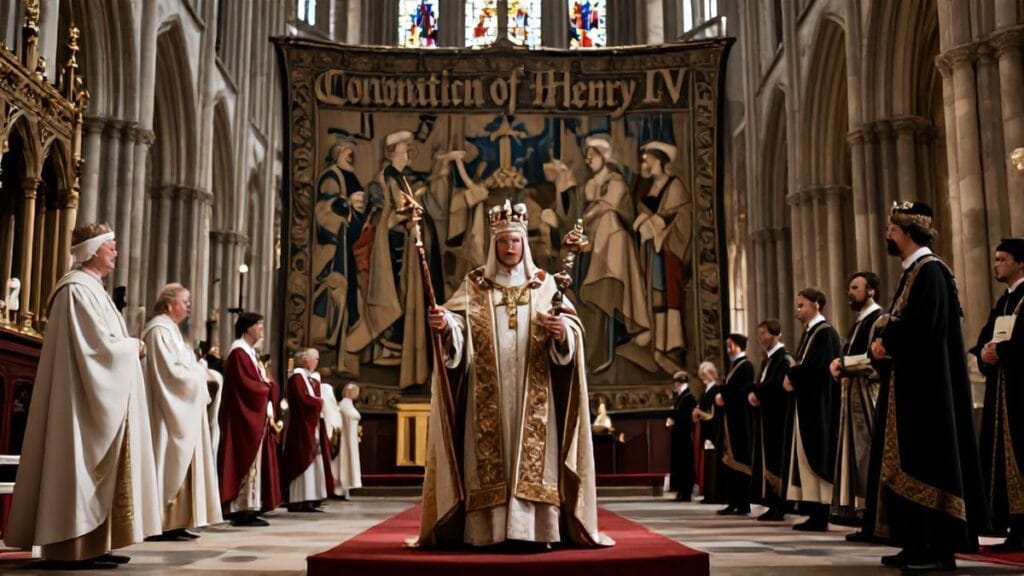
Table of Contents
- The Autumn Day When a New Dynasty Rose
- From Bolingbroke to Henry: A Prince in Exile
- The Fall of Richard II and the Seizure of the Crown
- Preparing for the Crown: Propaganda, Ritual, and Fear
- Westminster in October 1399: A City Holding Its Breath
- The Night Before: Prayers, Doubts, and Silent Corridors
- Procession to the Abbey: Trumpets, Tapestries, and Watching Eyes
- Inside Westminster Abbey: Architecture of Power and Faith
- Oaths, Anointing, and the Sacred Drama of Kingship
- The Crown Set Down: Acclamation, Applause, and Uneasy Hearts
- Feasting, Ceremony, and the Politics of Spectacle
- Voices in the Crowd: How Londoners Lived the Coronation
- Parliament, Legitimacy, and the Making of a New Regime
- Plots, Prophecies, and Rebellions in the Shadow of the Crown
- Henry IV, His Heirs, and the Shaping of Lancastrian England
- Memory, Myth, and the Coronation in Later Imagination
- Why 13 October 1399 Still Matters
- Conclusion
- FAQs
- External Resource
- Internal Link
Article Summary: On 13 October 1399, in the vaulted gloom of Westminster Abbey, the coronation of Henry IV marked not merely the rise of a new king but the birth of a new royal branch—the House of Lancaster—wrested violently from the faltering rule of Richard II. This article follows Henry from his youth as Henry Bolingbroke, through exile and return, to the carefully stage-managed spectacle that made him king. It explores how the coronation of Henry IV sought to mask the raw fact of usurpation with the shimmering veil of sacred ritual and ancient precedent. We move through London’s crowded streets, into the abbey’s incense-laden aisles, and into the minds of nobles and commoners who watched a controversial monarch crowned. The narrative then traces the political and social aftershocks, from uprisings and prophecies to the forging of Henry’s uneasy dynasty. Along the way, we examine how chroniclers and later writers, including Shakespeare, turned this moment into legend. In doing so, the article shows that the coronation of Henry IV was not an endpoint but the opening scene of a turbulent century of civil war, ambition, and contested memory.
The Autumn Day When a New Dynasty Rose
On the morning of 13 October 1399, the air over Westminster was cold and sharp, carrying the scents of river mud, smoke from countless hearths, and the tang of autumn leaves decaying in palace courtyards. Londoners crowded the narrow streets, their boots sinking into mud churned by horses’ hooves and wagon wheels, craning their necks for a glimpse of the man who would be king. The coronation of Henry IV, long anticipated and bitterly debated, was about to unfold beneath the ribbed stone vaults of Westminster Abbey. Yet even as the bells rang and trumpets blared, there was an undercurrent of unease, a sense that history was being wrenched sharply from one course to another.
The coronation of Henry IV was no ordinary succession, no smooth inheritance passed from father to son under the comforting glow of tradition. It was a coronation born of deposition, forced abdication, and the bruised authority of a monarchy that had seemed nearly absolute just a generation earlier. Richard II, the anointed king, still lived—dethroned but not yet dead—casting a long and troubling shadow over the ceremony. Within the abbey, candles fluttered in drafts that slipped through the ancient stonework, as if even the building itself were uncertain how to receive this new sovereign.
Yet for all its anxieties, the day also pulsed with a strange excitement. After years of misrule and political strife, some saw Henry Bolingbroke’s rise as a deliverance, a chance to restore balance and justice. To others, it was the beginning of a dangerous experiment, an open invitation to any powerful lord who might one day be bold enough to repeat Henry’s example. In the mosaic of faces pressing towards the route from Westminster Hall to the abbey were men and women who understood, dimly or clearly, that they were witnessing something extraordinary: the moment when the principle of hereditary kingship had to make room for the harsher logic of power.
The coronation of Henry IV would attempt to reconcile these conflicting truths. Through meticulously structured ritual—oaths, anointing, acclamation, and feast—the new king’s supporters sought to transform an armed seizure of the throne into an act of providence. The ceremony, woven from centuries of tradition, would be asked to do more than bless a king; it would be asked to rewrite the story of how he came to wear the crown. But this was only the beginning, the first step in a reign that would be fraught with rebellion, illness, and questions that refused to stay buried under robes and regalia.
From Bolingbroke to Henry: A Prince in Exile
To understand why the coronation of Henry IV mattered so profoundly, we must turn back to the boy who was not born to be king. Henry Bolingbroke first saw the world around 1367, the son of John of Gaunt, Duke of Lancaster, and grandson of Edward III. From his earliest days, Henry inhabited a world of vast estates, glittering courts, and solemn religious institutions, yet his path seemed clear and limited: he would be a great nobleman, wealthy and influential, but not the bearer of the crown itself. In the well-ordered imagination of medieval kingship, there was a line of succession, and it did not end on him.
Henry’s childhood unfolded amid the fading glory of the age of Edward III. The old king’s victories in France, the triumphs of Crécy and Poitiers, were already sliding into legend, even as the Black Death haunted the memories of Londoners. Young Henry moved between castles and manors, acquiring not just the skills of a knight—riding, jousting, wielding sword and lance—but the subtler arts of politics and piety. Under the guidance of tutors and confessors, he learned to speak in the language of chivalry and Christian kingship, though it would have seemed treasonous then to imagine him as the king who would one day replace Edward III’s great-grandson.
His father, John of Gaunt, was an immense presence—ambitious, controversial, and often resented. Gaunt’s power attracted suspicion, and by extension, so did his son. Even in his youth, Henry Bolingbroke would have sensed the peril of proximity to the throne: close enough to be feared as a rival, not close enough to be beyond reach. Yet he carved out a public image of courage and competence. He took part in tournaments, rode in campaigns, and built alliances among the nobility. Chroniclers describe him as tall, robust, and possessed of a gravity that belied his years.
The relationship between Henry and his cousin Richard II, the reigning king, began in the comfortable language of kinship, but it carried within it the seeds of disaster. As boys, they shared the orbit of their elders’ world; as men, they grew into rival centers of power. Richard’s kingship, buffeted by the Peasants’ Revolt in 1381 and the turbulent politics of the 1380s, hardened into a reign marked by suspicion and a demand for obedience. Henry, meanwhile, learned to move carefully within that regime—supporting the king at times, opposing him at others, always walking the narrow road between loyalty and self-preservation.
In 1398, the fragile balance finally shattered. A quarrel between Henry and Thomas Mowbray, Duke of Norfolk, exploded into public accusation: treason, conspiracy, unspoken threats. Richard II, perhaps seeing an opportunity to weaken two potentially dangerous nobles at once, forbade their trial by combat and instead banished them—Mowbray for life, Henry for ten years. For Henry, it was a stunning humiliation. His exile was a royal decree that his presence in England was more dangerous than his absence. Yet what Richard intended as a calculated act of control instead set in motion the chain of events that would end in the coronation of Henry IV.
Henry’s departure from England was not simply physical; it was a moral and political exile, a stripping away of assurances about the stability of the realm. From across the Channel, he watched as his father John of Gaunt fell ill and died in 1399—and with that death, Richard seized the Lancastrian estates, denying Henry his inheritance. In that single act, the king transformed a disgraced nobleman into a dispossessed prince with nothing left to lose. The path to Westminster, to 13 October, to the high altar of the abbey, began not with an ambitious claim to the throne, but with the bitter knowledge that he had been wronged.
The Fall of Richard II and the Seizure of the Crown
When Henry Bolingbroke returned to England in the summer of 1399, he came not wrapped in royal banners but under the modest pretense of recovering his rightful lands. He landed in Yorkshire with a small retinue, a band of exiles and allies whose numbers would grow as the weeks passed. Yet as he moved southward, it became clear that his cause had become more than a private dispute over property. Discontented lords, wounded by Richard’s heavy-handed rule, began to rally to him. The silent calculations of power turned in his favor.
Richard II, meanwhile, was far away in Ireland, struggling to assert his authority in campaigns that drained money and prestige. The king’s absence from the heart of his kingdom at this critical moment was a fateful misjudgment. By the time he returned to English soil, much of the political landscape had shifted beneath his feet. Supporters had deserted; supplies faltered; the confidence that once buttressed his divine right to rule began to crack. Within weeks, he found himself effectively a prisoner.
Chroniclers give a variety of accounts of the confrontation between the deposed king and the rising Bolingbroke. In one version, Richard met Henry at Flint Castle, descending from the walls to greet the man who had been his cousin and now might be his judge. Henry, in this telling, knelt before Richard with practiced humility, protesting that he sought only to reclaim what was his by inheritance. Yet everyone present must have sensed that the balance of power had shifted irrevocably. When armed men surround a king, and when that king no longer commands them, the language of courtesy rings hollow.
The formal deposition of Richard II took place in London in late September 1399, in a carefully orchestrated series of proceedings that sought to cloak a coup d’état in a mantle of legality. Richard was induced—or compelled—to abdicate, to renounce the crown and acknowledge his unfitness to rule. A list of accusations against him was read, cataloging abuses of power, financial extortion, and acts of vengeance against his nobles. Henry, now at the center of this gathering storm, listened as the edifice of Richard’s kingship was publicly dismantled.
Then came the crucial moment. Henry rose, according to one famous account, and claimed the crown “as that I am descended by right line of blood, coming from the good lord King Henry III, and through that right that God of his grace hath sent me, with the help of my kin and of my friends, to recover it.” It was a claim that blended legality, genealogy, and divine providence, sidestepping the uncomfortable fact that a living, anointed king still existed. Parliament, summoned to witness and ratify, played its part. The institutions of the realm bowed to the new reality.
Yet behind the formal words, the reality was stark: Richard II had been removed by force and political maneuver, and Henry had seized what law and tradition had not originally promised him. The coronation of Henry IV would have to perform an extraordinary act of transformation, turning a usurper into an anointed monarch. In a world where kings were believed to be chosen and blessed by God, ritual was not a mere decoration; it was the vital thread that tied raw power to sacred legitimacy. The days between deposition and coronation were thus filled with frantic planning, negotiation, and fear—fear of foreign reaction, of domestic rebellion, and of heaven’s judgment.
Preparing for the Crown: Propaganda, Ritual, and Fear
From the moment Henry’s claim to the throne was announced, his allies understood that swords alone could not secure his rule. He needed words, symbols, and stories—he needed a narrative that would justify why the grandson of Edward III’s third son could displace the grandson of the Black Prince. Preparations for the coronation of Henry IV therefore unfolded on several interlocking fronts: legal, liturgical, and propagandistic.
First, there was the matter of law. Parliament, more often an instrument than an equal partner of the crown, became a crucial stage on which legitimacy could be performed. Records were drafted and redrafted, framing Richard’s failings as morally and politically intolerable. The language used was not accidental: it portrayed Henry as the restorer of good governance, as a defender of the realm unjustly wronged, as the man called upon by God and the people to rescue England from a dangerous king. In a society where few could read, such documents were less about direct persuasion and more about providing an official script that priests, nobles, and royal officers could repeat.
Second came ritual. England already possessed a robust coronation liturgy, developed over centuries, blending biblical imagery with national tradition. But this time, the ceremony had to be subtly but decisively reshaped. The emphasis would be on election as well as inheritance, on the will of the people (represented by parliament and magnates) as well as the line of descent. The prayers and oaths were examined and, in some cases, adapted. Henry would be described not only as rightful heir but as chosen, a king for times of crisis. “In this way,” as one later historian observed, “the old words did new work, sanctifying an unprecedented act.”
Lastly, there was fear—fear that all these measures might not be enough. Richard II was still alive, held in captivity. His supporters, though cowed, had not vanished. Foreign powers, particularly in France and Scotland, might yet move against a regime born of internal upheaval. In this context, the coronation became both a celebration and a defensive wall, an attempt to present Henry’s rule as a fait accompli, accepted by God, people, and the visible church. Every banner hung, every candle lit, every noble summoned to attend worked, in theory, to normalize what had happened.
Artists and artisans were pressed into service. Robes were prepared in Lancastrian colors, rich with gold thread and lined with fur. The royal arms were adjusted to reflect Henry’s new role, projecting continuity with past kings while quietly erasing Richard’s presence. Preachers were surely crafting sermons to be delivered around London and beyond, explaining to congregations why shifting loyalty from one anointed king to another could be not only permissible but righteous.
And somewhere amid these preparations, Henry himself had to reckon with the enormity of what he had done and what he was attempting to become. He knew the stories of usurpers—from Stephen in the twelfth century to more distant figures on the continent—whose reigns had dissolved in blood and chaos. The coronation of Henry IV was meant as a shield against that fate, but it was also a test. Would his subjects, gathered in their thousands, truly acclaim him? Would the sacred oil and solemn vows convince a watching heaven that this bold, forceful man was, at last, God’s chosen king?
Westminster in October 1399: A City Holding Its Breath
As the date approached—13 October, the feast of Saint Edward the Confessor—Westminster and London woke each day beneath a growing sense of anticipation. The choice of date was itself a deliberate statement. Edward the Confessor, the pious king whose relics lay at the heart of Westminster Abbey, had long been a symbol of sanctified, almost saintly kingship. To be crowned on his feast day was to invoke his protective aura, to suggest that the new monarch stood in the shadow of one of England’s most revered rulers.
The city was transformed in the days before the coronation. Craftsmen labored to hang tapestries along the route that would carry Henry from Westminster Hall to the abbey. Streets were strewn with rushes and perhaps even flowers, though the season was late. Banners bearing the arms of Lancaster, alongside the royal lions and lilies of England and France, fluttered from windows and poles. Inns and taverns overflowed with visitors—nobles with their retinues, foreign envoys, clergy, and merchants drawn by the chance to witness a spectacle and perhaps to do profitable business.
For ordinary Londoners, the coronation was both disruption and entertainment. Markets were crowded; prices for basic goods edged upward; apprentices slipped away from their masters’ watchful eyes to join the growing throngs near Westminster. Children would have tugged at their parents’ sleeves, begging to be lifted up to see, while watchmen tried to maintain some semblance of order. The city’s sounds—hammering, cartwheels, the shouts of hawkers—merged with the unusual strains of royal music rehearsed for the ceremony.
Rumors flowed as easily as the ale in the taverns. Some whispered that Richard II had already been killed, his life quietly ended to prevent any future trouble. Others insisted he lived and would soon be paraded through the streets to acknowledge Henry as his rightful successor. Foreign emissaries, speaking in French, Flemish, or Italian, tried to gauge the mood: was this city genuinely welcoming its new king, or simply bowing under necessity? In these bustling streets, the abstract question of legitimacy took on human form in conversations, arguments, and hushed confessions.
Meanwhile, Westminster itself—both palace and abbey—became the beating heart of the coming drama. Courtyards filled with horses, attendants, and soldiers. Tents were erected for additional lodging and for the preparation of food for the great feast that would follow the coronation. Firewood, spices, wine, and carefully hoarded luxuries arrived in wagonloads. The palace kitchens, usually busy, now worked almost without pause, roasting meats, baking bread, preparing intricate dishes meant to dazzle the assembled nobility.
It’s astonishing, isn’t it, to imagine how all these threads wove together: the anxiety of loyalists who had served Richard for years; the hope of those who believed Henry’s rule would herald justice; the pragmatic resignation of people for whom the name on the throne mattered less than the stability of coin, law, and harvest. By the eve of 13 October, Westminster was like a theatre whose stage was set, whose audience had gathered, and whose actors waited in the wings. The script was partly written in ancient liturgies and precedent; but much of it would be improvised, moment by moment, in a volatile reality no one fully controlled.
The Night Before: Prayers, Doubts, and Silent Corridors
The night before the coronation of Henry IV must have been long and restless for the man at its center. Traditionally, a king about to be crowned participated in vigil-like devotions, offering prayers and confessions, seeking God’s favor before assuming the weight of the crown. Henry had been a knight, a crusader in liturgical garb, familiar with rituals of penitence and supplication. But this vigil would have a sharper edge, for he was not just asking for strength; he was asking for absolution—if not for the deposition of Richard itself, then for the violence and disruption it had entailed.
We can imagine him in a dim chapel within Westminster Palace, candlelight flickering against painted walls, a priest murmuring the familiar cadences of Latin prayers. Henry, broad-shouldered and seasoned by battle, kneels on cold stone or on a hastily laid cushion. Outside, the corridors are alive with muffled footsteps, whispered conversations, and the soft clink of armor. Inside, the air smells of beeswax, incense, and damp stone. In such a space, even a hardened man might feel small in the face of what lay before him.
There were practical considerations too. Advisors came and went, finalizing the order of procession, confirming that key nobles would attend and perform their roles. The allegiance of certain magnates could not be taken for granted; their presence at the coronation was both a public submission and a private calculation. Messengers hurried between palace and abbey, checking that the regalia—crown, scepter, orb, sword—were in place, that the monks and clergy understood their parts in the liturgy.
In quieter corners of the palace, Henry’s family gathered. His sons—most notably the young Henry of Monmouth, the future Henry V—would be present at their father’s coronation, absorbing sights and sounds that would shape their own understanding of kingship. For them, this night may have vibrated not with doubt but with awe and anticipation. Yet they, too, would have sensed the undercurrent of danger in the guarded doors, the extra watchmen, the careful planning for every contingency.
Somewhere, perhaps not far away, Henry’s enemies—or at least his skeptics—kept their own counsels. Bishops who had sworn oaths to Richard II wrestled with the theological problem of blessing his successor. Lawyers pondered the precedents that might be cited if things went wrong. Even common servants, carrying food or bedding through the half-lit corridors, must have felt the strange, taut energy in the air. Empires, as one chronicler later suggested, can rise or fall on such nights, when sleep is scarce and the future sits awake, waiting.
And, above all, the abbey stood silent in the dark, its great windows now black squares against the sky. Inside, relics and tombs kept their mute vigil. The shrine of Edward the Confessor, draped and adorned, awaited the new king; the effigies of earlier monarchs lay in carved stone, their faces turned upward in eternal repose. At dawn, this world of stone and silence would be invaded by color, sound, and human breath. For now, it waited, like a giant heart between beats.
Procession to the Abbey: Trumpets, Tapestries, and Watching Eyes
On the morning of 13 October 1399, the grey light of autumn crept over Westminster, and with it came the first stirrings of movement. The coronation of Henry IV would begin not with a single moment but with a procession—a choreographed journey from royal hall to sacred altar, from the world of secular power to the space where that power was to be sanctified. Processions mattered in the medieval mind. They stitched together places and meanings, turning streets into symbolic pathways, corridors of legitimacy.
Henry emerged from Westminster Hall dressed in rich robes, their colors chosen not merely for splendor but for their resonance with ancient tradition. Attendants bore swords of state, scepters, and possibly the royal sceptre with the cross, glittering faintly in the pale light. Around him gathered high-ranking nobles, bishops in elaborate vestments, and officers of the royal household. Trumpeters raised their instruments; the first clear notes cut through the morning chill, signaling to those outside that the spectacle had begun.
The route from hall to abbey was not long, but it was dense with meaning. Lining the way were ranks of soldiers, household retainers, and citizens formed into semi-orderly crowds. Some shouted “Long live the king!” as Henry passed, their voices ringing with conviction—or with the carefully practiced enthusiasm of those who understood the cost of silence. Others watched in thoughtful quiet, their faces unreadable. Foreign observers studied the procession like a text, trying to discern where power truly lay: in the number and zeal of the king’s supporters, in the demeanor of great lords, in the presence or absence of dissent.
Above the procession, windows and balconies overflowed with onlookers. Women leaned out, clutching shawls against the breeze, peering at the line of figures: there the new king; there the archbishop; there the banner of this or that noble house. Children pointed at the glittering armor, the shimmering cloth of gold, the plumes on helmets and horses. The smell of damp wool, tallow smoke, and human bodies mingled with sudden gusts of incense wafting from the abbey doors, flung wide in readiness.
Henry’s own face, as chroniclers hint, was composed but grave. He understood the theatre in which he was an actor—indeed, the principal actor—but he also understood that a single misstep, a single visible doubt or miscalculation, might feed the murmurs that already touched his name. So he walked steadily, eyes perhaps occasionally lifted to meet those of his subjects, acknowledging their presence, offering that kingly blend of distance and accessibility that could so quickly tip into aloofness or overfamiliarity.
As the procession drew near the abbey, the soundscape changed. Secular noise was replaced by the solemn voices of monks chanting, by the deeper roll of organ pipes. At the threshold of the church, Henry paused. Here lay the boundary between the temporal and the sacred, between the world in which he had seized power and the space in which that power would be mystically affirmed. Crossing that threshold, he must have felt not only the eyes of his people but, in his imagination at least, the gaze of God and of the generations of kings whose bones lay not far from where he would kneel.
Inside Westminster Abbey: Architecture of Power and Faith
Stepping into Westminster Abbey on that October day was like entering a universe of stone and light designed to humble and exalt in equal measure. The tall, pointed arches of the nave soared upward, drawing the eye toward heaven. Colored light filtered through stained glass, casting fractured patterns on the flagstones and on the faces of those gathered. The incense was thick, almost palpable, clinging to the air as if it were another fabric in the great tapestry of the ceremony.
The coronation of Henry IV unfolded within this architectural sermon. Westminster Abbey was not just a convenient location; it was the kingdom’s spiritual treasury of kingship. Here, Edward the Confessor had built his great church; here, the Plantagenet kings had been crowned and buried. Henry was stepping into a story that had been told in stone for centuries, a story of continuity even as he attempted to reshape its latest chapter.
Within the abbey, the layout of the ceremony reinforced hierarchies and relationships. The high altar blazed with candles, flanked by clergy in rich vestments—colors of white, gold, and red, evoking purity, glory, and sacrifice. Before the altar, a special platform or “theatre” had been erected, raising the king-to-be above the gathered throng so all might see him. On this platform, Henry would sit, stand, kneel, and finally be crowned, his every movement visible to the lords, bishops, and select commoners who filled the nave and choir.
To one side lay the shrine of Edward the Confessor, gleaming with precious metals and stones, reminding all present that English kingship had deep, sacred roots. Around the choir and along the nave stood the tombs of Henry III, Edward I, and other monarchs, their effigies carved in lifelike detail. They seemed almost to watch the proceedings, stone witnesses to another turn in the long drama of the crown. For those with eyes to see, the message was clear: a king might be removed, but kingship endured, anchored in this place, in this ritual, in this architecture.
The congregation was a tapestry of ranks and roles. In the front rows were the great magnates—earls, barons, and knights—whose military power could make or unmake a king. Nearby stood bishops and abbots, whose spiritual authority made the difference between a mere warlord and an anointed sovereign. Behind them, in less exalted positions, were representatives of the commons, foreign ambassadors, and selected citizens of London. Each person’s vantage point reflected their status, but all shared in the same sensory experience: the chanting, the scent of incense, the flicker of candlelight across cloth and armor.
In such a setting, the line between theatre and sacrament blurred. As one chronicler, writing some years later, observed of English coronations, “the people beheld in outward show what was inwardly worked by grace” (a remark preserved in a fifteenth-century chronicle). For Henry, whose claim needed this inward grace more desperately than most, every stone in the abbey, every shaft of light, every note of music carried immense weight. They were not mere background; they were part of the argument that his kingship was not only effective but rightful.
Oaths, Anointing, and the Sacred Drama of Kingship
The heart of the coronation of Henry IV lay not in the procession or the feast, but in the moment when ritual transformed a politically engineered victory into a divinely sanctioned monarchy. This transformation was enacted through oaths and anointing, gestures that spoke simultaneously to heaven and earth.
The ceremony began with presentation and recognition. Henry, seated upon a chair or standing upon the raised platform, was shown to the assembled people by the archbishop—almost certainly Thomas Arundel, a seasoned churchman who had himself endured exile and return. “Sirs,” the clergy would call, in Latin and perhaps also in French or English, “I here present unto you Henry, your rightful and undoubted king. Will you all swear to him your faith and truth?” The response was planned, yet not wholly predictable: shouts of assent, cries of “Yea! Yea! King Henry!” filling the vaulted space.
This public acclamation mattered deeply. It created a fiction—that the people had freely “elected” their monarch—which overlapped with but did not erase hereditary right. For Henry, whose bloodline claim was arguable but not incontestable, this affirmation by the gathered estates of the realm was an indispensable piece of his legitimacy. The coronation of Henry IV thus pivoted on the crowd’s willingness, or at least their acquiescence, to proclaim him king.
Next came the coronation oath. Henry knelt before the altar, placing his hands between those of the archbishop, promising to uphold the laws and customs of the realm, to execute justice with mercy, and to defend the Church. The language of the oath had evolved over centuries, but its central thrust remained: a king was not absolute in theory, however powerful in practice. He was bound by reciprocal obligations to his subjects. In Henry’s case, this moment carried a particular irony. He had broken with the reigning king, yet now swore to guard the stability and rights of the kingdom. The assembly, listening closely, would later judge him by these words.
Then came the most sacred act: the anointing. Henry was partially disrobed, leaving him clothed in a simple tunic, his head bare. The archbishop took holy oil—believed by some to possess a miraculous origin, linked to legends of earlier kings—and anointed Henry on his head, chest, shoulders, and hands, making the sign of the cross. The choir chanted; incense swirled; the king-to-be was, in this ritual logic, set apart, marked as God’s chosen servant. Medieval thinkers believed this anointing conferred a quasi-sacramental grace, making the king a kind of lay priest, an intermediary for his people.
After anointing, Henry was vested in the rich garments of kingship—the colobium sindonis, supertunica, and mantle—each piece symbolizing virtues and responsibilities: humility, justice, charity, the weight of office. He received the swords of state, especially the sword of justice, which he was to wield on behalf of the poor and oppressed. The orb, a golden sphere topped with a cross, represented his dominion under Christ; the scepter, royal authority tempered by mercy. These objects gleamed in the abbey’s half-light, tangible signs of invisible concepts.
At last came the crowning itself. The crown—likely St Edward’s Crown or an earlier form of it—was lifted high by the archbishop and then gently lowered onto Henry’s head. In that instant, a murmur rippled through the crowd, followed by another burst of acclamation. Trumpets sounded; bells rang from the abbey and, soon after, from churches across London. The coronation of Henry IV, in this climactic gesture, declared to all who saw and heard it that the realm now had a new anointed king. Whatever doubts lingered in the minds of nobles, whatever unease stirred in the hearts of churchmen, the ritual had done its work: it had made the fact of Henry’s rule sacred.
The Crown Set Down: Acclamation, Applause, and Uneasy Hearts
When the crown finally rested upon Henry’s head, the abbey erupted into a carefully orchestrated chaos of sound. Trumpeters blew fanfares that bounced off the stone walls, while choirs surged into hymns of thanksgiving—Te Deum laudamus, the ancient song of praise, rising like a tide through the nave. Nobles shouted, some with genuine fervor, others with polished skill, their voices weaving together into a roar that proclaimed: “God save King Henry!”
Yet behind the celebrations, there were hearts that did not rejoice. Some of those present had sworn oaths to Richard II, had received lands, titles, and favors from him. For them, the coronation of Henry IV was not only a moment of new beginnings but an occasion for private mourning, even guilt. They watched as the new king, now crowned and vested, sat upon the coronation chair—a wooden seat scarred by time and carved with centuries of graffiti—above the Stone of Scone, the captured relic of Scottish kingship. The symbolism was unmistakable: Henry now sat at the center of multiple conquered and incorporated traditions of authority.
In the ritual that followed, Henry received homage. Great lords approached him one by one, kneeling, placing their hands within his, and swearing fealty. As each rose, they affirmed not only their personal loyalty but the broader acceptance of Henry’s reign by the ruling elite. Yet every such gesture was also a bargaining chip. Some nobles undoubtedly calculated that submission now might preserve their place, or even bring rewards, under the new regime. Others may have wondered whether their loyalty would one day be tested again, should another rival rise as Henry had.
Commoners, too, had their share in the moment. Representatives of London’s guilds and the wider realm watched from their allotted places. To them, the change of king held concrete implications: taxes, law enforcement, peace or war. Henry’s supporters had painted him as a man of justice, a corrective to Richard’s extravagance and vengeance. Would the reality match the promise? As they watched him receive the sacrament of Holy Communion, his head bowed, they might have silently prayed—for his wisdom, for the realm’s stability, or simply for their families’ survival.
One late medieval chronicle, looking back on this day, observed that “the people rejoiced greatly, though some in their hearts did grieve” (a line preserved in a fifteenth-century English manuscript). It is a rare, honest admission that no coronation, least of all this one, could command uniform feeling. For all its triumphal music and glitter, the scene in Westminster Abbey on 13 October 1399 was charged with ambivalence. The crown Henry now wore was heavy with more than gold; it carried the weight of a broken succession, of a living, dethroned king, and of unspoken fears about what precedent had been set.
And yet, in the logic of medieval politics, what mattered most was not private emotion but public recognition. The coronation of Henry IV had been witnessed, recorded, and celebrated. Chroniclers would carry the news across Europe; priests would announce it from pulpits; royal writs would henceforth bear the name “Henry, by the grace of God, King of England and France, Lord of Ireland.” With each repetition of that title, the world inched further away from Richard’s reign and deeper into Henry’s.
Feasting, Ceremony, and the Politics of Spectacle
No medieval coronation was complete without a feast, and Henry’s was no exception. After the solemnity of the abbey, the scene shifted back to Westminster Hall, where tables groaned under the weight of roasted meats, spiced sauces, intricate pastries, and rivers of wine and ale. The hall itself, with its soaring timber roof and stone walls, had seen countless royal banquets; but tonight’s would help cement a new dynasty.
Seating arrangements were themselves a map of power. The king sat at the high table, elevated above the rest, flanked by leading churchmen and the mightiest nobles. Lower tables stretched down the hall, their occupants ranked by status. Every placement sent a message: this lord was in favor; that one had slipped. Those who were conspicuously absent drew as much notice as those present. Foreign envoys watched keenly, noting who approached the king, who lingered at the edges, who spoke eagerly and who kept his counsel.
Over the din of conversation and clatter of dishes, ritual acts continued. The king’s champion, a hereditary office, may have ridden into the hall in armor, challenging anyone who disputed Henry’s right to the throne to step forward and meet him in combat. It was a dramatic moment, equal parts theatre and threat. No one, of course, accepted the challenge. In a world where honor and reputation mattered intensely, the silence that followed was itself a kind of collective consent.
Entertainment filled the long hours: minstrels played lutes and harps, singers performed courtly and religious songs, perhaps even jongleurs or storytellers circulated among the guests. These performances were not mere diversion; they stitched the king’s image into the cultural fabric of his realm. Ballads might be composed that praised his valor, his justice, his divinely ordered rise. News of these songs would ripple outward, carried by travelers and traders to towns far from Westminster.
Meanwhile, in the city outside, feasting took on rougher, simpler forms. Taverns overflowed; bonfires crackled in squares; makeshift entertainments sprang up in streets and alleys. Some of this festivity was encouraged by royal largesse—free wine or food distributed as a mark of the king’s generosity. Some of it was spontaneous, a release of tension after weeks of uncertainty. Yet even in the midst of revelry, there were pockets of dissent, groups huddled in shadows muttering that a true king had been cast aside, that God would not be mocked forever.
For Henry and his advisors, the feast had another purpose: it was a chance to observe. Amid the wine and music, alliances were tested, favors requested, and loyalties signaled. A brief word at table, a smile or frown, a place given or withheld—these things could shape the politics of months and years to come. The coronation of Henry IV was not a single event but a series of interlocking performances, from the hall to the abbey and back again, each helping to construct and project the image of a rightful, accepted, and, above all, unassailable king.
Voices in the Crowd: How Londoners Lived the Coronation
To write the history of kings is one thing; to imagine how their subjects experienced those same events is another, more delicate task. Yet if we wish to grasp the full meaning of the coronation of Henry IV, we must listen, as best we can, for the faint echoes of ordinary voices in that October throng.
Consider a London apprentice, perhaps fifteen or sixteen years old, allowed by his master to step away from the shop for a few hours to see the new king. He pushes through the crowd, dodging elbows and stray dogs, the smell of bread and tallow candles clinging to his clothes. He has never been inside Westminster Abbey and likely never will be; his world is the street and the market. But he can see the banners, hear the trumpets, catch a glimpse of a crowned figure riding or walking past in gleaming finery. For him, the coronation is both distant and immediate: distant in its grandeur, immediate in the sense that it will shape the taxes his master pays, the stability of the coins in his pocket, the likelihood of war that might one day conscript him.
Or imagine a woman selling onions or fish near the procession route, pulling her cloak tight against the chill as she balances her basket. She is less interested in the philosophical rightness of Henry’s claim than in whether the change of king will mean fewer arbitrary arrests, more predictable enforcement of market regulations, some respite from the predations of local officials. As the church bells ring and the crowd surges, she may quietly make the sign of the cross, murmuring a prayer that this new reign will be gentler on the poor than the last.
In the churches of London, priests would soon preach sermons interpreting the coronation. Some, loyal to the new regime, would stress Henry’s role as God’s instrument of correction, a king raised up to chastise the pride and tyranny of his predecessor. Others, more cautious or troubled, might emphasize the need for repentance and humility in high and low alike, hinting that all earthly power was fragile before God’s judgment. Through such words, the coronation of Henry IV seeped into the spiritual consciousness of the city.
Gossip traveled quickly. Within days, people far from Westminster would be recounting, with embellishments, what had happened: how the new king looked, what he had worn, whether the weather had been fair or foul, whether any ominous signs had appeared. Portents mattered in this age. A sudden wind, an eclipse, a freak animal birth—such things could be spun as divine commentary on events. It is telling that no widely known negative omens clung to Henry’s coronation; at least for a time, the sky did not visibly protest.
Yet beneath all these impressions lay a deeper, quieter realization: if one anointed king could be set aside and another crowned in his place, what did that mean for the immutability of the world? For centuries, kings had been presented as pillars of stability, fixed in their places by God. The coronation of Henry IV, for all its pomp, had been made possible by rebellion, deposition, and the assertion that kings could, in fact, be judged and removed. For the apprentice, the fish-seller, the priest, and the noble alike, this was a lesson not easily forgotten.
Parliament, Legitimacy, and the Making of a New Regime
In the weeks and months following the coronation of Henry IV, the warm glow of ceremony gave way to the colder realities of governance. Having been crowned by church and acclaimed by the people, Henry now had to rule, and to rule in a way that would convince the realm that his was not merely a passing triumph of force. Parliament, that gathering of lords and commons, emerged as a crucial partner—or at least, a necessary collaborator—in this process.
Henry’s first parliament, convened shortly after the coronation, had to perform several delicate tasks. It needed to validate the legal mechanisms of Richard II’s deposition, to retroactively sanctify Henry’s assumption of the crown, and to address widespread grievances that had fueled support for regime change. The record of this parliament reflects a careful balancing act. On the one hand, it condemned Richard’s misgovernance, citing his arbitrary arrests, heavy taxation, and persecution of his political opponents. On the other, it sought to avoid establishing too sweeping a principle of resistance, one that might later be turned against Henry himself.
Henry, for his part, projected an image of kingly humility and responsiveness. He positioned himself as the restorer of “good governance,” aligning his rhetoric with long-standing ideals that kings should rule in consultation with the estates of the realm. Promises were made to live of his own—meaning, in theory, to avoid excessive taxation by relying on royal revenues—and to respect the law. Whether these promises could be kept in the face of war and financial strain was another matter, but at the level of public discourse, the new king understood the importance of appearing as a corrective to his predecessor.
Legal reforms and reversals followed. Some of Richard’s earlier acts, particularly those that had stripped nobles of lands and titles, were undone, winning Henry further support among the political elite. At the same time, care had to be taken not to unravel the entire fabric of royal authority. If every act of a deposed king were declared null, what would that mean for the continuity of justice and administration? In practice, decisions were made case by case, guided not by abstract principle but by the shifting needs of alliance and stability.
Parliament also became a stage upon which Henry’s broader claims to legitimacy were dramatized. Petitions and statutes referred to him as the rightful king, chosen and confirmed by God and realm. The language of official documents echoed the themes of the coronation of Henry IV, reinforcing through text what the ceremony had proclaimed through ritual. In an age before mass print, such records were crucial vehicles of political messaging, copied and circulated to sheriffs, justices, and local officials across England.
Yet for all this careful construction, cracks remained. Some members of the political nation could not wholly forget that a line had been crossed. The very precedent that parliament had now helped to create—that a king could be deposed for misrule and replaced—haunted the institution. If kingship rested on a combination of heredity, divine grace, and public acceptance, then parliament had become an undeniable player in that triad. The history of the fifteenth century, with its cycles of deposition and restoration, would show how momentous that new role really was.
Plots, Prophecies, and Rebellions in the Shadow of the Crown
No coronation, however splendid, can silence all opposition. In the years that followed 13 October 1399, the coronation of Henry IV became both a shield and a target—invoked by supporters as proof of his divine favor, denounced by enemies as the ritual that had sanctified a crime. Rebellion soon tested the new king’s resolve and the durability of his legitimacy.
The most immediate threat emerged in early 1400, in what historians call the Epiphany Rising. A group of nobles, some of whom had been close to Richard II, plotted to assassinate Henry and his sons during a tournament at Windsor. Their aim was to restore Richard to the throne. The plot unraveled, betrayed before it could be enacted, and was brutally suppressed. Rebels were hunted down; executions followed, some in grisly, public forms that served as warnings to others. The rebellion’s failure strengthened Henry’s grip, but it also confirmed that a core of resistance remained, willing to risk all to reverse what had been done.
Richard II himself soon vanished from the stage of history. By early 1400, he was dead, likely in Pontefract Castle. Whether he died of starvation, murder, or some combination of neglect and design remains debated, but his death removed a living alternative to Henry’s kingship. Yet it did not end the power of Richard’s memory. Rumors persisted that he was still alive, that a “false Richard” might one day return, that God would avenge the deposition and death of his anointed. Such murmurings blended with prophetic traditions that circulated in late medieval England—cryptic verses and visionary texts that foretold upheaval, the fall of kings, and the rise of new orders.
Henry’s reign was further shaken by uprisings in Wales, led by Owain Glyndŵr, and by discontent among the great northern lords, especially the Percy family. These conflicts were not only regional or personal; they were freighted with questions of authority and loyalty. If Henry’s title had roots in rebellion, some reasoned, why should others not rebel against him? Ironically, the very act that had made him king undermined the unconditional nature of obedience that medieval monarchs prized.
Propaganda wars accompanied the clashes of arms. Henry’s supporters portrayed him as a defender of order and orthodoxy, faced by rebels and malcontents. His enemies accused him of breaking sacred bonds, of violating the trust between king and realm. In some prophetic texts, scholars have detected veiled references to Henry’s accession—enigmatic images of a “red dragon” or a “lion” displacing another beast, of crowns exchanged in violence. Such interpretations may be speculative, but they testify to the way in which the coronation of Henry IV entered the symbolic and imaginative vocabulary of the time.
Despite these trials, Henry held on. He survived plots, defeated rebels, and navigated complex foreign relations. Yet the toll on his health and spirit appears to have been heavy. Chroniclers later described him as increasingly burdened, plagued by illness, and at times wracked by guilt or spiritual anxiety. The man who had walked confidently into Westminster Abbey in 1399 emerged from the subsequent decade a more haunted figure. The crown that had gleamed so brightly on his coronation day proved, in the long run, to be a circlet of thorns as much as gold.
Henry IV, His Heirs, and the Shaping of Lancastrian England
The coronation of Henry IV inaugurated not just a reign but a dynasty. The House of Lancaster, descending from John of Gaunt, now occupied the throne. In the shadow of Westminster Abbey’s towers, a new story of royal succession unfolded—one that would ultimately lead to some of the most famous figures in English history and to the brutal conflicts of the Wars of the Roses.
Henry’s sons, especially Henry of Monmouth, grew to adulthood under the constant reminder that their father’s title had been challenged and would likely be challenged again. The younger Henry absorbed the lessons of his father’s troubled reign: the need for strong military leadership, the importance of binding the nobility to the crown, and the enduring value of symbolic acts like coronation in shaping political reality. When he himself was crowned Henry V in 1413, he inherited not only a kingdom but also the unresolved question of Lancastrian legitimacy.
In a sense, every subsequent coronation in the fifteenth century echoed that of 1399. When Henry V was crowned, his ceremony emphasized continuity and piety, seeking to reassure a realm still wary of instability. His military victories, especially at Agincourt, added a martial luster that his father’s reign had often lacked, reinforcing the idea that God favored the Lancastrian line. But even glory in France could not fully erase the foundational trauma of Richard II’s deposition.
The reigns of Henry VI and the Yorkist challengers who would eventually seize the throne brought the issues raised by the coronation of Henry IV into brutal clarity. If one branch of the royal family could displace another, if parliaments and magnates could bless such transfers of power, then the crown itself became a prize in a deadly contest, not an untouchable inheritance. The Wars of the Roses, with their cycles of deposition, brief restorations, and shifting alliances, were in many ways the extended aftershock of what had happened in 1399.
Yet it would be too simple to portray Henry IV’s coronation as merely a step toward chaos. It also contributed to the evolution of English constitutional thought. Ideas about the king’s responsibility to his people, about the role of parliament in endorsing or critiquing royal policy, about the conditions under which resistance might be justified—all of these were shaped, in part, by how contemporaries and later generations interpreted Henry’s rise. The sacred oil poured on his head in Westminster Abbey did not just anoint a man; it seeped into the very foundations of the political imagination.
By the time the Tudor dynasty emerged in the late fifteenth century, English kings and those who counseled them had absorbed at least some of these lessons. Henry VII, a usurper by battle if not by line, was acutely aware of the need to bolster his fragile claim through careful ceremony, advantageous marriage, and calculated clemency. In his coronation and in those of his descendants, we can detect faint but persistent echoes of the challenges first faced by Henry IV: how to persuade a realm that a contested crown is, after all, God’s will.
Memory, Myth, and the Coronation in Later Imagination
Over the centuries, the coronation of Henry IV ceased to be a living memory and became, instead, a story to be told and retold—shaped by chroniclers, dramatists, and historians, each with their own agendas and sensibilities. Among the most influential of these storytellers was, of course, William Shakespeare, whose plays about Richard II and Henry IV have colored popular perceptions of this era more than any royal writ or ecclesiastical record.
In Shakespeare’s “Richard II,” the deposition of the king and the rise of Henry Bolingbroke are given a profoundly tragic and moral texture. Richard becomes a poetic, flawed, but ultimately sympathetic figure, a man who gradually recognizes the fragility of his own sacred status. Henry appears as a capable but pragmatic politician, torn between necessity and conscience. The actual coronation of Henry IV does not appear on stage, but its shadow looms over the final acts, an unseen ritual that both completes Richard’s downfall and inaugurates a troubled new chapter.
Shakespeare’s “Henry IV, Part 1” and “Part 2” explore the psychological and political legacy of that unseen ceremony. The aging Henry is presented as a man haunted by his path to the throne, fearful that “uneasy lies the head that wears a crown.” In one famous scene, he imagines a world in which he might trade his royal burdens for the carefree life of ordinary subjects. The playwright captures, with dramatic intensity, the idea that the coronation of Henry IV had not silenced doubts about his right to rule; it had merely transmuted them into inward torment and outward conflict.
Later historians and commentators, writing in more prosaic forms, grappled with similar themes. Some, especially in the seventeenth century, saw in Henry’s accession an important precedent for limiting royal power—an early instance in which a king’s misrule justified his removal. Others, particularly royalist thinkers, were more ambivalent, recognizing the dangers in endorsing rebellion, however necessary it might seem in specific cases. The event became a mirror in which later generations studied their own conflicts over authority and obedience.
Modern scholarship has sought to peel back the layers of myth and ideological appropriation, returning as closely as possible to the surviving records of 1399: chronicles, parliamentary rolls, liturgical texts, financial accounts. These sources reveal a coronation that was at once deeply traditional and quietly innovative, a ceremony that used ancient forms to address a genuinely new problem. They also show how contested and fragile the whole enterprise was, how much depended on the cooperation—or at least the non-resistance—of powerful figures throughout the realm.
Yet for all the archival detail, there remains something irresistibly dramatic, even cinematic, about imagining the coronation of Henry IV. The dim abbey; the flickering candles; the robed bishops and armored lords; the usurper-king kneeling to receive holy oil; the huddled spectators craning their necks for a better view. It is no wonder that artists, writers, and filmmakers continue to return to this moment. It encapsulates, in a single day, so many of the tensions at the heart of political life: between law and force, faith and ambition, ritual and reality.
Why 13 October 1399 Still Matters
Standing at such a distance from the fourteenth century, it might be tempting to treat the coronation of Henry IV as a curious but remote episode, a pageant of outmoded ideas about divine right and hereditary power. Yet the questions raised on that October day in Westminster continue to echo in modern debates about authority, legitimacy, and the stories we tell to justify power.
On one level, the event highlights the sheer power of ritual. A man who had seized power through military and political maneuver became, in the eyes of many, a rightful king because a recognized ceremony said he was. The combination of sacred words, ancient objects, and public acclamation created a new reality. In our own time, inaugurations, oaths of office, and state ceremonies still play this role, transforming contested elections or sudden successions into accepted facts. We may no longer believe in the mystical efficacy of holy oil, but we continue to invest certain acts and symbols with an almost magical ability to confer authority.
On another level, the coronation of Henry IV forces us to confront the tension between legality and morality. Was Henry justified in overthrowing Richard II? Did the king’s misrule warrant such a drastic remedy? Can an act that begins in rebellion become legitimate through broad acceptance and the passage of time? These questions resonate whenever governments are changed by revolution, coup, or popular uprising. History does not provide simple answers, but it offers case studies—like 1399—that illuminate the complexity of such choices.
The event also reminds us that political systems are more flexible, and more fragile, than they often appear. Medieval England imagined its monarchy as an unbroken line, anchored in sacred tradition. The deposition of Richard and the coronation of Henry exposed the seams in that story, showing that even the most foundational institutions can be renegotiated, reinterpreted, or broken under pressure. Our own constitutions, laws, and unwritten norms may feel solid, but they, too, depend on shared belief, habit, and consent.
Finally, the coronation invites reflection on the human costs of high politics. Behind the grandeur of the abbey ceremony lay exiles, imprisonments, executions, and wars. Henry himself paid a personal price in health and peace of mind. Richard died in confinement. Countless ordinary people were caught up in the turbulence that followed. To remember 13 October 1399 solely as a glittering spectacle would be to overlook the suffering woven into its edges.
And yet, to ignore the ceremony’s grandeur would also be a mistake. For those who stood in Westminster Abbey that day, or crowded the streets outside, the coronation of Henry IV was an unforgettable moment, a turning point in their understanding of who ruled them and why. In its interplay of ritual and reality, hope and fear, tradition and transformation, it remains one of the most revealing days in the long, intricate history of the English crown.
Conclusion
The coronation of Henry IV at Westminster on 13 October 1399 was far more than a gilded interlude in the chronicle of kings. It was the visible summit of a steep, dangerous ascent—from exile to rebellion, from deposition to anointment—through which Henry Bolingbroke remade himself into Henry IV, first king of the Lancastrian line. Inside the soaring Gothic spaces of Westminster Abbey, centuries of ritual and architecture labored to transform an act of political upheaval into a sanctified transfer of power. Holy oil, ancient oaths, and public acclamation together sought to erase—or at least to dignify—the raw fact that a living, anointed monarch had been overthrown.
Yet the ceremony could not entirely banish the tensions it sought to resolve. In the minds of many contemporaries, questions lingered about the justice of Richard II’s removal, about the precedent now set, and about whether heaven truly smiled upon the new regime. The years that followed, marked by plots, rebellions, and Henry’s own physical and spiritual struggles, revealed just how heavy the Lancastrian crown really was. The coronation of Henry IV created a new political reality, but it also opened a door to later contests over the throne, contests that would culminate in the Wars of the Roses.
At the same time, the events of 1399 helped to reshape ideas about kingship and governance in England. Parliament’s role in endorsing the new king, the invocation of misrule as a justification for deposition, and the blending of heredity with a notion of public “election” all contributed to a more complex, conditional view of royal authority. Later generations, from Shakespeare’s audiences to modern scholars, have returned again and again to this coronation as a lens through which to examine power, legitimacy, and conscience.
If we listen closely, the echoes of trumpets and chants from that October day still carry across the centuries. They remind us that every political order rests, in part, on ceremony and story—on shared performances that turn force into law and ambition into duty. The coronation of Henry IV stands as a vivid, enduring example of how a single ritual, compressed into a few intense hours within the walls of Westminster Abbey, can alter the trajectory of a kingdom and leave questions that history has never fully put to rest.
FAQs
- Why was the coronation of Henry IV considered unusual or controversial?
The coronation of Henry IV was controversial because it followed the deposition of a living, anointed king, Richard II. Unlike most successions, Henry was not the straightforward heir by primogeniture; he took the crown after leading a successful political and military campaign against his cousin. The coronation ceremony therefore had to do more than bless a new monarch—it had to legitimize a usurpation by presenting Henry as both rightful heir and divinely favored ruler. - How did Henry Bolingbroke justify his claim to the English throne?
Henry Bolingbroke justified his claim through a combination of hereditary argument, parliamentary approval, and an appeal to divine providence. He asserted descent from Henry III through the Lancastrian line, portrayed himself as a restorer of justice against Richard II’s misrule, and relied on parliament to endorse and ratify the transfer of power. The coronation ceremony itself reinforced these claims, presenting him as chosen by God and accepted by the people. - What role did Westminster Abbey play in the coronation of Henry IV?
Westminster Abbey provided both the physical and symbolic setting for the coronation of Henry IV. As the traditional site of English coronations and the burial place of kings, it embodied continuity and sacred authority. Its architecture, relics—especially the shrine of Edward the Confessor—and established liturgy all contributed to the impression that Henry’s accession was part of a divinely guided, ancient tradition, rather than a break produced by force and politics. - Did the coronation immediately secure Henry IV’s rule?
No, the coronation did not immediately secure Henry IV’s rule, although it significantly strengthened his position. In the years that followed, he faced serious challenges, including the Epiphany Rising, uprisings in Wales under Owain Glyndŵr, and rebellions by powerful nobles like the Percys. The anointing and acclamation in Westminster Abbey made him the legitimate king in legal and religious terms, but he still had to defend that status on the battlefield and in the political arena. - How did the deposition of Richard II and the coronation of Henry IV affect later English history?
The deposition of Richard II and the coronation of Henry IV set a powerful precedent that kings could be removed for misrule, and that parliament and the political community could play a decisive role in such changes. This weakened the aura of absolute inviolability surrounding the crown and contributed to later conflicts over succession and legitimacy, especially during the Wars of the Roses. It also influenced political thought about the conditions under which resistance to a monarch might be justified. - What sources do historians use to reconstruct the events of Henry IV’s coronation?
Historians rely on a range of sources, including contemporary chronicles, parliamentary rolls, royal financial accounts, liturgical texts describing coronation rites, and later narrative histories. Some chronicles provide vivid descriptive details, while administrative records confirm dates, participants, and expenditures. By comparing these sources and evaluating their biases, scholars piece together a coherent picture of the coronation of Henry IV and its wider context. - How did Shakespeare portray Henry IV’s rise to the throne?
Shakespeare explored Henry IV’s rise in his play “Richard II” and its sequels “Henry IV, Part 1” and “Part 2.” He presented Richard as a tragic figure whose downfall is both politically understandable and morally troubling, and Henry as a capable but morally burdened usurper. While the actual coronation is not staged, its consequences—Henry’s uneasy conscience, political unrest, and questions of legitimacy—pervade the dramas, shaping the character arcs and the themes of authority and rebellion.
External Resource
Internal Link
Other Resources
- Encyclopaedia Britannica – general search for the exact subject
- Google Scholar – academic search for the exact subject
- Internet Archive – digital library search for the exact subject

