Table of Contents
- A Republic on the Brink: Setting the Stage for 1672
- The Rise of the De Witt Brothers and the Dream of a True Republic
- Storm Clouds over the Low Countries: Europe Marches to War
- The Disaster Year Begins: Invasion, Panic, and Betrayal
- Johan de Witt Under Siege: Governance amid Hatred
- Cornelis de Witt and the Enemies of the House of Orange
- The Cult of William III: Orange Propaganda and Popular Fury
- The Plot Against Cornelis: Torture, Accusations, and a Sham Trial
- The Fatal Decision: Johan Visits His Brother’s Prison Cell
- “Johan and Cornelis de Witt Lynched”: The Mob Takes the Binnenhof
- Rituals of Violence: Mutilation, Cannibal Rumors, and Collective Guilt
- Silence and Satisfaction: How Authorities Allowed the Lynchings
- Europe Reacts: Shock, Approval, and Cold Realism
- William III’s Ascent: From Chaos to a New Political Order
- Memory, Myth, and Blame: Rewriting the Story of the De Witts
- From Republican Ideal to Cautionary Tale: Long-Term Consequences
- Representing Horror: Art, Literature, and the De Witt Lynching
- Echoes in Modern Politics: Populism, Scapegoats, and State Violence
- Conclusion
- FAQs
- External Resource
- Internal Link
Article Summary: This article traces the dramatic story of the Dutch Republic in its “Disaster Year” of 1672, when military catastrophe, political intrigue, and popular rage converged in a single shocking event: johan and cornelis de witt lynched in The Hague. It explores the brothers’ rise as architects of a proud, merchant-led republic that resisted monarchical power, and shows how war and propaganda turned their success into a fatal liability. Moving through the tense streets of 17th-century Holland, we follow the spiral from invasion to panic, from political rivalry to public demonization. The narrative lingers on the final hours of the De Witts, walking step by step toward the Gevangenpoort and the courtyard where the crowd broke every restraint. Beyond the horror, the article examines how the lynching reshaped Dutch politics, opened the way for William III, and altered Europe’s balance of power. It also interrogates how later generations remembered—or tried to forget—what it meant to see johan and cornelis de witt lynched by their own compatriots. Drawing on contemporary witnesses and later historians, it reveals the lynching as both a brutal crime and a grim mirror of political fear. In the end, this story becomes a warning about how modern states and citizens can slide together into sanctioned savagery.
A Republic on the Brink: Setting the Stage for 1672
The afternoon sky over The Hague in the summer of 1672 seemed as changeable as the fortunes of the Dutch Republic itself. Clouds rolled in from the North Sea, casting moving shadows over the gabled roofs and the tranquil ponds around the Binnenhof, while within its chambers tempers flared and fears multiplied. To understand why, on a single August day, johan and cornelis de witt lynched became not just a shocking headline but a brutal reality, we must begin here, in a republic that had long lived in defiance of the great monarchies of Europe.
For decades, the United Provinces had stood as a kind of miracle. A cluster of low-lying provinces, built on reclaimed marsh and guarded by dikes rather than mountains, had resisted the might of the Spanish Empire and carved out independence through the Eighty Years’ War. The Dutch Republic was a federation of jealous provinces, dominated economically by Holland and politically by wealthy regent families who ruled the cities and, through them, the States General. Its chief characteristics were pragmatism, commerce, and a hard-headed sense of collective advantage. Yet beneath this practical exterior lay deep ideological tensions: between princely and republican visions, between Calvinist zeal and relative tolerance, between city oligarchs and common folk who felt both dependent on and excluded by them.
By the mid-17th century, the Republic had become a maritime superpower. Amsterdam’s warehouses bulged with grain from the Baltic and spices from Asia; Dutch fleets crisscrossed the oceans, and the Dutch East India Company stood like a state within a state. Painters like Rembrandt and Vermeer captured the quiet dignity of domestic interiors and the ceaseless labor of merchants and sailors. The Dutch “Golden Age” glittered, but its shine masked the fragility of the political structure holding it all together. The prince of Orange, a hereditary stadtholder from the House of Orange-Nassau, had long been the symbol of armed resistance to Spain. Yet many regent families feared that a strong stadtholder looked uncomfortably like a king.
In 1650, that fear had sharpened. After the death of stadtholder William II, the regents of Holland and other provinces seized the moment to limit the power of the House of Orange. They left the office vacant, inaugurating what would be called the First Stadtholderless Period. Power flowed instead to a new generation of urban leaders, and among them, no figure loomed larger than Johan de Witt, a young, mathematically gifted lawyer from Dordrecht, and his older brother, Cornelis, a sea-minded, stubborn statesman of equal determination. The brothers’ ascent would become entwined with the fate of the Republic itself, and with the terrible day on which the phrase “johan and cornelis de witt lynched” would echo through Europe as a symbol of collective frenzy.
The Rise of the De Witt Brothers and the Dream of a True Republic
Johan de Witt entered the political stage like a man stepping into a complex mathematical proof. Born in 1625 into a prosperous regent family, he studied law at Leiden and dazzled his peers with his mastery of geometry and probability. He was not a soldier or a prince, but something more disconcerting to traditional elites: a bourgeois genius who believed that politics, like mathematics, could be solved through careful reasoning and prudent calculation. In 1653, in the wake of naval disasters and political turmoil, Johan was appointed Grand Pensionary of Holland—the leading political office in the wealthiest and most powerful province. At not yet thirty years old, he became, in effect, the prime minister of the Dutch Republic.
Cornelis de Witt, older and less polished but no less determined, held prominent posts in Dordrecht and in the Admiralty. Where Johan was cerebral, Cornelis was blunt; where Johan preferred elegant argument, Cornelis was drawn to firm action. Together, they formed a political partnership embedded in a wider network of regent families who shared a republican conviction: that the Republic should not be ruled by a hereditary prince, but by the collective wisdom of the provinces and the merchant elite. To them, the House of Orange had become an anachronism, a potential path to monarchy at odds with the hard-won freedoms of the provinces.
Under Johan’s leadership, the Republic pursued a clear line: peace when possible, naval strength when necessary, and commercial expansion as the bedrock of national power. He worked tirelessly to reduce the influence of the Orange party, culminating in the famous Perpetual Edict of 1667, which banned the same person from holding both the offices of stadtholder and Captain-General of the army. It was a direct attempt to block the political path of the young Prince William III of Orange, who, as a child, had already become a symbol for those who longed for princely leadership.
For years, Johan’s systems seemed to work. The Dutch navy, guided by admirals like Michiel de Ruyter, held its own, even humiliating England in the Second Anglo-Dutch War by sailing up the Medway and burning English ships in their own harbor. Diplomatically, Johan’s intricate web of alliances and treaties aimed to keep the Republic out of costly continental entanglements. Commerce thrived; regent families prospered. In those times of success, many could believe in the De Witts’ vision: a rational republic, governed by experienced merchants, holding the fate of a small but nimble state amidst proud monarchies.
Yet even in this apparent stability, opposition simmered. Calvinist preachers condemned the regent oligarchs as arrogant and worldly. Ordinary citizens, facing high taxes, war levies, and the ever-present fear of economic downturn, did not share in all the riches of the Golden Age. For them, the House of Orange remained a potent symbol of national unity and religious devotion. Pamphlets circulated whispering that Johan placed commerce above faith, that he was too soft on Catholic powers, too ready to compromise with England and France. While the dream of republican governance glittered in the minds of its architects, another narrative took root in taverns and pulpits: that of a proud, beleaguered people abandoned by calculating, godless elites.
In this ideological battlefield, the De Witt brothers became both the architects of a stable republic and, in the eyes of their enemies, the living embodiment of all that was wrong with it. That contrast would matter enormously once misfortune struck. When the shock of invasion came and the provinces trembled, it would be all too easy for rival factions to reduce a complex geopolitical disaster to a simple, brutal story: johan and cornelis de witt lynched not because of war and diplomacy gone wrong, but because they were traitors who had sold their country to the enemy. That lie waited for its moment.
Storm Clouds over the Low Countries: Europe Marches to War
To the west, the English Channel churned with the sails of hostile fleets; to the south, France under Louis XIV seemed an ever-growing sun around which lesser states must revolve or burn. The 1660s and early 1670s were not a time in which a small republic could relax. The De Witts knew this, but even their far-sighted calculations could not fully anticipate the ferocity of the storm about to fall on the Dutch Republic.
Louis XIV, the “Sun King,” had emerged from the chaos of the Fronde with an unshakable belief in royal authority and French greatness. His ministers and generals planned a series of wars to expand France’s borders and secure dominance over Western Europe. The Dutch, who controlled the vital river routes and rich trading networks, stood directly in the way of French ambitions. At the same time, relations with England, deeply entangled with trade rivalry and maritime competition, remained volatile. The Second Anglo-Dutch War ended in Dutch glory but English humiliation; resentment smoldered in London.
Johan de Witt sought safety in balance. He arranged alliances, fostered treaties, and hoped that naval power and careful diplomacy would dissuade aggression. In theory, the Republic could count on the support of some German princes and perhaps even Sweden. In practice, European politics was a shifting mosaic of secret agreements and sudden betrayals. Louis XIV and Charles II of England found common ground in their irritation, even hatred, of Dutch commercial supremacy. In 1670, the secret Treaty of Dover bound England to France against the Republic, laying the groundwork for a coordinated assault.
When the war finally broke out in 1672, it did so with a ferocity that shocked even seasoned observers. The French army, led by some of the finest generals of the age, rolled across the borders of the United Provinces with terrifying speed. The Republic had long relied on water, not walls; its main defense strategy was to flood large swaths of land by opening dikes, creating an artificial inland sea that would halt any invader. But flooding took time, and the invaders moved with unprecedented speed and organization. Town after town capitulated; fortresses surrendered; allies failed to act.
At sea, the Dutch navy under De Ruyter fought bravely, even brilliantly, holding back Anglo-French fleets in battles such as Solebay. Yet the psychological blow of defeat on land was severe. Within weeks, much of the Republic’s eastern and southern frontiers had collapsed. Refugees poured into Holland, bringing tales of French troops advancing almost unopposed. The once confident regent class found itself besieged, not just by foreign armies, but by the fury of its own people.
In this crucible, existing resentments crystallized into blame. The idea that a military catastrophe could have multiple causes—logistical failures, underestimated enemies, shifting alliances—found little traction among a terrified public. Instead, pamphleteers and preachers began to fill the air with accusations. Who was responsible? Who had failed to prepare? Who had weakened the army by denying the nation a strong, princely Captain-General?
The answers, for many, narrowed onto two names. In the mouths of their enemies, the phrase began to circulate with poisonous insistence: johan and cornelis de witt lynched would be the only justice for what had happened. The idea of their violent removal, still unthinkable in formal circles, started to be whispered openly in streets and taverns as the Republic’s “Disaster Year” unfolded.
The Disaster Year Begins: Invasion, Panic, and Betrayal
Later generations would know 1672 as “Het Rampjaar”—the Disaster Year—and it is not difficult to see why. One by one, the pillars on which Dutch security had rested seemed to crack. The French advanced from the south; the English harassed Dutch shipping from the sea; the bishops of Münster and Cologne attacked from the east. The Republic, once feared as a maritime and commercial giant, suddenly looked like a fragile sandcastle in the path of tidal waves.
In the cities, panic manifested in many forms. Merchants feared the loss of cargo and credit; peasants feared the ravages of foreign troops; devout Calvinists feared that God was punishing the nation for its sins. Public opinion, that volatile and often invisible force, turned like a weather vane. Just months earlier, Johan de Witt had still been widely respected as the cool-headed steward of the Republic’s fortune. Now, posters and pamphlets depicted him as a schemer, a coward, even an agent of France.
On church pulpits, some preachers framed the disaster in apocalyptic terms. They spoke of divine wrath and national repentance. It was, they implied, no coincidence that the Republic had turned away from the traditional leadership of the House of Orange and was now suffering. The Perpetual Edict, which barred William III from combining military and political powers, took on a sinister sheen: was it not this law, championed by Johan and supported by Cornelis, that had deprived the country of a proper war leader? Many in the crowd needed no further hint. Cause and effect merged into moral judgment.
Street rumors grew faster than any army could march. According to some, Johan had deliberately underfunded the army; according to others, Cornelis had passed information to the French. None of these claims had credible evidence, but in a climate of fear, evidence mattered little. The idea of “betrayal from within” was intoxicating. It transformed seemingly inexplicable defeats into a story of moral clarity: the nation had not been outmatched by greater armies; it had been stabbed in the back by its own rulers.
Politically, the Orange faction saw an opening. William III, still in his early twenties, had been marginalized for years by Johan’s republican policies. Now, his supporters organized, petitioned, and shouted that only a Prince of Orange could rally the armies and restore morale. Provincial States, feeling the pressure of angry citizens gathered outside their halls, began to reconsider their positions. Piece by piece, the carefully constructed republican bulwark that Johan and his allies had built began to crumble.
In such a climate, threats of violence became customary. Crowds surrounded the houses of certain regents; insults flew; stones rattled against shutters. The words “traitor” and “enemy of the fatherland” were deployed not against foreign invaders, but against domestic leaders. The notion that johan and cornelis de witt lynched would be both vengeance and purification moved from the fringes toward the center of political discourse. It was as if the Republic itself, in its fear and rage, was preparing to sacrifice two of its most prominent sons on the altar of national panic.
Johan de Witt Under Siege: Governance amid Hatred
In The Hague, Johan de Witt tried to go on governing. His daily routine, dense with meetings, dispatches, and calculations, had once been an emblem of the Republic’s orderly administration. Now each carriage ride through the city’s streets carried an undertone of menace. Faces in the crowd were no longer merely curious; they were watching, judging. Sometimes they spat. Sometimes they shouted curses. It is astonishing, isn’t it, how quickly admiration can curdle into loathing when fear takes hold.
Johan’s letters from this period, where they survive, show a man both exhausted and determined. He had suffered an attempt on his life in 1672, an ambush that left him wounded. Though he downplayed it, the attack was a clear sign that the line between verbal and physical aggression had already been crossed. Friends urged him to step back, to resign, to leave the political field to younger men and, perhaps, to the Prince of Orange. Johan hesitated. He worried that his resignation would signal defeat to foreign enemies and chaos at home. Moreover, he believed—perhaps naively—that rational politics could still prevail, that if he explained his policies and adjusted certain measures, the storm would pass.
In parliament and councils, he argued for continued resistance, for the careful use of the water defenses, for negotiation where possible but not surrender. He still sought to protect the Republic’s long-term interests, thinking not just in months but in years and decades. Yet the political ground beneath him was shifting. Allies grew distant; some turned openly hostile. Votes that would once have been easy victories now hung in the balance. The Orange party, emboldened by popular support, pushed to dismantle the Perpetual Edict and restore William III as both stadtholder and military leader.
The pressure built to the point where even Johan’s formidable intellect could not devise a winning strategy. In a sense, he was trying to apply the logic of mathematics to a situation that had ceased to obey rational rules. Panic politics obeyed its own twisted arithmetic: one rumor plus one defeat equaled treason; one speech from a hostile preacher plus one angry crowd equaled a death sentence yet unwritten.
On the streets of The Hague and other cities, pamphlets circulated with lurid accusations. Some drew caricatures of Johan as a spider weaving a web around the Republic, feeding on its strength. Others depicted him bowing before Louis XIV, pockets stuffed with imaginary French gold. These images did not merely entertain; they educated the public in a new story: that johan and cornelis de witt lynched would be not a crime, but a form of justice, a necessary cleansing of the body politic.
By the summer of 1672, Johan’s position had become untenable. He resigned as Grand Pensionary in early August, believing perhaps that stepping aside might cool the temperature. It did not. Instead, his departure was interpreted by some as an admission of guilt and by others as proof that the republicans were collapsing. In the political whirlpool, one constant remained: his brother Cornelis, still committed to their shared ideals and, soon, about to become the focal point of a calculated legal assault.
Cornelis de Witt and the Enemies of the House of Orange
Cornelis de Witt did not possess his younger brother’s polish, but he had his own kind of charisma: blunt honesty, a reputation for courage at sea, and a stubborn refusal to bow to princely claims. As a leading figure in Dordrecht and in naval administration, he had overseen important defenses and shared responsibility for Dutch successes in previous wars. To many in the republican camp, he was a dependable rock. To the Orange faction, he was an obstacle to be removed.
Cornelis’s conflict with the House of Orange was not only ideological; it was also personal. He had been instrumental in promoting the Perpetual Edict and in blocking William III’s swift rise to full power. In Orange pamphlets and songs, Cornelis was portrayed as arrogant and irreligious, a man whose disdain for princely authority bordered on sacrilege. The more the Disaster Year unfolded, the more attractive it became for the Orange party to focus popular fury on him. If they could break Cornelis publicly, they might bring down the whole republican edifice.
By mid-1672, the environment was ripe for a judicial spectacle. The rule of law, always fragile in times of crisis, could be bent to serve political aims. A pretext was required, a story that would resonate with the fear-infused imagination of the public. The charge that had already been whispered—treason—now needed to be made official. In this climate, rumor was not the enemy of justice; it was its eager companion.
It was around this time that the notion solidified in hostile circles that the ultimate endgame would be johan and cornelis de witt lynched, but it could not happen in a vacuum. Before the rope, there had to be ink; before the mob, there had to be a court. The plan that formed in the minds of their enemies was as cynical as it was effective: lure Cornelis into a legal trap, extract a confession by any means necessary, and then, using his “guilt” as fuel, turn the populace fully against the brothers.
The political culture of the Dutch Republic, with its city-based courts and overlapping jurisdictions, offered many avenues for maneuver. Loyalists to the House of Orange positioned themselves tactically, ready to seize on accusations that could be shaped into indictments. In this sense, Cornelis was not merely unlucky; he was being hunted in a system that had quietly been prepared for his downfall.
Still, even those who despised him might not have predicted just how far the process would go, how brutal the steps from accusation to torture, from torture to sentence, and from sentence to the unspeakable violence that would shock even hardened observers on 20 August 1672.
The Cult of William III: Orange Propaganda and Popular Fury
While the De Witt brothers struggled to defend their republican vision, the figure of William III of Orange rose like a beacon—or a weapon—over the Dutch political landscape. Orphaned young when his father died shortly after his birth, William had been a sort of political ward, shaped by competing factions. To republicans, he was a potential threat kept in check; to Orangists, he was the rightful heir to a glorious tradition of military leadership, stretching back to William the Silent and Maurice of Nassau.
In 1672, William was about twenty-one, thin, serious, and reserved, with a sense of personal destiny hardened by adversity. He lacked the obvious charisma of a battlefield hero, but he had something perhaps more important: symbolic power. In portraits and prints, he was depicted as the nation’s savior, a princely figure who could ride out to meet the French and stem the tide of disaster. Preachers and pamphleteers made frequent reference to the providential role of the House of Orange. In their telling, the Dutch had strayed from the straight path by marginalizing their traditional leaders. Now, facing calamity, God was offering them a chance to repent by restoring William.
Propaganda is rarely subtle, and in this period it was often crude and direct. Songs spread through taverns praising “our William” and condemning the “regent tyrants.” Images showed William as a shining knight while Johan and Cornelis slunk in shadows. The contrast was sharpened by every defeat on land. The logic was seductive: had William been given control of the army earlier, things would not have gone so badly. The claim was unprovable, but in times of distress, hypothetical saviors seem more convincing than struggling leaders.
As William’s formal power expanded—he was appointed stadtholder in several provinces during the summer of 1672—the emotional investment of his followers grew. To them, he was not merely a politician; he was a symbol of redemption. Attacking the De Witts became, by extension, an act of loyalty to William and to God. The idea that johan and cornelis de witt lynched would be a fitting sacrifice to seal William’s rising star began to appear, sometimes explicitly, sometimes as a dark implication behind calls for “justice” and “purification.”
William himself maintained a publicly measured stance. He did not openly call for violence against the De Witts. Yet neither did he exert his growing authority to halt the spiral of hatred. This silence would later fuel intense historical debates. Some contemporaries claimed that William tacitly allowed the lynching in order to remove dangerous rivals; others believed he was simply unable, or unwilling, to restrain the passions he had helped unleash. Whatever his inner thoughts, the cult around his person became the emotional engine that drove the De Witts closer to their fatal day.
The Plot Against Cornelis: Torture, Accusations, and a Sham Trial
The blow fell on Cornelis first. In August 1672, he was arrested on the allegation that he had conspired to assassinate Prince William III. The charge rested primarily on the testimony of a single man, a disreputable figure named Willem Tichelaar, who claimed that Cornelis had tried to recruit him for the deed. According to Tichelaar, Cornelis had offered money and promises in exchange for killing the Prince. It was an accusation tailor-made to inflame Orangist sentiment: the staunch republican plotting the murder of the nation’s would-be savior.
There was, by most reasonable standards, little credibility in the story. Cornelis vehemently denied it, and his long public record gave no hint of such reckless brutality. Yet the truth of the matter was less important than its political utility. The court that tried Cornelis, the Hof van Holland, was under immense pressure. The air around The Hague seemed saturated with demands for swift, exemplary punishment. Calvinist preachers thundered about enemies within; pamphlets insisted that half-measures would doom the Republic.
In that atmosphere, judicial norms bent. Cornelis was subjected to torture, as was not uncommon in the period for cases of alleged high treason. He was stretched on the rack, his body pulled to the threshold of breaking in the hope that pain would wring from him the confession that evidence could not provide. Still, he refused to admit guilt. Imagine the scene: an older man, bound and broken, insisting that he had not plotted murder, while judges, some perhaps inwardly doubtful, pressed him to confirm the narrative that the political storm demanded.
Ultimately, the court convicted Cornelis of the lesser charge of intending harm to the Prince’s life, though clear proof was lacking. Rather than sentencing him to death, they banished him from Holland, a punishment that to some in the Orangist camp seemed far too lenient. A man whom public opinion, whipped into fury, had already declared “traitor” and “assassin” was to be allowed to live, even if in exile. This disjunction between the legal sentence and the expectations of the street created a dangerous gap, one that violence was poised to fill.
Word of the verdict spread quickly through The Hague. Crowds gathered near the prison where Cornelis was held, the Gevangenpoort, muttering and jeering. For those who wanted to see johan and cornelis de witt lynched, the court’s decision felt like a betrayal. They had not followed the trials, weighed the evidence, and come to measured conclusions. They had been nourished on weeks of sermons, rumors, and inflammatory prints. If the judges would not deliver the “justice” they demanded, they would take it themselves.
In the meantime, the news reached Johan. Despite having resigned his office, he remained bound to his brother by blood, loyalty, and a shared political fate. Cornelis, tortured and condemned to exile, waited in the Gevangenpoort for the formalities of his departure. But this was only the beginning of the brothers’ final ordeal. The next step would be the one that brought them together for the last time.
The Fatal Decision: Johan Visits His Brother’s Prison Cell
On 20 August 1672, Johan de Witt made a decision that would seal his fate. Informed of Cornelis’s condition and impending exile, he resolved to visit his brother in the Gevangenpoort. Some friends, sensing the rising tide of anger in The Hague, warned him against it. The city was dangerous; the crowd outside the prison restless. Johan, recovering from his earlier injuries and no longer holding formal office, might have chosen safety and remained at home. Instead, he stepped into his carriage and set off for the prison, guided by familial duty and perhaps the hope that his presence would bring some measure of protection or comfort.
The Gevangenpoort, an imposing medieval gatehouse converted into a prison, stood near the heart of political life in The Hague, close to the Binnenhof. As Johan approached, he could see and hear the gathering crowd. Men loitered in groups, talking in low voices; some carried weapons—pikes, muskets, sticks—normally reserved for militia duty or household defense. Women and children clustered at a distance, drawn by the prospect of spectacle. The mood was tense, expectant, like the charged air before a thunderstorm.
Inside, Cornelis waited, his body aching from torture, his future uncertain. When Johan entered the cell, the brothers embraced. One can only speculate about their final conversation. Did they speak of their youth in Dordrecht, of political ideals, of the miscalculations that had led to this catastrophe? Did Johan confess to any regret, or did he insist that they had done what honor and reason required? The walls of the Gevangenpoort have long since fallen silent on such questions.
What we do know is that while they talked, events outside accelerated. Orangist militia officers, some deeply hostile to the De Witts, mingled with armed citizens. Rumors flew through the crowd: the brothers would escape; the court had spared Cornelis unjustly; the De Witts still plotted against William. Agitators fanned resentments, urging the people to act in the name of the Prince and the Fatherland. It was in these crucial hours that the fate summed up in the phrase “johan and cornelis de witt lynched” moved from a possibility feared by a few to an outcome willed by many.
Inside the prison, no one seems to have fully grasped the danger. The authorities had not significantly reinforced the guard; some officers, sympathetic to the Orangists, were at best ambivalent about defending the brothers. It is as if the state had walked the De Witts to the edge of a precipice and then stepped back, leaving them exposed to the gravity of popular rage.
By early afternoon, the situation was ripe for explosion. The crowd surged and ebbed around the prison gates; demands grew louder. Someone shouted that the De Witts must be brought out. Others cried that they should be hanged on the spot. The protective barrier between legal custody and mob violence thinned to a single, fragile line of steel and will. That line was about to snap.
“Johan and Cornelis de Witt Lynched”: The Mob Takes the Binnenhof
When the assault began, it did so with terrifying speed. A group of militiamen and citizens, emboldened by their numbers and by the passivity—or even complicity—of certain officers, forced their way into the Gevangenpoort. Doors were battered; keys were demanded. The prison, never designed to withstand a determined, internally aided attack, yielded. Guards stepped aside, some paralyzed by fear, others perhaps sympathetic to the assailants’ cause.
Cornelis was dragged from his cell first, beaten and abused. Johan, who had come as a visitor, not a prisoner, attempted to protect him but was quickly overpowered. The brothers were hauled down the narrow stairs and out into the open, into the courtyard near the Buitenhof. The crowd erupted at the sight, jeering and roaring. Years of propaganda, resentment, and fear found their targets in two wounded, unarmed men.
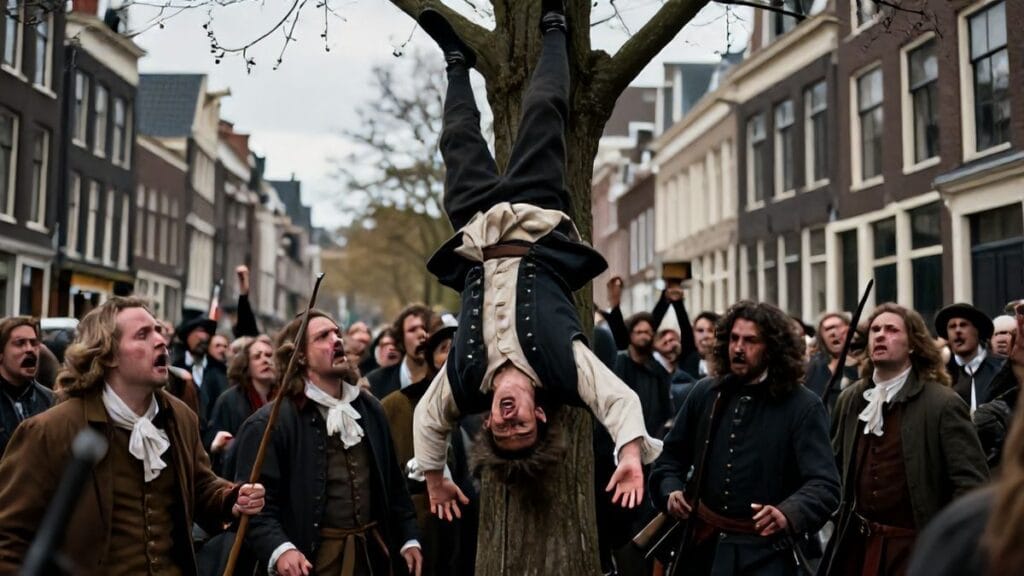
The lynching that followed was an eruption of raw, collective violence. Johan and Cornelis were beaten, stabbed, and finally hanged, their bodies suspended as the crowd pressed in. Witnesses later described scenes of almost ritualized savagery. One chronicler, quoted in modern studies, recalled “the people, like wild beasts, tearing at those they had yesterday named their governors.” The phrase “johan and cornelis de witt lynched” does not fully capture the horror: beyond the hanging came mutilation. The brothers’ bodies were cut down, hacked apart, their limbs and organs displayed and even, according to some accounts, cooked and eaten in grotesque gestures of vengeance.
Historians have long debated the extent of these acts. Some contemporaries may have exaggerated or taken rumor for fact; cannibalism in particular may have been more symbolic accusation than widespread practice. Yet there is no doubt that mutilation occurred and that parts of the De Witts’ bodies were taken as grisly trophies. In a society that prided itself on order, commerce, and Calvinist morality, the spectacle of citizens desecrating their former leaders proved a shocking rupture. The lynching took on the qualities of a dark festival, a moment in which normal constraints dissolved and the crowd enacted a brutal, inverted judgment.
In the chaos, there were shouts invoking William III, cries of loyalty to the Prince that mingled with curses at the “traitors.” Some among the mob may truly have believed that by hanging Johan and Cornelis they were saving the Republic. Others no doubt were caught up in the intoxication of collective action, the sudden sense of power that comes from belonging to a crowd that nothing seems able—or willing—to stop.
By the time the frenzy subsided, the courtyard was spattered with blood. The bodies, torn and desecrated, presented a sight that even hardened veterans found difficult to forget. Yet no immediate, serious attempt was made to punish the perpetrators. The authorities, who in other circumstances showed little hesitation in cracking down on unrest, were strangely absent, hesitant, or even approving. In the most literal sense, johan and cornelis de witt lynched had been an act of public judgment carried out with the state’s tacit permission.
Word of the lynching spread rapidly through The Hague, then outward across the provinces and beyond. In an age when news traveled by horse, carriage, and ship, the story raced with uncommon speed. The Republic had not merely lost two prominent statesmen; it had, before the eyes of Europe, staged a spectacle of self-destruction.
Rituals of Violence: Mutilation, Cannibal Rumors, and Collective Guilt
The aftermath of the lynching was, in some ways, even more disturbing than the act itself. For days, stories circulated about what exactly had happened to the De Witts’ bodies. Some accounts claimed that pieces of their flesh had been sold as souvenirs; others insisted that members of the crowd had roasted and eaten human remains. Whether these tales were entirely accurate or partially embellished, their persistence reveals a deeper psychological reality: the lynching was experienced and remembered as a transgression of fundamental moral boundaries.
In early modern Europe, public executions were not unusual. They were often highly choreographed rituals in which the state asserted its authority over condemned criminals. The executioner, the scaffold, and the gallows formed a theater of punishment. But what happened on 20 August 1672 fell outside those norms. Here, the crowd, not the executioner, determined the fate of the condemned. The punishment was not a measured, codified response to a proven crime; it was a chaotic eruption driven by passion. The mutilation of the bodies, the taking of trophies, and the rumored cannibalism lent the event an air of sacrilege, as if the Republic had not only killed its leaders but also defiled its own body.
For many observers, this was the most troubling aspect. How could a people renowned for their sobriety and discipline descend into such barbarity? Some blamed drunkenness; others pointed to the months of inflammatory propaganda that had dehumanized the De Witts, turning them from political opponents into monsters. When you convince yourself that an enemy is less than human, almost any act against them becomes imaginable, even justifiable. In that sense, the mutilation of the brothers’ corpses was the logical, if ghastly, endpoint of a long campaign of demonization.
Collective guilt, however, is seldom evenly distributed. Some citizens stayed away from the scene, horrified by reports. Others watched in silence, unsure how or whether to intervene. A few may have tried, ineffectually, to stop the worst excesses. Yet the fact remains that a significant portion of the crowd participated actively, and that the institutions of government did little to prevent or punish their actions. The lynching thus became not just a crime of individuals, but a stain on the Republic as a whole.
Contemporaries struggled to make sense of it. One foreign observer, cited by later historians, wrote that “the Dutch have devoured their own.” The phrase captures both the literal rumors and the metaphorical reality: a state that had prided itself on unity and mutual defense had turned inward, consuming its own political flesh. The phrase “johan and cornelis de witt lynched” came to signify not only the brothers’ deaths but also the Republic’s temporary surrender to its worst impulses.
Silence and Satisfaction: How Authorities Allowed the Lynchings
The question that has haunted historians ever since is simple and damning: where was the state? The Dutch Republic in 1672 still possessed functioning councils, courts, and militias. It had laws against murder and riot. It had, in other circumstances, proven quite willing to suppress unrest with force. Yet on the day when johan and cornelis de witt lynched became reality, those mechanisms either failed or were deliberately held back.
The involvement of some members of the civic militia (schutterij) in the lynching is well attested. These were not mere rabble; they were, at least in theory, guardians of public order. Yet many militiamen were ardent Orangists, and the cult of William III had inflamed their sense of mission. In their eyes, defending the public might mean siding with the crowd against “traitors,” rather than defending the De Witts from mob violence. Officers who might have curbed their men hesitated, perhaps unsure of how far the new political winds blowing from William’s camp would support or condemn such restraint.
The higher authorities—the States of Holland, the States General, and William himself—responded with a mixture of silence and platitudes. There was no broad, systematic effort to indict or punish the killers. A few token investigations were made, but they yielded little. No major organizer or participant suffered serious consequences. In effect, the state signaled that the lynching would be tolerated, perhaps even quietly approved, as an ugly but useful act that removed inconvenient figures.
William III’s role remains a matter of intense debate. Some historians suggest that he was informed in advance that trouble might occur and chose not to intervene. Others argue that he could not have foreseen the level of violence and that, once it began, it was beyond his immediate control. Yet what stands out is his subsequent inaction: he did not use his growing authority to demand justice for the brothers. Instead, he moved quickly to consolidate his power, benefiting from the removal of his staunchest republican opponents.
From a cold political perspective, the lynching solved several problems at once. It eliminated Johan and Cornelis as potential rivals or rallying figures for any future republican opposition. It satisfied, at least temporarily, the bloodlust of an angry populace, channelling their rage into a single, spectacular act. And it allowed William to distance himself from the worst excesses while still reaping the political rewards. This pattern—where leaders tacitly allow violence against opponents while maintaining plausible deniability—is sadly familiar in many eras.
For the Dutch Republic, the episode revealed a sobering truth: its republican institutions were not immune to the pressures of faction and fear. When tested, they bent, and in bending they permitted one of the darkest moments in the nation’s political history.
Europe Reacts: Shock, Approval, and Cold Realism
News of the lynching did not remain confined within Dutch borders. Envoys, merchants, and travelers carried the story to the courts of Europe, where it was received with a mixture of fascination, horror, and opportunistic satisfaction. In Paris, where Louis XIV had long viewed Johan de Witt as a formidable adversary in diplomacy, some at court reportedly smiled at the downfall of an enemy. Yet even among the French, there was unease at the manner of his death. Monarchs, after all, prefer their foes defeated on the battlefield or outmaneuvered at the negotiating table, not torn apart by their own people.
In England, memories of the recent Civil War and the execution of Charles I colored reactions. Some royalists saw the lynching as yet another proof of the instability of republican government: first the English had killed a king; now the Dutch were devouring their own leaders. Others, with more nuanced views, recognized the dangerous precedent of allowing crowds to decide political conflicts. The English diarist and naval administrator Samuel Pepys had previously recorded detailed impressions of the Dutch in his journals; although his diary ended in 1669, later English observers in his tradition noted that the lynching cast a shadow over the reputation of a people once admired for their restraint.
In the German states and elsewhere, the episode confirmed both the vulnerability and the volatility of the Dutch model. Some princes took dark satisfaction in seeing a republic humiliated; others worried that similar explosions of popular anger could erupt in their own territories if war, famine, or misrule struck. The image of johan and cornelis de witt lynched thus became a cautionary tale, a story used to argue various political positions: against republicanism, against populist agitation, or against the demonization of political opponents.
Diplomatically, the direct impact of the lynching was limited. Wars are decided by armies and treasuries more than by single acts of internal violence. Yet the psychological impact mattered. The Dutch negotiating position was weakened, not only by military disasters but also by the sense that their internal politics were spinning out of control. A state that cannot protect its own leaders from its own citizens appears less formidable at the bargaining table.
Nevertheless, Europe soon had other concerns. The great wars of the late 17th century continued, alliances shifted, and the focus moved on. But the story of the De Witts remained, lodged in the collective memory of diplomats, philosophers, and historians as a grim example of how quickly a sophisticated society could descend into political savagery.
William III’s Ascent: From Chaos to a New Political Order
In the months and years that followed the lynching, William III consolidated his position at the head of the Dutch Republic. The Disaster Year was not yet over in August 1672, but the worst shocks had passed. The Dutch managed, through flooding and stubborn resistance, to halt further French advances. The water line worked; the invaders found themselves stalled before inundated landscapes that neither cavalry nor artillery could easily cross.
William took personal command of the army and, in time, began to score modest but symbolically important successes. His reputation as a military leader—and as the providential savior his supporters had imagined—grew. The Perpetual Edict, once the cornerstone of Johan de Witt’s republican program, was formally repealed. William held both the stadtholderate and the role of Captain-General, centralizing civil and military power in his hands.
In this new order, there was little room for open reflection on the fate of the De Witts. To question the lynching too loudly could sound like criticism of the movement that had brought William to power. Many former allies of Johan and Cornelis kept their heads down, adapted to the new regime, or retreated into private life. A kind of public amnesia set in, at least in official discourse. The Republic needed unity to survive the ongoing wars; reopening old wounds was discouraged.
Yet in private writings and later memoirs, some contemporaries expressed unease. They recognized that the manner in which johan and cornelis de witt lynched had been allowed to happen reflected poorly on the Republic’s claims to moral and political superiority. Over time, as William’s own career expanded—culminating in his ascension to the English throne in 1689 during the Glorious Revolution—the contrast between his regime’s self-presentation and the bloody birth of his Dutch authority became sharper.
Paradoxically, William’s later image as a champion of constitutional monarchy in England would partly overshadow the darker aspects of his Dutch rise. English Whig historians celebrated him as a defender of Protestant liberties and parliamentary governance, paying relatively little attention to the lynching back in The Hague. In the longer view of history, the story of the De Witts would have to wait for a different kind of historian, more interested in the underbelly of power, to return it to the center of the narrative.
Memory, Myth, and Blame: Rewriting the Story of the De Witts
In the decades after 1672, the memory of Johan and Cornelis de Witt underwent a complex evolution. Immediately after their deaths, Orangist circles maintained a version of events that justified or minimized the lynching. In this account, the brothers were at best misguided, at worst traitorous, and the violence against them, while regrettable in form, was understandable in substance. Pamphlets still circulated that depicted them as arrogant oligarchs whose policies had nearly ruined the Republic.
Yet other voices refused to let this version stand uncontested. In private correspondence and later, more cautiously, in published works, some writers portrayed the De Witts as patriots sacrificed to ignorance and fanaticism. They highlighted Johan’s diplomatic skill, his dedication to the Republic’s independence, and his efforts to avoid unnecessary wars. Cornelis, too, was recast as a loyal servant of the state, unfairly maligned by political enemies. As the immediate passions of the Disaster Year cooled, it became easier for educated elites to question the official narrative.
By the 18th century, Enlightenment thinkers began to view the lynching through a broader lens. Voltaire, in his writings on the history of the Dutch Republic, treated the episode as evidence of the dangers of popular violence and religious fanaticism. He did not idealize the regent class, but he recognized in the destruction of the De Witts a failure of reason and tolerance. The story of “johan and cornelis de witt lynched” became, in this context, an allegory of what happens when passion outruns law.
Within the Netherlands, the long-term shift in memory continued. The 19th century, with its rising tide of nationalism and romantic historicism, produced new interpretations. Painters, novelists, and historians revisited the Disaster Year, often casting Johan as a tragic hero—brilliant but doomed—who had tried to hold back both foreign invasion and domestic reaction. Cornelis, once the brusque partisan, became in some works the loyal brother, the steadfast support without whom Johan could not have pursued his vision.
Of course, memory is never uniform. Some strands of Orangist tradition still regarded the brothers with suspicion or disdain. But the overall balance tilted toward sympathy and admiration. The lynching came to be seen not as justified retribution but as a stain on national honor, a moment when the Dutch, driven by fear and manipulated by propaganda, had betrayed some of their best sons. In this evolving remembrance, the brothers were gradually reclaimed as part of a national story that emphasized struggle, resilience, and the painful lessons of history.
From Republican Ideal to Cautionary Tale: Long-Term Consequences
The immediate political consequence of the De Witts’ fall was the triumph of the House of Orange. But the deeper, longer-term effects were more subtle. The lynching exposed the vulnerabilities of the Dutch republican experiment, highlighting how reliant it had been on a relatively small circle of regent families and how susceptible it was to popular discontent and factional propaganda.
One lesson that many Dutch elites drew—consciously or unconsciously—was the danger of overreaching republican reform in the face of a powerful princely tradition. Subsequent efforts to limit Orange power would be more cautious, more compromised. The memory of johan and cornelis de witt lynched served as a warning to would-be reformers about the potential costs of confronting entrenched symbols of national identity too directly.
At the same time, the episode contributed to a broader European skepticism about unmediated popular power. Philosophers and political theorists cited the lynching as one of several examples—from the English Civil War to various urban riots—of how easily “the people” could be turned into a destructive force. This did not mean that all thinkers abandoned the idea of republican government or civic participation. But many argued that such systems needed strong safeguards, checks and balances, and educational efforts to prevent the kind of frenzied violence seen in The Hague.
In the Netherlands itself, the political culture gradually shifted. Commerce and stability regained priority over grand ideological battles between princely and republican visions. The Republic muddled through the late 17th and 18th centuries, facing new wars and internal changes, but never again quite reproducing the sharp confrontation that had defined the De Witts’ era. When, in the late 18th century, new republican currents arose—the so-called Patriot movement—they looked back at 1672 as both inspiration and warning.
Thus the story of Johan and Cornelis did not end in 1672. It lived on as a cautionary tale about leadership in times of crisis, about the fragility of legal protections when fear reigns, and about the ease with which a society can convince itself that political murder is an act of salvation. These are lessons that have remained disturbingly relevant in many countries and eras since.
Representing Horror: Art, Literature, and the De Witt Lynching
No atrocity, however shocking, remains purely in the realm of fact. Over time, it is refracted through the lenses of art and literature, gaining symbolic meanings that sometimes overshadow the messy details of the original event. The lynching of the De Witts proved no exception. One of the most haunting representations is the painting “The Corpses of the De Witt Brothers” (1672) by the Dutch artist Jan de Baen, which shows their naked bodies hanging upside down, pale and inert, against a dark background. The painting confronts the viewer with the stark aftermath of violence, devoid of the crowd’s frenzy, inviting contemplation rather than participation.
In this and other images, the brothers become martyrs of a sort, their vulnerability emphasized, their humanity restored by the very act of depicting their victimhood. The gawking, jeering crowd is absent or minimized; the focus is on the cost, not the perpetrators. This artistic choice reflects a broader shift in sensibility. By the time such works were commissioned or displayed, the initial wave of Orangist triumphalism had waned, and a more reflective mood had set in.
Literature, too, took up the story. Plays and novels in later centuries revisited 1672, sometimes staying close to historical sources, sometimes indulging in romantic invention. The brothers’ final meeting in the Gevangenpoort became a favorite scene for dramatists, who imagined their conversation as a clash of despair and stoic resolve. Poets used the phrase “johan and cornelis de witt lynched” as shorthand for political martyrdom, juxtaposing their fate with that of other victims of state or popular fury.
Historians, for their part, have engaged in their own form of narrative crafting. Some, like the 19th-century Dutch historian Robert Fruin, treated the De Witts with great sympathy, emphasizing their intelligence and patriotism. Others have sought a more balanced view, acknowledging their political miscalculations and the genuine fears that some of their policies aroused. Modern scholarship, with its attention to social context and propaganda, has tended to see the lynching less as a sudden explosion than as the culmination of a longer process of polarization.
In all these representations, what stands out is the enduring power of the image: two brothers, once at the pinnacle of a proud republic, hanging lifeless in a public square. That image has transcended its specific time and place to become a symbol of what political hatred can do when it is granted free rein.
Echoes in Modern Politics: Populism, Scapegoats, and State Violence
It might be tempting to consign the lynching of Johan and Cornelis de Witt to the distant past, a product of a more brutal age that bears little resemblance to our own. Yet the dynamics that produced their fate—fear in the face of crisis, the search for scapegoats, the use of propaganda to demonize opponents, the ambiguous role of state authorities in condoning violence—are all too familiar in modern politics.
In the 20th and 21st centuries, many societies have experienced moments when popular anger, channeled by political movements or demagogues, turned against specific individuals or groups declared enemies of the people. While the methods may differ—modern media instead of pamphlets, social networks instead of tavern gossip—the underlying pattern is strikingly similar. Once a leader or minority is dehumanized in the public imagination, appeals to law and due process grow faint. The cry for immediate, direct “justice” rises, and with it the risk of violence.
The story summed up in the phrase “johan and cornelis de witt lynched” thus offers more than historical curiosity. It serves as a warning about how quickly a society that prides itself on rationality and legal order can, under pressure, abandon both. The Dutch Republic of the 1670s was not an ignorant backwater; it was one of the most advanced, literate, and commercially sophisticated societies in the world. Yet in a moment of fear and manipulated rage, it allowed a mob to murder two of its leading statesmen in broad daylight.
Modern democracies face their own Rampjaren, whether in the form of economic collapse, terrorism, pandemics, or geopolitical shocks. In such times, the temptation to find simple villains and to punish them swiftly can be overwhelming. Political leaders, like William III and his circle, may find it convenient to let anger run its course, even if that means tacitly accepting acts of violence or legal persecution. The lessons of 1672 suggest that such convenience carries a long shadow, staining not only the victims’ memory but also the legitimacy of the regimes that permit or encourage such acts.
Remembering the De Witts is therefore not only an act of historical curiosity; it is an exercise in civic vigilance. To study how and why a sophisticated republic allowed—and in some ways orchestrated—the lynching of its own leaders is to better understand the dangers that lurk whenever fear, faction, and propaganda converge.
Conclusion
On a single August day in 1672, amid the cobblestones and canals of The Hague, the Dutch Republic crossed a line from which it could never fully retreat. The lynching of Johan and Cornelis de Witt was not an isolated outburst, but the violent climax of years of political struggle, fear, and manipulation. The brothers, once the architects of a confident republic, became the sacrifices through which a frightened society tried to purge its anxieties and restore a sense of control.
The story is layered with ironies. Johan’s careful calculations could not predict the irrational fury that would engulf him; Cornelis’s blunt courage could not withstand the machinery of a politicized justice system. William III, later celebrated as a champion of constitutional government, rose to power in an atmosphere that condoned political murder. The Dutch Republic, admired for its tolerance and commercial sophistication, revealed in its darkest hour a capacity for collective savagery that stunned even its enemies.
Yet the lynching did not extinguish the ideals the De Witts represented. Over time, their memory was reclaimed, their work for a balanced, law-governed republic appreciated anew. Historians, artists, and citizens have returned again and again to the image of johan and cornelis de witt lynched, not to glorify the act, but to confront its implications. In doing so, they have transformed a moment of horror into a long meditation on the fragility of political order and the responsibilities of both leaders and citizens.
The events of 1672 remind us that no society, however advanced, is immune to the temptations of fear and vengeance. The safeguards of law, custom, and civility can be dismantled quickly when crisis strikes and when powerful interests find advantage in chaos. To honor the De Witts today is not only to lament their fate, but to heed the warning inscribed in their blood: that the line between politics and violence is thinner than we like to think, and that crossing it is far easier than returning.
FAQs
- Who were Johan and Cornelis de Witt?
Johan and Cornelis de Witt were influential Dutch statesmen from a regent family in Dordrecht. Johan served as Grand Pensionary of Holland from 1653 to 1672 and was effectively the political leader of the Dutch Republic, while Cornelis held important naval and municipal offices. Together they championed a republican system that limited the power of the House of Orange and emphasized collective governance by provincial and urban elites. - Why were Johan and Cornelis de Witt lynched in 1672?
They were lynched during the “Disaster Year” (Rampjaar) of 1672, when the Dutch Republic was invaded by France, England, and allied German states, causing widespread panic. Their political enemies, particularly supporters of Prince William III of Orange, blamed them for military defeats and portrayed them as traitors. Fueled by propaganda, religious rhetoric, and fear, a mob in The Hague stormed the Gevangenpoort prison on 20 August 1672 and murdered them, with authorities largely failing to intervene. - What role did William III of Orange play in their downfall?
William III did not openly order the lynching, but he was the central beneficiary of the political movement that targeted the De Witts. As Orangist propaganda built him up as the nation’s savior and vilified the brothers, pressure mounted to remove them from power. William’s subsequent failure to insist on a thorough investigation or to punish the perpetrators suggests at least a tacit acceptance of the outcome, even if his precise level of prior knowledge remains debated among historians. - Were the accusations against Cornelis de Witt credible?
The specific charge that Cornelis plotted to assassinate William III rested largely on the testimony of Willem Tichelaar, a dubious witness. Under torture, Cornelis refused to confess, and modern historians generally regard the accusation as politically motivated and unproven. The court ultimately sentenced him to banishment rather than death, indicating its own uncertainty; the mob, rejecting this legal outcome, imposed its own brutal “sentence” by lynching him. - Did cannibalism really occur during the lynching?
Contemporary accounts and later reports claim that parts of the De Witts’ bodies were cut off, sold as souvenirs, and in some cases eaten by members of the crowd. While the exact extent of cannibalism is difficult to verify and some reports may be exaggerated, there is strong evidence of mutilation and trophy-taking. Whether symbolic or literal, these acts have come to represent the extreme dehumanization and moral collapse that characterized the lynching. - How did the lynching affect the Dutch Republic’s politics?
The lynching removed two central figures of the republican regent party and cleared the way for William III to consolidate power as stadtholder and Captain-General. It marked the end of the First Stadtholderless Period and a decisive victory for the House of Orange. In the longer term, it contributed to a more cautious approach to republican reform and reinforced skepticism about popular violence, even among those sympathetic to limiting princely authority. - How are Johan and Cornelis de Witt viewed today?
Today, the De Witts are generally regarded in the Netherlands and among historians as capable, if controversial, statesmen who worked to preserve the Republic’s independence and stability. While their policies and strategic choices remain subject to debate, the lynching is widely condemned as a tragic miscarriage of justice and a stain on the nation’s history. Artistic and scholarly works now often portray them as tragic figures and victims of political hysteria.
External Resource
Internal Link
Other Resources
- Encyclopaedia Britannica – general search for the exact subject
- Google Scholar – academic search for the exact subject
- Internet Archive – digital library search for the exact subject