Table of Contents
- A World Holds Its Breath: Setting the Stage for Apollo 11
- From Cold War to Space Race: The Long Road to the Moon
- Designing a Journey to Tranquility Base
- Three Men, One Mission: Armstrong, Collins, and Aldrin
- Countdown to History: Launching Apollo 11
- Crossing the Cislunar Void: The Voyage Outward
- First Glimpse of a New World: Lunar Orbit and Preparation
- “The Eagle Has Wings”: Descent Toward Tranquility
- “Houston, Tranquility Base Here”: Touchdown on the Moon
- First Steps in the Dust: Humanity Walks on the Moon
- Flags, Footprints, and Experiments: Work on the Lunar Surface
- The Long Ride Home: Ascent, Rendezvous, and Return
- Behind the Headsets: The Invisible Army That Made Apollo 11 Possible
- The World Reacts: Awe, Skepticism, and Global Unity
- Politics, Propaganda, and Power: Apollo 11 in the Cold War Imagination
- Human Stories from Tranquility Base: Fear, Faith, and Silence
- From Moon Rocks to Microchips: Scientific and Technological Legacies
- From Triumph to Retreat: Why We Stopped Going to the Moon
- Memory, Myth, and Doubt: How Apollo 11 Lives in Culture
- From Apollo to Artemis: The Enduring Echo of Tranquility Base
- Conclusion
- FAQs
- External Resource
- Internal Link
Article Summary: On July 20, 1969, the apollo 11 moon landing transformed the dusty plain called Tranquility Base into the most famous spot in human history. This article traces how a tense Cold War rivalry evolved into a vast scientific and engineering undertaking that carried three men to the Moon and back. It follows the mission chronologically—from launch to splashdown—while pausing inside control rooms, cramped spacecraft, and living rooms around the globe. Along the way, it explores the political stakes, the technological breakthroughs, and the human emotions hidden behind the triumph. The apollo 11 moon landing is presented not as an isolated miracle, but as the peak of a decade-long effort involving hundreds of thousands of people. Yet behind the iconic phrases and heroic images, there were doubts, near-disasters, and complicated aftermaths. Finally, the article shows how the apollo 11 moon landing reshaped science, culture, and our sense of ourselves as a species perched on a small world in a much larger universe.
A World Holds Its Breath: Setting the Stage for Apollo 11
On the night of July 20, 1969, about 600 million people—nearly one-fifth of humanity at the time—leaned toward flickering television screens, radios, and loudspeakers. Cities fell strangely quiet. In New York, bars left drinks half-poured as patrons craned their necks toward TVs in smoky corners. In a small village in India, where electricity had just been strung a few years earlier, families gathered in front of a single black-and-white set in the local school. In Soviet apartments, tuned to foreign broadcasts through a haze of static, curious listeners tried to catch fragments in English. For a brief, fragile moment, the world seemed to turn its gaze away from war, protest, and political turmoil and fix it instead on a gray, cratered disc hanging in the night sky.
They were waiting for something no human being had ever experienced: the apollo 11 moon landing, the instant when a fragile, spidery vehicle would try to touch down on a world 380,000 kilometers away. No one could be certain it would work. The grainy images from NASA’s tracking cameras and the rattle of voices through Mission Control’s headsets only hinted at the risk. If the lander’s engine failed, if a valve stuck, if a guidance system malfunctioned at the wrong moment, the mission could become a live, slow-motion tragedy broadcast across the planet. The stakes were as high emotionally as they were technically. As one NASA historian later wrote, “The Moon was not just a destination, it was a mirror. Humanity was about to see itself in a new way.”
By the time the words “Tranquility Base here. The Eagle has landed” crackled across the airwaves, the mission had already threaded its way through a labyrinth of dangers: launch, vacuum, radiation, navigation across cislunar space, and insertion into lunar orbit. In living rooms from Paris to Buenos Aires, people barely understood the intricacies of Saturn V staging or the mathematics of orbital rendezvous. But they felt the tension. The empty lunar surface, shown in ghostly contrast on screens, looked hostile and ancient. That humans were about to reach it seemed, to many, simply unbelievable. And yet, 400,000 scientists, engineers, and workers across the United States had spent the better part of a decade doing the improbable work of turning the impossible into a flight plan.
It is astonishing, isn’t it? A species that had learned to fly barely two generations earlier was now attempting a soft landing on another world. The apollo 11 moon landing exists today as an icon—reduced to a few seconds of footage, a single sentence, a blurry photo of a flag. But in July 1969, it was an ongoing, fragile drama. Every second of radio silence felt like an eternity. Every call from Houston—a steady voice saying “Go” or “Stay”—was a lifeline. In that tension, in that shared breath held by so many millions, we can begin to understand what Tranquility Base truly meant: not only a technical achievement, but a turning point in the human story.
From Cold War to Space Race: The Long Road to the Moon
The story of the apollo 11 moon landing begins not with rockets or astronauts, but with fear. In October 1957, a small metal sphere called Sputnik 1 rose on a column of Soviet fire and circled the Earth. It weighed barely 84 kilograms, but its beeping signal reverberated like a thunderclap through American politics. The United States, a country that saw itself as technologically supreme, seemed suddenly behind. If the Soviet Union could launch a satellite, Americans reasoned, it could certainly deliver nuclear warheads across continents. The sky itself no longer felt safe.
From that anxiety grew the space race: a contest in which orbits, spacewalks, and eventually lunar landings became instruments of prestige and ideological power. John F. Kennedy, barely a few months into his presidency and shaken by early failures like the Bay of Pigs, chose space as the arena where the United States would prove its superiority. On May 25, 1961, he stood before Congress and declared that America should commit itself “to achieving the goal, before this decade is out, of landing a man on the Moon and returning him safely to the Earth.” The words were soaring, but the reality beneath them was stark: at that moment, the U.S. had only managed to send Alan Shepard on a short, 15-minute suborbital hop.
To promise a Moon landing when your total experience in space amounted to a brief upward arc was almost reckless. Yet Kennedy understood something fundamental about politics and imagination. The Moon was more than a rock in the sky. It had been woven into mythologies as a goddess, a clock, a mirror of human emotion. To conquer that ancient symbol was to claim a new kind of power. “We choose to go to the Moon,” he told a crowd at Rice University in 1962, “not because it is easy, but because it is hard.” His speechwriters crafted the line; history gave it weight.
In the Soviet Union, leaders like Nikita Khrushchev and scientists such as Sergei Korolev watched these developments with a mix of confidence and concern. The USSR, too, had lunar dreams. Its engineers secretly pursued giant rockets—N1 launch vehicles intended to rival the American Saturn V. But behind the façade of Soviet success lay overstrained budgets, bureaucratic rivalries, and technical setbacks that would grow fatal. By the late 1960s, the Soviet lunar program stumbled, plagued by catastrophic N1 test failures cloaked in secrecy. The United States, with its open press and televised launches, seemed ironically more vulnerable but was, in key ways, better organized.
The decades between Sputnik and Apollo 11 saw an astonishing escalation. First satellite, first dog, first man, first woman, first spacewalk—each milestone was counted, scored, tallied like points in an ideological game. Yet behind those headlines was an expanding infrastructure of launch pads, tracking stations, research labs, and training facilities. Children watched animations of rockets in classrooms while defense contractors negotiated billion-dollar contracts in Washington. The Moon, 384,400 kilometers away, became the endpoint of an immense industrial machine.
Designing a Journey to Tranquility Base
Promise is one thing; implementation is another. To make good on Kennedy’s challenge, NASA had to answer the question that haunted its engineers: how exactly do you land a human on the Moon and bring them home alive? In the early 1960s, this was not merely unknown—it bordered on science fiction. NASA’s engineers debated three main options: direct ascent (launching a single enormous spacecraft straight to the Moon and back), Earth-orbit rendezvous (assembling a Moon ship in orbit), and something radical called Lunar Orbit Rendezvous, or LOR.
LOR sounded to many like madness. It proposed that the spacecraft arrive at the Moon, split in two, and send a small lander down while the main command module remained in orbit. The lander would then have to rise back from the lunar surface and re-dock with the command module for the return home. In the early days, some managers scoffed. Why add such complexity? Why trust that two spacecraft could find and join each other again nearly 400,000 kilometers from Earth?
But John Houbolt, an engineer at NASA’s Langley Research Center, championed LOR with relentless conviction. He argued that it drastically reduced the mass needed to land and lift off from the Moon—mass that even the mighty Saturn V couldn’t afford to carry all the way down and up again. In a now-famous letter to a NASA official, Houbolt asked, “Do we want to go to the Moon or not?” His stubbornness paid off. LOR was eventually chosen, and with it the outline of Apollo’s architecture snapped into focus: a command-service module built by North American Aviation, and a lunar module—eventually nicknamed “Lem,” and on Apollo 11 called “Eagle”—built by Grumman.
The lunar module, in particular, looked like something out of an avant-garde art exhibit: no sleek curves, no aerodynamic lines. It didn’t need them. It would never fly through an atmosphere, only in vacuum. Its gold foil wrapping and spindly landing legs made it look delicate, but it was a highly specialized machine, its descent engine throttleable—a rare engineering feat at the time—so that astronauts could control their landing with fine precision. Inside, space was brutally tight. Astronauts would stand to pilot it, shoulder to shoulder, surrounded by switches and circuit breakers. Above them, in a small guidance computer, ran programs written in an early assembly language, compressed and woven into core memory that technicians literally stitched by hand.
Apollo’s systems were built with a philosophy NASA engineers called “fail-operational, fail-safe.” If one system failed, another would step in; only multiple layers of failure would doom a mission. Redundancy meant complexity, and complexity meant endless testing. There were simulators for launch, for docking, for re-entry; giant vacuum chambers mimicked the harshness of space. If the apollo 11 moon landing seemed smooth, it was only because thousands of dry runs, simulations, and failures had already been absorbed into design. As one engineer later remarked, “Every time something blew up in testing, it was a life we didn’t lose in space.”
Three Men, One Mission: Armstrong, Collins, and Aldrin
By 1969, NASA’s astronaut corps had the sheen of celebrity and the scars of sacrifice. The Apollo program had already claimed lives: Gus Grissom, Ed White, and Roger Chaffee, who burned to death in the Apollo 1 cabin fire in 1967. Their loss lingered in the corridors of the Manned Spacecraft Center in Houston, a quiet reminder that the elegant diagrams of mission profiles were, in the end, about human bodies placed in peril. Every new crew flew in the shadow of that tragedy.
Apollo 11’s crew was a careful balance of skills and temperaments. Neil Alden Armstrong, the commander, was a man of subdued demeanor and steady hands. A former Navy pilot and test pilot, he had already brushed against death more than once, ejecting from a failing lunar lander training vehicle just seconds before it crashed and exploded. Michael Collins, assigned as command module pilot, was tasked with perhaps the loneliest role in the flight: circling the Moon alone, tending to the systems that would bring all three men home. Edwin “Buzz” Aldrin, the lunar module pilot, was an engineer with a doctorate from MIT, meticulous and intense, whose work on orbital rendezvous had helped enable Apollo in the first place.
They trained together for months: rehearsing emergency procedures, memorizing checklists, running simulations until the sequences of calls, responses, and switch throws became almost instinctive. Yet beneath the drills lay personal fears and hopes. Collins worried about the burden of being the one left behind in lunar orbit. In an oft-quoted reflection, he later wrote that if the landing went wrong and Armstrong and Aldrin were stranded, he would have to fly home alone, “a marked man for life.” Aldrin struggled with the pressure of the spotlight even before they flew; afterward, it would strain him in unexpected ways.
Armstrong, for his part, resisted the notion of personal heroism. He often emphasized the collective nature of Apollo, once saying, “This was the culmination of the work of 300,000 to 400,000 people over ten years.” According to one NASA oral history, a colleague recalled Armstrong’s attitude as “confident, but never self-centered,” focused more on checklists than headlines. Yet it was he who would be the first to step off the ladder, he whose words would be replayed for decades. Leadership, in the context of Apollo 11, meant not only command in flight but calm under a level of global scrutiny no pilot had experienced before.
Countdown to History: Launching Apollo 11
Dawn came to Florida’s Merritt Island on July 16, 1969, wrapped in humidity and anticipation. At Launch Complex 39A, the Saturn V towered over the Atlantic shore—110 meters of steel, aluminum, and volatile propellants, the most powerful machine humans had ever built. White vapor curled from its flanks as liquid oxygen boiled off in the already-warming air. Crowds lined the beaches, arriving through the night in cars and campers. Some had binoculars; others just squinted against the sun, content to see only a streak of flame and a column of smoke.
Inside the white room at the top of the gantry, technicians helped Armstrong, Collins, and Aldrin into the command module Columbia. The spacecraft’s interior, no larger than a small car, became their world. Above them, three stages of the Saturn V held a combined 2.8 million kilograms of fuel and oxidizer. When ignition came, it would be like sitting at the tip of a controlled earthquake. The last few minutes of the countdown ticked away under the calm narration of the public affairs officer: “T-minus 60 seconds and counting…”
At 9:32 a.m. Eastern time, the first-stage engines ignited. For a fraction of a second, the Saturn V seemed to hang in place, fighting gravity. Then it began to rise, slowly at first, then faster, trailing a plume wider than a city street. The sound reached the spectators after a delay—a deep, shuddering roar that shook car windows and rattled bones. A woman watching from Cocoa Beach later recalled, “It was like the sky was cracking open.” On television, the launch appeared almost silent, only a white tower of smoke crossing a blue sky. In reality, it was violence tamed by engineering.
Within 12 minutes, Apollo 11 was in Earth orbit, the first leg of its journey complete. For a moment, the spacecraft and its crew circled the planet much like the earlier Mercury and Gemini missions had done. But this was only the beginning. Over the next hours, controllers in Houston reviewed telemetry, confirming that the systems were nominal. Then came the critical maneuver: translunar injection. The third stage’s engine fired again, this time not to lift them but to push them away—out of Earth orbit, onto a trajectory that would intersect the Moon. In that burn lay the point of no return. If anything major went wrong after that, turning back would be nearly impossible.
When the engine shut down and the clamps of acceleration released them, the astronauts felt the peculiar lightness of deep space. They were now on a three-day arc toward the Moon, falling and flying at the same time, in that deceptive weightless dance that orbital mechanics demands. Behind them, the Earth shrank steadily, a blue-and-white marble set against blackness. Ahead, the Moon brightened from a familiar disc into a looming destination.
Crossing the Cislunar Void: The Voyage Outward
The journey between worlds was, in some ways, the mission’s quietest phase, but it was also psychologically profound. For roughly 76 hours, Apollo 11 coasted through cislunar space, a region no human had traversed before Apollo 8’s pioneering flight the year prior. The crew used this time to perform midcourse corrections, test systems, broadcast television updates, and peer out of small windows at a universe unfiltered by atmosphere.
They conducted routine housekeeping: stowing equipment, taking navigation sightings using a sextant and the stars, checking the state of the fuel cells that powered their electrical systems. They ate meals squeezed from plastic packages, wiped with moistened towels, floated in their couches when not strapped in. Weightlessness made some tasks easier but others awkward. Even sleeping required adjustment, as bodies naturally drifted into odd angles unless tethered.
Yet behind the mundane lay moments of disorienting beauty. As the Earth dwindled, it became both more fragile and more abstract. Michael Collins, who spent much of the mission tending to navigation and the command module’s systems, later remarked that he felt a strange detachment: “I really believe that if the political leaders of the world could see their planet from a distance of 100,000 miles, their outlook would be fundamentally changed.” Looking back, the astronauts saw no borders, no wars—only a single, luminous sphere. In front of them, the Moon grew from a bright coin into a rugged world, shadows revealing craters and mountains older than any human civilization.
On Earth, the passage of those three days stretched the tension. News organizations ran continuous coverage, jumping between studio experts and live audio from the spacecraft. Newspapers printed diagrams of orbits, drawings of the lunar module, interviews with engineers. Some churches held special services to pray for the astronauts’ safety. Others questioned the expenditure, arguing that money was being burned in rockets while poverty thrived in city streets. Yet even many critics found themselves listening closely to the beeps and voices from the void, curious to hear if this grand gamble would succeed.
First Glimpse of a New World: Lunar Orbit and Preparation
On July 19, Apollo 11 approached the Moon’s gravitational embrace. As the spacecraft neared its target, Houston’s controllers prepared for one of the mission’s most nerve-wracking moments: lunar orbit insertion. To fall into orbit safely, the service module’s main engine had to fire at exactly the right time, for exactly the right duration, while the spacecraft passed behind the Moon—out of radio contact with Earth. If the burn was too short, Apollo 11 would slingshot past the Moon and return to Earth on an unintended trajectory. If too long, it could crash.
The spacecraft slipped behind the lunar limb, and communication cut off as expected. On Earth, it felt like a curtain dropping. There were no live updates to share, no telemetry to read, only a silent, unseen drama unfolding 380,000 kilometers away. In Houston, controllers stared at their consoles, waiting for the signal to return. In living rooms on Earth, commentators explained the stakes in hushed tones. Then, after what felt like an eternity but was merely minutes, the voice of Charlie Duke, the CapCom, crackled in: “We got you coming down, Eagle.” The burn had worked. Apollo 11 was in lunar orbit.
For the next series of revolutions, Armstrong, Collins, and Aldrin gazed down at a landscape no human had ever seen so closely with their own eyes. The Moon was not a smooth, friendly neighbor but a brutal, impact-scarred world. Craters overlapped craters; ancient lava plains, or maria, stretched like dark seas between brighter highlands. They located landmarks identified in pre-mission mapping: Maskelyne crater, the Sea of Tranquility, the planned landing ellipse where Tranquility Base would soon exist as more than a name.
While Collins remained in the command module Columbia, Armstrong and Aldrin began preparing the lunar module for its separate mission. They powered up Eagle, ran through checklists, tested communications, verified that guidance data had been properly aligned. The docking tunnel, connecting the two craft, became briefly bustling as they moved equipment and themselves between vehicles. Each step was deliberate, performed against the knowledge that once they undocked, the margin for error would shrink sharply.
“The Eagle Has Wings”: Descent Toward Tranquility
On July 20, 1969, Eagle separated from Columbia with a gentle burst of gas. To Michael Collins, watching from the command module, the lunar module looked like an “insect” with its extended landing gear. To Armstrong and Aldrin, inside the cramped cockpit, it was a fragile lifeboat. Collins would remain in orbit, a solitary guardian of the way home, while his crewmates dropped toward the unseen surface below.
The descent was a chain of precisely timed events: a deorbit burn to lower their orbit, a powered descent to slow their fall, and then a final approach phase under manual or semi-manual control. Eagle flipped around and fired its engine, the descent stage trembling as the thrust countered lunar gravity. Guidance computers monitored altitude and velocity, feeding data to the astronauts’ displays. In Houston, flight controllers watched numbers scroll down their screens, listening for anomalies.
They did not have to wait long. As Eagle descended, its guidance computer began flashing alarms: “1202” and “1201.” In the cockpit, Armstrong and Aldrin saw the codes and, for a moment, uncertainty flickered. What did they mean? Was the computer failing? In Mission Control, guidance officer Steve Bales and his team scrambled. Fortunately, they had rehearsed this very scenario. The alarms indicated that the computer was overloaded but still functioning, able to prioritize essential tasks. Within seconds, Bales relayed his verdict to Flight Director Gene Kranz, who passed it on: “We’re go on that alarm.”
Then another problem emerged. As they came low enough for Armstrong to see the surface clearly, it became obvious that the planned landing area was not as smooth as expected. A large crater, strewn with boulders the size of cars, loomed where their guidance system wanted to take them. In those tense seconds, Armstrong took semi-manual control of the lander, pitching Eagle forward to search for a safer spot. Fuel was running low. Controllers in Houston could see the readouts, hear the toggling of switches, but they could not see the rocks or the dust or the pilot’s instinctive calculations. That burden lay solely in the cramped cabin above the lunar plain.
“Forward, forward…” came Aldrin’s callouts as Armstrong flew them horizontally, skimming the surface. Dust began to billow below, kicked up by the descent engine. Fuel warnings chimed. At 60 seconds remaining, then 30, tension in Mission Control climbed toward panic, though the voices over the loop remained disciplined, clipped, professional. When Armstrong finally eased off the thrust and let the lander settle, the clock had only seconds of fuel to spare by conservative estimates. It touched down with a gentle thump that both men felt through their boots.
“Houston, Tranquility Base Here”: Touchdown on the Moon
There was a short pause—Neil Armstrong’s eyes scanning indicators, mind racing through a quick systems check—and then the words that would enter history: “Houston, Tranquility Base here. The Eagle has landed.” The phrase was deliberate. “Tranquility Base” instantly transformed an anonymous patch of lunar regolith into a named place: a human foothold. In Houston, applause and cheers burst forth, quickly reined back in as Flight Director Gene Kranz reminded his team they still had hours of work ahead. But for a moment, even veterans of Mercury and Gemini felt the enormity of what had just happened.
On Earth, those words rippled around the globe. Television anchors leaned closer to their microphones. Families who had drifted away from screens during the quieter, more technical coverage rushed back into living rooms. In London, where it was night, people gathered in pubs stayed late, eyes fixed on muted TVs as radio commentary filled the silence. In Tokyo, commuters paused in train stations where news bulletins scrolled across electric signs. Even in places with no live broadcast, people heard by word of mouth: “They did it—they landed.”
Yet behind the celebrations, NASA’s procedures were relentless. Armstrong and Aldrin ran through post-landing checklists, preparing Eagle to serve as a safe haven should anything go wrong during or after the moonwalk. They were scheduled to rest before stepping outside, but adrenaline and the uniqueness of their situation made genuine sleep almost impossible. After some discussion with Houston, the timeline was adjusted. The world did not want to wait, and neither did they.
In those hours between landing and the first steps, the Moon outside their thin walls lay utterly silent, unchanged by their arrival. The apollo 11 moon landing was, at that moment, only a human claim and a fragile machine. Should the ascent engine fail, Tranquility Base would become their tomb. The astronauts were acutely aware of this. The White House had even prepared, in grim prudence, a speech for President Nixon to deliver in case Armstrong and Aldrin were stranded. It began, chillingly, “Fate has ordained that the men who went to the Moon to explore in peace will stay on the Moon to rest in peace.” That speech, thankfully, was never used.
First Steps in the Dust: Humanity Walks on the Moon
As the time approached for the first moonwalk, Armstrong donned his portable life support system and pressurized space suit, a white cocoon of layers and technology weighing about 80 kilograms on Earth but far lighter in lunar gravity. Aldrin did the same. They depressurized the lunar module’s cabin, opened the hatch, and Armstrong positioned himself on the small platform leading to the ladder. Television cameras, rigged beforehand, captured ghostly images as he descended, one rung at a time, into a landscape that no living creature had ever touched.
At the foot of the ladder, Armstrong paused on the pad and described what he saw. The surface, he reported, seemed fine and powdery. He tested it with his boot, then stepped backward off the pad and onto the Moon itself. “That’s one small step for [a] man, one giant leap for mankind,” he said. Debate still circles around whether he actually said “a man,” but the intended meaning was clear. In that instant, a single human footprint transformed the apollo 11 moon landing from a mechanical feat into a human act. Dust that had lain undisturbed for billions of years now bore the imprint of a boot designed in Houston and stitched in Delaware.
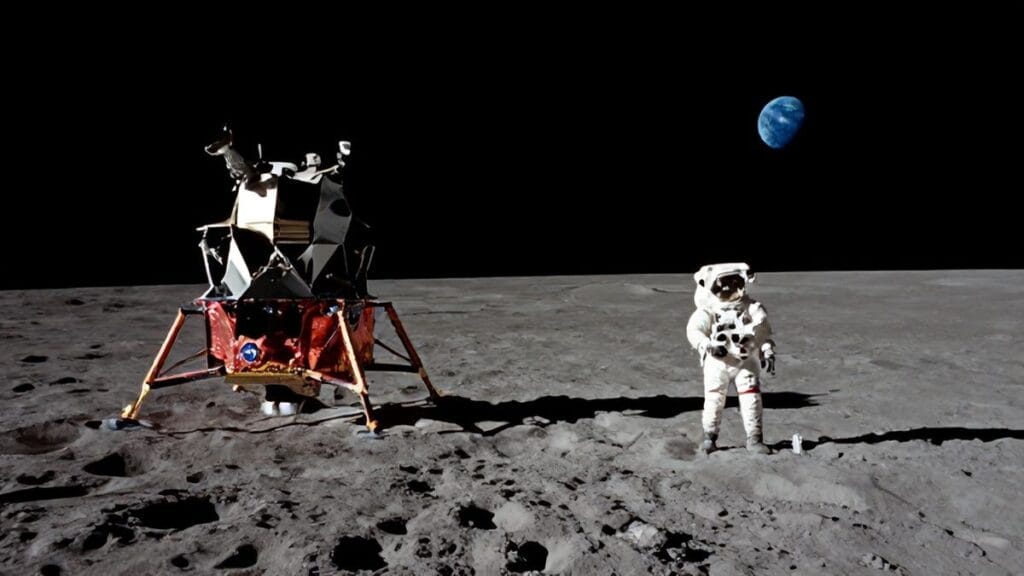
Buzz Aldrin followed, describing the surface as “magnificent desolation.” The phrase captured the strange emotional contrast: the awe of standing on another world and the stark emptiness of that world itself. There was no wind, no sound except their own movements relayed through their suits and into each other’s headsets. Overhead, the sky was black even though the Sun shone bright. At their backs, the Earth hung low over the horizon, a blue-and-white jewel, both distant and achingly familiar.
Their movements were awkward at first, constrained by pressurized suits and unfamiliar gravity. They learned quickly that a sort of loping, kangaroo-like gait worked better than walking. Each step kicked up a puff of gray dust that rose and fell in graceful arcs, unscattered by air. Bill Anders, an astronaut from Apollo 8, would later say, “We came all this way to explore the Moon, and the most important thing is that we discovered the Earth.” For billions watching, the sight of human figures silhouetted against the lunar surface made that discovery visceral: our home, seen from beyond, suddenly seemed both smaller and more precious.
Flags, Footprints, and Experiments: Work on the Lunar Surface
Once the television’s emotional peak passed, the work began in earnest. Apollo 11’s surface timeline was tightly choreographed: deploy the television camera, take contingency soil samples in case they had to leave quickly, set up the American flag, assemble scientific instruments, and document everything with photographs. Every minute had a task assigned, because every minute they spent outside consumed oxygen, water, and battery power from their life support systems.
Armstrong collected the first hurried scoop of lunar soil almost immediately after stepping off the ladder. This “contingency sample” was insurance—if anything forced them to abort the EVA, scientists on Earth would at least have something to analyze. Then came the raising of the flag, a moment heavy with symbolism. The flag was not intended to claim sovereignty—international treaties forbade that—but to signify national achievement. Armstrong and Aldrin struggled slightly to plant the staff into the compacted regolith, eventually twisting it back and forth until it stood, supported by a horizontal bar to make it appear to wave in the airless silence. The images of that flag, with its rippling illusion, would become among the most famous photographs of the 20th century and—ironically—the basis for some later conspiracy theories.
Then they turned to science. The Early Apollo Scientific Experiments Package included a passive seismometer, designed to detect “moonquakes” and meteorite impacts, and a laser ranging retroreflector, a panel of prisms that still, to this day, reflects beams from Earth-based lasers, allowing precise measurements of the Earth–Moon distance. They deployed these instruments with care, stepping around cables, consulting checklists clipped to their sleeves. Every move was recorded, every rock sample numbered and bagged. They collected about 21.5 kilograms of lunar material: fine soil, small rocks, fragments from different layers. In laboratories back on Earth, those samples would later reveal a Moon born from a colossal collision between the early Earth and a Mars-sized body—a violent origin story no one had suspected with certainty before.
Not everything went perfectly. At one point, a camera overheated and shut down. The astronauts occasionally lost their footing in the low gravity. Fine dust stuck to everything, working its way into joints and seals, a reminder that future lunar explorers would have to contend with an abrasive environment that eroded equipment faster than expected. Yet the overall mission stayed remarkably close to plan. After more than two hours outside, Armstrong and Aldrin made their way back to Eagle, climbing the ladder one last time. They closed the hatch, repressurized the cabin, and began to rest for the departure that would determine whether Tranquility Base remained a temporary outpost or a permanent monument.
The Long Ride Home: Ascent, Rendezvous, and Return
If landing on the Moon was daring, leaving it was even more unforgiving. The lunar module’s ascent engine had never been test-fired in vacuum conditions before being used in flight; it was designed to be so simple that it would be almost impossible for it not to work. But “almost impossible” is not the same as certain. On July 21, after their rest period, Armstrong and Aldrin donned their suits once more, secured themselves, and prepared for ignition. There was no backup. If the engine failed to light, there was no rescue option. Collins could do nothing from orbit but listen.
At the appointed moment, the ascent engine fired, severing the ascent stage from the descent stage left on the surface. Eagle’s upper half rose, leaving behind a base strewn with footprints, discarded equipment, and the lower section of the lander. Inside, vibrations rattled the cabin, but the engine held steady. The two men climbed back into lunar orbit, where Collins awaited in Columbia. Rendezvous and docking were complex maneuvers, but by now NASA and its astronauts had honed them during Gemini and earlier Apollo missions. Nonetheless, conducting such choreography around the Moon, with limited margins and no safety net, was a sobering exercise.
When the two craft finally docked and the hatches opened, the three men were reunited. The mission’s most dangerous phase was behind them, but the journey home still demanded care. They transferred samples and equipment, stowed the priceless bags of lunar rocks, and eventually jettisoned the lunar module, leaving it to orbit the Moon briefly before crashing to the surface. Their trajectory home required another precisely timed burn, swinging them out of lunar orbit and onto a return path toward Earth. For the second time, they passed behind the Moon in radio silence; for the second time, they re-emerged on a new course, the voices from Houston greeting them as if from a distant shore.
Over the next three days, as Apollo 11 fell back toward Earth, the world’s initial euphoria began to mingle with reflection. Newspapers ran editorials about human destiny, about what should come next. Some called for Mars missions; others argued for concentrating on Earthly problems. The astronauts, meanwhile, focused on re-entry preparations. A critical question lingered: would they encounter unknown pathogens from the lunar surface? The risk was considered extremely low, but not zero. As a precaution, NASA planned a quarantine process for the crew upon their return.
On July 24, 1969, Apollo 11 slammed into Earth’s atmosphere at about 39,000 kilometers per hour. The command module’s heat shield bore the brunt, temperatures outside reaching thousands of degrees. Inside, the astronauts endured high g-forces as plasma sheathed the capsule, blacking out radio communications for several minutes. Then, as designed, drag slowed them, communications resumed, and the sequence of parachute deployments began: drogue chutes to stabilize, then three main chutes billowing wide and bright against the Pacific sky. Television cameras on recovery ships captured the capsule splashing into the ocean. Frogmen from the USS Hornet swam out to secure it.
The first faces Armstrong, Collins, and Aldrin saw after eight days in space belonged to Navy divers wearing biological isolation garments. They handed the astronauts similar suits and escorted them to a mobile quarantine facility—a converted Airstream trailer—onboard the carrier. Through small windows, they waved at President Nixon, who had flown out to greet them. The cleaning rituals, the quarantine, even the careful handling of rocks and dust underscored a strange truth: humanity had touched another world, and now Earth itself felt slightly unfamiliar, as if it needed to confirm that it could safely host its wandering children again.
Behind the Headsets: The Invisible Army That Made Apollo 11 Possible
The story of the apollo 11 moon landing often focuses narrowly on three men in bulky suits and their capsule. Yet behind the televised heroism stood an army of people whose names rarely appeared in headlines. In Houston’s Mission Control Center alone, dozens of flight controllers worked in shifts, each responsible for a narrow slice of the mission: guidance, propulsion, life support, communications, electrical systems. They were mostly young—many in their twenties and early thirties—wearing short-sleeved white shirts and dark ties, headphones clamped over their ears as they stared at streams of numbers on green phosphor screens.
Flight Directors like Gene Kranz coordinated these teams, synthesizing their data into go/no-go decisions. Kranz, with his crew cut and trademark white vest, later became a symbol of Mission Control’s ethos. In the wake of the Apollo 1 fire, he had gathered his team and declared, “From this day forward, Flight Control will be known by two words: ‘Tough’ and ‘Competent.’” That mantra shaped the culture that carried Apollo through successes and near-misses alike. As historian Charles Murray noted in his book “Apollo,” “Behind every ‘go’ call was a man who knew that if he was wrong, the cost could be measured in coffins.”
Beyond Houston, the effort stretched across continents. Tracking stations in Australia, Spain, and other sites around the globe maintained constant communication as the Earth rotated. Engineers at MIT’s Instrumentation Laboratory crafted the guidance software in lines of code that had to fit in impossibly small memory banks. Technicians at factories from California to New York built everything from circuit boards to spacesuit zippers. At Grumman’s facilities on Long Island, workers came to feel a personal bond with the lunar module. When NASA informed them that Apollo 13’s crippled spacecraft had survived using the lunar module as a lifeboat, some reportedly placed a sign on a factory LM mock-up reading, “This lifeboat saved three men.”
The labor force itself reflected the social tensions of 1960s America. Women, barred from becoming astronauts, nonetheless played vital roles as mathematicians, engineers, and support staff. Figures like Katherine Johnson, whose calculations had been crucial for earlier missions, embodied this often-overlooked contribution. African American workers, both in technical roles and in the factories that produced hardware, participated in a national endeavor that unfolded even as the struggle for civil rights faced violent opposition at home. The Moon program thus became a paradox: a symbol of united national effort in a country that was, in many ways, profoundly divided.
The World Reacts: Awe, Skepticism, and Global Unity
As the news of the successful landing and safe return spread, reactions around the world were deeply varied but rarely indifferent. In many Western capitals, church bells rang, and front pages declared variants of the same sentiment: “Man on the Moon.” In Paris, Le Monde’s headline simply read, “Nous y sommes”—“We are there.” In the United States, parades honored the astronauts, and schools set aside time to discuss the achievement. For a few weeks, NASA enjoyed a level of adulation few government agencies have ever experienced.
Yet behind the jubilation lay threads of criticism and doubt. Some activists pointedly contrasted the billions spent on Apollo with the persistent poverty of American inner cities and rural regions. During the same era, the United States was entangled in the Vietnam War, wracked by protests, and grappling with assassinations and civil unrest. The Moon shot, to some, symbolized a misalignment of national priorities. Gil Scott-Heron would later capture this sentiment in his caustic spoken-word piece “Whitey on the Moon,” juxtaposing a “rat done bit my sister Nell” with “a man on the Moon.” His words underlined a question that lingered after the excitement faded: whose triumph was this, and at what cost?
In the Soviet Union, the official press acknowledged the American achievement but muted its significance, emphasizing Soviet firsts like Yuri Gagarin’s flight instead. Privately, some Soviet citizens were impressed, even admiring. Others saw Apollo 11 as a blow to their country’s prestige. In newly decolonized nations across Africa and Asia, reactions swung between wonder—seeing a predominantly white, Western power stride across the Moon—and a more complex awareness that space might become just another domain of superpower dominance.
Still, there were moments of genuine global unity. At the United Nations, representatives of many member states praised the mission as a landmark for all humankind. Messages from world leaders had been recorded on small silicon discs left at Tranquility Base, along with a plaque on the lunar module’s descent stage reading, “We came in peace for all mankind.” For a species whose history was steeped in conquest and conflict, the notion of exploring another world “in peace” carried a quiet, hopeful resonance, even if reality remained more ambiguous.
Politics, Propaganda, and Power: Apollo 11 in the Cold War Imagination
It would be naïve to view the apollo 11 moon landing as a purely scientific exercise. From the outset, Apollo existed within a matrix of Cold War competition. Kennedy himself admitted, in private conversations later revealed in archives, that he was less interested in lunar geology than in demonstrating American technological prowess to the world. The Moon, in this calculus, was a stage upon which the United States could dramatize its capabilities.
American officials framed the mission as a victory for freedom, democracy, and open societies. The sheer scale of NASA’s effort—with televised hearings, visible successes and failures, public debates over budgets—contrasted sharply with the secrecy of the Soviet program. When the Saturn V worked, when the Apollo guidance computers functioned, it suggested that a society built on open inquiry and capitalist-industrial might could surpass the centrally planned, opaque efforts of its rival. The landing therefore carried implicit and explicit propaganda value.
Yet the politics of Apollo were not uniformly celebratory. Within the U.S. government, budget hawks and social advocates questioned the massive cost—roughly $25 billion in 1960s dollars, over $150 billion in today’s money. Some argued that once the political point had been made—once American boots had stood on lunar soil—the justification for further missions would dwindle. And indeed, after Apollo 11, public enthusiasm gradually waned. By Apollo 17, many Americans reacted to new Moon landings with a shrug.
Internationally, Apollo 11 helped cement the image of the United States as the world’s premier technological power. It influenced how military alliances were perceived, how developing nations weighed relationships with Washington versus Moscow. It also spurred discussions about space law, resource rights, and the future militarization—or demilitarization—of space. The Outer Space Treaty of 1967, which barred national appropriation of celestial bodies, now had a concrete test: the flag on the Moon was a symbol, not a claim, and the Americans took pains to stress that distinction.
Human Stories from Tranquility Base: Fear, Faith, and Silence
Behind the broadcasts and ticker tape were quieter, more intimate stories. For Neil Armstrong’s family, watching the landing from home, the mission was not an abstraction of national glory but a very personal risk. His wife, Janet, had endured the peculiar anxiety of a test pilot’s marriage for years, living with the knowledge that any phone call might bring bad news. Apollo 11 magnified that dread on a planetary scale. In conversations remembered later, she described hearing technical chatter on NASA’s audio loops while trying to interpret what it meant for her husband’s chances of survival.
Buzz Aldrin, a devout Presbyterian at the time, took a communion kit with him to the Moon—bread and a tiny vial of wine—in a quiet act of personal faith. After landing, before the televised moonwalk began, he requested a moment of silence and privately administered the sacrament, reading from the Gospel of John. For him, this underscored the spiritual dimension of the journey. Not everyone would share his theology, but the notion that stepping onto another world might provoke contemplation, awe, or prayer cut across cultural boundaries.
Michael Collins, alone in lunar orbit while the moonwalk unfolded below, experienced a solitude almost unmatched in human history. For portions of each orbit, when Columbia passed behind the Moon, he was completely out of radio contact—not only from his crewmates, but from all of humanity. In later interviews, Collins said he did not feel loneliness as much as a deep sense of responsibility. He monitored systems, watched gauges, ran through procedures. Yet he also looked out at the Moon’s battered far side and, in moments of quiet, contemplated his place in a universe suddenly made both larger and more accessible.
After the mission, the psychological toll of fame weighed differently on each man. Armstrong retreated from the spotlight, preferring a modest life teaching engineering and working on aeronautical projects. Aldrin struggled with depression and alcoholism, pressures he later spoke about openly. Collins found a balance in public service and writing, reflecting with clarity on both the glory and absurdity of being celebrated for what he saw as simply doing his job. Their divergent paths underscore a truth often lost in heroic narratives: extraordinary moments do not erase ordinary human vulnerability.
From Moon Rocks to Microchips: Scientific and Technological Legacies
The apollo 11 moon landing was not only a symbolic victory; it yielded tangible scientific and technological advances that reshaped the late 20th century. The lunar samples brought back allowed geologists to rewrite the Moon’s origin story. Analysis revealed that lunar rocks shared many chemical similarities with Earth’s mantle but were depleted in volatile elements, suggesting that the Moon formed from debris blasted into orbit after a colossal impact early in Earth’s history. This “giant impact hypothesis,” now widely accepted, emerged directly from data Apollo made possible.
Experiments deployed at Tranquility Base and on subsequent missions provided insights into lunar seismic activity, surface temperatures, and the nature of the solar wind. The laser retroreflector array set up by Apollo 11 continues to be used in experiments today, allowing scientists to measure the Earth–Moon distance with centimeter-level precision. These measurements, in turn, inform our understanding of tidal interactions and even subtle aspects of general relativity.
Beyond pure science, Apollo accelerated technologies that would diffuse into civilian life. The demands of guiding a spacecraft across vast distances with limited onboard computers spurred advances in integrated circuits, software engineering, and systems reliability. While it is a myth that NASA “invented” Teflon or Velcro, it is no exaggeration to say that Apollo poured money and talent into the nascent semiconductor industry, helping to push microelectronics forward years faster than might otherwise have happened. Miniaturization, robust design, and fault-tolerant computing—concepts essential to spacecraft—would later underpin everything from medical devices to smartphones.
Materials science also leaped ahead. Lightweight alloys, heat-resistant coatings, and high-performance composites developed or refined for Apollo found their way into aviation, automotive engineering, and architecture. NASA’s culture of rigorous testing and failure analysis influenced safety standards in fields as diverse as nuclear power and commercial aviation. Even the complex logistics and project management approaches used to coordinate hundreds of contractors across multiple states became case studies in large-scale organizational design.
From Triumph to Retreat: Why We Stopped Going to the Moon
Given the monumental effort that culminated in Tranquility Base and the apollo 11 moon landing, it might seem natural to assume that humanity would soon build bases on the Moon, press onward to Mars, and weave spaceflight into the fabric of everyday life. That is not what happened. Between 1969 and 1972, five more Apollo missions landed on the Moon. Then, abruptly, the program ended. Apollo 18, 19, and 20, once penciled into plans, were canceled.
The reasons were complex. The political impetus that had launched Apollo faded once its primary goal—beating the Soviet Union to the Moon—had been achieved. Subsequent landings, however scientifically rich, lacked the same dramatic novelty. At the same time, domestic pressures mounted: the Vietnam War dragged on; economic concerns grew; movements for civil rights, women’s rights, and environmental protection all demanded attention and funding. For many Americans, sending additional crews to the same gray landscape, no matter how fascinating it was to geologists, seemed a lower priority than problems at home.
Budget cuts forced NASA to make hard choices. The agency pivoted toward Earth-orbital projects like Skylab and later the Space Shuttle, selling policymakers on their more immediate, practical benefits. The Moon, once the great prize, became a place we had “been there, done that.” This shift left a strange gap in human history: a few brief visits to another world, followed by decades in which human beings never again ventured beyond low Earth orbit.
For some, this retreat felt like a betrayal of Apollo’s promise. Science fiction writers had envisioned bustling lunar colonies by the 21st century; children who watched Armstrong and Aldrin on television assumed they would vacation on the Moon as grandparents. Instead, the lunar landing sites lay untouched, their equipment slowly deteriorating in harsh sunlight and extreme cold. Tranquility Base, in particular, became a symbol of both what humanity can achieve when it mobilizes around a clear goal and what it can let slip away when that focus dissipates.
Memory, Myth, and Doubt: How Apollo 11 Lives in Culture
Over the decades, Apollo 11 has taken on a life beyond the transcripts and telemetry. It has become mythic. Films, novels, documentaries, and songs have reimagined the mission, emphasizing different facets—heroism, risk, technology, politics. For many who were children in 1969, the apollo 11 moon landing was a defining memory, a point on the timeline of their lives that everything else seems to orbit. For those born later, it exists as archival footage: grainy, distant, yet strangely enduring.
Myths, however, invite counter-myths. Starting in the 1970s and gaining new life on the internet, conspiracy theories emerged claiming that the Moon landings had been faked. Proponents pointed to misunderstood details: the flag’s apparent waving in a vacuum, the absence of stars in photographs, the peculiarities of shadows cast on the lunar surface. Scientists, engineers, and historians responded patiently. They explained that the flag appeared to ripple because of how it was deployed, that camera exposure settings washed out faint stars against a bright foreground, that shadows behave differently in low-angle, unscattered sunlight. Yet the theories persisted, fueled not by evidence but by mistrust.
In a way, the very audacity of Apollo invited disbelief. The scale of cooperation required seemed at odds with a world accustomed to secrecy and conflict. Some people simply found it more plausible that a government would stage a spectacle than that thousands of individuals could successfully coordinate a real lunar expedition. Ironically, this underestimates both the capacity for human collaboration and the difficulty of maintaining a lie involving hundreds of thousands of participants across multiple countries and decades.
At the same time, Apollo 11 has inspired art that reaches beyond technical achievement into philosophical territory. The image of Earth seen from lunar distance has become a symbol for environmental movements—a reminder of our planet’s fragility. Writers and thinkers have used the mission as a lens to ask what it means to be “from” Earth rather than from any single nation. As Carl Sagan observed about another famous photograph, the “pale blue dot” taken later by Voyager 1, seeing ourselves from afar can be a humbling experience, one that undercuts the arrogance of our quarrels and amplifies our sense of shared fate.
From Apollo to Artemis: The Enduring Echo of Tranquility Base
The echoes of July 20, 1969, still resonate in contemporary space policy and ambition. Modern programs, like NASA’s Artemis initiative, explicitly invoke Apollo’s legacy while aiming to surpass it, promising not just brief visits but sustained presence on the Moon, with international and commercial partners. The language has shifted from “race” to “return,” from symbolic planting of flags to the building of infrastructure—landing pads, habitats, resource extraction systems.
Technologies that were science fiction during Apollo—reusable rockets, autonomous landing systems, 3D printing of structures—are now actively under development. Private companies, from SpaceX to Blue Origin and others, present themselves as inheritors of the Apollo spirit, even as they pursue profit alongside exploration. Nations that watched the apollo 11 moon landing from afar now operate their own significant space programs: China has landed rovers on the Moon and Mars; India has orbited the Moon and Mars; Europe, Japan, and others collaborate on probes and telescopes.
Yet Apollo 11 remains a singular reference point. When mission planners talk about new lunar landing sites, they measure distances from Tranquility Base. When television hosts describe a bold scientific enterprise—a new telescope, a medical breakthrough—they still reach for the phrase “our generation’s Moon shot.” The mission has become a metaphor, shorthand for any endeavor that pushes the boundaries of what seems possible through coordinated effort.
In classrooms around the world, children still watch the grainy footage of Armstrong’s first step and hear his words, even if they must be explained within a historical context that now feels remote. For them, the 1960s are as distant as the age of clipper ships was for Apollo’s astronauts. And yet the emotional core of the story—humans leaving home, risking their lives to touch another world—remains potent. It is as if Tranquility Base is not only a place on the Moon but a landmark in our collective imagination, a point we return to whenever we ask ourselves how far, and why, we are willing to go.
Conclusion
The apollo 11 moon landing on July 20, 1969, at Tranquility Base was a moment in which human ingenuity, politics, fear, and hope converged on a dusty plain four hundred thousand kilometers from home. It was born out of Cold War rivalry yet spoke to ideals that reached beyond any single nation. It relied on cutting-edge technology, but also on the judgment of pilots, the calculations of mathematicians, and the quiet labor of thousands whose names never made the news. Its success brought not only jubilation but also questions about priorities, equity, and the future direction of human effort.
In the years since, we have come to see Apollo 11 as both a pinnacle and a beginning. It stands as evidence that, under certain conditions, societies can marshal resources on a grand scale to achieve audacious goals. At the same time, our retreat from the Moon after a handful of missions underscores how fragile such commitment can be when political winds shift. The legacy of Apollo thus carries a dual lesson: we are capable of greatness, but we are not guaranteed to sustain it.
Perhaps the most enduring gift of Tranquility Base is perspective. From that barren surface, with Earth hanging overhead, our divisions—national, ethnic, ideological—shrink in significance. The footprints and abandoned equipment left in the lunar dust are, in one sense, monuments to a particular era of American power. But in another, deeper sense, they belong to all of us, to a species that dared to imagine its way off its cradle. As we contemplate new journeys—to the Moon again, to Mars, to asteroids—we carry with us the memory of that first fragile landing, the knowledge that “we came in peace for all mankind” can be more than a plaque, if we choose to make it so.
In the end, the story of Apollo 11 is not just about rockets and regolith. It is about what happens when curiosity intersects with courage, when fear is acknowledged but not obeyed, and when a world, however briefly, holds its breath together for something larger than itself. Tranquility Base may be silent, but its echo continues to shape how we see our past, our planet, and our possible futures among the stars.
FAQs
- Why was Apollo 11 chosen as the mission to attempt the first Moon landing?
Apollo 11 was the culmination of a sequence of increasingly complex Apollo missions that tested every component needed for a landing. Previous flights had demonstrated Saturn V performance, command module reliability, lunar module operations, and docking in both Earth and lunar orbit. By mid-1969, NASA judged that the hardware, procedures, and training had reached a point where a landing attempt was feasible and consistent with President Kennedy’s end-of-decade deadline. - How risky was the Apollo 11 mission for the astronauts?
The mission carried substantial risk at every stage: launch, translunar injection, lunar orbit insertion, descent, landing, ascent, rendezvous, and re-entry. NASA estimated the overall chance of returning safely to be high but far from certain. Contingency plans included prepared speeches in case of crew loss, and many engineers privately believed there was a significant probability—often cited informally as around 50 percent—that something serious could go wrong during the early landing missions. - Did Apollo 11 bring back any living organisms from the Moon?
No living organisms were found in Apollo 11’s samples. NASA imposed a 21-day quarantine on the crew and their lunar material as a precaution against unknown lunar pathogens. Extensive testing of soil and rock samples, as well as medical monitoring of the astronauts, revealed no signs of extraterrestrial life or harmful agents. After Apollo 14, the quarantine requirement was dropped because the Moon was deemed biologically inert. - What did the Apollo 11 mission teach us scientifically about the Moon?
Apollo 11’s samples and experiments confirmed that the Moon is geologically ancient, with surfaces dating back billions of years, and that it has no substantial atmosphere or liquid water on the surface. Chemical analyses supported the emerging “giant impact” theory, suggesting the Moon formed from debris created when a Mars-sized body struck the early Earth. Instruments left at Tranquility Base also provided data on lunar seismic activity and allowed precise laser ranging measurements of the Earth–Moon distance. - Why didn’t humans return to the Moon after the Apollo program ended?
After Apollo met its primary political goal of beating the Soviet Union to the Moon, public and congressional enthusiasm declined. The program was extremely expensive, and other priorities—such as the Vietnam War, domestic social programs, and emerging economic concerns—competed for federal funds. NASA shifted focus to Earth-orbiting projects like Skylab and the Space Shuttle, and proposed later Apollo missions were canceled to save money, effectively ending human lunar exploration for decades. - Were any women or non-American astronauts involved directly in Apollo 11?
All three Apollo 11 astronauts were American men, reflecting NASA’s selection policies and social norms of the 1960s. No women or non-Americans flew on Apollo missions. However, women and immigrants played important roles behind the scenes—as mathematicians, engineers, programmers, technicians, and support staff—contributing crucial expertise to guidance systems, mission planning, and operations. - Is Tranquility Base protected today, and can future missions land near it?
Tranquility Base is not formally protected by international law as a heritage site in the same way that monuments on Earth are, but there is growing consensus in the space community that it should be treated as a historical preserve. NASA has issued guidelines recommending that future missions keep a respectful distance from Apollo landing sites to avoid disturbing footprints, hardware, and scientific instruments. Many space agencies and private companies have signaled their intent to honor these guidelines. - How do we know the Apollo 11 Moon landing really happened?
Multiple lines of evidence confirm the reality of the Apollo missions: independent tracking by observatories and foreign space agencies; thousands of photographs and hours of film; rock samples whose composition and radiation exposure match a lunar origin; retroreflectors still used in laser experiments; and corroborating testimony from hundreds of thousands of people involved in different aspects of the program. Reproducing such a vast, detailed hoax without a single verifiable leak over more than half a century would be far more difficult than conducting the missions themselves.
External Resource
Internal Link
Other Resources
- Encyclopaedia Britannica – general search for the exact subject
- Google Scholar – academic search for the exact subject
- Internet Archive – digital library search for the exact subject