Table of Contents
- Storm Clouds over Scotland: The Road to Dunbar
- Kings, Covenants, and Conscience: Britain in Turmoil
- From Regicide to Renewal: Charles II and the Scottish Gamble
- Cromwell Crosses the Border: The New Model Army Marches North
- Dunbar under Siege: A Small Port at the Edge of Catastrophe
- The Scottish Host Assembles: Faith, Discipline, and Division
- Trapped against the Sea: Cromwell’s Darkest Night
- A Fatal Descent from Doon Hill: The Decision that Changed a Nation
- The Battle of Dunbar Unleashed: “The Lord Hath Delivered Them Into Our Hands”
- Pursuit and Rout: The Collapse of the Scottish Army
- Prisoners, Marches, and Misery: The Human Cost After the Guns Fell Silent
- A Conquered Kingdom: The Political Aftermath in Scotland
- Faith on Trial: Covenanters, Royalists, and the Meaning of Defeat
- Echoes across the Atlantic: From Dunbar Field to New England Shores
- Memory, Myth, and Excavation: How Dunbar Was Remembered and Rediscovered
- Interpreting Dunbar: Historians, Numbers, and Narratives
- From Civil War to Commonwealth and Restoration: The Long Shadow of 1650
- Walking the Battlefield Today: Landscape of a Turning Point
- Conclusion
- FAQs
- External Resource
- Internal Link
Article Summary: On a windswept strip of land between the Lammermuir Hills and the North Sea, the battle of dunbar on 3 September 1650 reshaped the fate of Scotland, England, and their uneasy union. This article traces how religious zeal, royal ambition, and revolutionary politics collided in that brief but decisive clash. Beginning with the tensions of the British Wars of the Three Kingdoms, it follows Oliver Cromwell’s grim advance into Scotland and the equally determined stand of David Leslie’s Covenanter army. Through narrative detail and human stories, it explores the chaos of the battle of dunbar itself, the grim aftermath for thousands of Scottish prisoners, and the political transformation that followed. It shows how this “miraculous” victory, as Cromwell saw it, opened the road to English occupation and eventually to the Cromwellian Protectorate. Yet behind the triumph lay enduring scars—of lost lives, broken communities, and fractured religious hopes. Drawing on historical research and later archaeological discoveries, the article also reveals how the memory of the battle of dunbar crossed the Atlantic and resurfaced centuries later. Above all, it presents Dunbar not as an isolated military episode, but as a pivot in the wider story of civil war, revolution, and the remaking of Britain.
Storm Clouds over Scotland: The Road to Dunbar
On the first days of September 1650, the wind off the North Sea scoured the low fields around the Scottish port of Dunbar. Salt spray drifted over stone walls and ripening crops, and the cries of gulls mingled—soon enough—with the roll of English drums and the muttered prayers of Scottish pikemen. The battle of Dunbar did not arrive out of nowhere. It was the violent resolution of years of gathering thunder, of promises made in God’s name, of kings tried and executed, of nations bound together against their will and yet unable to tear apart completely.
By that late summer, Scotland was already a country exhausted by a decade of turbulence. Ministers had preached that they were a chosen people, bound by a sacred Covenant to uphold a godly reformation. Nobles had led armies in the name of church and kingdom. Ordinary farmers had seen harvests trampled by hooves and boots, had watched sons vanish into regiments and never return. Dunbar, a small fishing and trading town clinging to the east coast between Edinburgh and the English border, suddenly found itself at the center of a storm no one there had chosen.
Across the border to the south lay a transformed England. The civil wars that had begun in the 1640s had toppled the ancient order. A king—Charles I—had died under the blade in January 1649, condemned in a trial unprecedented in English history. His son, Charles II, wandered Europe in exile, seeking allies. In London, the monarchy and House of Lords were abolished. A new Commonwealth proclaimed that sovereignty rested not in a single crowned head but in the people—though in practice that meant a tense alliance of officers, radical preachers, and politicians.
Standing between these worlds was religion: forms of worship, styles of church government, and the interpretation of scripture. Scotland, fiercely attached to its Presbyterian kirk, had watched in horror as the English Parliament drifted away from the strict Reformed orthodoxy that many Scots cherished. Sectaries—Baptists, Independents, even stranger groups—multiplied under the broad protection of the New Model Army. To Scottish eyes, these soldiers might talk of Christ, but they were overturning the godly discipline a reformed nation required. The stage was set for confrontation.
Kings, Covenants, and Conscience: Britain in Turmoil
To understand why men bled and died on the fields outside Dunbar, one must step back to the 1630s and 1640s, into a world where religion and politics could not be separated. Charles I’s persistent attempts to impose religious uniformity on his kingdoms—especially Scotland—sparked the chain reaction that became the Wars of the Three Kingdoms. When he tried to force a new prayer book on the Scottish kirk in 1637, congregations erupted. Pamphlets flew. Stools were hurled at ministers. And soon, in 1638, nobles, ministers, and commoners joined in swearing the National Covenant, vowing to defend the “true religion” against any innovation from king or bishop.
From that moment, Scotland became a power in British politics in a way it had not been for generations. The Covenanters raised armies, and in the Bishops’ Wars they defeated Charles I, forcing humiliating concessions. Their example emboldened English opponents of the king. When civil war erupted in England in 1642, the Scots again intervened, this time as allies of the English Parliament, sealed by the Solemn League and Covenant of 1643. In exchange for their military help, they sought the creation of a Presbyterian church settlement throughout the British Isles.
For a time, their influence triumphed. Scottish armies marched into England; Scottish commissioners sat in Westminster and advised Parliament. Yet the very power that Parliament had to grant them came increasingly from a force the Scots could not control: the New Model Army. This professional, ideologically charged force, led by figures like Sir Thomas Fairfax and Oliver Cromwell, grew more radical as victory approached. Many of its soldiers—even its officers—rejected the idea that any one form of church government, even Presbyterianism, should be imposed across all consciences.
The divergence between Scottish Presbyterian hopes and English Independent realities became stark after the first civil war ended in 1646. Negotiations over the defeated Charles I dragged on. The Scots wanted a king who had accepted the Covenant. The English Parliament wanted security and a workable settlement. The New Model Army began to speak of deeper reforms, of justice for a “bloody man” who had waged war against his own people. By the late 1640s, the fracture was irreparable. When Charles I mounted the scaffold in Whitehall in January 1649, the shock in Scotland was profound and visceral. This was not their revolution. This was a crime.
From Regicide to Renewal: Charles II and the Scottish Gamble
In the eyes of Scottish royalists and Covenanters alike, the moment the axe fell, the monarchy did not die—it merely changed person. Charles II, then in exile in the Netherlands, became king de jure of Scotland, England, and Ireland, even if he wore no crown and commanded no army. But for the Scots, legitimacy was conditional. They would recognize him only if he accepted the religious settlement for which they had fought, the National Covenant and the Solemn League and Covenant.
The negotiations with the young Charles II were long and uneasy. In exile, he had other suitors: Irish royalists, continental powers, even the hope that divisions between English army and Parliament might open a path home without Scottish conditions. But the reality was harsh. He had no secure base of support anywhere else. Scotland offered him at least one kingdom where he might be crowned legitimately, from which he could wage a campaign to recover his father’s broader dominions.
In June 1650, Charles II signed the Treaty of Breda, accepting the Covenants and committing to uphold Presbyterianism in Scotland. He landed in the northeastern port of Speymouth that July, stepping onto Scottish soil once more. Many Scots greeted him with unease rather than jubilation. His coming promised war with the English Commonwealth, which now regarded the Scottish royalist project as an existential threat. Yet it also offered a chance to restore the old order, cleansed and improved by years of reformation zeal.
For the English Council of State and for Oliver Cromwell, the Scottish move could not be tolerated. A crowned king in Edinburgh, allied to Covenanter ministers and nobles, might rally English Presbyterians who were already suspicious of army radicals. It might also provide a legitimate alternative to the Commonwealth in the eyes of European powers. The regicide could be reversed in everything but name if Charles II marched south with a Scottish army. The road to the battle of Dunbar began with that decision in London: that the Scottish experiment must be broken by force of arms before it matured.
Cromwell Crosses the Border: The New Model Army Marches North
In late July 1650, Oliver Cromwell led an English army across the River Tweed into Scotland. He came not as a mere general but as Lord General of a state that called itself the Commonwealth of England. The New Model Army he commanded had been blooded in the English civil wars and had helped crush royalist resistance in Ireland. It was hardened, disciplined, and driven by an intense sense of providential mission.
Cromwell himself saw the conflict through a religious lens. For him, the struggle was not against Scotland as a nation, but against what he saw as a rigid, intolerant Presbyterian establishment that now sheltered a king whose father had “deluged the land in blood.” He wrote letters to Scottish leaders, invoking scripture, urging them to abandon their support for Charles II. In a famous exchange with the Presbyterian minister Robert Baillie and the General Assembly of the Kirk, Cromwell pleaded for liberty of conscience and warned against making “the most high God a party” to rigid ecclesiastical structures. His words fell largely on deaf ears.
Militarily, Cromwell faced serious challenges. His army of perhaps 11,000–12,000 men was strong but operating at the end of a long logistical tether. Supplies had to come by sea along the east coast or through a landscape increasingly stripped by years of war. The Scots possessed a home advantage and a larger field army under David Leslie, perhaps 14,000–20,000 strong depending on estimates, including militia levies and more experienced veterans.
At first, Leslie refused to give battle. He had learned harsh lessons fighting with and against the English in earlier campaigns. With the Scottish army well positioned around Edinburgh and Leith, he used a Fabian strategy—shadowing Cromwell, denying him an opening, forcing the English to burn food and men with every weary march. The New Model Army advanced toward Edinburgh but could not draw Leslie from his fortified positions on the steep slopes and rugged ground that flanked the capital. Rain poured; disease and hunger crept through English ranks. Cromwell soon realized that the campaign might become a disaster of attrition.
By August, he was forced to retreat eastward along the coast, toward the port of Dunbar, where the English fleet could resupply and potentially evacuate. The Scots followed, never far away, like a pack waiting for its prey to tire enough for the kill. The fields of East Lothian, soon to become the setting of the battle of Dunbar, became the chessboard on which both commanders tried to outmaneuver the other in the last days of summer.
Dunbar under Siege: A Small Port at the Edge of Catastrophe
Dunbar in 1650 was not a grand city, but it possessed what Cromwell most needed: a good harbor, stout defensive walls, and links to the English-controlled sea. The town huddled around its castle and bay, with narrow streets and stone houses clinging to the slope above the shore. Beyond lay rolling farmland, cut by hedgerows and dykes, and the main road east–west, threading between the town and the rising ground inland.
As Cromwell’s army fell back toward Dunbar at the end of August, the sense of impending crisis thickened. The men were exhausted from weeks of marching and skirmishing, many sick with fever or dysentery. Horses had died or fallen lame. Rain soaked their powder and cloaks. They were leaving behind not only the hope of victory near Edinburgh but the very image of a confident invading force. Now, with the Lammermuir Hills to their west and the sea to their east, they risked being pinned against the coast with no easy escape.
On 31 August and 1 September, the English took up positions near Dunbar, their infantry spread along low ground close to the Broxburn, a small but significant stream that wound its way inland. Their backs were to the town and the sea. Their supplies, brought by ship, kept them from immediate collapse, but morale was fragile. Letters from officers reveal a grim realism mixed with an unyielding sense of providence: if God meant to judge them here, they would at least die fighting.
The Scots, marching from the west, now saw their chance. Leslie occupied the high ground to the south and southwest of Dunbar, particularly the long ridge known as Doon Hill, whose slopes and surrounding ridges gave him a towering view of the English positions below. From there, the Scottish campfires flickered at night like stars fallen onto the hillside. To the English soldiers looking up from the wet fields, it must have seemed as though doom literally loomed over them.
The Scottish Host Assembles: Faith, Discipline, and Division
The army that gathered under David Leslie near Dunbar was not merely a military force—it was also a religious community and a political experiment. It had been raised in the name of the Covenant, and ministers moved among the regiments, preaching, admonishing, and examining. Many officers were veterans of earlier civil wars, but large elements of the rank-and-file consisted of hastily levied militia and men who had not yet seen major battle.
Internal tensions plagued the Scottish leadership. The Kirk’s Commission and powerful clerical figures demanded a purged and godly army, free from “malignants” and lukewarm royalists. Leslie, a seasoned soldier who had served in continental wars and the English civil conflict, understood the value of experienced officers and noble cavalry commanders, even if their piety might be questioned. Yet pressure from hardline Covenanters forced the removal of some of these men and the elevation of more politically acceptable, but militarily inexperienced, figures.
These strains surfaced sharply in the last days before the battle of Dunbar. As Cromwell’s army huddled near the sea, some Scottish voices urged caution, arguing that the English were trapped and would soon wither without supplies or be forced to re-embark on their ships in humiliation. Others, including influential ministers, interpreted the English plight as the Lord’s deliverance of His enemies into their hands. Why wait, they asked, when God had placed the invaders in so vulnerable a position?
Leslie himself favored continuing the blockade from the heights, letting famine and terrain do the work that pikes and muskets might otherwise have to accomplish. But he was under immense political and spiritual pressure. To stand aloof from battle when the enemy seemed so near defeat risked accusations of cowardice or of faithlessness. This tension between military prudence and religious-political zeal would prove fatal when the time came to decide how and where to fight.
Trapped against the Sea: Cromwell’s Darkest Night
By the evening of 2 September 1650, the situation for Cromwell’s army looked nearly desperate. The Scots occupied the commanding heights of Doon Hill and the surrounding ridges, their lines stretching across the English flank and threatening to box them in entirely. The weather was foul—rain and chill winds sweeping down from the hills. Supplies, though coming by sea, were still limited, and the men were worn thin.
Cromwell, however, was not a commander who surrendered easily to despair. He rode through the English lines that evening, conferring with his officers, studying the ground, measuring distances. The Broxburn stream cut across the field between the armies, forming a kind of natural barrier and funnel. Where it could be crossed easily, where cavalry might move, where infantry could form and advance—these details occupied his mind as darkness fell.
In later accounts, Cromwell is said to have spent part of that night in earnest prayer, seeking a sign of God’s will. Whether or not one accepts every detail of these stories, it is clear from his own correspondence that he interpreted the campaign in providential terms. If God intended to chastise him and the English army for their sins, then so be it; but he also believed that an opening might yet be found, if human eyes were sharp enough to see it.
He was not alone in reading the field that night. English officers noted that the Scottish position, though strong, contained vulnerabilities. Doon Hill’s steep slopes and exposed crest made it a difficult place from which to launch a coordinated attack. The Scottish army, strung out along the hillside and down into the lower ground, faced the challenge of bringing men, horses, and guns down in good order if they chose to attack at dawn. The English, though cornered, could concentrate quickly along narrower fronts.
That night, under the low, cloud-choked sky, decisions were brewing on both sides. On the hill above, Scottish ministers and nobles debated whether to strike in the morning. In the low fields below, Cromwell and his council of war discussed how to exploit any overextension of Scottish lines. Men lay on damp ground, their match cords kept dry in their hats, their armor cold against their skin, wondering if the coming dawn would be their last.
A Fatal Descent from Doon Hill: The Decision that Changed a Nation
Early on 3 September, while a gray pre-dawn light crept over the Lammermuirs, a crucial decision was made in the Scottish camp. Under pressure from the Commission of the Kirk and some secular leaders who saw no glory in simply watching the English starve, Leslie agreed to move his army down from the security of Doon Hill’s upper slopes into the more level ground nearer the Broxburn. The aim was to cut off Cromwell’s route eastward and to force a decisive battle that would crush the invaders once and for all.
On paper, the plan made sense: bring superior numbers to bear, seize the initiative, and attack an enemy already weakened by illness and retreat. Yet the manner in which it was executed sowed the seeds of calamity. As the Scots descended, their formations stretched and distorted. The wet ground and broken terrain near the burn, combined with the dim light and the need to coordinate large bodies of infantry and cavalry, made perfect alignment nearly impossible.
Leslie’s right wing, facing the English left, came down farther than the rest, creating an opportunity that Cromwell’s keen eye quickly spotted. Whereas on Doon Hill the Scots had held an imposing defensive line, now parts of their army were moving into a cramped corridor between the burn and the slopes, with little room for maneuver. Their cavalry found itself in tight quarters. Their infantry, though determined, was not yet fully deployed in the best order of battle.
Historians have long debated why Leslie agreed to this movement. Some emphasize the role of the ministers, whose confidence in divine favor encouraged a bolder approach. Others point to Leslie’s recognition that simply waiting might eventually erode morale in his own ranks, even as it starved the English. Whatever the mix of motives, the outcome was clear: by leaving the impregnable ridge for the imperfect deployment below, the Scots traded strategic security for the uncertain promise of a swift victory. In doing so, they handed Cromwell the opening he needed.
The Battle of Dunbar Unleashed: “The Lord Hath Delivered Them Into Our Hands”
As dawn finally broke on 3 September 1650, mist clung to the low ground near Dunbar. Cromwell had readied his troops during the night for a preemptive strike, should the Scots present any weakness. Now, seeing Leslie’s right wing overextended and the Scottish line not yet fully settled, he seized his moment. He later wrote that the Scots “were coming down upon us” and that it seemed to him “the Lord had delivered them into our hands.”
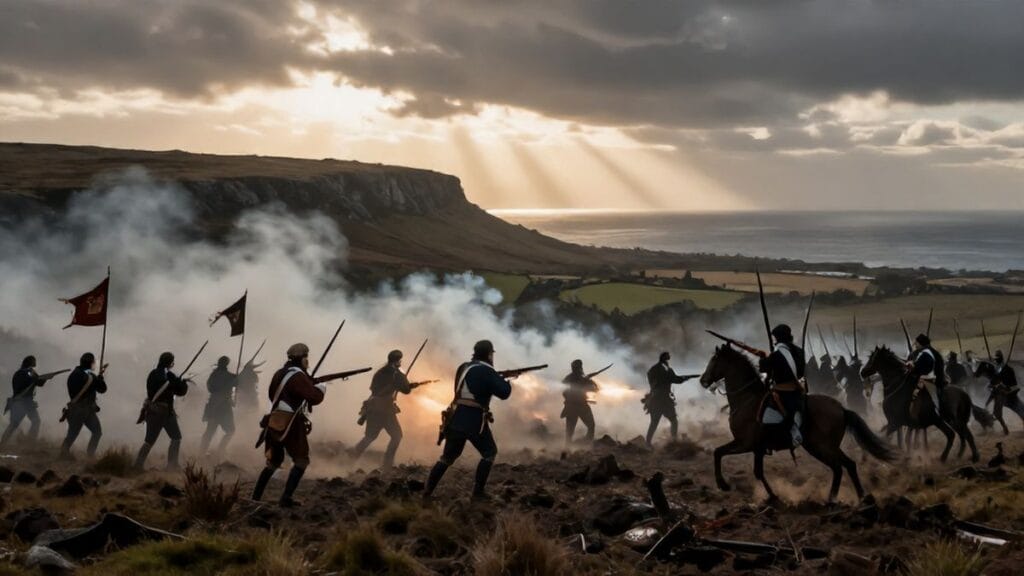
The battle of Dunbar began with a ferocious English assault on the Scottish right. Major-General John Lambert and Oliver Cromwell led the cavalry in person, charging across the Broxburn where it was fordable and driving into the flank and front of the Scottish horse. Behind them, English infantry pushed forward, their red coats pressing through hedges and over rough ground, drums beating, officers shouting to keep the lines dressed under fire.
For a time, the fighting was close and terrible. Scottish cavalry units attempted to rally and countercharge. Musketeers on both sides traded volleys in the damp air, the acrid smoke mingling with the chill morning breeze. Pikes clashed with swords. Men sank in mud or stumbled over ditches as they strove to maintain formation. Yet the advantage of coordination and discipline lay increasingly with the English. Their units had fought together for years, drilled to respond to quickly shifting orders.
On the Scottish right, confusion reigned as some infantry regiments found themselves struck before they had fully deployed. The constricted ground near the burn and the pressure from English horse and foot combined to push them back in disorder. Once a few key units broke, panic could spread with frightening speed along the line. Cromwell, seeing the Scots wavering, ordered renewed and concentrated attacks, seeking to turn setback into rout.
At the center and left of the Scottish line, some regiments fought with desperate bravery, holding their ground even as their comrades faltered. Officers tried to rally men around banners bearing the symbols of the Covenant or the lion of Scotland. But they could not ignore what was happening to their right. An army is not merely a collection of units; it is a living organism, and once its limbs begin to fail, its heart cannot hold indefinitely.
Cromwell would later famously describe the Scots as being “made as stubble to our swords.” The phrase, echoing biblical language, contains both awe and a hint of horror at the suddenness of the collapse. Within a few hours, what had begun as a seemingly promising offensive by a larger Scottish force had turned into a devastating defeat. The battle of Dunbar, though short, was decisive. As the morning wore on, resistance crumbled, and the field became a scene of flight, pursuit, and slaughter.
Pursuit and Rout: The Collapse of the Scottish Army
Once the Scottish right gave way, the rest of the army’s position became untenable. Panic is as contagious on a battlefield as courage, and rumors of flanking attacks, of regiments collapsing, of cavalry broken and scattered, raced along the Scottish ranks. Officers tried to form rallying points, to stem the tide, but they were fighting not just the English enemy but the psychological shock of a plan gone horribly wrong.
English cavalry poured into the gaps created by the Scottish retreat. What had been neat blocks of infantry dissolved into clusters of fleeing men, individuals dropping pikes, muskets, and armor to run faster. Some tried to reach the safety of the rising slopes, others stumbled toward the coast, seeking any path away from the encircling English horsemen. Pursuit in such circumstances is often more lethal than the initial clash. Blades struck unarmored backs. Men slipped in the churned mud and were trampled.
Cromwell, though satisfied that victory was complete, also insisted—at least in his own accounts—on attempting to restrain indiscriminate killing, preferring the capture of prisoners who could be used to demonstrate the Commonwealth’s power and mercy. Even so, estimates suggest that between 3,000 and 4,000 Scots were killed at Dunbar, though precise numbers are disputed. Another 8,000–10,000 may have been taken prisoner—a staggering proportion of the army.
Anecdotes preserved by later chroniclers speak of individuals who barely escaped. Some officers cut their way out with a handful of companions, riding hell-for-leather for Edinburgh. Others disguised themselves among peasants or hid in barns and churches. Ordinary soldiers, however, rarely had such options. Surrounded on alien ground, with no horses, no clear commanders still in control, they laid down their arms and trusted to God and the mercy of their captors.
By midday, the noise of battle had subsided into the grim sounds of its aftermath: groans from the wounded, the clink of weapons and armor being gathered, the shouts of guards ordering prisoners into columns. The Scottish army that had once stood as the shield of the Covenant and the hope of Charles II’s cause lay shattered on the lowlands of East Lothian. The battle of Dunbar was over. Its consequences were only beginning.
Prisoners, Marches, and Misery: The Human Cost After the Guns Fell Silent
If the clash itself lasted only hours, the suffering it unleashed extended for weeks, months, and for some men, years. The thousands of Scottish prisoners captured at Dunbar faced a grim fate. The English simply lacked the resources to care adequately for such numbers, especially in a landscape already strained by war. Moreover, these were not just any prisoners; they were the soldiers of an enemy army that had, in Cromwell’s view, taken up arms not merely against England but against what he believed to be God’s work in the world.
Initially, the prisoners were gathered and roughly sorted, with some wounded receiving basic care and others left in the open. Within days, columns of exhausted Scots were marched south into England, under guard, toward makeshift holding sites and eventually, for many, to the city of Durham and its great medieval cathedral. The march itself was a journey through hunger, exposure, and disease. Men already weakened by the campaign collapsed on the roadside; some died where they fell. Others were executed when they could not keep up, or left to their fate.
One of the most haunting episodes in the aftermath of the battle of Dunbar is the story of those imprisoned in Durham Cathedral. Stripped of its function as a place of worship under the Commonwealth, the vast stone building became a cage. Several thousand Scottish prisoners were herded inside in late September. There, with little food, minimal sanitation, and cold autumn winds seeping through ancient masonry, disease spread quickly. Contemporary accounts and later research suggest that as many as half of those confined may have died of dysentery, starvation, and illness in the weeks that followed.
Not all would remain in England. Some surviving prisoners were later transported as bonded laborers to English colonies overseas, particularly New England and the Caribbean. They were sold to ironworks, sawmills, and plantation owners, their labor helping to fuel an emerging Atlantic economy they had never imagined. Records from places like the Saugus Iron Works in Massachusetts show Scottish names that can be traced back to Dunbar, exiles whose lives were redirected by the outcome of a single morning’s battle.
For families back in Scotland, news filtered through slowly and often incompletely. Wives, parents, children, and siblings waited for word from men who would never return, or who might send a letter years later from a foreign shore. The human cost of Dunbar was not confined to casualty lists; it rippled through communities, altering population balances, leaving fields without laborers, parishes without elders, and a nation with a generation marked by trauma.
A Conquered Kingdom: The Political Aftermath in Scotland
The immediate military result of the battle of Dunbar was stark: the road to Edinburgh lay open. Within days, Cromwell’s forces occupied the Scottish capital and Leith, the vital port nearby. The government of the Covenanters retreated north, and Charles II’s position became precarious. Dunbar had broken the main field army that might have shielded central and southern Scotland from English invasion.
Politically, however, the story was not one of instant, unchallenged conquest. Scotland did not simply submit. Resistance continued in various forms. Another Scottish army would be assembled, leading eventually to the fateful battle of Worcester in 1651, where Cromwell once more defeated Charles II’s forces, this time on English soil. After Worcester, the king fled into exile again, and organized royalist resistance in Scotland faltered. Yet guerrilla warfare, local uprisings, and underground networks of royalists and Covenanters persisted.
For the English Commonwealth, Dunbar opened the door to a more ambitious project: the forcible incorporation of Scotland into a new British political structure. Over the early 1650s, commissioners negotiated—or imposed—terms that brought Scotland under direct English rule. The Scottish Parliament was dissolved. Representatives from Scottish constituencies were sent to sit in the Westminster Parliament of the Commonwealth and, later, the Protectorate.
English garrisons sprang up in strategic locations, from Inverness to Ayr, a chain of forts and citadels reinforcing the army’s presence. The economic burden of this occupation fell heavily on the Scottish population, through taxes, requisitions, and the disruption of trade. Yet it also brought, paradoxically, some improvements in infrastructure and modest openings for trade within a new, larger market dominated by London.
Dunbar, then, was more than just a battlefield victory. It was the hinge that allowed the English revolutionary regime to attempt a reordering of the entire British Isles. A contemporaneous observer, the Scottish divine Robert Baillie, wrote of the defeat with grief and bewilderment, calling it “the most lamentable day that ever Scotland saw.” His words capture both the immediate shock and the dawning recognition that a new chapter of subordination and enforced union had begun.
Faith on Trial: Covenanters, Royalists, and the Meaning of Defeat
For the Covenanters, the loss at Dunbar demanded explanation beyond strategy and numbers. This was a godly army, or so they had believed, led by men who prayed, who preached, who enforced moral discipline. Its cause was bound up with national oaths and solemn covenants sworn before God. How then could it have been beaten so decisively by an enemy they regarded as sectarian, schismatic, and dangerously tolerant of religious error?
In the months and years that followed, ministers and laypeople wrestled with this question. Some concluded that the defeat was divine chastisement for secret sins: pride, covetousness, internal divisions, and perhaps the willingness to compromise by accepting Charles II—a monarch whose personal piety and sincerity many doubted—as the head of a covenanted nation. The post-Dunbar soul-searching fed an already existing habit within Scottish Presbyterianism of reading national events as providential commentaries on spiritual health.
Royalists interpreted the defeat somewhat differently. While many Scottish nobles had accepted the Covenant, there remained a strain of royalist sentiment that saw in Dunbar a tragic but not definitive setback in the broader struggle to restore lawful monarchy to Britain. For them, Cromwell and his Commonwealth remained usurpers, and Dunbar a bloody page in an unfinished story. Some royalist memoirs, written later in the century, portrayed the Scots at Dunbar as valiant but undermined by ecclesiastical interference and political faction.
Cromwell and his supporters offered their own providential reading. In letters to Parliament and to allies, Cromwell portrayed the battle of Dunbar as an unmistakable sign that God supported the cause of the Commonwealth and the principles of religious liberty and political reform it claimed to advance. His famous dispatch to the Speaker of the House, John Lenthall, framed the victory as “a high act of the Lord’s providence,” emphasizing the numerical inferiority and precarious position of the English army compared to the Scots.
Thus the battle of Dunbar became a theological as well as a military reference point. It was cited in sermons, pamphlets, and private diaries as evidence for various interpretations of God’s will in British politics. One 17th-century commentator, summarizing the episode, wrote that “Dunbar did preach as loud as ever prophet did, though its voice was made of steel and smoke.” The phrase captures the sense that for contemporaries, the field near that small Scottish port had become a pulpit, and the sermon it gave could not easily be ignored.
Echoes across the Atlantic: From Dunbar Field to New England Shores
Among the many consequences of the battle of Dunbar, one of the most unexpected and far-reaching unfolded far from Scotland, across the Atlantic in the English colonies of North America. As noted earlier, some of the Scottish prisoners captured at Dunbar were transported as indentured laborers to New England. There, their fate intersected with the harsh realities of colonial enterprise and the deep currents of Puritan religious life.
At the Saugus Iron Works in Massachusetts, for example, records mention “Scotchmen” working under contract in the 1650s. Historians and genealogists, drawing on shipping records and surviving documents, have identified many of these men as likely prisoners from Dunbar. They labored in dangerous conditions, cutting timber, hauling ore, and tending furnaces in what was then one of the most sophisticated industrial ventures in English America. Their skills as hardy laborers and sometimes as metalworkers were prized, but their status remained precarious.
Over time, some of these Scots completed their terms of servitude and integrated into colonial society, marrying, acquiring land, and founding families whose descendants would spread throughout New England and beyond. In a bitter irony, men who had once fought to defend a Presbyterian Scottish kirk against what they saw as religious innovation found themselves living among English Puritans who shared some of their theology but not their political loyalties.
The memory of their origins persisted, sometimes blurred by time but never entirely erased. In local lore, hints of Scottish prisoners from an unnamed great battle circulated. Only in recent decades have scholars worked systematically to trace the fates of these men, piecing together a diaspora born of defeat. The battle of Dunbar thus occupies a quiet but significant place in the early transatlantic history of the British Isles, linking a windswept field in East Lothian to New England churches and townships thousands of miles away.
The Atlantic echoes of Dunbar remind us that the civil wars of the mid-17th century were not merely domestic quarrels contained within the shores of Britain and Ireland. They were part of a wider imperial story in which people, ideas, and coercion flowed along sea routes. What began as a clash of armies near a Scottish port contributed, however indirectly, to the shaping of communities on another continent.
Memory, Myth, and Excavation: How Dunbar Was Remembered and Rediscovered
For centuries after 1650, the battle of Dunbar lived on in memory, though often overshadowed by larger or more famous engagements such as Naseby or Worcester. In Scotland, Dunbar became a symbol of humiliation, a story of brave men undone by flawed leadership and divine displeasure. In some Lowland communities, family traditions quietly recalled ancestors who had fought and fallen there. In church histories, Dunbar appeared as a warning against overconfidence and the mingling of spiritual and temporal ambitions.
In England, especially among those sympathetic to Cromwell’s cause, Dunbar was remembered more triumphantly as a proof of God’s favor on the Commonwealth. Yet even here, as the 17th century gave way to the 18th and the monarchy was restored, such memories became politically sensitive. With the return of Charles II in 1660 and the subsequent reshaping of the national narrative, Parliament and Crown had little interest in celebrating victories that had confirmed the power of a regicidal regime.
The physical battlefield itself changed slowly. Fields were plowed; hedges moved; roads improved. The landscape of 1650 gradually blurred. Yet the general contours remained: the slopes of Doon Hill, the line of the Broxburn, the open ground where infantry had once collided at dawn. Antiquarians in the 18th and 19th centuries visited the area, sketching maps, interviewing locals, attempting to match textual descriptions to the living terrain. Their work kept Dunbar’s story alive in scholarly circles even as popular awareness waxed and waned.
A striking revival of interest occurred in the 21st century, when archaeologists at Durham uncovered human remains near the cathedral, later identified as likely belonging to Scottish prisoners from Dunbar. Through painstaking analysis of bones, teeth, and isotopes, researchers reconstructed aspects of these men’s lives: their diets, their health, the physical stresses they endured. Their story, once confined to a few lines in dusty records, gained new emotional immediacy. As historian Mark Nicholls has noted in another context, archaeology can “give faces, however fragmentary, to those who were once only numbers on a page.”
Modern commemorations at Dunbar itself have also evolved. Plaques, guided walks, and interpretive boards help visitors imagine the movements of armies and the cries of battle. Reenactments occasionally bring costumed soldiers back to the fields, their muskets firing blank volleys into the air where real bullets once tore through flesh. In this way, Dunbar is continually reinterpreted—by scholars, by local communities, and by those who see in it a mirror of more recent conflicts where politics, religion, and national identity collide.
Interpreting Dunbar: Historians, Numbers, and Narratives
As with many major battles, the interpretation of Dunbar has changed over time. Early accounts, shaped by immediate political and religious agendas, often emphasized providence and moral lessons over precise tactical analysis. Later historians, particularly from the 19th century onward, began to question numbers, reconstruct formations, and compare sources critically.
Disagreements remain. Estimates of troop strengths, casualties, and prisoner numbers vary among scholars, reflecting the ambiguities of 17th-century record-keeping and the tendency of both sides to exaggerate or minimize figures for propaganda purposes. Some historians stress the numerical superiority of the Scots and thus the seeming miracle of the English victory; others argue that the quality and cohesion of the New Model Army effectively offset any disparity in raw numbers.
There is also debate over the relative weight to give to different causes of the Scottish defeat. Was the fatal error simply the decision to descend from Doon Hill? Or was the army already compromised by the earlier “purging” of experienced officers under clerical pressure? To what extent did morale, supply, and weather play into the picture? These questions continue to animate scholarly discussion. As John Morrill and other historians of the Wars of the Three Kingdoms have emphasized, no single factor can fully explain outcomes in such complex conflicts.
What is striking, though, is how the battle of Dunbar has increasingly been situated within a broader story of state formation and revolution. Rather than a merely Scottish or English affair, it is now often treated as a British—or even proto-British—event, pivotal to the forced union attempted under Cromwell and the eventual, more negotiated union of 1707. By defeating the Covenanter-royalist alliance so dramatically, Cromwell cleared the way for experiments in union that, though short-lived at the time, foreshadowed later constitutional developments.
In this sense, Dunbar functions as a lens through which to view contested ideas of sovereignty, legitimacy, and political community. It sits at the crossroads of monarchy and republicanism, of centralized state-building and stubborn local identities, of religious uniformity and pluralism. Every new generation of historians, shaped by its own political questions, finds in Dunbar a different—but always significant—set of meanings.
From Civil War to Commonwealth and Restoration: The Long Shadow of 1650
The defeat at Dunbar and the subsequent English victories did not end Scottish national pride or religious fervor, but they did help set the trajectory of British politics for decades. With Scotland subdued and Ireland brought under harsh military occupation, the English Commonwealth and later Protectorate stood, for a time, atop a wider, forcibly integrated set of kingdoms. London exerted unprecedented direct influence over Edinburgh and Dublin.
Domestically, the Commonwealth and Oliver Cromwell’s Protectorate experimented with new forms of governance, balancing parliamentary institutions with military power and the personal authority of the Lord Protector. Religious policy oscillated between broad toleration for various Protestant sects and efforts to restrain “blasphemy” and social radicalism. The legacy of battles like Dunbar underpinned this regime’s legitimacy: it claimed to have been forged in the crucible of righteous war.
Yet the very militarization that had secured victory engendered discontent. Many in England, Scotland, and Ireland chafed at garrisons, taxes, and the sense that a standing army held ultimate sway. At Cromwell’s death in 1658, the delicate balance began to crumble. Within two years, the monarchy was restored in the person of Charles II—the same king whose cause had been so grievously wounded at Dunbar and finally crushed at Worcester.
The Restoration did not, however, simply turn the clock back to 1640. Too much had changed. Parliaments, religious pluralism, and a more centralized view of state authority had all been strengthened, even as older forms of hierarchy and deference reasserted themselves. In Scotland, the Restoration brought fresh persecutions of certain Covenanter groups, particularly those who refused to accept a royal settlement of the church. The hills and moors where Scottish soldiers had once marched against Cromwell now sheltered small conventicles of believers worshiping illegally, hunted by dragoons.
Looking back, one can trace a line from the battle of Dunbar through the entire arc of mid-17th-century upheaval to the eventual Glorious Revolution of 1688–89 and the Act of Union of 1707. Dunbar is not the sole or even the primary cause of these transformations, but it forms one of the hard knots in the rope—a place where strands of military victory, ideological conviction, and institutional change are pulled tight together. Its shadow falls, faintly but recognizably, across the later story of how Britain became Britain.
Walking the Battlefield Today: Landscape of a Turning Point
To walk the Dunbar battlefield today is to enter a landscape both familiar and estranged. Roads hum with traffic; fields are laid out in modern patterns; housing and industrial estates have crept over parts of what was once open country. Yet if one knows where to look, the ghost of 1650 still lingers. The slopes of Doon Hill rise gently to the south, offering a clear view over the coastal plain. The line of the Broxburn, though altered in detail, still marks a natural barrier and axis across the ground.
Standing there on a cool morning, it is not hard to imagine the Scottish campfires flickering higher up, or the nervous energy in the English lines below. The wind that brushes your face is the same wind that stung the eyes of soldiers four centuries ago. The sea, rolling against the harbor walls of Dunbar, carries the same salt tang that greeted Cromwell’s men as they looked anxiously over their shoulders toward the ships on which their hopes of supply and escape depended.
Interpretive signs, erected as part of heritage initiatives, help visitors locate key features: the approximate positions of armies, the direction of Cromwell’s attack, the routes of Scottish retreat. Maps compare the 17th-century battlefield with the modern landscape. Farmers plough fields in which, occasionally, a musket ball or fragment of equipment still turns up in the soil—a small, mute testimony to that September morning.
For descendants of those who fought, whether in Scotland, England, or far overseas, a visit to Dunbar can carry a quiet emotional charge. There is no grand monument dominating the skyline, no towering statue commanding the field. Instead, there is a sense of ordinariness—the realization that world-shaping moments often unfold on terrain that now seems unremarkable. It is astonishing, isn’t it, how a place that once echoed with trumpets and cries can, in later centuries, host nothing more dramatic than the rustle of crops and the call of birds?
Yet this very ordinariness is part of Dunbar’s power. It invites reflection on contingency, on the smallness of human lives set against the slow endurance of land and sea. It encourages us to think of the thousands of men—English and Scottish, officers and common soldiers—whose last view of the world may have been this same horizon. In doing so, it transforms the battle of Dunbar from a distant textbook entry into a lived, felt experience, a story still unfolding in how we choose to remember and interpret it.
Conclusion
The battle of Dunbar, fought on 3 September 1650, was a short, brutal encounter that changed the course of British history. Born of tangled disputes over monarchy, religion, and sovereignty, it brought together a covenanted Scottish kingdom defending its reformation and a revolutionary English Commonwealth seeking to secure its survival. In the chilly dawn near a small east-coast port, those vast, abstract questions condensed into the clash of steel, the crack of muskets, and the screams of the wounded.
Dunbar’s significance lies not only in its military outcome—a decisive English victory that opened the road to Edinburgh and enabled the subjugation of Scotland—but in its wider repercussions. It accelerated the experiment of a forcibly united Britain under Commonwealth and Protectorate rule. It scattered Scottish prisoners across England and the Atlantic world, seeding new communities even as it devastated their homeland. It challenged Covenanters, royalists, and republicans alike to interpret victory and defeat as signs of divine favor or judgment.
Over the centuries, the memory of Dunbar has waxed and waned, sometimes invoked as a warning, sometimes as a triumph, often overshadowed by larger narratives. Yet modern scholarship and archaeology have breathed new life into its story, recovering the names and fates of the men who suffered in its aftermath and re-situating the battle within the broader history of civil war and state formation in the 17th century. Today, when we speak of constitutional change, union and disunion, religious pluralism, and the limits of state power, we find ourselves grappling with themes that were already present, in rawer form, at Dunbar.
To stand metaphorically or literally on that battlefield is to be reminded that history turns not only on ideas and institutions but on moments of acute decision and miscalculation, on weather and terrain, on the convictions and fears of individuals. The descent from Doon Hill, Cromwell’s calculated counterstroke, the collapse of the Scottish right—these details matter because they show how fragile the line is between triumph and disaster. In recognizing this, we honor not only the victors and the defeated at Dunbar, but all those whose lives have been shaped by forces larger than themselves, and yet who faced those forces with courage, faith, or simple endurance.
FAQs
- What was the Battle of Dunbar?
The Battle of Dunbar was a major engagement fought on 3 September 1650 near the town of Dunbar in East Lothian, Scotland, between the English Commonwealth army under Oliver Cromwell and a Scottish Covenanter army commanded by David Leslie. It resulted in a decisive English victory that opened the way for the occupation of Edinburgh and the broader subjugation of Scotland. - Why did the Battle of Dunbar happen?
The battle occurred because Scotland had proclaimed Charles II king and allied itself with him on condition that he accept the Covenants, thereby challenging the legitimacy of the English Commonwealth. The English regime, fearing a royalist–Presbyterian alliance on its northern border, sent Cromwell to pre-empt this threat. Months of maneuvering and stalemate ended when the two armies finally clashed near Dunbar. - Who commanded the armies at Dunbar?
The English army was commanded by Oliver Cromwell, serving as Lord General of the Commonwealth forces, with Major-General John Lambert playing a key role. The Scottish army was led by David Leslie, an experienced soldier who had fought in earlier wars in Britain and on the continent, supported and often constrained by the Commission of the Kirk and leading Covenanter politicians. - How many soldiers fought and died at Dunbar?
Exact numbers are debated, but most historians estimate that Cromwell’s English army fielded around 11,000–12,000 men, while the Scots had perhaps 14,000–20,000. Between 3,000 and 4,000 Scots may have been killed in the battle, and as many as 8,000–10,000 taken prisoner. English losses were significantly lower, though still substantial, possibly in the low hundreds. - What was the main tactical reason for the Scottish defeat?
The key tactical error was the Scottish decision to move down from the strong defensive position on Doon Hill into more confined ground near the Broxburn in an attempt to attack the English. This descent stretched their lines, disrupted their formations, and created vulnerabilities on their right flank, which Cromwell’s forces exploited with a concentrated attack at dawn, leading to a rapid collapse. - What happened to the prisoners taken at Dunbar?
Thousands of Scottish prisoners were marched south into England under harsh conditions, during which many died from exhaustion and disease. A large number were confined in Durham Cathedral, where poor sanitation and limited food caused further heavy mortality. Some survivors were later transported as indentured laborers to colonies in North America and the Caribbean, where they worked in industries like ironworks and plantations. - How did the Battle of Dunbar affect the wider war?
Dunbar effectively destroyed the main Scottish field army defending the Lowlands, allowing Cromwell to capture Edinburgh and consolidate English control over much of Scotland. It greatly weakened the position of Charles II and the Covenanter government, though resistance continued. The battle paved the way for the eventual defeat of Charles II’s broader cause at Worcester in 1651 and for the imposition of English rule over Scotland during the Commonwealth and Protectorate. - Was the Battle of Dunbar part of the English Civil War?
Dunbar is often grouped within the broader series of conflicts known as the Wars of the Three Kingdoms, which include the English Civil War, the Scottish conflicts, and the Irish wars. By 1650, the fighting had moved beyond England’s internal civil war to become a struggle over the political and religious future of all three kingdoms under different competing regimes. - How do historians view Cromwell’s conduct at Dunbar?
Most historians regard Cromwell as having shown considerable tactical skill and flexibility at Dunbar, seizing an opportunity created partly by Scottish mistakes. They also note his reliance on religious language to interpret the victory and his role in the harsh treatment of prisoners afterward. Assessments vary, with some emphasizing his military brilliance and others highlighting the moral and human costs of his campaigns. - Can the Dunbar battlefield still be visited today?
Yes. While modern development has altered parts of the area, significant portions of the battlefield around Dunbar and Doon Hill remain accessible. Visitors can explore the landscape, follow interpretive trails, and read signage that explains the positions and movements of the armies. The site offers a powerful opportunity to connect the textual history of the battle with the physical ground on which it was fought.
External Resource
Internal Link
Other Resources
- Encyclopaedia Britannica – general search for the exact subject
- Google Scholar – academic search for the exact subject
- Internet Archive – digital library search for the exact subject