Table of Contents
- A Winter Morning on the Edge of War
- After Versailles: Europe Trembles and Borders Harden
- Stalin’s Calculus: Fear, Ambition, and the Leningrad Question
- Finnish Independence and the Shadow of Its Giant Neighbor
- Negotiations in the Kremlin: Maps on the Table, Guns in Reserve
- The Spark in the Forest: The Shelling at Mainila
- November 30, 1939: When the Soviet Union Invades Finland
- The Mannerheim Line: A Thin Shield of Rock, Timber, and Resolve
- Red Army in the Snow: Strength in Numbers, Weakness in Preparation
- White-Caped Ghosts: Finnish Tactics and the Birth of the “Motti”
- Civilians Under the Northern Lights: Cities Bombed, Families Scattered
- The World Watches: Sympathy, Volunteers, and Political Calculations
- Turning Points in the Deep Freeze: From Heroic Defense to Exhaustion
- The Moscow Peace Treaty: A Small Nation Bends but Does Not Break
- From Winter War to Continuation War: Unfinished Business
- Memory, Myth, and Numbers: Casualties, Legends, and Historical Debates
- Global Reverberations: Lessons for Hitler, Churchill, and the World
- The War in Personal Stories: Letters, Diaries, and Silences
- Why This Winter Still Matters: The War’s Legacy in Finland and Russia
- Conclusion
- FAQs
- External Resource
- Internal Link
Article Summary: In late November 1939, as Europe was still adjusting to the shock of the German invasion of Poland, the world watched in astonishment as the soviet union invades finland across a frozen frontier. This article tells the story of the Winter War as a human drama and a geopolitical gamble, tracing how one of the largest armies on earth crashed into one of the smallest and most vulnerable states in Europe. It follows the tense prelude of negotiations, the staged border incident at Mainila, and the brutal opening bombardments that shattered the silence of the Karelian forests. Through Finnish soldiers in white camouflage, Soviet conscripts stumbling through snowdrifts, and civilians hiding in bomb shelters, the narrative explores how technology, terrain, ideology, and sheer will collided in temperatures that could kill a man in minutes. It also examines how the conflict reshaped international opinion of the Soviet Union, encouraged Hitler’s miscalculations, and left Finland both wounded and unbroken. Throughout, the phrase “soviet union invades finland” is not just a description of an event but a lens on power, fear, and resistance. By the end, the article reflects on why this brief but ferocious war still echoes in Finnish and Russian memory, and what it says about small nations caught between empires.
A Winter Morning on the Edge of War
On the morning of November 30, 1939, the world was already uneasy. Only weeks earlier, Poland had been torn apart in a brutal pincer by Nazi Germany and the Soviet Union. The uneasy quiet that followed was deceptive: diplomats knew the map of Europe was being redrawn in secret, and ordinary people felt the tremor of something vast and terrible moving beneath the surface. Along the northeastern fringe of Europe, where Finland’s forests met Soviet territory, that tremor would soon become an earthquake.
It was still dark when residents of Helsinki, Viipuri, and small Karelian villages stirred to life. Farmers checked their cattle in frost-glittering barns; tram drivers in Helsinki traced familiar routes through streets crusted with ice. They had heard the rumors—that talks in Moscow had failed, that Soviet demands had grown more strident, that border incidents had flared like sparks in the pines—but many clung to the belief that war could still be avoided. In 1918 Finland had survived civil war; in the 1920s and 1930s it had built a fragile but functioning democracy. Surely reason would prevail over madness again.
Then the bombs fell.
At 9:20 a.m., Soviet bombers appeared over Helsinki. Their engines, heavy and insistent, cut through the brittle winter air. Sirens wailed, too late for many to reach cover. Explosions rolled through the city center, punching holes in streets and splintering wooden houses. In the Kallio district, a tram was torn apart; in Katajanokka, windows burst inward, showering rooms with glass. The attack felt both unreal and strangely intimate: the distant abstraction of “international tensions” had come crashing down into kitchens and schoolyards.
As word spread that not just Helsinki but numerous Finnish towns and villages were under attack, the shape of the day became clear. The Soviet Union had not merely tightened pressure. The Soviet Union had crossed the line of no return. This was the morning the soviet union invades finland, not with a furtive incursion or a border skirmish, but with artillery, tanks, planes, and orders to push deep into a sovereign neighbor’s land.
In barracks from Lapland to Karelia, Finnish reservists were already pulling on uniforms, many of them old and threadbare. They were carpenters, students, farmhands, shop clerks; they had been called up in waves as negotiations with Moscow deteriorated. They knew they were facing a giant: an industrialized empire with a population twenty times their own. And yet, as rumors of the bombings reached them, many reported feeling less fear than clarity. The question of whether war would come was resolved; only the question of survival remained.
In Moscow, the announcements were clinical and false. Soviet radio accused Finland of firing on Soviet territory at the village of Mainila, of rejecting reasonable territorial proposals, of forcing the USSR to “guarantee its own security.” In the language of great powers, invasions are rarely described as invasions. Yet in the forests, on the frozen lakes, and along the battered streets of Finnish towns, there was no mistaking what had begun. This was an assault, not a misunderstanding; a bid to redraw borders, not protect them.
But this was only the beginning. To understand why the soviet union invades finland on that frigid day in 1939, we must step back—into the wreckage of the First World War, into the paranoia of Joseph Stalin’s Kremlin, and into the anxious years when small states tried to build lives in the shadow of ruthless ideologies.
After Versailles: Europe Trembles and Borders Harden
The seeds of the Winter War were sown in the wreckage of an earlier catastrophe. When the First World War ended in 1918, empires crumbled: the German, Austro-Hungarian, Ottoman, and Russian empires all gave way to a patchwork of new or reborn states. Finland, long ruled as an autonomous Grand Duchy under the Russian Tsars, seized the chance to declare independence in December 1917. But the new border between Finland and Soviet Russia was more than a line on a map—it was a wound in the consciousness of leaders in Moscow.
For the Bolsheviks, who had seized power in Petrograd in 1917, the collapse of the old empire was both a blessing and a trauma. On one hand, they embraced the rhetoric of self-determination, signing treaties that allowed territories like Finland to go their own way. On the other, they saw each lost province as a potential staging ground for counterrevolution and foreign encirclement. The treaty ending hostilities between Soviet Russia and Finland in 1920, signed in the Estonian city of Tartu, recognized Finland’s independence and set a border that left Leningrad—formerly St. Petersburg—alarmingly close to a potentially hostile power.
Across Europe, this kind of uneasy line was everywhere. Germany was resentful, carved up, and humiliated by the Treaty of Versailles. Poland was reborn but encircled by enemies. The Baltic states—Estonia, Latvia, Lithuania—clung to sovereignty while watching Soviet and German ambitions twist like storm clouds over the Baltic Sea. The League of Nations promised collective security, yet its mechanisms were clumsy, its will uncertain.
Meanwhile, the Soviet Union, born of civil war and famine, set about consolidating control within its sprawling borders. Under Vladimir Lenin and then Joseph Stalin, the state pursued rapid industrialization and brutal political repression. The terror of the 1930s, which saw purges within the Communist Party, the military, and the intelligentsia, was not an isolated horror but part of a broader project: to harden the Soviet Union for the coming conflict that many in the Kremlin believed was inevitable.
Finland, small and comparatively poor, charted its own path. It nurtured a parliamentary system, weathered an internal civil war between “reds” and “whites,” and forged a sense of national identity built around language, land, and a hard-won autonomy. Its leaders were under no illusions about the friendliness of their enormous eastern neighbor, but neither were they eager for confrontation. Between the wars, Finnish foreign policy was cautious, seeking good relations with both the Soviet Union and Western powers, and relying on the hope that international guarantees and geography would provide some buffer against aggression.
All of this unfolded against the wider drama of the 1930s: the rise of Adolf Hitler in Germany, the rearmament of the Wehrmacht, the remilitarization of the Rhineland, the Anschluss with Austria, and the dismemberment of Czechoslovakia. Every bold move that went unpunished strengthened the sense that treaties were made to be broken, that might was reclaiming its throne over right. When Nazi Germany and the Soviet Union signed the Molotov–Ribbentrop Pact in August 1939—a non-aggression agreement accompanied by secret protocols carving Eastern Europe into spheres of influence—the stage was set for a terrible cascade of events.
In those secret protocols, Finland’s fate was effectively sealed. The Soviet sphere was to include Finland, the Baltic states, and parts of Romania. Less than two weeks later, Germany invaded Poland from the west. The Soviets invaded from the east. Europe was in flames again, and small nations along the periphery of both dictatorships understood that history was moving quickly and mercilessly toward them.
Stalin’s Calculus: Fear, Ambition, and the Leningrad Question
To understand why, in that frozen November of 1939, the soviet union invades finland, one must look into the mentality of Joseph Stalin and the strategic map spread on tables in the Kremlin. Stalin, who wielded power with a mixture of cold calculation and deep paranoia, saw the world in terms of encirclement and preemption. He feared Germany, distrusted Britain and France, and loathed the notion of any foreign power having a foothold near the industrial and political heart of the Soviet state.
Leningrad, the city of the 1917 revolution and a key industrial center, was a particular concern. The Finnish border along the Karelian Isthmus lay only about 32 kilometers from the city. In any major European war, Soviet planners argued, this would be intolerable. Artillery placed on Finnish soil could theoretically threaten Leningrad; foreign troops landing on Finnish coasts could use the country as a springboard for invasion. Soviet military journals and political speeches in the late 1930s increasingly emphasized this perceived vulnerability.
The Molotov–Ribbentrop Pact gave Stalin breathing room by securing his western flank from German attack, at least temporarily. It also effectively gave him license to advance Soviet frontiers westward under the guise of “security.” In the Baltic states, this took the form of “mutual assistance” pacts: Estonia, Latvia, and Lithuania were pressured into allowing Soviet bases on their soil, a prelude to full incorporation into the USSR in 1940. With Finland, the Soviet approach would be similar in logic but far more violent in execution.
Stalin’s objectives were both limited and ambitious. On paper, he demanded relatively small shifts in territory: the cession of parts of the Karelian Isthmus, some islands in the Gulf of Finland, and a long-term lease on the Hanko Peninsula for a naval base. In exchange, he offered Finland large but sparsely inhabited tracts of Soviet Karelia. To outsiders, this might have looked like a bargain of sorts—land for land, security for both. But to Helsinki, the stakes were existential. The areas demanded by Moscow were not just strips of forest; they were fortified defensive zones, industrial towns, and, symbolically, a slice of the country’s heart.
Stalin, influenced by reports from his intelligence services and his own ideological contempt for “bourgeois” democracies, believed Finland was weak, divided, and militarily insignificant. The Great Purge had gutted the Red Army’s officer corps, yet Soviet propaganda insisted that the revolution had given birth to a new, unbreakable military machine. The expectation in Moscow was that, if forced, Finland would fold quickly—perhaps in a matter of days—and that any resistance could be brushed aside by sheer mass and firepower.
The calculations were not purely strategic, either. There was prestige involved: the Soviet Union had just expanded into eastern Poland without serious international backlash. It had gained bases in the Baltics. Why should small, stubborn Finland be allowed to say no? In the logic of authoritarian empires, refusal by a tiny neighbor could look like insolence, even defiance.
Yet behind the celebrations in Soviet newspapers of “peaceful” territorial realignments lay a quieter anxiety. What if Germany turned against the Soviet Union earlier than expected? What if war with the West dragged Moscow into a multi-front conflict? For Stalin, buying depth around Leningrad and securing the Gulf of Finland felt like insurance against an uncertain future. Tragically for Finland, he was willing to pay for that insurance with blood—mostly Finnish, but also Soviet.
Finnish Independence and the Shadow of Its Giant Neighbor
Finland’s leaders did not need lengthy intelligence reports to grasp the danger. Their country’s entire modern history had been lived in the shadow of its larger neighbors, Sweden to the west and Russia to the east. For centuries a part of the Swedish kingdom, Finland had been ceded to the Russian Empire in 1809. Under the Tsars, it enjoyed a degree of autonomy, with its own diet (parliament) and laws, but the russification drives of the late nineteenth and early twentieth centuries had hardened Finnish nationalism.
The collapse of the Russian Empire in 1917 opened a new chapter. Finland declared independence that December, but what might have been a triumphant moment quickly dissolved into a bitter civil war between “whites” (conservative and nationalist forces) and “reds” (socialists, some of whom looked to Bolshevik Russia for support). The whites, aided indirectly by German troops, emerged victorious in 1918. The trauma of that conflict lingered—mass executions, camps, and reprisals left scars across Finnish society. Yet it also produced a fierce determination among many Finns to preserve their autonomy at nearly any cost.
During the 1920s and 1930s, Finland stabilized politically. A multiparty parliamentary democracy took root, with power often shifting among coalitions. The social divisions from the civil war never vanished, but they faded somewhat as economic reconstruction and reforms absorbed attention. In foreign policy, Finland sought to avoid entanglements, cultivating correct, if wary, relations with Moscow while quietly hoping that the League of Nations and distant Western democracies would, if necessary, provide diplomatic cover.
Yet there was always a strategic asymmetry that could not be wished away. Finland’s army was small, its industrial base modest, its air force tiny. Its strength lay primarily in its terrain and the character of its people: a population accustomed to hard winters, to forests and lakes, to scarcity and self-reliance. Conscription meant that most Finnish men had at least some military training. The officer corps was professional and tempered by the experiences of the civil war.
As tension with the Soviet Union increased in the late 1930s, Finnish public debate intensified. Some argued for concessions to Moscow to avoid catastrophe; others insisted that giving up territory would only invite further demands. President Kyösti Kallio and his government, including Foreign Minister Väinö Tanner and the aging but still influential military leader Carl Gustaf Emil Mannerheim, understood that any negotiation over the Karelian Isthmus touched the very core of Finland’s defense strategy.
In the cafes of Helsinki, in timber camps in the north, in farmhouses scattered among frozen fields, ordinary Finns followed these debates with a mixture of apprehension and fatalism. Most did not believe their small country could defeat the Soviet Union in a prolonged war. Yet a quiet consensus emerged: they would not accept a dictated peace that stripped away their most important defensive positions and humiliated their hard-won independence. If there had to be a war, many concluded, better to face it now, while the country was still relatively united and its young men still strong.
Negotiations in the Kremlin: Maps on the Table, Guns in Reserve
In October 1939, as the ink dried on the partition of Poland, Finnish delegates arrived in Moscow to negotiate. The scene, described by several participants in memoirs and diplomatic reports, had a theatrical air. Long tables, heavy curtains, maps spread out under lamps: the visual language of power. On one side, the representatives of a vast totalitarian state; on the other, the envoys of a small democracy, keenly aware that the outcome might determine whether their country would live or die.
Leading the Soviet side was Vyacheslav Molotov, Stalin’s foreign minister, known for his impassive demeanor and ruthless efficiency. Stalin himself appeared at some meetings, chain-smoking, asking questions in a deceptively casual tone. The Finns, including Juho Kusti Paasikivi, an experienced politician, and later Väinö Tanner, faced a barrage of demands. The Soviets insisted that, for the “mutual security” of both nations, Finland must move its border on the Karelian Isthmus westward, cede several islands, and grant the USSR a 30-year lease on the Hanko Peninsula for a naval base. In return, Finland would receive larger but less valuable parcels of Soviet territory in the north.
On maps, the exchanges could be framed as fair, almost mathematical. On the ground, they were anything but. The Karelian Isthmus was heavily fortified; its loss would expose the interior of Finland to rapid attack. The towns and farms that would be ceded were homes, not abstractions. Mannerheim, who had fought as an officer in the Tsarist army before commanding the Finnish whites, argued forcefully against giving up key defenses. His military assessments, combined with political resistance in Helsinki, hardened Finland’s position.
The Finns did consider limited concessions. They were not suicidal; they understood the imbalance. Some Finnish leaders were prepared to yield a small strip of land, perhaps rearrange certain islands, as a gesture toward Moscow’s security concerns. But the Soviets, confident in their leverage, pressed for more. They expected fear to do their work.
Diaries and notes from the Finnish negotiators convey a deepening sense of dread. They understood that if they said “no” for too long, the discussions might end in something far worse than diplomatic failure. Yet their sense of responsibility to their homeland, and the reality of Finland’s narrow defenses, prevented them from simply signing away what Moscow demanded.
As the talks dragged on, Soviet leaders likely already had another plan in mind. The presence of huge Red Army formations along the border, the construction of logistical hubs, and the tightening control over the Baltic states suggested that negotiation and preparation for war were unfolding in parallel. In the Kremlin, maps were not only instruments of diplomacy; they were blueprints for invasion.
The Spark in the Forest: The Shelling at Mainila
On November 26, 1939, the tension snapped. Near the village of Mainila, close to the Finnish-Soviet border on the Karelian Isthmus, artillery shells exploded on Soviet territory. The Soviet government promptly accused Finland of firing on their troops, claiming several casualties. Moscow demanded an apology and immediate withdrawal of Finnish forces several kilometers back from the border. Helsinki, stunned, replied that its artillery could not have fired such shells without violating its own defensive protocols and that Finnish guns had not been used.
Subsequent research by historians, as well as testimony from Soviet defectors and archival material released decades later, strongly indicates that the shelling at Mainila was staged by the Soviets themselves—a classic false-flag operation designed to provide a casus belli. Soviet artillery likely fired the shells from their own side of the border. Finland, aware of the danger of any incident, had actually pulled its forces somewhat back from the frontier, precisely to avoid accidental clashes.
The diplomatic exchange that followed was surreal. The USSR insisted on Finnish guilt, broke off the non-aggression pact between the two countries, and escalated its rhetoric. Finnish attempts to propose joint investigations or neutral observers were brusquely rejected. The stage play of provocation and outrage was unfolding according to a script written long before.
Three days later, on November 29, the Soviet Union severed diplomatic relations with Finland. That same night, troops massed on the border received final orders. Ammunition was distributed, engines warmed in the biting cold. In command posts, Soviet officers—many of them inexperienced, promoted after the purge of more seasoned commanders—ran through plans that called for rapid advances: seize the Karelian Isthmus, capture Viipuri, press toward Helsinki. It would, they were assured, be quick.
For Finland, the Mainila incident was the last warning. Reservists were rushed to their positions; coastal batteries checked and rechecked their sights. In farmhouses and city apartments, families quietly gathered important papers, warm clothes, and treasured photographs. Yet even then, many Finns could not quite imagine the scale of what was coming.
November 30, 1939: When the Soviet Union Invades Finland
Dawn on November 30, 1939, broke cold and gray over the Karelian forests. Snow lay deep in the trees, covering trenches and barbed wire like a deceptive blanket of peace. Then the guns opened up.
Along a front stretching hundreds of kilometers—from the icy shores of the Gulf of Finland in the south to the lonely expanses of Lapland in the north—the Red Army rolled forward. Artillery batteries pounded Finnish positions. Columns of tanks, their crews shivering in poorly insulated uniforms, lurched along roads that soon turned into churned-up, frozen ruts. Infantry in long coats and ill-fitting boots trudged through waist-deep snow, their breath steaming in the air.
This was the moment the soviet union invades finland in full force, turning political demands and fabricated incidents into a brutal reality. The offensive was massive: around 450,000 Soviet soldiers were committed in the initial stages, with thousands of tanks and aircraft at their disposal. Against them stood a Finnish army that, even with mobilization, could field only about 300,000 men at peak strength, with a tiny tank corps and a modest air force.
In Helsinki, the bombs that had fallen earlier in the morning signaled that no part of the country was safe. Over the next days, more than 90 Soviet bombing raids would hit Helsinki, Turku, and other cities, killing hundreds of civilians and destroying homes, factories, and hospitals. The attacks were widely reported abroad, provoking condemnation—even from some who had previously argued for accommodation with Moscow.
Yet on the ground, the Soviet advance did not go as planned. In many sectors, initial gains were shallow. Finnish border guards and small units, often operating in familiar terrain, sacrificed themselves to slow down the armored spearheads. Roads were mined, bridges blown, trees felled across paths to create obstacles. The Finns lacked heavy equipment, but they had ingenuity and an intimate knowledge of their own land.
In some villages, the invaders arrived suddenly, their numbers overwhelming any possibility of resistance. Families fled into the woods, leaving behind livestock, furniture, and heirlooms. The shock of seeing the Red Army up close—a force that had existed for decades mostly in propaganda posters and distant rumors—seared itself into memory. For many Finns, this was not just a foreign invasion; it was the intrusion of an alien system, the physical arrival of a regime they associated with terror, atheism, and Gulag camps.
As reports of Soviet atrocities and looting filtered back, the conflict crystallized for the Finnish population. This was not a limited border adjustment; it was a fight for national survival. The phrase “soviet union invades finland” would become shorthand for a trauma that would shape Finnish identity for generations, but in those first days, it was lived minute by minute, in fear and fury, by people who had not expected history to turn so brutally upon them.
The Mannerheim Line: A Thin Shield of Rock, Timber, and Resolve
Facing the onslaught, Finland leaned heavily on a defensive system that had been built with limited resources but considerable foresight: the Mannerheim Line. Stretching across the Karelian Isthmus, from the Gulf of Finland to Lake Ladoga, this line of fortifications was named—though not by his choice—after Field Marshal Carl Gustaf Emil Mannerheim, the aging commander-in-chief who had become a symbol of Finnish resistance.
Contrary to later myth, the Mannerheim Line was not an unbroken wall of concrete bunkers and steel. It was, in many places, a series of interconnected strongpoints, trenches, anti-tank obstacles, and natural barriers, cleverly integrated into the rocky, forested terrain. Years of limited defense budgets had meant improvisation: logs where there should have been reinforced concrete, field fortifications where permanent structures had been planned but not completed.
Still, the line was formidable by the standards of the day, particularly when manned by determined defenders who understood every hillock and marsh. Finnish engineers had blasted anti-tank ditches, laid mines, and constructed “dragon’s teeth” concrete obstacles. Artillery was carefully sited, with overlapping fields of fire. Behind the front, road networks allowed for relatively rapid movement of reserves.
Mannerheim himself, who had initially been skeptical about the adequacy of Finland’s defenses, now placed his trust in the bravery of his troops and the ability of the line to delay the enemy. His relationship with the political leadership in Helsinki was sometimes strained—he had resigned in protest earlier in the 1930s over defense spending—but when the soviet union invades finland, he returned to take on a role that combined military leadership with a kind of paternal symbolism. Photographs from the period show him tall, austere, white-haired, inspecting trenches, speaking quietly with soldiers.
For the Red Army, the Mannerheim Line soon became a nightmare. Initial assaults in December 1939, launched with inadequate reconnaissance and overconfidence, were repulsed with heavy losses. Soviet tanks, advancing in tight formations, found themselves funneled into kill zones. Infantry attacks faltered under machine-gun fire and accurate Finnish artillery. The line did not hold everywhere, and there were breakthroughs and retreats, but the idea that the Finnish front would crumble swiftly was shattered.
In the cold, in the forests, in the low concrete bunkers they nicknamed with affectionate or bitter humor, Finnish soldiers clung to this improvised wall. They were under no illusions; they knew that if the line fell completely, there was little to stop the Red Army from pushing deeper toward Helsinki. But they also knew that every day they held on was a day that confounded Stalin’s plans and rallied sympathy abroad.
Red Army in the Snow: Strength in Numbers, Weakness in Preparation
The Soviet Army that crossed into Finland was, on paper, a colossus. It possessed vast reserves of men and materiel, a formidable tank force, and a growing air arm. Yet the reality beneath the statistics was more complicated, and the Winter War would expose many of the weaknesses created by Stalin’s own policies.
In the late 1930s, the Great Purge had gutted the Soviet officer corps. Thousands of experienced commanders were arrested, executed, or sent to labor camps on charges of treason and “counterrevolutionary” activity. This left the Red Army with a generation of often inexperienced, politically vetted officers, many of whom were hesitant to take initiative for fear of making a misstep that could be interpreted as disloyalty. The institutional memory of the Civil War and earlier conflicts was badly damaged.
In addition, the Soviet troops sent into Finland were not always well-prepared for winter warfare in such a harsh climate. While the USSR encompassed many cold regions, the logistics of equipping and training large formations for coordinated operations in deep snow and extreme sub-zero temperatures were daunting. Many Soviet soldiers wore cotton uniforms under heavy greatcoats, which became dangerously inadequate when temperatures plunged to -30°C or lower. Frostbite claimed thousands of casualties, sometimes without a shot being fired.
Communication and coordination were also serious problems. Offensive doctrines developed in the 1930s emphasized deep operations and mechanized thrusts, but the terrain of Finland—with its narrow roads, dense forests, and frozen lakes—was ill-suited to large armored maneuvers. Tanks bogged down or ran into ambushes. Supply lines stretched thin, vulnerable to attacks by small, mobile Finnish units on skis.
None of this meant that the Soviet forces were incompetent or doomed. They were learning, often brutally, and they were able to replace losses at a rate Finland could not imagine. But the early weeks of the war revealed that mass alone could not guarantee victory, especially against a defender who understood how to turn climate and terrain into allies.
The psychological impact on Soviet soldiers was profound. Many had been told they were entering a minor “conflict” with a weak adversary. Instead, they found themselves facing well-camouflaged enemies who seemed to appear and disappear like specters in the snow, in a landscape that could kill as efficiently as any rifle. Letters home, where censors allowed glimpses of truth, spoke of hunger, cold, confusion, and the unsettling realization that what had been promised as a swift campaign was becoming a war of attrition.
White-Caped Ghosts: Finnish Tactics and the Birth of the “Motti”
If the Soviet Union brought numbers, Finland brought ingenuity. Outnumbered, outgunned, and cut off from easy resupply, Finnish commanders developed tactics that exploited every weakness in the Red Army’s deployment. Central to this was the “motti” tactic, a term borrowed from the Finnish word for a pile of logs prepared for chopping.
The idea was straightforward but devastating. Soviet units, especially in the north where the front spread into vast, road-poor wilderness, moved in long columns along narrow forest roads. Finnish ski troops, familiar with the terrain and able to move quickly over snow, would attack these columns at vulnerable points, cutting them into isolated segments—“mottis.” Each segment, surrounded and deprived of support and supplies, could then be harassed, starved, and eventually destroyed or forced to surrender.
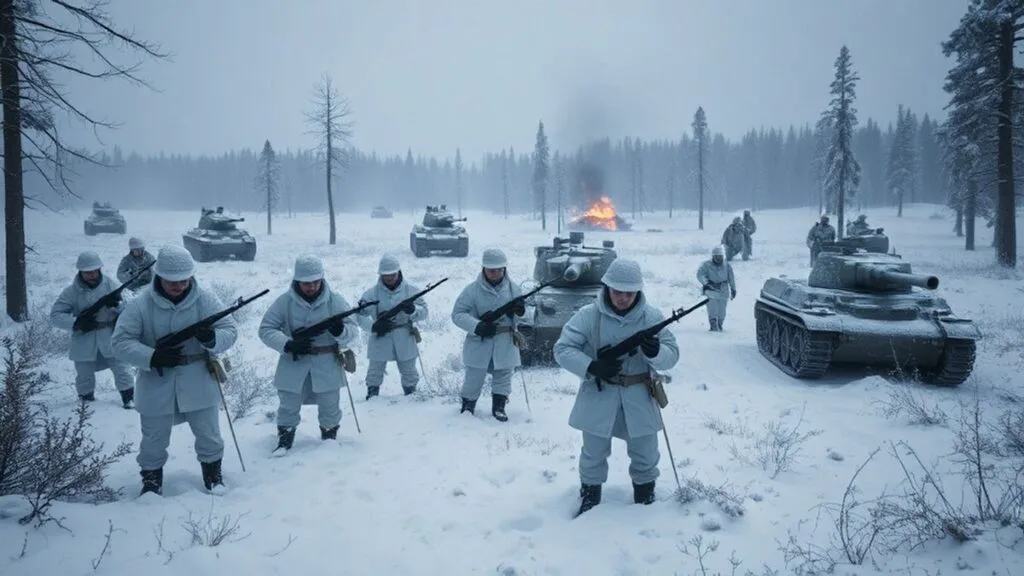
These operations required courage, initiative, and endurance. Finnish soldiers, often wearing white camouflage suits over their uniforms, would move silently through the woods, closing in on Soviet positions. They targeted supply trucks, command vehicles, and artillery batteries. Snipers, many of them hunters in civilian life, took a deadly toll. One, Simo Häyhä, would become legendary, credited with over 500 confirmed kills during the war, earning the chilling nickname “the White Death.” While historians debate exact numbers, his story, documented in Finnish sources and later Western studies, has become a symbol of how individual skill could tilt the scales, if only slightly, against overwhelming odds.
Molotov cocktails—improvised incendiary devices made from gasoline-filled bottles—became a staple of the Finnish anti-tank arsenal. Their nickname, a sardonic jab at Soviet Foreign Minister Molotov, captured the dark humor that soldiers sometimes use to cope with fear. Thrown onto tank engine compartments, they could ignite fuel and disable vehicles. In close-in, chaotic fights among the trees, where tanks could not maneuver freely, such weapons allowed lightly armed infantry to challenge steel monsters.
Finnish radio discipline and intelligence work also proved effective. Units were often small and semi-autonomous, allowing for flexibility and deception. At times, Finnish forces even mimicked Soviet commands or used captured equipment to slip past enemy lines. These tactics could not win the war outright—Finland’s resources were far too limited—but they transformed what might have been a swift Soviet blitzkrieg into a grinding, humiliating struggle.
The image of Finnish soldiers as “white-caped ghosts” haunting Soviet columns entered international reportage. Journalists who managed to reach the front—or who interviewed veterans later—spoke of men who seemed almost fused with the landscape, emerging from drifting snowbanks, striking, and then disappearing. The legend sometimes overshadowed the reality of exhaustion, fear, and loss, but it captured something true: that in this war, small units of determined defenders could, for a time, defy an empire.
Civilians Under the Northern Lights: Cities Bombed, Families Scattered
While soldiers clashed in forests and on frozen lakes, civilian life in Finland was torn apart. The Soviet air raids that began on the first day of war continued throughout the conflict, though not with the intensity seen later in World War II’s great bombing campaigns. Still, for those under the bombs, the scale was less important than the terror.
In Helsinki, people learned the rhythms of air-raid sirens, the scramble to shelters, the anxious counting of booms in the distance. Children were evacuated from cities to rural areas when possible, part of a massive effort to shield the next generation from the worst horrors. In some towns, entire schools relocated to farmhouses or village halls, lessons continuing as best they could in improvised classrooms where the cold made ink freeze in inkwells.
In Karelia, especially around Viipuri (Vyborg) and the villages along the Mannerheim Line, the dislocation was even more severe. As the front shifted and Soviet artillery drew nearer, tens of thousands of civilians fled westward. They traveled by sled, truck, even on foot, often in blizzards, bringing what they could carry. Farm animals were driven along roads choked with refugees and military traffic. Homes that had stood for generations were left behind, sometimes burned by retreating Finnish forces to deny shelter to the enemy.
One Finnish woman later recalled in an interview, cited in a local historical society publication, how her family left their village in such haste that her younger brother forgot his winter boots; he traveled for days wrapped in spare scarves and blankets, his feet swaddled in rags. “We thought we would be back in a week or two,” she said. “We did not understand that we would never see that house again.”
Civilians on the Soviet side also suffered, though their stories were less widely reported at the time. Villages near the border were emptied or fortified, their inhabitants relocated deeper into the USSR. Some Soviet citizens were caught between loyalty to their state and confusion about why they were now fighting “brotherly” Finns whom propaganda had previously portrayed as neighbors within the broader socialist family of nations.
War warped everything it touched. Rationing tightened; black markets emerged. Churches and community halls turned into field hospitals. Women stepped into roles as factory workers, nurses, and organizers of relief efforts. The experience of total mobilization, though harsh, also knitted Finnish society together in a new way: old class resentments were overshadowed by a shared fear of annihilation and a shared commitment to keep the country alive.
The World Watches: Sympathy, Volunteers, and Political Calculations
From afar, the image of a small, democratic nation resisting the onslaught of a totalitarian giant captured the world’s imagination. Newspapers in London, Paris, Stockholm, and New York ran front-page stories with stark headlines: “Red Army Bogged Down,” “Tiny Finland Defies Stalin,” “Heroic Ski Troops in Snow.” The narrative was clear: Finland was David; the Soviet Union was Goliath.
The League of Nations, desperate to prove its relevance, took up the Finnish cause. On December 14, 1939, after condemning the Soviet attack as an act of aggression, the League voted to expel the USSR from its ranks. It was a dramatic gesture, but largely symbolic; the League had no military force and little means to coerce a great power that ignored its directives. Still, the expulsion underscored how differently the world perceived this war compared to the Soviet occupation of eastern Poland or the forced agreements in the Baltics.
Sympathy translated into volunteers and limited material aid. Sweden, officially neutral, became a crucial rear area for Finland. Swedish volunteers—around 8,000 in total—crossed the border to fight, forming the Swedish Volunteer Corps that served especially in northern Finland. Norway and Denmark also saw smaller numbers of volunteers join the Finnish side. Medical teams, arms shipments, and financial aid flowed in, though never in the quantities that might have decisively altered the balance.
In Britain and France, governments debated more direct intervention. Some plans envisioned sending troops to aid Finland via Norway and Sweden, under the pretext of securing vital iron ore shipments. Others saw the conflict as a possible opening to strike the Soviet Union and disrupt its alliance with Germany. Yet political hesitations, logistical difficulties, and the risk of widening the war kept these schemes largely on paper. When the soviet union invades finland, many in the West saw it as confirmation of Soviet brutality, but few were willing to risk their own soldiers in large numbers to change the outcome.
Germany, bound by the Molotov–Ribbentrop Pact, remained officially aloof. Hitler, while not displeased to see the Soviet Union bogged down, was wary of provoking Stalin prematurely. German diplomacy discouraged Sweden and Norway from allowing Allied troops to use their territory for intervention, fearing it might bring British or French forces uncomfortably close to German interests. At the same time, German military observers studied the conflict closely, drawing lessons that would later influence their own disastrous decisions about invading the USSR.
For Finland, the international response was a bittersweet mix. Moral support and volunteers were deeply appreciated; newspapers and radio broadcasts celebrating Finnish courage boosted morale. But the lack of massive, timely military assistance was a bitter reminder that small nations, however admired, often stand alone when the shells begin to fall.
Turning Points in the Deep Freeze: From Heroic Defense to Exhaustion
By January 1940, the war had settled into a grim rhythm. The initial shocks had given way to grinding attrition. Along the Mannerheim Line, Finnish forces held out against repeated assaults. In the northern sectors, motti tactics inflicted severe casualties on Soviet divisions, some of which were virtually annihilated.
Yet the reality behind the dramatic headlines was increasingly harsh. Finnish ammunition stocks were dwindling. Replacement weapons and supplies, though arriving from abroad, could not match the pace of consumption. Soldiers at the front went weeks with minimal rest, their bodies worn down by cold and strain. Frostbite, trench foot, and illness took a growing toll. Even heroes get tired.
The Soviet Union, for its part, began to adapt. Stalin replaced some commanders, authorized more thorough reconnaissance, and demanded better coordination among infantry, artillery, and armor. New waves of troops arrived, and more heavy guns were brought to bear. Soviet engineers learned to cut through Finnish defenses with concentrated fire and sapping operations. Units received improved winter clothing and skis. The Red Army was learning from its painful mistakes, and it had the depth of resources to keep learning through blood.
February 1940 marked a turning point. Massive Soviet bombardments hammered the Mannerheim Line, reducing some sectors to wasteland. Finnish bunkers that had withstood earlier attacks now crumbled under the impact of heavier shells. In some areas, defenders were forced to retreat to secondary positions, fighting delaying actions as they fell back. The psychological impact was severe. The line that many had believed could not be broken was being eaten away, piece by piece.
In Viipuri, the second-largest city in Finland and a jewel of Karelia, residents watched the horizon with dread. The thunder of artillery grew closer each day. By early March, Soviet troops were pushing into the city’s outskirts. Streets that had been bustling with commerce and culture became battlegrounds, then ruins. For many Finns, the sight of Viipuri threatened was like a knife to the heart.
It is astonishing, isn’t it, how quickly the romantic image of a plucky underdog can be overtaken by the cold arithmetic of war. Brave tactics, intimate knowledge of terrain, and international admiration could delay defeat, but they could not conjure bullets or bread from frozen earth. Finland faced a stark choice: fight on to probable destruction or seek terms while some bargaining power remained.
The Moscow Peace Treaty: A Small Nation Bends but Does Not Break
As February wore on and losses mounted, the Finnish government opened channels for peace talks. Sweden and other neutral states helped mediate, but the Soviet Union, now in a stronger military position, was in no mood to be generous. Stalin wanted not only security for Leningrad but also proof that resistance to Soviet power was futile.
Negotiations in Moscow were tense and painful. Finnish leaders knew that public opinion at home still burned with determination, but they also had detailed reports from the front: ammunition reserves counted in days, exhausted units no longer able to hold their lines, the looming loss of Viipuri. President Risto Ryti, who had replaced Kallio during the war due to the latter’s declining health, and Mannerheim both recognized that to continue fighting may have meant national catastrophe—occupation, perhaps annexation, and the likely destruction of Finland as an independent state.
On March 12, 1940, the Moscow Peace Treaty was signed. Its terms were harsh. Finland was forced to cede about 11 percent of its territory and 30 percent of its economic assets to the Soviet Union, including most of the Karelian Isthmus, the city of Viipuri, parts of eastern Salla, and the Rybachy Peninsula in the far north. The Hanko Peninsula was leased to the USSR for use as a naval base. Approximately 400,000 Finns, more than 10 percent of the country’s population, found themselves displaced, their homes now on the wrong side of the new border.
The following day, March 13, the guns fell silent. Soldiers who had spent months in trenches and forest outposts emerged into a quiet that felt almost unreal. Some wept with relief; others with anger. Many felt an overwhelming sense of sorrow for the lands lost, the comrades buried in unmarked graves under snow, the communities that would never again be Finnish.
Yet, crucially, Finland remained independent. Its government, institutions, and army were intact. The soviet union invades finland had not culminated in full occupation or regime change. This outcome was no small thing in an era when many states, once attacked by totalitarian powers, simply disappeared from the map. Mannerheim, in a farewell order of the day, acknowledged both the bitter sacrifices and the fact that Finland had preserved its political existence—a foundation, he hoped, for future generations to rebuild upon.
In the West, reactions were mixed. Some saw the treaty as a sellout, a betrayal of heroic resistance. Others, more familiar with the hard realities of geopolitics, understood that a small country had done what it could and then, at the brink of destruction, chosen a path that kept the possibility of a future alive.
From Winter War to Continuation War: Unfinished Business
The signing of the Moscow Peace Treaty ended the Winter War but not the underlying tensions. For Stalin, the new borders provided a buffer for Leningrad and secured Soviet strategic objectives in the region. For Finland, the loss of Karelia and other territories was a wound that throbbed with resentment and grief. The vast resettlement of Karelian refugees into the remaining parts of Finland placed heavy social and economic burdens on a country already stretched thin.
As Europe plunged deeper into war—Germany invading Denmark and Norway in April 1940, then Belgium, the Netherlands, and France—Finland struggled to rebuild. Its leaders, embittered by what they perceived as Western passivity and betrayal, became more open to contacts with Germany, which was now ascendant on the continent. When Hitler turned his gaze eastward and planned Operation Barbarossa, the invasion of the Soviet Union, Finland saw an opportunity to regain lost territories and perhaps more.
In June 1941, just over a year after the Winter War ended, Finland entered what it called the Continuation War, aligning militarily with Germany (though never signing the Tripartite Pact) and launching operations to retake Karelia. From the Soviet perspective, this was simply a continuation of aggression; from the Finnish perspective, it was a chance to reverse the outcomes imposed by the 1940 treaty. The moral and political complexities of this alliance—fighting alongside Nazi Germany while maintaining a parliamentary democracy and refusing to persecute Jews domestically—would haunt Finnish memory and historiography for decades.
Thus, the moment in 1939 when the soviet union invades finland was not an isolated flare of violence but the opening act in a longer drama of conflict, compromise, and shifting alliances. The Winter War set patterns of mistrust and strategic calculation that would shape Finnish foreign policy long after the last shot was fired.
Memory, Myth, and Numbers: Casualties, Legends, and Historical Debates
The human cost of the Winter War was staggering, especially for a conflict that lasted barely three and a half months. Estimates vary—a reminder of how difficult it is to tally suffering with precision—but most historians agree that Finland lost around 25,000 soldiers killed and about 43,000 wounded. For a nation of roughly 3.7 million people, these figures represented a grievous blow.
Soviet casualties were far higher. Contemporary Soviet reports minimized losses, but post-Soviet archival research suggests that the Red Army may have suffered between 126,000 and 167,000 killed or missing, with total casualties (including wounded and frostbite victims) exceeding 300,000. Some accounts, especially in earlier Western literature, cited even higher numbers, but careful work by historians such as William R. Trotter and others has helped produce more grounded estimates. Regardless of the exact figures, it is clear that the Soviet Union paid a huge price for its eventual victory.
Numbers, however, tell only part of the story. The Winter War also generated myths and legends that have become integral to national identities. In Finland, stories of small units holding out against impossible odds, of ski troops vanishing into blizzards after striking Soviet columns, of snipers like Simo Häyhä, have been passed down in books, films, and family tales. These narratives, while sometimes embellished, served important functions: they honored sacrifice, reinforced a sense of collective resilience, and offered meaning to losses that might otherwise feel senseless.
On the Soviet side, the war was for a long time something of an embarrassment. Official histories downplayed the heavy casualties and initial failures, framing the conflict instead as a necessary security measure that ultimately succeeded. Only with the opening of archives and more critical scholarship in the late twentieth century did a fuller picture emerge, including accounts of demoralized troops, inadequate leadership, and the sheer brutality of the fighting.
Historians still debate aspects of the war. Could Finland have accepted more Soviet demands and avoided conflict? Did international politics—especially Western hopes of using Finland as a front against the USSR—encourage Helsinki to resist beyond what was prudent? How decisive were individual Finnish tactics compared to broader structural factors like Soviet logistical overreach? These questions resist easy answers and ensure that the study of the Winter War remains dynamic rather than frozen in heroic or villainous archetypes.
What is not in doubt is that the moment the soviet union invades finland became a symbol far beyond the borders of those two countries. It came to represent the vulnerability of small states, the dangers of authoritarian miscalculation, and the unpredictable interplay between geography, technology, and human will.
Global Reverberations: Lessons for Hitler, Churchill, and the World
The Winter War did not occur in isolation; it was part of the larger storm system of World War II, and its ripples extended into the decisions of major powers. For Adolf Hitler, the Soviet Union’s initial poor performance was a data point—one he would tragically misinterpret. Watching the Red Army struggle against a tiny opponent, he and his generals concluded that the Soviet military was a hollow shell, weakened irreparably by Stalin’s purges and ideology.
This impression fed into Hitler’s confidence in planning Operation Barbarossa. If the Soviets had bled so heavily to subdue Finland, how could they resist the mechanized might of the Wehrmacht? The fact that the Red Army had, by March 1940, adapted and eventually broken through Finnish defenses was discounted or misunderstood. Overconfidence, built in part on a shallow reading of the Winter War, contributed to one of the greatest strategic errors in history.
In Britain, the conflict shaped the thinking of figures like Winston Churchill, then First Lord of the Admiralty and a vocal critic of appeasement. Churchill publicly praised Finnish courage and denounced Soviet aggression, using the example of the Winter War to argue that dictators could not be appeased, only resisted. When he became Prime Minister in May 1940, this conviction would underpin his refusal to consider a separate peace with Hitler, even when Britain stood seemingly alone.
For smaller states, especially in Eastern Europe and the Nordic region, the war was a grim warning. It showed how easily great powers could carve up spheres of influence, how limited the protection of international organizations could be, and how quickly non-aggression pacts might be torn up. It also demonstrated that, under certain conditions, determined resistance could extract a price high enough to force an aggressor to settle for less than total conquest.
In a broader intellectual sense, the Winter War influenced military thought. Analysts studying the conflict drew lessons about winter warfare, the importance of logistics, and the potential of small, mobile units to harass and disrupt larger formations. Some of these lessons were applied, for better or worse, in theaters from the Eastern Front to the mountains of Italy and the snows of Korea.
The War in Personal Stories: Letters, Diaries, and Silences
Beyond strategy, politics, and maps, the Winter War lived—and still lives—in personal stories. Letters written by Finnish soldiers from the front, many preserved in archives and family collections, reveal a mixture of fear, humor, homesickness, and stoic acceptance. One conscript wrote to his mother in January 1940: “Do not worry too much if you do not hear from me for a while. The mail has trouble finding us, but the snow finds us easily enough.” His letter, cited in a Finnish local history journal, ends with a simple request: “Keep my rifle oiled in your thoughts.”
Diaries kept by civilians speak of endless nights in bomb shelters, of the strange quiet after raids, of learning to recognize the sound of different aircraft types. Children’s drawings from the period, some of which survive in museum collections, show planes, anti-aircraft guns, and houses with giant red crosses painted on their roofs in the hope of discouraging attacks. Even in crayon, the unease is palpable.
On the Soviet side, personal testimonies were harder to collect and publish during the Soviet era, when official narratives suppressed accounts that contradicted the heroic image of the Red Army. Still, some diaries and letters have surfaced, along with later memoirs. They speak of confusion about the reasons for the war, resentment at poor equipment and leadership, and moments of unexpected human connection—such as exchanges of shouted insults or songs across no-man’s land, or the discovery of Finnish family photos in abandoned houses that looked, disconcertingly, like those back home.
Silence, too, is part of the Winter War’s legacy. Many veterans did not speak in detail about their experiences for years, even decades. In Finland, the later trauma of the Continuation War and the complicated politics of postwar neutrality sometimes overshadowed the earlier conflict. It was only with time, and with the efforts of historians, journalists, and families, that a more complete tapestry of voices emerged.
Why This Winter Still Matters: The War’s Legacy in Finland and Russia
More than eight decades have passed since the soviet union invades finland in that bitter winter, yet the echoes of the conflict are still audible in both countries. In Finland, the Winter War is foundational to national identity. It embodies a narrative of courage, unity, and sacrifice that has influenced everything from civil defense policies to political culture. The concept of “sisu”—a Finnish term roughly translating to grit, tenacity, and inner strength—is often linked in popular imagination to the stoic endurance shown during 1939–1940.
Memorials and museums across Finland keep the memory alive. School curricula include the Winter War as a core subject, not only as military history but as a story about democracy under siege. The political doctrine that emerged in the postwar years, often associated with President Juho Kusti Paasikivi and later Urho Kekkonen, aimed to balance firm defense with careful diplomacy toward the Soviet Union—a recognition that geography could not be changed, but that policy could, perhaps, mitigate its risks.
In Russia, the memory is more ambivalent. For much of the Soviet period, the Winter War was overshadowed by the far greater national trauma and triumph of the “Great Patriotic War” against Nazi Germany. Official accounts framed it as a necessary, if costly, prelude to the more glorious struggle that followed. Only after the collapse of the USSR did more critical appraisals emerge, examining the war as a case study in Stalinist miscalculation and brutality.
Contemporary debates in Russia about the Soviet past sometimes touch on the Winter War as part of a larger argument about empire, security, and responsibility. Was it an understandable, if harsh, attempt to safeguard Leningrad, or an unjustified act of aggression against a smaller neighbor? The answer often depends on one’s broader view of Soviet history.
Internationally, the Winter War remains a touchstone in discussions about small-state security, resistance to aggression, and the limits of international organizations. When modern commentators look back at 1939–1940, they see not only a particular conflict between Finland and the Soviet Union, but also enduring questions: What obligations do larger powers have to defend smaller ones? When does resistance become futile, and when does it become a moral imperative regardless of the odds?
Ultimately, the story that began when the soviet union invades finland is not just about borders and battles. It is about how societies confront existential threats, how they remember trauma, and how they try to shape a future in the shadow of fearful winters long past.
Conclusion
When we look back on the Winter War, we see more than a clash of armies in snow. We see a collision between a totalitarian empire seeking depth and security and a small democracy determined to exist on its own terms. The morning the soviet union invades finland in November 1939 crystallizes many of the tensions of the twentieth century: the fragility of international law, the brutality of power politics, and the stubborn resilience of people who refuse to yield quietly.
The war’s course confounded expectations. The Red Army, assumed to be unstoppable, found itself stalled by terrain, climate, and unexpectedly effective defenders. Finland, assumed to be doomed, carved out a space for survival through courage, tactical ingenuity, and painful compromise. The Moscow Peace Treaty cut deep, but it left the country alive, capable of shaping its own destiny in the turbulent decades that followed.
The legacy of these months is written not only in history books but in the lives of those who survived and the societies they helped to rebuild. In Finland, the Winter War still stands as a template of unity in crisis, a reminder that even when the odds are impossible, the manner in which a nation resists can define it for generations. In Russia, the conflict remains a cautionary tale about the costs of misjudgment and the dangers of believing one’s own propaganda.
As long as small states face large neighbors, as long as leaders weigh security against justice, the story of this war will remain relevant. It invites us to ponder uncomfortable questions about what can be justified in the name of safety, and what must never be. Above all, it reminds us that behind every movement of a border line, every strategic calculation, there are human beings—farmers, students, mothers, conscripts—whose lives are forever altered when great powers decide that maps must change.
FAQs
- Why did the Soviet Union invade Finland in 1939?
The Soviet Union invaded Finland primarily to secure a buffer zone around Leningrad and to push its western borders away from vital industrial and political centers. Stalin feared potential German or Western attacks via Finnish territory and sought territorial concessions that Finland, valuing its independence and defensive positions, refused to grant. The result was a calculated decision in Moscow to use force after diplomatic pressure and a staged border incident at Mainila failed to achieve Soviet aims. - How long did the Winter War last?
The Winter War began on November 30, 1939, when Soviet forces attacked across the Finnish border and bombed several Finnish cities, and it ended on March 13, 1940, with the signing and implementation of the Moscow Peace Treaty. In total, it lasted 105 days. - Did Finland win or lose the Winter War?
Militarily, Finland was forced to accept harsh peace terms and cede significant territory, so in a narrow sense it lost. However, Finland preserved its independence and governmental system, avoided full occupation, and inflicted heavy casualties on the Soviet forces, surprising the world and shaping future political developments. Many historians describe the outcome as a strategic survival for Finland despite territorial defeat. - What were the approximate casualties on both sides?
Estimates vary, but Finland lost around 25,000 soldiers killed and some 43,000 wounded. Soviet losses were much higher, with many historians estimating roughly 126,000–167,000 killed or missing and overall casualties (including wounded and frostbite cases) well over 300,000. Civilian casualties, particularly from bombing raids and evacuations, added further to the human cost. - What is the Mannerheim Line?
The Mannerheim Line was a system of fortifications built by Finland across the Karelian Isthmus to defend against attack from the east. Named after Field Marshal Carl Gustaf Emil Mannerheim, it combined concrete bunkers, trenches, anti-tank obstacles, and natural features like lakes and rocky ridges. Though not as strong as later legends suggested, it played a crucial role in delaying the Soviet offensive and inflicting severe losses. - What were “motti” tactics used by the Finns?
“Motti” tactics involved cutting long Soviet columns, often moving along narrow forest roads, into isolated segments or “piles” (mottis). Finnish ski troops would infiltrate the forests alongside these roads, sever supply lines, and surround smaller groups of Soviet troops, which could then be harassed, starved, or destroyed piecemeal. These tactics were especially effective in the northern, less-developed regions of the front. - How did the Winter War influence World War II?
The Winter War affected strategic thinking in multiple capitals. Hitler drew the erroneous conclusion that the Red Army was weak, which helped embolden his decision to invade the Soviet Union in 1941. Allied planners studied the conflict for lessons on winter warfare and considered, but never fully implemented, interventions via Scandinavia. The war also highlighted the limitations of the League of Nations and underscored the vulnerability of small states in a world of aggressive powers. - Did any foreign volunteers fight for Finland?
Yes. Several thousand volunteers, particularly from Sweden, but also from Norway, Denmark, and other countries, joined the Finnish side. The Swedish Volunteer Corps was the largest foreign contingent and saw action especially in northern Finland. Additionally, various nations sent medical teams, humanitarian aid, and limited quantities of weapons and equipment. - What happened to the territories Finland ceded to the Soviet Union?
The areas ceded under the Moscow Peace Treaty, including most of the Karelian Isthmus and the city of Viipuri, were incorporated into the Soviet Union. Their Finnish populations were evacuated into the remaining parts of Finland before or during the final stages of the war. After the collapse of the USSR, these territories remained within the Russian Federation. - Why is the Winter War still significant today?
The Winter War remains significant because it illustrates how small nations can resist much larger aggressors, how miscalculations by great powers can lead to unexpected difficulties, and how geography and climate can shape the course of war. For Finland, it is a central part of national memory and identity; for Russia and the wider world, it offers enduring lessons about the costs of aggression, the challenges of winter warfare, and the resilience of societies under extreme pressure.
External Resource
Internal Link
Other Resources
- Encyclopaedia Britannica – general search for the exact subject
- Google Scholar – academic search for the exact subject
- Internet Archive – digital library search for the exact subject