Table of Contents
- A City Before the Storm: Pavia on the Eve of Invasion
- Who Were the Magyars? Riders from the Eastern Horizon
- Italy in Fragment: A Kingdom Riven by Rival Kings
- An Alliance with Riders of Doom: King Berengar and the Magyars
- Scouts on the Po: The Magyars Approach Northern Italy
- The Night Before: Pavia’s Fears, Prayers, and False Security
- When the Magyars Sack Pavia: The Assault of 12 March 924
- Fire and Plunder: Inside the Ravaged Streets of Pavia
- Captives, Ransoms, and Slavery: The Human Cost of the Raid
- Echoes in the Latin Chronicles: How Medieval Witnesses Remembered the Horror
- After the Flames: Political Upheaval in the Italian Kingdom
- Fear on the Frontiers: How Europe Reacted to the Raiding Age
- From Raiders to Rulers: The Transformation of the Magyar People
- Memory, Legend, and Silence: Pavia’s Long Shadowed Recollection
- Archaeology and Landscape: Tracing the Invisible Scars
- Comparing Catastrophes: Vikings, Saracens, and Magyars in the 10th Century
- Violence and Faith: The Church’s Response to the Ruin of 924
- From Terror to Integration: Europe Learns to Live with the Magyars
- Conclusion
- FAQs
- External Resource
- Internal Link
Article Summary: On a March day in 924, the quiet rhythms of an Italian royal city were shattered when the magyars sack Pavia, turning its churches, markets, and homes into scenes of violence and flame. This article follows the story from both sides: the riders who came from the Eurasian steppe and the townspeople who suddenly found their world collapsing. We explore how this raid emerged from a web of Italian civil wars, fragile alliances, and opportunistic diplomacy, culminating in the dramatic moment when the magyars sack Pavia and shake the foundations of a kingdom. Yet beyond the smoke and blood, we look at the broader age of raids that also saw Vikings and Muslim corsairs, and we ask how people adapted to such uncertainty. As we trace the political and spiritual aftermath, the article shows how the terror of that day influenced kingship, church policy, and urban life across the peninsula. When the magyars sack Pavia, they do more than destroy a city; they become a symbol of a Europe struggling to defend itself while slowly changing in response to its attackers. In the end, we follow the Magyars themselves as they transition from feared marauders to settled rulers in the Carpathian Basin, leaving the events of 924 as a dark but formative memory in European history.
A City Before the Storm: Pavia on the Eve of Invasion
In the early decades of the tenth century, Pavia awoke each morning to the sound of bells ringing over the River Ticino. The city, perched just south of the Po River in northern Italy, had been a royal capital since the days of the Lombards. Its streets were narrow and crowded, lined with timber-framed houses and a scattering of stone buildings that spoke of older Roman grandeur. Merchants bargained along the riverfront; artisans hammered, stitched, and carved in dim workshops; clerics moved between churches bearing books and liturgical vessels. On the surface, life followed a familiar rhythm, but anxiety simmered underneath. Rumors traveled as quickly as boats along the Po: strangers prowled the frontiers, raids swept through distant valleys, and kings argued while peasants built makeshift defenses around their villages.
Pavia was no ordinary town. It had hosted kings, coronations, and councils. The memory of Charlemagne and the Carolingian revival still hovered over its halls, even as that empire had shattered into competing kingdoms. In the early 900s, the city served as a political stage where Italian magnates, bishops, and envoys negotiated fragile alliances. The crown, as symbol and object, still mattered deeply here. To wear the iron crown of the Lombards, a ruler had to be acknowledged in places like Pavia, where royal traditions anchored their otherwise shaky grasp on power. But royal prestige could not stop the world outside from shifting, and this becomes brutally clear on 12 March 924, when the magyars sack Pavia and force its people to face what it means to live at the crossroads of ambition and vulnerability.
The streets offered other hints of unease. City walls, originally Roman and repeatedly repaired, now bore signs of more recent work: hastily raised wooden palisades, deepened moats in some sections, and rough stone patches where crumbling masonry had given way. The local bishop urged processions and prayer, while secular leaders tried to organize urban militias. But the city’s population was not a trained army; they were artisans, boatmen, vintners, scribes. Many had never faced more than a local feud or a bandit skirmish. Yet whispers told of distant peoples—light cavalry who could appear like a storm and vanish before a heavy infantry force could even assemble.
This was the world into which the Magyars would ride. To understand why Pavia, a city of royal ceremony and religious devotion, became the target of a devastating raid, we must turn our gaze eastward—to the steppe, to the riders, and to the way Europe’s political fractures made such catastrophe possible. The day when the magyars sack Pavia did not come from nowhere; it was the result of decades of migrations, diplomacy, and war that converged upon that one city and that one morning.
Who Were the Magyars? Riders from the Eastern Horizon
Long before they appeared on the plains of northern Italy, the Magyars had ridden across the vast grasslands of the Eurasian steppe. They were a confederation of tribes, speakers of a Ugric language, shaped by the demands of life as semi-nomadic pastoralists moving with their herds. Their world was one of rivers and pastures, of shifting alliances with other steppe powers, and of constant movement. Around the late ninth century, pressed by pressure from the Pechenegs and attracted by political opportunities, the Magyars migrated into the Carpathian Basin, occupying a land cradled by mountains and threaded with rivers like the Danube and the Tisza. From this new homeland, they launched raids in all directions, testing the resilience of the surrounding kingdoms.
Their military strength rested on mobility and precision. Mounted on hardy steppe horses, Magyar warriors wielded composite bows made of wood, horn, and sinew, capable of delivering deadly arrows with astonishing range and power. Their tactics, described by frightened chroniclers, involved feigned retreats, rapid encirclements, and hit-and-run attacks that exploited the rigidity of heavy infantry and the sluggishness of feudal levies. To western eyes, they seemed almost ghostlike, appearing at dawn, devastating a region, and disappearing before a counterattack could be organized. “They came like a whirlwind,” one later writer would say of similar incursions, condensing the shock and helplessness into a single image.
But the Magyars were not simply mindless raiders. Their actions were part of a broader economic and political logic. Raiding was both strategy and livelihood. It provided booty, slaves, and, crucially, tribute: kingdoms would sometimes agree to pay annual sums or grant privileges in exchange for temporary peace. The Magyars understood diplomacy as well as war. They could be mercenaries as readily as enemies, hired by rival rulers to attack one another. In this sense, the moment when the magyars sack Pavia can be seen not merely as an invasion from outside Europe, but as a violent chapter in European internal politics, where kings’ short-term calculations invited long-term disaster.
Contemporary Latin chroniclers struggled to categorize them. Some called them Hungarians (Hungari), linking them—falsely but revealingly—to the Huns of Attila, as if to explain their cruelty and speed by invoking an older terror. Others fixated on their non-Christian status, casting them as scourges sent by God to punish a sinful Christendom. Yet even these condemnations reveal grudging admiration. Their horsemanship, discipline, and coordination impressed as much as they horrified. It is in this context that their appearance on the Italian stage must be understood: as the arrival of a formidable power whose raids exposed underlying weaknesses in the Christian kingdoms that claimed dominion over the West.
Italy in Fragment: A Kingdom Riven by Rival Kings
If the Magyars provided the spear, Italy provided the chink in the armor. The peninsula in the early tenth century was nominally a kingdom, heir to the Lombard realm and recognized, at least on parchment, as a coherent political entity. In reality, it was a mosaic of competing powers: regional nobles, powerful bishops, city communities, and two or more kings locked in bitter rivalry. The imperial heritage of Charlemagne, who had been crowned Emperor in Rome, loomed as a promise and a burden. Men vied for the Italian crown in hopes of eventually claiming the imperial title, which would mark them as supreme among Christian rulers.
By the 920s, the central figure was Berengar I, king of Italy, a man of ambition but limited means. He had spent decades fighting off rivals, such as Guy of Spoleto and Louis of Provence. Each twist in this struggle eroded the stability of the kingdom. Support was bought with lands and privileges, while neglected regions sought protection wherever they could find it. The countryside bristled with private fortifications, and local warlords rose in prominence. The very landscape, once dotted with Roman villas and monastic estates, now bore the stamp of fortified hilltop settlements and castles.
In such an environment, Pavia’s status as royal seat made it both grand and vulnerable. The city was a prize, and its fortunes were tied to those of the king who claimed it as his capital. When the magyars sack Pavia, they were not striking at a random town on the Po; they were plunging a knife into the symbolic heart of the Italian kingdom. But why were they there? The answer lies in the tangled web of alliances that Berengar himself had woven. Instead of uniting Italian forces against external threats, he—like some of his contemporaries in Germany and France—chose to employ the very riders that terrified his neighbors.
Italy’s geography made it both a prize and a trap. The alpine passes invited northern invaders: Franks, Germans, and now, indirectly, Magyars. The seas exposed southern regions to Muslim raiders from North Africa and Sicily. Local rulers often focused more on immediate survival than on grand strategies. It was easier, in the short term, to hire outsiders to fight internal enemies than to forge a lasting national defense. This political culture of improvisation set the stage for 924. Pavia’s fate was intertwined with Berengar’s policies, and his decision to lean on the Magyars would have consequences he could not fully control.
An Alliance with Riders of Doom: King Berengar and the Magyars
Berengar’s Italy was besieged not only by external threats but by internal rebellion. His rivals, including kings like Rudolf II of Burgundy, contested his authority and sought to claim the Italian throne for themselves. In this struggle, the Magyars appeared as a tool—a sharp, dangerous blade that might cut enemies more effectively than any Italian levy. At some point in the early tenth century, Berengar entered into an arrangement with the Magyars, inviting them to aid him against his rivals in exchange for pay and plunder. It was a gamble that reflected the grim logic of the time: better to unleash terror on one’s enemies than to see them win the crown.
This was not entirely unprecedented. Across Europe, rulers sometimes made pacts with raiding peoples: Frankish princes with Vikings, southern lords with Muslim corsairs, and now Berengar with the Magyars. But because the Magyars operated with such autonomy and speed, any alliance carried immense risks. Once invited into a region, they did not necessarily confine themselves to appointed targets. Campaigns could blur from mercenary operations into opportunistic raids. The line between ally and assailant was dangerously thin. When later chroniclers recount how the magyars sack Pavia, there is often an undercurrent of bitter irony: the very king charged with protecting the kingdom had helped open the door to its devastation.
The political situation deteriorated rapidly. Berengar’s enemies also sought allies, and the Italian landscape became a chessboard on which foreign riders moved freely. Control of Pavia shifted as rival coalitions formed and re-formed. In 922, Rudolf II of Burgundy gained advantage, and Berengar’s position weakened. According to some accounts, Berengar’s alliance with the Magyars backfired spectacularly; the riders he had once courted returned as plunderers, no longer the tools of a king but independent predators exploiting chaos. By 924, their attention turned toward the capital itself.
It is astonishing, isn’t it, that a royal city could stand so exposed? Yet behind the high-sounding titles and solemn ceremonies of early medieval kingship lay a harsh reality: most rulers had limited capacity to impose their will beyond their immediate entourage. Berengar could not easily mobilize a unified, disciplined army to defend every river crossing and every city wall. Instead, power flickered and shifted in response to personal loyalty, local interests, and raw coercion. In this environment, the Magyars, nimble and opportunistic, thrived. When they turned their gaze on Pavia in early 924, there was little the king or his rivals could do to stop them in time.
Scouts on the Po: The Magyars Approach Northern Italy
Sometime before March 924, Magyar raiding parties moved across the Alps and into northern Italy, following routes that traders and armies had used for centuries. Chroniclers do not provide daily logs of their movements, but we can reconstruct the outline from geography and patterns seen in other raids. Their scouts would have probed river valleys, evaluated bridgeheads, and identified weakly defended settlements. They likely followed the Po River corridor, a natural artery that led directly toward the heartland of the Italian kingdom and its capital at Pavia.
The countryside felt their presence even before the city did. Villages burned, flocks were driven off, and captives were taken. Those who escaped carried stories to neighboring communities, tales of mounted archers who seemed to float across the fields, firing arrows with deadly accuracy before vanishing. Some peasants fled to local strongholds; others crowded into walled towns, trusting stone and faith to protect them. Messages would have reached Pavia’s authorities: the Magyars were in the region, and their intentions were obvious. The phrase that future historians would repeat—magyars sack Pavia—had not yet been written, but the possibility now loomed in the minds of those who heard the rumors.
Along the Po, boatmen and merchants may have tried to evade the danger, halting traffic or hugging the banks near fortified points. Trade temporarily yielded to survival. Regional nobles faced hard choices. Should they confront the Magyars in open battle, risking annihilation by a more mobile enemy, or retreat behind walls and hope that the raiders moved on to easier targets? The fragmented Italian political landscape made large-scale coordination difficult. Each lord thought first of his own estates. Meanwhile, the Magyars, unencumbered by baggage trains or heavy siege equipment, could adapt their route as opportunities presented themselves.
We must imagine the psychological tension in those days. Smoke on the horizon could mean a routine field burning—or the destruction of a neighboring village. The sound of distant hooves might be local mounted retainers—or advance scouts of a raiding column. Pavia, set on the Ticino, could watch the waterways uneasily, knowing that the river, once a conduit of prosperity, might now bring devastation. Scouts and messengers raced between city and countryside, but events were moving faster than human response. Every hour a decision was not made, the raiders drew nearer.
The Night Before: Pavia’s Fears, Prayers, and False Security
On the eve of the attack, Pavia was a city holding its breath. We have no diary entry from a terrified artisan, no letter from a bishop detailing the final calm; what we have instead are chronicles written afterward, stories told by survivors, and the physical contours of the city itself. From these, we can imagine the scenes. The city gates were likely closed and reinforced. Men old enough to fight stood watch on the walls while women and children clustered in courtyards or huddled in churches. Torches flickered along the ramparts as sentries peered into the darkness.
Inside Pavia’s churches, the clergy led vigils. Candles glowed before altars bearing relics—bones of saints, fragments of the True Cross, objects believed to anchor heaven’s protection in this particular place. Litanies and psalms filled the air. Many believed that God might yet spare them, that the city which had crowned kings and guarded relics possessed a certain sacred shield. Yet behind the prayers lay an undercurrent of doubt. If Christendom as a whole was being punished for its sins, as some preachers insisted, why should Pavia be exempt? People prayed harder, offered alms, confessed their wrongs, trying to tip the scales of divine judgment.
City leaders debated in hurried councils. Could they buy off the raiders with tribute? Did they have enough coin or treasures to satisfy them? Or was the Magyar host already too committed to pillage to accept negotiation? Some argued for sortie and aggressive defense; others cautioned that opening the gates even briefly could invite disaster. Underneath strategic talk lay personal fear. Each man knew that if the walls were breached, no office or title would guarantee safety. The same riders who felled peasants in the fields would not hesitate to strike down magistrates or merchants within the streets.
Children sensed the tension, even if they did not fully understand it. The normal bedtime stories were replaced by whispered accounts of distant battles, of saints who thwarted invaders, of miraculous deliverance. Every creak of timber, every bark of a dog outside the walls could jolt a family awake. Yet for all the vigil, Pavia was not fully prepared. The city’s defenses had not been built with the Magyars in mind; they had evolved over centuries to meet different threats. Nor could stone walls alone counter an enemy skilled in exploiting confusion and fear. By dawn, the fragile line between anxious order and chaos would snap.
When the Magyars Sack Pavia: The Assault of 12 March 924
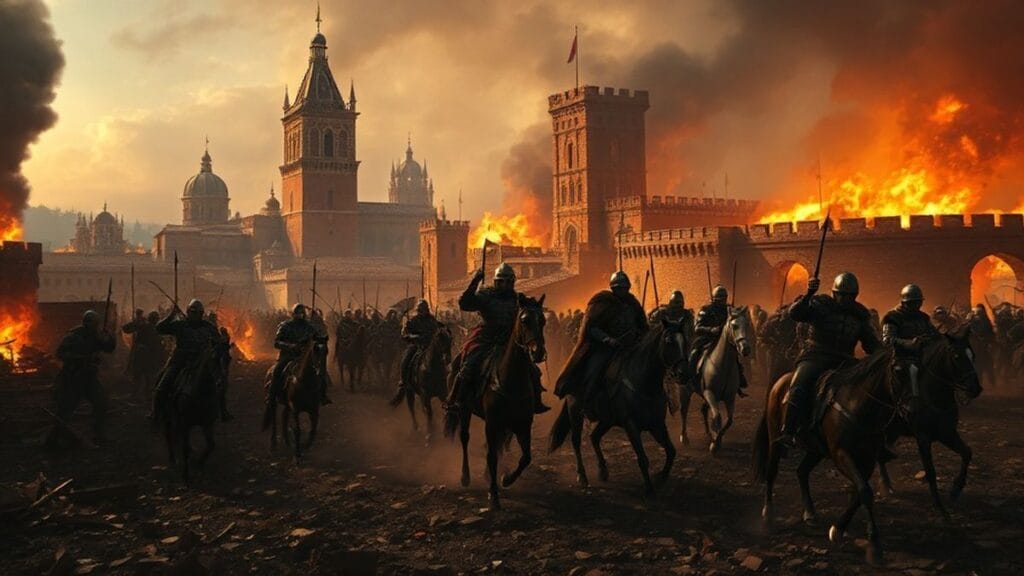
Dawn on 12 March 924 did not break quietly. According to later accounts, the attack came with sudden ferocity. The Magyars, having encircled the city or approached from multiple directions, pressed toward Pavia’s gates and vulnerable points along the walls. Trumpets or horns may have sounded an alarm inside the city, but the raiders moved quickly. Arrows hissed through the air, striking down defenders on the ramparts before they could organize a coordinated response. The cry spread from gate to market to cloister: the Magyars were here.
It was in these frantic hours that the phrase “magyars sack Pavia” took on its full, dreadful meaning. The attackers were not interested in a ritual siege, with formal negotiations and staged displays of royal power. Their goal was to break the city’s defenses as efficiently as possible and open it to plunder. Some may have used captured tools or simple battering techniques against the gates; others shot fire-arrows toward wooden structures, hoping to ignite roofs and sow panic. Once a single gate or weak section gave way, the logic of defense collapsed. Riders surged into the streets, cutting down anyone who resisted.
Contemporary chroniclers emphasize the swiftness and brutality of the fall. The Annales Iuvavenses and other sources, though terse, capture the shock: the royal capital, long a symbol of Italian kingship, had been overrun by “pagani,” the pagans from the east. A later writer, Liutprand of Cremona—never shy about his opinions—would recall the period of Magyar raids as a time when Italy lay exposed to “barbarian” plunder, its rulers ineffectual. While he does not give a minute-by-minute account of the sack itself, his broader narrative frames it as the culmination of Berengar’s failures. The fact that the magyars sack Pavia rather than some lesser town was, for him and others, a sign that the kingdom’s moral and political order had unraveled.
Inside the city, the defense dissolved into scattered pockets of resistance. Some householders barred their doors and hoped the storm would pass them by. Others tried to rally around local lords or clergy. But the attackers’ speed and coordination made such efforts sporadic and often futile. The clang of steel on steel, the screams of the wounded, the roar of spreading fires—these merged into a single cacophony. For many inhabitants, there would have been no clear sense of time, only the overwhelming need to survive or protect loved ones. The morning that began with fear soon plunged into despair.
Fire and Plunder: Inside the Ravaged Streets of Pavia
Once inside Pavia, the raiders set about their grim work with methodical efficiency. They sought wealth in all its forms: coin, jewelry, religious vessels, textiles, and above all, human beings who could be sold as slaves or ransomed for precious payments. Churches and monasteries, with their stored treasures and symbolic significance, became prime targets. Altars were stripped of gold and silver; reliquaries were seized, sometimes smashed open in search of hidden compartments. For the Magyars, these were valuable objects; for the faithful, their loss was a spiritual wound as deep as the physical destruction.
Fire followed plunder. Buildings constructed with timber frames and shingled roofs were vulnerable to even small sparks. In the chaos of combat and looting, fires spread rapidly, leaping from house to house in the dense quarters of the town. Smoke darkened the sky, and ash drifted down like a grim snowfall. People fled through the streets, clutching children or hastily gathered possessions, only to encounter Magyar riders blocking their path. Some were cut down; others were captured and bound. The city, which at dawn had still resembled its old self, by midday had been transformed into a landscape of ruin.
Yet even within this horror, there were moments of desperate courage and fleeting mercy. A group of defenders might have held a narrow alleyway long enough for families to slip away through back passages. A Magyar warrior, moved by pity or calculation, might have spared a captive who showed signs of noble or clerical status, hoping for a larger ransom. These individual choices, lost to official records, nonetheless shaped the fates of hundreds. The broad narrative—magyars sack Pavia—risks flattening these complexities, but the lived reality would have been a patchwork of terror, resistance, loss, and fragile reprieve.
The psychological violence was immense. To see one’s city violated, its sacred spaces robbed, its social order inverted by foreign warriors—this was not just a material catastrophe but an existential one. Many inhabitants would emerge, if they survived at all, into a world where the familiar landmarks of their identity had been burned or desecrated. The royal capital had failed to protect them, the king’s authority had evaporated in the face of external force, and even the expected shelter of the church had proven fragile under the weight of events. The sack of Pavia in 924 seared itself into local and regional memory precisely because it revealed, in the starkest terms, how vulnerable even the most prestigious of cities could be.
Captives, Ransoms, and Slavery: The Human Cost of the Raid
When the noise of the fighting finally subsided, Pavia was not empty; it was transformed. The dead lay in streets and courtyards, their bodies awaiting burial or, in some tragic cases, left unburied due to fear of renewed attacks. Survivors emerged cautiously from hidden rooms, cellars, and cloisters. They searched for family members, called out names, and found instead silence or strangers. For many, the worst realization was not merely that loved ones had died, but that they had vanished—taken alive by the raiders, their fates unknown.
Slave-taking and ransom were core components of Magyar raiding. Men, women, and children were rounded up, often bound with ropes or chains, and gathered outside the city or in secure places within it before the raiders withdrew. Strong young men could be sold as laborers or soldiers; women and children had their own grim markets. Some captives would be marched north and east, crossing mountains and rivers, eventually disappearing into the networks that connected the steppe to Byzantine and even Islamic markets. Others, especially those of higher social rank, were held for ransom, their lives leveraged for wealth.
Ransom negotiations could drag on for months or years. Families and monasteries scrambled to gather the necessary funds, selling land, melting down silver, or borrowing at high interest. In rare cases, captives might manage to escape or be freed by later diplomatic interventions. Yet for many, the moment when the magyars sack Pavia also marked the beginning of a long exile, severed from their homeland and immersed in cultures that saw them primarily as commodities. Medieval chronicles, often focused on bishops and nobles, rarely linger on the fates of ordinary captives, but their sufferings formed a silent backdrop to the political drama.
Even those who remained in Pavia faced a kind of bondage. Debts contracted to pay ransoms or rebuild homes could trap families in generations-long dependency. The city’s economic fabric, once stretched across crafts, trade, and royal patronage, had been torn. Artisans lost tools and workshops; merchants saw stocks looted and creditlines shattered. In this sense, the human cost of the raid extended far beyond the immediate casualties. It reshaped social relations, deepened inequalities, and etched new lines of trauma into the memories of those who survived.
Echoes in the Latin Chronicles: How Medieval Witnesses Remembered the Horror
We know about the events of 924 not because a modern historian has imagined them, but because medieval chroniclers and annalists, writing in Latin, noted them down with varying degrees of detail. Their works are often terse, sometimes frustratingly so, but they preserve the essential fact: in that year, the magyars sack Pavia. The Annales Iuvavenses (Salzburg Annals), for example, record Magyar movements across central Europe and into Italy, reflecting a broader awareness of their impact. Other sources, like Liutprand of Cremona’s Antapodosis, offer more interpretive narratives, saturated with moral judgment and political partisanship.
Liutprand, writing later in the tenth century, cast the Magyar raids as part of a larger pattern of divine punishment for the sins and incompetence of rulers like Berengar. He described Berengar as tyrannical and inept, blaming him for inviting or failing to prevent the incursions that ravaged Italy. In Liutprand’s telling, the devastation of Pavia stands as an indictment of a king who put his own power above the safety of his people. While historians must handle such biased accounts carefully, they nonetheless reveal how contemporaries interpreted the catastrophe: not as a random misfortune, but as a symptom of deeper disorder.
Another strand of memory appears in hagiographical texts, the lives of saints. Here, the Magyars sometimes emerge as foils in miracle stories: an abbey spared through the intercession of its patron saint, a fugitive protected by divine intervention while raiders pass close by. These accounts do not always refer explicitly to Pavia, but they share the same mental world shaped by the shock of sudden attacks. They show how religious communities processed terror through narratives of sanctity and deliverance. Even in texts where the words “magyars sack Pavia” do not appear, the shadow of such events colors perceptions of God’s justice, human frailty, and the need for repentance.
Modern historians, working with these scattered references, reconstruct not only the basic chronology but also the atmosphere of the time. The combination of annals, chronicles, charters, and archaeological hints helps illuminate how a single raid fits into a wider pattern of Magyar activity. As historian Charles R. Bowlus has argued in his studies of central Europe, the Magyar menace prompted significant changes in the political and military organization of German and Italian realms. The sack of Pavia belongs, in this view, to a turning point era when European polities began to adapt to the realities of quick-strike cavalry warfare and border insecurity.
After the Flames: Political Upheaval in the Italian Kingdom
The immediate political consequence of the sack was crisis. Pavia’s prestige as a royal center had been brutally undercut. If the capital could be plundered by hired or once-hired raiders, what did that say about the authority of its king? Berengar I, already embattled, saw his legitimacy collapse around him. Within months, his enemies capitalized on the disarray. In 924, the same year the magyars sack Pavia, Berengar was assassinated at Verona, reportedly by a vassal who had once served him. His death symbolized the end of a long, troubled reign and the failure of a political strategy that had entangled Italy with Magyar power.
The throne did not remain empty. Rival claimants, notably Rudolf II of Burgundy and later Hugh of Arles, maneuvered to control the kingdom. Each brought new networks of support and new political calculations, but none could simply erase the memory of 924. The raid had demonstrated that Italy, for all its resources and history, lacked a cohesive defense system. Subsequent rulers faced the dual challenge of consolidating authority over fractious nobles and dealing with external threats. Although the Magyars would continue to raid parts of Italy and central Europe for decades, the shock of events like Pavia’s fall spurred adaptations, from fortified refuges in the countryside to new forms of military organization.
Diplomatically, Italy had to consider its place within a larger Christian world trying to respond to Magyar incursions. German rulers, particularly Henry the Fowler and his successor Otto I, began building fortified towns (burhs) and developing cavalry forces capable of countering steppe tactics. As their power grew, they increasingly intervened in Italian affairs, culminating in Otto’s coronation as emperor in 962. In a long, indirect arc, the day the magyars sack Pavia contributed to the conditions that allowed a new imperial authority to emerge from the east, reshaping the relationship between Italy and the German lands.
On a local level, Pavia itself had to reconstruct both physically and politically. Rebuilding required resources and trust. Monasteries and churches sought to replace stolen treasures; nobles tried to restore their residences. But the psychological rebuilding was slower. The memory of burned streets and foreign riders lingered in family stories and urban identity. It reminded citizens and rulers alike that no title—king, bishop, count—could guarantee safety, and that alliances forged for short-term gain might carry terrible long-term costs.
Fear on the Frontiers: How Europe Reacted to the Raiding Age
The sack of Pavia was one episode in a broader “age of raids” that afflicted Europe between the ninth and tenth centuries. From the north came Vikings; from the south, Muslim raiders often labeled Saracens; from the east, the Magyars. Each threat had its own distinctive tactics and cultural background, but together they produced a pervasive sense of insecurity. No coastal monastery, no river town, no frontier village could assume itself beyond reach. The phrase “magyars sack Pavia” thus resonates with parallel laments: Vikings sack Nantes, Saracens raid the coasts of Provence, and so on. To be a Christian community in these centuries was to live with the possibility of sudden violence.
Responses varied. Some rulers attempted large-scale military reforms, building fortified centers, organizing rapid-response forces, and negotiating collective defenses among nobles. Others opted for tribute, effectively buying temporary safety. In practice, most realms did a bit of both, depending on resources and political circumstances. The problem was compounded by internal rivalries; as in Italy, princes sometimes weaponized raiders against each other, weakening the very societies that needed to stand united. The story of how the magyars sack Pavia is thus not only a story of foreign invasion; it is equally a story of European political fragmentation and shortsightedness.
The church played a key role in shaping the psychological response. Preachers interpreted the raids as divine chastisement, calling for repentance and reform. Synods and councils condemned moral laxity, simony, and violence among Christians themselves, arguing that only a more faithful society could hope to regain God’s favor. Fasting, processions, and the promotion of particular saints as protectors against raiders became common. Over time, these religious practices contributed to a sense of shared Christian identity that cut across regional divisions, even as political unity remained elusive.
Economic adaptations also emerged. Some communities withdrew from especially exposed locations, moving inland or to more defensible sites. Trade routes shifted, avoiding certain coastal or river passes notorious for ambush. Fortified market centers grew in importance, altering the geography of commerce. While the raids were destructive in the short term, they also inadvertently pushed Europe toward new patterns of settlement and defense, shaping the medieval landscape in ways that would endure long after the Magyars themselves had ceased to be raiders.
From Raiders to Rulers: The Transformation of the Magyar People
To stop the story in 924 would be to miss an essential transformation. The people who made the magyars sack Pavia possible were not destined to remain eternal marauders on Europe’s margins. In the decades that followed, internal developments and external pressures pushed the Magyar leadership toward a different path. Repeated defeats, such as the crushing loss at the Battle of Lechfeld in 955 against Otto I of Germany, demonstrated that the window of opportunity for large-scale raiding was closing. Neighboring realms were adapting militarily, and the costs of continued predation now outweighed the benefits.
Within the Carpathian Basin, the Magyar tribal confederation began to consolidate into a more centralized principality and, eventually, a kingdom. Leaders like Prince Géza and his son Stephen (later Saint Stephen, the first king of Hungary) recognized that long-term survival required integration into the Christian political order of Europe. They embraced Christianity, encouraged the establishment of dioceses and monasteries, and adopted more sedentary forms of governance. This did not erase the memory of raids like the one against Pavia, but it reframed the Magyars from existential enemies into potential allies, vassals, and eventually peers within the Latin Christian world.
The transition was neither simple nor uniform. Elements of steppe military culture persisted, and the kingdom of Hungary retained its distinct identity. But from the perspective of Italian chroniclers, the terrifying riders who once seemed like a divine scourge became, over generations, just another Christian monarchy with which to correspond, trade, and occasionally feud. It is a reminder that labels such as “barbarian” and “raider” are fleeting, bound to particular historical moments. Those who, in 924, made the magyars sack Pavia a nightmare could, a century later, send envoys bearing gifts and letters writ in Latin.
This transformation also complicates the moral narratives that medieval writers favored. If the Magyars were once God’s punishment for Christian sins, what did it mean when they themselves converted and built churches? Some saw in it a triumph of mission and grace; others viewed it as evidence that God’s anger had abated. For modern historians, it underscores the dynamism of medieval societies. The steppe raiders did not remain fixed in the European imagination forever. They changed, and as they did, so too did the political map and cultural texture of the continent they had once terrorized.
Memory, Legend, and Silence: Pavia’s Long Shadowed Recollection
Pavia survived. It would go on to host imperial coronations under the Ottonian dynasty and to play a role in the long, complex history of northern Italian cities. Yet the sack of 924 left a mark on its collective memory. Medieval communities rarely forgot such traumas, even if they did not always record them in elaborate narratives. The very mention of the year could evoke a shudder among those who had heard their grandparents’ stories. Place-names, local traditions, and the orientation of rebuilt structures sometimes carried quiet reminders of what had once been destroyed.
At the same time, memory is selective. Later generations, preoccupied with new conflicts—communal wars, imperial interventions, struggles with neighboring cities like Milan—may have relegated the Magyar raid to a distant, dimly understood event. Urban identity evolved, layering new experiences over old. The refrain “magyars sack Pavia,” which for eyewitnesses was a living horror, risked becoming, for descendants, a mere phrase in a chronicle, overshadowed by fresher wounds. That interplay between vivid trauma and gradual forgetting is part of the human way of coping with disaster.
Legends may have grown around particular episodes: a church miraculously spared, a family line said to descend from a captive who returned against all odds, a hidden treasure never discovered by the raiders. Such stories, while impossible to verify, testify to the need to find meaning and agency within catastrophe. They allowed people to imagine spaces of resistance and grace even in the midst of overwhelming force. The scars of 924 were not only physical but narrative, shaping how Pavians told their own story to themselves and to outsiders.
In the long run, the memory of the sack intertwined with broader Italian reflections on vulnerability and strength. As city-states rose and asserted new forms of communal power, they looked back on earlier centuries as a time of fragmentation and exposure. The sack of a royal capital by foreign raiders served as a cautionary tale about divided leadership and misplaced alliances—a historical mirror held up to contemporary politics. It suggested that unity and preparedness were not abstract virtues but hard-won lessons paid for in blood and ash.
Archaeology and Landscape: Tracing the Invisible Scars
Unlike some ancient catastrophes, the sack of Pavia has left few clear archaeological “smoking guns.” Cities are living organisms; they rebuild, repave, and repurpose. Layers of later construction can obscure or obliterate traces of earlier destruction. Yet archaeologists and historians, working together, can still read subtle signs in the urban fabric. Burn layers in excavation trenches, abrupt breaks in pottery sequences, and the sudden appearance of new building techniques all hint at episodes of disruption followed by renewal.
In Pavia and its environs, researchers have found evidence of early medieval fortifications and later modifications that may bear indirect witness to the anxieties of the post-raid era. While we cannot point to a single charred beam and say with certainty, “this burned when the magyars sack Pavia,” we can observe patterns consistent with textual reports of widespread destruction and rebuilding. The city’s defensive structures, for example, show phases of reinforcement in the tenth and eleventh centuries, aligning with a broader European trend toward better-fortified urban centers after the age of raids.
The landscape beyond the walls tells its own story. Abandoned rural sites, shifts in settlement patterns toward more defensible locations, and the rise of fortified rural churches (so-called “church-castles” in some regions) suggest a countryside responding to fear of sudden attacks. These changes did not occur overnight in 924, but the raid on Pavia forms part of the pressure that pushed communities toward such adaptations. Archaeology, in this sense, captures not just the moment of violence but the long-term consequences for how people inhabited and shaped their environment.
Material culture also offers clues about the interactions that followed the raiding period. Finds of coins, trade goods, and imported luxury items in Hungarian contexts, for example, indicate the increasing integration of the former raiders into European economic networks. The same people who once rode into Pavia as enemies would later handle coins minted in Italian or German cities as trading partners. The physical objects that survived the centuries thus bear silent witness to both war and peace, to rupture and reconnection.
Comparing Catastrophes: Vikings, Saracens, and Magyars in the 10th Century
To fully appreciate what it meant that the magyars sack Pavia, it helps to set the event alongside other raids that shook medieval Europe. Vikings, operating largely by sea and river, targeted monasteries, towns, and trade routes along the North Sea, Baltic, and major rivers like the Seine and the Loire. Muslim raiders, sailing from bases in North Africa, Sicily, and parts of southern Italy, struck at coastal settlements and sometimes established semi-permanent strongholds, such as the notorious base at Fraxinetum in Provence. The Magyars, for their part, brought the logic of the steppe cavalry raid into the heart of continental Europe, riding deep inland and exploiting river valleys and plains.
Each raiding people exploited gaps in existing defense systems. Viking longships could sail up rivers that traditional shore defenses did not cover. Muslim corsairs benefited from Christian naval weakness in the Mediterranean. The Magyars capitalized on slow, locally organized land forces that struggled to respond to sudden mounted incursions. Yet the psychological impact of all three was similar: they made distance and apparent remoteness unreliable shields. A monastery far from the coast or a city well inland might once have felt secure; in the age when magyars sack Pavia and Vikings sack Paris, such assumptions crumbled.
Responses also shared common features. Tribute payments, fortification, and eventual military adaptation marked the trajectories across different regions. Over time, as European realms developed more effective cavalry forces, rapid communication systems, and fortified centers, large-scale raids grew less profitable and more dangerous. Meanwhile, many of the raiders themselves transitioned toward settlement, trade, and integration. The Normans of Normandy began as Vikings; the future kingdom of Hungary began as a Magyar raiding base. Even some Muslim groups in southern Italy shifted toward more stable forms of rule.
In this comparative light, the sack of Pavia appears both unique and typical. It is unique in its specific context—a royal Italian capital, undone by riders once courted by its king. It is typical in that it reflects a broader structural condition of the tenth century: a world in which frontiers were porous, central authorities weak, and military innovation lagged behind the tactics of mobile raiders. By examining these catastrophes together, we can see not merely a series of disconnected tragedies but a shared European crisis that ultimately pushed societies toward new forms of resilience.
Violence and Faith: The Church’s Response to the Ruin of 924
The church in Pavia, like the city itself, suffered deeply in 924. Churches and monasteries lost treasures, manuscripts, and sometimes buildings. Clergy were killed or captured; liturgical life was disrupted. Yet the institutional church also provided one of the main frameworks through which people interpreted and responded to the disaster. Bishops, abbots, and preachers had to explain how such horror could befall a Christian city, and what, if anything, could be done to prevent a recurrence.
Sermons after the event likely echoed themes found in surviving homilies from similar contexts: calls to repentance, denunciations of moral corruption among clergy and laity alike, and exhortations to trust in God’s ultimate justice even when earthly suffering seemed inexplicable. The sack of Pavia would have been used as a concrete example of what happens when a society turns away from divine commandments or tolerates injustice. At the same time, pastoral sensitivity required acknowledging the raw grief of those who had lost everything. The church’s task was to bind wounds, material and spiritual, while also insisting that the catastrophe carry a moral message.
Institutionally, the church played a crucial role in reconstruction. Monasteries and cathedral chapters often represented the most stable and wealthy landholding organizations in a region. Their resources could be mobilized to rebuild churches, support the poor, and ransom captives. Charters from later years sometimes record donations made “for the redemption of captives” or “for the rebuilding of the church which was destroyed by the pagans,” thin textual threads that point back to events like 924. In this way, the memory that the magyars sack Pavia was inscribed not only in chronicles but in legal documents and stone inscriptions.
Over the longer term, experiences of vulnerability at the hands of non-Christian raiders shaped the church’s stance toward mission and conversion. The eventual Christianization of the Magyars, as noted earlier, was celebrated as a triumph. Some churchmen framed it as the ultimate answer to the terror they had once inspired. If those who had burned Pavia’s churches now built their own, if those who had enslaved Christians now knelt before the same altar, perhaps God’s providence could be glimpsed even in the darkest storms. Such interpretations did not erase the suffering of 924, but they offered a narrative arc in which violence and faith intersected in complex, sometimes surprising ways.
From Terror to Integration: Europe Learns to Live with the Magyars
By the late tenth and early eleventh centuries, raids like the one that shattered Pavia had largely ceased. The Magyars, now in the process of becoming the Christian kingdom of Hungary, redirected their energies toward internal consolidation, regional politics, and participation in the broader diplomatic and ecclesiastical networks of Latin Christendom. Embassies traveled between Hungarian kings and rulers in Germany, Italy, and beyond. Marriages linked dynasties; ecclesiastical councils included Hungarian bishops. The people who once made chroniclers write, with dread, that the magyars sack Pavia were now part of the shared, if still competitive, European family.
For Italy, the transition was gradual but significant. External threats shifted focus over the centuries—to imperial overreach, to Norman adventurers, to internal communal wars—but the memory of the raiding age lingered as a foundational trauma. Defenses remained important; alliances with northern emperors seemed more appealing when one recalled how vulnerable a divided kingdom had been in 924. The urban communes that emerged in northern Italy would inherit both the physical structures and the psychological lessons of that earlier time, investing in walls, militias, and civic identity as bulwarks against chaos.
On an intellectual level, European thinkers began to conceptualize their world with greater awareness of its interconnectedness. The realization that events in the distant steppes could send riders into the streets of Pavia shifted perceptions of geography and fate. Christian universalism, already a theological principle, gained a political edge: if enemies could become brothers in faith, as the Magyars did, then the boundaries of Christendom were not fixed. They expanded, enclosing those who had once stood outside as terrifying strangers. The long arc from the day the magyars sack Pavia to the coronation of Saint Stephen as king of Hungary embodies this dynamic of exclusion and integration.
In this sense, the catastrophe of 924, while deeply local in its immediate impact, belongs to a continental story of transformation. It marks a moment when old assumptions about safety, kingship, and the “other” collapsed, forcing societies to adapt. Those adaptations—military, political, theological—would shape the Middle Ages in ways that still ripple through modern historical memory. To walk today through the quiet streets of Pavia is to tread on ground once shaken by hooves and fire, and to stand at a crossroads where terror and renewal, destruction and integration, met in one fateful year.
Conclusion
On 12 March 924, when the magyars sack Pavia, a royal city fell not only to foreign riders but to the accumulated weight of political fragmentation, ill-judged alliances, and strategic unpreparedness. The raid was as much a mirror as a blow, reflecting the vulnerabilities of a kingdom divided against itself and of a continent slow to adapt to new forms of warfare. Behind the terse notes of the chronicles lies a tapestry of individual lives: artisans and clergy, children and captives, raiders and rulers, all swept up in a catastrophe that reshaped their world.
Yet the story does not end in ashes. Pavia rebuilt, even as its memory carried the scars of 924. The Magyars themselves transformed from feared marauders into Christian kings, their horses no longer pounding through Italian streets but trotting in diplomatic processions and pilgrimage routes. Europe responded to the age of raids with fortified towns, reformed armies, deeper inter-regional alliances, and a renewed sense of Christian solidarity. The cry that the magyars sack Pavia thus becomes, in retrospect, a chapter in a longer narrative of crisis and adaptation.
History, at its most humane, resists the temptation to see only victims and villains. It compels us to acknowledge the complex motives that led Berengar to seek Magyar aid, the economic and political logic that drove Magyar leaders to raid, and the daily hopes and fears of ordinary Pavians who simply wanted to live through another market day. In revisiting 924, we are invited to consider how societies manage risk, how they respond to trauma, and how enemies of one age can become neighbors in the next.
Today, as we look back across more than a millennium, the sack of Pavia serves as both warning and lesson. It warns of the dangers inherent in short-sighted political bargains and in the neglect of common defense. It teaches that even the most devastating violence can be followed by reconstruction, reconciliation, and transformation. Above all, it reminds us that the past is not a distant foreign land but a living inheritance, its echoes still audible whenever we speak of kings and capitals, frontiers and raids, fear and resilience.
FAQs
- Who were the Magyars who sacked Pavia in 924?
The Magyars were a confederation of semi-nomadic, steppe-origin peoples who settled in the Carpathian Basin in the late ninth century. Skilled mounted archers, they conducted long-distance raids across central and western Europe, including the 924 attack on Pavia, before gradually forming the Christian kingdom of Hungary. - Why did the Magyars attack Pavia specifically?
Pavia was the royal capital of the Italian kingdom and a symbol of kingship and wealth, making it an attractive target. Political fragmentation and King Berengar I’s earlier reliance on Magyar mercenaries created conditions in which the raiders could penetrate deeply into Italy and turn on the very city they had once been courted to protect or aid. - What happened during the sack of Pavia on 12 March 924?
The Magyars breached Pavia’s defenses, likely overcoming the gates and walls through a combination of missile fire, direct assault, and the city’s unpreparedness. Once inside, they looted houses and churches, set fires that devastated large parts of the city, killed resisters, and carried off many inhabitants as captives for slavery or ransom. - How did the sack affect the political situation in Italy?
The destruction of Pavia gravely undermined King Berengar I’s authority, contributing to the collapse of his reign and his assassination later in 924. It highlighted the kingdom’s vulnerability, encouraged rival claimants like Rudolf II of Burgundy and Hugh of Arles, and indirectly paved the way for greater German intervention in Italy under Otto I. - What happened to the people captured during the raid?
Captives taken by the Magyars were used as slaves, sold in broader markets that connected central Europe with Byzantine and Islamic regions, or held for ransom. Families and religious institutions often had to sell property or melt down silver to secure the release of relatives, and many captives never returned, disappearing into distant lands and new social contexts. - How reliable are the sources about the sack of Pavia?
Our knowledge comes from terse annals, narrative chronicles like those of Liutprand of Cremona, charters, and later interpretations. These sources are biased and incomplete, often written with moral or political agendas, but when read critically and compared with archaeological and contextual evidence, they provide a reasonably coherent picture of the event and its consequences. - Did the Magyars continue raiding Italy after 924?
Yes, Magyar raids in Italy and neighboring regions continued into the mid-tenth century, though not always on the same scale. Over time, improved defenses, stronger rulers in Germany and Italy, and Magyar military defeats reduced the frequency and effectiveness of such incursions. - How did the Magyars transition from raiders to the kingdom of Hungary?
After significant defeats, especially at the Battle of Lechfeld in 955, Magyar leaders recognized the need for a new strategy. Under Prince Géza and his son Stephen, they embraced Christianity, centralized authority, encouraged the founding of churches and monasteries, and gradually integrated into the European diplomatic and ecclesiastical order, culminating in Stephen’s coronation as king around 1000. - What broader European trends does the sack of Pavia illustrate?
The event exemplifies the “age of raids” in which Vikings, Muslim raiders, and Magyars exploited weak, fragmented polities. It shows how tribute, fortification, and military reform became key responses, and how these pressures ultimately encouraged stronger, more centralized forms of rule and new patterns of settlement across Europe. - Is there visible evidence in Pavia today of the 924 sack?
Direct, clearly datable physical evidence of the 924 destruction is hard to isolate due to centuries of rebuilding, though archaeologists have identified general patterns of early medieval damage and reconstruction. The event survives more palpably in written records and in the long-term evolution of the city’s defensive structures and political role.
External Resource
Internal Link
Other Resources
- Encyclopaedia Britannica – general search for the exact subject
- Google Scholar – academic search for the exact subject
- Internet Archive – digital library search for the exact subject

