Table of Contents
- Medina Holds Its Breath: The Day of Oath and Uncertainty, June 18, 656
- Shadows Before the Dawn: The Murder of Uthman and the Crumbling Consensus
- A Reluctant Standard-Bearer: Ali’s Acceptance and the Weight of Duty
- Pledges on the Mosque Floor: Bay’ah, Legitimacy, and the People’s Mandate
- The Measure of Justice: Early Reforms and a New Political Ethos
- The Cry for Retribution: Demands, Delays, and Irreconcilable Agendas
- Governors, Grain, and Grievances: Reordering the Provinces
- Road to Basra: Letters, Envoys, and the Fragile Bridge of Dialogue
- The Night Before the Camel: Remorse, Appeals, and the Last Quiet Words
- The Day of the Camel: Thunder of Hooves and a City’s Bitter Lesson
- Kufa as a Compass: Moving the Capital and Mending a Fractured Community
- The Syrian Defiance: Mu‘awiya’s Calculus and the Tangle of Authority
- Toward Siffin: River of Stalemate, River of Stories
- Pages Against Spears: The Arbitration and the Politics of Piety
- Fracture Within: The Khawarij, Nahrawan, and the Peril of Purity
- Letters as Lanterns: Governance, Sermons, and the Moral Grammar of Power
- Winds of Loss: Desertions, Dilemmas, and the Ever-Narrowing Circle
- The Last Ramadan: A Blade in the Dawn and Kufa’s Tears
- Echoes and Lines of Memory: Legacies Across Centuries
- Conclusion
- FAQs
- External Resource
- Internal Link
Article Summary: The election of Ali ibn Abi Talib as the fourth Rashidun caliph in Medina on June 18, 656, unfolded at a hinge moment in early Islamic history, when the murder of Uthman had unloosed rival claims and wounded loyalties. This narrative follows the fragile ascent of the ali ibn abi talib caliph, the hesitant pledges on the mosque floor, and the crackdown on corruption that redefined political ethics. But this was only the beginning: the call for justice for Uthman split the community, sending armies to Basra and then to the Euphrates, where pages of the Qur’an rose against spearheads at Siffin. The arbitration that followed shook authority, birthing the Khawarij and splintering support for Ali. As the capital moved to Kufa, administration, letters, and law wrestled with rebellion and loss, while the ali ibn abi talib caliph navigated between principle and survival. The story ends in the hushed dawn of Ramadan 661, with an assassin’s blade and a legacy that would inform centuries of theology, politics, and moral reflection. In tracing his contested leadership, the article illuminates the human texture of power, the ache of justice delayed, and the spiritual measure of statecraft.
Medina Holds Its Breath: The Day of Oath and Uncertainty, June 18, 656
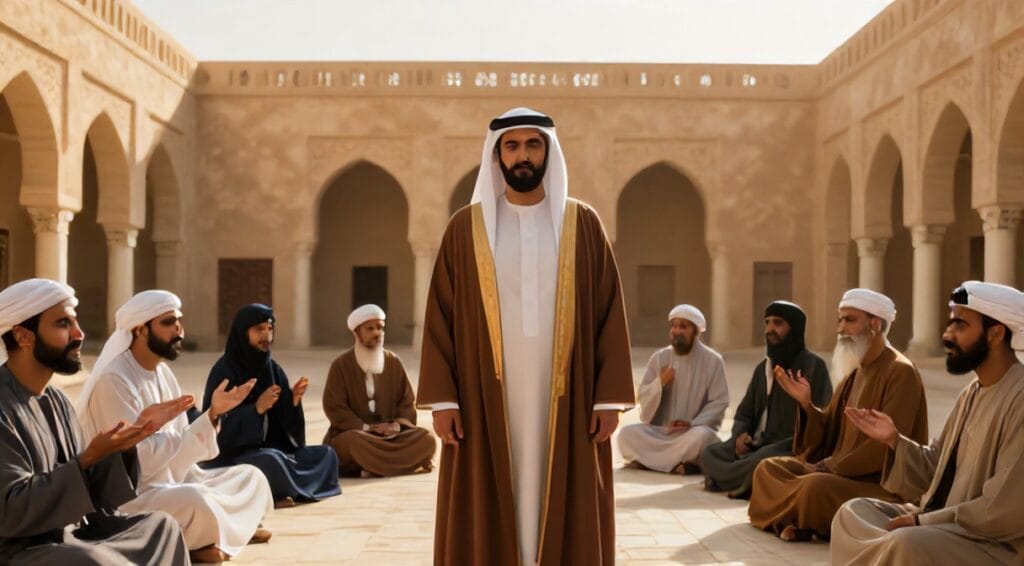
The day was hot and close, and the streets of Medina seemed to constrict under the weight of rumor. Uthman was dead; the third caliph had been murdered within his own walls. A city that had once echoed with the Prophet’s confident stride now drew curtains and slowed its footsteps. And then the call went out: the companions, the elders, the men who had fought at Badr and stood on Uhud’s slopes—come to the mosque. That morning, the square around the Prophet’s Mosque filled with wary faces and the taste of iron in the air. Swords hung low at hips, but the greater weapon was the voice: to speak for peace, to argue for order, to urge a new oath. At the center stood a man who had never needed a herald—cousin to the Messenger, husband to Fatimah, father of Hasan and Husayn—yet a man who was slower to reach for power than for a principle. In the columns’ shadows, some demanded him by name; others whispered of the rebels outside the city and of provincial lords who would not bend the knee. Amid this tightening circle, the ali ibn abi talib caliph emerged not as a victor but as a necessary anchor—reluctant, grave, and fully aware of the cost.
It’s astonishing, isn’t it? Legitimacy became a fragile bridge made of vows and memory. Medina’s marketplace paused as people poured into the mosque: goldsmiths still smelling of smoke, water-bearers white with dust, farmers with callused hands. Some clutched at Ali’s sleeves, invoking his justice; others flinched at the rebels’ shadow. Yet behind the celebrations—if they could be called that—lurked the specter of revenge. Phantoms of the siege of Uthman’s house drifted through every exchange. The new ali ibn abi talib caliph held the bay’ah not as a trophy, but like a physician handling a wounded patient whose breathing was shallow and whose heart had not decided to live.
Shadows Before the Dawn: The Murder of Uthman and the Crumbling Consensus
The murder of Uthman had not erupted from a single spark; it was a brushfire that crept across provinces with the slow arithmetic of grievance. Egypt complained of corrupt governors; Kufa and Basra protested dismissals and favoritism; tribes counted slights like beads. In Medina, the earliest community of the faithful, the sense of a moral economy—of justice measured not only in law but in fairness—had begun to fray. Uthman’s defenders insisted upon his piety and the continuity he brought; his critics listed names of governors accused of excess. Letters flew by courier across deserts; complaints arrived like lapping waves at the Prophet’s city.
When the siege formed around Uthman’s house, companions tried to intercede. Ali himself, in one strand of tradition, sent his sons to guard the aging caliph’s door. Footsteps pattered on rooftops, food passed hand to hand, and then the line was crossed: blood was shed where none had dared spill it. The murder divided memory itself. Was the community responsible for failing to prevent it, or had the murderers been vipers slithering between sanctities? This was the wound Ali would inherit. The ali ibn abi talib caliph would face not only enemies in armor, but also questions with no easy answer, questions that could not be lanced like an abscess. If Uthman’s murder demanded immediate retribution, who would carry it out, and with what authority? If a legal investigation was to be made, how could it be conducted while rebellion rattled the city gates?
A Reluctant Standard-Bearer: Ali’s Acceptance and the Weight of Duty
He refused at first, so the reports say. The alleys around the mosque gossiped about his reluctance: he would not chase the mantle of caliphate as one hunts a stray horse; it would have to come to him. He held the notion of leadership like a lamp, careful not to scorch what it sought to illuminate. When finally he consented—pressed by companions, pressed by necessity—he did so with caveats. He would govern according to the Book of God and the Sunna of His Messenger; he would not barter justice for alliance. The tones of his acceptance sermon were lean and upright. He would be, in the deepest sense, accountable.
For the ali ibn abi talib caliph, acceptance was a judgment upon himself as much as an answer to the crowd. “If I respond to you,” he is reported to have implied, “I must respond to God first.” That set a standard which, like all high measures, would prove both noble and costly. Even as he stood before the people, palm out to receive their hands in allegiance, he felt the crosswinds—some companions deeply devoted, others wary because of the men who had pushed for his election. A nursery of rumors had already sprouted: did the rebels plan to own him? Would Ali punish them? On that day, the man and his moment met in a silence almost as thick as the speeches that followed.
Pledges on the Mosque Floor: Bay’ah, Legitimacy, and the People’s Mandate
The bay’ah is tactile, an intimacy of law and skin. One by one, men placed their hands in his, repeating the vow. This was not a royal anointing but a community’s handshake—performative, yes, but binding. Here lay the delicate balance between consensus and coercion. Aisha, Talha, and Zubayr—giants of the early narrative—hesitated or delayed, histories differ, but the image that emerges is of a pledge made under strain. There is a human truth in the scene: even the faithful sign a contract with trembling pens when the room is already smudged with blood.
The ali ibn abi talib caliph did not lean on theatrics or lavish promises; he called back to first principles: justice for the weak, frugality in the treasury, removal of abusive appointees, and a renewal of the prophetic style of governance. Medina was still the city of the Prophet; the memory of his judgments lit the doorways like Pharos flames. But this was only the beginning. If a caliphate is a bridge, it must hold; if it is a promise, it must be kept. The pledges that day bore the perfume of courage and the tang of fear, as if everyone had boarded a ship in a rising storm.
The Measure of Justice: Early Reforms and a New Political Ethos
Within days, the new administration made signals clear: public funds belonged to the public, and governors served at the people’s trust. Debts would not be paid with gifts from the treasury; land grants would be scrutinized; men cloaked in power would be asked to step into the sun and show their hands. These measures were as much moral theater as policy—deliberate scenes meant to reset expectations corrupted by years of complaint. Ali’s famous insistence on justice, unbending to friend or foe, quickly earned him admirers—and enemies. Expectation, after all, is a jealous god, and the ali ibn abi talib caliph raised it high.
He dismissed or declined to reappoint several widely criticized provincial governors. He redistributed stipends with a mind toward equity, refusing to favor Quraysh elites above newly converted tribes. The treasury’s door swung on new hinges. Word traveled quickly—across caravan routes to Kufa, downriver to Basra, north to Syria—that Medina had a caliph who would not make private arrangements in exchange for public obedience. Those who desired a pliant center resolved to test him. Those who had long prayed for justice began to hope. Hope itself, however, is inflammable; handled roughly, it can explode.
The Cry for Retribution: Demands, Delays, and Irreconcilable Agendas
“Justice for Uthman,” cried voices in Medina and beyond. Many meant it in the deepest sense: the sanctity of leadership had been violated; those who brought the sword to an elder’s home must answer before God and man. Ali agreed that the crime demanded justice, yet he demanded procedure. The city was unstable, the culprits were intermingled, and no court could function while arms rattled at doorways. He insisted that the state must return to order before the state could prosecute. It was a careful, legalistic, and, to some, infuriating answer. The ali ibn abi talib caliph would not be stampeded.
But politics is rarely a contest between truth and falsehood; it is more often a collision of truths that cannot coexist. Some companions, whose grief for Uthman was sharp as glass, argued that the caliph who delayed retribution risked blessing the murderers by inaction. They did not trust his circle; they distrusted the rebels who had helped elevate him. In Egypt, in Basra, in Kufa, letters circulated calling for action, for naming names, for purification. And in Syria, Mu‘awiya, kinsman to Uthman and governor of a formidable province, prepared to make that demand the pillar of his political house. Each insisted that the tapestry could be mended—but only with their needle, only with their thread.
Governors, Grain, and Grievances: Reordering the Provinces
Governance is often measured by the price of grain before it is measured by the price of loyalty. In the markets of Kufa and Basra, receivers of stipends watched the baskets; in Egypt, the irrigation schedules were as binding as treaties. Ali’s government moved to replace or correct provincial administrations, drawing lines between loyalty and competence, between reputation and proof. Appointments to Egypt, Kufa, and Basra were debated like chess moves, each countered by powerful local factions. The treasury, already strained by unrest, had to serve both armies and widows. In this atmosphere, every decision could be misread as partisanship; every correction could be sold as vendetta. The ali ibn abi talib caliph now balanced ledgers and loyalties with the same trembling exactness with which he balanced law and mercy.
He demanded transparency from tax collectors and equity in the distribution of war spoils. Corruption was not merely an offense; it was a disease that spread through trust until the body politic refused to rise. Letters to governors, in one tradition later preserved, emphasize impartial justice and the rights of the vulnerable—widows, orphans, non-Muslim subjects under treaty. Even those who questioned his politics could not easily deny the seriousness of his ethic. But seriousness, too, is a blade. Warlords prefer negotiation; moralists prefer principle. When those two temperaments share a frontier, smoke appears on the horizon.
Road to Basra: Letters, Envoys, and the Fragile Bridge of Dialogue
Basra became a lodestone. Aisha, Talha, and Zubayr journeyed with the call for justice for Uthman’s blood, amassing supporters and stirring the city’s factions. Ali sent letters, envoys, overtures. Let us reason first, he urged, then judge. He knew, perhaps better than any, that a battle among the earliest companions would poison the well from which the entire community must drink. So he rode east. Along the road, tribes weighed their options, merchants kept their treasure at home, and scholars tried to place a word of caution into winds that did not listen. Negotiations flickered like candlelight: one meeting raised hopes, another snapped them. In one telling, Zubayr faltered when Ali reminded him of a prophetic warning about fighting him; passions were not impervious to memory.
What is history if not a sequence of near misses? The ali ibn abi talib caliph sought to avoid war without abandoning law; his opponents sought to demand justice without enthroning chaos. On the plain outside Basra, camels knelt under burdens of armor and tents; lances gathered in hedges. A city looked on from its walls, not sure whether it was hosting a parley or a tragedy in rehearsal. The sky was a lid. The ground seemed to demand a verdict.
The Night Before the Camel: Remorse, Appeals, and the Last Quiet Words
The night before the clamor, there were conversations tender as bruises. Ali met with emissaries in lamplight, the scrawl of letters mixing with the scent of sweat and wax. Some spoke of compromise: secure Basra, appoint an investigative council, isolate the known murderers of Uthman. Others insisted the time for mediation had passed. Aisha’s pavilion glowed like a moon in the camp; she, revered as “Mother of the Believers,” had taken a public stand to rouse accountability. Talha and Zubayr, veterans of the Prophet’s wars, carried both gravitas and haunted eyes. “We do this for justice,” the refrain went. But justice had many claimants. The ali ibn abi talib caliph paced the ground, knowing that dawn might bring the bitterest lesson: that even the righteous cannot always agree on how to defend righteousness.
Some narrations describe tears that fell before swords rose. Talha is said to have felt a late unease; Zubayr allegedly remembered a prophecy and withdrew. Fear, regret, conviction—each flickered in different hearts. The desert, indifferent and vast, had held many armies; it held this one with the same spacious irony. And when, in those last hours, hopes nursed by envoys sputtered out, it felt less like a choice than a weather system overtaking tents.
The Day of the Camel: Thunder of Hooves and a City’s Bitter Lesson
Battle is both spectacle and collapse. When it came, the day roared. Aisha’s camel stood as a symbol around which her forces rallied; amid the crash of spear and shield, its howdah became a banner. The field tilted and re-tilted with every charge. Ali, it is said, forbade pursuit of the fleeing, ordered protection for the wounded, and sought to end the conflict with minimal blood. By afternoon, the lines buckled. The camel became the vortex of the fight—its fall the punctum of the narrative. When it was finally brought down and the howdah secured, the battle dissolved into the sickly quiet of victory without triumph.
Ali approached Aisha with honor, sending her safely back to Medina under escort. The ali ibn abi talib caliph had prevailed in arms and now tested his ethic in aftermath. Post-battle policy was not lenient from weakness but principled from strength: no confiscation of property, no vengeance upon prisoners, burial for the dead with respect. Yet behind the celebrations lay a gaping wound: the community had tasted civil war. Brothers had faced brothers. Basra’s dust absorbed tears it could not return. And the victor, if that word still carried any meaning, left the field convinced that the sword was the worst of remedies.
Kufa as a Compass: Moving the Capital and Mending a Fractured Community
Medina, heart of revelation, was no longer the heart of administration. Ali felt the need to be closer to the Iraqi frontier where the muscle of the garrison towns lay. Kufa, with its stern barracks and diverse tribes, became the seat of power. The move was strategic and symbolic: a pivot eastward, toward the places where grain, soldiers, and decisions now massed. In Kufa’s mosques, sermons shaped a culture of fairness and restraint; in its markets, the presence of the caliph curbed some excesses and prompted others. For those who lamented the shift from Medina, the message was sobering: leadership must follow responsibility, and responsibility had followed the frontier.
But this choice had a price. Syria, stable and disciplined under Mu‘awiya, looked upon Kufa with resentment and, at times, disdain. The migration of the court scattered Medina’s social center of gravity. In Kufa, the ali ibn abi talib caliph worked to build loyalties that were new, to sew together tribes with histories of friction, to address pay scales and quartering arrangements that could spark mutiny if mishandled. All the while, letters from Syria arrived not with pledges but with postures. And the river continued to flow, indifferent and steady, as though wars were gentle storms that left no mark on its surface.
The Syrian Defiance: Mu‘awiya’s Calculus and the Tangle of Authority
Mu‘awiya ibn Abi Sufyan, governor of Syria, was the kind of leader who knew the power of patient time. He had waited through storms, built networks inside networks, and fostered a disciplined army loyal to its stipends and its stability. He was also kin to Uthman, and he dressed his refusal to pledge allegiance in the garments of justice: bring us the killers first, then we will talk of unity. Underneath was a contest of visions. Was caliphal authority a moral ideal to be obeyed unless clearly unjust, or a treaty negotiated among power centers?
Letters between Kufa and Damascus reveal two men testing each other’s arguments like swords at measured distance. Ali insisted that unity under legitimate authority was the precondition for justice; Mu‘awiya insisted that justice for Uthman was the precondition for unity. Each posed as the defender of principle. Each gathered men to his banner. Syria’s borders stiffened; Iraq’s drums beat in answer. The ali ibn abi talib caliph prepared to ride. He had fought on fields where the Prophet stood; now he would fight on fields where the Prophet was an echo carried by men’s memories and motives.
Toward Siffin: River of Stalemate, River of Stories
The Euphrates carries stories as well as water. At Siffin, its banks watched two Muslim armies arrive with prayers on their lips and grimness in their eyes. Initially, the conflict was a contest of maneuver and river access; the control of the water supply itself became weapon and bargaining chip. There were moments when it seemed that talk might win the day; emissaries reversed their tracks so many times that even the camels learned the route. Desert winds recorded sighs more than shouts. According to chroniclers, hundreds fell in fighting that spiked and subsided like fever. Neither side could claim the clear advantage; both could claim the righteousness they felt in their bones.
The ali ibn abi talib caliph insisted upon rules of engagement aimed at reducing civilian harm and preventing total destruction of the opposing force. He applied ethics as a curb to entropy. Yet as the weeks wore on, time eroded patience. Faithful men began to ask whether their prayers were being answered in blood or in delay. Nights were thick with recitation; days were sharp with steel. Any truce seemed to dissolve under the heat of noon. Then came the sight that would blaze into memory: Qur’an pages raised upon spearpoints, as if to arrest the sun.
Pages Against Spears: The Arbitration and the Politics of Piety
When the Syrian line lifted pages of Scripture to the sky, they did so with a theatrically sacred gesture: let the Book judge between us. For soldiers on the ali ibn abi talib caliph’s side, the appeal was both stirring and disarming. How do you cut through a verse? How do you advance on a text? Under pressure from parts of his own army, Ali ceased the onslaught and agreed to arbitration. It was a decision born of principle and circumstance—respect for the Qur’an’s authority, concern for the soul of the community, and an instinct against compulsion when the call to God was raised. But once swords pause, politics speaks. The two arbiters—Abu Musa al-Ash‘ari and ‘Amr ibn al-‘As—entered a theatre where script and stagecraft were not the same.
The outcome, in many retellings, left Ali weakened. The Syrian narrative claimed advantage; Iraq echoed with quarrels. Some accused Ali of being right but too easily swayed; others accused his soldiers of sabotaging a victory with scruples. Historians have argued over what the arbiters intended and achieved. One classic assessment holds that the process was crafted to dilute Ali’s moral authority in a forum where moral authority was his strongest suit (Madelung, The Succession to Muhammad, 1997). In any case, the arbitration, meant as balm, became an irritant. It fractured allegiance and opened within Ali’s camp a wound that would prove more dangerous than the swords across the river.
Fracture Within: The Khawarij, Nahrawan, and the Peril of Purity
They were called the Khawarij, the “those who go out,” emerging from within Ali’s own ranks, radicalized by the belief that arbitration in a matter God had already decided was a sin. “La hukma illa lillah”—“No judgment but God’s”—they cried, and their ferocious purity turned first upon their erstwhile comrades. The ali ibn abi talib caliph argued with them, debated in sermon and in person, offering amnesty to those who returned and standing firm against those who shed blood. It was a heartbreaking dialogue: a leader who valued principle, facing men who weaponized principle against the very society it sought to guard.
The rupture worsened. Along the roads and in villages, zeal mixed with violence. Eventually, at Nahrawan in 658, confrontation became unavoidable. Ali’s army crushed the insurgents militarily, yet he grieved the necessity. He ordered his forces to avoid plunder, to offer water to the wounded, to invite survivors back into the fold. He had won—but at a cost that multiplied like sorrow. In civil wars, even victory feels like losing something you cannot name. And the Khawarij, though broken there, would endure as a nerve in the Muslim body—raw to the touch, flaring in times of stress, capable of impossible demands.
Letters as Lanterns: Governance, Sermons, and the Moral Grammar of Power
What remains when banners fall? Words, inscribed and recited. Ali’s letters to governors, his sermons to soldiers, his instructions about taxes and the treatment of non-Muslims, later anthologized in traditions like Nahj al-Balagha, are the lanterns he left to those who would walk after him. He urged officers to be shepherds, not wolves; told tax collectors to regard the peasant’s sweat as sacred; reminded judges that the poor man’s truth is as weighty as the rich man’s argument. He even instructed that a fallen enemy’s dignity must be guarded, for the soul’s sake as much as the polity’s. In an era of chronic exhaustion, these words were like cups of clear water passed from hand to hand.
The ali ibn abi talib caliph held to an ascetic personal style: scant furnishings, unpretentious meals, public accountability. This contrasted with the growing Persianate and Byzantine tastes creeping into provincial courts, where governors enjoyed the trappings of rank. That contrast wasn’t merely aesthetic; it was a policy statement. In one often cited letter to Malik al-Ashtar, appointed to Egypt, he drew a whole architecture of governance: rights of citizens, duties of officials, oversight mechanisms, and a portrait of the good life in a just city. Such texts made him a touchstone across centuries, called upon by theologians, rebels, and reformers alike. As one medieval chronicler summarized with restrained admiration, “He taught leaders how to be afraid of their own power” (al-Tabari, History). Even a fragment of that fear can be a kind of wisdom.
Winds of Loss: Desertions, Dilemmas, and the Ever-Narrowing Circle
After arbitration, Ali’s coalition thinned. Some Iraqi tribes developed a new hesitancy, requesting pay before service, justifying delay with the language of prudence. Syria’s cohesion stood in pointed contrast. The ali ibn abi talib caliph found himself forced to choose between his own tempo and the tempo the world forced upon him. He reorganized, re-argued, re-summoned loyalties that now responded like echoes: present, but fading. Every delay was a victory for those who preferred not to be governed by him. Every stern sermon to rally spirits risked sounding like reproach. The theater of statecraft had gone from classical tragedy to something colder: administrative attrition.
Yet he refused to trade integrity for efficacy. Fighters grew weary; treasuries grew thin; letters returned without signatures. Through it all, he kept the standard raised: equity in stipends, no special privileges for tribal nobles, and a constant insistence that the orphan’s cry mattered more than the notables’ applause. In the short run, such policies alienate. In the long run, they teach. But history rarely pays tuition on time. And so the ali ibn abi talib caliph walked a narrowing road, at dusk, with fewer companions than at noon.
The Last Ramadan: A Blade in the Dawn and Kufa’s Tears
Ramadan, the month of fasting and return, arrived in 661 with a hush that felt like reprieve. Ali prayed in the mosque of Kufa before dawn, his forehead familiar with the earth. A man moved in the half-light—Abd al-Rahman ibn Muljam, whose grievance had calcified into murder—and the strike came quick, a poisoned blade on the tender place of bowing. The cry rippled through the city like a shiver through water. Even those who had opposed him felt the gravity of what had been done. In the caliph’s home, the sound of children’s grief met the calm of a man who forgave even as his breath thinned.
“Do not exceed,” he is reported to have instructed; let the law judge, not rage. The ali ibn abi talib caliph in death spoke the same grammar of justice he had demanded in life. Kufa wore gray faces for days; markets murmured prayers; minarets offered recitation like a balm. It is said that when news reached far provinces, even adversaries were stilled; some enemies are too valuable to lose, because they force you to think. The funeral carried both intimacy and enormity, as if each palm branch carried two weights: a single man’s absence and a century’s task list. He was buried quietly, the location veiled in early tellings to protect the grave from profanation. Silence took the last word, as it always does. But silence is not forgetfulness. It is the soil from which memory grows.
Echoes and Lines of Memory: Legacies Across Centuries
What did it all mean—this four-year axis on which so much turned? For Sunni historians, Ali is the fourth of the Rightly Guided, a caliph whose justice and piety gild the chain of succession even as civil strife warns of human frailty. For Shia communities, he is Imam and guide, the divinely designated leader whose claims were obscured by politics and whose descendants would suffer for a truth too bright for their age. For all, he is the exemplar of courage restrained by conscience, eloquence harnessed to honesty. The ali ibn abi talib caliph stands at a crossroad made of scripture, law, and love: the Qur’an’s letter, the Prophet’s memory, and the people’s aching desire for a ruler who fears God more than defeat.
Across centuries, his words have been recited in courts and kitchens, at revolts and reconciliations. The Battle of the Camel teaches that even the noblest can collide when grief rules counsel. Siffin and its pages teach that piety can be a riptide as well as a harbor. The Khawarij remind us that purity without prudence becomes cruelty. His letters to governors—on not overlooking the widow, on punishing the tax collector who offends the peasant—give spine to the idea that governance is a moral craft or it is nothing. The political effects of his rule reached beyond his lifespan: Mu‘awiya’s consolidation would inaugurate dynastic rule, the Umayyads would rise with their own moral and administrative logic, and the memory of Ali would become both balm and banner in struggles to come. In the end, the ali ibn abi talib caliph is less a statue than a question: How much integrity can power bear before it breaks, and how much compromise can it survive before it loses its soul?
Conclusion
On June 18, 656, in a sun-struck Medina that prayed for calm and bristled for war, Ali accepted a role that would test the very boundaries of conscience in power. From the trembling pledges on the mosque floor to the bitter clarity of Basra, from the river-washed stalemate of Siffin to the tense theater of arbitration, he led with a compass set to justice and mercy. The ali ibn abi talib caliph navigated a topography in which every moral choice had military consequences and every political choice carried theological reverberations. His victories were carved in restraint as much as in strategy, his defeats often born of principles he refused to betray. His letters teach rulers to be human, his battles teach the faithful to be patient, and his death teaches even enemies to weep. More than any single verdict, the tale abides as a living curriculum: that integrity is not a soft virtue but a severe discipline, that justice without wisdom wounds, that unity without conscience corrodes. To read his story is to step into a room where time holds its breath, where the demands of heaven and the demands of earth argue their case, and where a man with a calm gaze chooses, again and again, to be answerable to both.
FAQs
- Why was Ali chosen as the fourth caliph?
After the murder of Uthman, Medina faced a leadership crisis. Many companions believed Ali’s piety, kinship to the Prophet, and reputation for justice made him the strongest moral anchor. He initially resisted but accepted when pressed, vowing to govern by the Qur’an and the Prophetic tradition. - What made his rule distinctive?
The ali ibn abi talib caliph emphasized equitable distribution of resources, accountability of governors, and protection for the vulnerable. He rejected patronage politics and set a high ethical standard that appealed to many but alienated those who sought negotiated privileges. - Why did conflict erupt with Aisha, Talha, and Zubayr?
Differing views on immediate retribution for Uthman’s killers and anxieties about the rebels’ influence prompted a coalition to mobilize in Basra. Although both sides claimed justice, negotiations failed, and the Battle of the Camel ensued, followed by Ali’s careful post-battle reconciliation efforts. - What happened at Siffin?
Ali’s and Mu‘awiya’s forces clashed near the Euphrates in a grueling stalemate. The raising of Qur’an pages on spearpoints prompted a pause and arbitration, which undercut Ali’s position and sowed division within his camp. - Who were the Khawarij?
A radical faction that emerged from Ali’s own ranks after Siffin, condemning arbitration as ungodly. They turned to violence; Ali defeated them at Nahrawan but lamented the bloodshed and continued to invite repentance and reintegration. - Why did Ali move the capital to Kufa?
Strategic necessity: Iraq was a military and economic center. From Kufa, he could manage armies, stipends, and provincial governance more effectively, even though the move cost him some of Medina’s moral centrality. - How did Ali’s governance influence later Islamic thought?
His letters and sermons, emphasizing justice, humility in leadership, and care for the marginalized, became canonical in political ethics. They shaped Sunni and Shia notions of just rule and inspired later reformers and scholars. - What led to Ali’s assassination?
The lingering resentments of civil conflict and extremist opposition culminated in an assassination by Ibn Muljam during Ramadan 661 in Kufa’s mosque. Ali’s final instructions upheld legal procedure and forbade vengeance beyond the law. - How do Sunni and Shia perspectives differ on his caliphate?
Sunni tradition honors him as the fourth Rightly Guided caliph and a model of piety. Shia tradition regards him as the first Imam, divinely designated, whose rights were eclipsed by political circumstances. Both view him as a paragon of justice and courage. - What is the significance of the Bay’ah in his election?
The bay’ah was a public pledge that conferred communal legitimacy. Amid crisis, it symbolized a renewed compact to uphold law and collective responsibility, even as divisions persisted. - How did he treat opponents after battle?
With restraint: protecting prisoners, forbidding plunder, and offering safe passage. The ali ibn abi talib caliph extended dignity even in victory, a policy that marked his moral approach to civil strife. - What are key sources for this period?
Classical chronicles such as al-Tabari’s History, reports preserved in later anthologies like Nahj al-Balagha, and modern analyses, for instance Wilferd Madelung’s The Succession to Muhammad and Hugh Kennedy’s works, are central references.
External Resource
Internal Link
Other Resources
- Encyclopaedia Britannica – general search for the exact subject
- Google Scholar – academic search for the exact subject
- Internet Archive – digital library search for the exact subject

