Table of Contents
- Dawn over the Danube: Esztergom Awakes, 1001
- From Bloodline to Baptism: The House of Árpád Turns West
- A Rebellion Quelled: The Defeat of Koppány and the Path to a Crown
- Envoys, Relics, and a Ring from Rome
- Esztergom’s High Winter: The City as Stage
- The Crown and the Hand: Rite, Relic, and Symbol
- New Year, New Kingdom: The Moment of Anointing
- Queen Gisela and the Bavarian Bridge
- The First Oaths: Nobles, Warriors, and County Lords
- The Christian Kingdom Takes Shape: Bishoprics and Monasteries
- Law and Mercy: The Decrees of Saint Stephen
- Sword and Plow: Fortresses, Markets, and Coin
- Between Empires: Diplomacy with Rome and the Ottonian Court
- Dissent and Conversion: The Price of Alignment
- Memory and Legend: Chronicles, Hagiography, and the Crown’s Story
- Everyday Lives After the Coronation
- The Long Arc: Wars, Heirs, and the Question of Succession
- Echoes Across Centuries: National Myth and Political Tool
- Conclusion
- FAQs
- External Resource
- Internal Link
Article Summary: In the winter of 1001, at Esztergom beside the frozen Danube, a young ruler named Stephen received a crown and turned a confederation of clans into a Christian kingdom. This article follows the months, breaths, and decisions that culminated in the coronation of stephen i, showing how a rite performed in candlelight reshaped the political map of Central Europe. It traces the line from pagan steppe riders to Latin Christianity, from family feuds to sacramental kingship, and from the anxious night before the ceremony to the decades of lawmaking that followed. Along the way, emissaries move through snow, bishops whisper prayers, and families weigh old customs against new obligations. We dwell on the human costs and hopes of conversion, the building of churches, the raising of fortresses, and the creation of coinage that tied markets to the king’s peace. We also follow the afterlife of the crown in chronicles and legend, and the way later centuries pressed Stephen into the shape of a saint and a symbol. By the end, the reader will see the coronation of stephen i not as a single moment, but as a living hinge between worlds, carrying its legacy far beyond Esztergom into the modern idea of Hungary. The story is at once intimate and monumental, where a candlelit anointing becomes the instrument of centuries of change.
Dawn over the Danube: Esztergom Awakes, 1001
The river was a sheet of hammered pewter under winter light. Esztergom, perched high on its rocky outcrop, exhaled steam and smoke into the first morning of the new century’s first year. The hilltop fort, wood and stone braided together, knew the footfalls of smiths and guards, of monks whose breath fogged the cloisters as they sang in Latin; they knew, too, the gathered retinues of a ruler who would soon be a king in the eyes of Christendom. The town below, its lanes etched by sleigh runners and hoofprints, seemed to listen for a bell that had not yet sounded. Here, the coronation of stephen i would take form, and with it a new answer to the question that had hovered over the Hungarian plains for generations: would this people bind themselves to the law of Rome, with all its discipline and promise?
To say that the day erupted from nowhere is to ignore the slow accretion of vows, victories, and fears that preceded it. Stephen, the son of Grand Prince Géza and the Bavarian-born Sarolt in some legends, had been baptized as a child and prepared not only in hunting and warfare but also in the tastes of Latin letters and the protocols of court. His marriage to Gisela of Bavaria turned a family choice into a continental hinge. Yet none of this carried the sacramental charge that would flow, on this day, through the king’s brow and hands when oil met skin. The coronation of stephen i, whether dated to December’s last breath or January 1 of 1001 as many later annalists remembered, was less an event than a proclamation to neighbors near and far that the time of negotiations was over: Hungary would be a Christian kingdom, and this young man would be more than a clan leader.
But this was only the beginning. Even before dawn, the courtyards filled with bundled men whose clothes proclaimed their lineage, their provincial tongues, and their proximity to power. They came from the Danube’s floodplains and the forested uplands, from the new market towns rising at strongholds, and from the farms that pulled food out of winter-stiff earth. Some bore spears and swords; others held candles or staffs; many bore scars. Their eyes lifted to the keep, to the new church at Esztergom, to the banners snapping weakly in the brittle wind. Above them, a boy become duke become king-in-waiting prayed, or paced, or both. He might have remembered how close the kingdom had come to slipping away in civil war, how near the knife’s edge between competing rites and calendars the country had always stood. The coronation of stephen i would not erase the past; it would consecrate a future that still had to be fought for step by step.
From Bloodline to Baptism: The House of Árpád Turns West
Before the crown, before the church doors opened, there was a family reckoning: what did it mean for the Árpád line, heirs of a conquest a century old, to submit to an order crafted in far-off Rome? Géza, Stephen’s father, had navigated the question with a pragmatist’s heart. He had permitted baptisms, welcomed monks, and tightened his grip on the fractious tribal leaders who had long thrived in the spaces between custom and command. His court at Esztergom became a testing ground for Western ritual, yet he never forgot the sinews of power that had sustained the confederation—alliances cemented by marriage, oaths sworn over meat and mead, and the readiness to move men and horses swiftly and without apology.
Stephen inherited this delicate web and, with it, the tenuous promise that Christianity need not unravel a warrior culture. He was christened István, named for the first martyr of the Church, whose feast day fell just after Christmas—a coincidence later choristers would savor. If Stephen’s name was a prayer, it was also a prophecy: he would be crowned not only as ruler but as defender of a fragile ecclesiastical scaffolding stretched over restless plains. His marriage to Gisela tightened the hinge that linked Esztergom to Regensburg and beyond. Bavarian influence brought advisors versed in the discipline of bishoprics and the counting of coin. It also drew enmity from those who saw in Latin ritual an insult to the old ways and in German friendship a leash.
Yet behind the celebrations lay a practical calculus. Alignment with Rome and the Holy Roman Empire was not simply a matter of how to pray, but of how to survive among neighbors who measured legitimacy in chrism and iron rings. The coronation of stephen i, once completed, would speak a language Europe understood. A baptized ruler with holy oil on his brow could levy tithes, found monasteries, issue coinage, and be treated as a peer. A warlord could always be treated as a target. Stephen was too shrewd to mistake sentiment for security; he prepared for both.
A Rebellion Quelled: The Defeat of Koppány and the Path to a Crown
None of the rites of January would have been possible without the harsh arithmetic of blood and victory that preceded them. After Géza’s death, Stephen confronted Koppány, a powerful kinsman who claimed leadership according to older rules of seniority and levirate marriage. Koppány’s claim was not outlandish within the old code, but it collided—violently—with the new model of direct succession and Christian marriage that Stephen and his advisors championed. The ensuing clash around 997 or 998 was a crisis of regime and of ritual; behind each charging horse rode a vision of what Hungary would become.
When Stephen’s forces, assisted by German knights including the often-named Vecelin, broke Koppány’s resistance near Veszprém, the victory did more than avert a parochial family disaster. It set the terms for the coronation of stephen i by cutting away the most formidable domestic alternative. The grim display of Koppány’s quartered body upon the walls of major centers announced that the past would not be permitted to dictate the future—an act both macabre and clarifying. It was in the shards of that rebellion that a path to the altar opened. The lesson was cruel but effective: Stephen’s new order would protect, and it would punish.
To the monks bending over parchment and to the warriors cleaning their swords in melted snow, the message was the same. Authority must be singular if it is to be sacred. The anointing that would soon fall on Stephen’s head never swam free of this battlefield baptism. The coronation of stephen i would be both prayer and settlement, absolution and threat, a promise that the peace of the king could and would be made with iron if necessary.
Envoys, Relics, and a Ring from Rome
Legitimacy traveled in winter with men whose boots squeaked on frost. In the months before the ceremony, Stephen’s emissaries traced routes to Rome and to the courts that answered to the Ottonian emperors. They carried gifts and letters, arguments and deference. The old chronicles disagree on the exact choreography—did Pope Sylvester II send a crown? Was Emperor Otto III a partner in the theater of recognition?—but the pattern is unmistakable: this coronation would be recognized, and by recognition it would generate the very authority it claimed.
Later hagiography, including the 12th-century Vita by Bishop Hartvic, insisted that a crown was indeed dispatched from Rome, a sign that the Apostolic See embraced the new king. Whether the metal that touched Stephen’s head that icy morning was the same as the later Holy Crown of Hungary—with its Greek and Latin elements now so famous—is a matter of learned debate. Yet the symbols were not in dispute: a crown conferred by Christian Europe’s highest altar, a ring signaling nuptials between ruler and realm, a scepter and a sword promising both justice and protection. In the telling of Thietmar of Merseburg, who wrote within Stephen’s lifetime, the Hungarian ruler emerged not as a marauder or client, but as rex—king by divine favor and diplomatic recognition (Thietmar, Chronicle, Book VII).
It is astonishing, isn’t it, how a few objects can change the weight of a man’s hand. With a ring, he becomes bridegroom of a land; with a sword, its judge; with a crown, its visible soul. The coronation of stephen i would gather these into a single rite that bound Esztergom to Rome and to a network of sacral kingship that would endure for centuries.
Esztergom’s High Winter: The City as Stage
Esztergom was both fortress and chrysalis. In winter, its streets were a chorus of crunching snow and the occasional clatter of armor against stone. The cathedral—new, perhaps still smelling of worked wood and resin—stood ready to hold a drama many had never witnessed. Torches and candelabra prepared to turn night into a golden cave. Cloaks were brushed, banners repaired, voices rehearsed. The town’s women had braided hair and carried tokens to the churches that dotted the ridge, praying in the uncertain dawn for husbands, sons, and brothers who would pledge anew to a king and to a God who demanded much.
Look closely and you might see the debated boundaries of power written in how men positioned themselves. Counts and castle chieftains clustered in groups that corresponded to lands and loyalties. Bishops-to-be, some brought from Bavaria or guided by missionaries from Passau, conferred with monks whose hands bore the ink-stains of recent translations. The ceremony’s placement at Esztergom mattered. This was no accidental stage. As the seat where Géza had balanced old and new, as a river port linking hill to plain, the city offered a geography of synthesis. The coronation of stephen i would locate sovereignty not in a nomad’s moving camp but in a hill crowned by stone and altar, in a city that could host markets and courts as well as armies.
The bells began to toll, slow and heavy. Smoke drifted low along the streets then lifted, like a veil. The people pressed forward, each step a decision to belong to what would unfold. The first notes of chant rose, and with them, the old world tilted toward the new.
The Crown and the Hand: Rite, Relic, and Symbol
Medieval coronations were orchestras of touch. Oil on skin; silk against palm; iron set in scabbard at the hip; the cool circle of a ring around the kingly finger. Stephen’s rite—modeled on Latin liturgies that had sanctified kings in Francia and Saxony—mixed the consecration of a priest with the investiture of a war leader. The new king would be anointed, blessed, enthroned, entrusted with the regalia that made private power public. Each object preached a sermon. The scepter demanded ordered justice. The sword promised protection for the poor and punishment for the violent. The crown declared that authority had a shape that could be seen and, by being seen, internalized.
Relics, too, had their say. Some accounts speak of Stephen’s connection to the relics of Saint Stephen the Protomartyr, his namesake; later history, of course, would house the king’s own right hand—the Holy Right—as a relic venerated by generations. But in 1001, relics mattered as bridges between heaven and earth, approving the ceremony not just by words but by presence. The coronation of stephen i was performed before altars that held bones and fragments, the tactile testimony of faith in a world that believed touch could carry grace.
The prayers intoned over Stephen were ancient to the voices that spoke them. They invoked protection over fields and laws, victory over enemies, wisdom in counsel, and a just heart in judgment. The choreography of kneeling and rising, of receiving and holding, established a grammar of rule that would be taught to every count and peasant by repetition. In this hour, the body of the king became the book from which the land learned to read the legitimacy of power.
New Year, New Kingdom: The Moment of Anointing
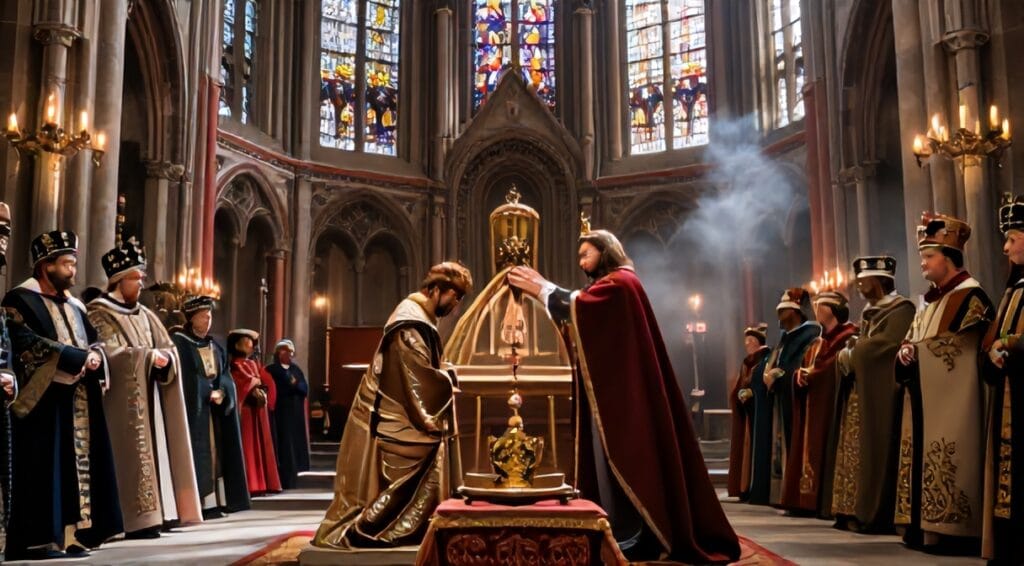
Imagine the oil, warm from the deacon’s hand. It moves from thumb to brow, tracing the sign of the cross. Silence gathers and then cracks, like ice yielding on a river, as the chant swells again. The ring slips into place; the sword is girded; the scepter set in his grasp. At last, the crown is lifted—gravity and gleam—and lowered onto Stephen’s hair. Eyes widen, breath catches, the king’s gaze fixes on the crucifix. The consecration tips from potential into reality. The coronation of stephen i is complete.
The smell of the church deepens—wax and wool, sweat and incense. Outside, the city waits for the tone of bells that signal the new status of the man within. Trumpets answer; drums or the stamping of boots underscore the sound. Clergy chant, perhaps in a rite adapted from what bishops had seen at Regensburg or Passau. The effect is deliberate: the kingdom is new only in the sacramental sense. It is to be built by old hands whose ritual expertise is imported and localized, the better to fuse universality and uniqueness.
The first cheer is not merely relief. It is the cathartic voice of a people who have stepped off a precipice and found stone beneath their feet. The year 1001, in Esztergom, acquires a center of gravity: the coronation of stephen i becomes the axis around which courts and laws will turn. Beyond the church doors, messengers prepare to carry the news. In the west, dukes will take note. In the south, Byzantine observers will calculate. In the north and east, pagan chieftains and Christian princes alike will measure what new alignments this crown implies. The anointing delivers a future written in wax and steel.
Queen Gisela and the Bavarian Bridge
At Stephen’s side stood Gisela, sister to the Bavarian duke and niece to imperial power—a woman whose presence smoothed roads otherwise rough with rivalry. Her dowry traveled not only as chests and cloth but as relationships, letters of introduction, and a grammar of governance perfected in the workshops of the Regensburg scriptorium and the court of the Ottonian world. She would sponsor churches and monasteries, shelter reformers, and become a living reminder that the new king’s crown rested on a web of alliances as much as on bone and oil.
Legends would later crown her as cofounder of Hungarian Christianity, and while the poetry of that claim eclipses the nuance, its spirit is accurate: she was advisor, advocate, and often, interlocutor between competing minds at court. The coronation of stephen i did not happen to Gisela; she helped make its afterlife possible by turning the soft power of kinship into hard institutional change. In her wake came artisans, scribes, and knights familiar with the discipline of comital administration. If Stephen was the hand that signed, Gisela was the whisper that guided the line.
Her story reminds us that kingdoms are not built by single men. They are braided from marriages, treaties, and friendships that survive dinners and outlast arguments. In the intimate theater of the royal apartment, Gisela and Stephen translated each other’s worlds—hers of cathedral chapters and imperial etiquette, his of steppe memory and the practical politics of fortress and field—into the common language of a kingdom that had to speak both to succeed.
The First Oaths: Nobles, Warriors, and County Lords
With the crown secure, the ritual continued in a sequence of vows and acclamations. Nobles swore fidelity; bishops pledged counsel; warriors pounded fists to breast or shield. Oaths, in this world, were knives with two edges: they bound both the swearing and the sworn-to, constraining the king as well as his lords. The bond promised mutual defense, justice, and predictable exactions. It also set the frame for a reorganization that would define Stephen’s reign: the creation of counties (vármegyék), each tied to a royal fortress and administered by an ispán, a county head who answered to the crown.
The count system was not invented in a day, but the coronation of stephen i gave it a soul and a starting gun. County lords collected taxes, dispensed justice, and mustered troops. Around the royal fortresses grew market settlements whose weekly rhythms braided commerce and court. This web turned the old tensile strength of a nomadic confederation into the layered resilience of a kingdom. It could absorb shocks because it dispersed authority through a lattice that still pointed, clearly and firmly, back to the king.
Those who bent the knee did so because they recognized both opportunity and threat. Under the king, their lands gained security and their disputes a forum. Against the king, they faced not a solitary household but an institution girded by sacral authority and staffed by men whose legitimacy marched in step with the year’s liturgical calendar. The old ways did not disappear. They were absorbed, mapped onto new offices and obligations until custom learned to wear law like a well-cut cloak.
The Christian Kingdom Takes Shape: Bishoprics and Monasteries
Stephen’s next acts were acts of architecture. Not only the building of churches and monasteries, but the laying of invisible foundations: diocesan borders, charters of privilege, endowments in land and exemption. The bishoprics that would anchor the kingdom—Esztergom and Kalocsa among the primatial centers, with Veszprém, Pécs, Győr, Eger, and others forming a spiritual geometry—began to coalesce. To each, Stephen attached revenues and immunities, ensuring that clerics would have the means to preach, teach, and adjudicate matters that touched both soul and purse.
Monasteries were seeds Stephen planted with deliberate hands. Pannonhalma, already rising under Benedictine guidance, became a fountain of learning and administration. Monks kept accounts, copied texts, and taught the sons of nobles to read the Latin that would be the state’s second tongue. In a famous tradition, Stephen’s laws demanded that a church be built every ten villages—a policy less about counting settlements than about saturating the land with regular ritual. Sunday took on a new gravity; feast days punctured the calendar with meaning. In market squares and at the gates of castles, the chant and the bell taught time to keep a new beat.
This structure was not mere piety. It was method. The coronation of stephen i, by infusing kingship with divine sanction, created the logic by which bishops reinforced royal law and royal officers protected ecclesiastical privilege. It was a symbiosis the frontier had not known, and it gave Hungary the ability to move grain and gold, justice and grace, across a wide, sometimes unruly, canvas.
Law and Mercy: The Decrees of Saint Stephen
From Esztergom’s chancery flowed words sharp as blades and gentle as balm. Stephen’s decrees survive in collections that show a ruler attentive to the fabric of daily life: Sunday rest enforced, tithes collected, theft punished, hospitality to strangers mandated. He regulated fasting, demanded due respect for bishops, and ruled against pagan rites. He curbed blood feuds by channeling vengeance into fines and judicial process. The combination was paternal and stern; he imagined a realm in which obedience would save souls and quiet villages.
His laws asked much of ordinary people. Tithes bit into hard-earned stores; the building of churches demanded labor and wood that might otherwise have warmed families through winter. Yet they gave something in return: a framework of predictability. A shepherd in Eger and a merchant in Győr could recognize the same market rules, the same penalties, the same holy days. The coronation of stephen i had been a liturgy; his laws made it a lived pattern. Even criminals were sometimes offered conversion as mitigation; mercy and penance replaced the quick blade in certain cases, a sign that justice sought to imitate divine patience where possible.
It is in these texts that Stephen first emerges as more than a crowned silhouette. He is a craftsman of social order, a ruler who understood that power without statute is noise and terror, and that statute without power is paper. The balance he sought—to let mercy breathe within the lattice of discipline—would be tested again and again in the valleys and courts of his expanding realm.
Sword and Plow: Fortresses, Markets, and Coin
Stephen ruled a land that fed itself with grain and herds, that traded salt, furs, and slaves at its darker edges, and that dreamt of coin minted with the king’s name. Esztergom’s mint did indeed begin to strike silver denars, small bright messages that traveled pockets and saddlebags from fair to frontier. On them, the letters of the Latin West encircled symbols that the East might still recognize, a quiet declaration that the kingdom would speak in both alphabets when it had to.
Fortresses rose and thickened existing ramparts. Royal castles anchored counties, their garrisons a home for warriors who learned to see themselves as servants of an office, not only companions of a man. In their shadows, markets swelled. Weekly fairs drilled the rhythm of buying and selling into the bones of the countryside. The coronation of stephen i had promised protection; these places provided it in wood and stone. A thief who learned to count the steps to a gallows might also learn to count the steps between stalls where bread, cloth, and iron tools could be found as predictably as the Mass on Sunday.
Stephen’s economic vision was less about innovation than about institutionalization. He took the caravan and tied it to a calendar; he took the plow and tied it to a tithe. In the mixture, one can sense the limits of royal reach—frontiers would always attract raiders and refugees—but also the increasing difficulty for rivals to imagine Hungary as a prize rather than a partner. Stability is its own diplomacy, and Stephen studied it as carefully as he had studied prayer.
Between Empires: Diplomacy with Rome and the Ottonian Court
After the coronation, letters crossed mountains. Messengers warmed hands at monastery hearths and read aloud words that joined altar to throne and throne to neighbor. Stephen addressed the Papacy with deference, the Ottonian court with kinship, and Byzantium with courtesy edged by caution. A king who had been anointed and crowned could play a longer game than a warlord who had to seize respect each spring anew. Treaties took shape. Borders were interpreted rather than merely tested.
Friendship with the Holy Roman Empire never meant servility. The Ottonian world, itself embroiled in questions of regency and reform, winked and frowned by turns at Hungary’s growing self-confidence. Yet the advantage of a shared vocabulary of rule—bishops, counts, monasteries, and the notary’s pen—was enormous. When disputes rose, they could be arbitrated in ways that didn’t always require the saddle. The coronation of stephen i had been a public invitation to treat Hungary as a familiar. The invitation was not always accepted gracefully, but it could not be ignored.
Meanwhile, Rome worked on Stephen as Stephen worked with Rome. The Vatican prized an obedient, missionary king guarding the marches of Latin Christendom. Stephen wanted recognition and moral authority to discipline his own magnates. The exchange suited both. It was in this interplay—half-choreography, half-contest—that the shape of Central Europe hardened into something neighbors could name and map without squinting.
Dissent and Conversion: The Price of Alignment
No kingdom converts in a day, nor does a crown abolish habit. In the shadows of new churches, old rites still breathed. Families lit fires on hills at the wrong times, whispered prayers to the wrong gods, or simply kept the old calendars that governed planting and marriage. Some dissent was quiet stubbornness; some turned sharp. Stephen’s reign contains episodes of rebellion and of harsh retribution, of priests murdered and of leaders hanged or exiled for clinging to what the king now called error.
The cost was human, and it was not paid only by the guilty. A father in the northern forests might watch his daughter leave to marry in a town she would not have visited a decade earlier. A hunter whose patience at dawn once counted as virtue might find himself fined for missing Mass. This is what the coronation of stephen i meant at ground level: a thousand small dislocations, each justified by the promise of peace, order, and salvation. Many accepted the trade with relief; violence wears on a people’s nerves. Others bore it with resentment and adapted out of fear or weariness. The priests who learned enough vernacular to preach toward the heart softened the edges; the officers who learned only how to fine and flog hardened them.
Stephen’s own instructions to his son, later known as the Admonitions, urge rulers to honor guests, to treat strangers with kindness, to preserve the plurality of peoples in the realm. It is an extraordinary window into a mind that understood the paradox of a diverse kingdom consecrated to a single faith. Within that paradox lay both the tenderness and the steel of his governance.
Memory and Legend: Chronicles, Hagiography, and the Crown’s Story
Events become stories; stories become bones in the body of a people. The coronation of stephen i soon grew a literature of its own. Thietmar of Merseburg, writing early in the eleventh century, speaks of Stephen as king by God’s favor and European consent—a contemporary voice that, while brief, grounds the legend in the sturdy soil of reportage. Later, Hartvic’s Vita wove the miracle and the moral together, insisting that the Pope had sent not only the crown but divine approval for Hungarian kingship as a concept. It is in Hartvic that one hears the medieval conviction that ritual does not just reflect reality; it creates it.
Meanwhile, the crown itself gathered tales like snow gathers contour. Was it the same as the Holy Crown reverenced in later centuries, with Byzantine enamel portraits and Latin inscriptions married together? Or did that composite diadem grow from the needs and accidents of later dynasties? Scholars argue, as scholars should. In a way, the debate proves Hartvic’s point: the object matters because of the rite it carried. The coronation of stephen i is the gravitational center, not the metal. The crown’s current form—its tilted cross a familiar silhouette—is a palimpsest of centuries of reverence and repair. Its story is the kingdom’s, scuffed by war, burnished by devotion.
Citation matters, but so does song. Minstrels sang of Stephen’s justice and of the strong right hand he bore into battle and blessing. Painters later set his figure against golden backgrounds, king and saint entwined. In these images and texts, one senses a people comforting themselves that their order had a sacred author and that their sacrifices found purchase on a ladder that reached beyond the clouds.
Everyday Lives After the Coronation
Step away from palace and altar, and listen to a winter evening in a village near the Tisza. A woman spins wool by firelight while her husband patches a harness. Their children drowse, and a dog thumps its tail against the door. On the wall hangs a wooden cross, newly carved; on the shelf, a clay lamp sits beside a spoon and a knife with a bone handle worn smooth. The price of salt at the nearest market has stabilized. The priest—who arrived three years ago and speaks with a soft German accent—come Sunday will preach on the importance of keeping faith with oaths, paying tithes, and giving a portion of fresh bread to the poor. The law Stephen’s notaries penned reaches them in fragments, mediated by the ispán’s men and by the whispered counsel of older women who know how to make a winter last to spring.
For these people, the coronation of stephen i is not a memory but a climate. It governs how disputes are heard, how weddings are blessed, how graves are dug. The fortress two valleys over no longer changes hands each season; its captain is a man with a recognizable seal on his letters. Bandits exist, but the road is safer, and a man can risk walking two days to sell hides without assuming he will die for it. The cost is a complexity their grandparents did not know. Taxes, tithes, courts, markets, holy days—these must be navigated. But complexity has its comforts: predictability and a sense that, when one says “king,” the word names not a distant rider but a system one can anticipate.
Change is a slow teacher. Within a generation, a child born the year of the coronation might forget the taste of a world before Sunday bells and market days. He might save for a silver coin that bears the king’s symbols and consider it normal that soldiers defend a road because the road is everyone’s, not a particular clan’s. These are the invisible pillars of Stephen’s reign, patient as ice forming on a river, strong as the spring that follows.
The Long Arc: Wars, Heirs, and the Question of Succession
Rulers crown themselves in stability and then must manage the unruly mathematics of mortality. Stephen’s line, despite its sanctified beginning, would face the grim arithmetic of heirs lost and alliances frayed. His son Emeric, a figure of youthful piety in the chronicles, died in a hunting accident—an event that bruised the kingdom’s succession and pierced the king’s heart. Such losses put the very premise of an ordered Christian kingdom under pressure: would the counties hold, would the bishops’ counsel suffice, would the nobility accept the next arrangement with anything like grace?
Stephen answered with the tools the coronation had sharpened: law and sanctity. He elevated Emeric in spiritual memory; he punished threats with severity. External wars were fewer than internal negotiations, but neither disappeared. Steppe raiders tested frontiers. Local magnates toyed with autonomy. Through it all, the idea that kingship was sacramental did a paradoxical thing: it made rebellion not just illegal but impious. The coronation of stephen i had transformed treason from a political act into a spiritual wound.
When the king finally died in 1038, he left a kingdom that was at once stronger and more brittle than the world he had inherited. Its strength lay in its institutions; its brittleness in the human drama of succession. Later Árpád kings would spend enormous energy returning to the template Stephen had drawn, mending edges where the fabric threatened to fray. That they had a template at all is the coronation’s most concrete bequest.
In time, the Church would canonize Stephen, binding his memory to an altar and sending his story into every parish where his name day was kept. As Saint Stephen, his laws glowed with the aura of sanctity. As King Stephen, his coin and castles spoke the colder language of power. Between the two lay a tension that dignified power while softening its edges—a tension the kingdom would navigate for centuries.
Echoes Across Centuries: National Myth and Political Tool
Centuries after the candles in Esztergom went cold, politicians and poets alike warmed their hands over the memory of that morning. During reform ages, Stephen was invoked as a model of enlightened statecraft; in harder times, as a shield for national pride against foreign dominance. The crown—whether displayed, hidden, or exiled—became a sacrament of identity. In the modern era, when empires rose and fell and maps were redrawn with trembling hands, the coronation of stephen i stood as a mythic beginning, proof that Hungary’s statehood was not an accident but a consecrated fact.
It is tempting to iron the creases out of history, to make Stephen into a simple hero without contradiction. But the fullness of his story is richer, more instructive. He was a hard man when need pressed him, a pious one by conviction, a builder by temperament, and a politician by necessity. His coronation did not solve the problem of governance in a violent age; it founded a forum in which that problem could be addressed with instruments other than the sword alone. Every later reformer, every later despot, reached for Stephen to justify choices. The ghost of Esztergom’s winter morning hovered over diets and parliaments, over courtrooms and battlefields, an ever-present reminder that legitimacy was a language first spoken there in oil and chant.
Today, tourists climb Esztergom’s hill to a basilica that bears little resemblance to the church of 1001, yet the slope feels the same underfoot. The river still shines, sometimes pewter, sometimes gold. One can stand against the wind and hear, if one wishes, the bells. The coronation of stephen i does not end. It recurs in ceremony and in story, in quiet prayer and in the noisy churn of politics. The kingdom it founded has been wounded and reborn more times than the first chroniclers could have imagined, but the axis remains. A nation remembers how it first named its power, and the name will not fade.
Conclusion
The winter coronation in Esztergom offered more than a crown to a man; it offered a grammar to a people. From that morning, Hungary was not just a landscape but a polity, stitched together by ritual, law, and the patient work of building. In the coronation of stephen i, Europe recognized a king; in the decades after, Hungarians recognized themselves as subjects and citizens of a realm that could command loyalty and offer justice. The bishoprics carved into geography, the counties strapped to fortresses, the markets timed to bells, and the coins stamped with authority turned sacrament into society. The cost—blood shed in civil and religious conflicts, the compression of custom beneath statute—was real. So was the gain: stability, a shared calendar, a language of legitimacy that made possible diplomacy and the slow prosperity of fields unburned.
History rarely grants us clean beginnings, but the rite at Esztergom comes close. Its drama was cinematic; its consequences, administrative and profound. In the cold air of 1001, a young ruler received oil, ring, sword, and crown. He rose not merely as Stephen, but as an axis around which administration and devotion would spin for generations. To walk away from that church was to walk into a new world where power answered to altar and law alike, and where a people would one day pray to their first king as saint. The coronation of stephen i was not the end of a pagan age, nor the final victory of Christendom; it was the decisive seam between, robust enough to hold through storms and flexible enough to be re-stitched when torn. In its light, we can see the long arc of a nation learning to stand, to speak, and to endure.
FAQs
- When did the coronation of Stephen I take place?
Most traditional accounts place it either on December 25, 1000, or January 1, 1001. This article follows the New Year chronology tied to Esztergom, aligning with annalistic traditions that emphasize the dawn of a new century. Regardless of the exact day, the coronation of stephen i marked the same decisive transformation. - Where was Stephen I crowned?
At Esztergom, the Árpád court’s principal stronghold on the Danube. The choice symbolized a shift from itinerant steppe leadership to a fixed, sacral kingship linked to cathedral and court. - Did the Pope send Stephen’s crown?
Later hagiography (notably Hartvic’s Vita) claims Pope Sylvester II sent a crown to Stephen. Contemporary sources like Thietmar of Merseburg confirm Stephen’s recognized kingship but are less specific about the crown’s exact origin. The ritual’s meaning is certain even if the crown’s provenance is debated. - Was the Holy Crown of Hungary used in 1001?
The now-famous composite crown likely took shape over time. Whether it is identical to the diadem used in 1001 is uncertain. What is clear is that the coronation of stephen i consecrated the idea of a sacred regalia binding crown and kingdom. - How did Stephen reorganize Hungary after his coronation?
He established counties anchored by royal fortresses, founded and endowed bishoprics and monasteries, issued laws regulating worship and public order, and began minting coinage that integrated Hungary into European commerce. - What were the social consequences of Christianization?
Ordinary people experienced new obligations—tithes, Sunday observance, court procedures—as well as new protections, such as more predictable justice and safer roads. The shift restructured time, economy, and local governance. - Did Stephen face resistance?
Yes. From the earlier rebellion of Koppány to later local resistance against Christian rites and royal authority, opposition persisted. Stephen combined severe punishment with the pastoral work of clergy to secure the new order. - How did Stephen’s marriage to Gisela matter?
It created a crucial Bavarian bridge, importing advisors, institutional models, and diplomatic ties that helped embed Hungary within Latin Christendom’s political and religious networks. - What is Stephen’s legacy?
A stable, centralized Christian kingdom; a legal tradition balancing mercy and order; a network of bishoprics and monasteries; and a national myth centered on a saintly founder. The coronation of stephen i is remembered as the origin point of Hungary’s statehood. - Is Stephen I a saint?
Yes. He was canonized in 1083, and his memory is kept in churches across Hungary. His sanctity fused moral authority to institutional legacy.
External Resource
Internal Link
Other Resources
- Encyclopaedia Britannica – general search for the exact subject
- Google Scholar – academic search for the exact subject
- Internet Archive – digital library search for the exact subject

