Table of Contents
- Rome’s Northern Sea: Nicomedia Before Disaster
- The Summer of 358: Port, Palace, and Pressure
- The Morning the Ground Broke: August 24
- Fires, Aftershocks, and the Long Night
- Power in Rubble: Imperial Politics in the Wake
- Letters, Couriers, and Grain: Organizing Relief
- Rebuilding or Retreat? Urban Policy After the Quake
- Churches, Temples, and Meaning-Making
- Commerce Interrupted: Bithynia’s Economy Reels
- Witnesses and Chroniclers: How We Know
- A Seismic Age: From Nicomedia to Crete
- The City’s Bones: Diocletian’s Capital Rewritten
- Lives Unhoused: Families, Slaves, and Soldiers
- Reading the Faults: Science Beneath the Story
- Conclusion
- FAQs
- External Resource
- Internal Link
Article Summary: On August 24, 358 CE, sources describe a violent earthquake that devastated Nicomedia, a major Roman city on the Propontis. This article reconstructs the event, the relief that followed, and the city’s long recovery. It traces political decisions in Constantinople, religious interpretations across Bithynia, and the economic shock along the Sea of Marmara. Drawing on ancient chroniclers with caution, it evaluates how “earthquake destroys nicomedia” entered memory. The story connects imperial policy, urban form, and human survival. It shows how catastrophe reshaped a region already balancing old capitals and new priorities.
Why keep reading: What fell in seconds took decades to answer. A city of palaces and warehouses was forced to test the strength of an empire’s promises, the reach of its couriers, and the meaning of its gods. Follow the shockwaves from one morning into the political, social, and spiritual landscape of late Rome.
At a glance:
- Event: Destruction of Nicomedia by a major earthquake
- Date: 24 August 358 CE (ancient chroniclers differ slightly on the hour and sequence)
- Place: Nicomedia, Bithynia (modern İzmit, Turkey), on the Propontis/Sea of Marmara
- Main figures: Emperor Constantius II; the provincial governor of Bithynia; local bishops and civic elites; chroniclers such as Ammianus Marcellinus and later Theophanes
- Why it mattered: It tested imperial relief systems, accelerated urban change, altered trade patterns, and left an enduring mark on late Roman memory.
01 – Rome’s Northern Sea: Nicomedia Before Disaster
Before the catastrophe, Nicomedia stood as a strategic jewel at the northeastern bend of the Propontis. It controlled maritime passages toward the Bosporus and inland routes to Anatolia’s markets. Diocletian once made it an imperial residence, leaving palatial architecture and administrative gravity that outlasted his reforms.
By 358, Constantinople had eclipsed Nicomedia as the Eastern Empire’s primary stage, yet the older city still mattered. Warehouses lined its sheltered gulf, guilds supplied the capital, and an educated elite negotiated favor with provincial officials. It was a place where imperial memory met daily commerce.
That status made the risk sharper. Ancient builders knew the ground sometimes quivered here, but scale could breed complacency. The phrase “earthquake destroys nicomedia” was not yet written in any chronicle. It waited, as cities unknowingly do, in the soil’s locked strain beneath their feet.
02 – The Summer of 358: Port, Palace, and Pressure
The city’s late summer tempo moved with predictable urgency. Grain carriers angled for docking space, customs clerks counted amphorae, and masons worked through the long light to finish terraces before the autumn rains. Administrators planned tax remittances; bishops prepared for feast days and disputes that never quite slept.
There were also reminders of fragility. Minor tremors had brushed the region in earlier years, and distant reports from Asia Minor spoke of cracked walls and spooked herds. But the calendar bred confidence. Most citizens had survived worse in memory, and the harbor promised continuity with each arriving sail.
03 – The Morning the Ground Broke: August 24
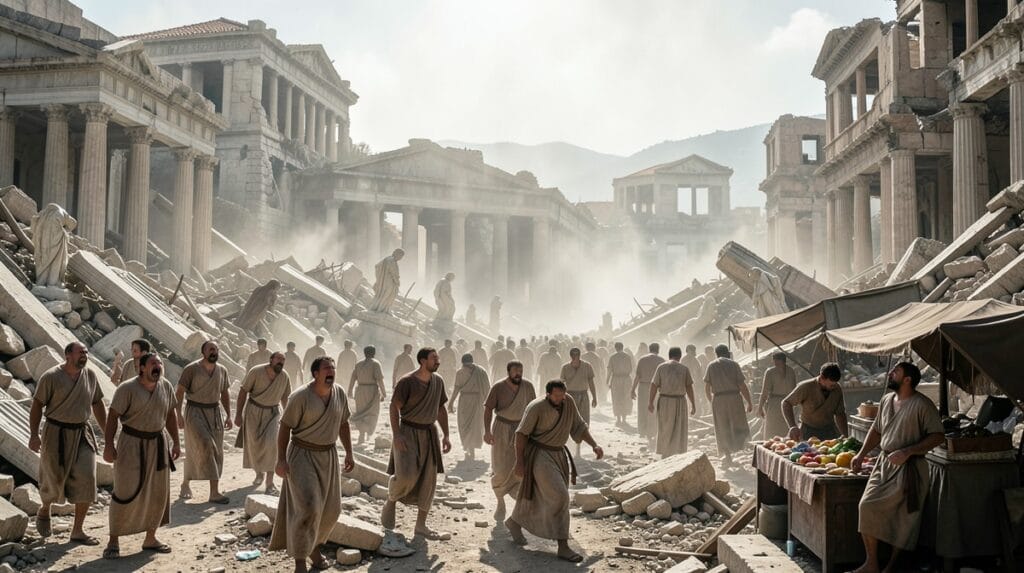
On August 24 the stored strain found its hour. Contemporary sources suggest a violent shock that ripped through the harborside and climbed the slopes. Rooflines failed, facades buckled, and streets became fissures. The sea, unsettled, heaved against quays as if the bay itself had turned hostile.
Writers later emphasized the speed. A few breaths of confusion, then the city altered. Public buildings were not spared; masonry boasted of imperial order until gravity claimed it. In this suddenness, memory fixed on a simple verdict: earthquake destroys nicomedia. Complexity would return later, as it always does.
Mini timeline:
- 330 CE: Constantinople founded; Nicomedia remains a key provincial center.
- 358-08-24: Major earthquake strikes Nicomedia; widespread urban collapse reported.
- Autumn 358: Imperial relief measures begin; correspondence circulates.
- 359–360: Rebuilding efforts proceed unevenly across Bithynia.
It is tempting to imagine the very quarter where Diocletian’s entourage once moved folding in on itself. This is safe only as an inference. Still, where palatial mass met hillside, vulnerability was real. The quake’s pattern punished heavy masonry and narrow lanes, driving survivors toward the waterfront.
04 – Fires, Aftershocks, and the Long Night
The first shock was not the last. Aftershocks found broken structures and finished them, loosening charred beams into sparks and setting pockets of fire. With aqueduct channels fractured, firefighting relied on buckets, luck, and the brief mercy of coastal winds that shifted without warning.
Survivors gathered in open spaces: markets cleared of debris, parade grounds, the strand. Night brought a second terror, the kind that listens for the next rumble with a chest held tight. Those who could formed camps, kept children within reach, and tried to count loved ones through the dark.
News traveled outward almost as quickly as damage spread inward. Sailors braved a jittery harbor to run messages along the coast. Inland, mounted couriers found cut roads and detours through estates. Every route became a ledger of loss, and the empire’s attention pivoted to this shattered edge of the Propontis.
05 – Power in Rubble: Imperial Politics in the Wake
In 358 the Eastern Empire was ruled by Constantius II, often attentive to the symbols of order. A city like Nicomedia mattered not only for its stores but for what its survival said about imperial competence. The quake converted administrative reputation into an urgent, visible trial.
Governors in Bithynia and nearby provinces had to prioritize, a task as political as humanitarian. Should funds go first to wharves that preserved tax revenue, or to basilicas where communities gathered and rumors were tamed? The choice shaped the stories people told about who the empire was for.
In the language of later summaries—earthquake destroys nicomedia—the emperor appears only as a shadow of response. Yet behind that phrase, decrees were drafted, officials replaced, and envoys charged to reassure the shaken. Politics was in the mortar: every repaired column carried an argument about authority.
06 – Letters, Couriers, and Grain: Organizing Relief
Relief began with information. Reports assembled casualty estimates, listed collapsed bathhouses, and assessed which bridges could bear grain wagons. The machinery of empire—cursus publicus couriers, storehouse managers, and local councils—moved from peacetime rhythms into emergency choreography with remarkable, if uneven, speed.
Grain shipments from Thrace and the Black Sea region were diverted, sometimes at the expense of inland towns. Timber permits were fast-tracked; quarry labor was requisitioned. In a society where logistics equaled survival, the first visible success was bread arriving at safe harbors and reaching the inland markets before speculation spiked.
Yet relief also had a face. The arrival of an imperial agent meant public readings of rescripts, the suspension of certain levies, and the grim task of adjudicating disputes over collapsed property lines. Here the official language of mercy became practical, deciding who would rebuild and who would move.
07 – Rebuilding or Retreat? Urban Policy After the Quake
Once immediate hunger receded, the question sharpened: rebuild Nicomedia as it was, or reimagine it around safer ground? The memory of Diocletian’s grandeur argued for restoration, but landslips and cracked terraces whispered retreat. Unrealistic pride and practical caution met across drafting tablets and contested plots.
Some quarters were likely shifted or thinned, improving street widths and sightlines for future emergencies. The harbor, if damaged, would have demanded priority, for without it the city’s reason would dim. But the survivors also needed housing fast, and quick timber solutions often trumped elaborate new plans.
Later writing condensed all this into the headline effect—earthquake destroys nicomedia—yet the truer work lay in compromises. Each scaffold contained policy: what to strengthen, what to abandon, and whom to compensate when yesterday’s neighborhood became tomorrow’s danger zone.
08 – Churches, Temples, and Meaning-Making
Nicomedia’s religious landscape in the mid-fourth century was layered. Christianity had state favor, but temples and civic cult memory remained. After the quake, interpretation arrived as quickly as relief. Bishops framed fasts and prayers; pagan intellectuals sought moral causes in neglected rites or populace mores.
Libanius, writing from Antioch, lamented the decline of temples in his age, though he blamed earthquakes obliquely. In Nicomedia, sermons may have linked charity to repentance, while household shrines received renewed vows. The city’s identity, bruised by collapse, sought coherence in narratives older than the broken stones.
Even as people searched for reasons, practical rituals of mourning carried the heaviest weight. Bodies needed honoring, widows needed neighbors, and the hum of shared labor rebuilt a sense of fate endured together. Meaning-making here was not abstraction; it was bread baked and pall-bearers gathered.
09 – Commerce Interrupted: Bithynia’s Economy Reels
The quake struck not only homes and halls but the invisible web that sustained them. Disrupted docks delayed shipments to Constantinople, forcing the capital to draw more heavily on alternate ports. Inland, merchants discovered missing partners, debt notes buried under beams, and customers with needs greater than coin could solve.
Prices flickered upward as scarcity rippled through markets. Speculators always found a line, yet imperial edicts threatened them with penalties to steady the exchanges. Guilds lobbied for timber and tax relief, arguing that without rope-makers and millers, no amount of piety could feed the populace.
Over months, patterns re-formed. Some trade shifted permanently toward safer harbors, rewarding towns that had watched Nicomedia with a mixture of envy and dependence. Others doubled down on rebuilding, betting that the city’s location would always outweigh its dangers. Risk itself became an economic factor.
10 – Witnesses and Chroniclers: How We Know
Our knowledge of the 358 disaster comes pieced from voices near and far. Ammianus Marcellinus, a fourth-century historian of military and court life, recorded catastrophic earthquakes in this era and noted devastation in Bithynia. Later chroniclers like Theophanes and the Antiochene John Malalas preserved dates and vignettes colored by their own centuries.
Libanius’s letters register the cultural shock that tremors dealt to civic life, even when his gaze was fixed on Antioch. Ecclesiastical historians, including Sozomen, sometimes interpreted earthquakes through a theological lens, blending portents with policy. Reading across them demands patience and a willingness to keep the event and the sermon separate.
For this reason, “earthquake destroys nicomedia” functions as both statement and simplification. It captures a remembered truth while compressing uncertainty about how many quarters fell, which harbor works cracked, and how swiftly aid arrived. The gaps themselves remind us how crisis outpaces record-keeping.
11 – A Seismic Age: From Nicomedia to Crete
The mid-fourth century was no lullaby. Within a decade of Nicomedia’s ruin, the 365 Crete earthquake sent a devastating tsunami across the eastern Mediterranean, smashing Alexandria and coastal towns. To those who remembered 358, the later event seemed to confirm a world rattled from its hinges.
Comparisons can mislead. The Nicomedia shock was fierce but local; the 365 event radiated havoc across sea routes. Yet the pairing helps place 358 on a continuum of instability that framed imperial policy and private anxiety. Resilience and fatalism grew together from repeated tests.
In both cases, urban form and governance mattered as much as stone strength. Cities that cleared obstructions, widened streets, and secured water supplies recovered faster. Those that treated catastrophe as an interruption rather than a condition lagged. Memory, too, became infrastructure.
12 – The City’s Bones: Diocletian’s Capital Rewritten
Nicomedia had carried the imprint of Diocletian’s administrative imagination: palatial complexes, armories, and bureaucratic quarters fitted to imperial traffic. The quake turned architecture into archaeology overnight. What had been a living plan became layers of collapse, with foundations visible where colonnades had stood in ordered lines.
Reconstruction confronted these bones. Some walls could be re-used; others were liabilities. Engineers, trained more by experience than by treatise, judged by feel and fracture. They stabilized slopes, softened terrace edges, and learned to triangulate support where past builders had relied on mass alone.
The result was a city less uniform and more pragmatic. Inscriptions might still praise emperors, but the street told a story of survival: irregular rebuilds, patched vaults, and courtyards reoriented for safety. Among these compromises, the refrain—earthquake destroys nicomedia—translated into a cautious, stubborn present tense.
13 – Lives Unhoused: Families, Slaves, and Soldiers
Statistics, when guessed at by later writers, never capture tents in the forum or the taste of smoky bread. Households improvised with salvaged beams and woven screens. Extended kin and patrons mattered, distributing food, tools, or a corner of a courtyard where children could sleep without crying at every creak.
Slaves and day laborers were often first to clear rubble, their hands remembered only by the steadier walls they left behind. Soldiers helped discipline distribution and deter looting, but they were also sons and brothers scanning lists of the missing. The city’s social web flexed under shared grief.
Memory filtered all this into manageable forms. Annual remembrances, modest inscriptions, and the recitation of the day the ground broke became anchors. In the stories families told, the empire appeared when grain arrived; God appeared when a child was found. Both became part of the city’s stitched skin.
14 – Reading the Faults: Science Beneath the Story
Nicomedia sits near the western reach of what modern geology identifies as the North Anatolian Fault, a formidable strike-slip system. Though ancient writers lacked this language, their descriptions of sharp, lateral devastation near the gulf align with a rupture along these crowded crustal seams. Place and process, tragically, were aligned.
Reports of disturbed waters in the Propontis suggest local seabed shifts, though the evidence for a true tsunami in 358 is thin. More likely, harbor damage came from ground failure and seiche-like oscillations, enough to break moorings but not to empty the bay. Natural caution is warranted here.
What the science adds is not certainty about every fallen arch but a frame for the pattern: a region primed for shaking, a city built on slopes and reclaimed ground, and a populace whose architecture was tested regularly. In that context, “earthquake destroys nicomedia” reads as recurring potential, not a single fate.
Immediate consequence:
Collapse of key public and private buildings, disruption of harbor operations, fires, hunger, and a wave of imperial relief orders to stabilize food supply and public order.
Long-term consequence:
Shifts in trade routes, incremental urban redesign prioritizing wider streets and lighter construction, and a durable narrative that placed Nicomedia among Rome’s cautionary cities.
15 – Conclusion
The phrase “earthquake destroys nicomedia” endures because it compresses terror, policy, and survival into four words. Yet its full meaning lies in the web of responses it set in motion: couriers on ruined roads, sermons tailored to fear, scaffolds above markets, and a city learning to live with the ground’s memory.
This was more than a single disaster date. It was a demonstration of imperial capacity and local resilience in a seismic landscape that would test the eastern Mediterranean again and again. In the cracks of Nicomedia’s stones, later builders read instruction. In its story, later rulers measured responsibility.
16 – FAQs
- When did the earthquake occur?
Ancient chroniclers place the disaster on 24 August 358 CE, though exact timing and sequences of shocks are not uniformly recorded in surviving sources. - Where did the destruction happen?
The worst damage struck Nicomedia in Bithynia, on the Propontis/Sea of Marmara, with effects likely felt in nearby towns along the gulf and inland routes. - Who were the main historical figures involved?
Emperor Constantius II reigned at the time; provincial officials in Bithynia implemented relief, while writers like Ammianus Marcellinus and later Theophanes preserved accounts of the devastation. - What caused the disaster?
A major seismic event, almost certainly linked to activity along the North Anatolian Fault system, produced violent ground shaking that toppled buildings and ruptured infrastructure. - What were the main consequences?
Immediate collapse, fires, and hunger were followed by imperial relief efforts, partial urban redesign, and longer-term shifts in trade patterns. In memory, the event is often summarized as “earthquake destroys nicomedia.” - What is the legacy of the 358 earthquake?
Beyond local rebuilding, the quake entered late Roman memory as a warning about urban vulnerability in a seismically active region and influenced how cities balanced grandeur with safety.
17 – External Resource
18 – Internal Link
Other Resources
- Encyclopaedia Britannica – general search for the exact subject
- Google Scholar – academic search for the exact subject
- Internet Archive – digital library search for the exact subject
Sources and References
-
Ammianus Marcellinus, Res Gestae, Book XVII (esp. ch. 7–10).
Note: Primary late Roman narrative source for the reign of Constantius II and the mid‑4th‑century eastern provinces. While Ammianus focuses mainly on military and political events, his work underpins the broader chronology, political context, and imperial setting in which the 358 Nicomedia earthquake occurred. -
Libanius of Antioch, Selected Letters and Orations (4th century), in A. F. Norman (ed. & trans.), Libanius: Selected Works, 3 vols., Loeb Classical Library, Harvard University Press, 1969–1977.
Note: Primary source from a contemporary eastern imperial city (Antioch). Libanius includes references to earthquakes and civic disasters in the eastern Mediterranean, helping to illuminate the social and political environment, urban vulnerability, and civic responses to seismic events in the region and period relevant to Nicomedia. -
Guidoboni, E., Comastri, A., & Traina, G. (eds.), Catalogue of Ancient Earthquakes in the Mediterranean Area up to the 10th Century, Istituto Nazionale di Geofisica, Rome, 1994.
Note: Comprehensive seismological and historical catalog used by scholars to date and assess ancient earthquakes. Provides critical discussion of the 358 Nicomedia earthquake (date, magnitude estimates, and documentary basis) and situates it among other major late antique seismic events. -
Ambraseys, N. N. Earthquakes in the Mediterranean and Middle East: A Multidisciplinary Study of Seismicity up to 1900, Cambridge University Press, 2009.
Note: Modern seismic and historical synthesis that collates primary sources, geological data, and previous catalogues. Supplies technical evaluation of the 358 Nicomedia shock (intensity, possible epicentral area, and regional impact) and its place in the long‑term seismic history of Bithynia and northwestern Asia Minor. -
Mitchell, Stephen. Anatolia: Land, Men, and Gods in Asia Minor, Vol. 1, Oxford University Press, 1993.
Note: Scholarly study of the historical geography and urban development of Asia Minor. Provides background on Nicomedia’s role as a major city of Bithynia and an imperial residence, its strategic position on the Propontis, and the administrative significance of Bithynia in the Roman and late Roman periods. -
Jones, A. H. M. The Later Roman Empire, 284–602: A Social, Economic and Administrative Survey, Vol. 1, Johns Hopkins University Press, 1964.
Note: Classic reference for the institutional and administrative framework of the mid‑4th‑century empire. Used for contextual information on provincial administration (including Bithynia), urban governance, imperial policies toward cities, and the broader socio‑economic environment in which the Nicomedia disaster occurred. -
Princeton University, Princeton Encyclopedia of Classical Sites (PECS), entry “Nicomedia (İzmit, Turkey).”
Note: Academic reference on the archaeology and topography of Nicomedia. Supports statements about the city’s location, urban character, and significance as a Roman and late Roman center in Bithynia, as well as its exposure to seismic risk along the northern Anatolian region. -
Türkiye Cumhuriyeti Kültür ve Turizm Bakanlığı (Republic of Türkiye Ministry of Culture and Tourism), museum and heritage documentation for İzmit/Nicomedia (online site records and publications).
Note: National heritage and museum documentation used for modern archaeological and historical information on Nicomedia’s remains, the long‑term impact of earthquakes on the city’s fabric, and the identification of the ancient site with modern İzmit in Bithynia.