Table of Contents
- Washington City in 1809: A Capital Still Emerging
- Madison’s Road to the Presidency
- The Election of 1808 and the Press Wars
- Dawn of March 4: A City Awakens
- Procession to the Capitol and the Ceremony
- The Oath and the First Inaugural Address
- Dolley Madison and the Theater of Politics
- After the Embargo: Commerce, War, or Caution?
- Building a Cabinet: Friends, Rivals, and Compromise
- Public Reaction and Partisan Echoes
- Fault Lines at Home: Slavery, Expansion, and Republican Creed
- The Foreign Field: Britain, France, and American Neutrality
- The First Months: Signals, Missteps, and Persistence
- Conclusion
- FAQs
- External Resource
- Internal Link
Article Summary: On March 4, 1809, James Madison took the oath at the U.S. Capitol, inheriting a fragile peace and a divided political world. The city was still young, the republic still experimental, and Britain and France still threatening American commerce. This article follows the day’s scenes, the inaugural message, and the early policy dilemmas. It also traces Madison’s path from revolutionary thinker to executive leader. Along the way, it addresses how “james madison inaugurated president” became a pivot between Jeffersonian ideals and looming war. The narrative weighs sources, social context, and the long shadow of Madison’s choices.
Why keep reading: Behind the polite ceremony lay a contest between constitutional ideals and geopolitical pressure. Follow the procession, the words, the factions, and the fragile moment when Madison had to be more than the “Father of the Constitution”—he had to govern a nation edging toward conflict.
At a glance:
- Event: First Inauguration of James Madison
- Date: March 4, 1809
- Place: U.S. Capitol, Washington City, District of Columbia
- Main figures: James Madison, Dolley Madison, Thomas Jefferson, Chief Justice John Marshall
- Why it mattered: Peaceful transfer within the same party masked deep rifts over trade, neutrality, and national power that would shape the path to the War of 1812.
01 – Washington City in 1809: A Capital Still Emerging
In 1809, Washington City was less a polished capital than a promise under construction. The avenues were broad but raw, the Capitol a neoclassical shell still taking shape, and muddy stretches tested every boot. Government boardinghouses functioned as political salons, where cabinet whispers and partisan retorts drifted through thin walls and over coarse suppers.
Amid these unfinished streets, the idea of national sovereignty felt tangible and vulnerable. As james madison inaugurated president, the setting spoke volumes: a republic still establishing its rooms, stairs, and sightlines. The President’s House loomed impressive yet somehow provisional, like a stage built faster than the play could be learned.
The population of the city was small by European standards, with artisans, enslaved laborers, clerks, and visitors mingling in close quarters. It was easy to meet the powerful by accident and feel the nation’s basic experiments—representation, balance, public opinion—playing out at your very elbow.
02 – Madison’s Road to the Presidency
Madison arrived at this moment after three decades of public life shaped by study and struggle. He had helped design the Constitution, collaborated with Hamilton and Jay on The Federalist, and battled for a Bill of Rights, localizing grand theory into common guarantees. Yet theorist and executive are rarely the same vocation.
As Jefferson’s secretary of state, Madison navigated the shoals of neutrality and commercial retaliation. France and Britain treated American ships as pawns, and impressment humbled American pride. Madison learned that constitutional finesse could not mute a cannon’s report, and legal doctrine could not always deflect imperial hunger for leverage.
His private temperament was often cautious, even shy, but his political mind could be steel-bound. By 1809, supporters trusted his republican sincerity; critics caricatured him as small in physique and policy. The presidency would soon test how a delicate style might withstand coarse pressures.
03 – The Election of 1808 and the Press Wars
The 1808 election was a referendum on Jefferson’s legacy and the nation’s place in a belligerent world. Madison carried the Democratic-Republican banner against Federalist Charles Cotesworth Pinckney. He won decisively in the Electoral College, though newspapers waged a close-quarters war over his character, courage, and capacity.
Republican editors defended his constitutional expertise, while Federalist sheets mocked him as “Little Jemmy,” doubting his firmness against Britain. Factional crosscurrents complicated matters, with Republicans themselves split among personal loyalties and policy grudges. Campaign rhetoric sharpened anxieties that would not disappear at the stroke of inauguration.
Madison’s victory secured continuity but not calm. As the ballots settled, unresolved dilemmas remained: How far should a commercial republic go to protect its rights at sea? Which tools—sanctions, diplomacy, or arms—best matched its principles and power?
04 – Dawn of March 4: A City Awakens
On the morning of March 4, 1809, Washington City stirred early. Carriages rattled along uneven avenues, and crowds aimed toward Capitol Hill. Boardinghouses emptied into the brisk air, gentlemen adjusted coats, and women—some of them politically attuned through circles around Dolley Madison—took seats wherever space allowed.
The day’s choreography promised modesty rather than grandeur. This was not an imperial city and indeed wished not to be. Yet behind the unpretentious visuals lay an outsized significance: the absorption of revolutionary ideals into routine governance, staged in a chamber where voices could echo longer than intentions.
Whispers spread that Thomas Jefferson might appear. The sight of the retiring president in the same space as his successor would confirm the steadying rhythm of republican succession. Continuity was a message in itself, especially as European empires stalked the seas and tested American patience.
05 – Procession to the Capitol and the Ceremony
Accounts describe a simple procession to the Capitol, devoid of military spectacle. Madison’s small frame and reserved manner belied his intellectual command, and the mood, though expectant, lacked carnival excess. This sobriety matched a city still half-built and a nation conscious that theater must not eclipse purpose.
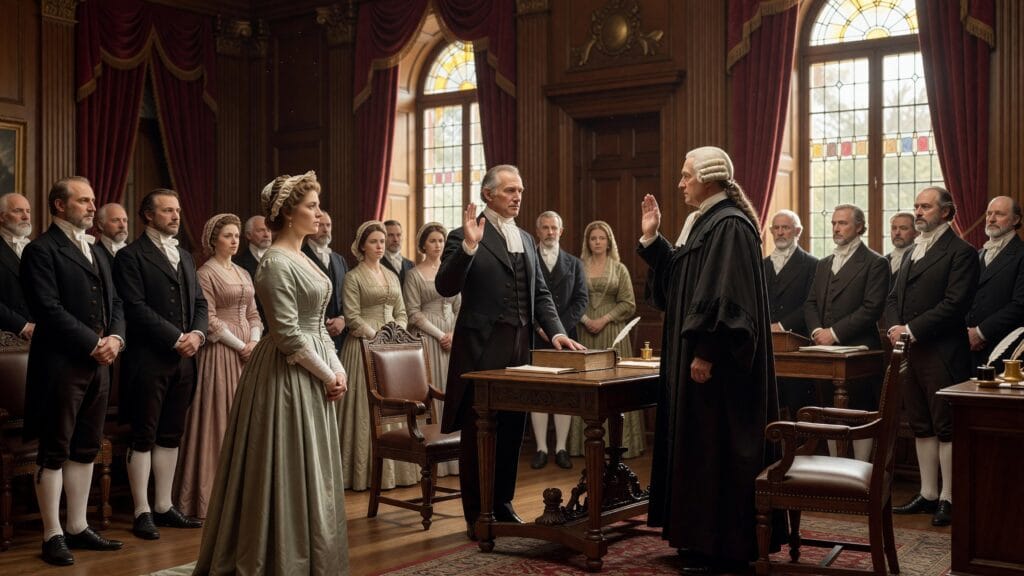
Inside, legislators, dignitaries, diplomats, and citizens crowded the House chamber. Chief Justice John Marshall—Madison’s political antagonist and the Court’s towering Federalist—waited to administer the oath. Their shared presence embodied a constitutional settlement balancing rival visions under one rule of law.
Contemporary reports suggest a crowd attentive to every syllable. The moment was ceremonial yet not empty; it pressed Madison to translate text into governance. In a republic that prized words, the oath linked Madison’s reputation to the living document he had helped draft and now had to serve.
06 – The Oath and the First Inaugural Address
Madison took the oath from Chief Justice Marshall, a tableau of rivalry reconciled by duty. In his inaugural address, Madison emphasized moderation, constitutional equilibrium, and the protection of neutral commerce. He appealed for unity while conceding the difficulty of preserving rights without courting war.
The address favored measured tone over fiery rhetoric. He signaled firmness in defense yet scorned rashness, proposing that restrictions on trade could be instruments of sovereignty rather than surrender. Listeners heard the imprint of a scholar determined to keep liberty and power in careful conversation.
The text, later printed widely, urged confidence that republican institutions could weather external threats and internal divisions. This faith was ideological and practical: national resilience required public patience, congressional cooperation, and executive restraint that did not devolve into weakness.
Mini timeline:
- 1807: Embargo Act halts American exports amid British and French predations.
- 1808: Madison wins the presidency against Federalist opposition.
- March 1, 1809: Non-Intercourse Act replaces embargo, targeting Britain and France.
- March 4, 1809: Madison is inaugurated at the U.S. Capitol.
07 – Dolley Madison and the Theater of Politics
Dolley Madison understood that politics was not only votes and statutes but rooms, rituals, and memory. She built on her years at Jefferson’s side to shape a capital society that softened edges and brokered trust. Her weekly receptions—later dubbed “squeezes”—brought adversaries into the same light.
The inaugural festivities included a ball estimated by observers at several hundred guests, staged at a prominent Washington venue. Dolley’s presence mattered beyond fascination with her clothes or charisma; it turned social gravity into political architecture. People who might not converse in chambers spoke across punch bowls and music.
These gatherings did not end policy disagreements, but they humanized them. In a city of rumors and fractures, Dolley’s hospitality built the habit of encountering opponents without collapsing into insult. The republic benefited from this civility even when legislation stalled or tempers ran short.
08 – After the Embargo: Commerce, War, or Caution?
Jefferson’s Embargo Act had aimed to wield commerce as a weapon, denying belligerents American goods. It punished American livelihoods more immediately than it swayed European cabinets. On March 1, 1809, Congress replaced it with the Non-Intercourse Act, reopening trade except with Britain and France.
Madison thus began with a compromise already in motion. He had defended commercial restrictions as constitutional and potentially effective, but the domestic backlash was vivid. Coastal towns and interior farmers had borne the cost. What tool would work where embargo had stumbled—negotiation, targeted retaliation, or a measured readiness for war?
Here the limits of theory met the raw arithmetic of ports and prices. The administration would test different combinations of law and diplomacy. Yet citizens wanted relief yesterday, while Great Britain and Napoleonic France treated urgent American appeals as one more item on a ledger crowded with European priorities.
09 – Building a Cabinet: Friends, Rivals, and Compromise
Madison’s early cabinet choices balanced loyalty and regional politics. He retained Albert Gallatin at Treasury for fiscal experience, named Robert Smith to State, and appointed William Eustis and Paul Hamilton to War and Navy. Gideon Granger continued as Postmaster General, while Caesar A. Rodney remained as Attorney General until later resigning.
These selections mitigated and provoked. Some Republicans favored James Monroe for State, and the choice of Smith seeded later friction. Unity was essential, yet personal reputations, ambitions, and alliances turned personnel into policy. Cabinets are coalitions stitched from strengths and disagreements.
Madison’s managerial approach favored consultation, sometimes to a fault. Colleagues respected his intellect but wondered if his caution would slow decision-making. Crisis management would either vindicate deliberation or expose it as drift, depending on how events unfolded abroad.
10 – Public Reaction and Partisan Echoes
Reaction to the inauguration cleaved along familiar lines. Republican papers praised the sobriety of the proceedings and the steadiness of the address. Federalist editors conceded dignity but questioned resolve. In taverns and parlors, ordinary observers welcomed a peaceful transition yet fretted about ships, prices, and honor.
Madison’s reputation as a constitutional craftsman invited respect and impatience. Admirers saw prudence; skeptics detected equivocation. The young republic wanted both principle and decisiveness. It is easy to forget how fragile this world still was, operating without settled traditions of executive leadership beyond Washington and Jefferson.
Meanwhile, the exact mechanics of government—custom receipts, loan schedules, naval deployments—determined whether rhetoric translated into relief. People living by trade counted weeks, not ideals. The pressure on Madison was to make constitutional balance produce edible bread and navigable seas.
11 – Fault Lines at Home: Slavery, Expansion, and Republican Creed
The inauguration also unfolded in a society standing on contradictions. Enslaved labor had helped build the Capitol where liberty was celebrated. Madison, like many founders, abhorred slavery in theory and compromised with it in practice. The capital’s streets reminded visitors that republican language floated over human hierarchies.
Territorial expansion, meanwhile, promised opportunity and conflict. Speculators watched borders; settlers eyed land beyond formal treaties; Native nations defended sovereignty with waning leverage. In the fall of 1809, the Treaty of Fort Wayne would sharpen fault lines, foreshadowing Tecumseh’s resistance and widening the hinge between American ambition and indigenous rights.
Madison could not resolve these tensions on inauguration day, but his presidency would move through them. The ideals of consent and limited government collided with systems of bondage and dispossession that outlasted speeches and statutes.
12 – The Foreign Field: Britain, France, and American Neutrality
Britain’s Orders in Council and Napoleon’s Berlin and Milan Decrees constrained American trade. The British Royal Navy’s impressment of sailors enraged communities on the seaboard. Madison believed a republic could assert rights without abandoning restraint, yet every seized cargo or humiliated captain pushed temper toward reprisal.
Diplomats navigated shifting promises. In the spring of 1809, British minister David Erskine reached an understanding with Madison to relax restrictions, prompting the administration to reopen trade. London soon repudiated the agreement, embarrassing Washington and reviving Federalist laughter about Republican naïveté.
The episode taught a brisk lesson: without leverage, moral appeals may be admired and ignored. Yet leverage had its costs, and militarization risked unraveling the fiscal prudence Madison valued. The victory solved one problem and created another: how to protect commerce without exposing the treasury or the Constitution.
13 – The First Months: Signals, Missteps, and Persistence
Madison’s early months mixed cautious experimentation with bruising reality. Legislative fixes adjusted commercial policy while embassies worked to untie knots made in London and Paris. The president sought to buttress coastal defenses, steady revenues, and signal patience that did not mean paralysis.
Public attention flickered between relief and disappointment. Any sign of deal-making raised hope; any reversal stoked anger. The Erskine fiasco was particularly bitter, but it did not end attempts to negotiate. The administration kept probing for a path that could trade temporary pain for lasting autonomy.
Immediate consequence:
Madison’s measured inauguration and address calmed fears of radical change but left stakeholders anticipating concrete relief from trade restrictions and naval insults.
Long-term consequence:
The search for leverage through law and diplomacy laid tracks toward the War of 1812, reshaping federal authority, party identities, and the nation’s sense of itself as a maritime power.
Through it all, Madison’s personal style remained reserved but purposeful. He wrote, consulted, revised. The aura of scholarly patience tested a culture that sometimes preferred the theater of anger. Yet institutions require more than spectacle; they depend on the slow work of holding alternatives together until one proves feasible.
14 – Conclusion
Madison’s inauguration day fused modest ceremony with immense expectation. In a half-built capital, before a crowd attentive to every clause, the man most associated with designing the Constitution promised to govern by it. For contemporaries and posterity alike, the scene confirmed that “james madison inaugurated president” was not just an announcement but an argument about power, prudence, and peace.
What followed would test that argument across domestic contradictions and global storms. The inauguration neither guaranteed triumph nor ensured failure; it clarified a premise. Ideas must face events. In choosing patient strength over easy fury, Madison set a tone that could not avert every crisis but helped define the nation’s constitutional stamina.
15 – FAQs
- When did Madison’s first inauguration take place?
It occurred on March 4, 1809, aligning with the constitutional schedule used before the twentieth-century change to January inaugurations. - Where was the ceremony held?
It was held in the House chamber of the U.S. Capitol in Washington City, a building and a capital still under ambitious construction. - Who were the main figures involved in the event?
James Madison took the oath administered by Chief Justice John Marshall; former President Thomas Jefferson was present in the city, and Dolley Madison hosted the inaugural social world that followed. - What caused the tensions surrounding the inauguration?
Years of maritime harassment by Britain and France, the unpopular Embargo Act, and fierce partisan press battles created a climate where every word and appointment carried extra political voltage. - What were the immediate consequences of the inauguration?
Madison’s address reassured many Americans while expectations rose for a workable alternative to embargo, eventually leading to new trade policies and an ill-fated 1809 agreement with British minister David Erskine. - What is the legacy of this inauguration?
It set a model of restrained executive tone under severe strain, bridging Jeffersonian ideals and the practical necessities that culminated in the War of 1812, and cementing how a constitutional republic manages continuity amid crisis; in short, james madison inaugurated president marked a turning hinge.
16 – External Resource
17 – Internal Link
Other Resources
- Encyclopaedia Britannica – general search for the exact subject
- Google Scholar – academic search for the exact subject
- Internet Archive – digital library search for the exact subject
Sources and References
-
Madison, James. Inaugural Address, March 4, 1809. In The Writings of James Madison, edited by Gaillard Hunt, Vol. 8. New York: G.P. Putnam’s Sons, 1908. Also available via the Library of Congress and the Avalon Project (Yale Law School).
Note: Primary source text of Madison’s first inaugural address, supporting specific statements about his themes (constitutional fidelity, neutrality in foreign affairs, and the context of British–American tensions) and the language he used when assuming the presidency. -
“Journal of the Senate of the United States of America, 1809–1811.” Washington, D.C.: U.S. Government Printing Office. Accessible via Library of Congress, https://memory.loc.gov.
Note: Primary governmental record confirming the date and formal proceedings of Madison’s inauguration on March 4, 1809, including the administration of the oath of office in Washington, D.C. -
Rutland, Robert Allen, ed. James Madison and the American Nation, 1751–1836: An Encyclopedia. New York: Simon & Schuster, 1994.
Note: Scholarly reference providing contextual information on Madison’s political career, his role in the founding era, and the domestic and foreign-policy issues facing the United States at the time of his inauguration. -
McCoy, Drew R. The Last of the Fathers: James Madison and the Republican Legacy. Cambridge: Cambridge University Press, 1989.
Note: Academic study that informs analysis of Madison’s political philosophy, his understanding of republican government, and how his presidency—beginning with the 1809 inauguration—fit into the broader legacy of the Founding Fathers. -
“James Madison: Life Before the Presidency.” Miller Center, University of Virginia. https://millercenter.org/president/madison.
Note: University-based overview used for details on Madison’s background, earlier public service, and the political situation leading up to the 1809 election and inauguration. -
“James Madison (1809–1817).” Office of the Historian, U.S. Department of State. https://history.state.gov/departmenthistory/people/madison-james.
Note: Official historical profile used to corroborate information on Madison’s foreign policy challenges at the beginning of his presidency, especially Anglo‑American tensions that framed his inauguration. -
“James Madison.” Mount Vernon Ladies’ Association (Mount Vernon Digital Encyclopedia). https://www.mountvernon.org/library/digitalhistory/digital-encyclopedia/article/james-madison/.
Note: Museum/educational source providing biographical context and supporting discussion of Madison’s stature as a leading constitutional thinker at the time he assumed the presidency. -
“James Madison, 4th President of the United States: Fast Facts.” Library of Congress, Research Guides. https://guides.loc.gov/james-madison.
Note: Library-based guide used to confirm chronological details, including the 1809 inauguration date, succession from Thomas Jefferson, and basic framework of Madison’s presidential terms.