Table of Contents
- Europe at War: The Road to Bavaria, 1701–1704
- Commanders and Coalitions: Marlborough, Eugene, Tallard
- The March to the Danube: A Gamble Across Germany
- Bavaria on the Brink: Max Emmanuel’s Calculus
- Eve of Battle: Terrain, Villages, and Rivers
- Opening Moves at Dawn: Nebel Stream and the Flanks
- Crisis at Blenheim: The Village that Swallowed an Army
- Breakthrough at Oberglauheim: Guns, Squares, and Counterstrokes
- The Decisive Charge: Marlborough and Eugene Converge
- Rout and Capture: Tallard’s Defeat and Aftermath on the Field
- Counting the Cost: Prisoners, Casualties, and Civilians
- From Battlefield to Diplomacy: 1704–1705 Consequences
- Memory, Debate, and Sources: Writing Blenheim
- Strategic Legacy: Britain’s Rise and Bourbon Limits
- Conclusion
- FAQs
- External Resource
- Internal Link
Article Summary: On 13 August 1704, near the Danube village of Blindheim in Bavaria, a coalition army under the Duke of Marlborough and Prince Eugene shattered a Franco-Bavarian force led by Marshal Tallard. Known as the battle of blenheim, it redirected the War of the Spanish Succession and prevented a catastrophic collapse of the Habsburg position. The victory stabilized the Grand Alliance and reshaped European power politics. This article traces the road to the battlefield, the day’s decisions, and the aftermath. It weighs sources, follows the human cost, and considers long-term consequences for Britain, France, and the Holy Roman Empire.
Why keep reading: A summer morning on the Danube determined whether Louis XIV’s Europe would reach Vienna. This is a story of speed, deception, and a village that swallowed regiments whole, where one misjudgment trapped thousands and a desperate charge cracked an empire’s design.
At a glance:
- Event: Battle of Blenheim (Second Battle of Höchstädt)
- Date: 13 August 1704
- Place: Near Blindheim (Blenheim), Bavaria, Holy Roman Empire, along the Danube and Nebel stream
- Main figures: John Churchill, Duke of Marlborough; Prince Eugene of Savoy; Marshal Camille d’Hostun, Duc de Tallard; the Elector of Bavaria, Maximilian II Emanuel; Marshal Marsin
- Why it mattered: It saved Vienna, kept the Habsburgs in the war, checked Louis XIV’s ambitions, and elevated Britain as a decisive military and financial power.
01 – Europe at War: The Road to Bavaria, 1701–1704
Europe in 1704 was stretched between ambition and anxiety. The War of the Spanish Succession began after Charles II of Spain died childless, plunging crowns into calculations about who would control a vast empire. Louis XIV backed his grandson, Philip of Anjou; the Habsburgs resisted, and the Grand Alliance formed to contain France.
The early years saw French successes in Italy and the Rhineland, and a dangerously exposed Habsburg Austria. Bavaria’s Elector tilted toward France, offering a gateway to the Danube heartland. If Vienna fell, alliance strategy would unravel. The battle of blenheim was not inevitable, but the march toward it accelerated.
Diplomacy flickered in the background, yet logistics often decided strategy. The Dutch guarded their own frontiers; English politics scrutinized expense and risk. The Holy Roman Empire needed time to gather. Against this gridlock, Marlborough and Eugene looked for movement, believing a sudden strike into Bavaria could reset the war’s geometry.
Louis XIV’s ministers also read the map. Tallard and Marsin coordinated with the Elector, hoping to pin the allies in the Low Countries, then swing toward Vienna. Every courier’s delay or flooded ford mattered. By midsummer 1704, opposing plans tightened into a single thread across German roads.
02 – Commanders and Coalitions: Marlborough, Eugene, Tallard
John Churchill, Duke of Marlborough, inherited neither a vast fortune nor a grand title, but he mastered administration, coalition charm, and a cool operational eye. His letters show a man who weighed supply lines as seriously as honor. He led British, Dutch, and German contingents under political scrutiny that could chill any general’s hand.
Facing him, Marshal Tallard carried the prestige of Louis XIV’s court and a reputation for steadiness. Yet French marshals were often cautious, wary of fatigue and stretched logistics. Tallard and Marsin had to cooperate with the Bavarian Elector, whose own judgment was bold and local. Coordination promised strength but risked confusion.
Prince Eugene of Savoy, a Habsburg sword with a French accent, balanced Marlborough’s enterprise. He understood imperial constraints, navigated court politics, and drilled into detail. Eugene’s willingness to shoulder the hard side of the Danube battle, and Marlborough’s confidence in him, gave the allied plan a rare joint rhythm.
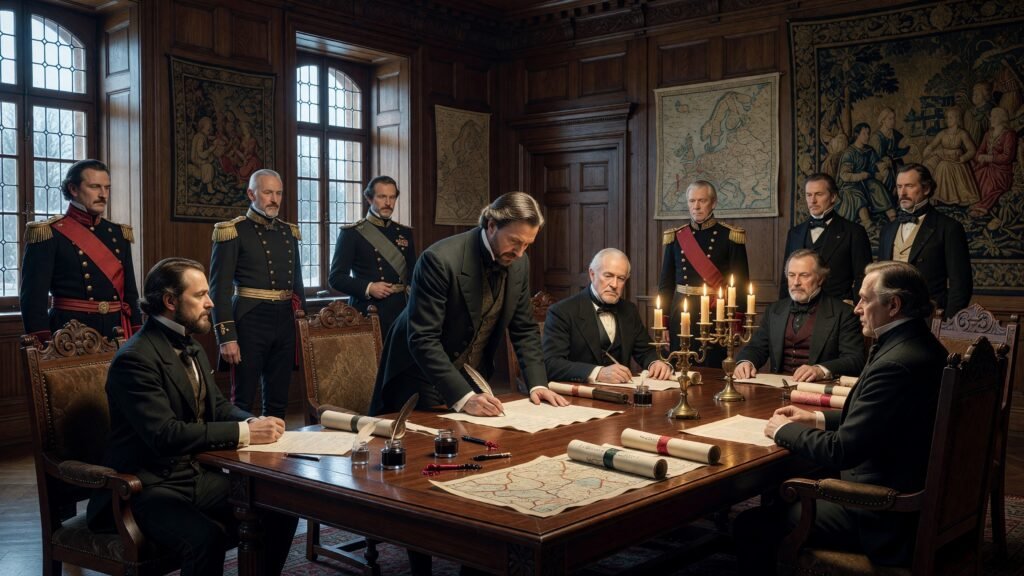
Coalition warfare blurs lines between strategy and persuasion. Orders crossed languages; supply chits crossed currencies. The three commanders, with their different courts behind them, would decide more than deployments. They would test whether promises made in distant capitals could hold together under cannon fire along a narrow stream.
03 – The March to the Danube: A Gamble Across Germany
Marlborough’s 1704 march from the Low Countries to the Danube was an audacious thread drawn through enemy expectations. He masked his intentions, used feints to mislead French commanders, and secured bridges and magazines in a sequence that reads like a logistics opera. Speed was both weapon and disguise.
Every stage risked unraveling. Detachments could be trapped; garrisons might not yield. The allied columns crossed territories with mixed loyalties, requiring negotiation as much as command. Eugene moved to join, striking through the empire’s interior corridors, knitting together a front that might shield Vienna or expose it irretrievably.
Contemporaries sensed the stakes. The London Gazette celebrated progress but conveyed unease about distances. In Munich and Paris, calculations shifted with every messenger. By early August, the two allied leaders closed with Tallard and Marsin near Höchstädt, the Danube curving like a drawn bow around the coming field.
04 – Bavaria on the Brink: Max Emmanuel’s Calculus
Maximilian II Emanuel, Elector of Bavaria, was no puppet. He saw advantage in French alliance and dreamed of a larger Bavarian destiny. The Danube plain, dotted with villages and marshy brooks, was his terrain. He believed French strength and local knowledge might break the imperial hold and secure Bavaria’s future.
But Bavaria bore the war’s weight. Harvests were requisitioned; bridges rebuilt for armies not always friendly. Villagers learned new geographies of fear: fords, granaries, and churchyards mapped against supply needs. The Elector’s calculation linked honor with survival, yet every allied success tightened the ring around his position.
French coordination with Bavarians faced the usual coalition question: whose plan at the crucial hour? Marsin balanced the Elector’s urgency with Tallard’s caution. The presence of strong cavalry offered promise, but the ground would decide how that promise could be delivered. Villages could anchor lines—or entrap men by the thousand.
Local rumor played its own role. Farmers traded stories of marching flags; priests noted omens. Yet the military truth was plainer. The side that kept its line across the Nebel, controlled the crossings, and refused a flank would likely hold the Danube plain. Max Emmanuel fixed on seizing those advantages first.
05 – Eve of Battle: Terrain, Villages, and Rivers
The field stretched between three key village anchors: Lutzingen on the left, Oberglauheim near the center, and Blindheim—Blenheim to English mouths—on the right by the Danube. Between the allied assembly ground and the enemy line ran the Nebel, a shallow, marshy stream that could slow an army at the worst moment.
It was a battlefield designed for nerve. Villages were strongpoints if packed with musketeers and guns, yet force massed inside could not react quickly to changes elsewhere. Cavalry needed drier ground; infantry needed coordination at the fords. Generals studied paths at dusk, measuring minutes as carefully as yards.
Mini timeline:
- May–June 1704: Marlborough marches from the Low Countries toward the Danube.
- Early August 1704: Allied and Franco-Bavarian forces converge near Höchstädt.
- 12 August 1704: Both armies deploy; villages fortified; Nebel crossings reconnoitered.
- 13 August 1704: Battle breaks out at dawn along the Nebel and the Danube.
Contemporary maps differ in detail but agree on the essentials. The Danube guarded one flank; wooded knolls and hedged fields textured the other. The battle of blenheim would test whether the allies could coordinate assaults across the Nebel while resisting the danger of being split and hammered by French cavalry.
06 – Opening Moves at Dawn: Nebel Stream and the Flanks
Sunrise found allied columns edging toward the Nebel. Marlborough aimed to fix the enemy with pressure at Blenheim while probing the center and left for an opening. Eugene, on the allied right, faced Marsin and the Elector near Lutzingen, terrain that proved unforgiving and contested hedgerow by hedgerow.
Crossings were everything. Infantry splashed through with difficulty; guns bogged; cavalry searched for firmer ground. Tallard’s guns punished slow assembly, and French cavalry eyed gaps. Yet the allies built fragile bridges from fascines and farm timbers, throwing small units across to widen footholds. The plan hinged on multiplying those footholds.
Early fighting was brutal but indecisive. At Blenheim, French infantry and dismounted dragoons thickened the defense, firing from walls and gardens. On the allied right, Eugene’s men suffered while trying to keep pace with Marlborough’s push. The morning gave no winner, only the promise that boldness or error would pay dearly by noon.
Amid this struggle, Marlborough watched the center for patterns. If Blenheim drew in too many French battalions, the allied center-left could break through. If not, the day might end with wrecked brigades on the Nebel’s banks and coalition blame racing down the post roads toward London and Vienna.
07 – Crisis at Blenheim: The Village that Swallowed an Army
Blenheim became a magnet. Tallard, determined to seal his right, poured battalions into the village, turning it into a musketry furnace. Stone walls shielded defenders; narrow lanes funneled attackers. The more troops that filed in, the stronger the position looked—and the less flexible the French wing became.
Allied assaults there were costly. British and Hessian infantry recoiled from volleys and grapeshot, regrouped behind hedges, then returned to the breach. Commanders on both sides sensed the village’s psychological pull. Control of Blenheim felt like a verdict on the day, yet its garrison risked becoming a regiment-eating cul-de-sac.
Outside the village, the center told a different story. As more French troops disappeared into Blenheim’s alleys, the line between Tallard’s center cavalry and Marsin’s left stretched thinner. Marlborough’s staff marked the spaces appearing beyond the Nebel crossings. Opportunity often looks like disorder rushing past one’s eyes.
By late morning, pressure on Eugene’s side continued, but the French right was locked inside stone and smoke. The decisive point would come where mud, cavalry, and quick-thinking officers could convert strain into rupture. The village held; the field around it began to yield possibilities that neither side had predicted at dawn.
08 – Breakthrough at Oberglauheim: Guns, Squares, and Counterstrokes
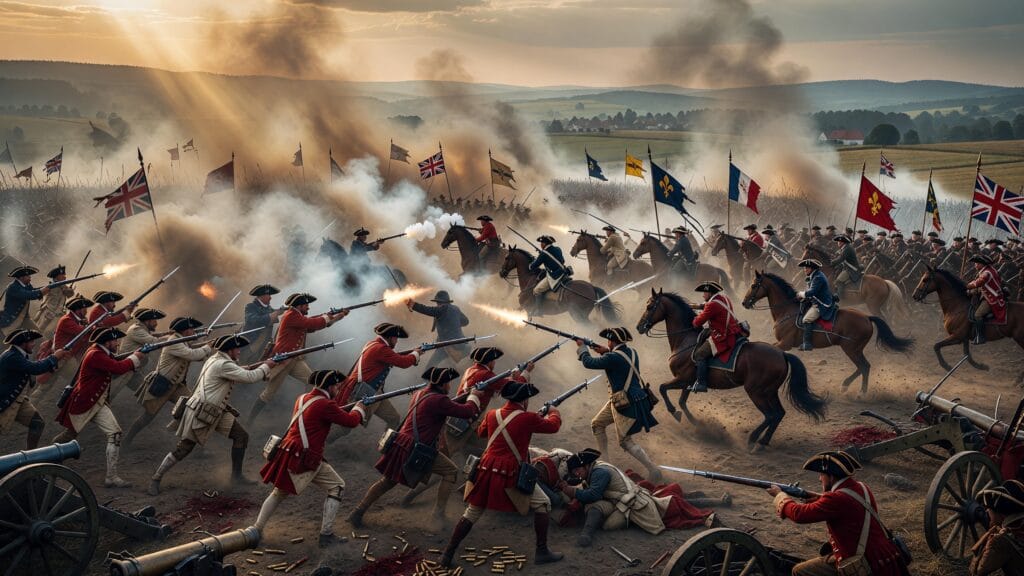
Oberglauheim, the center village, became the hinge as the allied center-left massed across the Nebel. Here, terrain offered a platform for artillery and a springboard for cavalry. French infantry attempted to hold with squares and hedged lines, buying time for countercharges. The ground shook with alternating surges and withdrawals.
Allied guns, once across, began to bite. Marlborough refused to be pinned by local setbacks, using brigades as levers to prise open the line between Blenheim and Oberglauheim. French reserves, thinned by the village garrison, found themselves reacting piecemeal. Momentum favors those who can act faster than fear spreads.
Counterstrokes came hard. French cavalry lunged at exposed allied battalions, sometimes catching them mid-movement, sometimes stalling in the marshy fringes. Imperial troops on the left and center steadied themselves, reinforcing the crossing points. These minutes were measured in officers’ decisions, flags reoriented, and the ability to accept losses without losing the frame of the plan.
By early afternoon, the line wavered. A corridor opened where the ground dried and allied cavalry could form. What had been a contested approach now looked like a channel toward the heart of Tallard’s position. The battlefield’s shape simplified: a clogged village on the French right and a weakening center beyond it.
09 – The Decisive Charge: Marlborough and Eugene Converge
Marlborough coordinated a mounted blow once the center crossings firmed. Squadrons assembled with deliberate quiet, screened by infantry who held fire until the last moment. Timing with Eugene mattered: if the allied right could bind Marsin and the Elector, Tallard’s exposed cavalry would take the full weight without rescue.
The allied charge broke like a tide on Tallard’s center. First contact scattered advanced squadrons; follow-on lines folded against pressure from fresh units pouring through the Nebel corridor. Smoke and dust hid detail, but the movement pattern was unmistakable. French cavalry cohesion dissolved faster than reserves could steady it.
Eugene, still hard-pressed, did enough. His stubborn fight at Lutzingen denied French-Bavarian forces the latitude to roll up Marlborough’s flank. That refusal saved the center assault from envelopment. Coalition warfare, in its purest form, became visible: one partner absorbing punishment so the other could wield the decisive blade.
As the French center buckled, the village of Blenheim turned from shield to snare. Inside, battalions heard the field’s ruin without seeing it. Outside, allied units widened the breach, pivoting to seal retreat routes. It was the moment when battlefield geometry, long contested yard by yard, finally collapsed into a rout.
10 – Rout and Capture: Tallard’s Defeat and Aftermath on the Field
With the center shattered, Tallard’s army fractured. Allied squadrons cut lines of withdrawal; infantry pressed into gaps. Chaos spread faster than orders could. On the Danube bank near Blenheim, thousands found themselves squeezed between water and enemy. Tallard himself was captured, a personal calamity that symbolized the strategic one.
The village garrison, now isolated, faced a terrible choice. Break out into cavalry-dominated ground or capitulate. Under fire from multiple directions, with ammunition low and formations compressed, surrender followed. The bag of prisoners reached numbers that shocked Europe. Few battles of the age ended with such disproportion in captives.
In the field’s quiet that evening, soldiers searched for comrades and water. Officers counted flags and guns, not yet grasping the political thunderclap to come. The geography that had threatened to pin the allies now trapped their enemies. The battle of blenheim ended not with pursuit, but with encirclement and astonished inventory.
11 – Counting the Cost: Prisoners, Casualties, and Civilians
Numbers circulated within days, and they rarely matched. Allied losses were heavy yet endurable; Franco-Bavarian casualties, including prisoners, were devastating. Surrender at Blenheim produced a ledger as much as a lament, with entire regiments struck from rolls. Modern historians caution that early totals served propaganda as well as grief.
For civilians, the aftermath was intimate. Barns became dressing stations; churches housed the wounded. Bavarian families saw winter scarcity approach as fields trampled in August yielded thin harvests in October. The war’s arithmetic translated into bread, straw, and time, the quiet economy of survival amid great-power calculations.
Prisoner exchanges, ransoms, and paroles unfolded over months. Some officers returned to service under conditions; many rank-and-file disappeared into captivity lists. Letters from both sides beg for news of sons and brothers. War’s ledger never closes neatly, and Blenheim’s balance sheet spilled beyond any single autumn.
12 – From Battlefield to Diplomacy: 1704–1705 Consequences
Military collapse in Bavaria triggered a diplomatic recalculation. The Elector fled his capital; imperial forces occupied and administered Bavarian territories. Vienna breathed, London exhaled, and The Hague allowed itself a smile. Yet even in victory, coalition politics demanded careful division of spoils and burdens to keep partners aligned.
France confronted a dangerous narrative shift. Louis XIV’s aura dimmed, and allies sensed the possibility of pressing the advantage. But the war did not end in 1704. French armies remained formidable; resources were vast; and strategy adapted. Blenheim solved the Vienna crisis and created the problem of sustaining momentum.
Credit and finance intertwined with strategy. British public credit strengthened as success encouraged investors and Parliament. Logistics chains stretched deeper into Germany. The ability to fund another campaign season became a strategic asset equal to battalions. Marlborough’s celebrity helped, but institutions and taxes carried the weight.
The coalition exploited the window. Garrisons were redistributed; rivers secured; negotiations probed Bavarian elites for accommodation. The year after the battle saw less drama but crucial consolidation. Without that consolidation, Blenheim’s brilliance might have been a bright flash fading into French recovery.
13 – Memory, Debate, and Sources: Writing Blenheim
Historians grapple with competing narratives. Some portray Blenheim primarily as Marlborough’s masterpiece; others underscore Eugene’s tenacity and the compounded French error of over-garrisoning the village. The surviving evidence points toward a synergy: allied timing met French misallocation, and terrain magnified both effects decisively.
Source traditions diverge. British accounts emphasize the deliberate crossing and the climactic charge; French memoirs linger on initial confidence and sudden collapse; imperial reports highlight Eugene’s grinding work on the right. The documentary record is fragmentary in places, especially for unit-level movements swallowed by smoke and dust.
Contemporary cartography alternates between precision and propaganda. Engraved plans circulated in capitals, each adjusting proportions subtly to flatter generalship. Later compilers, including the editors of the Blenheim Papers at Blenheim Palace and Austrian military archives, tried to reconcile discrepancies. Modern historians debate margins but agree on the battle’s strategic pivot.
Memory built monuments as much as histories. In Britain, “Blenheim” became shorthand for deliverance and imperial possibility; in France, a lesson about coordination; in Bavaria, a scar carried in place-names and parish books. The challenge for readers is to hear the chorus without letting one proud voice drown the rest.
14 – Strategic Legacy: Britain’s Rise and Bourbon Limits
Blenheim’s legacy unfolded over years. It announced that the Grand Alliance could strike far from the Low Countries and win. It convinced financiers that Britain could project power on credit and deliver results. It reminded France that even well-led armies could be undone by terrain, misallocation, and an opponent’s timing.
Politically, Marlborough’s stature soared, but so did envy and scrutiny at home. The victory solved one problem and created another: maintaining coalition momentum without overreach. Meanwhile, Habsburg Austria survived to reclaim ground, and the Dutch, cautious as ever, measured commitments against the long war still ahead.
Economically, Blenheim stabilized investor confidence in London’s emerging fiscal-military state. Revenue streams for future campaigns found supporters who saw returns in interest and security. The new model army marched with ledgers as surely as with drums, building a scaffolding that future British governments would refine and exploit.
Immediate consequence:
Vienna was saved, Bavaria overrun, and French diplomatic posture weakened, forcing strategic recalibration across several fronts for the 1705 campaign season.
Long-term consequence:
Britain’s credibility as a coalition leader and financial power deepened, shaping a century in which sea power, credit, and selective continental interventions defined its rise.
Culturally and ideologically, the victory fed a British narrative of constitutional strength meeting absolutist overreach, even if reality was more complicated. For France, reformers drew lessons about command unity and resource concentration. For the empire, the battle affirmed that German states could rally under pressure without dissolving into local rivalries.
15 – Conclusion
On the Danube’s bends, the battle of blenheim transformed a summer gamble into a European turning point. A village crammed with troops, a marshy stream, and a timed charge converged to save Vienna and bruise Louis XIV’s designs. It was less a miracle than the result of coalition will, operational daring, and an opponent’s missteps.
The legacy reaches beyond banners and captives. Blenheim helped craft Britain’s fiscal-military future, strengthened alliance cohesion, and set a limit to Bourbon power. It also left villages counting losses and memories that endured longer than treaties. The field at Blindheim reminds us that strategy is human, contingent, and measured in lived aftermaths.
16 – FAQs
- When did the battle take place?
It occurred on 13 August 1704, during the War of the Spanish Succession, at the height of a campaign aimed at protecting Vienna from a Franco-Bavarian advance. - Where was the battlefield?
Near the village of Blindheim (Blenheim), along the Danube and the Nebel stream in Bavaria, within the Holy Roman Empire; adjacent key points included Lutzingen and Oberglauheim. - Who were the main commanders?
The allied army was led by John Churchill, Duke of Marlborough, and Prince Eugene of Savoy; the opposing Franco-Bavarian forces were commanded by Marshal Tallard with Marshal Marsin and the Elector of Bavaria, Maximilian II Emanuel. - What caused the battle?
The clash emerged from allied efforts to break French-Bavarian designs against Vienna; Marlborough’s march to the Danube sought to force a decision that would relieve pressure on Austria and reshape the wider war. - What were the immediate consequences?
The allied victory shattered Tallard’s army, led to the capture of thousands in Blenheim, secured Vienna, and brought Bavaria under allied control, altering the campaign of 1704–1705 decisively. - Why does the battle of blenheim matter today?
It exemplifies how operational daring, coalition leadership, and logistics can redirect a major war, while its legacy—Britain’s rising power, France’s recalibration, and imperial survival—echoed through eighteenth-century geopolitics.
17 – External Resource
18 – Internal Link
Other Resources
- Encyclopaedia Britannica – general search for the exact subject
- Google Scholar – academic search for the exact subject
- Internet Archive – digital library search for the exact subject
Sources and References
-
John Churchill, Duke of Marlborough. Letters and Dispatches of John Churchill, First Duke of Marlborough, ed. Sir George Murray. London: John Murray, 1845–1846.
Note: Primary source containing Marlborough’s contemporary reports on the 1704 campaign, operational intentions, troop movements, and his own account of the Battle of Blenheim. -
Savory, Thomas. The Campaign of 1704: Being an Account of the Remarkable Movements That Led to the Battle of Blenheim. London: Henry S. King, 1879.
Note: Detailed narrative of the 1704 campaign including the march to the Danube, the dispositions of Allied and Franco-Bavarian forces, and the tactical development of the battle near Blindheim. -
Chandler, David G. Marlborough as Military Commander. London: Spellmount, 2003 (orig. 1973).
Note: Modern scholarly study analyzing Marlborough’s generalship, including a chapter-length treatment of Blenheim, operational strategy, and its significance within the War of the Spanish Succession. -
Lynn, John A. The Wars of Louis XIV, 1667–1714. London and New York: Longman, 1999.
Note: Situates the Battle of Blenheim within the broader military and political strategy of Louis XIV, providing context on French aims, coalition politics, and the wider course of the War of the Spanish Succession. -
Black, Jeremy. Europe and the World, 1650–1830. London: Routledge, 2002.
Note: Offers broader European context on the balance of power, the role of the Holy Roman Empire, and the geopolitical consequences of major battles such as Blenheim for early eighteenth‑century international relations. -
Blenheim Palace. “The Battle of Blenheim, 1704.” https://www.blenheimpalace.com (accessed 2026).
Note: Museum/heritage site interpretation summarizing the course of the battle, Marlborough’s role, and the way the victory was commemorated in Britain through the building and naming of Blenheim Palace. -
Bavarian State Library (Bayerische Staatsbibliothek). “Blindheim (Blenheim) und der Spanische Erbfolgekrieg.” Digital collections and regional historical overview. https://www.bsb-muenchen.de (accessed 2026).
Note: Regional and archival material on Blindheim in Bavaria, including maps and documentation relevant to the local setting of the battle and the impact on the Bavarian electorate. -
“War of the Spanish Succession.” In Encyclopaedia Britannica Online. https://www.britannica.com/event/War-of-the-Spanish-Succession (accessed 2026).
Note: Concise academic overview providing reliable background on causes, major theaters and outcomes of the war, under which the Battle of Blenheim is treated as a decisive Allied victory.