Table of Contents
- Prologue: Bethsaida‑Julias, Spring 34 CE
- The Herodian Settlement after Herod the Great
- Philip the Tetrarch: Roots and Rule
- Building Cities: Caesarea Philippi and Julias
- Governing the Frontier: Law and Roads
- Money and Image: Coinage and Cult
- The Last Illness and Death in Julias
- Mourning and Announcement: From the Jordan Valley to Rome
- Administrative Vacuum and Annexation to Syria
- Caligula and Agrippa: Rewriting the North
- Life on the Ground: Taxes, Faith, and Memory
- Borders and Neighbors: Nabataea, Damascus, and Syria
- What the Sources Say—and What They Don’t
- Aftermath and Historical Legacy
- Conclusion
- FAQs
- External Resource
- Internal Link
Article Summary: In spring 34 CE, Philip the Tetrarch died at Bethsaida‑Julias, closing three quiet decades of border governance between Syria and the Jordan Valley. His passing triggered a brief Roman annexation and then a political reshuffle under Caligula. This article reconstructs the setting, traces the administrative consequences, and weighs how cities like Caesarea Philippi and Julias fared. It examines Josephus, coins, and archaeology to separate certainty from conjecture. We consider why the herod philip ii death mattered regionally, and how local communities experienced the transition. The result is a documentary narrative centered on governance, roads, temples, and lives disrupted by a ruler’s end.
Why keep reading: A minor monarch died, and an entire frontier shifted. Follow the ripple: from the sickbed in Julias to Syrian accountants, from Pan’s sanctuary to fisher families on the lake, and from Tiberius’s last years to Caligula’s first favors. The tension here is quiet power—what changes when a careful hand leaves the wheel.
At a glance:
- Event: Death of Philip the Tetrarch (often called Herod Philip II)
- Date: 34 CE (exact day uncertain; aligned with Tiberius’s twentieth year)
- Place: Bethsaida‑Julias (Julias), in the northern Jordan Valley
- Main figures: Philip the Tetrarch; Emperor Tiberius; Emperor Caligula; Herod Agrippa I
- Why it mattered: Triggered annexation of his tetrarchy to Syria and later transfer to Agrippa I, reshaping northern Palestine’s political landscape.
01 – Prologue: Bethsaida‑Julias, Spring 34 CE
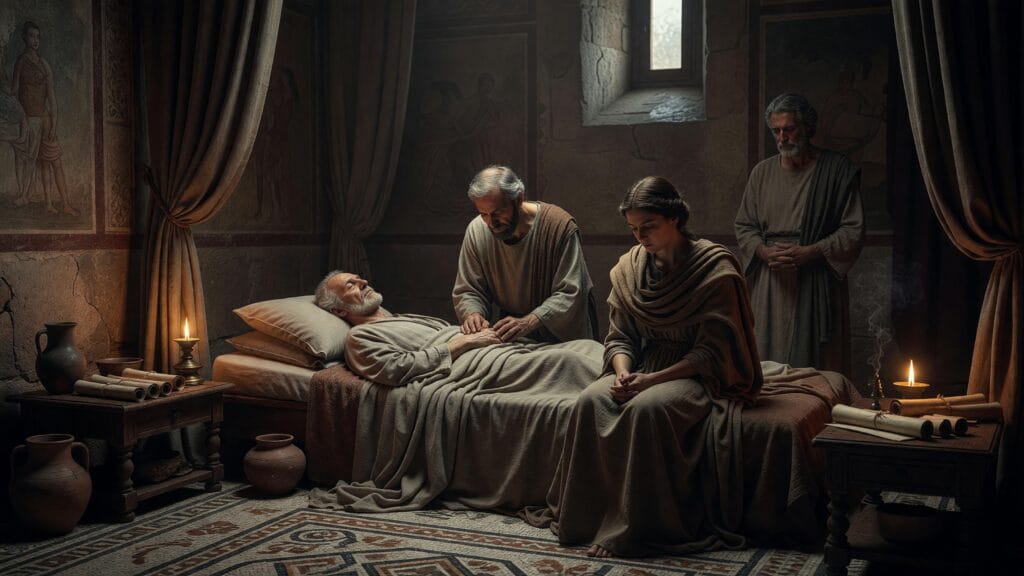
The river slowed beneath Julias, where reedbeds caught the wind and fishermen mended nets. In one of the town’s official residences, the aging tetrarch Philip fell ill and never recovered. The herod philip ii death, quiet and untheatrical, echoed beyond the Jordan marshes into Rome’s administrative files and the minds of subjects who prized his steadiness.
Julias, renamed in honor of the imperial family, was both a stage and a statement. It signaled Philip’s choice to anchor his power in urban spaces, court ceremony, and civic rhythms. Yet behind the façades lay dirt roads north to Paneas, cargo animals dragging salt and fish, and small shrines that held rival loyalties in uneasy balance.
There was no son to succeed him, no primed faction to claim the seal. The stillness around the bier betrayed a looming question. What happens to a frontier carefully held together by a cautious ruler when that caution ends? The news moved with couriers, but the consequences moved with accountants.
02 – The Herodian Settlement after Herod the Great
After Herod the Great’s death in 4 BCE, Augustus divided the kingdom among three heirs. Archelaus took Judea, Samaria, and Idumea; Antipas received Galilee and Perea; Philip controlled the northern highlands from Gaulanitis to Trachonitis and beyond. It was not a single crown but a map of calculated fragments, designed to restrain ambition and stabilize Rome’s flank.
Philip’s territories were not the populous heartlands. They were shelves of basalt, gorges haunted by bandits, and crossroads leading to Damascus. Augustan policy rewarded rulers who secured roads, tamped down raiders, and kept tax receipts predictable. Philip’s slender profile in later histories partly reflects his success—crises were rare under his hand.
Still, the structure was fragile. Archelaus faltered and Judea became a Roman province in 6 CE, governed by prefects subordinate to the legate in Syria. Philip’s north stayed within client-kingdom status, a buffer that could be trusted so long as its ruler neither provoked nor underperformed. It is easy to forget how fragile this world still was.
03 – Philip the Tetrarch: Roots and Rule
Philip was a son of Herod the Great, often distinguished from his half‑brother Herod II by modern scholars who call him “Herod Philip II.” He grew up in the shadow of palace intrigues but carved a different legacy. Josephus remembers him as measured and just, a man who traveled with a portable court to hear cases in situ.
He tended to the logistics of governance: roads, safe corridors, and modest public works. He spoke the language of empire in coins and titles, yet worked among Aramaic‑speaking communities with their local sensibilities. His marriage to Salome late in life produced no children, and that absence would shape the political future more than any decree he issued.
Rather than build a cult of royal charisma, Philip cultivated routine. He favored incremental fixes, lenient tax administration, and diplomacy with neighbors from Damascus to the Decapolis. This conservative style did not fill chronicles with triumphs, but it filled storehouses, and for most subjects that mattered more than marble inscriptions ever could.
04 – Building Cities: Caesarea Philippi and Julias
Philip refounded the ancient Pan sanctuary at Paneas as Caesarea Philippi, aligning his city with imperial reverence and differentiating it from the coastal Caesarea. In the wetlands near the upper Jordan, he elevated Bethsaida to urban status and renamed it Julias, honoring Livia Julia. Cities were policy instruments: tax hubs, courts, and showcases of loyalty.
Unlike Jerusalem, these towns bore images without controversy among many residents. Temples and colonnades advertised Rome’s permanence, while markets tied highlands to lake fisheries and trans‑Jordan trade. Urban life offered elite houses, inscriptions, and coinage mint sites; it also offered surveillance, where disputes could be settled under a magistrate’s seal rather than a clan’s reprisal.
Mini timeline:
- 4 BCE: Philip receives the northern tetrarchy after Herod’s death.
- c. 1–4 CE: Bethsaida elevated and renamed Julias in honor of Livia.
- c. 14 CE: Paneas refounded as Caesarea Philippi at Tiberius’s accession.
- 34 CE: Philip dies at Julias; the tetrarchy faces administrative reordering.
Archaeology at Banias and the proposed site for Bethsaida suggests urban fabrics layered over older sanctuaries and villages. The surviving evidence points toward steady, rather than spectacular, growth. In such places, Philip’s ideology became mortar: mix local tradition with imperial symbols, and the wall might stand through storms he could neither foresee nor outlive.
05 – Governing the Frontier: Law and Roads
Philip’s dominion stretched across difficult ground, where basalt plateaus met caravan paths and pastoralists grazed near market towns. Banditry troubled Trachonitis long before his rule; roads required watchtowers, and justice required patience. Contemporary sources suggest he toured with adjudicators, hearing disputes far from grand halls and closer to contested fields.
Legal processes, modest but reliable, distinguished his regime from improvisational clan justice. Fixed taxes mattered less than predictable enforcement; a merchant can plan for a levy he knows, but not for a shakedown he fears. The tetrarch’s presence on the road signaled accountability, and accountability turned mule trains into arteries rather than targets.
It is astonishing how much political weight could rest on a seal, a signature, or a hostage. Yet Philip’s order rarely needed such dramatics. His quiet authority drew from Rome’s shadow and local respect. The victory solved one problem and created another: stability tethered to a person dissolves with the person, and laws quickly become letters without breath.
06 – Money and Image: Coinage and Cult
Philip struck coins showing imperial figures—Tiberius, and sometimes Livia—paired with local motifs, including temples at Paneas. Numismatists note their conservative style and limited bronze denominations, fitting a landscape of market bargains rather than ostentatious silver hoards. Coins spoke a fluent bilingualism: Roman faces to the empire, sacred architecture to regional pride.
Where Judea often resisted images, Philip’s districts housed longstanding iconography in sanctuaries like Pan’s grotto. The pairing of imperial portraits with local cult sites advertised continuity. It also advertised caution. Philip avoided inflammatory symbols and stressed titles that reassured the legate in Syria he governed without theatrical disloyalty or religious agitation.
Money changed hands; so did meanings. A trader reading Tiberius’s profile found not just a ruler, but the guarantee of road repair and fair arbitration. That promise kept caravans moving from Damascus toward the lake and beyond. When the herod philip ii death arrived, those small bronze circles suddenly commemorated a contract with no signer left alive.
07 – The Last Illness and Death in Julias
Josephus, in Antiquities and The Jewish War, dates Philip’s death to the twentieth year of Tiberius, making 34 CE the accepted frame. The exact illness is unrecorded, and ancient writers rarely linger on medical details. What they note is decisive: he died at Julias, was carried to rest nearby, and left no heir to receive the ring and counselors.
The scene is easy to picture only in outline. Officials kept the ports open and sent runners north and west, while family retainers weighed how to mourn without suggesting political claims. The herod philip ii death did not trigger a palace crisis, but it did open an administrative vacuum with implications larger than any funeral procession.
Bearing him to a local tomb met practical and symbolic needs. He had spent years elevating Julias; now Julias embraced him. That civic gesture closed the circle of a reign defined by towns rather than courts. Yet behind the ceremony, Rome began its own calculus, one where grief mattered less than revenue flows.
08 – Mourning and Announcement: From the Jordan Valley to Rome
Grief traveled slowly; news moved faster. Couriers followed the river road to the Decapolis and Damascus, and another file crossed into provincial Syria where the legate kept his ledgers. In Julias, magistrates likely declared a local period of mourning, suspending cases while scribes drafted the notices that would reclassify offices and titles.
Some townspeople will have felt the change as silence rather than speech—judges convened less frequently, petitions paused, and the visible figure of order was simply gone. Merchants and fishermen could not stop for long. The lake still offered a day’s catch, and caravans timed departures to avoid late spring storms on the plateau.
In the formal letters, the herod philip ii death became a line of administrative prose: a successor absent, a status pending. Yet ordinary people carried versions of the story back from the funeral. He judged cases from a litter. He spoke without swagger. He kept the roads clear. Such memories do not pass by decree; they are retold at market stalls.
09 – Administrative Vacuum and Annexation to Syria
With no heir, Philip’s tetrarchy reverted to imperial discretion. Tiberius chose annexation: the domains were folded into the province of Syria, and their revenues joined a different column in the accounts. Roman governors preferred predictability, and a direct hand seemed safer than improvising a successor among Herodian branches.
Annexation changed more than titles. A client ruler’s discretion in local disputes gave way to provincial procedure and a chain of appeals less familiar to villagers. Taxes might not have increased immediately, but their rhythms likely shifted, aligning with Syria’s fiscal calendar and the habits of distant accountants in Antioch.
Contemporary sources suggest the transition was orderly, without revolt or grand protest. Stability endured, proving that Philip’s institutions held even when his person did not. But this was only the beginning of the rearrangement. The north would soon find a new Herodian at the helm, reshaping loyalties and refreshing old patronage networks.
10 – Caligula and Agrippa: Rewriting the North
When Tiberius died in 37 CE, the young emperor Caligula redistributed favor across the east. He granted Philip’s former tetrarchy to Herod Agrippa I, a grandson of Herod the Great whose fortunes had risen with imperial friendship. The transfer reversed annexation without undoing the paperwork’s effects on local administration.
Under Agrippa, cities like Caesarea Philippi retained their urban identities but gained a courtly sheen. New titles, fresh dedications, and renewed ties to Rome accompanied the change. For subjects, it meant another round of adjustment—replacing the impersonal cadence of Syria with a monarch’s entourage reintroducing face‑to‑face petitions and gifts.
The herod philip ii death thus began a relay of authority: from a stable tetrarch to a provincial ledger and finally to a Herodian revival. Each stage kept order, but each recoded memory. By the early 40s, when Agrippa briefly reunited most of Herod’s old realm, Julias and Paneas remembered three regimes in a single decade.
11 – Life on the Ground: Taxes, Faith, and Memory
For fishermen near the lake, life’s measure was the haul, the tax, and tomorrow’s weather. Annexation replaced one set of collectors with another, but the net still had to be mended. In markets at Julias, Greek, Aramaic, and Latin mixed as prices were counted in bronze coins stamped with faces that changed while fish remained fish.
Faith took many forms. Pan’s grotto at Caesarea Philippi drew festivals, while Jewish villages navigated purity rules and calendar observances. The Gospels remember nearby places—Bethsaida, the region of Caesarea Philippi—situating their narratives within Philip’s geography, even if their theological horizons looked elsewhere. Urban shrines and Sabbath shops shared streets without agreeing on meanings.
Memory formed quietly. Older residents claimed Philip listened without arrogance; younger ones grew under Agrippa’s patronage and recalled civic games. The herod philip ii death became a chronological hinge in household stories, marking when taxes felt different, when a cousin’s case disappeared into Syria’s paperwork, or when a new magistrate mispronounced a village name.
12 – Borders and Neighbors: Nabataea, Damascus, and Syria
Philip’s lands touched Nabataea under Aretas IV, brushed Damascus’s commercial orbit, and fell beneath the Syrian legate’s strategic gaze. Routes carried bitumen, fish sauce, wool, and wine; they also carried jurisdictional headaches. A caravan cross‑checked which official to pay and which officer to avoid, mapping law as carefully as landscape.
Neighborly friction was routine. Antipas’s disputes with Aretas erupted a few years after Philip’s passing, exposing how one border’s instability could rattle another’s. Philip’s earlier stability had insulated his northern districts from spirals of retaliation; after his death, the protection shifted from personal diplomacy to bureaucratic lines that did not always meet realities on the ground.
Damascus’s merchants kept their ledgers open. Syria’s legate tracked tolls moving toward the Orontes. Over time, the herod philip ii death faded from official memory, but not from the routes he once sustained. Stability on a frontier is a living thing; starve it of attention, and roads remember, quickly and without sentiment.
13 – What the Sources Say—and What They Don’t
Our knowledge leans heavily on Josephus, whose Antiquities and War provide the skeleton chronology. He describes Philip’s character, itinerant judging, and the decision to bury him at Julias. Modern historians read these passages against coins, city plans at Banias, and debated identifications of Bethsaida’s precise site on the lake’s shifting shoreline.
Terminology confuses the uninitiated. “Herod Philip II” is a modern label to distinguish the tetrarch from Herod II (sometimes also called Philip), who married Herodias. The documentary record is fragmentary, and later Christian memories of Caesarea Philippi and Bethsaida carry theological weight that must be carefully separated from administrative history.
Even dates carry margins. The twentieth year of Tiberius fits 34 CE, but alternative calculations once proposed adjacent years. Scholars tend toward 34 as the most consistent reading. In such reconstructions, humility matters. Precision may be bought only at the cost of overstating what the earth and ink can attest.
14 – Aftermath and Historical Legacy
Philip’s governance left few monuments of conquest, but many habits of order. After annexation and the grant to Agrippa I, his districts resumed the dance of client rule under imperial supervision. When Agrippa died in 44 CE, direct Roman control returned to much of the region, proving again that sovereignty here was always provisional.
Legacy lives in cities. Caesarea Philippi survived as a cultic and administrative hub; Julias continued as a market town whose name preserved the imperial link. For communities, the herod philip ii death became less a story of palace intrigue than of continuity under new faces—a testimony to how well he had converted personality into process.
Immediate consequence:
Annexation to the province of Syria replaced a local monarch with provincial procedure. Tax cycles realigned, appeals rerouted, and city elites recalibrated patronage from a tetrarch’s court to a governor’s office.
Long-term consequence:
Caligula’s grant to Agrippa I restored Herodian leadership and rewove personal ties. Yet the episode taught subjects and emperors alike that the north could shift between systems without revolt—encouraging later Roman flexibility in frontier management.
In the end, historical memory kept two images of Philip: the patient judge on the road and the founder whose coins paired Rome’s faces with regional sanctuaries. Between them lies the essence of his reign. He governed a conversation between empire and province, then departed, leaving the conversation to continue without him.
15 – Conclusion
Viewed from Julias, Philip’s death was not an epic but a hinge. The herod philip ii death in 34 CE triggered an administrative sequence that redrew authority while preserving daily routines. It proved that stability on a frontier could be taught as habit, not merely enforced as fear—though habits always risked unraveling once their teacher left the room.
His legacy is stitched into streets and coins: cities that balanced Pan’s grotto and market justice, and bronzes that broadcast imperial faces alongside local pride. Later rulers would claim his towns and taxes, but not easily his reputation. In a region famous for crises, Philip’s quiet exit may be his most telling monument.
16 – FAQs
- When did Philip the Tetrarch die?
Most scholars follow Josephus in placing his death in 34 CE, aligning with the twentieth year of Tiberius. This is the standard dating used to frame the herod philip ii death in modern histories. - Where did he die and where was he buried?
He died at Bethsaida‑Julias (Julias) in the northern Jordan Valley and was buried there, completing the civic arc of his rule by resting in a town he had elevated and renamed in honor of the imperial family. - Who were the main figures involved in the aftermath?
Emperor Tiberius initially annexed the tetrarchy to the province of Syria. After Tiberius’s death, Emperor Caligula granted the territory to Herod Agrippa I, reshaping northern politics under renewed Herodian leadership. - What caused his death?
Ancient sources do not specify a cause. Josephus reports the fact and date but offers no clinical detail. Modern historians infer natural causes related to age, while noting that the documentary record is sparse on medical matters. - What were the immediate consequences?
Annexation to Syria changed the administrative framework: provincial procedures, adjusted tax cycles, and different channels for legal appeals. These shifts affected city elites and rural petitioners more than soldiers or priests in the short term. - How did his death shape the region’s legacy?
His passing began a sequence—annexation, then Agrippa’s grant—that demonstrated the north’s adaptability. Cities like Caesarea Philippi and Julias endured, and Philip’s reputation as a fair, road‑minded governor influenced later expectations for frontier order.
17 – External Resource
18 – Internal Link
Other Resources
- Encyclopaedia Britannica – general search for the exact subject
- Google Scholar – academic search for the exact subject
- Internet Archive – digital library search for the exact subject
Sources and References
-
Josephus, Flavius. Jewish Antiquities, Book 18, especially §§106–108.
Primary source. Josephus provides the key narrative for the reign and death of Herod Philip II, including his rule over Batanea, Trachonitis, and Auranitis, the founding and renaming of Bethsaida as Julias, his administrative style, and the succession arrangements after his death in 34 CE. -
Josephus, Flavius. The Jewish War, Book 2, §§94–98.
Primary source. Offers a parallel account of Herod Philip II’s tetrarchy, the character of his rule in the northeastern territories, and the political organization of the region under the Herodian dynasty, corroborating details about his domain and its later incorporation into the Roman provincial system. -
Schürer, Emil. The History of the Jewish People in the Age of Jesus Christ (175 B.C.–A.D. 135), revised and edited by Geza Vermes, Fergus Millar, and Martin Goodman. 3 vols. Edinburgh: T&T Clark, 1973–1987.
Modern scholarly source. Provides a comprehensive reconstruction of the political and administrative context of Herod Philip II’s reign, the territorial divisions of the Herodian kingdom, the chronology of his death, and the subsequent integration of his tetrarchy into the Roman province of Syria. -
Richardson, Peter. Herod: King of the Jews and Friend of the Romans. Columbia, SC: University of South Carolina Press, 1996.
Modern scholarly source. Although centered on Herod the Great, this study includes detailed discussion of the Herodian dynasty, the allocation of territories to Herod’s sons, and Philip II’s position within that dynastic framework, helping clarify his status, policies, and relationship with Rome. -
Smallwood, E. Mary. The Jews under Roman Rule: From Pompey to Diocletian. Leiden: Brill, 1976.
Modern scholarly source. Analyzes the broader context of Roman provincial administration in the eastern Mediterranean, including how territories like Philip II’s tetrarchy were governed, the transition from client rule to direct Roman control, and the political implications of his death in 34 CE. -
Berlin, Andrea M., and J. Andrew Overman, eds. The First Jewish Revolt: Archaeology, History, and Ideology. London/New York: Routledge, 2002.
Modern scholarly source. Contains archaeological and historical studies relevant to Galilee and the Golan region, including Bethsaida-Julias and surrounding areas, supporting discussion of the urban development, economic life, and strategic importance of Philip II’s territories. -
University of Pennsylvania Museum of Archaeology and Anthropology. “Bethsaida (et-Tell) Excavations.”
Institutional/archaeological source. Summarizes results of archaeological work at the site identified with ancient Bethsaida-Julias, providing material evidence for the city’s layout, Hellenistic-Roman urban features, and regional role that align with literary accounts of Philip II’s foundation and building activities. -
“Herod Philip II.” In Encyclopaedia Judaica, 2nd ed. Detroit: Macmillan Reference USA, 2007.
Reference work. Offers a concise scholarly overview of Herod Philip II’s biography, chronology, territorial jurisdiction, and death, helping to verify key dates (including 34 CE), relationships within the Herodian family, and the identification of Bethsaida-Julias as one of his principal urban centers.

