Table of Contents
- Dawn on the Inland Sea: Setting the Stage, 10 September 1813
- Why the War Reached the Lakes: Strategy, Supply, and Sovereignty
- Shipyards in the Wilderness: Building an American Squadron
- Two Commanders, Two Constraints: Perry and Barclay
- Wind and Water: Maneuvering into Battle off Put-in-Bay
- Carronades versus Long Guns: The Opening Broadsides
- “Don’t Give Up the Ship”: Perry’s Boat Transfer
- Breaking the Line: Niagara’s Charge and British Disarray
- “We Have Met the Enemy”: Capture, Controversy, and Claims
- After the Guns Fell Silent: Detroit, the Thames, and the Frontier
- Civilians, Nations, and the Costs of Control
- What Memory Remembers and What Records Reveal
- From Regional Victory to National Story: Consequences and Legacy
- Conclusion
- FAQs
- External Resource
- Internal Link
Article Summary: On 10 September 1813, in the western reaches of Lake Erie, American and British squadrons fought for command of the Great Lakes and the fate of the Northwest Territory. The encounter, remembered as the battle of lake erie, pivoted on wind, gunnery, leadership, and endurance. Oliver Hazard Perry’s audacious mid-battle transfer turned collapse into victory. Britain’s supply lines unraveled, Detroit changed hands, and Native nations faced narrowing options. What followed reshaped campaigning that autumn and the memory of the War of 1812. This narrative blends scene-setting, sources, and sober analysis to track cause, combat, and consequence.
Why keep reading: A lake that looked like a horizon became a battlefield where range, weather, and a single boat ride decided a campaign. Follow how shipwrights, sailors, and commanders built power from timber, and how a local victory echoed from Detroit to diplomatic tables and Native homelands.
At a glance:
- Event: Battle of Lake Erie, War of 1812 naval engagement
- Date: September 10, 1813
- Place: Western Lake Erie, near the Bass Islands and Put-in-Bay, Ohio
- Main figures: Oliver Hazard Perry, Robert Heriot Barclay, Jesse D. Elliott, William Henry Harrison, Tecumseh
- Why it mattered: Secured U.S. control of Lake Erie, forced British retreat from Detroit, enabled the American victory on the Thames, and transformed regional strategy.
01 – Dawn on the Inland Sea: Setting the Stage, 10 September 1813
Just after sunrise, low cloud streaked the water around the Bass Islands, and mist softened the tree line along the Ohio shore. Two lines of vessels, improvised navies of timber and iron, edged toward each other under a fickle wind. Few expected that before noon a regional war would hinge on decisions taken within minutes, within yards, and often within sight of the shore.
Oliver Hazard Perry’s brigs, Lawrence and Niagara, flew signals across a squadron largely crewed by landsmen learning the sea as they fought. Facing them, Robert Heriot Barclay’s compact squadron gathered itself under the British flag, long guns run out for range. The lake, a commercial highway on most days, now became a test of logistics, discipline, and nerve.
Within hours, many men would not see the shoreline again. Yet the waters were familiar, even domestic, to settlers, traders, and Native communities who fished and traveled this inland sea. War had come to their doorstep, and with it the moment that histories later called the battle of lake erie, a phrase deceptively simple for a day so complex.
02 – Why the War Reached the Lakes: Strategy, Supply, and Sovereignty
At stake in 1813 was more than a single naval victory; the Great Lakes were arteries feeding armies and towns. Whoever controlled them controlled movement, supply, and momentum. The British position in Upper Canada leaned on lake routes to sustain garrisons like Detroit and Amherstburg, while American planners sought to pry open a path for offensives into the Northwest.
This contest unfolded on Native homelands. Tecumseh’s confederacy had reshaped the strategic map, joining British forces to resist American expansion. When the U.S. declared war in 1812, it did so amid frontier conflict and maritime grievances that quickly spilled inland. On the lakes, shipbuilding became strategy, and strategy became survival for soldiers and civilians alike.
Both sides entered 1813 under strain. The United States suffered a humiliating loss of Detroit the previous year and now needed a reversal. Britain fought a global war against Napoleon, rationing ships, men, and guns for the inland waterways. The Great Lakes boiled down imperial arithmetic to scarce timber, iron, hands, and time.
03 – Shipyards in the Wilderness: Building an American Squadron
Before battle, there was carpentry. In the spring and summer of 1813, at Presque Isle on Lake Erie’s southern shore, American crews transformed forest into fleet. Shipwright Noah Brown and local mariner Daniel Dobbins oversaw the brigs Lawrence and Niagara, built quickly but stoutly, while smaller gun vessels took shape nearby, all under the eye of young Commander Perry.
Timber was hauled from green woods and iron fittings arrived over primitive roads. The bay’s sandbar protected construction but trapped the vessels inside; heavy guns had to be landed and “camels” or makeshift floats devised to lift the brigs over the bar. Speed and secrecy mattered, since a British squadron could appear at any time and strike at half-made hulls.
Arming the ships introduced its own compromises. American depots provided a mix of carronades—light, short-range smashers—and a handful of long guns. Crews were short on trained seamen, so soldiers and frontiersmen learned lines and guns alongside a core of navy regulars. It was a naval force grown on land, destined to meet an enemy that had trained at sea.
Mini timeline:
- July 1812: Detroit falls to the British, raising stakes on Lake Erie.
- March–June 1813: American brigs laid down at Presque Isle; crews recruited.
- Late July 1813: U.S. squadron crosses the Presque Isle bar, fully armed.
- August–Early September 1813: Maneuvering and scouting; squadrons converge near the Bass Islands.
04 – Two Commanders, Two Constraints: Perry and Barclay
Oliver Hazard Perry was just twenty-eight, ambitious and energetic, posted to a lake where quick action could redeem earlier American setbacks. He carried with him both impatience and ingenuity, raising a blue battle flag stitched with the dying words of his friend James Lawrence: “Don’t give up the ship.” The phrase served as rallying cry and pressure point alike.
Across the water, Robert Heriot Barclay, a veteran of Atlantic service, brought experience tempered by hardship. He had lost an arm earlier in the wars, yet accepted the difficult command on Lake Erie where shipyards were thin and supplies thinly stretched. His tactical mind, however, remained sharp, and he trusted disciplined gunnery and seamanship to do their work.
Constraints defined both men. Perry’s advantage lay in carronades that could devastate at close range, but he needed the wind to close. Barclay’s edge was in long guns that could punish from distance, but he had fewer hands and material to absorb a prolonged fight. The battle would test whose constraints would bend or break first.
05 – Wind and Water: Maneuvering into Battle off Put-in-Bay
The morning wind was light and uncertain, holding the lines apart. Perry’s squadron stood downwind, inching forward toward the British, who waited in compact order with long guns trained. The geography mattered: the Bass Islands shaped the airflow, channels, and escape routes. Both leaders calculated angles and speed as if the lake itself were another piece of ordnance.
Perry put Lawrence at the head of the American line, signaling an intent to absorb punishment while closing the range for his carronades. Niagara, with Commander Jesse D. Elliott, held the second place in line, a position that later would draw praise and criticism in equal measure. The smaller American gun vessels moved to support, their lighter pieces adding volume more than precision.
Barclay’s Detroit led the British, with Queen Charlotte, Lady Prevost, Hunter, Chippeway, and Little Belt in station. His plan, according to contemporary accounts, was straightforward: rake the American van at long range, damage rigging, and prevent an effective close-in assault. On this lake, patience was a weapon, and distances could decide before muskets ever spoke.
06 – Carronades versus Long Guns: The Opening Broadsides
When the first shots boomed across the water, they came from the British long guns, throwing iron well beyond the reach of most American carronades. Lawrence shuddered under repeated hits, spars splintering and rigging slashing crews on deck. Perry’s gunners fought to reply with their few long pieces, buying time and distance until the heavier carronades could bite.
The early exchanges carved a pattern of damage more than decision. Smoke drifted and hid bearings, and ships strained to keep alignment. American gunboats tried to harass the British flanks, but the principal struggle centered on whether Lawrence could survive long enough to close. The ship’s decks grew slick and chaotic, yet discipline on both sides held.
Accounts from the day emphasize the unevenness of the opening phase. The British squadrons’ training in long-range gunnery told, and American casualties concentrated around Perry’s flagship. Still, every minute that Perry maintained steerage brought his short-range advantage closer. It is easy to forget how fragile this world still was when a shift of wind could rewrite plans.
07 – “Don’t Give Up the Ship”: Perry’s Boat Transfer
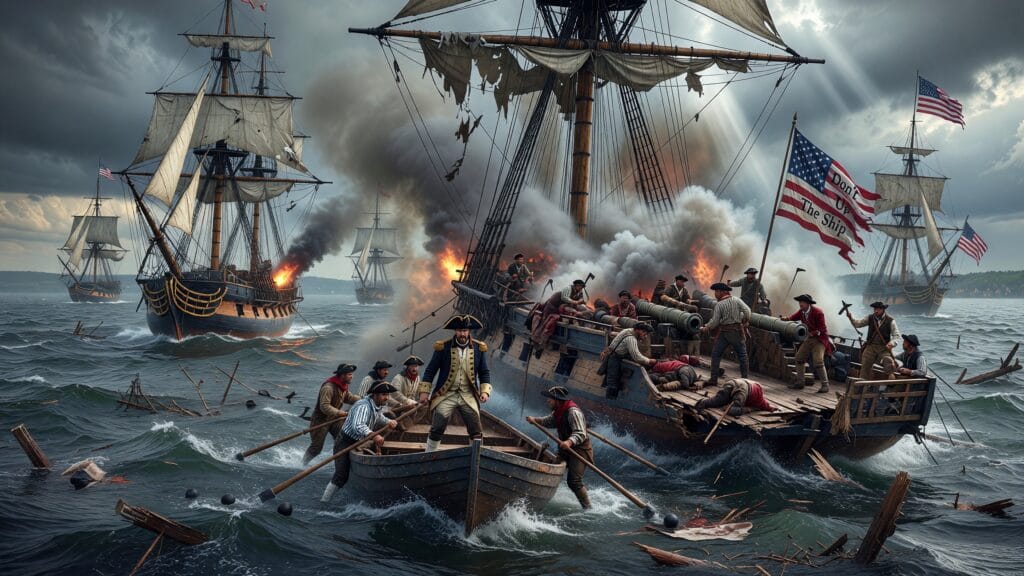
As Lawrence neared wreckage, masts wounded and guns dismounted, Perry made a decision that defined the day. Carrying his broad blue flag, he took a small boat, a cutter, and ordered a pull through drifting smoke and iron splashes toward Niagara. The row was a few hundred yards yet felt like a campaign within a campaign, exposed, deliberate, and visible to all.
This was no theatrical flourish. Lawrence could no longer serve as a fighting platform, yet the squadron needed a commander who could carry the line forward. By transferring, Perry preserved unity of action and moved to a ship that had suffered less damage and could still maneuver decisively. The battle’s hinge turned with each oar stroke.
Later controversies would argue over how quickly Niagara engaged before the transfer and what Elliott could or should have done. In the moment, however, the sight of Perry standing in the boat steadied American morale. The victory solved one problem and created another: credit and blame would travel as stubbornly as smoke across the lake for years afterward.
08 – Breaking the Line: Niagara’s Charge and British Disarray
Once aboard Niagara, Perry acted aggressively. He ordered sail and steered to break the British line, raking opponents at near point-blank range where carronades dominated. Detroit and Queen Charlotte, both damaged and struggling with impaired command and control, fouled each other in a collision that compounded their troubles and exposed them to destructive fire.
At close range, the balance flipped. American short guns now hurled heavy shot that tore wood and will together. The smaller American vessels closed, and their combined broadsides created a storm the British could no longer weather. Leadership mattered, but so did geometry; convergence amplified American fire just as entanglement weakened British response.
These minutes were decisive. British casualties soared, and the ability to coordinate fell away as masts and spars crashed to deck. Under the weight of converging American attack, silence spread along the British line not as strategy but as damage, a mute testament to the fury of short-range combat that neither side would soon forget.
09 – “We Have Met the Enemy”: Capture, Controversy, and Claims
By early afternoon, the British ships struck their colors. Detroit, Queen Charlotte, Lady Prevost, Hunter, Chippeway, and Little Belt lay prisoners of battle, battered and barely afloat, crews exhausted or wounded. Perry penned his famously economical dispatch to General William Henry Harrison: “We have met the enemy and they are ours,” adding a list of captured vessels as proof.
That message traveled fast, transforming regional news into national headline. In celebration, however, lay the seed of dispute. Questions about Niagara’s early position and Elliott’s choices sparked inquiries, letters, and partisan takes in the American press. The British, for their part, pointed to material inferiority and bad luck intertwined with gallantry under fire.
Evidence rarely settles emotion. American memory fixed on the boat transfer and the dispatch, while British narratives emphasized Detroit’s crippling injuries and the hazards of the collision. Between them sat the material fact of six captured ships, a lake wrested from British control, and a campaign reshaped in the space of one late-summer day.
10 – After the Guns Fell Silent: Detroit, the Thames, and the Frontier
Control of Lake Erie yielded immediate strategic effect. Harrison moved to retake Detroit, now impossible for the British to hold without lakeborne supply. The British general Henry Procter withdrew up the Thames River with Tecumseh’s warriors, a retreat becoming a chase. In October, the American victory at the Battle of the Thames killed Tecumseh and broke the confederacy’s cohesion.
The chain is unmistakable even if each link had its own tensions. Perry’s victory enabled Harrison’s logistics and projected American power deep into contested territory. As British posts emptied or burned stores they could not carry, the frontier altered in days what politics had failed to do in months. It is astonishing how much political weight could rest on a flotilla.
These consequences marched beyond military maps. Civilians along the lakes saw prices, trade patterns, and even shoreline security change. For many settlers, the American flag on the water promised protection; for others, especially among Native communities, it heralded consolidation and encroachment. Victory and vulnerability traveled together, depending on who read the horizon.
11 – Civilians, Nations, and the Costs of Control
On the southern shore, communities that supplied the American fleet felt an economic lift. Timber cutters, ironmongers, and farmers sold to government contractors. Yet prices spiked, transport strained, and wartime reimbursements came late or in depreciated forms. The lake’s new security encouraged commerce, but disruptions rippled through households that had given men to the squadron and crops to the mills.
For Indigenous nations, the aftermath undercut confederated resistance. Britain’s capacity to arm and provision allies eroded with the loss of the lake, and the retreat left communities exposed to punitive expeditions and land pressure. Oral traditions and later petitions remember this as a pivot, when choices narrowed and diplomacy alone became less able to extract respect or relief.
Canadian settlements and militia families along the north shore bore parallel burdens. With supply now less reliable, garrisons demanded more local contributions of labor, food, and cartage. The war that seemed distant on maps landed as requisitions and fear, and the memory of the American flag on Lake Erie became both a caution and a spur toward resilience.
12 – What Memory Remembers and What Records Reveal
Monuments and prints settled on images: Perry standing in a small boat; captured masts bristling like a trophy forest; the laconic dispatch. Commemoration favors the visible moment, yet the surviving paper trail invites nuance. The American press, including Niles’ Weekly Register, amplified triumph, while British reports highlighted gallant resistance under inequitable conditions of armament and damage.
Modern scholarship parses the gunnery math and the wind, but also reads silences. The British court-martial proceedings for the loss of ships, routine in such cases, sifted responsibility amid injury and collision. The Liber Pontificalis offers no guidance here, but British and American administrative records do, if read with care, showing how logistics and command routine framed heroics.
Even within American ranks, letters reveal fissures. Perry and Elliott’s dispute fermented into partisanship that colored later histories, including Theodore Roosevelt’s 1882 study, which attempted to balance valor with analysis. The best reading joins technical assessment with human scale, remembering that this was a regional fight fought by men who learned their sea on a lake.
13 – From Regional Victory to National Story: Consequences and Legacy
Strategically, the United States secured the lake for the remainder of the war, denying Britain a platform for offensive operations in the Old Northwest. Diplomatically, the triumph strengthened American bargaining confidence, though the war’s end would come through larger global shifts. In naval culture, Lake Erie became a lesson in initiative, training versatility, and the risks and rewards of audacity.
The material footprint lingered in ship timbers reused or scuttled and in communities tied to new trade routes. The victory also lived in classrooms and parades, embedding the lake into a pantheon of American naval firsts. But this was only the beginning of a longer story, where expansion pressed outward and the costs fell unevenly across peoples and places.
Immediate consequence:
British evacuation of Detroit and the success of Harrison’s campaign, culminating in the Battle of the Thames, where Tecumseh was killed and the allied resistance fractured.
Long-term consequence:
Enduring U.S. control of the southern Great Lakes, reinforcement of naval professionalism narratives, and acceleration of American settlement in the Old Northwest at the expense of Native sovereignty.
In the broader rhythm of the War of 1812, the episode demonstrated how inland seas could act like oceans when it came to strategy. The battle of lake erie shaped not only months, but mental maps for decades, encouraging policymakers to invest in coastal and lake defenses and to imagine maritime power beyond blue-water fleets.
14 – Conclusion
The morning that began in haze closed with captured ships anchored under a new flag, and with a dispatch that condensed a battle into a sentence. Yet the deeper meaning lay in how a lake decided a land campaign, and how material constraints—guns, timbers, trained hands—interacted with judgment. The battle of lake erie remains a case study in adapting means to ends under unforgiving pressure.
Perry’s boat ride has become emblematic, but it was the product of a system: hurried shipyards, shifting winds, mixed armament, and officers navigating rivalry and responsibility. Its legacy ran from Detroit through the Thames to peace negotiations and frontier settlements. To read this day well is to see strategy surface in spray, then roll ashore with consequences felt for generations.
15 – FAQs
- When did the battle occur?
It took place on September 10, 1813, during the War of 1812, unfolding over late morning and early afternoon as winds shifted and lines closed. - Where was the battle fought?
The engagement occurred in western Lake Erie near the Bass Islands and Put-in-Bay, off the Ohio shoreline, on waters that served as strategic highways for both armies. - Who were the main commanders?
American forces were commanded by Oliver Hazard Perry, with Jesse D. Elliott as his second in command; British forces were led by Robert Heriot Barclay, a veteran Royal Navy officer. - What caused the confrontation?
Both sides sought control of Lake Erie to secure supply lines and troop movements. After months of shipbuilding and maneuvering, their squadrons finally met, each trying to exploit its gunnery advantages and the prevailing wind. - What was the immediate consequence?
Perry captured the entire British squadron, enabling the American recapture of Detroit and setting the conditions for the victory at the Battle of the Thames the following month. - Why does this battle matter today?
The battle of lake erie illustrates how inland naval power can determine land campaigns, and it shaped the political and demographic future of the Old Northwest, especially for Native nations facing intensified American expansion.
16 – External Resource
17 – Internal Link
Other Resources
- Encyclopaedia Britannica – general search for the exact subject
- Google Scholar – academic search for the exact subject
- Internet Archive – digital library search for the exact subject
Sources and References
-
Perry, Oliver Hazard. Official Report to the Secretary of the Navy on the Action of 10 September 1813. In American State Papers: Naval Affairs, Vol. 1. Washington, D.C.: Gales and Seaton, 1834.
Note: Primary source. Perry’s after-action report provides first-hand details on the course of the battle, the condition of U.S. ships, casualty figures, and the circumstances under which the British squadron surrendered. -
Barclay, Robert Heriot. Dispatch to Sir James Yeo on the Action of 10 September 1813. In William James, A Full and Correct Account of the Chief Naval Occurrences of the Late War Between Great Britain and the United States of America. London: T. Egerton, 1817.
Note: Primary British account. Barclay’s report offers the British perspective on the engagement, including explanations of British ship readiness, ammunition shortages, and tactical decisions, helping to balance the narrative of the battle. -
Skaggs, David Curtis, and Gerard T. Altoff. A Signal Victory: The Lake Erie Campaign, 1812–1813. Annapolis, MD: Naval Institute Press, 1997.
Note: Modern scholarly monograph. This work gives a detailed operational history of the Lake Erie campaign, including shipbuilding at Presque Isle, command decisions by Perry and Barclay, the battle’s tactical developments, and the strategic consequences for control of the Northwest. -
Hickey, Donald R. The War of 1812: A Forgotten Conflict, Bicentennial Edition. Urbana: University of Illinois Press, 2012.
Note: Widely cited academic overview of the War of 1812. Hickey situates the Battle of Lake Erie within the larger war, discussing its impact on American morale, the recapture of Detroit, and subsequent campaigns in the Old Northwest. -
U.S. Naval History and Heritage Command. “Battle of Lake Erie, 10 September 1813.” Naval History and Heritage Command, Department of the Navy.
https://www.history.navy.mil/
Note: Official U.S. Navy historical resource. Provides battle diagrams, ship lists, biographical details on Perry and key officers, as well as analysis of the engagement’s naval significance. -
National Park Service. “Perry’s Victory and International Peace Memorial: History & Culture.” U.S. National Park Service.
https://www.nps.gov/pevi
Note: Federal heritage site interpretation. Summarizes the background to the Battle of Lake Erie, its outcome, commemorative efforts on South Bass Island, and the broader implications for U.S.–British relations and the Northwest frontier. -
“Battle of Lake Erie.” In Encyclopaedia Britannica, online edition. Encyclopaedia Britannica, Inc.
Note: Authoritative reference entry that corroborates key factual elements of the battle: date (10 September 1813), location on Lake Erie off Put-in-Bay, composition of opposing squadrons, the U.S. victory, and its role in securing American control of the lake. -
Library of Congress. “Oliver Hazard Perry Papers” and related War of 1812 collections. Manuscript Division, Library of Congress.
https://www.loc.gov
Note: Archival material including correspondence, orders, and later recollections by Perry and contemporaries. These documents support details on Perry’s preparation, command relationships, and the famous message “We have met the enemy and they are ours.”