Table of Contents
- Santiago on a Knife-Edge: Chile in Early 1818
- After Cancha Rayada: Panic, Rumor, and Resolve
- San Martín’s Rebuild: Plans, Terrain, and Trust
- The Armies that Faced Each Other
- Dawn over Maipú: Opening Moves on 5 April
- Infantry against Fire: Las Heras and Alvarado Advance
- Cavalry on the Plain: Zapiola, Necochea, and the Break
- Osorio’s Gamble and Ordoñez’s Last Stand at Lo Espejo
- The Abrazo de Maipú: Symbol and Statecraft
- War Finance, Supply Lines, and the Capital’s Nerves
- Church, Patriotism, and the Making of a Chilean Public
- From Maipú to the Pacific: Navy-Building and the Road to Peru
- Winners, Losers, and Those Caught Between
- Memory, Myth, and the Sources We Trust
- Conclusion
- FAQs
- External Resource
- Internal Link
Article Summary: On 5 April 1818, the battle of maipu determined Chile’s future. In the days after the Patriot disaster at Cancha Rayada, José de San Martín rebuilt his army and chose the ground at Maipú, southwest of Santiago. Facing Mariano Osorio’s royalists, the Patriots fought a decisive, disciplined action that ended with a surrender at Lo Espejo. O’Higgins’s dramatic arrival and the “Abrazo de Maipú” turned victory into nation-building theater. This article follows the battle’s human stakes, the fragile logistics, the political aftermath, and the long road from Chile’s plains to Peru’s liberation.
Why keep reading: Because Maipú was won on a field and fortified in memory. Panic turned to resolve in days, the capital held its breath, and a single morning reshaped the Andes. This is the story of how a near-defeat became a nation’s hinge—and why the consequences echoed across the Pacific.
At a glance:
- Event: Battle of Maipú, decisive engagement of the Chilean War of Independence
- Date: 5 April 1818
- Place: Plains southwest of Santiago, near Maipú and the Lo Espejo estate
- Main figures: José de San Martín; Bernardo O’Higgins; Mariano Osorio; José Ordóñez
- Why it mattered: It secured Santiago, stabilized the Patriot government, and opened the maritime campaign that carried independence to Peru.
01 – Santiago on a Knife-Edge: Chile in Early 1818
In the first months of 1818, Santiago felt smaller than its valley. That winterless light on the cordillera could not dispel the fear that everything might still be undone. The Patriot victory at Chacabuco the previous year had seemed conclusive, yet royalist columns still moved, and the viceroy’s agents still wove influence from Peru.
Bernardo O’Higgins, newly styled Supreme Director, governed from a capital where the state was improvisation and pledge. Armories beat out musket parts; church bells signaled both ceremony and alarm. In this unsettled world, the battle of maipu would not merely be a clash of arms; it would be a referendum on whether Chile could stand alone.
The Patriot army, built from Argentine veterans of the Andes crossing and Chilean recruits, camped near the arteries of the fertile valley. They were supported by merchants who opened ledgers to a cash-starved administration, and by civilians who learned that independence depended on bread, powder, and patience as much as on flags.
02 – After Cancha Rayada: Panic, Rumor, and Resolve
On 19 March 1818, at Cancha Rayada near Talca, the royalists disrupted the Patriot camp at dusk, inflicting a sudden, confusing defeat. Rumors raced before the retreating soldiers: San Martín had been killed; independence was finished; Santiago would burn. O’Higgins was badly wounded, San Martín bruised but very much alive.
In the capital, families packed what they could and watched the roads. Some planned to flee to Mendoza, others to the coast. Yet terror ripened into discipline with startling speed. San Martín summoned deputies, restored chains of command, and promised to fight where the valley opened toward Maipú’s plain.
News from the south remained erratic, but auxiliary units rallied to the Patriot standards, and messengers rode the farms of the Maipo basin. The choice was implicit: either meet the royalists outside Santiago or fight street by street. San Martín, wary of urban catastrophe, chose the open ground.
03 – San Martín’s Rebuild: Plans, Terrain, and Trust
In days, San Martín set about what he did best: turning shock into structure. He staged musters, rearmed detachments, and reordered divisions under officers he trusted. The army was not enormous, but it became coherent again, its core Argentine veterans holding together Chilean battalions that had learned from a year of campaigning.
The chosen field lay southwest of the city, along gentle undulations near the Maipo River and the Lo Espejo estate. The ground advantaged Patriot lines that could anchor on slight rises and deploy artillery with clear fields of fire. If the royalists pressed too quickly, they would meet ordered volleys and cavalry poised to countercharge.
Trust, however, was the decisive terrain. Officers had to convince men that Cancha Rayada was a rupture, not a pattern. O’Higgins, carried in a litter due to his wounds, became a symbol of endurance, while San Martín projected calm determination. The capital’s breath would be held on that plain.
04 – The Armies that Faced Each Other
The Patriot army combined Argentine veterans of the Army of the Andes with Chilean infantry and cavalry raised in the previous year. Divisions under Juan Gregorio de Las Heras and Rudecindo Alvarado formed the infantry backbone. José Matías Zapiola and Mariano Necochea led cavalry that had learned to strike and regroup across open country.
Opposite stood Mariano Osorio, experienced and confident after the surprise at Cancha Rayada. His royalists included Peninsular and American-born troops, bolstered by respected battalions. José Ordóñez, a firm commander, would prove both aggressive and stubborn, especially when the battle pushed toward the walls of Lo Espejo.
Both sides fielded comparable numbers—roughly five to six thousand infantry apiece, with over a thousand cavalry and two dozen guns each, according to most reconstructions. Exact figures vary across official reports and later histories, but parity in arms served only to magnify the difference made by leadership and timing.
Mini timeline:
- 12 Feb 1817: Patriot victory at Chacabuco opens Santiago.
- 12 Feb 1818: Formal declaration of Chilean independence.
- 19 Mar 1818: Cancha Rayada shocks the Patriot army.
- 5 Apr 1818: Maipú decides the campaign around the capital.
05 – Dawn over Maipú: Opening Moves on 5 April
The morning rose with dust and order. San Martín placed his divisions in a line that curved slightly, artillery posted forward. The royalists, advancing from the southwest, found the Patriots waiting. If Cancha Rayada had begun with confusion, Maipú opened with the opposite: deliberate, geometrical war.
An artillery duel stung both sides, more moral pressure than murderous devastation. Gunners calibrated range while commanders watched for thin places along the ridges. The Patriots intended to absorb the first shock, then roll up the flank that tired earliest, a method born from drill as much as from audacity.
Orders moved by gallop and shout. San Martín’s calm circulated down the line, transmitted through the posture of officers and the steadiness of the colors. The battle of maipu, promised to a terrified city, began without flourish, as if a mathematical problem were being set on open ground.
06 – Infantry against Fire: Las Heras and Alvarado Advance
The left under Las Heras pressed carefully, trading volleys and ground with royalists who answered shot for shot. Accounts emphasize steadiness more than spectacle here. Lines bent but did not shatter; companies closed ranks after each impact. The Patriots had learned to endure the clatter of musketry and the soft terror of smoke.
On the right, Alvarado pushed to prevent a royalist envelopment, using terrain folds to shelter movements. The exchange felt like a contest of attention—who would blink, who would commit reserves too early. Amid the clangor, officers recalculated every minute, seeking that slim moment when pressure might become rupture.
For a time, the royalist center showed resilience that worried the Patriot staff. But any advance required exposure, and with exposure came cavalry. The battlefield’s logic tightened, drawing both armies toward a climax neither could easily control once set in motion.
07 – Cavalry on the Plain: Zapiola, Necochea, and the Break
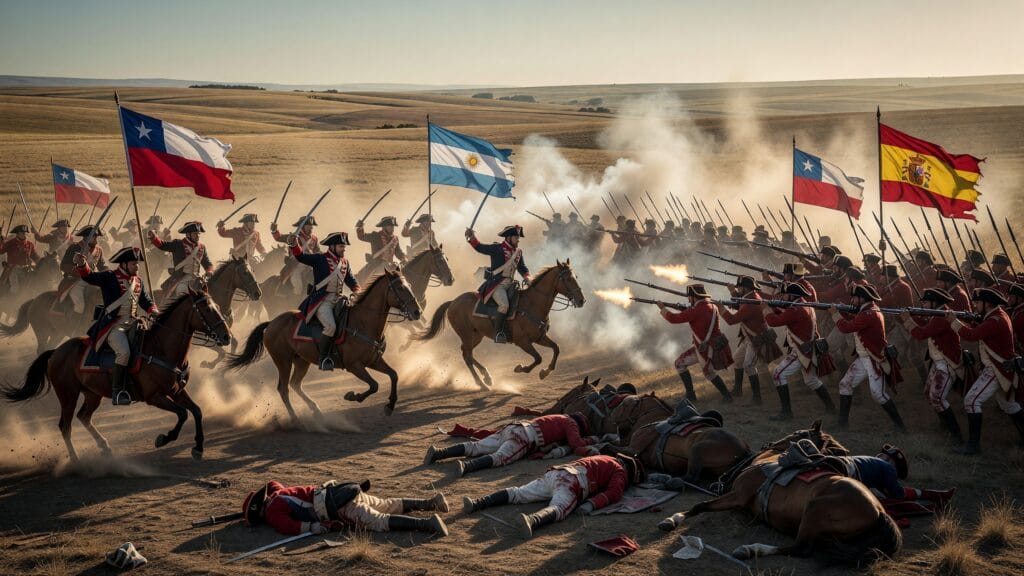
With infantry engaged across the line, Zapiola’s and Necochea’s squadrons began to move. They probed where dust hung thinner, signaling ground less torn by fire. When royalist cavalry attempted to turn the Patriot flank, Zapiola countered with a fierce, disciplined charge that disrupted the maneuver and bought breathing room.
Necochea, no stranger to the violence of short distances, led another strike that cut into shaken units and then wheeled away before infantry could form proper squares. The purpose was not romantic dash; it was to splinter cohesion, to strip the enemy of the ability to act in concert. That effort worked.
The royalist line began to fray. Retreats became stumbles; stumbles became gaps. San Martín saw it from the center and pressed infantry forward to widen the rupture. In such moments, wars are decided not by courage alone but by whether an army’s training can turn seconds into strategic advantage.
08 – Osorio’s Gamble and Ordoñez’s Last Stand at Lo Espejo
As the Patriot tide rose, Osorio faced an unaffordable choice: commit dwindling reserves or preserve a remnant to fight again. He withdrew with cavalry elements, a decision for which later critics chastised him but which likely spared a total rout. Command, in that hour, meant gambling with history’s memory.
Ordoñez did not leave. He pulled royalist troops toward the Lo Espejo estate, a stout house and walls that could be turned into a miniature fortress. There, the fight compressed into brutal close-quarters exchanges. The house changed hands and then became a pocket where surrender or slaughter would decide the end.
Patriot infantry, supported by guns dragged forward, battered the position. Eventually, Ordoñez offered capitulation for those still within the walls. The Patriot command accepted, counting prisoners and flags even as skirmishing lingered on the margins. The battle of maipu had moved from field maneuver to the reckoning of survivors.
09 – The Abrazo de Maipú: Symbol and Statecraft
After the firing faded, O’Higgins—bandaged from his Cancha Rayada wound—arrived on the field. San Martín rode to meet him, and their embrace, the “Abrazo de Maipú,” became a scene that Chile still teaches to schoolchildren. It was both genuine relief and calculated message: the state had survived, and it had leaders who stood together.
Symbols are not trivial in the making of nations. The embrace reassured a shaken public and silenced whispers that defeat had cracked the alliance between Argentine liberator and Chilean director. It also projected a future, one in which Chile would be not only free but instrumental in freeing its neighbors.
In city squares, that embrace would be reenacted in speeches and ceremonies. Yet behind the ceremony lay administrative urgency. Prisoners had to be processed, supplies reordered, and Santiago kept calm. The performance of unity eased those tasks, turning emotion into institutional momentum.
10 – War Finance, Supply Lines, and the Capital’s Nerves
Victory solved one problem and created another: how to pay for it. The army’s munitions burned quick fortunes, and the government’s credit was a fragile thread spun from patriotism and promissory notes. Merchants in Santiago and Valparaíso extended loans, betting that the state born at Maipú would outlast arrears.
Supply lines wound through haciendas whose owners had to choose cooperation or obstruction. Grain, mules, leather, and saltpeter moved under guards who remembered that a starving regiment is a regiment that dissolves. The Patriot leadership worked to professionalize requisitions, blunt the bitterness of exactions, and keep civilian morale intact.
In the weeks after the battle, the city’s nerves calmed by increments. Markets returned to their chatter, even as hospitals remained crowded. The government’s capacity to function—dispatches filed, taxes collected, uniforms sewn—was the real dividend of Maipú. The battle’s echo was the hum of administration reasserting itself.
11 – Church, Patriotism, and the Making of a Chilean Public
Priests preached thanksgiving in churches that, only weeks earlier, had led supplications for survival. The Patriot project neither discarded Catholicism nor submitted entirely to ecclesiastical prerogatives. Instead, O’Higgins’s government sought a civic Catholicism, one that could bless banners and yet answer to laws passed by men in coats rather than cassocks.
Public rituals—the Te Deum, the parades, the reading of decrees—trained a population in the habits of a state becoming real. Printing presses multiplied proclamations that joined religious gratitude to patriotic duty. Critics later judged some of this choreography as heavy-handed, but new countries always rehearse themselves into being.
Education and patronage followed. Scholarships for sons of officers, clinics for the wounded, and state funerals for the dead created narratives of belonging. The battle of maipu, memorialized almost as soon as it ended, thus became a civic textbook, an organizing memory with room for both reverence and debate.
12 – From Maipú to the Pacific: Navy-Building and the Road to Peru
With the valley secured, strategy turned seaward. San Martín had long believed the key to ending Spanish rule lay in Lima, not Santiago. That meant building a navy in a country whose maritime strength, until then, was more aspiration than reality. Valparaíso transformed into a shipyard of purpose and improvisation.
Foreign officers and sailors—many British—entered Chilean service. Within months, Lord Cochrane would arrive to command a fleet that grew from captured prizes and purchased hulls. Its reason for being was born at Maipú: a government confident enough to mortgage future revenues in exchange for ships that could carry revolution north.
Economically, wartime measures strained households, but openness to trade after stability brought new goods, credits, and ambitions. The Pacific, once a highway for royal monopoly, became a contested arena. When Cochrane sailed and San Martín later landed in Peru, the continuity from Maipú to Lima was clear even to skeptical observers.
Immediate consequence:
Royalist threat to Santiago collapsed, thousands of prisoners were taken, and O’Higgins’s government consolidated authority to legislate, tax, and build a navy without the constant fear of sudden overthrow.
Long-term consequence:
Chile became the logistical and naval springboard for liberating Peru, anchoring a regional shift that diminished Spanish imperial power along the Pacific coast and reconfigured South American politics.
13 – Winners, Losers, and Those Caught Between
For the victors, Maipú yielded promotions, land grants, and the moral capital of having “saved” the nation. For royalist officers, it meant capture or exile. Some would find later service in Spain or other monarchies; others adjusted to new realities under suspicion or surveillance, their loyalties now liabilities.
Many Chileans simply endured. Rural communities near the battlefield lost harvests to requisition and suffered the traumas that armies always carry: disease, theft, and the disruption of family economies. Indigenous communities, far to the south, watched a state consolidate that would soon claim their lands with new energy, if not yet new policy.
Historians caution against victory’s blindness. The battle closed one chapter but left open conflicts over centralization, local autonomy, church influence, and the burdens of militarization. O’Higgins’s later fall from power, in 1823, had roots partly in the strains that even a righteous victory cannot erase.
14 – Memory, Myth, and the Sources We Trust
Stories about Maipú multiplied quickly. The official “parte” emphasized providence and discipline; patriotic newspapers embroidered details; later chroniclers, writing with the hindsight of nationhood, polished a heroic arc. Modern historians remain cautious because the surviving record is fragmentary, not fraudulent but partial, stamped by purpose.
Debates linger: Did Osorio’s withdrawal constitute prudence or perfidy? Were casualty figures inflated to magnify triumph? How decisive were particular charges compared with the grinding work of infantry lines? The answers often depend on which memoir or report one privileges, and on how one reads silences in the archive.
Yet the evidence forms a recognizable pattern. Independent accounts agree on the battle’s result, on Ordoñez’s stand at Lo Espejo, and on the symbolic power of the embrace between San Martín and O’Higgins. The battle of maipu endures not because every detail is fixed, but because its consequences are unmistakable.
15 – Conclusion
Maipú was the moment the Patriot project in Chile passed from precarious experiment to anchored reality. The field outside Santiago made national administration plausible, naval ambition practicable, and regional strategy coherent. In the span of a morning, panic receded and possibility enlarged, not by miracle but by organization, choice of ground, and endurance under fire.
Today, when Chileans recall the battle of maipu, they honor more than a victory. They remember a hinge between defeat and determination; a handshake that tied legitimacy to unity; a decision that opened the road to Lima. The legacy is not triumphalism but testimony: nationhood is built in crisis and maintained in the daily work that follows.
16 – FAQs
- When was the battle fought?
It took place on 5 April 1818, in the tense weeks following the Patriot setback at Cancha Rayada. - Where did it happen?
On the plains southwest of Santiago, Chile, near Maipú and the Lo Espejo estate, a landscape of low rises and open fields suitable for infantry lines and cavalry maneuvers. - Who were the main commanders?
José de San Martín commanded the Patriot army, with Bernardo O’Higgins as Chile’s political leader; Mariano Osorio led the royalists, and José Ordóñez commanded the stubborn defense at Lo Espejo. - What caused the battle?
After the surprise royalist success at Cancha Rayada, both sides raced to decide control of the capital. San Martín rebuilt his forces and chose ground at Maipú to force a decisive engagement. - What were the consequences?
Royalist forces in central Chile collapsed, thousands were taken prisoner, and the Patriot government stabilized. The victory enabled Chile to build a navy and support the campaign that would carry independence to Peru. - What is the legacy of the battle of maipu?
It secured Chilean independence in practice, forged powerful national symbols like the “Abrazo de Maipú,” and marked the pivot from survival to regional liberation, influencing South American politics well beyond 1818.
17 – External Resource
18 – Internal Link
Other Resources
- Encyclopaedia Britannica – general search for the exact subject
- Google Scholar – academic search for the exact subject
- Internet Archive – digital library search for the exact subject
Sources and References
-
O’Higgins, Bernardo. “Parte Oficial sobre la Batalla de Maipú” (Official Dispatch on the Battle of Maipú), 5 April 1818.
Primary source. Official report sent by Supreme Director Bernardo O’Higgins describing the outcome of the battle and its political-military significance for Chilean independence. Supports statements about the decisive nature of the victory and the consolidation of Chile’s independence. -
San Martín, José de. “Parte del General en Jefe sobre la Jornada de Maipú,” in Documentos para la Historia de la Independencia de Chile, vol. 4, Biblioteca Nacional de Chile.
Primary source. Field report by General José de San Martín detailing troop dispositions, phases of the engagement, and casualty estimates. Supports descriptions of the battle’s development, leadership roles, and the tactical context of Maipú. -
Collier, Simon, and William F. Sater. A History of Chile, 1808–2002. 2nd ed. Cambridge University Press, 2004.
Modern scholarly source. Provides a synthesized narrative of Chile’s independence process and situates the Battle of Maipú within the broader political and social transition from colonial rule to republican government. Supports interpretations of Maipú’s long‑term impact on Chilean state formation. -
Lynch, John. The Spanish American Revolutions, 1808–1826. 2nd ed. W.W. Norton, 1986.
Modern scholarly source. Offers comparative analysis of independence movements across Spanish America, including Chile and the Andean campaigns. Supports contextualization of Maipú in relation to regional military strategy, the role of San Martín, and the collapse of royalist power in the Southern Cone. -
Barros Arana, Diego. Historia General de Chile, vol. 10. Santiago: Rafael Jover, 1886. (Reprinted by Editorial Universitaria, various editions).
Classic Chilean historiography. Nineteenth‑century comprehensive history that includes a detailed narrative of the 1817–1818 campaigns and the Battle of Maipú. Supports specific chronological details, the composition of forces, and key figures on both patriot and royalist sides. -
Biblioteca Nacional de Chile – Memoria Chilena. “La Batalla de Maipú (1818).”
https://www.memoriachilena.gob.cl
Museum/library digital collection. Curated essays and digitized documents from Chile’s National Library related to Maipú and the independence wars. Supports general background on the battle, biographical notes on leading commanders, and links to primary materials such as proclamations and correspondence. -
Instituto de Chile, Academia Chilena de la Historia. “La Independencia de Chile y la Batalla de Maipú.”
https://www.academiahistoria.cl
Academic institution resource. Scholarly articles and conference papers discussing military aspects and historiographical debates around Maipú. Supports analytical points about the strategic importance of the battle and differing interpretations of its consequences. -
Encyclopædia Britannica Online. “Maipú;” “Bernardo O’Higgins;” “José de San Martín.” Encyclopaedia Britannica, Inc.
https://www.britannica.com
Reference encyclopedia. Concise, peer‑reviewed overviews of the battle, its principal commanders, and the Chilean independence process. Supports verification of key dates, geographic location (Maipú, near Santiago, Chile), and the basic outcome of the engagement on 5 April 1818.