Table of Contents
- Greenwich, July 1553: A Fading King
- The Making of a Boy King: Reformation and Expectation
- Illness and Autopsy of an Era: What Killed the King?
- Succession Dilemma: Law, Blood, and Belief
- The “Device” and Lady Jane Grey’s Precarious Claim
- Northumberland’s Gamble: Power, Marriage, and Risk
- The Last Evening: Witnesses, Rituals, and Silence
- London Reacts: Rumor, Market, and Pulpit
- Mary Moves: Letters, Musters, and Framlingham
- Jane Proclaimed: Nine Days that Shook England
- Faith on a Knife’s Edge: Prayer Books, Altars, and Articles
- Diplomatic Weather: Habsburgs, Valois, and the Channel
- Governance and the Purse: Council, Coin, and Commoners
- Funeral and Memory: Burying a Protestant Prince
- Conclusion
- FAQs
- External Resource
- Internal Link
Article Summary: On the evening of 6 July 1553, Edward VI died at Greenwich Palace, leaving England leaderless and divided. This article traces the political, religious, and human consequences that followed the death of Edward VI, from secret councils to a contested proclamation and a queen who refused to yield. We examine the king’s illness, the “Device” for the succession naming Lady Jane Grey, and Mary Tudor’s swift countermove. Sources are read carefully and contradictions acknowledged. The narrative situates the crisis within Europe’s turbulent rivalries. It closes by exploring Edward’s memory, his Protestant project, and the fragile machinery of Tudor power.
Why keep reading: A teenage king dies, a council hides the news, and two women claim the crown. Faith is at stake, but so are livelihoods and international treaties. Follow the nine tense days that decided whether Edward’s Reformation would endure or be swept aside.
At a glance:
- Event: Death of King Edward VI and the ensuing succession crisis
- Date: 6 July 1553 (evening), Julian calendar
- Place: Greenwich Palace, Kent (near London), England
- Main figures: Edward VI, Mary Tudor, Lady Jane Grey, John Dudley (Duke of Northumberland), Thomas Cranmer, the Privy Council
- Why it mattered: Triggered a contested succession, led to Mary I’s accession, and put England’s Protestant Reformation under immediate threat.
01 – Greenwich, July 1553: A Fading King
Greenwich Palace, once bright with masques and river pageants, fell quiet as the young king struggled to breathe. Edward VI, lean and devout, had ruled as an emblem of reform while others pulled the levers. Now he lay surrounded by attendants who understood that the next hours could reorder a kingdom.
Even before his final prayers, something more than a life was ending. Policies written into law, alliances drawn in ink, and fragile loyalties held by oaths would all be tested at the instant news spread. The death of Edward VI promised not a smooth succession, but a reckoning.
The Privy Council felt the pressure in each corridor footfall. Their choices would shape London markets and parish pulpits by morning. But the city did not yet know, and that ignorance gave the powerful a little time to act, or at least to decide what to hide.
02 – The Making of a Boy King: Reformation and Expectation
Edward’s education prepared him for a reformed monarchy, steeped in Scripture, wary of images, and disciplined by humanist tutors. He kept a terse journal, noting wars and weather with cool efficiency. Under protectors and councils, his signature moved coinage, churches, and rebellion, even as he learned to wield it.
The reign had been eventful. The 1549 Prayer Book shocked parishes, provoked revolts, and created martyrs in some accounts. By 1552, a second liturgy advanced Protestant theology more sharply. To supporters, this was godly progress. To critics, it was theft of sanctity, plate, and parish independence under the language of reform.
Children on the throne were never safe propositions in sixteenth-century Europe. Advisors ruled, factions sharpened, and foreign powers watched. Edward’s illness meant the constitutional experiment of a Protestant boy-king was running out of time, just as his government’s most daring religious measures took effect.
03 – Illness and Autopsy of an Era: What Killed the King?
Contemporary descriptions speak of a wasting disease, cough, and fever. Later physicians have suggested pulmonary tuberculosis, possibly complicated by infections after a severe bout of measles and smallpox earlier in the decade. The documentary record is fragmentary, but the path from weakness to decline seems agonizingly clear.
Rumors of poison surfaced quickly, a predictable charge in a court of sharp practice and sharper stakes. Modern historians debate these tales cautiously and mostly reject them. The slow course of illness and the lack of credible forensic evidence point instead to natural causes rather than deliberate murder.
We cannot recover the precise symptoms day by day, but letters and council notes indicate a rhythm of hope and relapse. Watching a king diminish, courtiers measured not only his pulse but also the odds of their survival. The death of Edward VI would place friends and enemies in sudden peril.
04 – Succession Dilemma: Law, Blood, and Belief
English law gave primacy to bloodline, and Henry VIII’s will, buttressed by statute, named Edward’s half-sisters Mary and then Elizabeth. Both had been declared illegitimate in earlier storms but restored in succession rights. Their rank was clear enough. Their religions, however, promised upheaval if either prevailed.
Mary was Catholic and firm, shaped by humiliation and exile within her father’s shifting marriages. Elizabeth’s sympathies leaned Protestant but with caution, and she was younger. To the men who ruled in Edward’s name, Mary’s accession threatened the edifice of reform; Elizabeth’s presented uncertainty and time they did not control.
Conscience and law did not easily agree. Could a Protestant state be secured by setting aside a Catholic heir? Or did such an act shatter the legitimacy on which any monarchy depends? The question was not abstract. It moved pens across parchment and sent messengers thundering down Kentish roads.
Mini timeline:
- 1547: Edward VI becomes king at nine; Somerset serves as Lord Protector.
- 1549–1552: Two Prayer Books reshape worship; Northumberland rises to power.
- May 1553: Lady Jane Grey marries Guildford Dudley.
- 6 July 1553: Edward VI dies at Greenwich; succession crisis begins.
05 – The “Device” and Lady Jane Grey’s Precarious Claim
As illness deepened, Edward drafted a “Device for the Succession.” Its first version passed the crown to heirs male of Lady Jane Grey and her sisters. Later revisions named Jane herself, effectively bypassing Mary and Elizabeth as illegitimate. This was constitutional innovation under a child’s seal.
Judges and councillors were summoned to endorse it. Some resisted, wanting parliamentary authority or fearing future prosecution. Pressure mounted. Northumberland needed signatures; Edward wanted Protestant continuity. The letters patent of June 1553 tried to give the scheme legal force, but Parliament never ratified them before the king died.
Jane, learned and intensely Protestant, was scarcely consulted as a political architect. She had conviction but lacked a power base of her own. Her claim rested on legal daring and a network of men whose fortunes were bound to a settlement most of the country had not been asked to accept.
06 – Northumberland’s Gamble: Power, Marriage, and Risk
John Dudley, Duke of Northumberland, had climbed to dominance after Somerset’s fall. He cultivated order after years of dislocation and won reformers’ trust without the earlier Protector’s idealism. He was also a strategist with few good options and a family newly tied to Jane Grey by marriage.
Was this calculation pure ambition or a defense of reformed religion cloaked in ambition? The surviving evidence points toward both. Northumberland saw a chance to secure policy and lineage at once. But a female monarch without broad backing, proclaimed over a more senior heir, carried terrible risk.
His reputation suffered for it. Later chroniclers claimed cynical manipulation, while some Protestant writers cast him as a necessary shield against Catholic reversal. Modern historians remain cautious, noting how politics, religion, and personal survival braided tightly in the summer of 1553, often beyond clean moral sorting.
07 – The Last Evening: Witnesses, Rituals, and Silence
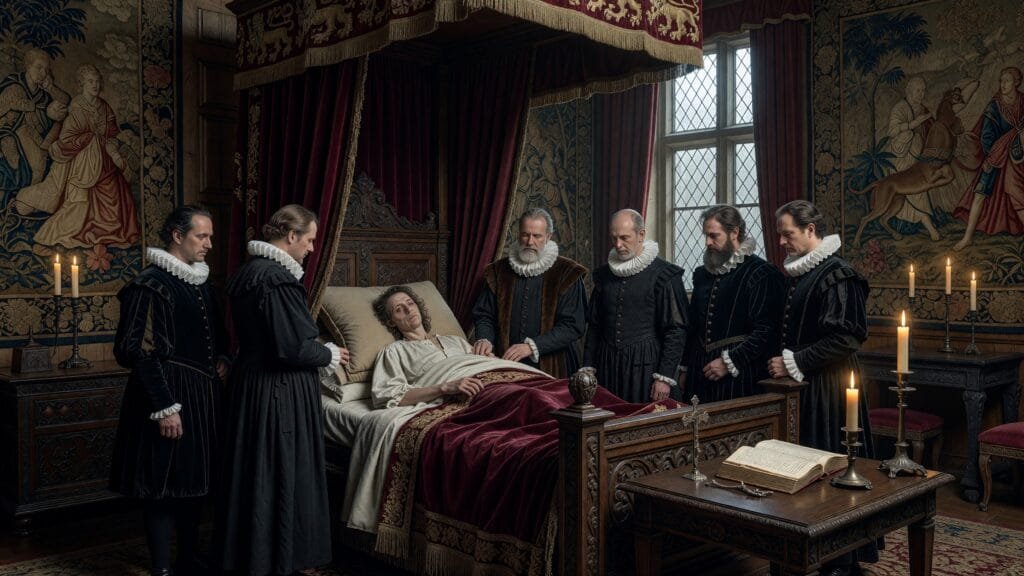
Edward died in the evening at Greenwich, attended by physicians, servants, and a council unready to share the news. Later tradition remembers a whispered prayer and a calm faith. Contemporary sources suggest a death expected by those at his bedside, yet devastating in its implications for everyone beyond the chamber.
The council moved quickly to secure papers and couriers. Letters prepared in advance could speed the “Device” into action. They also needed secrecy. Silence gave them room to station guards, summon Jane discreetly, and watch for Mary’s movements. In the river air, the machinery of succession turned quietly.
Within hours, decisions about mourning were entwined with strategy. How and when to tell London mattered as much as what to tell London. The death of Edward VI, once public, might create a rush to parish bells and to Mary. Delay could bind crucial men to Jane before the city learned.
08 – London Reacts: Rumor, Market, and Pulpit
News leaked as it always did, through servants, boatmen, and watchful ambassadors. Markets paused, then resumed with caution. Preachers weighed words, and parish clerks made entries that captured anxiety without quite naming it. The city had learned to read smoke signals from the court, and the signs were not reassuring.
For printers and merchants, policy meant profit or ruin. If Mary prevailed, the old altars might return along with different creditors. If Jane reigned, reform would press onward, bringing opportunities for some and losses for others. London’s mood swung with each rumor of a muster or a proclamation.
Ambassadors listened closely. The French, active since the Treaty of Boulogne, watched for instability that might divert England’s attention. Imperial agents gauged Mary’s prospects and sympathies. What unfolded in London streets and churchyards over the following week would signal whether diplomacy or intervention would shape the island’s immediate future.
09 – Mary Moves: Letters, Musters, and Framlingham
Mary Tudor acted with speed from East Anglia. Learning of her brother’s decline, she moved to assert her right at once, writing to the council and to major towns. Her letters were calm but firm, invoking law and Henry VIII’s will. She called loyalists to her standard before the council named anyone else.
East Anglia offered her more than sanctuary. It was a recruiting ground seasoned by recent unrest and fortified by local magnate networks. Mary rode to Framlingham Castle, its walls looming over the countryside. There, numbers grew. Gentry, yeomen, and veterans gathered, sensing that legitimacy had a strong champion.
Money, munitions, and messages mattered as much as banners. Mary’s side tapped into discontent with recent government and loyalty to the old royal line. It is easy to forget how fragile this world still was. A few strongholds, a few roadblocks, and the fate of a kingdom could tilt in days.
10 – Jane Proclaimed: Nine Days that Shook England
On 10 July 1553, Jane Grey was brought to the Tower and proclaimed queen. The ceremony had fanfare, but enthusiasm varied by neighborhood. Some cheered dutifully. Others kept their hats on. Londoners had seen sudden turns before and saved their loudest voices for victories more certain than this.
Northumberland marched to confront Mary, leaving the council to sustain Jane’s cause. That absence proved fateful. With the army gone, councillors felt popular and international winds shift. Letters from counties suggested Mary’s strength. Merchants preferred the security of Henry’s settlement over the experiment unfolding at the Tower.
By 19 July, the council reversed itself and proclaimed Mary queen. Bells rang, bonfires flared, and London felt the ground settle beneath its feet. Jane’s nine-day reign ended almost at once, her counselors suddenly supplicants. The victory solved one problem and created another: what to do with the losers.
11 – Faith on a Knife’s Edge: Prayer Books, Altars, and Articles
Edward’s Church had moved far in six years. Images came down, stone altars were replaced with wooden tables, and the English liturgy taught a different understanding of the Eucharist. The 1552 Book of Common Prayer became the ordinary language of worship, and reformers pressed to make the shift permanent.
Even in 1553, the final shape of doctrine was unsettled. The Forty-Two Articles were drafted and issued by royal authority but not enacted by Parliament before the king died. With Mary’s accession, they lost state backing at once. Tradition remembers the see-saw of forms; parishioners remembered painful uncertainty.
For Protestants, the death of Edward VI felt like the loss of a breathing guarantee. Many clergymen adjusted swiftly to Mary’s policies to survive. Others resisted and would pay dearly. John Foxe’s later Acts and Monuments would cast them as martyrs, shaping memory longer than any council minute or statute.
12 – Diplomatic Weather: Habsburgs, Valois, and the Channel
Europe’s rivalries framed England’s choices. The Habsburg-Valois wars gave each power an interest in London’s direction. Under Edward, Northumberland sought balance through peace with France and distance from the Emperor. With Mary’s success, imperial counselors saw a chance to restore Catholic influence without an invasion.
Yet behind the ceremony of proclamations, ambassadors calculated credit and risk. Would Mary align England firmly with Charles V, or retain English interests first? Would French agents stir trouble to extract concessions? The calendars of state papers preserve dispatches that read like weather reports, measuring gusts of rumor and resolve.
International finance also loomed. Merchants from the Low Countries carried credit across the Channel, and their confidence mattered. Political storms could close exchanges and strangle trade. In that sense, the July crisis was as much about Antwerp’s ledgers as about London’s pulpits, each reacting to news before it fully arrived.
13 – Governance and the Purse: Council, Coin, and Commoners
Edward’s government faced stubborn economic troubles. Debasement under his father had unraveled prices and wages; reforms in 1551 sought to steady the coin. Enclosures and poor harvests aggravated tensions that burst open in 1549. By 1553, inflation gnawed, and social trust frayed, even as policy tried to right the scales.
Commoners judged rulers less by sermons than by bread, work, and predictable justice. Councillors feared that a new reign might void offices and grants. Creditors watched for devaluations. The machinery of the state—courts, customs, musters—needed a clear chain of command. The death of Edward VI left head and body momentarily apart.
Jane’s brief regime could not settle accounts. Mary’s first measures reassured some lenders and disturbed reformers. It is astonishing how much political weight could rest on a seal, a signature, or a hostage. In July, even a royal warrant for wheat could become a test of loyalty and a signal to the streets.
14 – Funeral and Memory: Burying a Protestant Prince
Edward’s funeral took place on 8 August 1553 in Westminster Abbey’s Henry VII Chapel. The service followed the 1552 Prayer Book, a final flourish of the liturgy he championed. Mary did not attend. The rite expressed a policy already fading, even as it honored a young sovereign who had embodied it.
Monuments and sermons began the work of shaping memory. Some saw in Edward a Josiah-like reformer, purging idolatry and teaching Scripture. Others remembered disorder and confiscation. The Liber-like compilations of reigns would place him between a dangerous father and a queen who restored order, each narrative correcting the other.
Burial did not end debate. Later Protestants crafted a saintly portrait; Catholics pointed to abrupt changes and broken oaths. Historians today balance these portrayals with records from parish accounts, royal rolls, and ambassadorial letters. Memory hardened into legend, but the paper trail, such as it is, keeps arguing back.
Immediate consequence:
Mary’s successful claim ended Jane’s nine days, reversed the council’s position, and placed Protestant leaders under suspicion. Trials followed swiftly, signaling a reorientation of law and worship.
Long-term consequence:
Edward’s reforms were partly undone, yet not erased. Under Elizabeth, a settlement drew on his liturgies and ideas, proving that the crisis of 1553 redirected the Reformation rather than destroying it.
15 – Conclusion
Edward VI’s passing was more than a royal death; it was a stress test of Tudor statecraft. The gap between legal succession and religious ambition opened a perilous corridor, through which Jane, Northumberland, and Mary rushed in turn. The death of Edward VI became the hinge on which policy, prayer, and power swung.
In the short run, Mary’s victory ended a Protestant experiment led by a boy-king. In the long run, Edward’s liturgies and ideas survived to shape Elizabethan religion. The July crisis taught England how quickly legitimacy could fracture, how forcefully it could be restored, and how memory would keep arguing the case.
16 – FAQs
- When did the event occur?
Edward VI died on the evening of 6 July 1553, according to the Julian calendar then in use. - Where did Edward VI die?
He died at Greenwich Palace in Kent, just downriver from London, a favorite Tudor residence along the Thames. - Who were the key figures involved?
Main figures included Edward VI, Mary Tudor, Lady Jane Grey, John Dudley (Duke of Northumberland), Archbishop Thomas Cranmer, and the Privy Council who tried to manage the succession. - What caused his death?
Contemporary descriptions point to a wasting illness; most modern historians conclude pulmonary tuberculosis, possibly complicated by prior infections. Poisoning rumors circulated but lack persuasive evidence. - What were the consequences?
The immediate result was a contested succession. Jane was proclaimed queen for nine days, but Mary prevailed, reversing much of Edward’s religious policy and reshaping alliances and governance. - What is the legacy of his death?
The death of Edward VI triggered a political and religious reconfiguration that influenced Elizabeth’s later settlement. His Protestant liturgies and ideas endured, even after Mary’s Catholic restoration.
17 – External Resource
18 – Internal Link
Other Resources
- Encyclopaedia Britannica – general search for the exact subject
- Google Scholar – academic search for the exact subject
- Internet Archive – digital library search for the exact subject
Sources and References
-
Primary Source – Chronicle and Eyewitness Material
John Gough Nichols (ed.), The Chronicle of Queen Jane and of Two Years of Queen Mary, and Especially of the Rebellion of Sir Thomas Wyat (Camden Society, London, 1850).
Note: A contemporary narrative including references to Edward VI’s final illness, his death in July 1553, and the immediate succession crisis. Useful for corroborating the date and basic circumstances of Edward’s death and the rapid moves to enforce the “device for the succession.” -
Primary Source – Official Record
Letters and Papers, Foreign and Domestic, of the Reign of Henry VIII, and the continuation in the Calendar of State Papers, Domestic, Edward VI, Mary, and Elizabeth, published by the Public Record Office (UK National Archives).
Note: These calendared documents include ambassadorial dispatches and official correspondence from 1553 that report Edward VI’s declining health, news of his death at Greenwich, and the diplomatic reactions across Europe, supporting the chronology and political context. -
Scholarly Biography of Edward VI
Jennifer Loach, G. W. Bernard, and Penry Williams, Edward VI (Yale University Press, New Haven & London, 1999).
Note: A modern academic study of Edward VI’s life and reign. Provides detailed discussion of his health, the final months at Greenwich, the circumstances of his death on 6 July 1553, and the political maneuvering over the succession (including Northumberland and Lady Jane Grey). -
Scholarly Study of the Tudor Monarchy
David Loades, Mary Tudor: A Life (Basil Blackwell, Oxford, 1989) and David Loades, Politics and Nation: 1450–1660 (4th ed., Wiley-Blackwell, 2014).
Note: Loades analyzes the succession crisis of 1553 from Mary Tudor’s perspective and within wider Tudor politics. These works support statements about how Edward’s death opened the way to Mary’s eventual accession and the short-lived regime of Lady Jane Grey. -
Academic Reference Work on the Tudor Period
Penry Williams, The Tudor Regime (Oxford University Press, Oxford, 1979).
Note: Offers a broad analysis of Tudor government and succession practices, including the legal and constitutional issues raised by Edward VI’s “device” altering the succession, the role of the Privy Council, and the political aftermath of his death at Greenwich. -
Encyclopedia / Reference Entry
“Edward VI, king of England and Ireland,” in Encyclopaedia Britannica Online, Encyclopaedia Britannica, Inc. (accessed via britannica.com).
Note: Provides a concise, peer-reviewed overview of Edward VI’s reign, his health problems, the date and place of his death (Greenwich, 6 July 1553), and the succession conflict that followed, confirming basic factual details in the article. -
Museum / Heritage Site Documentation
Historic Royal Palaces, “The Story of the Palace of Placentia (Greenwich),” and related materials on the Tudor court at Greenwich, Historic Royal Palaces (UK) – accessed via the organization’s official site.
Note: Supplies historical information about Greenwich Palace (the Palace of Placentia) as a principal Tudor residence, including its use by Henry VIII and his children. Confirms the status of Greenwich as a royal setting for Edward VI’s final days and death. -
University-Linked Scholarly Context
Diarmaid MacCulloch, Reformation: Europe’s House Divided 1490–1700 (Penguin, London, 2003).
Note: While broader in scope, MacCulloch’s work provides crucial context on Edward VI’s strongly Protestant regime, the religious reforms of his reign, and the wider European Reformation background. This supports the discussion of how Edward’s death influenced the religious direction of England through the succession struggle that followed.