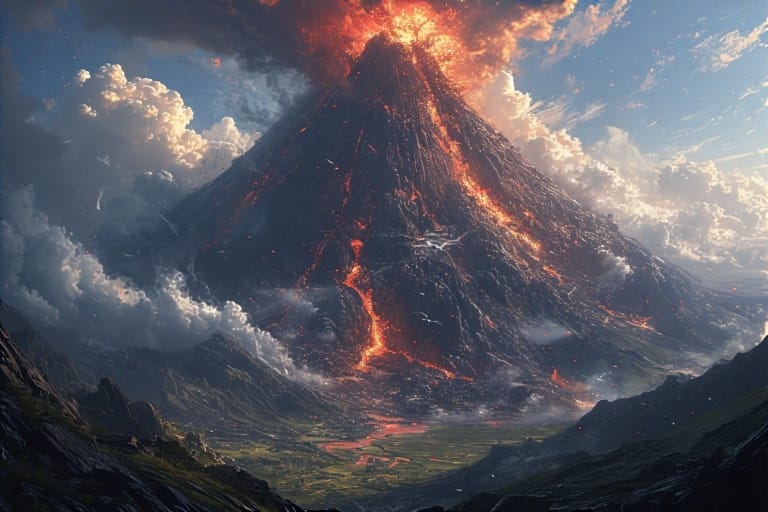
Laki 1783: The Fiery Summer That Chilled the World
Table of Contents
- Introduction
- What Is Laki?
- Eruption Timeline
- Lava and Fire Fountains
- The Deadly Gas Emissions
- Effects on Iceland
- European and Global Impact
- Famine and Mortality
- Environmental Legacy
- Scientific Reflections
- Conclusion
- External Resource
- Internal Link
1. Introduction
In the summer of 1783, the Earth cracked open in Iceland, spewing fire, gas, and molten rock for eight continuous months. The Laki eruption, one of the most violent and impactful in human history, changed not only the landscape of Iceland but the climate of the entire Northern Hemisphere.
2. What Is Laki?
Laki, or Lakagígar, is a fissure vent system in southern Iceland, located near the Grímsvötn volcano. Instead of a singular explosion, Laki produced a line of 130 craters and fountains of fire, stretching 27 km. It belongs to the volatile Icelandic hotspot, where tectonic plates pull apart.
3. Eruption Timeline
✔️ Eruption began on June 8, 1783
✔️ Activity continued through February 1784
✔️ Consisted of both lava flows and explosive gas emissions
✔️ Over 14 cubic kilometers of basaltic lava were released
The eruption was not a single event but a series of pulses—each wave raining fire and ash across Iceland.
4. Lava and Fire Fountains
The lava fountains reached heights of 800 to 1,400 meters. Entire villages were surrounded or buried. Farmlands were coated in hardened lava and destroyed beyond repair.
✔️ 597 square kilometers were flooded by lava
✔️ One of the largest lava flows in recorded history
✔️ Fiery fountains visible from over 100 km away
The Laki fissures reshaped the land into a twisted volcanic labyrinth.
5. The Deadly Gas Emissions
Perhaps more dangerous than lava was the gas. The eruption released massive amounts of sulfur dioxide, fluorine, and hydrogen chloride into the air.
✔️ Created a toxic “Blue Haze” over Iceland
✔️ Caused acid rain and poisoned water supplies
✔️ Livestock died en masse from fluorosis
✔️ Human respiratory failure was widespread
6. Effects on Iceland
Iceland was devastated.
✔️ An estimated 25% of the population died
✔️ 50% of livestock perished
✔️ Famine spread across the island
✔️ Entire communities were abandoned
This period is known in Iceland as the Móðuharðindin or “Mist Hardships.”
7. European and Global Impact
The sulfuric haze did not stay local. Winds carried it across Europe, where it caused:
✔️ Respiratory illnesses in England and France
✔️ Summer snowfalls and crop failures
✔️ An estimated tens of thousands of deaths from starvation and illness
The haze even reached Asia and North America, causing an unusual volcanic winter.
8. Famine and Mortality
✔️ Global food shortages followed
✔️ Some historians link Laki’s effects to the French Revolution, citing its role in creating hunger and unrest
✔️ In Britain, the summer of 1783 was remembered for its heat, haze, and death
Mortality soared in areas far from the volcano itself.
9. Environmental Legacy
Laki remains a case study in climate-altering eruptions.
✔️ Triggered one of the coldest winters in recorded European history
✔️ Lowered global temperatures by 1.3°C
✔️ Provided data for understanding climate feedback loops
Its lessons are critical for modern disaster planning.
10. Scientific Reflections
Scientists now understand that even non-explosive eruptions can be deadly due to aerosol emissions.
✔️ Laki influenced climatology, volcanology, and emergency response policy
✔️ It is one of the first eruptions to show a global reach beyond its eruption site
Laki’s story changed how we see the connection between geology and humanity.
11. Conclusion
The Laki eruption of 1783 was not just an Icelandic disaster—it was a planetary event. With its rivers of fire and clouds of death, it reshaped societies and ecosystems alike. It serves as a grim reminder that Earth’s forces can—and do—alter the course of history.

