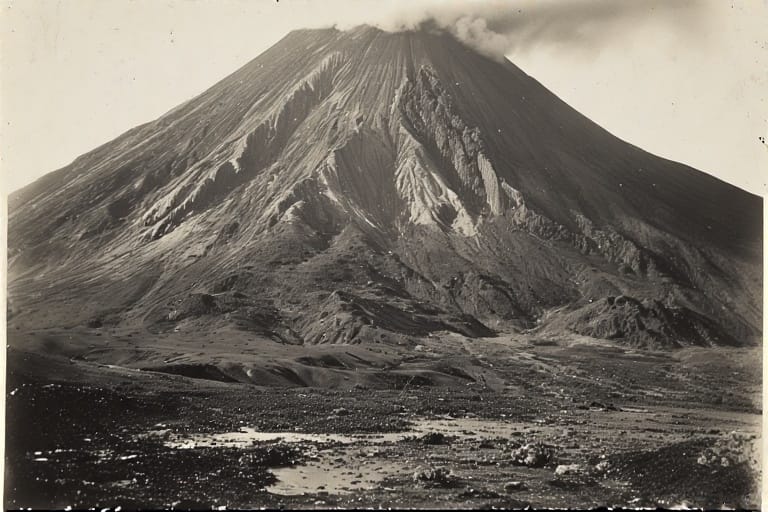
Hekla 1104: The Fire Mountain Awakens
Table of Contents
- Introduction
- Hekla in Icelandic Folklore
- Iceland in the 12th Century
- A Sudden Awakening
- The Eruption Unfolds
- The Scope of the Disaster
- Cultural and Religious Fear
- Hekla’s Long-Term Infamy
- Scientific Insights from Historical Records
- Hekla in Later History
- Conclusion
- External Resource
- Internal Link
1. Introduction
On January 1st, 1104, Mount Hekla in Iceland erupted for the first time in recorded history. To medieval Europeans, this event was more than a natural disaster—it was a terrifying mythic awakening, interpreted by many as a gateway to Hell.
This eruption marked the beginning of Hekla’s reputation as one of Iceland’s most feared volcanoes, and its impact on both the landscape and collective psyche would echo through centuries.
2. Hekla in Icelandic Folklore
Before it erupted, Hekla already had a mysterious aura in Icelandic oral tradition.
✔️ Known as “the Gateway to Hell” in European folklore
✔️ Associated with witches, spirits, and demons
✔️ Often avoided by travelers and feared by nearby communities
Its name itself became synonymous with doom.
3. Iceland in the 12th Century
In 1104, Iceland was a young and sparsely populated island nation.
✔️ Governed by local chieftains under the Icelandic Commonwealth
✔️ Communities were tightly bound by farming and kinship
✔️ No scientific understanding of volcanoes—natural events were explained through religion and superstition
People lived in turf homes, vulnerable to ash and fire.
4. A Sudden Awakening
The eruption began suddenly, without modern warning systems.
✔️ Eyewitnesses describe rivers of fire
✔️ Ashfall reportedly reached Scandinavia
✔️ The eruption lasted several months
Farms were buried under meters of ash, destroying settlements like Þjórsárdalur.
5. The Eruption Unfolds
This was no minor explosion—it was a massive Plinian eruption:
✔️ Huge columns of ash darkened the skies
✔️ Volcanic bombs and pyroclasts spread across southern Iceland
✔️ Affected an estimated 800 square kilometers
The sheer scale stunned observers and caused panic throughout the region.
6. The Scope of the Disaster
✔️ Dozens of farms destroyed
✔️ Livestock perished, and food supplies were ruined
✔️ Volcanic ash entered rivers, affecting water quality
Survivors had to relocate, and Iceland’s population declined in the eruption’s aftermath.
7. Cultural and Religious Fear
The eruption fed into deep-rooted superstitions:
✔️ Some monks wrote that Hekla led to the underworld
✔️ Widespread fear spread through Christian Europe
✔️ Interpreted as a divine punishment for humanity’s sins
For centuries, Hekla would be feared as Satan’s chimney.
8. Hekla’s Long-Term Infamy
The 1104 eruption became a touchstone in Europe’s cultural memory:
✔️ Chronicled in medieval sagas and church records
✔️ Invoked during future eruptions as a bad omen
✔️ The term “Hekla” entered common language as a symbol of fear
Icelandic culture absorbed the trauma and wove it into legends and literature.
9. Scientific Insights from Historical Records
While the science came later, 1104’s eruption left a rich record:
✔️ Tephrochronology used ash layers to date other events
✔️ Helped understand the frequency of major eruptions
✔️ Created a template for recognizing plinian eruption characteristics
Hekla became a vital subject in the study of volcanology.
10. Hekla in Later History
Hekla erupted multiple times after 1104, but its first recorded blast remains legendary.
✔️ Major eruptions in 1300, 1510, 1766, and 1947
✔️ Still considered one of Iceland’s most dangerous volcanoes
✔️ Today monitored by the Icelandic Meteorological Office
Its 1104 legacy remains central in both science and story.
11. Conclusion
The Hekla eruption of 1104 was more than a geological event—it was a psychological rupture in medieval Europe’s understanding of nature. Terrifying in scope and mythic in consequence, it cemented Hekla’s status as a mountain of fear and fire.
And even today, as scientists watch it with precision instruments, the echoes of 1104 still rumble in Iceland’s cultural soul.
12. External Resource
🌐 Wikipedia: Hekla Eruption 1104

