Table of Contents
- The Siege of Ladysmith: A City Under Fire
- The Strategic Importance of Ladysmith in the Second Anglo-Boer War
- The Opening Moves: Boer Tactics and British Responses
- Life Inside the Besieged Town: Endurance and Desperation
- The British High Command: Winston Churchill and the Call for Reinforcements
- Shifting Frontiers: Early Attempts at Lifting the Siege
- General Sir Redvers Buller: The Commander’s Burden
- The Battle of Colenso: A Costly Failure
- The Calm Before the Storm: Preparations and Morale
- The March Towards Relief: Sir Redvers Buller’s Renewed Offensive
- The Battle of Spion Kop: Heroism and Tragedy on the Heights
- Lessons Learned: Tactical Revisions and Renewed Resolve
- The Tugela Heights Campaign: The Final Push
- The Day of Liberation: February 28, 1900—Relief at Last
- The Emotional Impact on Soldiers and Civilians
- Political Ramifications: Boosting British Morale and Imperial Prestige
- Boer Responses: Strategy in Retreat
- International Reactions and Media Coverage
- The Siege’s Legacy: Memory and Myth in South Africa and Britain
- The Human Cost: Survival, Suffering, and Stories of Courage
- The Relief of Ladysmith in the Broader Context of the Anglo-Boer War
- How Ladysmith Shaped Modern Warfare Tactics
- The Aftermath: Reorganization and Continued Struggle
- Remembering Ladysmith: Monuments, Literature, and Film
- Conclusion
The Relief of Ladysmith on February 28, 1900, was more than a military event; it was a dramatic moment of hope and endurance amidst the brutal and unfamiliar warfare of the South African veldt. To truly grasp why this event shaped the course of the Second Anglo-Boer War—and left an indelible mark on history—we must travel back to a city under siege, to the tense anticipation of soldiers and civilians trapped behind walls of defense as the world waited for salvation.
The Siege of Ladysmith: A City Under Fire
Imagine yourself standing at the edge of a small South African town, surrounded by rugged hills and scorched earth, under clouds heavy not only with the African sun but thick with the smoke of rifle fire. Ladysmith, nestled in the Natal province, was suddenly encircled by Boer forces in November 1899. This wasn’t merely a military engagement; it was a test of human spirit against hunger, disease, and the threat of annihilation.
Ladysmith’s population—a mix of British soldiers, colonial officials, and local civilians—found themselves cut off from the outside world, huddling behind hastily erected barricades. The thick murmur of worried conversations and the sudden crack of distant rifle shots became the new rhythm of life. Food supplies dwindled, and every day brought the anxious shadow of uncertainty: would help come in time?
This was not just a siege of a town; it was a crucible where bravery, desperation, and hope converged to shape a pivotal chapter in imperial history.
The Strategic Importance of Ladysmith in the Second Anglo-Boer War
To understand the siege, one must grasp why Ladysmith mattered so deeply to both British and Boer forces. The Second Anglo-Boer War (1899–1902) had ignited from simmering tensions between the British Empire and the Boer republics—the South African Republic (Transvaal) and the Orange Free State—over control of the mineral-rich highveld.
Ladysmith’s location made it vital. As a railway hub and gateway to Natal, controlling it meant securing supply lines and opening paths deeper into Boer territory. For the Boers, seizing Ladysmith was both a tactical move and a psychological blow aimed at rallying Boer nationalism and deterring British advancement.
On the British side, holding Ladysmith was essential to maintaining imperial prestige and foiling the Boer strategy of swift, decisive sieges meant to isolate and weaken British forces.
The Opening Moves: Boer Tactics and British Responses
When Boer forces, led by General Piet Joubert and General Louis Botha, swept into Natal, they demonstrated remarkable skill in mobile warfare, capitalizing on intimate knowledge of the terrain. Their plan? To encircle the British force under General Sir George White and trap them in Ladysmith.
White, initially caught off guard by the intensity and swiftness of the Boer advance, hurried to reinforce the town’s defenses. Trenches, redoubts, and barricades sprang up as the enemy closed in, turning Ladysmith into a fortress. But the Boers were relentless.
Boer artillery pounded the town, cutting off communication and supply lines. The British troops, accustomed to colonial policing more than heavy combat, struggled to adapt.
Life Inside the Besieged Town: Endurance and Desperation
Siege life is unlike any other chapter of warfare—there are no swift victories, only the grinding passage of days and nights. Civilians and soldiers alike faced shortages, disease outbreaks, and psychological strain.
Eyewitness accounts paint a compelling, human portrait. Families rationed flour and meat, using every conceivable resource to survive harsh winters. Soldiers rotated between guard duty, trench work, and brief respites, their morale buoyed by camaraderie yet battered by fatigue and fear.
Amidst this hardship, stories emerge: nurses caring for wounded under bombardment, children sleeping in basements as shells whistled overhead, and brave officers trying to maintain order and discipline.
Sir Winston Churchill, then a young war correspondent, famously chronicled the siege, capturing not just military actions but the vivid humanity within the walls.
The British High Command: Winston Churchill and the Call for Reinforcements
Winston Churchill’s role during the siege added a dramatic literary flair to an already tense situation. Captured once by Boer forces but daringly escaping, Churchill became a symbol of defiance and the indomitable British spirit.
Meanwhile, across the seas, the British government grappled with the reality of the conflict and the urgency of relieving the besieged troops. Sending reinforcements meant overcoming terrain, logistical nightmares, and a determined enemy.
The relief effort evolved into a major military operation, with newly appointed General Sir Redvers Buller tasked with leading the campaign to break the siege.
Shifting Frontiers: Early Attempts at Lifting the Siege
Buller’s first attempts to break through to Ladysmith met with mixed results. His forces repeatedly clashed with entrenched Boer troops, who used guerilla-like tactics and the advantages of high ground to counter British advances.
The Battle of Colenso, fought in December 1899, was a disastrous engagement where British miscalculations led to heavy casualties and a sharp blow to morale. The Boers’ mastery of modern rifles and excellent reconnaissance proved a harsh lesson in adapting to new modern warfare.
General Sir Redvers Buller: The Commander’s Burden
Buller was a seasoned officer, experienced in colonial conflicts, but his campaign in South Africa tested him as never before. He faced not only a tenacious enemy but also harsh geography and vocal critics back home.
The pressure mounted. Every failure was magnified by media headlines and public opinion. Yet Buller demonstrated resilience, reorganizing his forces, adapting tactics, and pushing forward with renewed vigor.
The Battle of Spion Kop: Heroism and Tragedy on the Heights
January 1900 brought one of the war’s most dramatic and bloody confrontations—the Battle of Spion Kop. British forces sought to seize the high ridge overlooking the Boer positions, a plan promising decisive advantage.
The battle turned into a harrowing tale of confusion, fog, and close combat. Soldiers found themselves isolated on the hilltop, cut off by Boer counterattacks and suffering from inadequate supplies and command errors.
Casualties piled up, heroes emerged, and the British withdrawal marked another painful pause before the eventual successful relief.
The Tugela Heights Campaign: The Final Push
Learning from prior mistakes, Buller refined his approach for the Tugela Heights campaign. Leveraging overwhelming artillery and infantry, his forces methodically captured key positions along the river’s rugged slopes.
This grinding yet effective campaign wore down Boer defenses, paving the way for the climactic breakthrough.
The Day of Liberation: February 28, 1900—Relief at Last
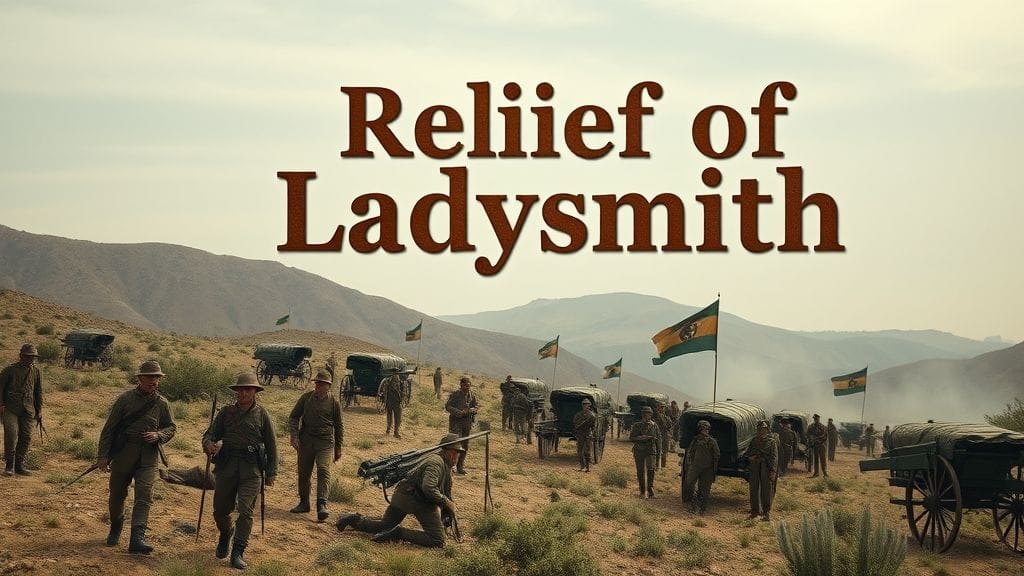
On a bright morning of late February, after months of siege and countless battles, the British forces finally entered Ladysmith. Soldiers and civilians poured into the streets, some weeping, others cheering, all relieved beyond measure.
The sight of Buller’s troops cut through the last Boer lines like a flood freeing a trapped river. For those inside, it was nothing less than a rebirth.
The city, battered but unbowed, opened its gates to the relieving army. Messages of triumph echoed not just through Natal but across the globe, stirring imperial pride and relief.
The Emotional Impact on Soldiers and Civilians
The relief was not simply a strategic victory—it was an emotional catharsis. Soldiers exhausted by months of relentless siege lifted their heads, civilians who had endured hunger and fear felt a surge of hope.
Yet wounds—both physical and psychological—remained. The experience left scars, toughened a generation, and enriched the war narratives with tales of sacrifice and resilience.
Political Ramifications: Boosting British Morale and Imperial Prestige
The relief of Ladysmith had wide political echoes. In Britain, it reinvigorated public support for the war, bolstered the government, and quieted critics who had labeled the campaign a “bloody fiasco.”
For the empire, it symbolized the resolve to maintain control over South Africa’s destiny and resources, even as the conflict dragged on.
Boer Responses: Strategy in Retreat
The Boers, despite setbacks, demonstrated tenacity and adaptability. The lifting of the siege forced them to withdraw and reassess strategies. Over the coming years, they shifted to prolonged guerilla warfare, demonstrating that the struggle was far from over.
International Reactions and Media Coverage
Worldwide, newspapers followed the campaign with fascination. The siege and its relief captivated the imperial imagination, aided by figures like Churchill and vivid dispatches from the front.
Some foreign observers sympathized with the Boer cause, viewing the conflict as a resistance against imperial aggression, adding complexity to the war’s historical interpretation.
The Siege’s Legacy: Memory and Myth in South Africa and Britain
The relief of Ladysmith transcended its moment, entering the mythos of British military history. Monuments, songs, stories, and films would later commemorate the siege and its relief, often emphasizing themes of courage, endurance, and empire.
In South Africa, memories were more divided, reflecting the complex legacies of colonialism, resistance, and nationhood.
The Human Cost: Survival, Suffering, and Stories of Courage
Behind any military campaign lie the untold stories of loss and heroism. The siege touched the lives of thousands—soldiers fighting bravely, medics working tirelessly, civilians enduring hardships.
Personal diaries, letters, and oral histories provide intimate glimpses into this world, reminding us that history is not just dates and battles, but human experience.
The Relief of Ladysmith in the Broader Context of the Anglo-Boer War
This event was a turning point, but not the end. The war dragged on until 1902, with shifting fortunes and brutal tactics, notably the use of concentration camps by the British—a grim legacy.
Nevertheless, Ladysmith’s relief remains emblematic of the struggle and complexities of imperial warfare.
How Ladysmith Shaped Modern Warfare Tactics
The siege exposed the deadly efficiency of modern rifles, the importance of artillery, and the challenges of siege warfare amid rugged terrain.
Military analysts and historians point to Ladysmith as a precursor to trench and attrition warfare that would later define World War I.
The Aftermath: Reorganization and Continued Struggle
Following the relief, British forces reorganized, pushing deeper into Boer territory. The war evolved into a prolonged campaign marked by harsh counterinsurgency tactics and widespread suffering.
Even as Ladysmith celebrated liberation, the shadows of future battles loomed large.
Remembering Ladysmith: Monuments, Literature, and Film
The story of Ladysmith has been retold through various media. From bronze statues to novels and documentaries, its narrative endures—sometimes glorified, sometimes critically examined—as a lesson in courage, colonial ambition, and the costs of war.
Conclusion
The Relief of Ladysmith stands as a testament to resilience in the darkest of times—a siege that tested soldiers and civilians alike, a military campaign marked by brilliance and blunder, and a moment that rejuvenated an empire’s resolve. Yet beneath the banners and battlefield maneuvers lies the human story: of people clutching hope amid hardship, of leaders wrestling with impossible choices, and of a nation grappling with the price of power.
More than a historical event, Ladysmith’s relief is a mirror reflecting the complexities of empire, the brutal realities of modern warfare, and the unyielding spirit of those caught in its midst. It reminds us that beyond strategy and politics, history unfolds through the lived experience of individuals bravely facing the unknown—and emerging, against all odds, into the light of liberation.
FAQs
Q1: Why was Ladysmith so strategically important during the Second Anglo-Boer War?
A: Ladysmith was a crucial railway hub and gateway into Natal, making it vital for controlling supply lines and advancing military operations, both for the British and the Boers.
Q2: How did the siege affect daily life inside Ladysmith?
A: Civilians and troops suffered from shortages of food and medicine, outbreaks of disease, constant bombardment, and psychological strain, highlighting human resilience amid extreme adversity.
Q3: What role did Winston Churchill play during the siege?
A: Churchill was a war correspondent who became a symbol of British resolve after escaping captivity. His writings brought vivid attention to the siege and its conditions.
Q4: Why was the Battle of Colenso significant?
A: It was a major early attempt to break the siege, resulting in heavy British casualties and demonstrating the challenges of confronting well-armed and entrenched Boer forces.
Q5: What was the impact of the relief of Ladysmith on British public opinion?
A: The relief boosted morale, increased public support for the war, and reinforced the narrative of imperial strength, despite earlier setbacks.
Q6: How did the Boers respond after the siege was lifted?
A: They retreated strategically and shifted toward guerilla warfare, prolonging the conflict and challenging British forces anew.
Q7: In what ways did the siege influence future military tactics?
A: It highlighted the effectiveness of defensive entrenchments, modern rifle fire, and the importance of artillery, foreshadowing tactics used in World War I.
Q8: How is the siege and relief remembered today?
A: Through monuments, literature, and films, the event remains a powerful symbol of endurance and imperial struggle, while also prompting critical reflection on colonial history.