Table of Contents
- A Pact Forged in Shadows: The Signing of the Anglo-Japanese Alliance
- Behind Closed Doors: London, January 1902
- The Geopolitical Chessboard at the Turn of the Century
- British Imperial Concerns: Protecting the Raj and the Far East
- Japan’s Rising Star: A Nation Determined to Claim Its Place
- Diplomatic Courting: From Curiosity to Cooperation
- The Treaty Text: Terms, Limits, and Unspoken Understandings
- Reactions in London and Tokyo: Hope, Skepticism, and Surprise
- Ripples Across Asia: How China and Russia Perceived the Alliance
- From Peace to War: The Russo-Japanese War and the Alliance Tested
- Naval Power and Strategy: Securing Sea Lanes and Interests
- The Alliance as a Turning Point in Anglo-Japanese Relations
- Shifting Alliances and the Frailty of Trust Among Empires
- Cultural Exchanges Amid Political Compacts
- Legacy of the 1902 Pact: A Prelude to Global Power Shifts
- The Alliance’s End and Its Historical Footprint
- Lessons from the Anglo-Japanese Alliance: Diplomacy’s Human Drama
A Pact Forged in Shadows: The Signing of the Anglo-Japanese Alliance
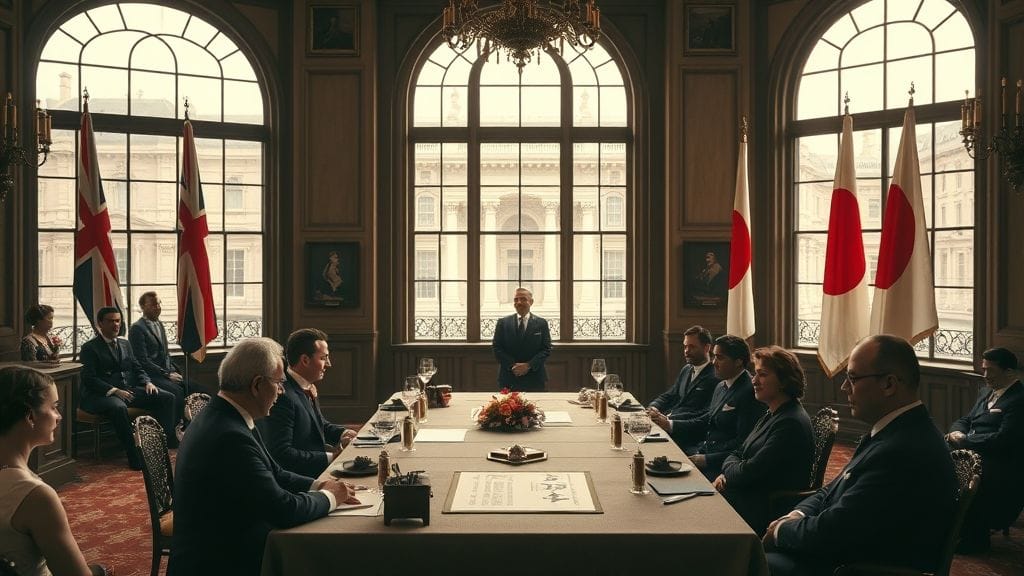
On a bleak winter day, January 30th, 1902, in the stately chambers of London, two unlikely allies gathered to reshape the balance of power in East Asia. The air, heavy with the scent of polished oak and burning coal fires, bore witness to the birth of a treaty destined to ripple far beyond the smoke of the British Empire’s citadels or the rising sun over Japan’s archipelago. The room was guarded, conversations hushed, yet the weight of history was palpable. With the stroke of a pen, the Anglo-Japanese Alliance was born—a pact that defied expectations, outmaneuvered rival empires, and heralded a new chapter in the story of modern diplomacy.
This was not merely a diplomatic formality; it was a calculated gamble, a delicate dance of imperial ambition and strategic necessity. Britain, then the dominant naval power protecting sprawling colonies, found an unexpected partner in Japan, a nation that had reinvented itself with extraordinary speed. Together, they carved an agreement that would shape two decades of international relations and provoke seismic shifts in global politics.
Behind Closed Doors: London, January 1902
In the heart of London, under the austere roof of the Foreign Office on Whitehall, British and Japanese diplomats — representatives of two worlds culturally and geographically far apart — sat down to negotiate the terms. Japan’s extraordinary transformation after the Meiji Restoration had caught the attention of British strategists grappling with the diminishing returns of “splendid isolation.” For Japan, a fledgling empire looking outward, aligning with Britain provided safety against the predatory ambitions of Russia and other Western powers in East Asia.
The secrecy enveloping the talks was essential. Newspapers buzzed with speculation, but for weeks, official silence ruled. The final document, concise but deeply strategic, outlined mutual recognition of interests in Korea and China and defined the terms of naval cooperation. It was signed with a sense of urgency, driven by the gathering storm clouds over the Russian Far East.
The Geopolitical Chessboard at the Turn of the Century
To fully grasp why the Alliance came into being, one must zoom out to the larger panorama of world affairs. The closing years of the 19th century overflowed with changing tides of power. The British Empire was the unchallenged titan of the seas, but its Victorian confidence was tested by the rise of new naval competitors and the ominous shadow of Russian expansionism in northeast Asia. At the same time, Germany under Kaiser Wilhelm II flexed militarily and diplomatically, complicating British calculations.
Japan had emerged from centuries of isolation, embracing industrialization and modernization with a fervor that astounded many European observers. The nation’s eyes were fixed firmly on Korea and Manchuria, regions coveted both by Tsarist Russia and Qing China. For Britain, an alliance with Japan was a pragmatic step: it promised to contain Russia’s progress without forcing Britain into costly direct conflict.
British Imperial Concerns: Protecting the Raj and the Far East
Britain’s imperial heart beat strongest in India—the jewel of the crown—and its eastern frontiers in Burma and China. Any Russian move southward was a direct threat to the integrity of British dominions. The phrase “The Great Game” evoked the precarious rivalry in Central Asia, but the situation in East Asia was swiftly becoming the new focus.
A direct confrontation with Russia could strain British resources and expose vulnerable points throughout the empire. Hence, a more subtle approach was desired: Britain sought a local counterbalance that could take on Rusland’s ambitions. Japan, now an ascendant naval power with modern armies, was the rising star on this stage.
Japan’s Rising Star: A Nation Determined to Claim Its Place
From its Meiji Restoration in 1868, Japan embarked on a radical transformation. Samurai swords were replaced with factories; tradition gave way to innovation. The nation industrialized rapidly, built a formidable military, and crafted a naval force modeled after the Royal Navy itself. However, such progress carried its own risks. Surrounded by larger, established empires, Japan’s survival depended on diplomatic acumen as well as military strength.
The alliance offered Japan validation on the world stage: a European power now regarded Japan not as a mere curiosity, but as a serious player. This alliance enabled Japan to pursue expansion in Korea with the backing of a global maritime power.
Diplomatic Courting: From Curiosity to Cooperation
The story of the alliance includes colorful diplomatic figures, from Britain’s Foreign Secretary Lord Lansdowne to Japan’s Ambassador Sir Tadasu Hayashi. Diplomatic envoys worked tirelessly, navigating cultural misunderstandings and contrasting political priorities. British policymakers were often skeptical about the reliability of their eastern partner; Japanese officials, in turn, sought reassurance amidst Western doubts.
Yet, step by step, respect blossomed behind the facades of protocol. This slow courtship bore fruit in the form of practical cooperation agreements preceding the final treaty, including naval visits and intelligence sharing.
The Treaty Text: Terms, Limits, and Unspoken Understandings
Though brief, the treaty carefully laid out the framework for bilateral relations. Britain and Japan agreed to remain neutral if either became involved in a war with a third power, but to come to each other’s defense if either were attacked by two or more powers simultaneously—clearly aimed at deterring Russian aggression. The treaty also acknowledged and respected each party’s interests: Britain in India and Japan in Korea.
The alliance was explicitly defensive, calculated to reassure but also firmly set boundaries. The text was deliberately ambiguous in places, designed to provide flexibility—a diplomatic tightrope walk that would influence many crises ahead.
Reactions in London and Tokyo: Hope, Skepticism, and Surprise
Press reactions were mixed. Some British newspapers hailed the treaty as a brilliant move restoring balance in the Far East; others worried it might drag Britain into conflicts far from home. In Japan, the alliance was celebrated as a historic triumph but accompanied by anxious whispers about the extent of British commitment.
Publicly, leaders emphasized peace and mutual respect, yet within diplomatic circles an awareness grew that this pact was less a guarantee of tranquility than a calculated deterrent standing between rival ambitions.
Ripples Across Asia: How China and Russia Perceived the Alliance
The treaty sent shockwaves through Beijing and Saint Petersburg. Qing China, weakened and fragmented, viewed the Anglo-Japanese partnership as a threat to its already fragile sovereignty, especially regarding Korea and Manchuria. Russia, bristling with imperial pride, saw the accord as a direct challenge to its eastern aspirations.
This unease escalated tensions and contributed more directly to the Russo-Japanese War of 1904-1905. Moscow’s reaction oscillated between attempts to diplomatically isolate Japan and military preparations—momentum that made confrontation seemingly unavoidable.
From Peace to War: The Russo-Japanese War and the Alliance Tested
Within two years of the treaty, war erupted between Japan and Russia. Here, the Anglo-Japanese Alliance was truly put to the test. Britain’s stance was cautious but supportive; no formal military intervention occurred, yet diplomatic and logistical support from Britain was critical to Japan’s success.
Japan’s stunning victory, culminating in the naval Battle of Tsushima, not only shattered Russia’s eastern ambitions but also marked the first time an Asian power defeated a major European empire in modern warfare. The alliance had helped tip the scales, establishing Japan firmly on the global stage.
Naval Power and Strategy: Securing Sea Lanes and Interests
The alliance underscored the importance of naval dominance. Protecting trade routes—the arteries of empire—and blocking rival fleets from unchallenged access was paramount. Joint naval doctrines and intelligence exchanges improved operational capabilities.
Britain’s global naval network combined with Japan’s regional focus created a complementary shield across critical maritime chokepoints. This synergy revealed the strategic foresight behind the alliance’s architects.
The Alliance as a Turning Point in Anglo-Japanese Relations
Before 1902, Britain and Japan had limited official relations, tinged with suspicion from racial and cultural misunderstandings. This accord transformed their relationship into one of unprecedented cooperation, laying foundations for decades of partnership.
The alliance fostered mutual respect and opened doors to economic exchanges, education, and cultural appreciation, while simultaneously embroiling both in the tangled web of early twentieth-century imperial rivalries.
Shifting Alliances and the Frailty of Trust Among Empires
Yet, even as the alliance endured through the early 1900s, cracks and contradictions remained. The global balance continued shifting—America’s rise, Germany’s aggression, the breakdown of old empires—forcing Britain and Japan to continually reevaluate their commitments.
Trust was tentative, fragile. Each side balanced cooperation with vigilance, aware that imperial alliances were as much about suspicion as friendship.
Cultural Exchanges Amid Political Compacts
Beyond politics and military strategy, the Alliance initiated a flow of cultural contact. Japanese scholars attended British universities; British diplomats reported on Japanese modernization with interest; artists, writers, and businessmen crossed seas eager to learn and trade.
This human dimension of collaboration softened edges, creating threads of understanding that outlasted policies.
Legacy of the 1902 Pact: A Prelude to Global Power Shifts
The Anglo-Japanese Alliance marked a significant turning point—foreshadowing the emergence of Japan as a great power and heralding the complexities of twentieth-century diplomacy. It disrupted old balances, encouraged new ambitions, and illustrated how alliances could serve as both shields and swords.
The pact’s influence extended into the complex prelude to World War I, shaping alignments and rivalries, and reminding the world that global order was never static.
The Alliance’s End and Its Historical Footprint
Formally renewed and expanded in 1905 and 1911, the alliance finally ended in 1923 under shifting geopolitical conditions. The Washington Naval Conference and changing British priorities led to its demise, but its imprint on history remained.
It represented an early and rare example of an East-West alliance based on mutual respect and practical interests—its echoes heard in modern international relations.
Lessons from the Anglo-Japanese Alliance: Diplomacy’s Human Drama
What lessons does this episode hold? Beyond treaties and power politics, it reveals the human dimension: hopes and fears, mistrust and solidarity, the role individuals and nations play in shaping destiny. It is a reminder that alliances are living agreements—always suspended between cooperation and conflict.
The Anglo-Japanese Alliance, born in the cold halls of London, still resonates as a testament to the complexity and ambition of diplomacy in a transforming world.
Conclusion
The Anglo-Japanese Alliance of 1902 embodies the paradox of early modern empire—marked by both rivalry and reconciliation. It was a partnership forged not from personal friendship but from shared necessity, a fleeting alignment of destinies that altered the course of history. As Britain sought to safeguard its global empire and Japan rose from centuries of isolation to imperial prominence, their treaty symbolized a new chapter in international relations—one that combined strategic prudence with bold vision.
Though it ultimately dissolved amid the shifting sands of postwar geopolitics, the alliance’s true legacy lies in how it altered perceptions, expanded horizons, and reshaped the balance of power. It reminds us that diplomacy is as much about human ambition and resilience as it is about ink and paper. From the shadowed rooms of London to the distant shores of the Pacific, the Anglo-Japanese Alliance stands as a pivotal story of how nations navigate the tides of history together.
FAQs
Q1: Why did Britain decide to ally with Japan in 1902?
Britain sought to counter Russian expansionism in East Asia without engaging in costly direct conflict. Aligning with Japan, a rising regional power, was a strategic move to protect British imperial interests, especially in India and China.
Q2: What were the key terms of the Anglo-Japanese Alliance?
The treaty stipulated mutual neutrality unless either was attacked by two or more powers, at which point the other would come to its defense. It recognized British interests in India and Japanese interests in Korea, emphasizing a defensive rather than aggressive stance.
Q3: How did the alliance influence the Russo-Japanese War?
While Britain remained officially neutral, it provided diplomatic backing and logistical support to Japan. The alliance discouraged other powers from intervening against Japan and helped secure Japan’s victory over Russia, marking a historic moment in global power shifts.
Q4: What impact did the alliance have on relations between East and West?
It marked the first formal military alliance between a Western and an East Asian power, fostering more respect towards Japan and encouraging cultural and economic exchanges alongside political cooperation.
Q5: Why did the alliance end in 1923?
Changing geopolitical conditions after World War I, including the Washington Naval Conference and shifting British priorities towards new alliances, led Britain to end the pact formally.
Q6: Who were the key figures behind the alliance’s negotiation?
Lord Lansdowne, then British Foreign Secretary, and Sir Tadasu Hayashi, the Japanese ambassador to the UK, were instrumental diplomats who navigated the delicate negotiations and mutual suspicions.
Q7: How was the alliance received domestically within Britain and Japan?
The treaty was met with mixed feelings; some hailed it as a diplomatic masterstroke, while others feared entanglement in Asian conflicts. In Japan, it was widely celebrated as a marker of national prestige despite cautious concerns.
Q8: What broader lessons does the Anglo-Japanese Alliance teach about diplomacy?
It illustrates that alliances are complex tools balancing strategic interests and trust, often forged amid uncertainty and requiring continual renegotiation as global dynamics evolve.