Table of Contents
- The Dawn of a New Era: October 16, 1905, Calcutta
- Bengal on the Brink: A Land Divided
- Political Backdrop: The British Raj and the “Problem” of Bengal
- Lord Curzon’s Vision: The Architect of Partition
- The Official Announcement: Shockwaves in Calcutta
- Communal Lines Drawn: Hindu and Muslim Responses
- The Cultural Rift: Literature, Art, and Identity in Tumult
- The Swadeshi Movement Ignited: Boycott and Revival
- Voices of Dissent: Leaders Who Rose Against the Divide
- The Everyday Lives Disrupted: Human Stories from Bengal
- The Press and Propaganda: Battle for Public Opinion
- British Justifications: Administrative Efficiency or Political Strategy?
- The Legal Hurdles and Legislative Maneuvers
- The Escalation of Tensions: From Protest to Police Clash
- Reversal and Repeal: The Dissolution of Partition in 1911
- Aftermath: The Legacy of Division on Bengal’s Politics
- The Seeds of Communalism: Long-Term Impact on Indian Unity
- Calcutta in Flux: The Symbolism of the City Amidst Turmoil
- Reflections in Literature and Cinema: Bengal’s Partition Endures
- Lessons from History: Understanding Colonial Divide-and-Rule
- Conclusion: Echoes of 1905 in Modern South Asia
- FAQs
- External Resource
- Internal Link
The Dawn of a New Era: October 16, 1905, Calcutta
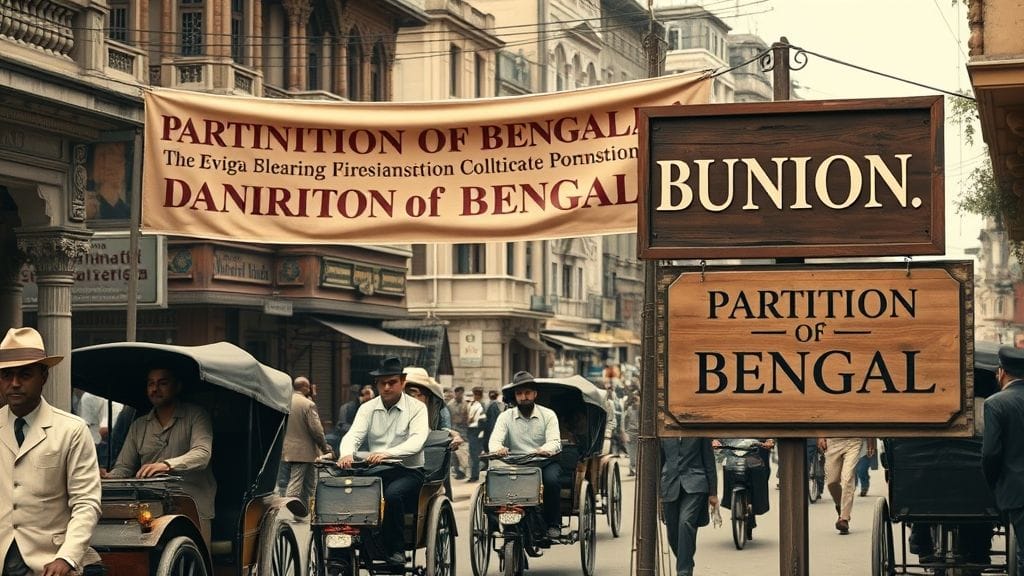
The sun had barely risen over the bustling sprawl of Calcutta on that humid October morning in 1905 when a proclamation rippled through the city—and across the province of Bengal—that would upheave an already volatile social and political landscape. The Partition of Bengal had been enacted by the British administration, formalizing the division of one of India’s most populous and culturally rich provinces into two separate entities. A seemingly administrative adjustment on paper, the partition was anything but benign. It signaled the opening salvo in one of the most profound crises of colonial resistance in Indian history, pulling at the threads of identity, religion, and politics in ways which still resonate today.
This was more than a colonial reorganization; it was a calculated move that unleashed a storm of nationalist fervor and cultural trauma. For many Bengalis, it was the first brutal encounter with the imperial tactic of “divide and rule” which would later echo throughout the subcontinent. But for others, particularly some Muslim communities in eastern Bengal, it opened new political opportunities. The story of Bengal’s partition is therefore a tapestry of clashing hopes and fears, violent upheavals and steadfast hope.
Bengal on the Brink: A Land Divided
Bengal—vast, fertile, and densely populated—was historically one of British India’s most significant provinces. It was a melting pot of religions, languages, and traditions, home to Hindu, Muslim, and numerous tribal communities, all interwoven in a delicate social fabric. Politically and economically, Bengal was the jewel in the Raj’s crown, with Calcutta serving as the capital of British India until 1911.
Yet beneath this surface of prosperity brewed deep tensions. The rapid growth of a Bengali Hindu middle class, empowered by education and modernization, was contrasted by the relative political marginalization of Bengali Muslims, many of whom occupied poorer rural positions. This imbalance made the province complex and challenging to manage from an imperial perspective.
But more than anything, the stability of Bengal was perceived to be at risk after the emergence of increasingly vocal nationalist movements, which sought to contest British rule. The British administration, wary of rising anti-colonial sentiment, sought a solution that would contain and fragment potential opposition.
Political Backdrop: The British Raj and the “Problem” of Bengal
By the early 20th century, British India was a boiling cauldron of nationalist ideologies. The Indian National Congress had established itself as a platform for the political aspirations of the Indian middle class, largely dominated by Hindus in Bengal. The Raj saw these movements as threats to their control.
Lord Curzon, appointed Viceroy of India in 1899, was a man deeply committed to what he called “the art of empire.” His strategic mindset viewed Bengal as a microcosm of challenges facing British rule: demographic complexity, religious diversity, and burgeoning political activism. For him, the “problem of Bengal” was twofold—administrative inefficiency and nationalist agitation. Partition, he believed, could “solve” both problems by decentralizing control and sowing divisions among people who shared a province but not a political vision.
Lord Curzon’s Vision: The Architect of Partition
Lord Curzon’s announcement of Bengal’s partition was, in his mind, a bold and necessary administrative reform. On October 16, 1905, he declared that Bengal would be divided into two distinct provinces: East Bengal and Assam, with a Muslim majority, and West Bengal, with a predominantly Hindu population.
Curzon’s plan was portrayed as an act of governance and efficiency—smaller provinces meant more focused administration. But beneath the surface lay a clear political design: by separating the Muslim-majority east from the Hindu-majority west, the British Raj aimed to fracture the unified opposition that nationalism posed and to cultivate a loyal Muslim political force in the east.
His carefully crafted statement framed the partition as beneficial to all, downplaying the political and emotional consequences that were about to explode.
The Official Announcement: Shockwaves in Calcutta
The official proclamation did not land quietly. In Calcutta, the heart of intellectual and nationalist Bengal, it was met with incredulity, anger, and despair. The city’s well-educated classes perceived the partition as an attack not only on the province’s territory but on its very identity.
Street meetings erupted, editorials throbbed with denunciation, and cultural salons buzzed with outrage. Bengali Hindus, in particular, felt targeted—the partition was seen as a direct effort to fragment their rising political power. To many, it was the Raj wielding a double-edged sword: ostensibly administrative but fundamentally divisive.
Yet, some sections of Bengal’s Muslim population received the decision with cautious optimism. For decades, Muslims had felt politically marginalized and resented Hindu dominance in Bengal’s political institutions. The creation of a Muslim-majority province offered them newfound administrative recognition, planting the seed for future Muslim political assertions.
Communal Lines Drawn: Hindu and Muslim Responses
Partition ripped apart the delicate communal balance of Bengal, hardening identities that had previously coexisted, if uneasily. Hindu nationalists perceived it as an act designed solely to weaken their influence and national unity, while many Muslims saw the new province as an opportunity for socio-political advancement.
These divergent reactions deepened communal lines. Hindu leaders rallied around the idea of not just reversing the partition but resisting British rule itself through mass mobilization. Muslim leaders, while not unanimously supportive, cautiously navigated this new political terrain, seeking to assert their interests within the partitioned framework.
This period marked a growing politicization of religious identity, laying early groundwork for the communal tensions that would later scar Indian society.
The Cultural Rift: Literature, Art, and Identity in Tumult
Bengal was, and remains, a crucible of culture—home to poets, writers, musicians, and artists who used their crafts to give voice to their people. The partition sparked a cultural renaissance, but one born out of protest and pain.
Poets like Rabindranath Tagore emerged as glowing beacons, using literature and music to condemn the partition and rally Bengali unity. His compositions, including the famous “Banglar Mati Banglar Jol” (“Bengal’s Soil, Bengal’s Water”), became anthems of resistance. The arts became a battlefield where the colonial state and the colonized fought over identity and history.
Even as the province was carved up, the intangible spirit of Bengal remained fiercely united within these cultural expressions.
The Swadeshi Movement Ignited: Boycott and Revival
Perhaps no reaction was as potent or as sustained as the Swadeshi Movement—the call for economic self-sufficiency and the boycott of British imports. The movement quickly became the primary form of protest against the partition. Shops selling foreign goods were targeted, indigenous industries revived, and nationalist newspapers spread fiery rhetoric.
The Swadeshi Movement was revolutionary—it transcended mere economic action and became a mass political movement uniting diverse social groups. Students, merchants, peasants, and intellectuals joined hands in one of the most vibrant campaigns of anti-colonial resistance the subcontinent had yet witnessed.
Voices of Dissent: Leaders Who Rose Against the Divide
The resistance found voices in leaders both known and obscure. Surendranath Banerjee, an experienced nationalist politician, vehemently opposed partition in the public sphere. Bipin Chandra Pal, one of the prominent extremists of the time, urged a more militant approach.
Rabindranath Tagore, though primarily an artist, lent gravity and coherence to the movement’s cultural front. These leaders, despite their differences, converged on one goal: reversing the partition and challenging British authority.
Their efforts energized youth organizations and set the stage for future independence struggles.
The Everyday Lives Disrupted: Human Stories from Bengal
Beyond political theaters and cultural salons, the partition’s impact was deeply felt in daily life. Families found themselves split across new provincial boundaries. Economic networks shattered as markets divided. Travel became restricted by new administrative borders.
The common Bengali—farmers, traders, students—became involuntary actors in a colonial drama. Oral testimonies from this era speak of uncertainty, loss, and resilience. Many faced displacement and the traumatic sense of belonging to a homeland suddenly divided.
The Press and Propaganda: Battle for Public Opinion
The power of the press came sharply into focus during these tumultuous years. Newspapers like Amrita Bazar Patrika and The Bengalee became platforms of scathing anti-partition rhetoric. The British, in turn, used official gazettes and loyalist outlets to justify their policies.
Editorial battles shaped public opinion, shaped national and communal narratives, and maintained the fervor of resistance. The press was not merely observer but participant, amplifying outrage and hope alike.
British Justifications: Administrative Efficiency or Political Strategy?
The British framed the partition as an exercise in administrative efficiency. The northern and eastern parts of Bengal were vast and challenging to govern. Smaller provinces, it was argued, would foster better governance and economic development.
Yet sharp-eyed critics saw this reasoning as a thin veil. The real strategy lay in fragmenting nationalist activity and exploiting communal divides. Ganguly, a historian of the period, remarks: “The partition was less an act of governance than a calculated imperial tactic to undermine Bengal’s growing unity and political power.”
The Legal Hurdles and Legislative Maneuvers
Executing the partition was no straightforward task. The British government navigated complex legal and bureaucratic processes, dealing with the Bengal Legislative Council and the Indian Councils Act framework. Despite resistance from elected representatives, the administration invoked imperial authority to enforce its will.
The legislative process highlighted the limits of Indian political representation under colonial rule—a bitter lesson for nationalist leaders.
The Escalation of Tensions: From Protest to Police Clash
As protests mounted, so did British repression. Demonstrations were banned, leaders arrested, and police crackdowns became routine. Violent clashes erupted in Calcutta and beyond.
In this fraught environment, the partition became a flashpoint of colonial violence and resistance—an early indicator of the turmoil that would engulf India in the decades ahead.
Reversal and Repeal: The Dissolution of Partition in 1911
Despite fierce opposition, the British persisted until 1911, when an imperial conference at Delhi announced the annulment of Bengal’s partition. The province was reunited, and the capital of British India shifted from Calcutta to Delhi—a symbolic retreat of British priorities.
The repeal was a victory for nationalists but did not erase the scars caused. It essentially admitted the British failure to pacify Bengal’s nationalist aspirations, yet the seeds planted during partition would grow persistently.
Aftermath: The Legacy of Division on Bengal’s Politics
The 1905 partition and its repeal left an indelible mark on Bengal’s political landscape. While it temporarily fractured the province, it also accelerated political consciousness among Muslims, setting the stage for future autonomy demands.
Meanwhile, Hindu nationalists refined their strategies, learning the power of mass mobilization. The events crystallized patterns of political identity that would influence Bengal’s—and India’s—twentieth century.
The Seeds of Communalism: Long-Term Impact on Indian Unity
Partition’s legacy was arguably its role in fostering communal division. The policy underscored the British use of communal fault lines as a tool of control. Over ensuing decades, this approach deepened mistrust and polarization between communities, contributing directly to the tragic events of the 1947 Partition of India.
Thus, the 1905 Bengal Partition was not merely a colonial administrative decision but a moment with consequences reaching far beyond its immediate context.
Calcutta in Flux: The Symbolism of the City Amidst Turmoil
Calcutta itself became a symbol of conflict and hope. The city witnessed the bloom of political agitation, cultural resistance, and communal discourse. It bore the physical and emotional weight of partition’s ruptures.
From its crowded streets to its universities and cultural institutions, Calcutta was the beating heart of Bengal’s tumult, a city perpetually shaping and shaped by history.
Reflections in Literature and Cinema: Bengal’s Partition Endures
The partition has inspired countless works of fiction, poetry, and film. These artistic reflections revisit the trauma and resilience, weaving personal stories into the fabric of collective memory.
Works by authors like Bibhutibhushan Bandopadhyay and cinematic retellings highlight how the 1905 events remain alive in Bengal’s cultural imagination.
Lessons from History: Understanding Colonial Divide-and-Rule
The Bengal Partition offers crucial lessons on the dangers of colonial strategies predicated on division. It exposes how artificial boundaries and strategic communalism undermine social cohesion.
It also reveals the power of collective resistance and cultural identity in facing imperial designs—a theme that transcends time and geography.
Conclusion: Echoes of 1905 in Modern South Asia
More than a century later, the echoes of Bengal’s partition continue to reverberate. Whether in the geopolitical realities of Bangladesh and India, the ongoing communal tensions, or the cultural pride of Bengal, the event remains a poignant chapter in the story of colonialism and resistance.
The Partition of Bengal was a moment when empire sought to redraw not just maps but minds, yet it also sparked an indomitable spirit among the colonized—a spirit of unity, cultural resurgence, and enduring hope.
Conclusion
The Partition of Bengal in 1905 was far more than an administrative reshuffling; it was a deliberate fracture in the colonial fabric that swept Bengal into a whirlpool of political awakening and communal redefinition. The announcement on that fateful October day set off a chain reaction of passionate resistance, cultural renaissance, and political realignment. While the British intended to divide and control, their actions inadvertently galvanized nationalist forces and reconfigured the region’s political identity in lasting ways.
This historical episode underscores both the fragility and the resilience of society under imperial pressure. It reveals how political decisions reach deep into the cultural and emotional core of people’s lives, provoking responses that blend anger, creativity, and hope. As modern South Asia continues to grapple with the legacies of partition and colonialism, understanding this decade-long chapter helps illuminate the roots of conflict and the possibilities for unity beyond division.
FAQs
Q1: Why did the British decide to partition Bengal in 1905?
The British cited administrative efficiency and better governance as reasons, but their underlying motive was to weaken the growing nationalist movement by dividing Bengal along communal lines, fostering rivalry between Hindus and Muslims.
Q2: How did Bengali Hindus and Muslims react differently to the partition?
Most Bengali Hindus vehemently opposed the partition, seeing it as a political attack. Many Muslims viewed the creation of a Muslim-majority province as an opportunity for greater political representation, though opinions varied within the community.
Q3: What role did the Swadeshi Movement play in resisting partition?
The Swadeshi Movement mobilized Indians to boycott British goods and promote indigenous industries, representing a widespread, grassroots form of resistance crucial in uniting the population against the partition.
Q4: Who were some key leaders opposing the partition?
Rabindranath Tagore, Surendranath Banerjee, and Bipin Chandra Pal were prominent figures leading protests, combining cultural, political, and militant resistance.
Q5: When and why was the partition reversed?
The partition was annulled in 1911 after sustained protests and unrest, with the British shifting the capital to Delhi in recognition of Bengal’s political significance and to quell agitation.
Q6: What long-term impact did the 1905 partition have on India?
It intensified communal divisions and set precedents for future separations based on religion, influencing the eventual partition of India in 1947 and shaping South Asian communal politics.
Q7: How did the partition affect ordinary people in Bengal?
It disrupted social and economic networks, split families, and fostered uncertainty and displacement, bringing the geopolitical divide into everyday life.
Q8: In what ways has the partition been reflected in art and literature?
Writers and artists memorialized the period’s trauma and resistance, preserving its memory in poems, novels, songs, and films, highlighting its deep emotional and cultural imprint.