Table of Contents
- A Day Like No Other: September 22, 1908, in Veliko Tarnovo
- The Long Shadow of Ottoman Rule
- National Awakening: Bulgaria’s 19th Century Renaissance
- The Russo-Turkish War and the Treaty of San Stefano: The Birth of Modern Bulgaria
- The Congress of Berlin: A Dream Deferred
- Turning Point: The Young Bulgarian Principality’s Struggles
- Bulgaria’s National Spirit in the Early 20th Century: Politics, Culture, and Identity
- External Pressures: The Great Powers and the Ottoman Decline
- Ferdinand of Saxe-Coburg-Gotha: The Prince with Royal Ambitions
- The Secret Preparations for Independence
- September 22, 1908: Veliko Tarnovo’s Grand Declaration
- The Historic Proclamation: Ceremony, Speeches, and Symbolism
- Reactions Across Europe: Surprise, Anxiety, and Calculations
- The Ottoman Empire’s Response: From Outrage to Resignation
- Bulgaria’s Diplomatic Maneuvers: Securing Recognition
- The Balkan Domino Effect: Independence Movements Reverberate
- Aftermath and Immediate Challenges: Nation-Building Begins
- Economic and Social Transformations Following Independence
- Bulgaria’s Role in the Balkan Wars and the Road to World War I
- The Legacy of Independence: National Identity and Memory
- Veliko Tarnovo Today: Symbolism and Commemoration
- Conclusion: The End of an Era, The Dawn of a Nation
- FAQs: Understanding Bulgarian Independence
- External Resource
- Internal Link: Visit History Sphere
1. A Day Like No Other: September 22, 1908, in Veliko Tarnovo
Morning mist blanketed the rolling hills of Veliko Tarnovo on that crisp September day in 1908. The air was electric, thick with anticipation, as crowds gathered under the ancient fortress of Tsarevets, where centuries before Bulgarian tsars had ruled. In the cobbled streets filled with villagers, soldiers, and politicians alike, an undercurrent of triumph and solemn pride pulsed through the people. This was not merely another day in Bulgaria’s calendar. It was the moment when a nation, long shackled and subjugated, declared itself free at last. With heartfelt declarations and ringing cries of “Long live Bulgaria! Long live the Tsar!” Bulgaria proclaimed its full independence from the Ottoman Empire—changing the course of its history forever.
To understand the magnitude of this act, one must travel back through the labyrinth of political intrigue, suffering, and hope that had defined Bulgaria’s path for decades. Veliko Tarnovo, often called the “City of the Tsars,” bore witness once again to a historic rebirth.
2. The Long Shadow of Ottoman Rule
For nearly five centuries, Bulgaria had been under the control of the Ottoman Empire, a vast and multi-ethnic Muslim state that stretched across southeastern Europe, western Asia, and northern Africa. Ottoman rule, beginning in the late 14th century, had deeply altered the social, political, and religious landscape of the region. Bulgarian lands were absorbed into the empire’s provincial structure, the powerful Orthodox Church was curtailed, and Bulgarian nobility either subordinated or eradicated.
Despite long years of oppression, Bulgarian identity—anchored in language, faith, and folklore—persisted in villages and monasteries. The “Bulgarian spirit” survived through oral histories, folk songs, and subtle acts of resistance. The church in particular became a bastion of national consciousness, clandestinely preserving the language and customs.
Still, for many Bulgarians, the Ottoman yoke was synonymous with hardship. Heavy taxation, forced conversions, and the devshirme system (child levies) left scars on the collective memory. But as the Ottoman Empire began to weaken in the 19th century, so did its grip on the Balkans. This created openings for revolutionary ideas and the rise of nationalist movements.
3. National Awakening: Bulgaria’s 19th Century Renaissance
The 19th century saw what historians call the Bulgarian National Revival, a profound cultural, religious, and political awakening. From the dusty schools of Pleven to the coffeehouses of Rousse, intellectuals and revolutionaries nurtured the dream of a restored Bulgarian state. Figures such as Paisius of Hilendar, whose 1762 history of the Bulgarian people stirred pride; Vasil Levski, the “Apostle of Freedom,” who formed clandestine revolutionary cells; and Hristo Botev, a poet and freedom fighter, became emblematic heroes.
Greek ecclesiastical dominance was challenged, culminating in the establishment of the Bulgarian Exarchate in 1870, a remarkable achievement that strengthened Bulgarian autonomy within the church—a critical step towards political self-determination.
The spirit was now unstoppable: Bulgarians demanded an end to Ottoman suzerainty and sought international support. Revolts erupted, notably the April Uprising of 1876, which, although brutally suppressed, caught the world’s attention thanks to the accounts of foreign journalists and diplomats.
4. The Russo-Turkish War and the Treaty of San Stefano: The Birth of Modern Bulgaria
The April Uprising, despite its failure, proved that Bulgarian resistance was potent. It also provided Russia with the pretext to declare war on the Ottoman Empire in 1877, rallying under the banner of pan-Slavic and Orthodox solidarity.
The Russo-Turkish War was a pivotal moment. Bulgarian volunteers fought alongside Russian troops, and the Russian army’s victories opened the path for Bulgarian liberation. The conflict culminated in the Treaty of San Stefano in March 1878, which proposed a large Bulgarian state encompassing much of Macedonia, Thrace, and other Bulgarian-inhabited lands. For many, it was a dream realized.
Yet, this blossoming victory soon wilted under the forces of great power politics.
5. The Congress of Berlin: A Dream Deferred
Only months later, the Treaty of San Stefano was revised at the Congress of Berlin, convened by the Great Powers—Britain, Austria-Hungary, France, Germany, Italy, Russia, and the Ottoman Empire—to redraw the Balkan map.
The results were disappointing for Bulgarians. The great Bulgarian state was reduced: the Principality of Bulgaria was created north of the Balkan Mountains as an autonomous but nominal vassal of the Ottoman Sultan, while Southern Bulgaria became Eastern Rumelia, granted limited self-rule but still under Ottoman suzerainty. Macedonia and other Bulgarian-populated lands were returned under Ottoman control.
The Congress’s decisions sowed seeds of resentment and nationalist fervor. Bulgarian leaders rejected partial autonomy as insufficient; full sovereignty became the ultimate goal.
6. Turning Point: The Young Bulgarian Principality’s Struggles
From 1878 to 1908, Bulgaria navigated a complex and often precarious existence as an autonomous principality technically under Ottoman suzerainty but increasingly independent in practice.
The young state grappled with internal political strife between conservative monarchists supporting Prince Alexander of Battenberg and liberals pushing reform. The period was punctuated by coups and attempted reforms as Bulgaria sought to stabilize governance.
Economically, Bulgaria was largely agrarian but began industrializing and modernizing infrastructure. A growing middle class embraced nationalism and education.
But looming over all was the empire’s weakening hold and the possibility that the moment for full independence might arrive—and soon.
7. Bulgaria’s National Spirit in the Early 20th Century: Politics, Culture, and Identity
At the dawn of the 20th century, Bulgarian nationalism had reached a confident maturity. Cultural production flourished: literature, theater, and art drew from folklore and historical themes celebrating the medieval Bulgarian empire. Poetry glorified heroes who had sacrificed for freedom.
Politically, the country experimented with parliamentary democracy while walking a tightrope between Russian influence and European diplomacy. Tsar Ferdinand I, a german prince married into Bulgarian royalty, championed independence ambitions while balancing external pressures.
The common people, still largely peasants, embraced education reforms and national festivals, embedding the cause of freedom into their daily lives.
8. External Pressures: The Great Powers and the Ottoman Decline
International dynamics shaped Bulgaria’s options. The Ottoman Empire was known as the “Sick Man of Europe,” its territories shrinking, but still holding strategic reverence.
Russia, a natural Bulgarian ally, was wary of upsetting the balance and provoking conflict with Austria-Hungary and Britain.
Austria-Hungary ruled Bosnia-Herzegovina and eyed the Balkans warily.
Britain, seeking to protect Mediterranean routes, monitored Balkan nationalism cautiously.
These overlapping interests meant Bulgaria needed careful diplomacy to secure independence without igniting war.
9. Ferdinand of Saxe-Coburg-Gotha: The Prince with Royal Ambitions
Ferdinand, installed as Bulgarian prince in 1887, harbored grand plans beyond mere autonomy. Raised with the confidence of European aristocracy, he sought to elevate Bulgaria to a fully sovereign kingdom under his dynasty.
His reign, marked by tension with Russia due to his pro-Western leanings, nonetheless advanced military reform, education, and national unity.
By 1908, Ferdinand and his advisors secretly prepared to end Ottoman suzerainty, anticipating the right moment to strike under favorable international conditions.
10. The Secret Preparations for Independence
The early months of 1908 were rife with clandestine negotiations. Bulgarian diplomats gauged the Ottoman Empire’s weakness and the distraction of other powers.
Ferdinand sought to proclaim himself Tsar (King) of the Bulgarians, a title recalling the medieval Bulgarian Empire and symbolizing total sovereignty.
Revolutionary fervor mixed with pragmatic diplomacy. Plans were laid in secrecy in Sofia and Veliko Tarnovo, preparing an announcement timed to catch the world by surprise.
11. September 22, 1908: Veliko Tarnovo’s Grand Declaration
The choice of Veliko Tarnovo was symbolic and sacral. This medieval capital had been the seat of Bulgarian Tsars, representing centuries-old independence and glory.
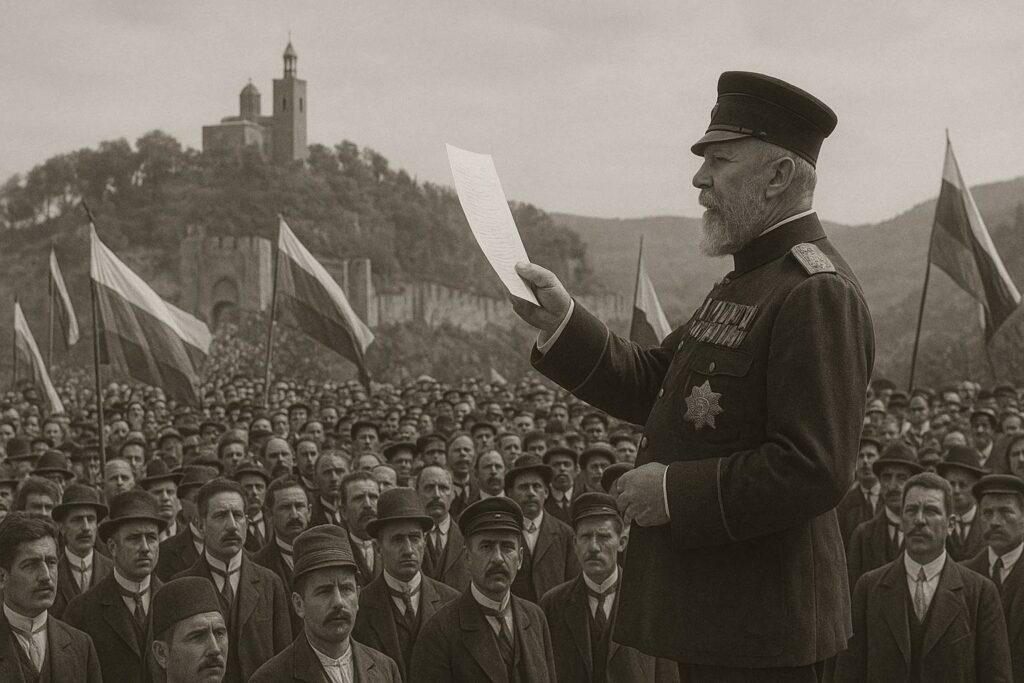
On September 22, thousands gathered before the Tsarevets fortress, amid banners, church bells, and the echo of drums. Political leaders, clergy, and military officers stood united.
Ferdinand sent a telegram to the Ottoman Sultan declaring Bulgaria’s independence and proclaiming himself Tsar. The official ceremony included prayers, speeches praising Bulgarian heroes, and the hoisting of the Bulgarian flag.
12. The Historic Proclamation: Ceremony, Speeches, and Symbolism
In a speech resonant with historic pride, Prime Minister Aleksandar Malinov declared: “Today, Bulgaria, through the will of its people and the courage of its sons, takes its rightful place among the free nations of Europe.”
The crowd erupted in cheers. The church offered prayers for the homeland—a spiritual affirmation that centuries of oppression had yielded to new dawn.
The proclamation was a blend of nostalgia for the medieval empire and modern nationalism, invoking a united future under lawful sovereignty.
13. Reactions Across Europe: Surprise, Anxiety, and Calculations
The news sent ripples throughout diplomatic circles from Vienna to London, Istanbul to Paris.
Some saw Bulgaria’s move as inevitable, the natural consequence of Ottoman decline.
Others feared Balkan instability, concerned that this would encourage Serb, Greek, and Macedonian nationalists and inflame tensions.
Ottoman authorities condemned the act as illegitimate but were increasingly powerless to reverse it.
14. The Ottoman Empire’s Response: From Outrage to Resignation
The Ottoman government declared the proclamation unlawful and demanded retraction. Some military deployments were planned but ultimately restrained due to internal weakness and international pressure.
The empire’s symbolic claims persisted, but day-by-day, Bulgaria asserted its de facto sovereignty.
This event accelerated the empire’s diminishing influence in the Balkans.
15. Bulgaria’s Diplomatic Maneuvers: Securing Recognition
The Bulgarian government immediately set to work securing international recognition.
Russia, though initially disapproving of Ferdinand’s ambitions, eventually acquiesced, seeing Bulgaria as a useful buffer.
The Great Powers reluctantly recognized Bulgaria’s independence by mid-1909, acknowledging a new state order in the Balkans.
This diplomatic success ensured Bulgaria’s place in the community of nations.
16. The Balkan Domino Effect: Independence Movements Reverberate
Bulgaria’s bold proclamation inspired neighboring peoples.
Serbia intensified its own independence posture; the idea that imperial suzerainty could be challenged gained momentum.
This regional shift helped set the stage for the Balkan Wars of 1912-1913, conflicts which would redraw the map yet again.
17. Aftermath and Immediate Challenges: Nation-Building Begins
Independence brought jubilation but also daunting tasks.
Bulgaria had to establish a fully sovereign government, modernize its army, codify laws, and build institutions.
Internal divisions and external threats posed ongoing challenges, but the nationalist consensus provided momentum toward unity and state-building.
18. Economic and Social Transformations Following Independence
Economically, Bulgaria embarked on modernization campaigns.
Railways, industry, education reform, and agricultural development became priorities.
Socially, the aristocracy and intelligentsia flourished, while peasants faced gradual reforms.
The creation of a modern Bulgarian identity combined pride in tradition with ambitions of European progress.
19. Bulgaria’s Role in the Balkan Wars and the Road to World War I
Independence emboldened Bulgaria to pursue further territorial ambitions.
Allied with other Balkan states, Bulgaria fought to free remaining Ottoman-held lands.
Although victorious in parts, post-war treaties left some ambitions unfulfilled, sowing future conflicts.
Bulgaria’s strategic position made it a key player as Europe spiraled toward World War I.
20. The Legacy of Independence: National Identity and Memory
Bulgarian independence became a foundational myth.
Every year, September 22 is celebrated with ceremonies remembering the courage of 1908.
The event defined a national narrative: from subjugation to sovereignty, a story of resilience and rebirth.
It continues to inspire Bulgarians as a symbol of freedom and self-determination.
21. Veliko Tarnovo Today: Symbolism and Commemoration
Veliko Tarnovo remains a cherished symbol of Bulgaria’s national soul.
Tourists, historians, and citizens alike visit the Tsarevets fortress, the site of the proclamation.
Museums, monuments, and plaques commemorate the moment, linking past and present in the city’s streets.
The city’s medieval walls echo with the voices of history and hope.
22. Conclusion: The End of an Era, The Dawn of a Nation
September 22, 1908, was the culmination of a centuries-long struggle. It was an act both bold and inevitable—a reclaiming of identity that echoed across generations.
Bulgaria moved from a vassal state to a kingdom welded by the sacrifices of its people and the vision of its leaders.
The declaration at Veliko Tarnovo stands as a testament to the power of national will and the endurance of hope. It reminds us that freedom is hard-won, but when achieved, it can reshape history.
Conclusion
The proclamation of Bulgarian independence on that crisp autumn day in Veliko Tarnovo was more than a political event—it was a deeply emotional and symbolic triumph. It captured the aspirations of an entire nation, one that had persevered through centuries of hardship and fragmentation. The ceremony reunited past and present, conjuring the glories of the medieval Bulgarian empire and signaling a modern destiny on the world stage. This was Bulgaria claiming its right to self-determination, sovereignty, and dignity.
Yet independence also marked a beginning of new challenges: diplomatic balancing acts, social transformation, and regional conflicts that would soon envelop the Balkans and the world. The courage and vision of 1908 ripple through Bulgarian history, continuing to inspire citizens to preserve their hard-earned freedom and honor the sacrifices of their ancestors. The spirit of Veliko Tarnovo endures—the heartbeat of a nation reborn.
FAQs
Q1: Why was Bulgaria under Ottoman rule for so long?
A1: Ottoman control began in the late 14th century after the fall of the medieval Bulgarian empire. The empire’s military conquest was decisive, and Bulgaria became a province within the Ottoman administrative system. Despite varying degrees of autonomy and resistance, Ottoman dominance persisted for nearly 500 years, largely because of the empire’s military strength and political organization.
Q2: What role did the Russo-Turkish War play in Bulgaria’s path to independence?
A2: The 1877-1878 war was crucial because it resulted in Russian military victory against the Ottomans and the subsequent Treaty of San Stefano, which proposed a large autonomous Bulgarian state. Though later modified, this war reignited Bulgarian hopes and established its status as an autonomous principality.
Q3: Who was Ferdinand of Saxe-Coburg-Gotha, and why was he important?
A3: Ferdinand was the Bulgarian prince from 1887 who proclaimed himself Tsar of Bulgaria in 1908. His leadership combined strategic diplomacy and national ambition, pushing Bulgaria from Ottoman vassalage to full independence and strengthening Bulgaria’s national institutions.
Q4: How did the Great Powers react to Bulgaria’s declaration of independence?
A4: Reactions ranged from cautious acceptance to concern over Balkan stability. While the Ottoman Empire condemned the move, European powers varied in their responses, often prioritizing their geopolitical interests. Eventually, most recognized Bulgaria to maintain the regional balance.
Q5: What immediate challenges did Bulgaria face after proclaiming independence?
A5: Bulgaria had to develop full sovereign institutions, modernize its military, reform governance, manage ethnic tensions, and gain international recognition. It also sought to assert its territorial claims in the Balkans, which led to future conflicts.
Q6: Why is Veliko Tarnovo significant in Bulgarian history?
A6: Veliko Tarnovo was the medieval capital of the Bulgarian empire, a center of cultural and political power. Choosing it for the 1908 proclamation symbolized a link between Bulgaria’s glorious past and its sovereign future, reinforcing national pride.
Q7: How did Bulgarian independence influence the Balkan region?
A7: Bulgaria’s declaration inspired nationalist movements elsewhere, contributing to increased tensions leading to the Balkan Wars. It challenged Ottoman authority and shifted alliances, signaling the beginning of a new political order.
Q8: How is Bulgarian independence commemorated today?
A8: September 22 is a national holiday marked by official ceremonies, cultural events, and educational programs. The city of Veliko Tarnovo hosts special celebrations honoring the historic proclamation and its significance in the national memory.