Table of Contents
- The Morning of October 7, 1908: A Moment Suspended in Time
- Crete at the Crossroads: Historical Backdrop of a Turbulent Island
- The Decline of Ottoman Authority: Cracks in a Waning Empire
- Nationalism on the Rise: The Greek Spirit Rekindled on Crete
- The Role of the Great Powers: Guardians or Manipulators?
- The Cretan Assembly: Gathering of Defiance and Hope
- The Declaration: Bold Words That Shook the Mediterranean
- Reaction in Chania and Beyond: Euphoria and Unease
- The Ottoman Empire's Countermove: From Denial to Military Threats
- International Diplomacy Intensifies: The Chessboard of Empires
- The Cretan Struggle for Autonomy: More than Just a Union
- Venizelos and the Cretan Patriots: Faces of Resistance
- The Role of the Local Populace: From Villages to Townsfolk
- The Aftermath in Greece: Political Ripples and Popular Support
- Consequences for the Ottoman Empire: A Prelude to Greater Losses
- The European Powers' Dilemma: Stability or Change?
- The Cultural Renaissance Following the Declaration
- The Memory of 1908 in Modern Crete: Celebrations and Commemorations
- The Cretan Question in the Balkan Turmoil: Setting the Stage for the Balkan Wars
- Lessons from the Cretan Declaration: Nationalism, Diplomacy, and Self-Determination
- Final Reflections: The Enduring Legacy of a Fevered Autumn Day
1. The Morning of October 7, 1908: A Moment Suspended in Time
The cool autumn air of Chania stirred with a restless energy on October 7, 1908. The sun had just begun to stretch its rays across the tiled roofs and rugged hills when the Cretan Assembly convened in a charged atmosphere. Voices, usually muffled under the weight of empire, rose with unprecedented confidence. In the chambers where decisions shaped destinies, history was being written — not through imperial decree, but through the stout will of a people defying centuries of subjugation. The declaration that day was more than a political act; it was a testament to identity, hope, and the inextinguishable desire for freedom.
Suddenly, the island of Crete was no longer a mere Ottoman possession with a fragile autonomy — it boldly proclaimed its union with Greece. And across the seas, empires trembled.
2. Crete at the Crossroads: Historical Backdrop of a Turbulent Island
Nestled midway between Europe and the Levant, Crete’s story had long been one of cultural crossroads, trade, conquest, and resistance. For centuries, the island had lived under Ottoman dominion since the mid-17th century — a grip that, while unrelenting, was never wholly uncontested. The island’s Christian Orthodox majority, sharing language, religion, and culture with mainland Greece, harbored persistent dreams of enosis — union with the fledgling Greek state born in 1830.
Yet, Crete was not just a quiet footnote in Ottoman history. The 19th century saw repeated uprisings — from the 1866–69 Great Cretan Revolt to the near-independence granted by the Pact of Halepa in 1878. But these tentative gains failed to satisfy the fiery nationalist aspirations simmering beneath. Crete was a jewel coveted not only by its own people and the Ottoman Porte but also by an array of European powers, each eyeing the island’s strategic position in the Eastern Mediterranean.
3. The Decline of Ottoman Authority: Cracks in a Waning Empire
By the dawn of the 20th century, the Ottoman Empire was often called the “sick man of Europe.” Political inertia, military defeats, and external interference had diminished its authority. On Crete, Ottoman control was limited, largely symbolic, with an Ottoman governor presiding more in name than in fact.
The island’s semi-autonomous status, instituted after years of conflict and foreign mediation, had fostered a fragile equilibrium. But it was an uneasy peace, maintained under the watchful eyes of Britain, France, Italy, and Russia. The empire dealt with widespread unrest elsewhere too, and Crete represented one of the many fractures that presaged its eventual collapse.
4. Nationalism on the Rise: The Greek Spirit Rekindled on Crete
The late 19th and early 20th centuries heralded a surge in nationalist sentiment not just on the mainland but on Crete itself. Nationalism was no abstract ideology but a living momentum, galvanized by education, print culture, and guerrilla uprisings.
Young men donned the traditional Cretan dress defiantly in public gatherings; Greek flags were hoisted alongside the Cretan emblem; clandestine societies plotted for liberation and union. This resurgence coincided with the charismatic leadership of figures like Eleftherios Venizelos, a native Cretan lawyer whose vision transcended the island itself to embrace the national destiny of Greece.
5. The Role of the Great Powers: Guardians or Manipulators?
Crete’s fate in 1908 unfolded not in a vacuum but under the watchful eyes of the Great Powers. Britain, France, Russia, and Italy had jointly supervised the island's administration since 1898, following the intervention that ended Ottoman military presence.
Their interests were conflicting yet overlapping: geopolitical influence, naval bases, control of trade routes. While they professed to support autonomy under Ottoman suzerainty, their realpolitik often prioritized imperial stability over Cretan aspirations. The powers acted as both guarantors and jailers, oscillating between keeping Crete pliant and averting wider Balkan instability.
6. The Cretan Assembly: Gathering of Defiance and Hope
On that consequential morning, the Cretan Assembly convened in Chania with a determined focus. Representatives of the island’s provinces, from rugged mountain villages to bustling coastal towns, filled the chamber. Their collective will was clear: no more semi-autonomy, no more half-measures.
The assembly was a microcosm of Cretan society — composed of landowners, merchants, clerics, and former insurgents. Long debates underpinned by impassioned speeches culminated in overwhelming consensus. To declare union with Greece was to reclaim the island’s destiny, to resolve decades of liminal existence.
7. The Declaration: Bold Words That Shook the Mediterranean
The formal declaration, concise yet momentous, was read aloud with solemn pride:
“With the will of the Cretan people expressed by this Assembly, Crete today proclaims union with the Kingdom of Greece.”
The words echoed beyond the stone walls of the assembly hall, through narrow alleys and olive groves, carried on winds bound for Athens, Istanbul, and European capitals. It was not merely a statement of fact, but an act of defiance — a break with centuries-old imperial bonds, a voice crying for national rebirth.
8. Reaction in Chania and Beyond: Euphoria and Unease
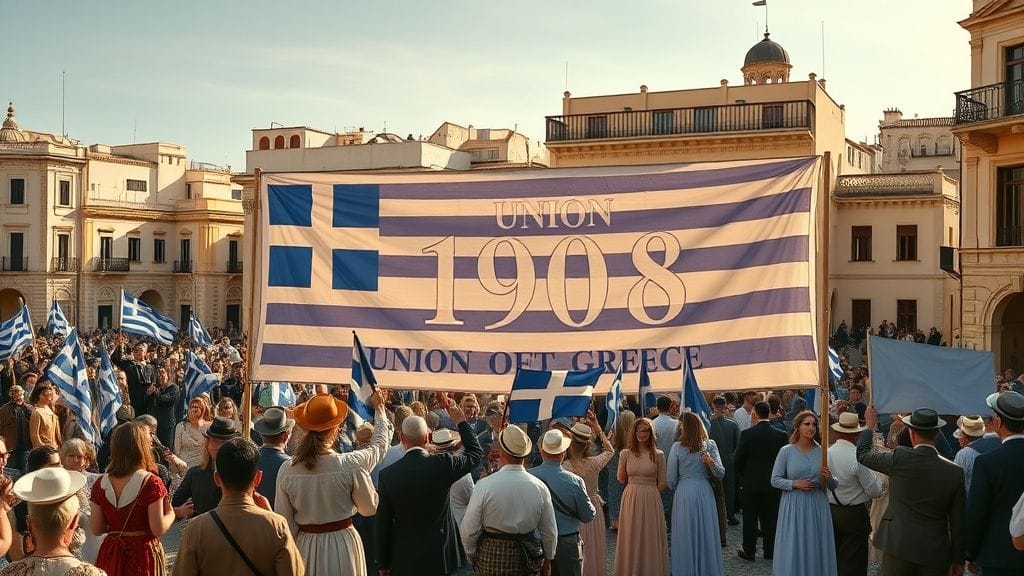
In Chania’s bustling streets, the news spread quickly. Crowds gathered, singing patriotic songs, waving Greek flags, and celebrating with spirited dances. The air crackled with joy but also tension — the shadow of Ottoman reprisals loomed.
In nearby villages, the peasantry and shepherds expressed their fervor too, some taking up arms in anticipation of conflict. While many saw this as a long-overdue triumph, others feared that the declaration might invite harsher occupation or international intervention.
9. The Ottoman Empire's Countermove: From Denial to Military Threats
The Ottoman government’s initial reaction was denial. The sultan’s administration refused to recognize the declaration, branding it rebellion. Under pressure to maintain imperial prestige, Ottoman troops were ordered to fortify positions near Crete, and diplomatic protests flooded the European capitals.
Some military officers advocated intervention to reassert control, but the empire’s resources were stretched thin — Balkan uprisings and global pressures made any direct confrontation risky. Nevertheless, tensions escalated, threatening to ignite a regional powder keg.
10. International Diplomacy Intensifies: The Chessboard of Empires
The Great Powers rushed to mediate. London, Paris, and Rome convened emergency meetings to assess the crisis. Their aim was to prevent the island from becoming a flashpoint that might unsettle the delicate balance in the Balkans.
Negotiations and ultimatums peppered the following months. While all recognized the legitimacy of Cretan grievances, none were willing to endorse outright union without broader regional consensus. The European press sensationalized the crisis, casting Crete as a microcosm of the fading Ottoman world order.
11. The Cretan Struggle for Autonomy: More than Just a Union
Union with Greece had long been the ideal, but the struggle for autonomy had nuances beyond political slogans. It encompassed struggles over land reforms, social reforms, and the assertion of civil rights against established Ottoman hierarchies.
The local Christian Orthodox church played a central role in rallying the population and legitimizing the movement. Crete’s diverse society grappled with internal divisions, yet the unionist cause created a rare moment of unified purpose.
12. Venizelos and the Cretan Patriots: Faces of Resistance
Eleftherios Venizelos stands out as the towering figure of this era. Having returned to Crete after a period in Greece, he galvanized the movement with intellectual rigor and pragmatic leadership.
Venizelos navigated local militias, diplomatic channels, and political intrigue, framing the union not as rebellion but as the natural right of a nation reunited. His vision extended beyond Crete to envision a stronger, more unified Greece.
13. The Role of the Local Populace: From Villages to Townsfolk
The declaration was not simply a top-down political act; it was rooted deeply within local communities. Farmers, fishermen, artisans, and merchants all contributed — some by raising funds, others by spreading the message or providing shelter to fighters.
Oral histories recount the tension of that autumn, the clandestine meetings, and the hope-filled prayers said in small chapels. The island’s youth, inspired by tales of heroes, imagined a future liberated from foreign control.
14. The Aftermath in Greece: Political Ripples and Popular Support
In Athens, news of the declaration sent waves of exhilaration. The Greek government, though cautious under international pressure, could not ignore the popular mandate.
Supporters of Venizelos and the unionist cause leveraged public sentiment, pushing for more assertive policies. At the same time, skeptics warned against provoking the Ottomans and the Great Powers. The event intensified political debates that would shape Greece's trajectory for years.
15. Consequences for the Ottoman Empire: A Prelude to Greater Losses
The loss of effective control over Crete was symbolic and strategic. It foreshadowed the eventual loss of other territories in the Balkans during the coming wars.
Internally, it exposed the empire’s administrative weaknesses and undermined confidence among loyalists. The Cretan declaration became a rallying cry for other separatist movements.
16. The European Powers' Dilemma: Stability or Change?
For Britain, France, Russia, and Italy, Crete represented a problem without easy solutions. Supporting union could destabilize the region, but denying self-determination could provoke conflict.
Their diplomacy danced between threat and appeasement, reflecting larger imperial calculations — from protecting shipping lanes to curbing rival influence. The island was a testing ground for the fragile balance of power.
17. The Cultural Renaissance Following the Declaration
The union declaration sparked renewed interest in Cretan culture, folklore, and history. Intellectuals compiled local songs, stories, and traditions that celebrated Greek identity.
Festivals honoring the heroes of the uprising blossomed. Artists painted scenes of struggle and hope, while writers chronicled the island’s rugged landscape and indomitable spirit.
18. The Memory of 1908 in Modern Crete: Celebrations and Commemorations
Today, Cretans remember October 7, 1908, as a cornerstone of their identity. Annual celebrations in Chania and other towns honor the assembly and its bold declaration.
Monuments stand where defiant voices once rose. Schools teach the event as a lesson in courage and national pride, reminding new generations that history is alive, shaped by those who dare.
19. The Cretan Question in the Balkan Turmoil: Setting the Stage for the Balkan Wars
The declaration was more than an isolated incident; it was a spark in the tinderbox of the Balkans. The following years saw competing nationalist movements clash, leading to the Balkan Wars of 1912–1913.
Crete became a symbol of what could be achieved, influencing other territories seeking liberation from Ottoman or Austro-Hungarian rule.
20. Lessons from the Cretan Declaration: Nationalism, Diplomacy, and Self-Determination
Reflecting on 1908 offers insights into the powerful interplay of nationalist aspirations and international politics. It demonstrates how local movements can reverberate across continents, challenging empires and changing borders.
It also cautions on the complexities of diplomacy where great power interests often trump popular will.
21. Final Reflections: The Enduring Legacy of a Fevered Autumn Day
The Cretan Assembly’s declaration on that crisp October morning remains a beacon of determination. It reminds us how identity, courage, and unity can alter the course of history.
Though the road ahead was fraught with peril, that moment stirred a vision of freedom that would eventually become reality. Crete’s story is a poignant chapter in the saga of nations seeking their place under the sun — a testament to the indomitable power of hope.
Conclusion
October 7, 1908, was far more than a date on a calendar for the people of Crete. It was the crystallization of decades of struggle and longing, a bold claim to belonging, dignity, and self-rule. Against the backdrop of an empire in decline and a Europe trembling on the edge of upheaval, the Cretan Assembly’s declaration was both daring and prophetic.
The courage exhibited by those representatives and the population they embodied speaks to a universal human desire — the right to shape one’s destiny. Though met with resistance and shadowed by political intrigue, the declaration eventually paved the way for Crete’s full union with Greece in 1913, altering the geopolitical map and inspiring countless others.
Their story teaches us that history is not only made by kings and empires, but by the determined voices of communities fighting for identity and freedom. In remembering the spirit of that autumn day, we honor a legacy of resilience and hope that continues to resonate beyond the shores of Crete.
FAQs
Q1: What were the main causes leading to the Cretan Assembly’s declaration of union with Greece in 1908?
The declaration resulted from long-standing grievances against Ottoman rule, fueled by rising Greek nationalism, years of armed uprisings, and a desire for complete political and cultural union with Greece. The weakening Ottoman Empire and semi-autonomous status of Crete also created a unique opportunity.
Q2: Who were the key figures involved in the 1908 declaration?
Eleftherios Venizelos was the most prominent leader, advocating for union and guiding the political movement. The Assembly also included local leaders from various social strata representing the united will of the Cretan people.
Q3: How did the Ottoman Empire react to the declaration?
The Ottoman government rejected the proclamation outright, attempting to reinforce military control and staging diplomatic protests. However, due to internal and external pressures, they could not immediately reassert authority over Crete.
Q4: What role did the Great Powers play during this event?
The Great Powers acted as overseers of the island’s semi-autonomous status and sought to maintain regional stability. While sympathizing with the people’s aspirations, they prioritized balance and negotiated efforts to avoid wider conflict.
Q5: How did the declaration impact Greece politically?
The event energized nationalist movements within Greece, boosting the political standing of leaders like Venizelos and influencing Greek foreign policy towards a more assertive stance on territorial expansion.
Q6: What were the consequences of the declaration for Crete itself?
While immediate union was not internationally recognized, the declaration solidified the island’s national identity and paved the way for eventual formal union with Greece in 1913, following the Balkan Wars.
Q7: How is the 1908 declaration remembered in Crete today?
It is celebrated as a foundational moment of Cretan identity, commemorated annually with ceremonies, cultural festivals, and public education emphasizing the event’s importance in the island’s history.
Q8: Did the Cretan declaration influence other nationalist movements in the Balkans?
Yes, the declaration was part of a broader pattern of nationalist assertions challenging Ottoman authority in the region, contributing to the tensions that precipitated the Balkan Wars and the reshaping of Southeastern Europe.