Table of Contents
- A City on the Brink: Athens in August 1909
- Seeds of Discontent: The Roots of the Goudi Coup
- Greece at the Dawn of a New Century: Political and Social Tensions
- The Military Catalyst: The Military League and Their Vision
- The Day of Reckoning: August 15, 1909, at Goudi Barracks
- A Bold Gesture: Demanding Reform, Not Revolution
- The Coup as a Manifesto: The Military League’s Twelve Demands
- The Political Response: Government Shock and Hesitation
- Enter Eleftherios Venizelos: The Unexpected Statesman
- Venizelos’ Return: From Crete to the Heart of Athenian Politics
- Reform Winds: Venizelos’ First Moves After the Coup
- The Parliament’s Transformation: Constitutional Reforms and Modernization
- Public Reaction: From Enthusiasm to Resistance
- The Impact on Greek Society: Militarism, Nationalism, and Democratization
- The Macedonian Struggle and the Balkan Wars: Prelude to Expansion
- The Goudi Coup’s Legacy in 20th Century Greece
- Personalities in the Storm: Military Leaders and Political Figures
- Behind the Scenes: International Observers and Reactions
- Narratives from the Ground: Soldiers, Citizens, and Anecdotes
- The Coup’s Role in Forging Modern Greek Identity
- Lessons Learned: The Balance Between Military Influence and Democracy
- Conclusion: A Turning Point That Reshaped a Nation
- FAQs: Understanding the Goudi Coup
- External Resource
- Internal Link: Visit History Sphere
A City on the Brink: Athens in August 1909
The sun hung low over Athens on a late summer day in August 1909. The heat clung to the blood and sweat of a city caught between tradition and the urgent needs of modernity. The streets, filled with murmurs of discontent, bore witness to a nation teetering on the edge of transformation. Under the warm sky, distant cannon fire and the thunder of boots echoed from the Goudi barracks—a military outpost preparing to shake the foundations of Greek politics.
This was not a revolution born of chaos and cry; it was a carefully calculated upending of Greece’s political malaise. Soldiers, once sworn guardians of the status quo, now stood as harbingers of change. They were not rebels, nor anarchists. They were patriots, driven by frustration and a fierce desire to see the nation step out from the shadows of inefficiency and foreign humiliation.
Seeds of Discontent: The Roots of the Goudi Coup
The roots of the Goudi Coup ran deep into the fertile soil of discontent that had been nourishing Greek society for decades. Greece in 1909 was a nation caught between its heroic past and an uncertain future. The 19th century’s founding struggles and the bloody wars of independence had given birth to a fragile state, often torn by political infighting, corruption, and a paralyzed bureaucracy.
Economic difficulties grew alongside political scandals, compounded by the failures of military campaigns in Crete and the lingering humiliation of the Greco-Turkish War of 1897. The country’s military, increasingly aware of its own inadequacies and the dilapidated state of its equipment, grew restless. A new generation of officers felt the country needed bold leadership and sweeping reforms. Yet the political class seemed deaf to these calls.
Greece at the Dawn of a New Century: Political and Social Tensions
The early 1900s in Greece were marked by stark contrasts. On one side stood a monarchy under King George I, whose reign had brought some stability but whose power remained constrained by an inflexible parliamentary system dominated by entrenched oligarchs. On the other side, a populace hungry for national revitalization, modernization, and social justice, living in cramped neighborhoods and marginalized rural villages.
The political parties were weak, fragmented, and often beholden to local interests or foreign influences—most notably the Great Powers aiming to safeguard their stake in the Eastern Mediterranean. Social tensions simmered beneath the surface, with workers agitating for better conditions and farmers burdened by taxes and outdated land systems.
Into this volatile mix stepped the military, asserting itself as the guardian of national honor—frustrated, impatient, and increasingly confident that Greece needed a radical shake-up to survive amongst the rapidly changing geopolitics of the Balkans.
The Military Catalyst: The Military League and Their Vision
Formed in 1908, the Military League was a clandestine group of middle-ranking officers disillusioned by Greece’s military failures and political corruption. They gathered quietly but deliberately in Athens and elsewhere, exchanging ideas inspired by effective models abroad—especially the Meiji Restoration in Japan, where military officers had successfully pushed society towards modernization.
The League’s vision was stark and direct: a revitalized Greece with a modern, efficient army capable of defending national interests and reclaiming lost territories. They sought a professional officer corps, cutting through the patronage and favoritism that plagued promotions. At the same time, they did not seek to impose direct military rule but to pressure a flagging political class into reform.
Their preferred instrument for change was the threat of force, carefully calibrated to avoid spilling unnecessary blood. And on August 15, 1909, this threat crystallized into action.
The Day of Reckoning: August 15, 1909, at Goudi Barracks
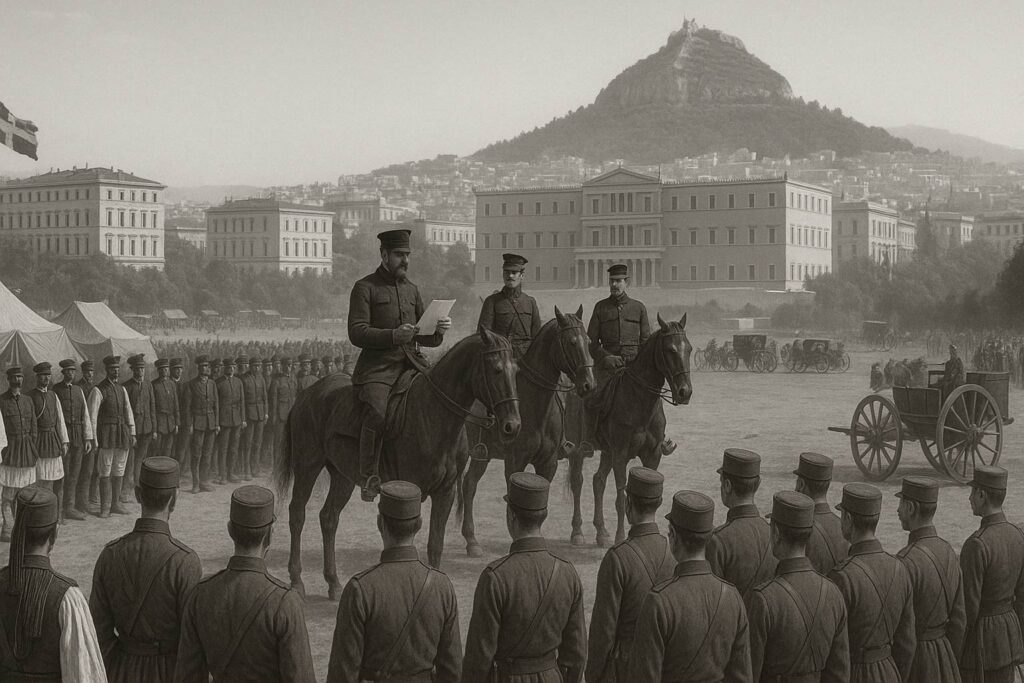
The Goudi barracks, located on the outskirts of Athens, became ground zero for what many would call a coup, though the participants preferred the term “revolution of reform.” On that hot August day, hundreds of soldiers and officers assembled under the banner of the Military League, making their presence unmistakably known.
They moved with discipline, declaring their intent not to seize power but to demand change. The city awoke to rumors and then confirmation: Greece’s armed forces demanded that the government take immediate steps to address corruption, inefficiency, and military weakness.
It was a spectacle both shocking and oddly hopeful to the Athenian public. Soldiers who ordinarily performed marches or guarded ministries now challenged politicians within their own capital. Yet, remarkably, no blood was shed in this first act. The emphasis was on a theatrical display of power, a provocation aimed at consciousness rather than conquest.
A Bold Gesture: Demanding Reform, Not Revolution
Unlike violent overthrows common in other countries, the Goudi activists made clear their goals were not personal power grabs or a military dictatorship. Instead, they presented a platform of twelve demands addressing vital national issues:
- Reform of the military command structure
- Modernization and expansion of the army
- Purging corruption from government offices
- Judicial independence
- Electoral reform and political accountability
- Improved infrastructure and public education
- More efficient tax collection
- National revitalization initiatives
These demands read like a utopia where Greece could shed years of stagnation and complacency. The message was clear: the army was tired of waiting. The country needed competent governance or risk further decline.
The Coup as a Manifesto: The Military League’s Twelve Demands
These twelve demands resonated as a civic manifesto, resonating with many Greeks weary of elite failings. Newspapers seized upon them; intellectuals debated their feasibility, and common citizens expressed cautious optimism.
The demands were not revolutionary in the sense of overturning democracy. Instead, they sought a stronger democracy, one capable of delivering justice and national dignity. The Military League framed their demands as a patriotic duty—an urgent call to awaken the nation’s leaders and citizens alike to forgotten responsibilities.
The Political Response: Government Shock and Hesitation
Prime Minister Georgios Theotokis and King George I found themselves blindsided. The demands shook the government to its foundations. Political elites scrambled to placate the military, fearing both loss of control and the potential rupture of social order.
While some politicians wanted to suppress the uprising with force, the government ultimately decided on negotiation. Still, the generals behind the coup were unnervingly confident, and this unexpected assertiveness energized reformist factions.
The political debate deepened: who would lead the response? Who could unite people behind urgent change without descending into chaos?
Enter Eleftherios Venizelos: The Unexpected Statesman
In the backdrop of this crisis emerged Eleftherios Venizelos, a charismatic Cretan statesman with a modern vision for Greece. Having made his mark in Crete where political reforms and self-administration had thrived, Venizelos represented the new face of Greek politics.
Invited to Athens by the Military League—the very men who respected his reformist reputation—Venizelos arrived as a beacon of hope. His political savvy, eloquence, and pragmatic idealism quickly positioned him not merely as a mediator, but as the man destined to turn demands into action.
It was a pivotal moment: a fresh leader stepping forward amid paralysis, bridging the military’s urgings and the people’s aspirations.
Venizelos’ Return: From Crete to the Heart of Athenian Politics
Venizelos’ arrival was electrifying. His history of modern reforms in Crete helped him command legitimacy beyond partisan lines. His vision was comprehensive: not only military reform but fundamental transformation of political institutions, economic modernization, social justice, and expansion of national territory.
His presence emboldened the Military League and reassured wary politicians. Over the months that followed, Venizelos negotiated tirelessly, crafting compromises and rallying popular support. His political skills would soon reshape Greek governance far beyond what the Military League had imagined.
Reform Winds: Venizelos’ First Moves After the Coup
By 1910, a new political era was dawning. Venizelos was elected to parliament, and his reform proposals were sweeping: restructuring the army, modernizing administration, reforming justice, and investing in education and infrastructure.
Perhaps most importantly, he initiated constitutional amendments restricting monarchical power and empowering elected officials, thus redefining Greece’s political balance.
Venizelos’ pragmatic idealism won praise and opposition in equal measure. His reforms faced entrenched resistance but also energized public debate and participation, marking Greece’s step into modern parliamentary democracy.
The Parliament’s Transformation: Constitutional Reforms and Modernization
The Goudi aftermath accelerated Greece’s path toward constitutional reform. Parliament revised electoral laws, creating more representative bodies, and streamlined bureaucratic procedures. Venizelos’ efforts targeted corruption directly, introducing mechanisms for accountability.
Military reforms followed: professional officers replaced favorites, and the army expanded and trained anew. These changes dramatically increased Greece’s diplomatic standing and military readiness, crucial for the conflicts looming in the Balkans.
The political transformation was not absolute or painless, but it set an irreversible course toward modernization.
Public Reaction: From Enthusiasm to Resistance
The Greek populace met these reforms with a mixture of enthusiasm and apprehension. In cities, many celebrated hope for efficiency and national pride. Rural areas, however, often resisted rapid change, fearful of upheaval to traditional social orders.
Political opponents accused reformers of pushing too fast or betraying national traditions. The monarchy watched uneasily as parliamentary power grew. Yet, despite this dynamic flux, the momentum of reform was unstoppable.
Popular newspapers carried stories of renewed national vigor, while cafés buzzed with debates on patriotism, democracy, and Greece’s future.
The Impact on Greek Society: Militarism, Nationalism, and Democratization
The Goudi Coup’s legacy transcended political institutions. It amplified a sense of militarism fused with nationalism, celebrating Greek identity while emphasizing citizen responsibility.
At the same time, reforms enhanced democratization, particularly by involving broader social classes in politics and reducing oligarchic dominance. Education reforms nurtured a new intelligentsia, and civil society gained impetus.
The coup thus reshaped Greece not as a mere power rebalancing but as a cultural and political renaissance.
The Macedonian Struggle and the Balkan Wars: Prelude to Expansion
The newly reformed Greece under Venizelos would soon face larger challenges. The unresolved question of Macedonia, under Ottoman control but populated by ethnic Greeks, Albanians, Bulgarians, and Serbians, catalyzed nationalist tensions.
Armed bands and diplomacy intertwined in a struggle that would erupt into the Balkan Wars (1912-1913). Greece’s strengthened military and political resolve, forged in the crucible of the Goudi reforms, enabled it to play a decisive role in these conflicts, expanding its territory and influence.
The Goudi Coup, therefore, was not only an internal reset but a strategic prelude to Greece’s emergence as a key Balkan power.
The Goudi Coup’s Legacy in 20th Century Greece
The political transformations seeded by the Goudi Coup continued to influence Greek society throughout the 20th century. The balancing act between military and civilian powers, the emphasis on national pride, and commitment to state modernization became defining themes.
Venizelos’ leadership, fostered by the coup, marked an era remembered for diplomatic successes and vibrant, if sometimes fraught, democracy. Conversely, the increased role of military actors in politics also foreshadowed future tensions culminating in later interventions.
Still, the Goudi Coup remains a seminal moment—a bold act that challenged complacency and charted a course for Greece’s future.
Personalities in the Storm: Military Leaders and Political Figures
At the heart of the coup stood figures like Colonel Nikolaos Zorbas, who led the Military League with quiet determination, and Eleftherios Venizelos, whose charisma and intellect captivated Greece.
Others, like Prime Minister Georgios Theotokis, epitomized the old guard confronted with an unstoppable tide of reform. Their interactions reveal a political theater where courage, pragmatism, ambitions, and patriotism intermingled, shaping the fate of a nation.
Behind the Scenes: International Observers and Reactions
Europe watched Greece’s upheaval with cautious interest. The Great Powers—Britain, France, Russia, Austria-Hungary, and Germany—understood that Greece’s stability affected Mediterranean balances.
While some feared military adventurism, others welcomed the prospect of a more efficient Greek state allied to Western interests. Venizelos’ diplomatic finesse later positioned Greece favorably among these powers, a byproduct of the foundations laid during the Goudi crisis.
Narratives from the Ground: Soldiers, Citizens, and Anecdotes
Amid political grandstanding, the voices of ordinary soldiers and citizens recall August 1909 in more textured hues. A sergeant recounting the tense but orderly occupation of city streets, a shopkeeper reminiscing about the nervous chatter in cafés, or a schoolteacher inspired by promises of educational renewal—all capture the human dimensions of this historical moment.
These anecdotes reveal how change rippled across everyday lives, knitting history into the social fabric.
The Coup’s Role in Forging Modern Greek Identity
Ultimately, the Goudi Coup signified more than political reform; it was a defining episode in crafting modern Greek identity—fusing pride in Hellenic heritage with resolve to embrace progress.
The themes of patriotism, duty, and renewal introduced then echo in contemporary debates on citizenship, governance, and national purpose. The coup embodied Greece’s perennial quest to reconcile its ancient past with the demands of modern statehood.
Lessons Learned: The Balance Between Military Influence and Democracy
The Goudi Coup serves as a historical case study on the delicate relationship between military intervention and democratic evolution. While the military played a pivotal role in initiating reforms, the ultimate success lay in civilian political leadership and institutional modernization.
It demonstrates the risks and possibilities when armed forces assume activism—not as conquerors but as catalysts. The balance achieved then remains a reference point for scholars and statesmen alike.
Conclusion
The Goudi Coup of August 1909 is often overshadowed by the tumultuous wars and politics that followed, yet it stands as one of the most pivotal moments in modern Greek history. Emerging not from frenzy but a disciplined and principled desire for reform, it embodied the hopes and frustrations of a nation seeking to define itself amidst global change.
It cast military force not as an end, but as a means to awaken a paralyzed political system. It introduced Eleftherios Venizelos, a towering figure whose vision propelled Greece into a new century with renewed strength and ambition.
More than an episode of rebellion, the Goudi Coup was a clarion call—a reminder that a nation’s destiny depends on courage to confront its own flaws and the wisdom to build anew. It elucidates how history can pivot on moments of uneasy cooperation between power and principle, charting courses that ripple across generations.
In the echoes of the barracks at Goudi, we hear the heartbeat of a nation revitalized, grappling forever with the tension between tradition and transformation. And that, perhaps, is why this moment continues to resonate so profoundly in the annals of Greece and world history.
FAQs
1. What were the main causes of the Goudi Coup?
The coup stemmed from military frustration with corruption, political paralysis, and inadequate national defense. The Military League sought to compel reforms that the existing government ignored.
2. Who were the key figures involved in the Goudi Coup?
Colonel Nikolaos Zorbas led the Military League, while Eleftherios Venizelos emerged as the pivotal political leader who translated military demands into reform.
3. Was the Goudi Coup a violent overthrow?
No. The coup emphasized pressure and negotiation over bloodshed. It was characterized by a disciplined occupation of Goudi barracks and demands rather than armed insurrection.
4. How did the Goudi Coup influence Greek politics?
It precipitated significant reforms in military structure, parliamentary representation, and administration, setting Greece on a path toward modernization and democratic consolidation.
5. What role did Eleftherios Venizelos play after the coup?
Venizelos became prime minister and spearheaded reforms in governance, defense, education, and national expansion, earning lasting fame as a founder of modern Greece.
6. How did the international community view the coup?
European powers monitored the situation with cautious interest, balancing concerns about military adventurism with hopes for a stable, reform-oriented Greece.
7. Did the Goudi Coup directly lead to the Balkan Wars?
While not directly causing them, the coup created the political and military conditions necessary for Greece to play a prominent role in the Balkan Wars.
8. What is the historical legacy of the Goudi Coup today?
It remains a symbol of military-civilian cooperation for national reform, highlighting challenges in balancing armed forces’ involvement with democratic governance.