Table of Contents
- A New Dawn Breaks: The Birth of the Republic of China
- The Twilight of the Qing Dynasty: Seeds of Revolution
- Sun Yat-sen: The Visionary Architect of Change
- The Wuchang Uprising: Spark that Ignited a Nation
- Revolutionary Waves Sweep China’s Provinces
- The Negotiation and Abdication of the Last Emperor
- The Proclamation Ceremony in Nanjing: Hope on the Horizon
- The Establishment of the Provisional Government
- Yuan Shikai’s Role: From General to Power Broker
- The Challenges of Unity: Regionalism and Warlordism
- The Ideals of the Revolution: Nationalism, Democracy, People’s Livelihood
- The Overseas Chinese Community and Global Support
- Cultural and Social Ripples of Republicanism
- Women and the Revolution: Emerging Voices
- The International Context: How the World Viewed the New Republic
- The Early Legislative and Political Experiments
- Power Struggles and the Fragility of the New Regime
- Economic Turmoil and Modernization Efforts
- The Republic’s Symbolism in Chinese National Identity
- Legacy of 1912: Foundations for Twentieth-Century China
- Memories, Myths, and Historical Debates about the Republic’s Birth
A New Dawn Breaks: The Birth of the Republic of China
At the stroke of midnight on January 1, 1912, in the ancient city of Nanjing, a tidal wave of hope surged through a nation ravaged by centuries of imperial rule and internal strife. The Republic of China was proclaimed. In that historic moment, the heavy chains of over two millennia of imperial dynasties seemed to shatter. The weary eyes of millions — peasants, intellectuals, soldiers, merchants — gazed toward a new horizon, fragile yet radiant with possibility.
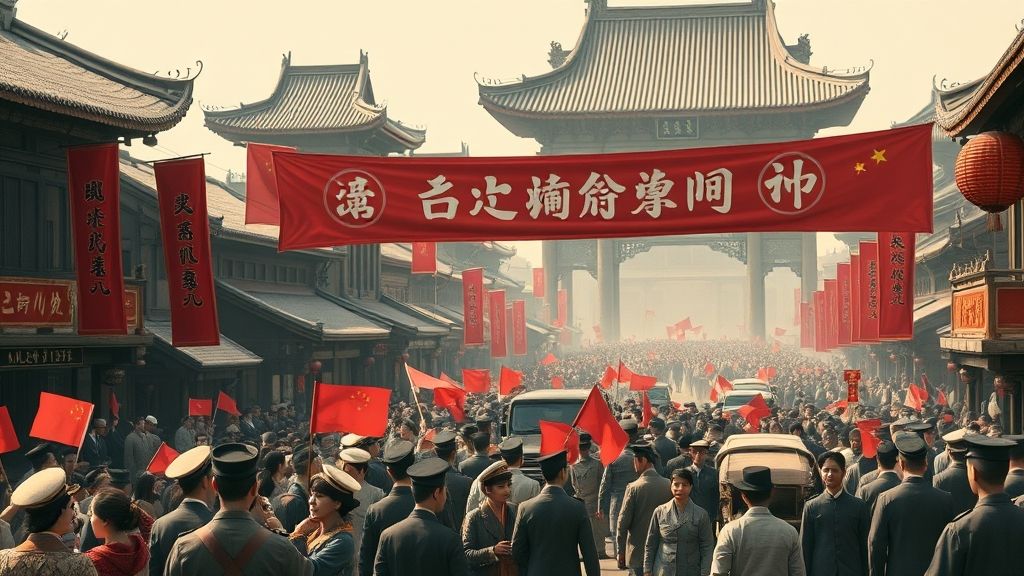
Nanjing’s winter air carried a cold clarity as leaders gathered amid the echoes of drumbeats and the fluttering of red banners. From the city’s gates to the riverbanks, whispers of transformation grew louder. The worn-out Qing dynasty was finally fading into history. For countless Chinese, this was no mundane political event, but a profound reimagining of their identity, governance, and future.
Yet beneath this thrilling dawn lay a complex tapestry of revolutions, alliances, compromises, and mounting uncertainties. The birth of the Republic was not an end, but the first chapter in a tumultuous journey that would redefine China for decades.
The Twilight of the Qing Dynasty: Seeds of Revolution
The 19th century had been unkind to the Qing dynasty, the last imperial house of China. Once mighty, the ruling Manchu elites faced unprecedented challenges: foreign invasions, humiliating defeats, and internal rebellions that eroded their legitimacy.
The Opium Wars, the Taiping Rebellion, the Sino-Japanese War—all these upheavals exposed a fractured state grappling with modernity’s demands and the failure of its archaic institutions. Corruption was rampant, taxes oppressive, and the majority of the population mired in poverty without political voice.
Reform efforts, such as the Self-Strengthening Movement and the late Qing's Hundred Days’ Reform, proved too little, too late. The Qing rulers, bound by tradition and suspicion of change, failed to meet the demands of a rapidly evolving world.
Amid this backdrop, intellectuals and revolutionaries nurtured ideas that would soon explode into open rebellion: nationalism, democracy, individual rights, and the urgent need to overthrow the dynastic cycle.
Sun Yat-sen: The Visionary Architect of Change
No figure embodies the tumult and aspirations of China more than Sun Yat-sen. A man forged by westward education and Chinese nationalism, Sun’s life journey was itself a bridge between worlds.
Though his ideologies absorbed Western notions of republicanism, socialism, and nationalism, his vision was deeply rooted in Chinese soil, aimed at restoring dignity and sovereignty to a fractured land.
Sun’s Three Principles of the People—nationalism, democracy, and people’s livelihood—became the ideological compass for revolutionaries fighting to end centuries of autocracy.
But Sun was not a lone swordsman. He was the head of the revolutionary Tongmenghui (United League), tirelessly amassing supporters both inside China and among overseas Chinese communities spread across Southeast Asia, North America, and beyond.
His charisma and persistence made him a beacon of hope, though his path was riddled with setbacks, exile, and personal sacrifice.
The Wuchang Uprising: Spark that Ignited a Nation
On October 10, 1911, an event in the provincial military garrison of Wuchang erupted into a full-scale uprising that would soon engulf China.
The immediate cause was a failed attempt by revolutionary forces to seize control of new railway lines, symbols of modernization and central government power. This act triggered a mutiny among soldiers disillusioned by corruption and inefficiency.
The Wuchang Uprising caught Qing authorities off guard. Its success emboldened other provinces, each declaring independence from the dynasty. Within days, the revolutionary flame spread like wildfire, turning local victories into a near-national upheaval.
It was a moment when ordinary soldiers and civilians found themselves actors in a grand historical drama of liberation and uncertainty.
Revolutionary Waves Sweep China’s Provinces
From southern Guangdong to southwestern Sichuan, provinces began to cast off Qing control one after another.
The revolution’s momentum was staggering. Previously loyal regional governors had to choose between siding with the dynasty or the burgeoning republican movement. Many seized the chance to assert autonomy, complicating the quest for a unified new government.
Amid the chaos, different factions emerged—military leaders, intellectuals, merchants—each with distinct visions for China’s future.
However, the unity forged by the common goal of ending Qing rule was fragile. The challenge of transforming a sprawling, diverse empire into a cohesive republic was monumental.
The Negotiation and Abdication of the Last Emperor
As insurgents gained ground, high-ranking Qing officials faced the grim reality of inevitable defeat.
Negotiations increasingly centered on the fate of the child emperor, Puyi, who symbolized both a dynasty’s past and an uncertain future for China itself.
Yuan Shikai, a pragmatic and powerful military leader with close ties to the Qing court, emerged as the key negotiator. His influence was decisive in persuading the Empress Dowager to accept abdication in exchange for conditions protecting imperial privileges.
On February 12, 1912, Emperor Puyi officially abdicated, ending over two millennia of imperial autocracy. This moment marked a profound rupture in Chinese history—the fall of the imperial system that had shaped the culture, governance, and identity of the nation.
The Proclamation Ceremony in Nanjing: Hope on the Horizon
Before the abdication was finalized, revolutionaries gathered in Nanjing to declare the founding of the Republic of China.
On January 1, 1912, in the shadow of historic city walls, leaders including Sun Yat-sen took the oath of office as members of the provisional government.
The event was a mix of solemn ceremony and passionate celebration. People from diverse social strata, some brandishing swords, others waving banners, witnessed the birth of a republic that promised modernity, democracy, and social justice.
The proclamation was both a symbolic rupture from the past and a beacon for a better future. The air was thick with emotion—a mix of exhilaration, uncertainty, and determination.
The Establishment of the Provisional Government
The fledgling republic faced immediate challenges. The provisional government, seated in Nanjing, needed to stabilize the nation while negotiating with powerful generals and regional leaders who wielded real influence.
Sun Yat-sen was inaugurated as the provisional president, embodying the new republican ideals, but his authority was both symbolic and precarious.
The government began drafting fundamental laws, organizing military forces loyal to the republic, and attempting to introduce policies aiming at land reform, education, and infrastructure.
The enormity of governing a fragmented and vast country, however, quickly became apparent.
Yuan Shikai’s Role: From General to Power Broker
Yuan Shikai’s entry into the new political landscape transformed the trajectory of the Republic’s early days.
Initially appearing as a collaborator with the revolutionaries, Yuan leveraged his formidable military command and political acumen to become the real power behind the scenes.
In a tactical compromise, Sun Yat-sen agreed to Yuan’s presidency of the republic in exchange for bringing the powerful Beiyang Army and northern provinces under the government’s control.
Yet many feared Yuan’s ambitions—which would soon reveal themselves—threatening the fragile republican experiment.
The Challenges of Unity: Regionalism and Warlordism
China’s vastness was both its richness and its curse. The collapse of imperial authority unleashed centrifugal forces that fragmented the country.
Powerful regional military commanders, or warlords, asserted control over provinces with their own armies, ignoring the central government’s often feeble decrees.
This decentralization meant that Republican China was less a unified nation-state than a patchwork of competing sovereignties.
Efforts at national integration faced constant setbacks, exacerbated by diverse ethnic, linguistic, and social landscapes.
The Ideals of the Revolution: Nationalism, Democracy, People’s Livelihood
The revolution was inspired by lofty ideals.
Sun Yat-sen’s Three Principles of the People became rallying points: to free China from imperialist domination (nationalism), to establish a government by the people (democracy), and to improve the economic conditions of all citizens (people’s livelihood).
Though these ideas stirred imaginations and mobilized masses, their practical implementation was hindered by political fragmentation and resistance from entrenched elites.
Nonetheless, they planted seeds for later reforms and fostered a new political culture.
The Overseas Chinese Community and Global Support
The republic’s proclamation resonated far beyond China’s borders.
The global Chinese diaspora—businessmen, students, and immigrants—served as crucial financial and ideological supporters of the revolution.
Cities like San Francisco, Singapore, and Manila became hubs for fundraising and revolutionary discourse.
These overseas communities helped shape the modern image of China, linking nationalism with global networks and modern political thought.
Cultural and Social Ripples of Republicanism
Republican ideals reverberated in Chinese literature, education, and art.
The New Culture Movement emerged shortly after, calling for vernacular literature, scientific thinking, and the rejection of Confucian traditions seen as obstacles to progress.
Newspapers proliferated, spreading republican and nationalist ideas among broader populations.
Though society was still largely traditional, cracks appeared as younger generations embraced new political and cultural identities.
Women and the Revolution: Emerging Voices
While the revolution was largely dominated by male elites, women found inspiration and new roles amid the upheavals.
Some women joined reformist and revolutionary circles advocating for education, suffrage, and the abolition of feudal practices like foot binding.
Figures like Qiu Jin became symbols of female courage and revolutionary spirit.
This era marked one of the early awakenings of feminist consciousness in modern China.
The International Context: How the World Viewed the New Republic
Foreign powers watched China’s republican birth with a mixture of caution and opportunism.
While some viewed it as a hopeful sign that China might modernize and become a reliable partner, others feared instability that could threaten their privileges.
The Republic’s policy of “respect for treaties” was a diplomatic attempt to reassure imperial powers, but anti-foreign sentiments remained strong among the populace.
Japan, Russia, Britain, and others would continue to influence China’s fate in the decades to come.
The Early Legislative and Political Experiments
The Republic began tentative steps toward establishing constitutional governance.
Assemblies, parliaments, and local governments were formed, often struggling against interference by military strongmen.
The drafting of a provisional constitution laid foundations for rule of law, though practical realities frequently undermined democratic ideals.
Political parties emerged, and the idea of popular sovereignty gained traction among the educated classes.
Power Struggles and the Fragility of the New Regime
Despite high hopes, the Republic’s early years were marred by factional disputes.
Sun Yat-sen abdicated the presidency in favor of Yuan Shikai, hoping to foster unity, but Yuan’s authoritarian tendencies soon surfaced.
Warlordism intensified, revolts erupted, and central authority weakened.
Political assassinations, coups, and betrayal became common, threatening to undo revolutionary gains.
Economic Turmoil and Modernization Efforts
China’s economy faced severe challenges amid political instability.
Efforts to modernize railways, industry, and finance met resistance and resource constraints.
Foreign debts and unequal treaties limited economic sovereignty.
However, pockets of growth and reform signaled the gradual transformation of China’s traditional economy.
The Republic’s Symbolism in Chinese National Identity
The fall of the dynasty and rise of the Republic marked a symbolic break from millennia of imperial identity.
The Republic promoted the idea of a modern Chinese nation, transcending ethnicity and regionalism.
New flags, anthems, and holidays sought to forge a shared national consciousness.
Though imperfect, this reimagining inspired future struggles for unity and modernization.
Legacy of 1912: Foundations for Twentieth-Century China
The proclamation of the Republic of China in 1912 was not a final victory but a foundational moment.
It destroyed the imperial certainty and opened China to radical debates about governance, society, and identity.
Subsequent decades would see civil wars, foreign invasions, and ideological conflicts rooted in this epochal shift.
The Republic’s birth remains a pivotal milestone in China’s journey toward becoming a modern state.
Memories, Myths, and Historical Debates about the Republic’s Birth
Over time, narratives about 1912 have been subject to reinterpretation.
Sun Yat-sen is canonized as “Father of the Nation,” yet scholars debate the extent of his political skill versus opportunism.
The roles of the Qing court, Yuan Shikai, and local leaders are contested.
Public memory oscillates between pride in republican ideals and recognition of the tumult and tragedy that followed.
But the birth of the Republic endures as a symbol of aspiration and transformation.
Conclusion
The moment when the Republic of China was proclaimed in Nanjing on January 1, 1912, remains one of the most emotionally charged and historically profound events in modern Chinese history. It was a moment where centuries of imperial weight lifted—if only temporarily—to reveal the fragile, luminous potential of a new nation forged in the fires of revolution, hope, and the yearning for dignity.
Yet the story of that day is not one of pure triumph. It is woven from contradictions—between old and new, unity and division, idealism and realpolitik. The Republic’s birth was a clarion call to Chinese people everywhere that a different future was possible, even as it laid bare the immense challenges that lay ahead in uniting a fractured land and defining a modern identity.
To understand this event is to glimpse the profound struggles of a nation in transition, the sacrifices of countless individuals, and the enduring power of ideas to inspire change. The Republic of China’s proclamation was a beginning—a beginning neither simple nor guaranteed—whose reverberations shaped the tumultuous path of the twentieth century and continue to influence China’s collective memory and destiny today.
FAQs
1. What were the main causes of the fall of the Qing Dynasty?
The Qing Dynasty fell due to a combination of internal corruption, inability to modernize effectively, military defeats by foreign powers, financial crises, and widespread social unrest including uprisings such as the Taiping Rebellion. The dynasty’s failure to respond to demands for reform also fueled revolutionary movements.
2. Who was Sun Yat-sen and why is he important?
Sun Yat-sen was a revolutionary leader often called the “Father of the Nation.” He was instrumental in uniting disparate revolutionary factions through his political ideology—The Three Principles of the People—and worked tirelessly to overthrow the Qing Dynasty and establish the Republic of China.
3. How did the Wuchang Uprising impact the revolution?
The Wuchang Uprising of October 1911 was the catalyst for the Xinhai Revolution. It sparked a chain of provincial defections from Qing control and mobilized widespread rebellion that ultimately led to the abdication of the last emperor and the founding of the Republic.
4. What role did Yuan Shikai play in the early Republic?
Yuan Shikai was a powerful general and politician whose influence was decisive in securing the Qing emperor’s abdication. He became the Republic’s president but later attempted to restore monarchy, which led to political fragmentation and internal conflict.
5. Why was the new Republic’s government so fragile?
The government lacked centralized control over vast and diverse regions, faced competing warlords, ethnic divisions, economic difficulties, and the legacies of imperial rule. Political parties were inexperienced and factionalized, making governance difficult.
6. How did the international community react to the Republic of China?
Foreign powers generally viewed the republic with cautious optimism but retained significant influence in China through treaties and economic privileges. Some supported modernization efforts; others sought to exploit China’s instability.
7. Did the revolution improve conditions for women in China?
While it did not overturn traditional gender roles immediately, the revolution and subsequent intellectual movements opened new spaces for women’s education and political participation. Activists like Qiu Jin symbolized this emerging feminist consciousness.
8. What is the lasting legacy of the Republic of China’s founding in 1912?
The founding marked the end of imperial China and the birth of modern Chinese nationalism. It set the stage for 20th-century political developments, including the struggle between republicanism, communism, and ultimately the foundation of present-day China and Taiwan.