Table of Contents
- The Fog of a Fateful Morning: Vienna, July 28, 1914
- The Spark in Sarajevo: Assassination and Outrage
- The Austro-Hungarian Empire at a Crossroads
- The Serb Question: Longstanding Tensions in the Balkans
- The Domino Effect: Europe’s Powder Keg Ignites
- The Ultimatum That Changed the World
- Behind Closed Doors: Vienna’s Calculations and Decisions
- The Role of Emperor Franz Joseph: A Monarch’s Burden
- Serbia’s Response: Defiance and Diplomacy
- Mobilization and Madness: Militaries on High Alert
- The Alliance Web: Germany, Russia, and the Stakes
- The European Powers Brace Themselves: From Crisis to Catastrophe
- July 28, 1914: Austria-Hungary’s War Declaration
- Reaction Across the Continent: A Continent in Shock
- The First Shots of a Global Conflict
- The Human Toll Begins: From Vienna to the Battlefield
- Consequences for Austria-Hungary: Empire on the Edge
- Serbia’s Struggle Against the Odds
- The Broader Impact: World War I Unfolds
- Memory and Myth: How the War Declaration Resonates Today
- Lessons from the Brink: Diplomacy and Failure
- Conclusion: The Day the World Changed Forever
- FAQs: Understanding Austria-Hungary’s Declaration of War
- External Resource
- Internal Link
1. The Fog of a Fateful Morning: Vienna, July 28, 1914
The air in Vienna on that late July day was thick with tension. It wasn’t the kind of heat that weighs down the city’s grand avenues or the whispers of summer tourists; this was a chill born from anticipation, dread, and the heavy scent of inevitability. On July 28th, 1914, at precisely 11 a.m., the Austro-Hungarian Empire shook itself out of cautious restraint and declared war on the Kingdom of Serbia. The imperial capital, steeped in centuries of Habsburg grandeur, stood on the precipice of a conflict that would soon engulf a continent and redefine modern history.
Flags fluttered in the silken breeze, but there was no triumph in their colors. Instead, there were final smiles and clenched fists behind closed doors, as Vienna’s leaders prepared to ignite a war born of tangled alliances, national pride, and seething nationalist rivalries. This was no sudden rebellion of the masses; it was an orchestration at the highest levels of power – cold, calculated, and fatal.
2. The Spark in Sarajevo: Assassination and Outrage
The dramatic events that cascaded into war began just three weeks prior, on June 28, 1914, in Sarajevo. Archduke Franz Ferdinand, heir to the Austro-Hungarian throne, and his wife Sophie were assassinated by Gavrilo Princip, a young Bosnian Serb nationalist connected to the secretive group known as the Black Hand. The assassination was not just an attack on individuals; symbolically, it was a bullet fired at the heart of a sprawling empire struggling to maintain control over its fractious and diverse territories.
This single event ignited a firestorm because it encapsulated longstanding ethnic and national tensions in the Balkans — a region often dubbed “Europe’s powder keg.” The Habsburg monarchy blamed Serbia for fostering and supporting nationalist agitators, and the political response was swift and severe.
3. The Austro-Hungarian Empire at a Crossroads
By 1914, the Austro-Hungarian Empire was a vast mosaic of over 50 million people, spanning numerous ethnicities, languages, and cultures — Germans, Hungarians, Czechs, Slovaks, Croats, Slovenes, and more. Yet, beneath the imperial veneer lay simmering resentments and fractious nationalism. The ruling elite feared disintegration. The assassination was a stark reminder that their grasp on the Slavic populations within their borders was tenuous.
Emperor Franz Joseph, a stalwart monarch who had reigned for over six decades, felt his empire’s pride and stability were at stake. He faced mounting pressure from military leaders and nationalist politicians to demonstrate strength decisively. Could the empire afford to appear weak? The answer, sadly, was no.
4. The Serb Question: Longstanding Tensions in the Balkans
Serbia was both a symbol and a strategic threat in the eyes of the Austro-Hungarians. Emerging from Ottoman rule only decades earlier, Serbia was ambitious, nationalist, and supported by pan-Slavic ideas — the notion that Slavic peoples should unify and resist imperial domination. Vienna viewed Serbia’s influence on Slavic minorities inside the empire as sabotage.
For many Serbs, Austria-Hungary represented oppression. The assassination of Franz Ferdinand during his visit to Bosnia-Herzegovina, a territory forcefully annexed by Austria-Hungary in 1908, was a nationalist statement. The “Serb question” was an existential issue: a challenge to the empire’s legitimacy and territorial integrity.
5. The Domino Effect: Europe’s Powder Keg Ignites
Europe was a continent balanced precariously on a system of alliances and antagonisms. The dual alliance of Austria-Hungary and Germany faced off against the entente of Russia, France, and Britain. When Austria-Hungary moved against Serbia, the gears of this complex machinery began to turn uncontrollably. Each power had its interests, fears, and red lines.
This interconnectedness transformed a regional dispute into a potential continental catastrophe. When Vienna declared war on Serbia, it set off a chain reaction that would draw all the great powers into conflict in a matter of weeks.
6. The Ultimatum That Changed the World
On July 23rd, 1914, Austria-Hungary delivered an ultimatum to Serbia, demanding harsh concessions including the suppression of anti-Austro-Hungarian propaganda and acceptance of Austro-Hungarian officials investigating within Serbia. Serbia’s reply, while conciliatory, did not meet all demands.
Vienna’s intentions were clear: reject the ultimatum, and war would ensue. The ultimatum was designed with such severe terms that acceptance was unlikely. It was a diplomatic gambit with war lurking at its core.
7. Behind Closed Doors: Vienna’s Calculations and Decisions
The decision to declare war was not made lightly, yet it was deeply fraught. Austrian leaders were aware that Russia, Serbia’s Slavic protector, might intervene. The German Empire gave Austria-Hungary what historians call the “blank check,” promising unconditional support. This assurance steeled Vienna’s resolve.
The war declaration was both a display of resolve and an act of desperation: a signal to internal critics, a warning to Slavic nationalists, and a move to maintain the empire’s stature on the European stage.
8. The Role of Emperor Franz Joseph: A Monarch’s Burden
At age 84, Emperor Franz Joseph was both a symbol of continuity and a figure confronting a world he barely recognized. His empire was beset by modernizing forces and nationalist discontent. Yet, he understood the gravity of war. His approval was both reluctant and resolute.
Franz Joseph’s reign had seen decades of upheaval, but this conflict would turn out to be the greatest trial of his long monarchy — and indeed, a death knell for the empire he embodied.
9. Serbia’s Response: Defiance and Diplomacy
Serbia responded carefully but could not accept all Vienna’s terms. The country hoped for mediation and was backed morally, if not militarily, by Russia. Serbian Prime Minister Nikola Pašić sought to avoid war but was constrained by nationalist pressures at home.
Ultimately, Serbia’s refusal to fully submit was interpreted as provocation. For Vienna, this was enough to move forward with war.
10. Mobilization and Madness: Militaries on High Alert
Once the war declaration was imminent, militaries across Europe mobilized rapidly. Austria-Hungary and Serbia prepared for confrontation; but the alliances meant Germany, Russia, France, and Britain would soon be drawn in.
The mass mobilization orders set Europe on a course from diplomacy to military conflict. Railways hummed, troops trained by day and night; the continent braced itself.
11. The Alliance Web: Germany, Russia, and the Stakes
Germany’s support for Austria-Hungary was both a strategic calculation and a gamble. Russia’s decision to mobilize in defense of Serbia alarmed Germany and Austria alike. Within days, the alliance system escalated local conflict into a continental war.
Served as a grim reminder that Europe’s balance of power had become dangerously fragile.
12. The European Powers Brace Themselves: From Crisis to Catastrophe
July 28 was not an isolated moment but the climax of weeks of tension, miscommunication, and political brinkmanship. Diplomats and monarchs scrambled, but the momentum was unstoppable.
The declaration of war was the first domino in the cascade that became World War I.
13. July 28, 1914: Austria-Hungary’s War Declaration
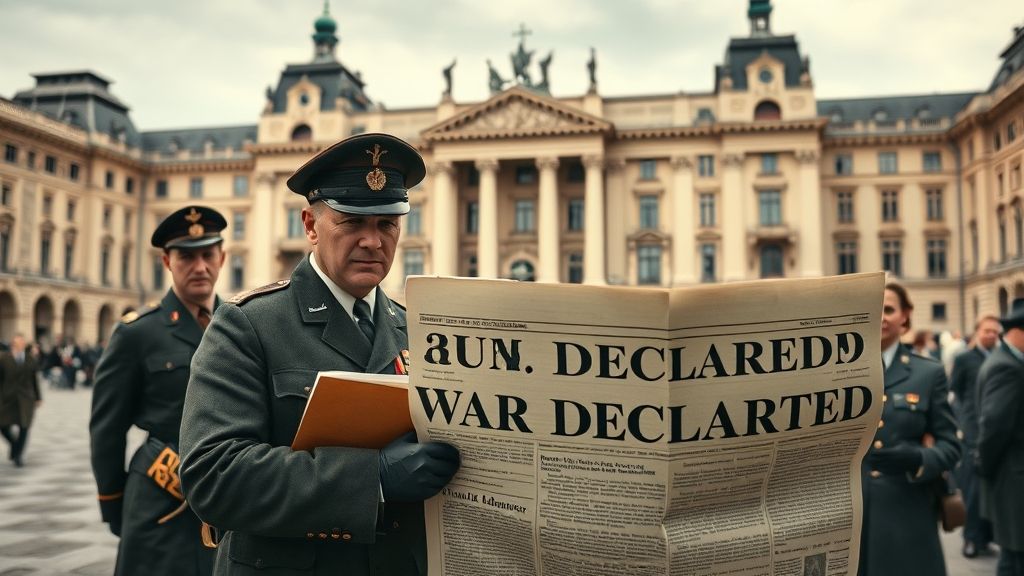
At precisely 11:05 a.m., the Austro-Hungarian government announced to Serbia that the state of war existed. The announcement echoed across Europe like a gunshot heard around the world in 1776. It was a declaration not just against Serbia but against the old order.
From that moment, Europe was no longer at peace.
14. Reaction Across the Continent: A Continent in Shock
Capitals from London to Paris to St. Petersburg reacted with consternation and resolve. The assassination in Sarajevo was transformed into a rallying cry for national defense and honor. Newspapers bore headlines announcing the new war, citizens faced the terrifying prospect of decades of peace unraveling.
Yet many also felt disbelief — how could Europe, which had prospered for decades, suddenly be hurtling toward unimaginable carnage?
15. The First Shots of a Global Conflict
Within days, armies clashed along the Austro-Serbian border. Battles at places like the Battle of Cer revealed the brutal new face of warfare. What had started as a bilateral Austro-Serb conflict broadened rapidly into a world war.
The mechanized slaughter would continue for over four brutal years.
16. The Human Toll Begins: From Vienna to the Battlefield
War declarations soon translated into shattered lives. Thousands of soldiers marched away from home; families braced for loss. Vienna, once a cultural jewel, would be haunted by the loss and suffering the war unleashed.
The declaration of war marked not only a political moment but a human tragedy unfolding on an unprecedented scale.
17. Consequences for Austria-Hungary: Empire on the Edge
The war strained Austria-Hungary’s resources and exacerbated ethnic tensions. Military setbacks and internal divisions grew deeper. By the war’s end in 1918, the empire would collapse, its territories divided into new nation-states.
The declaration of July 28 was, in hindsight, the beginning of the end for Habsburg rule.
18. Serbia’s Struggle Against the Odds
Serbia endured immense hardship but won early victories. Nevertheless, the country paid a heavy price, suffering invasions, occupation, and destruction. Serbia’s defiance became a symbol of national endurance amidst catastrophe.
Yet the war’s destructive power spared few in the region.
19. The Broader Impact: World War I Unfolds
The declaration on July 28 lit a fuse that would explode into the Great War — involving millions, reshaping borders, societies, and the global order. It handed Europe a century shadowed with conflict and transformation.
Austria-Hungary’s choice irrevocably altered the world.
20. Memory and Myth: How the War Declaration Resonates Today
In historical memory, the declaration is a cautionary tale about diplomacy’s failure and the peril of nationalism unchecked by dialogue. It reminds us how quickly old alliances and rivalries can spiral into catastrophe.
Historians debate blame, but the human cost remains central.
21. Lessons from the Brink: Diplomacy and Failure
The July crisis and subsequent war show the importance of diplomacy, crisis management, and willingness to compromise. The failure to seek peaceful resolutions led Europe into an abyss.
This moment serves as a perennial warning in international relations.
22. Conclusion: The Day the World Changed Forever
July 28, 1914, was not just the start of a war—it was the unraveling of an order and the dawn of a turbulent century. The Austro-Hungarian decision to declare war on Serbia transformed a regional dispute into a global catastrophe.
Remembering this day is to remember both the fragility of peace and the weight of history’s choices.
FAQs
Q1: What were the main causes behind Austria-Hungary’s declaration of war on Serbia?
A1: The immediate cause was the assassination of Archduke Franz Ferdinand in Sarajevo by a Serbian nationalist. More deeply, longstanding ethnic and national tensions in the Balkans, pan-Slavism, and Austria-Hungary’s desire to assert dominance over Serbia fueled the decision.
Q2: How did alliances influence Austria-Hungary’s decision?
A2: Germany’s promise of unconditional support, known as the “blank check,” encouraged Austria-Hungary’s hardening stance, while fears of Russian intervention complicated the crisis. The alliance system escalated local tensions to a broader conflict.
Q3: Was Austria-Hungary’s ultimatum to Serbia designed to provoke war?
A3: Many historians argue the ultimatum was intentionally harsh, crafted to be unacceptable so that Austria-Hungary could justify a war against Serbia.
Q4: How did the declaration of war impact the common people in Austria-Hungary and Serbia?
A4: It led to mobilization, conscription, and the beginning of widespread suffering. Families were shattered, and both societies faced enormous human and material losses.
Q5: Could the war have been avoided after the assassination?
A5: Historians debate, but most agree that miscommunications, nationalism, rigid alliances, and miscalculations made avoidance difficult once the crisis escalated.
Q6: How did the declaration contribute to the outbreak of World War I?
A6: The declaration set off a chain reaction involving alliances, mobilizations, and declarations of war across Europe, leading to the global conflict known as World War I.
Q7: What role did Emperor Franz Joseph play in the decision?
A7: Though aging, Franz Joseph approved the war declaration, reflecting the imperial leadership’s determination to confront Serbian nationalism decisively.
Q8: How is this event remembered in modern historiography?
A8: It is viewed as a pivotal moment illustrating how nationalism, imperialism, and diplomatic failure converged to ignite a catastrophic war.